
Standard form and order of magnitude calculations Mathematics
- Slides: 29
Standard form and order of magnitude calculations Mathematics for GCSE Science This presentation covers these Maths skills: • recognise and use expressions in decimal form • recognise and use expressions in standard form • make order of magnitude calculations. 1 of 29 © 2016 AQA. Created by Teachit for AQA.
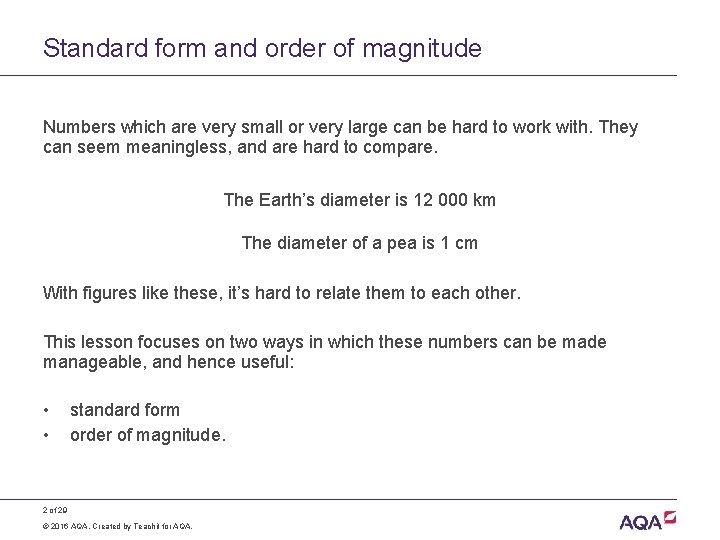
Standard form and order of magnitude Numbers which are very small or very large can be hard to work with. They can seem meaningless, and are hard to compare. The Earth’s diameter is 12 000 km The diameter of a pea is 1 cm With figures like these, it’s hard to relate them to each other. This lesson focuses on two ways in which these numbers can be made manageable, and hence useful: • • standard form order of magnitude. 2 of 29 © 2016 AQA. Created by Teachit for AQA.
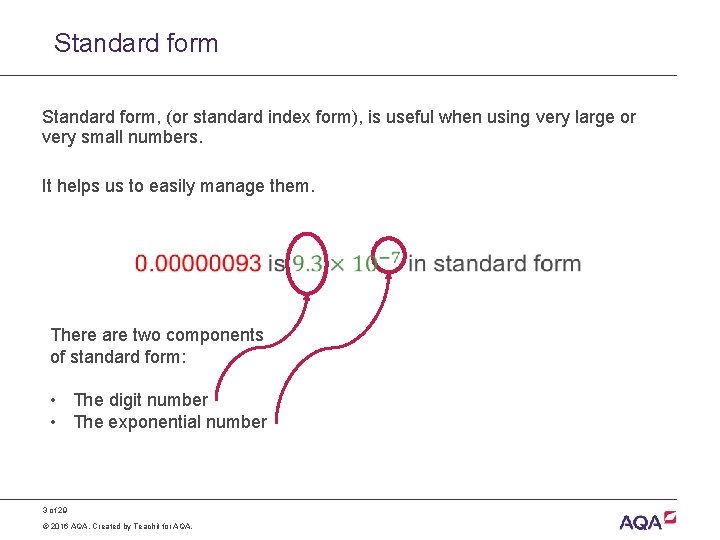
Standard form, (or standard index form), is useful when using very large or very small numbers. It helps us to easily manage them. There are two components of standard form: • The digit number • The exponential number 3 of 29 © 2016 AQA. Created by Teachit for AQA.
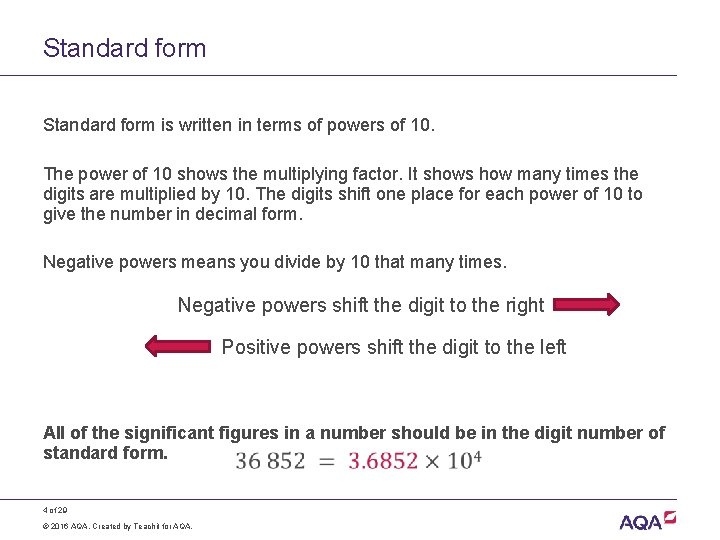
Standard form is written in terms of powers of 10. The power of 10 shows the multiplying factor. It shows how many times the digits are multiplied by 10. The digits shift one place for each power of 10 to give the number in decimal form. Negative powers means you divide by 10 that many times. Negative powers shift the digit to the right Positive powers shift the digit to the left All of the significant figures in a number should be in the digit number of standard form. 4 of 29 © 2016 AQA. Created by Teachit for AQA.
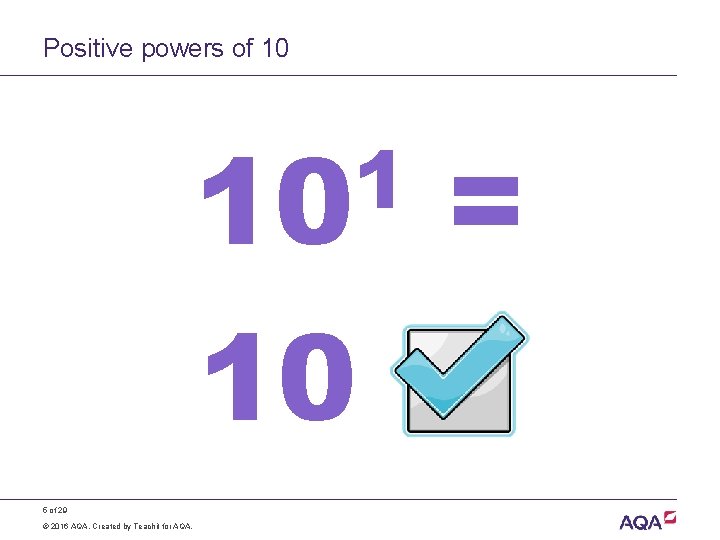
Positive powers of 10 10 5 of 29 © 2016 AQA. Created by Teachit for AQA. =
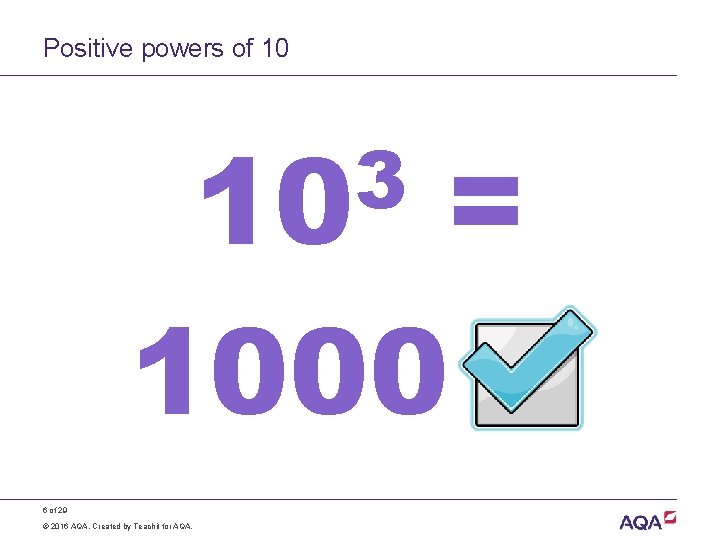
Positive powers of 10 3 10 = 1000 6 of 29 © 2016 AQA. Created by Teachit for AQA.
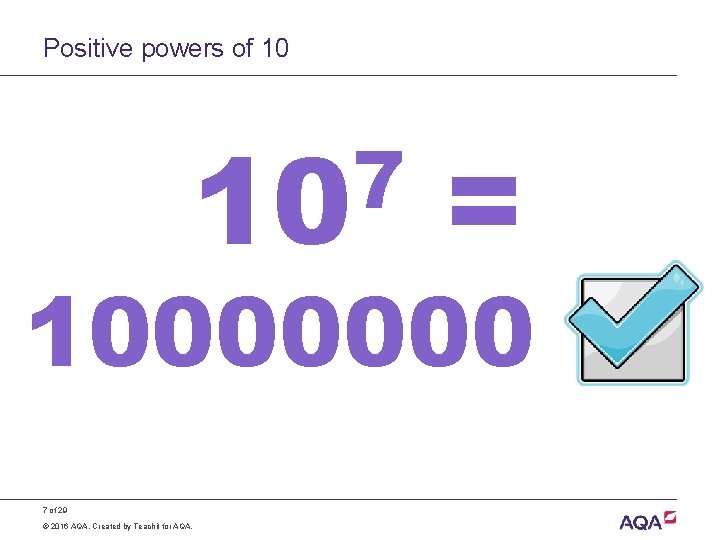
Positive powers of 10 7 10 = 10000000 7 of 29 © 2016 AQA. Created by Teachit for AQA.
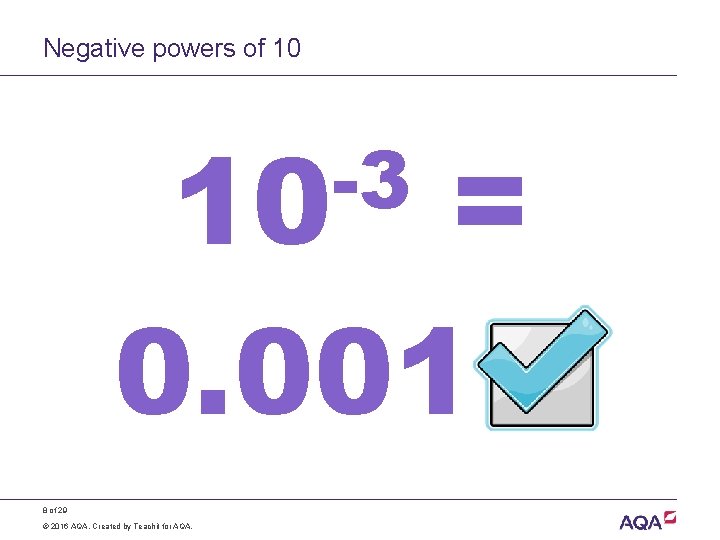
Negative powers of 10 -3 10 = 0. 001 8 of 29 © 2016 AQA. Created by Teachit for AQA.
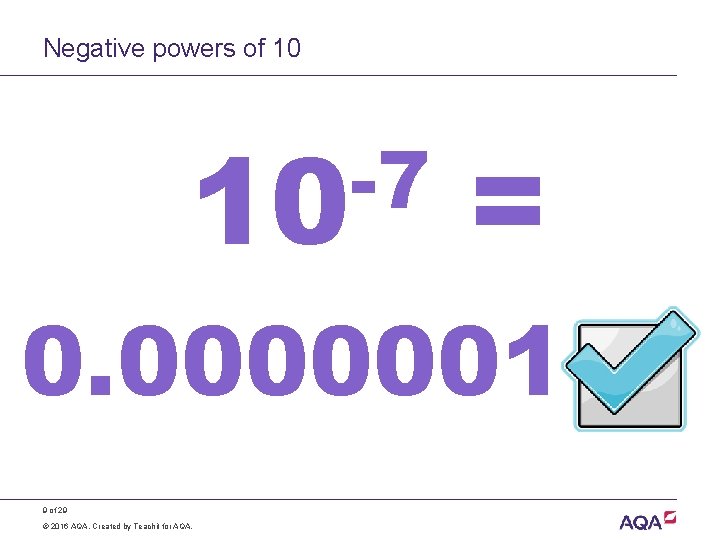
Negative powers of 10 -7 10 = 0. 0000001 9 of 29 © 2016 AQA. Created by Teachit for AQA.
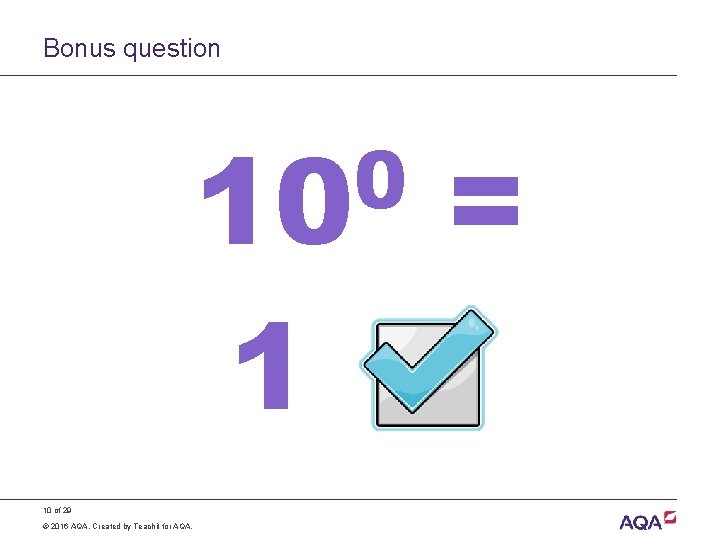
Bonus question 0 10 1 10 of 29 © 2016 AQA. Created by Teachit for AQA. =
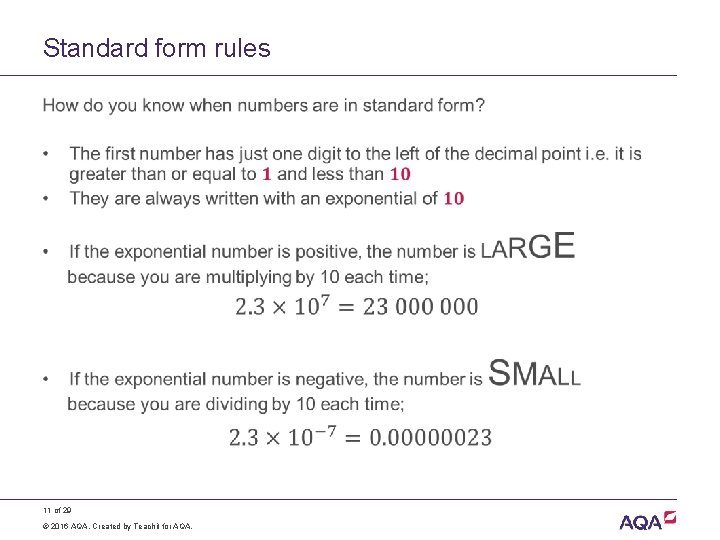
Standard form rules • 11 of 29 © 2016 AQA. Created by Teachit for AQA.
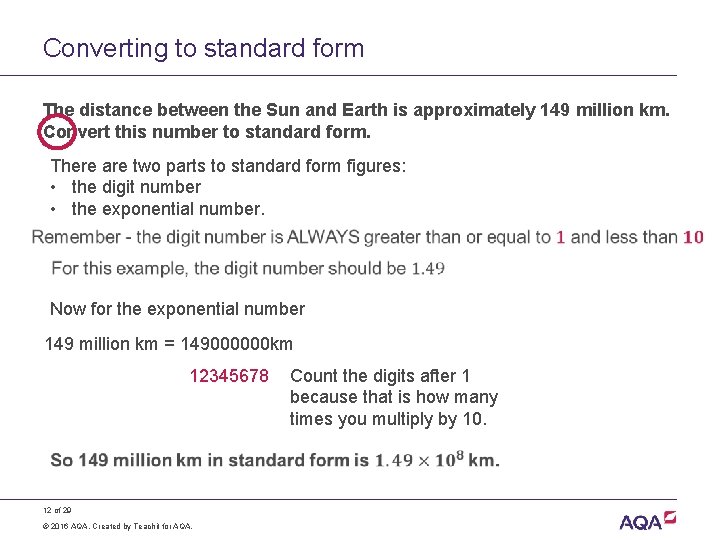
Converting to standard form The distance between the Sun and Earth is approximately 149 million km. Convert this number to standard form. There are two parts to standard form figures: • the digit number • the exponential number. Now for the exponential number 149 million km = 149000000 km 12345678 12 of 29 © 2016 AQA. Created by Teachit for AQA. Count the digits after 1 because that is how many times you multiply by 10.
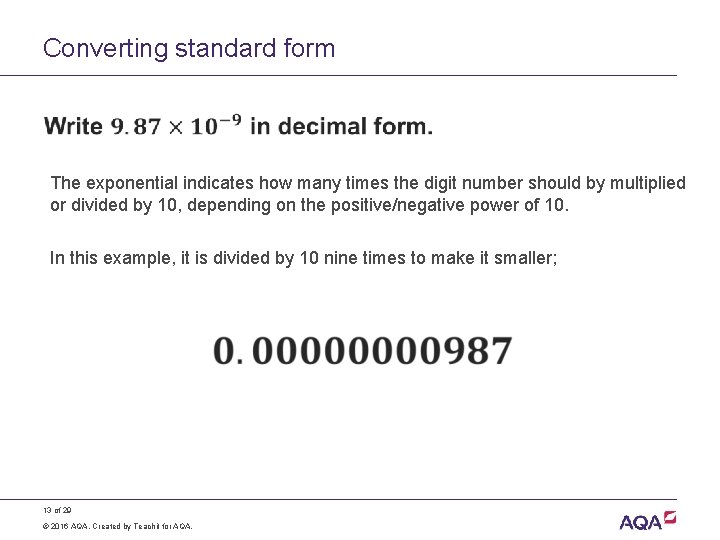
Converting standard form • The exponential indicates how many times the digit number should by multiplied or divided by 10, depending on the positive/negative power of 10. In this example, it is divided by 10 nine times to make it smaller; 13 of 29 © 2016 AQA. Created by Teachit for AQA.
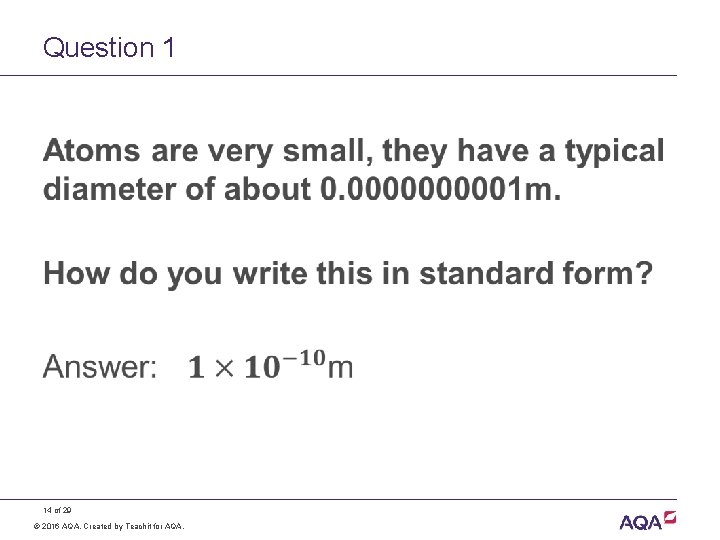
Question 1 • 14 of 29 © 2016 AQA. Created by Teachit for AQA.
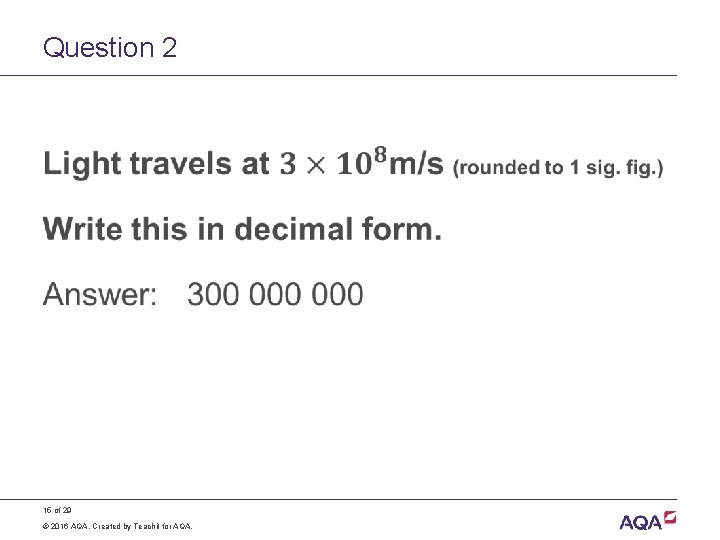
Question 2 • 15 of 29 © 2016 AQA. Created by Teachit for AQA.
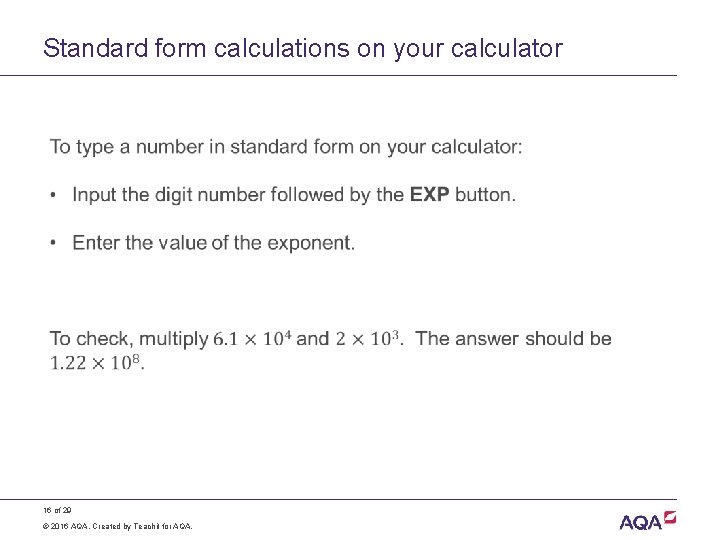
Standard form calculations on your calculator 16 of 29 © 2016 AQA. Created by Teachit for AQA.
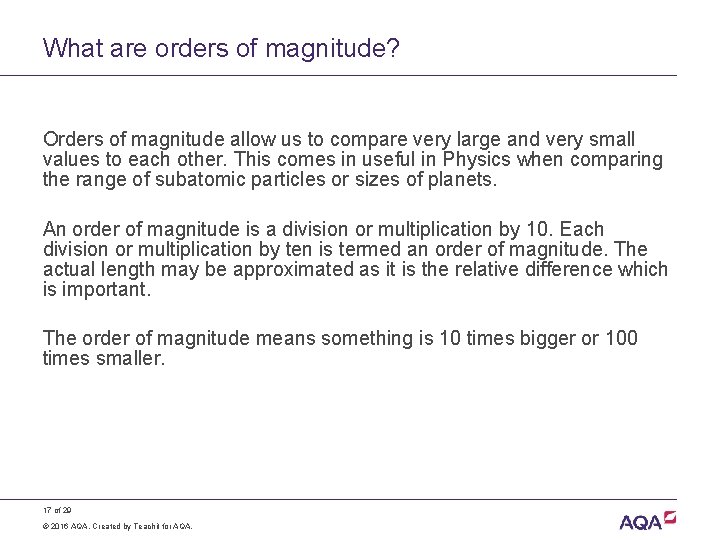
What are orders of magnitude? Orders of magnitude allow us to compare very large and very small values to each other. This comes in useful in Physics when comparing the range of subatomic particles or sizes of planets. An order of magnitude is a division or multiplication by 10. Each division or multiplication by ten is termed an order of magnitude. The actual length may be approximated as it is the relative difference which is important. The order of magnitude means something is 10 times bigger or 100 times smaller. 17 of 29 © 2016 AQA. Created by Teachit for AQA.
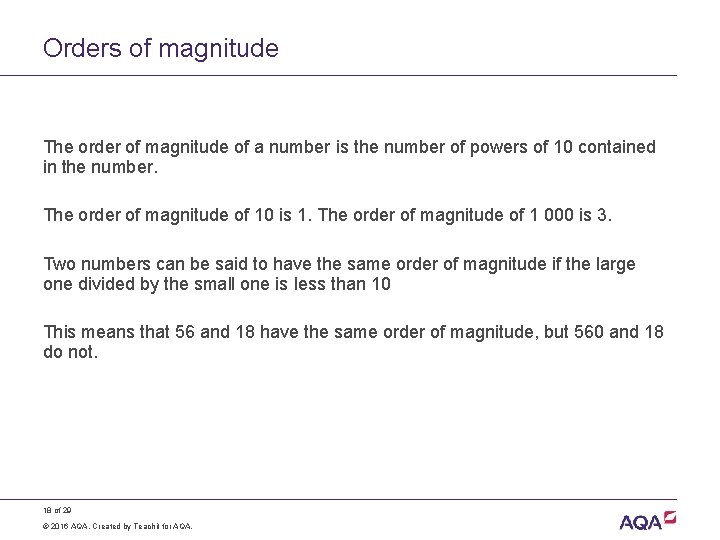
Orders of magnitude The order of magnitude of a number is the number of powers of 10 contained in the number. The order of magnitude of 10 is 1. The order of magnitude of 1 000 is 3. Two numbers can be said to have the same order of magnitude if the large one divided by the small one is less than 10 This means that 56 and 18 have the same order of magnitude, but 560 and 18 do not. 18 of 29 © 2016 AQA. Created by Teachit for AQA.
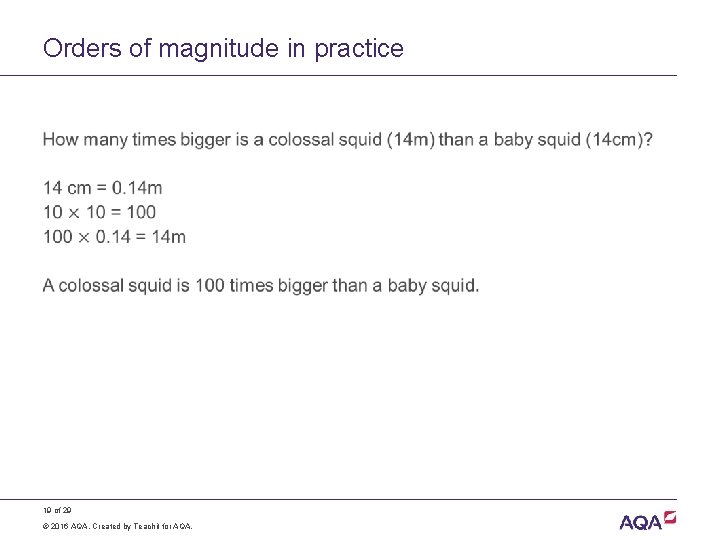
Orders of magnitude in practice • 19 of 29 © 2016 AQA. Created by Teachit for AQA.
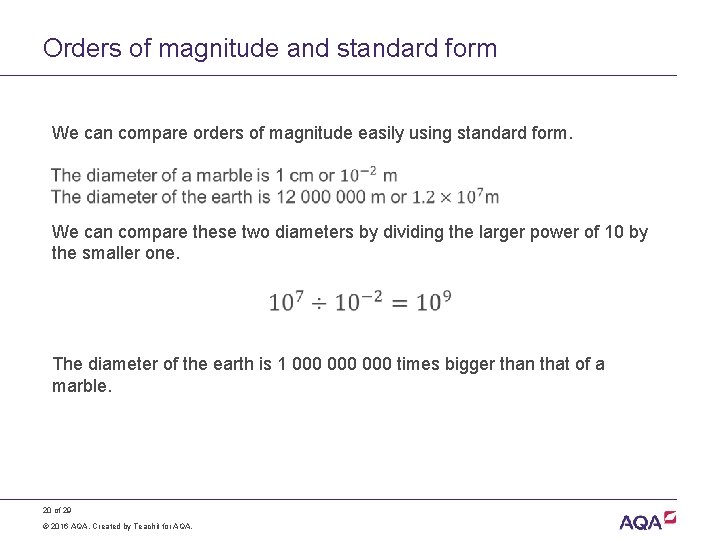
Orders of magnitude and standard form We can compare orders of magnitude easily using standard form. We can compare these two diameters by dividing the larger power of 10 by the smaller one. The diameter of the earth is 1 000 000 times bigger than that of a marble. 20 of 29 © 2016 AQA. Created by Teachit for AQA.
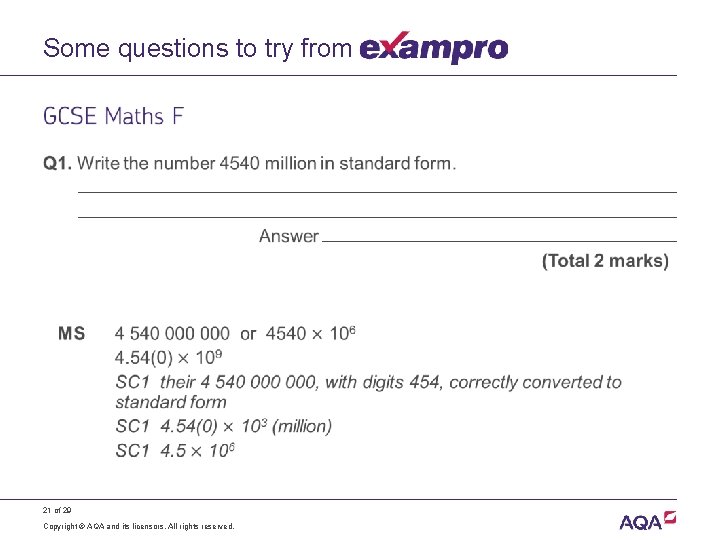
Some questions to try from • 21 of 29 Copyright © AQA and its licensors. All rights reserved.
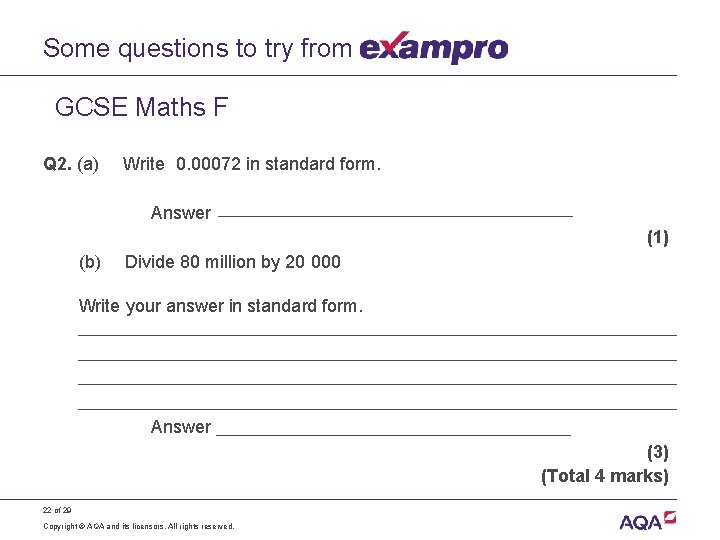
Some questions to try from GCSE Maths F Q 2. (a) Write 0. 00072 in standard form. Answer (1) (b) Divide 80 million by 20 000 Write your answer in standard form. Answer (3) (Total 4 marks) 22 of 29 Copyright © AQA and its licensors. All rights reserved.
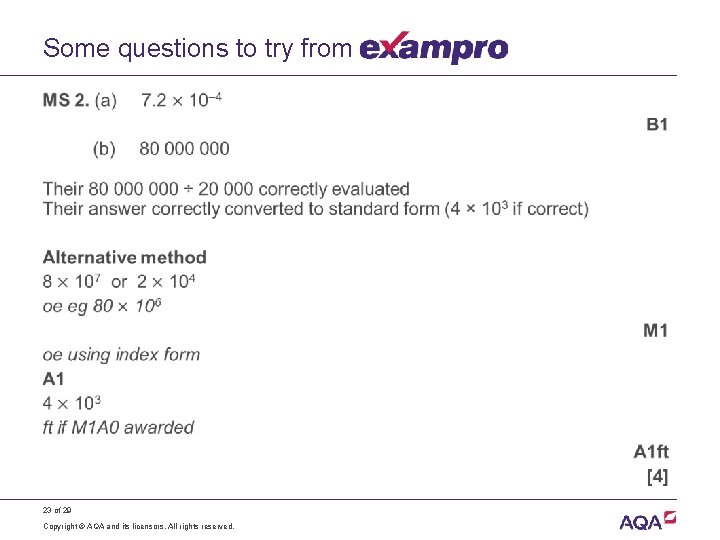
Some questions to try from • 23 of 29 Copyright © AQA and its licensors. All rights reserved.
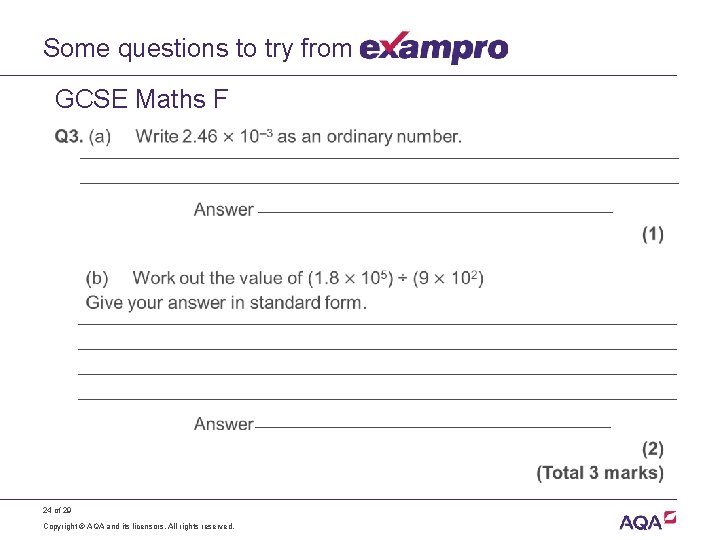
Some questions to try from GCSE Maths F • 24 of 29 Copyright © AQA and its licensors. All rights reserved.
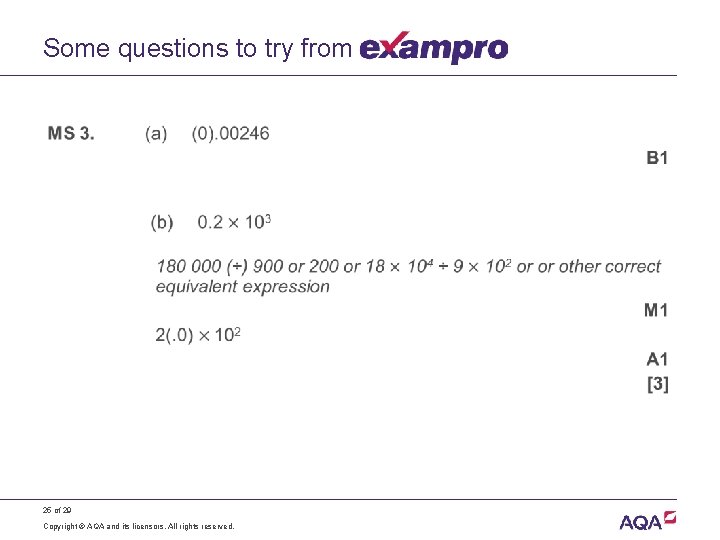
Some questions to try from • 25 of 29 Copyright © AQA and its licensors. All rights reserved.
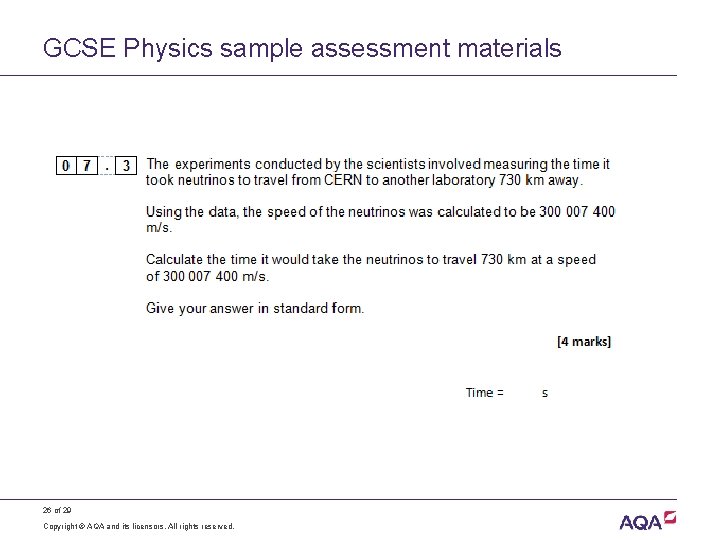
GCSE Physics sample assessment materials 26 of 29 Copyright © AQA and its licensors. All rights reserved.
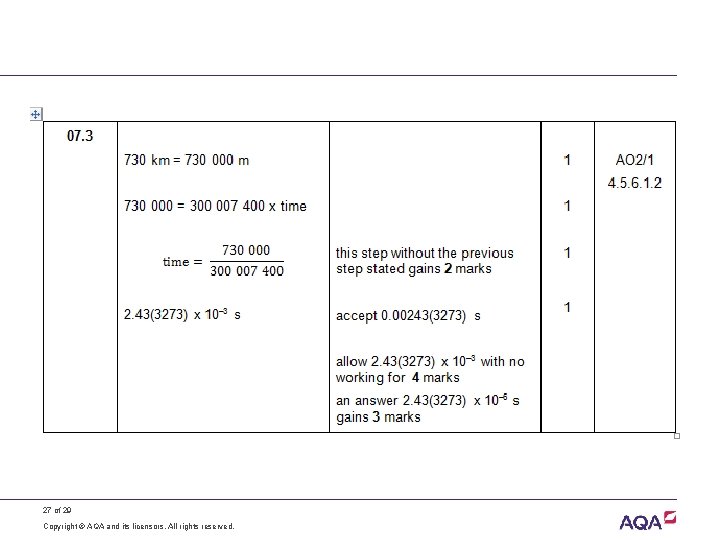
27 of 29 Copyright © AQA and its licensors. All rights reserved.
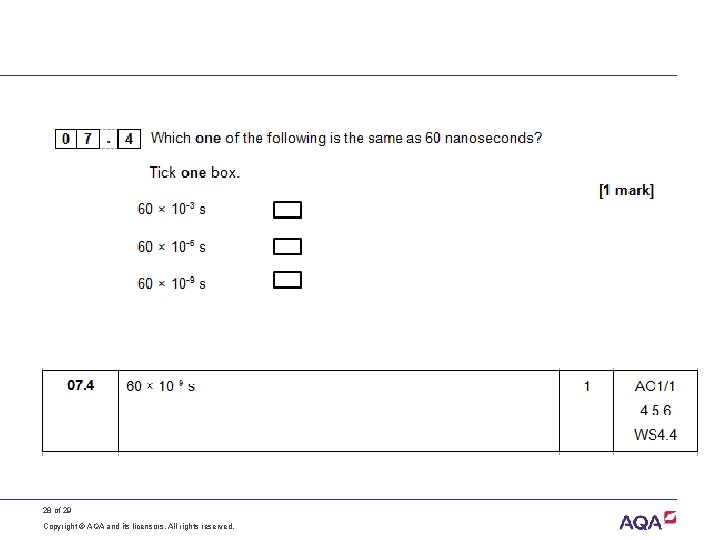
28 of 29 Copyright © AQA and its licensors. All rights reserved.
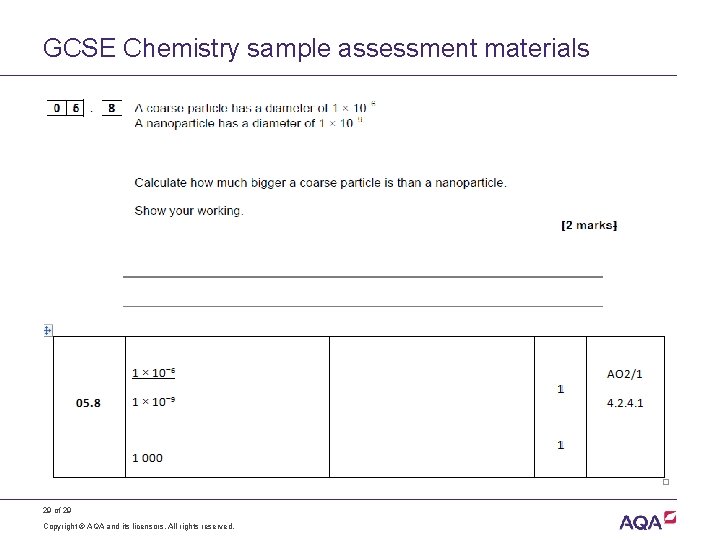
GCSE Chemistry sample assessment materials 29 of 29 Copyright © AQA and its licensors. All rights reserved.