
Standard Electrode Potentials and Thermodynamic Feasibility The Electrochemical
Standard Electrode Potentials and Thermodynamic Feasibility
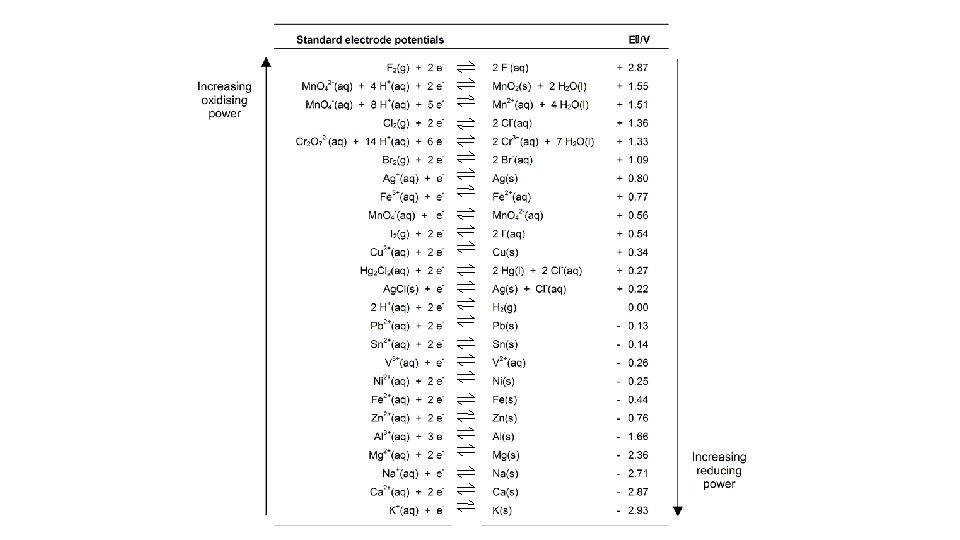
The Electrochemical Series • Different elements have different standard electrode potentials, Eθ • They can be listed in order to produce The Electrochemical Series • (They can give you the data in any order in an exam)
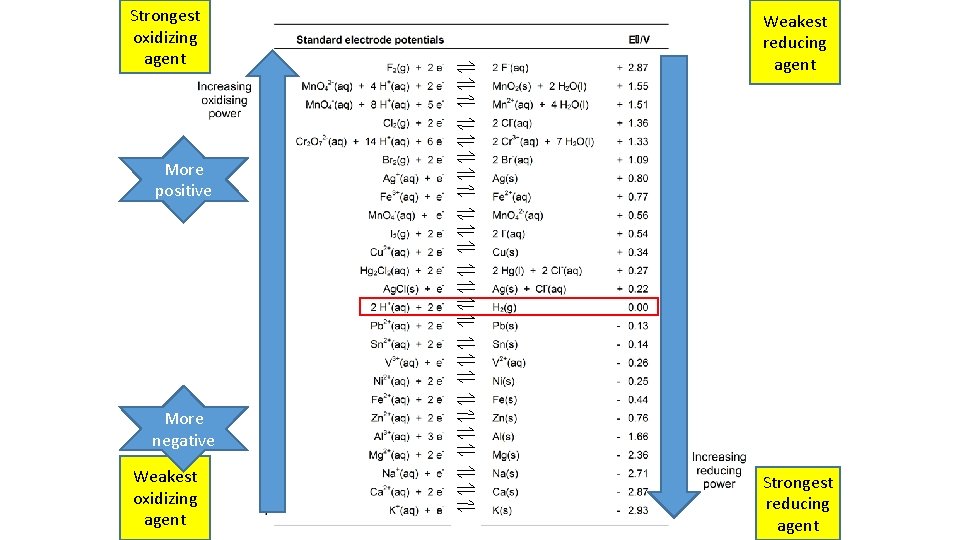
Strongest oxidizing agent Weakest reducing agent More positive More negative Weakest oxidizing agent Strongest reducing agent
The more +ve electrode gains electrons (+ charge attracts electrons)
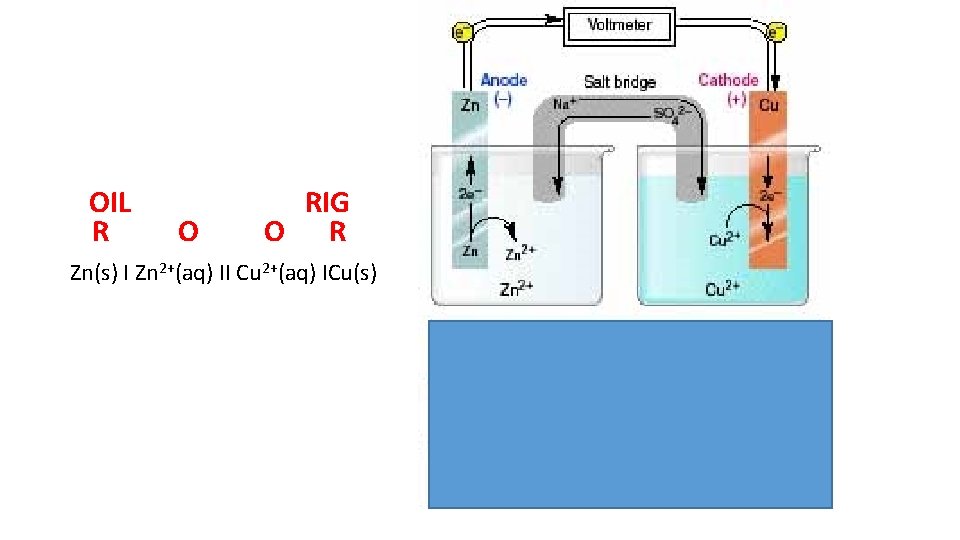
OIL R O RIG O R Zn(s) I Zn 2+(aq) II Cu 2+(aq) ICu(s)
How do we know if it is thermodynamically feasible?
Will zinc displace copper from an aqueous solution containing copper (II) ions? • Zn 2+ (aq) + 2 e- ↔ Zn (s) E° = - 0. 76 V • Cu 2+ (aq) + 2 e- ↔ Cu (s) E° = +0. 34 V Equilibrium 1 – more negative so will shift to the left, releasing electrons. Equilibrium 2 – less negative than 1, so will shift to the right, accepting electrons
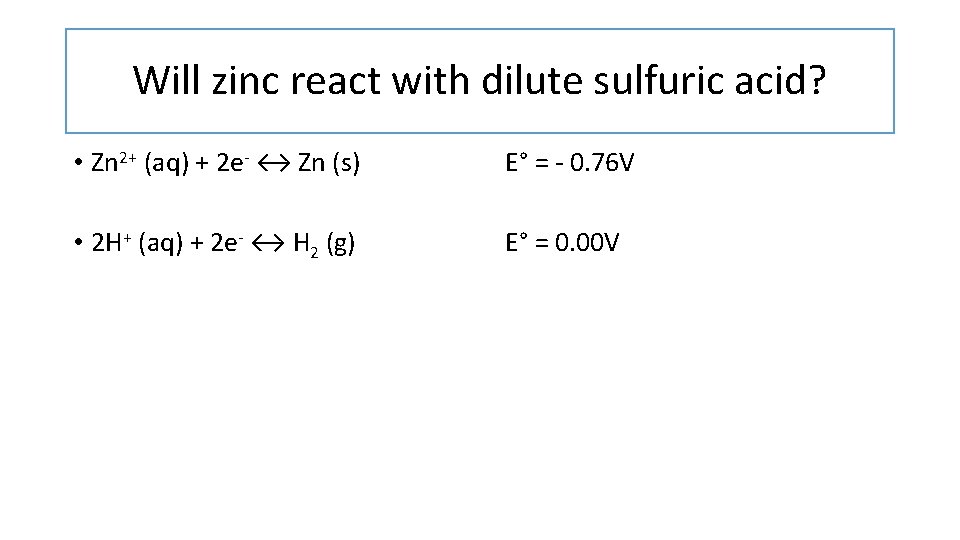
Will zinc react with dilute sulfuric acid? • Zn 2+ (aq) + 2 e- ↔ Zn (s) E° = - 0. 76 V • 2 H+ (aq) + 2 e- ↔ H 2 (g) E° = 0. 00 V
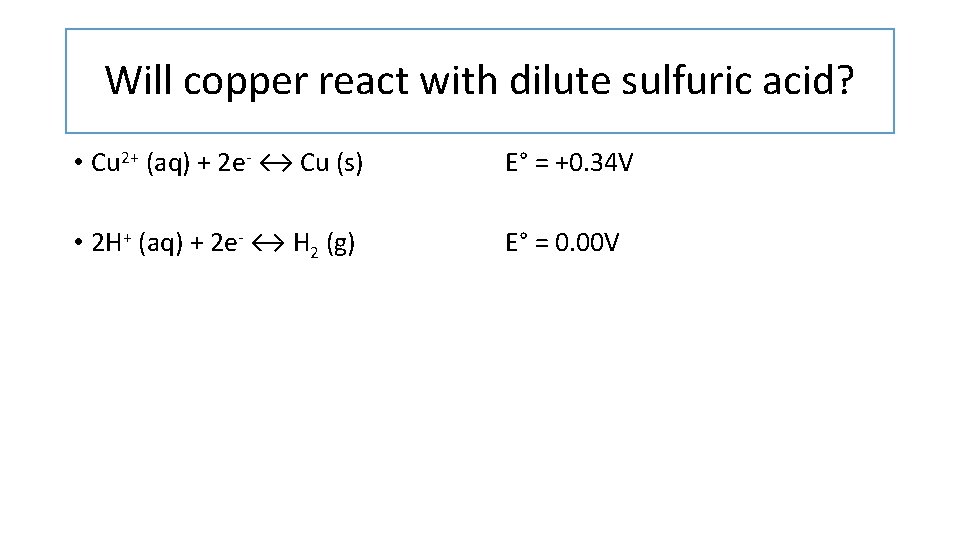
Will copper react with dilute sulfuric acid? • Cu 2+ (aq) + 2 e- ↔ Cu (s) E° = +0. 34 V • 2 H+ (aq) + 2 e- ↔ H 2 (g) E° = 0. 00 V

Manganese (V) oxide and hydrochloric acid Mn. O 2 (s) + 4 HCl (aq) Mn 2+ (aq) + 2 Cl- (aq) + 2 H 2 O (l) + Cl 2 (g) Mn. O 2 (s) + 4 H+ (aq) + 2 e- ↔ Mn 2+ (aq) + 2 H 2 O (l) E° = +1. 23 V Cl 2 (g) + 2 e- ↔ 2 Cl- (aq) E° = +1. 36 V

Manganese (V) oxide and hydrochloric acid Mn. O 2 (s) + 4 HCl (aq) Mn 2+ (aq) + 2 Cl- (aq) + 2 H 2 O (l) + Cl 2 (g) Mn. O 2 (s) + 4 H+ (aq) + 2 e- ↔ Mn 2+ (aq) + 2 H 2 O (l) E° = +1. 23 V Cl 2 (g) + 2 e- ↔ 2 Cl- (aq) E° = +1. 36 V Should not happen – equilibrium 2 is more positive so the chloride ions cannot release the electrons to Mn. O 2. However, this reaction can actually happen! Increase the concentration of HCl (10 moldm-3). Hydrogen and chloride ions increase so shifts equilibrium 2 to the left and equilibrium 1 to the right.
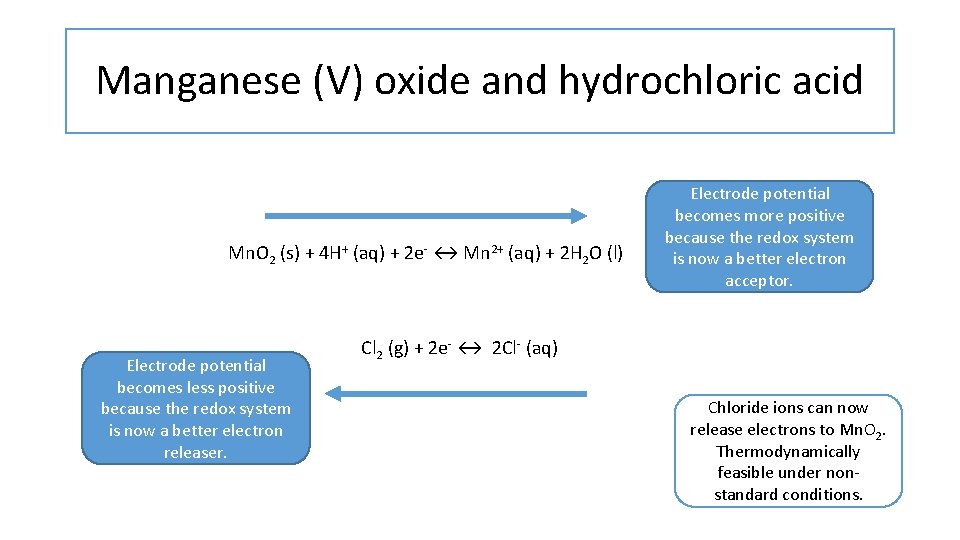
Manganese (V) oxide and hydrochloric acid Mn. O 2 (s) + 4 H+ (aq) + 2 e- ↔ Mn 2+ (aq) + 2 H 2 O (l) Electrode potential becomes less positive because the redox system is now a better electron releaser. Electrode potential becomes more positive because the redox system is now a better electron acceptor. Cl 2 (g) + 2 e- ↔ 2 Cl- (aq) Chloride ions can now release electrons to Mn. O 2. Thermodynamically feasible under nonstandard conditions.
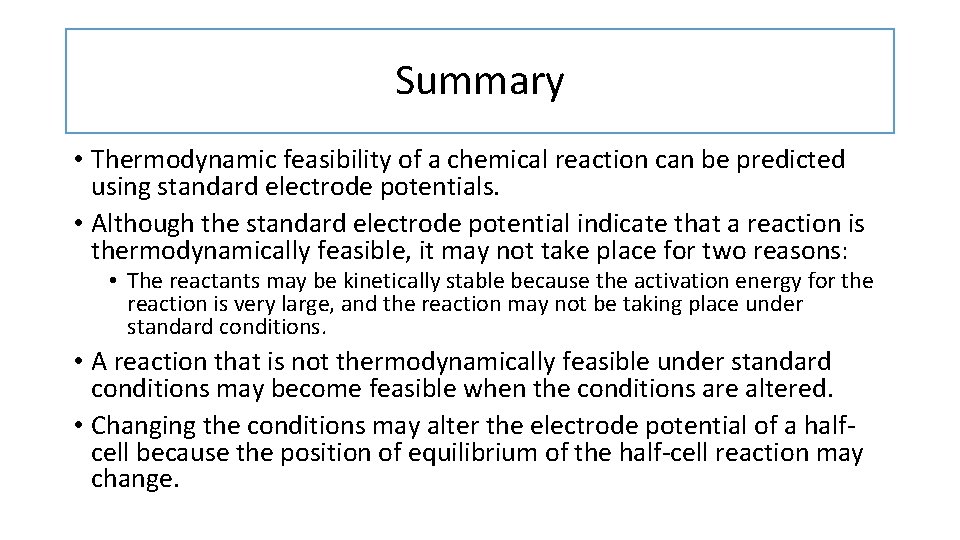
Summary • Thermodynamic feasibility of a chemical reaction can be predicted using standard electrode potentials. • Although the standard electrode potential indicate that a reaction is thermodynamically feasible, it may not take place for two reasons: • The reactants may be kinetically stable because the activation energy for the reaction is very large, and the reaction may not be taking place under standard conditions. • A reaction that is not thermodynamically feasible under standard conditions may become feasible when the conditions are altered. • Changing the conditions may alter the electrode potential of a halfcell because the position of equilibrium of the half-cell reaction may change.
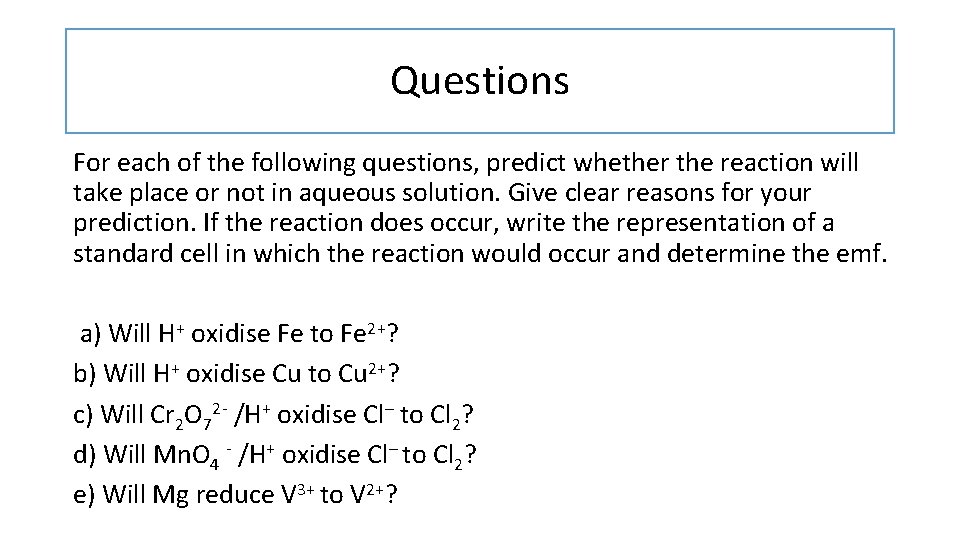
Questions For each of the following questions, predict whether the reaction will take place or not in aqueous solution. Give clear reasons for your prediction. If the reaction does occur, write the representation of a standard cell in which the reaction would occur and determine the emf. a) Will H+ oxidise Fe to Fe 2+? b) Will H+ oxidise Cu to Cu 2+? c) Will Cr 2 O 72 - /H+ oxidise Cl– to Cl 2? d) Will Mn. O 4 - /H+ oxidise Cl– to Cl 2? e) Will Mg reduce V 3+ to V 2+?
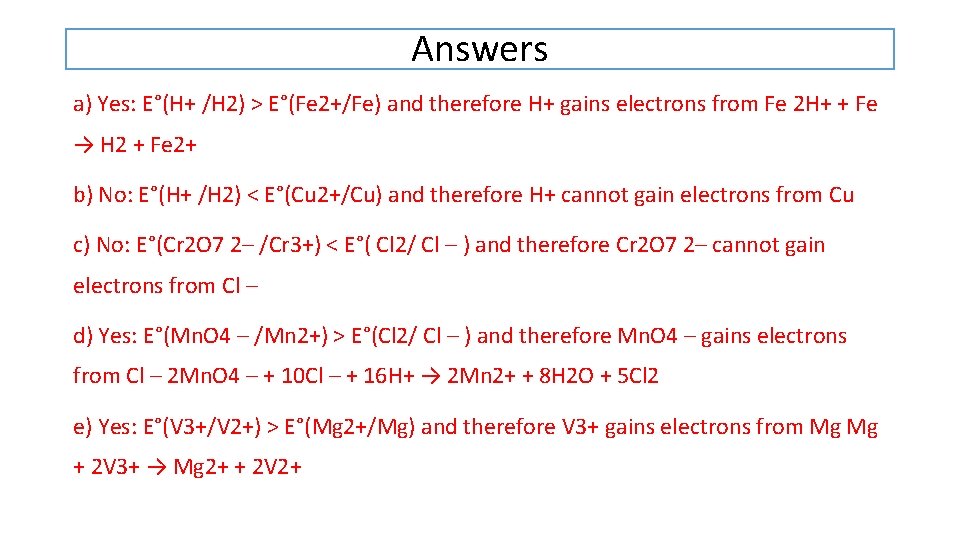
Answers a) Yes: E°(H+ /H 2) > E°(Fe 2+/Fe) and therefore H+ gains electrons from Fe 2 H+ + Fe → H 2 + Fe 2+ b) No: E°(H+ /H 2) < E°(Cu 2+/Cu) and therefore H+ cannot gain electrons from Cu c) No: E°(Cr 2 O 7 2– /Cr 3+) < E°( Cl 2/ Cl – ) and therefore Cr 2 O 7 2– cannot gain electrons from Cl – d) Yes: E°(Mn. O 4 – /Mn 2+) > E°(Cl 2/ Cl – ) and therefore Mn. O 4 – gains electrons from Cl – 2 Mn. O 4 – + 10 Cl – + 16 H+ → 2 Mn 2+ + 8 H 2 O + 5 Cl 2 e) Yes: E°(V 3+/V 2+) > E°(Mg 2+/Mg) and therefore V 3+ gains electrons from Mg Mg + 2 V 3+ → Mg 2+ + 2 V 2+
Think, Pair, Share What is a disproportionation reaction?
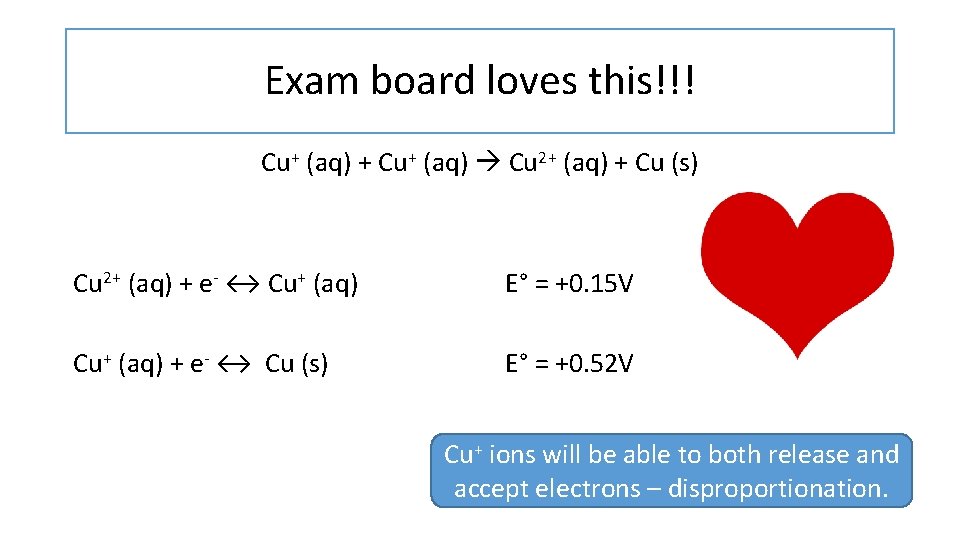
Exam board loves this!!! Cu+ (aq) + Cu+ (aq) Cu 2+ (aq) + Cu (s) Cu 2+ (aq) + e- ↔ Cu+ (aq) E° = +0. 15 V Cu+ (aq) + e- ↔ Cu (s) E° = +0. 52 V Cu+ ions will be able to both release and accept electrons – disproportionation.
Relationship between total entropy and E°cell
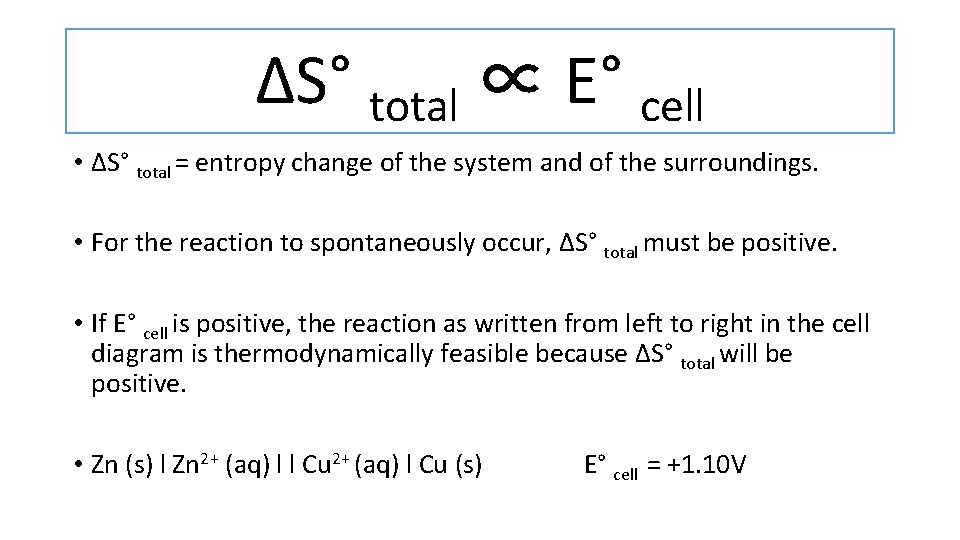
ΔS° total ∝ E° cell • ΔS° total = entropy change of the system and of the surroundings. • For the reaction to spontaneously occur, ΔS° total must be positive. • If E° cell is positive, the reaction as written from left to right in the cell diagram is thermodynamically feasible because ΔS° total will be positive. • Zn (s) l Zn 2+ (aq) l l Cu 2+ (aq) l Cu (s) E° cell = +1. 10 V
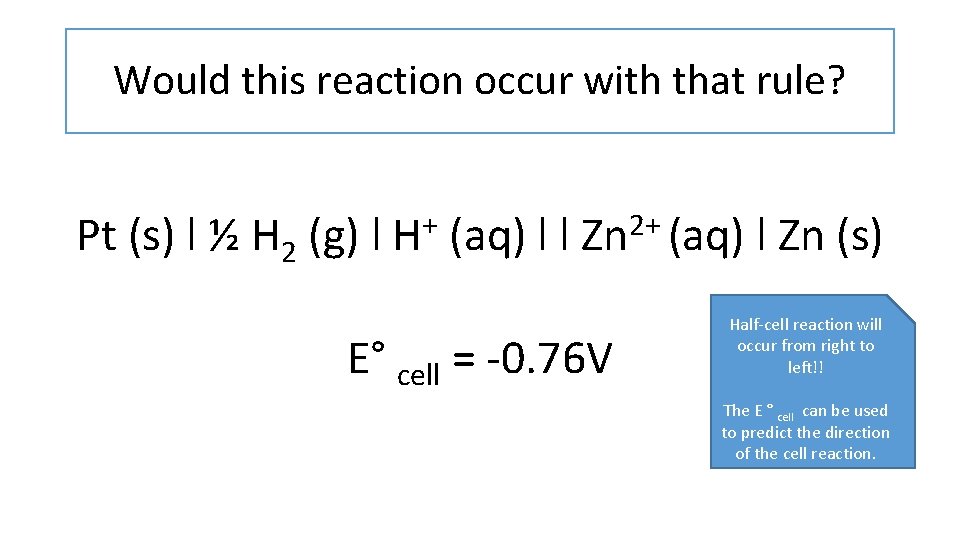
Would this reaction occur with that rule? Pt (s) l ½ H 2 (g) l + H (aq) l l 2+ Zn (aq) E° cell = -0. 76 V l Zn (s) Half-cell reaction will occur from right to left!! The E ° cell can be used to predict the direction of the cell reaction.
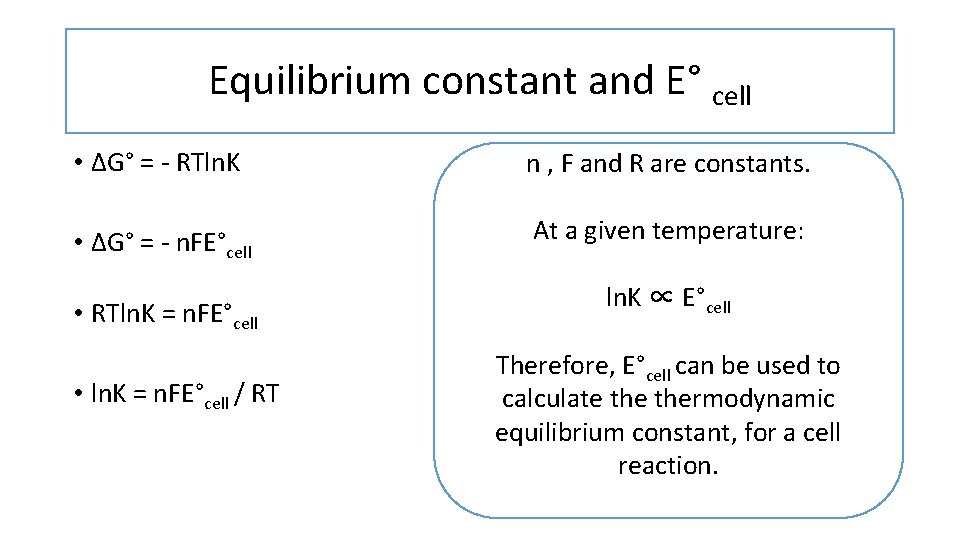
Equilibrium constant and E° cell • ΔG° = - RTln. K n , F and R are constants. • ΔG° = - n. FE°cell At a given temperature: • RTln. K = n. FE°cell • ln. K = n. FE°cell / RT ln. K ∝ E°cell Therefore, E°cell can be used to calculate thermodynamic equilibrium constant, for a cell reaction.
Summary Questions – Page 95
- Slides: 23