
Standard Data File Formats for GNSS Total Stations



- Slides: 30
Standard Data File Formats for GNSS, Total Stations, Automatic Levels, and Relative Gravimeters Dan Gillins, Ph. D. , P. L. S. Geodesist, National Geodetic Survey May 5, 2021 Daniel. Gillins@noaa. gov 1
Outline 1. 2. 3. 4. Background on why we need standard file formats Problem statement and objectives RINEX 3 as standard for raw GNSS data Other XML-based file formats as standards 1. 2. 3. 4. GVX – GNSS vectors CVX – Classical (angles/distances) LVX – Leveling RGX – relative gravity 2
Why Standard File Formats? • Differing instrument manufacturers output data in varying file formats (often proprietary, closed-source) • Standardization benefits: • • • Broadens use; easier to work with by others who will use the data Easier to share with others Reduces the need to convert from one format to another Data in proprietary format can be converted to open, standard format Increases likelihood critical metadata is captured and accurate; significant figures are preserved • Lengthens the preservation of the data • Can be made machine-readable 3
Examples of Standard File Formats • RINEX = Receiver Independent Exchange Format • v. 1 (1989) by Werner Gurtner (University of Bern); initial proposal • v. 2 (1990) by Gurtner and Gerald Mader (NGS); added GLONASS, SBAS, later Galileo • v. 3 (2007) by Gurtner and Estey (UNAVCO); full support of all GNSS signals and constellations • Aimed for the easy exchange and processing of raw GNSS data • GNSS carrier-phase and pseudorange (code) measurements, and time • LAS = LASer format • Proposed by the American Society of Photogrammetry and Remote Sensing (ASPRS) in 2003 • Open format used for exchanging point cloud data 4
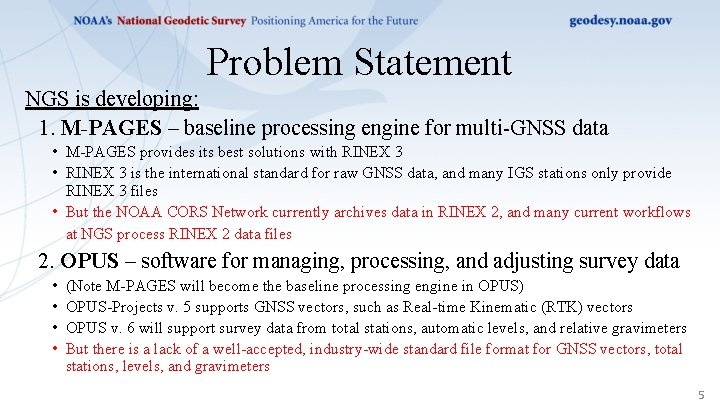
Problem Statement NGS is developing: 1. M-PAGES – baseline processing engine for multi-GNSS data • M-PAGES provides its best solutions with RINEX 3 • RINEX 3 is the international standard for raw GNSS data, and many IGS stations only provide RINEX 3 files • But the NOAA CORS Network currently archives data in RINEX 2, and many current workflows at NGS process RINEX 2 data files 2. OPUS – software for managing, processing, and adjusting survey data • • (Note M-PAGES will become the baseline processing engine in OPUS) OPUS-Projects v. 5 supports GNSS vectors, such as Real-time Kinematic (RTK) vectors OPUS v. 6 will support survey data from total stations, automatic levels, and relative gravimeters But there is a lack of a well-accepted, industry-wide standard file format for GNSS vectors, total stations, levels, and gravimeters 5
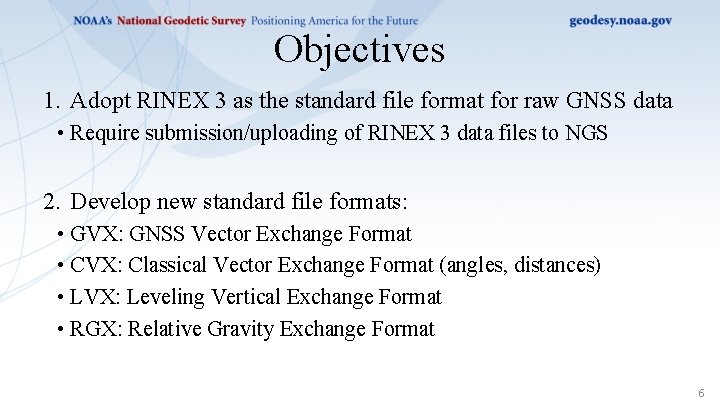
Objectives 1. Adopt RINEX 3 as the standard file format for raw GNSS data • Require submission/uploading of RINEX 3 data files to NGS 2. Develop new standard file formats: • GVX: GNSS Vector Exchange Format • CVX: Classical Vector Exchange Format (angles, distances) • LVX: Leveling Vertical Exchange Format • RGX: Relative Gravity Exchange Format 6
RINEX 3
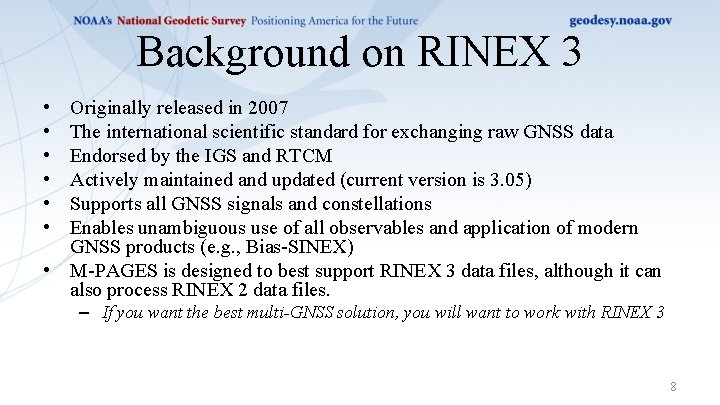
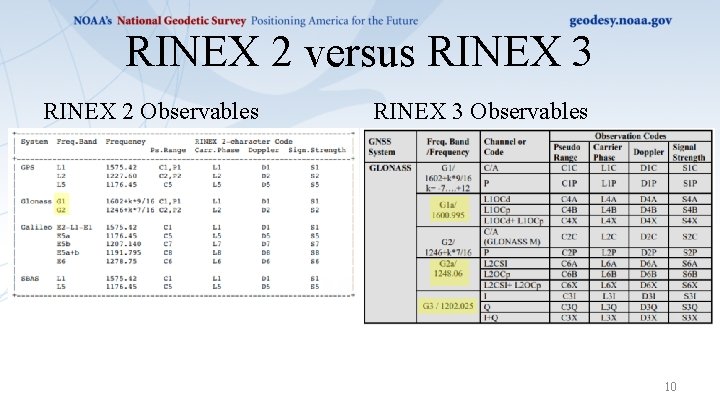
Background on RINEX 3 • • • Originally released in 2007 The international scientific standard for exchanging raw GNSS data Endorsed by the IGS and RTCM Actively maintained and updated (current version is 3. 05) Supports all GNSS signals and constellations Enables unambiguous use of all observables and application of modern GNSS products (e. g. , Bias-SINEX) • M-PAGES is designed to best support RINEX 3 data files, although it can also process RINEX 2 data files. – If you want the best multi-GNSS solution, you will want to work with RINEX 3 8
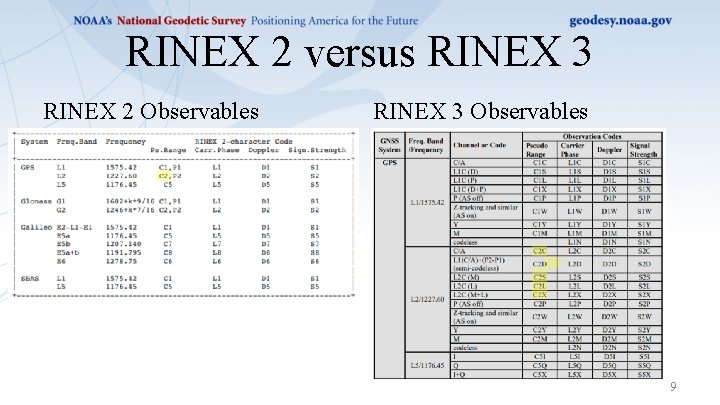
RINEX 2 versus RINEX 3 RINEX 2 Observables RINEX 3 Observables 9
RINEX 2 versus RINEX 3 RINEX 2 Observables RINEX 3 Observables 10
NGS and RINEX 3 • In the near future (date to be determined), NGS will only support RINEX 3 for its products and services which rely upon raw GNSS data, with some exceptions • NGS will be releasing a Federal Register Notice for notification and public commenting 11
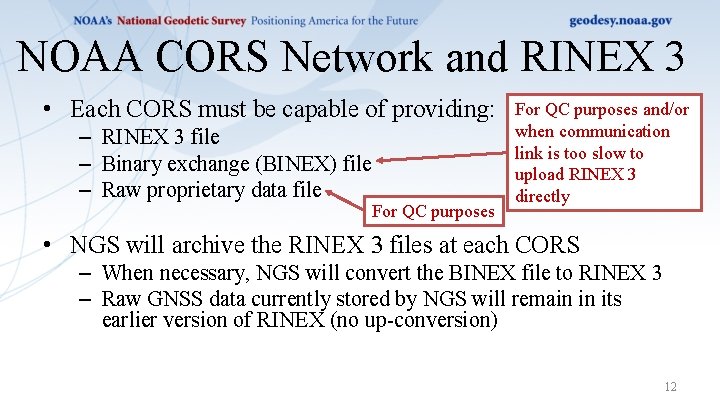
NOAA CORS Network and RINEX 3 • Each CORS must be capable of providing: – RINEX 3 file – Binary exchange (BINEX) file – Raw proprietary data file For QC purposes and/or when communication link is too slow to upload RINEX 3 directly • NGS will archive the RINEX 3 files at each CORS – When necessary, NGS will convert the BINEX file to RINEX 3 – Raw GNSS data currently stored by NGS will remain in its earlier version of RINEX (no up-conversion) 12
What is BINEX? • “BINary EXchange” • Existed since 2000 • Binary standard for GNSS research and operational purposes • Collaborative format, partnering UNAVCO with numerous receiver manufacturers • Ongoing design, aims to incorporate RINEX, SINEX, IONEX, SP 3, etc. • Compact and fast 13
OPUS and RINEX 3 • NGS will recommend and encourage use of RINEX 3 for OPUS – Provides the best multi-GNSS solutions • NGS will continue to allow use of RINEX 2 in OPUS for legacy data and equipment • NGS will discontinue support of non-RINEX data submissions to OPUS 14
Development of XML-Based Standard File Formats
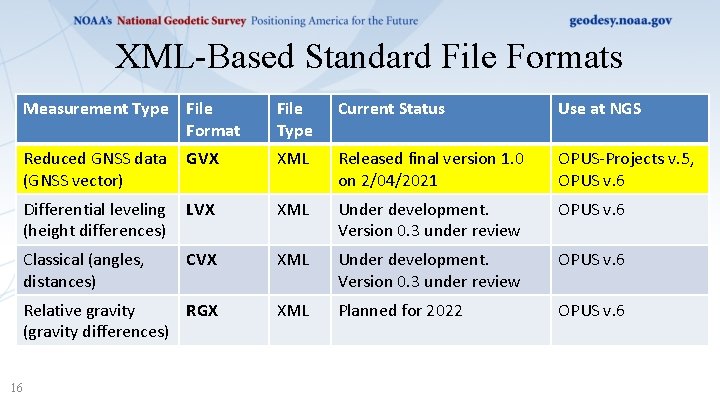
XML-Based Standard File Formats 16 Measurement Type File Format File Type Current Status Use at NGS Reduced GNSS data (GNSS vector) GVX XML Released final version 1. 0 on 2/04/2021 OPUS-Projects v. 5, OPUS v. 6 Differential leveling (height differences) LVX XML Under development. Version 0. 3 under review OPUS v. 6 Classical (angles, distances) CVX XML Under development. Version 0. 3 under review OPUS v. 6 Relative gravity RGX (gravity differences) XML Planned for 2022 OPUS v. 6
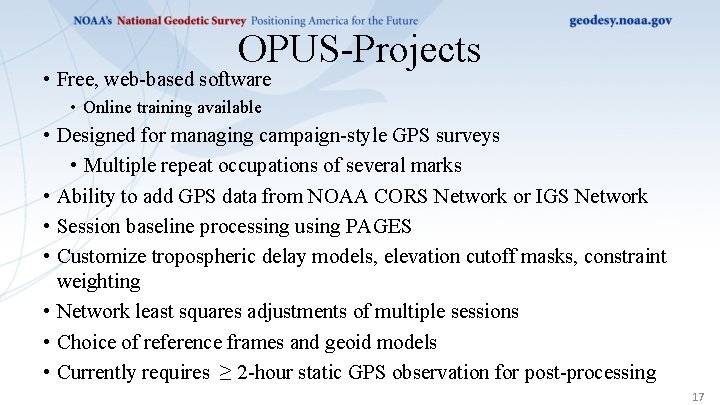
OPUS-Projects • Free, web-based software • Online training available • Designed for managing campaign-style GPS surveys • Multiple repeat occupations of several marks • Ability to add GPS data from NOAA CORS Network or IGS Network • Session baseline processing using PAGES • Customize tropospheric delay models, elevation cutoff masks, constraint weighting • Network least squares adjustments of multiple sessions • Choice of reference frames and geoid models • Currently requires ≥ 2 -hour static GPS observation for post-processing 17
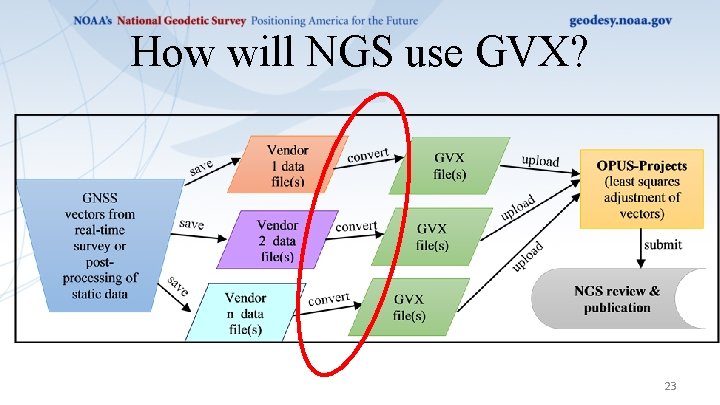
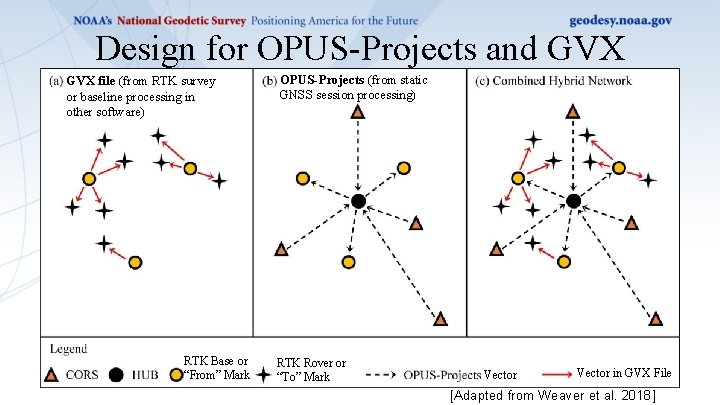
OPUS-Projects v. 5 • Inclusion of previously processed GNSS vectors – Single-base RTK vectors – Network RTK vectors – Vectors processed in other software • Allows QA/QC of uploaded vectors • Automatically “weights” uploaded vectors in a network least squares adjustment • Final adjustment results can be submitted to NGS for publication • Released to Beta for external testing. Available at: https: //beta. ngs. noaa. gov/OPUS-Projects/Opus. Projects. shtml • Webinar scheduled for May 20, 2021 18
GNSS Vector EXchange Format (GVX) Website: https: //www. ngs. noaa. gov/data/formats/GVX/index. shtml • Detailed documentation • Schema (XSD) • Example vector file GVX is written in Extensible Markup Language (XML) • Designed to store and carry data in plain text format • Flexible representation of arbitrary data structures • Extensible – new elements can be added later without breaking applications • Both machine-readable and human-readable • Schemas can be used to define “must haves” and “should haves” 19
GNSS Vector EXchange Format (GVX) Timeline • Solicited internal and external feedback for GVX since 8/2019 • Introduced to industry in 10/2019; solicited feedback • Addressed all comments and feedback • Released version 1. 0 to industry in 02/2021 Some important details: • All start and stop times must be in GPS time • Distance must be in meters • Angles must be in decimal degrees • Follow IGS naming conventions for antenna names • Follow ISO Geodetic Register for reference systems
GNSS Vector EXchange Format (GVX) 1. 2. 3. 4. 5. 6. 7. 8. SOURCE_DATA (source of data file, conversion software) PROJECT_INFORMATION (project title, agency, party chief, etc. ) REFERENCE_SYSTEM (reference frame for coordinates and orbits; IDs from ISO Geodetic Registry) EQUIPMENT (antenna and receiver types, serial numbers, calibration metadata, firmware) SURVEY_SETUP (solution type, processing software, corrector format, RTN IP address and port, operator) POINT (coordinates and uncertainties, point type) GNSS_VECTOR (differential components and correlation matrix, start and stop time, quality metrics such as mask, DOP, satellites used, orbit info. ) SESSION (intra-vector or cross-correlations matrix for simultaneous baseline processing) 21
Industry Invited to Provide Feedback • Released GVX v. 1. 0 released to industry on February 4, 2021 • Over 30 people attended mtg 22
How will NGS use GVX? 23
Design for OPUS-Projects and GVX file (from RTK survey or baseline processing in other software) RTK Base or “From” Mark OPUS-Projects (from static GNSS session processing) RTK Rover or “To” Mark Vector in GVX File [Adapted from Weaver et al. 2018]
Other XML-based File Formats • GVX sets template for other XML standard file formats • CVX = classical (angles/distances) • LVX = leveling • RGX = relative gravity • Working with industry to adopt all of these common file formats, and goal is to make OPUS v. 6 capable of using them • Aim to take these files to international community for adoption or inclusion in Geodesy. ML 25
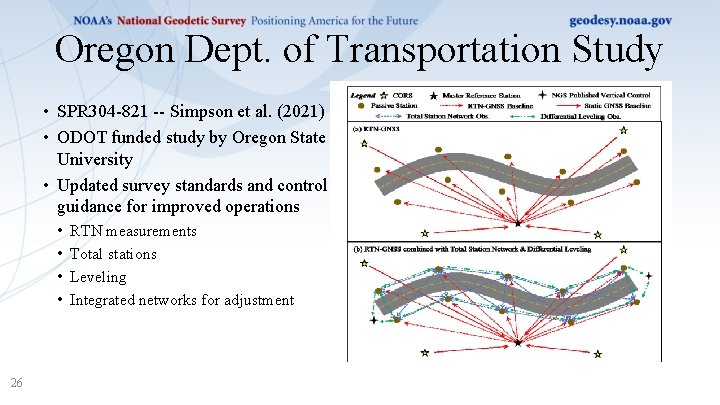
Oregon Dept. of Transportation Study • SPR 304 -821 -- Simpson et al. (2021) • ODOT funded study by Oregon State University • Updated survey standards and control guidance for improved operations • • 26 RTN measurements Total stations Leveling Integrated networks for adjustment
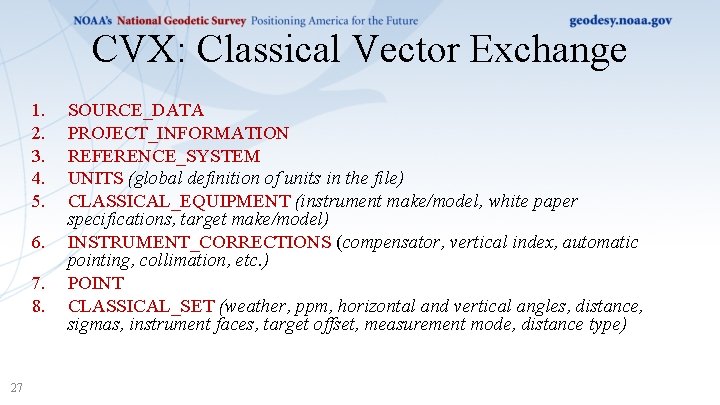
CVX: Classical Vector Exchange 1. 2. 3. 4. 5. 6. 7. 8. 27 SOURCE_DATA PROJECT_INFORMATION REFERENCE_SYSTEM UNITS (global definition of units in the file) CLASSICAL_EQUIPMENT (instrument make/model, white paper specifications, target make/model) INSTRUMENT_CORRECTIONS (compensator, vertical index, automatic pointing, collimation, etc. ) POINT CLASSICAL_SET (weather, ppm, horizontal and vertical angles, distance, sigmas, instrument faces, target offset, measurement mode, distance type)
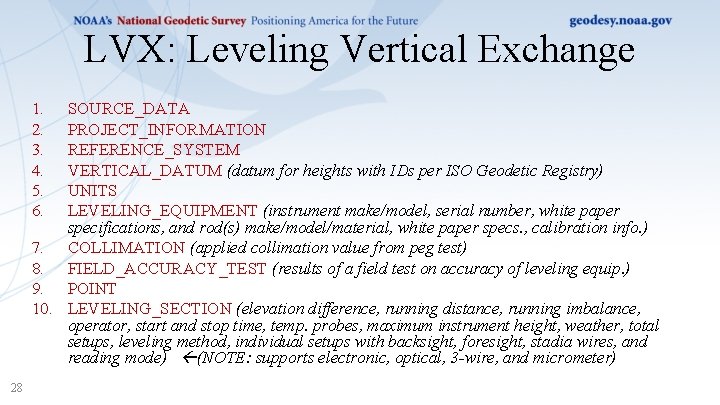
LVX: Leveling Vertical Exchange 1. 2. 3. 4. 5. 6. SOURCE_DATA PROJECT_INFORMATION REFERENCE_SYSTEM VERTICAL_DATUM (datum for heights with IDs per ISO Geodetic Registry) UNITS LEVELING_EQUIPMENT (instrument make/model, serial number, white paper specifications, and rod(s) make/model/material, white paper specs. , calibration info. ) 7. COLLIMATION (applied collimation value from peg test) 8. FIELD_ACCURACY_TEST (results of a field test on accuracy of leveling equip. ) 9. POINT 10. LEVELING_SECTION (elevation difference, running distance, running imbalance, operator, start and stop time, temp. probes, maximum instrument height, weather, total setups, leveling method, individual setups with backsight, foresight, stadia wires, and reading mode) (NOTE: supports electronic, optical, 3 -wire, and micrometer) 28
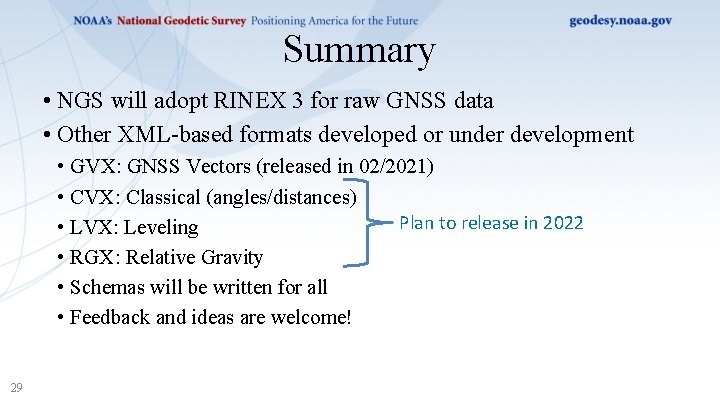
Summary • NGS will adopt RINEX 3 for raw GNSS data • Other XML-based formats developed or under development • GVX: GNSS Vectors (released in 02/2021) • CVX: Classical (angles/distances) Plan to release in 2022 • LVX: Leveling • RGX: Relative Gravity • Schemas will be written for all • Feedback and ideas are welcome! 29
Questions? • Daniel. Gillins@noaa. gov 30