
Standard Cells Cell Potential Standard Cells Standard cell


- Slides: 5
Standard Cells & Cell Potential
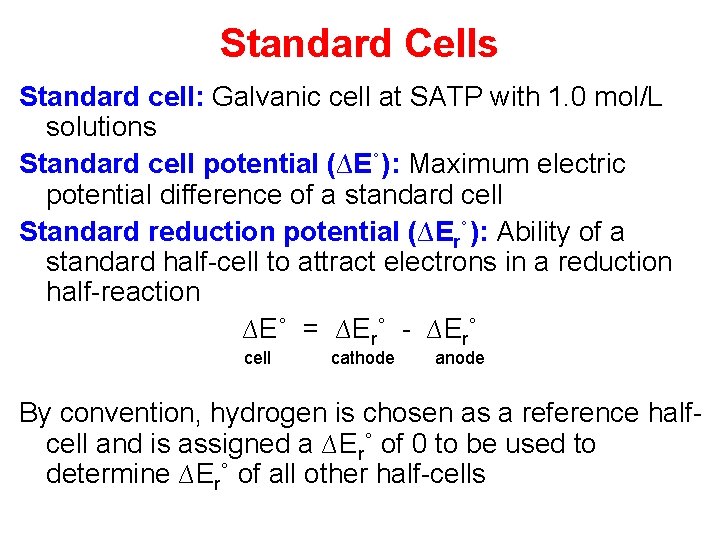
Standard Cells Standard cell: Galvanic cell at SATP with 1. 0 mol/L solutions Standard cell potential (∆E˚): Maximum electric potential difference of a standard cell Standard reduction potential (∆Er˚): Ability of a standard half-cell to attract electrons in a reduction half-reaction ∆E˚ = ∆Er˚ - ∆Er˚ cell cathode anode By convention, hydrogen is chosen as a reference halfcell and is assigned a ∆Er˚ of 0 to be used to determine ∆Er˚ of all other half-cells
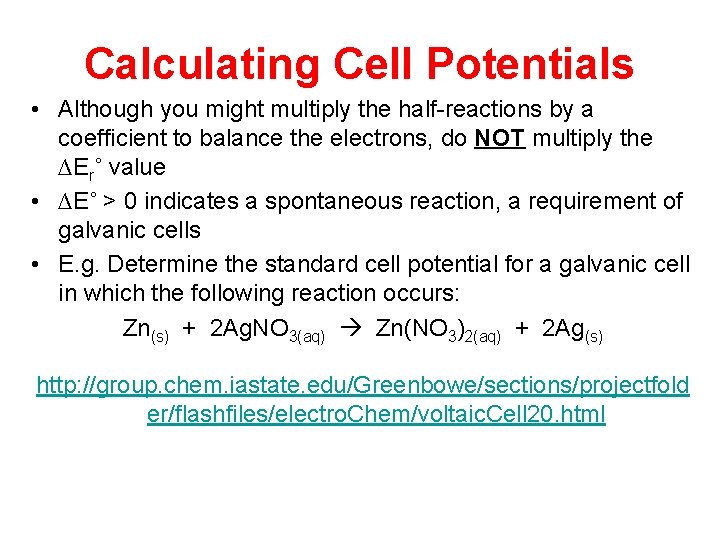
Calculating Cell Potentials • Although you might multiply the half-reactions by a coefficient to balance the electrons, do NOT multiply the ∆Er˚ value • ∆E˚ > 0 indicates a spontaneous reaction, a requirement of galvanic cells • E. g. Determine the standard cell potential for a galvanic cell in which the following reaction occurs: Zn(s) + 2 Ag. NO 3(aq) Zn(NO 3)2(aq) + 2 Ag(s) http: //group. chem. iastate. edu/Greenbowe/sections/projectfold er/flashfiles/electro. Chem/voltaic. Cell 20. html
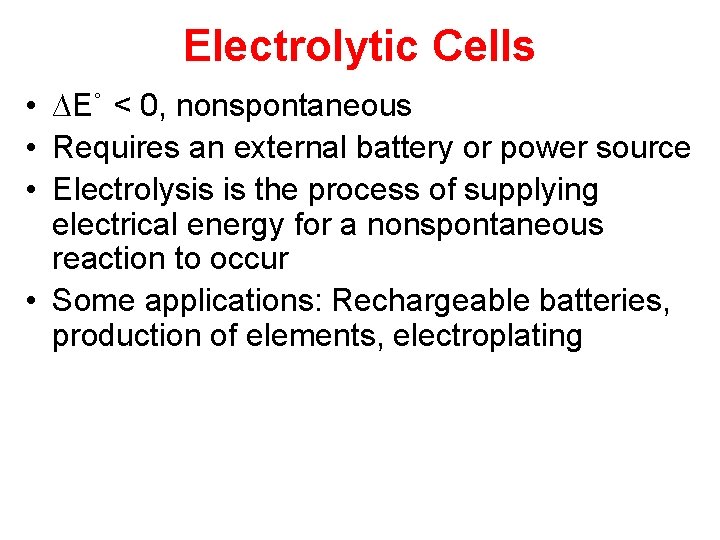
Electrolytic Cells • ∆E˚ < 0, nonspontaneous • Requires an external battery or power source • Electrolysis is the process of supplying electrical energy for a nonspontaneous reaction to occur • Some applications: Rechargeable batteries, production of elements, electroplating
Practice • p. 708 #10 -12 • p. 709 # 2, 6 -8 • Review: – p. 725 # 1 -7, 10 -14 – p. 726 # 1 -12, 14 -16, 22