
Standard Business Roadmap Step by Step Guide Standard
Standard Business Roadmap Step by Step Guide
Standard Business Roadmap The acid test for ANY system is; “Does it work ? ” This system is no different. Results are today’s business currency. Without results no system is worth the paper it’s written on. This system is not based on theory or strategic waffle, it’s based on hard won experience and developed by people who have used the tools contained within it to get measurable results. Time after time. Follow the process, step by step, in the order it is laid out and you will get results. This system can be used for areas from an individual department or small business right up to major corporations. Theories and complex models may look impressive in boardroom presentations, but only action gets results.
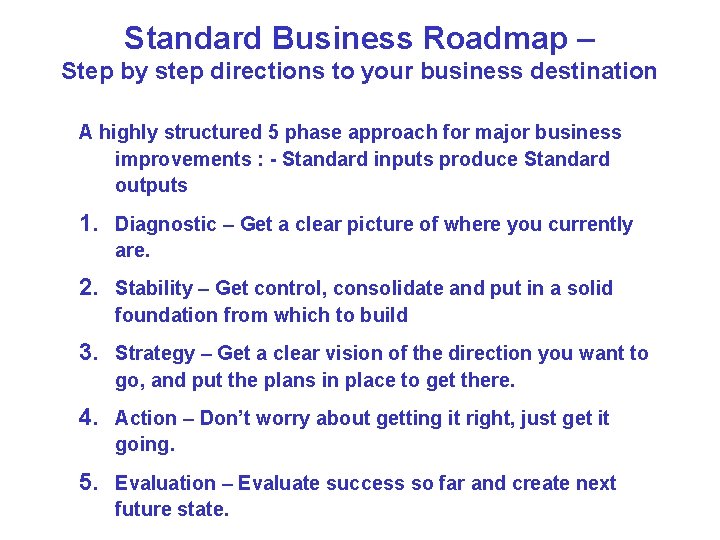
Standard Business Roadmap – Step by step directions to your business destination A highly structured 5 phase approach for major business improvements : - Standard inputs produce Standard outputs 1. Diagnostic – Get a clear picture of where you currently are. 2. Stability – Get control, consolidate and put in a solid foundation from which to build 3. Strategy – Get a clear vision of the direction you want to go, and put the plans in place to get there. 4. Action – Don’t worry about getting it right, just get it going. 5. Evaluation – Evaluate success so far and create next future state.

Standard Business Roadmap 1. Diagnostic 2. Stability 3. Strategy 4. Action 5. Evaluation Each of the following business areas will have a specific role to play in the implementation of the “Standard Toolkit” for each stage of the cycle Human Resources Operations Business Leadership Logistics Quality

Standard Business Roadmap – 1. Diagnostic • Cultural Audit • Stakeholder Analysis • Business Assessment • Current State Map 2. Stability • Discipline Ø Policy in place? ØAdhered to? ØLateness ØAttendance • Terms of Payment ØSuppliers & customers • Install Measures ØKPI’s etc. • Business Case Ø(If necessary for • Organisational your company) Model – Sensible? • Takt Time ØDrumbeat / DSA • Work Sequence ØHow long / ØWhen ? 3. Strategy • Business Vision • Future State Map • Route Map & Tactical Plans • Operating Principles ØAlso to be used for Gateway 4. Action • Cultural Change • Gateway • Leadership Model ØShadow of Leader 5. Evaluation • Evaluation of Success • Next Phase • Key HR Policies ØOr Handbook • PMS / Visual Mgmt • Stock Turns ØInventory control • Standardised work • TPM / SMED • Current State Map • Future State Map • Route Map • 5 C • Line Balancing • Detailed TIP’s

Standard Business Roadmap – Timescales (Cumulative) 1. Diagnostic 2. Stability 3. Strategy • Small Business < 500 staff • Small Business < 500 staff 1 -2 weeks < 8 weeks < 12 months 6 monthly • Medium Business 500 – 1000 staff • Medium Business 500 – 1000 staff 1 -2 weeks < 12 weeks <12 weeks 12 – 18 months annually • Large Business >1000 staff • Large Business >1000 staff 2 -4 weeks < 6 months < 24 months annually 4. Action 5. Evaluation
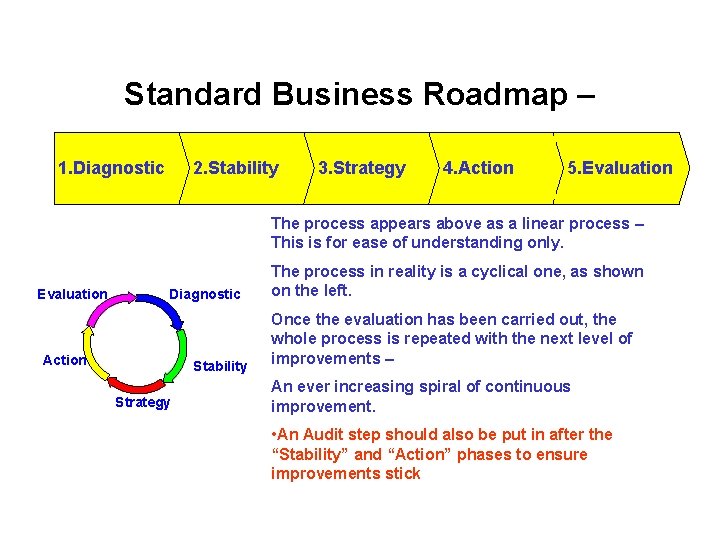
Standard Business Roadmap – 1. Diagnostic 2. Stability 3. Strategy 4. Action 5. Evaluation The process appears above as a linear process – This is for ease of understanding only. Evaluation Diagnostic Action Stability Strategy The process in reality is a cyclical one, as shown on the left. Once the evaluation has been carried out, the whole process is repeated with the next level of improvements – An ever increasing spiral of continuous improvement. • An Audit step should also be put in after the “Stability” and “Action” phases to ensure improvements stick

Standard Business Roadmap – 1. Diagnostic Evaluation 2. Stability Diagnostic 3. Strategy 4. Action 5. Evaluation As you progress through to the second cycle, providing the actions you have implemented earlier have become firmly embedded, more advanced Lean, six sigma tools or other improvement tools may be used. This will depend upon the environment in which you are operating. Action Stability Strategy Each of the five steps to Lean can be tailored to be implemented in progressive cycles. An example of this is shown on the following slide:
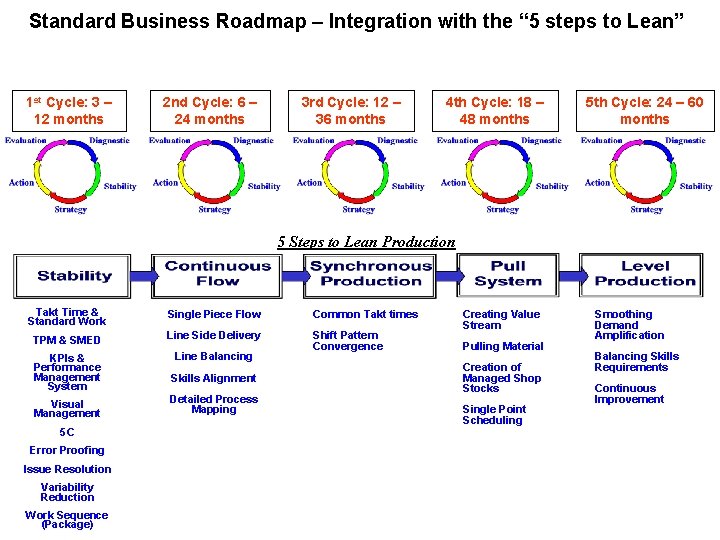
Standard Business Roadmap – Integration with the “ 5 steps to Lean” 1 st Cycle: 3 – 12 months 2 nd Cycle: 6 – 24 months 3 rd Cycle: 12 – 36 months 4 th Cycle: 18 – 48 months 5 th Cycle: 24 – 60 months 5 Steps to Lean Production Takt Time & Standard Work Single Piece Flow Common Takt times TPM & SMED Line Side Delivery KPIs & Performance Management System Line Balancing Shift Pattern Convergence Visual Management 5 C Error Proofing Issue Resolution Variability Reduction Work Sequence (Package) Skills Alignment Detailed Process Mapping Creating Value Stream Pulling Material Creation of Managed Shop Stocks Single Point Scheduling Smoothing Demand Amplification Balancing Skills Requirements Continuous Improvement
- Slides: 9