
Stand Quietly Lesson 3 3 Angles of Polygons





- Slides: 37
Stand Quietly
Lesson 3. 3 Angles of Polygons
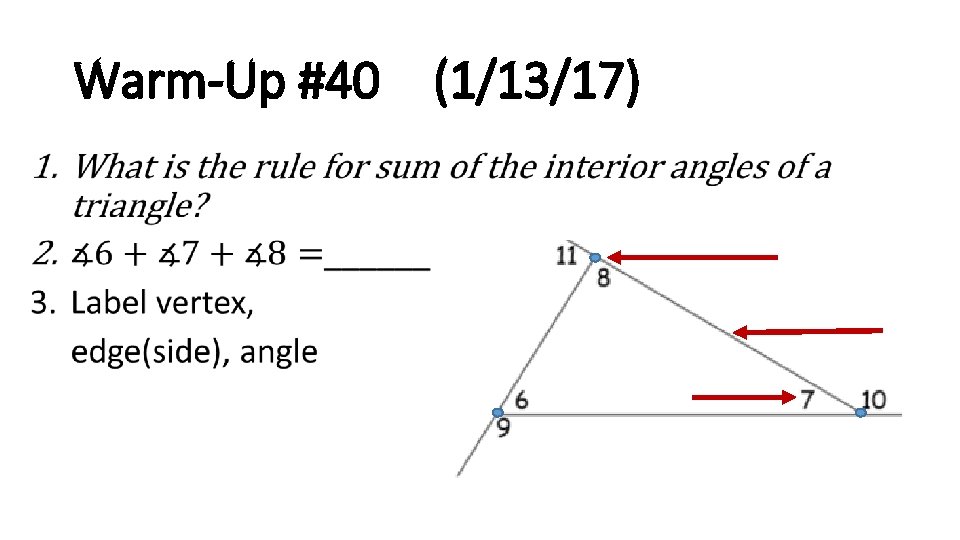
Warm-Up #40 (1/13/17) •
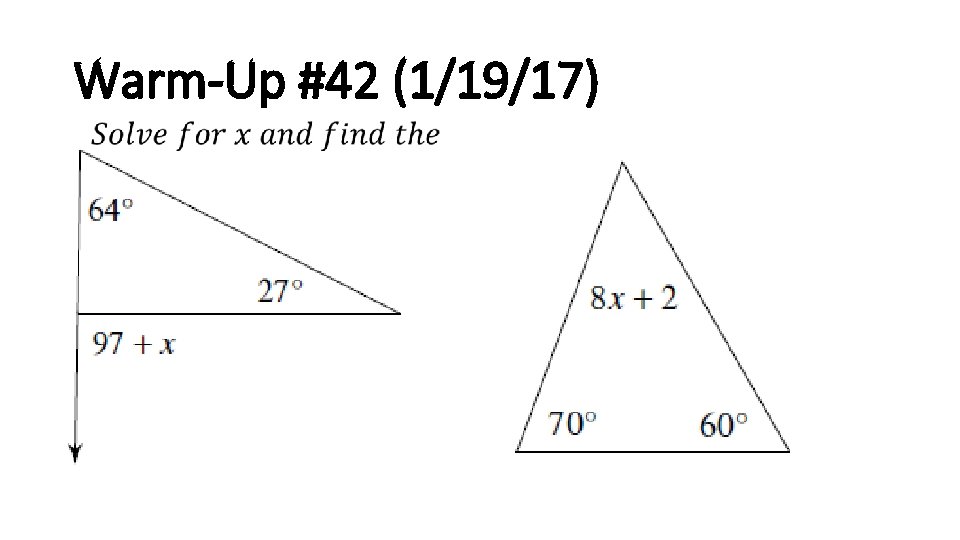
Warm-Up #42 (1/19/17)
Homework (1/19/17) Lesson 3. 3 Packet Page 1 and 2 ODD
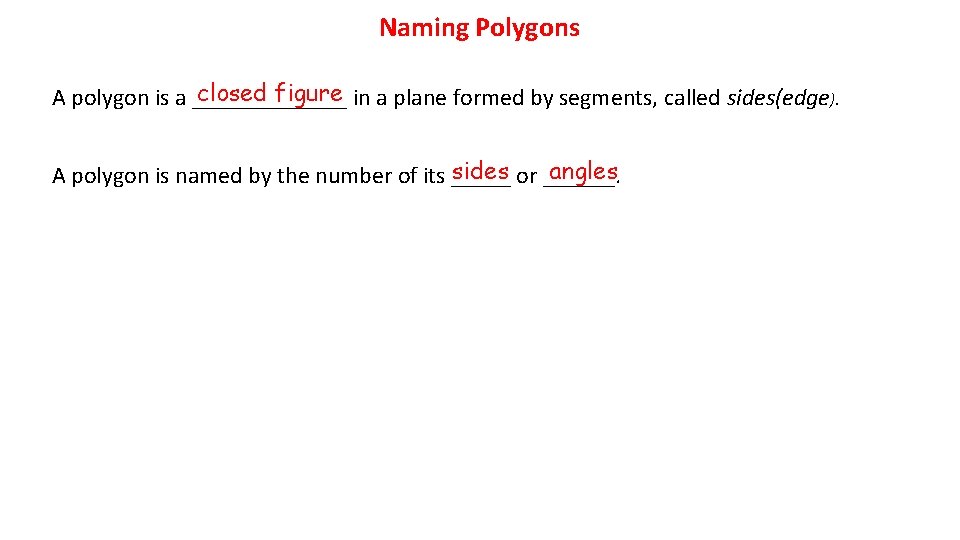
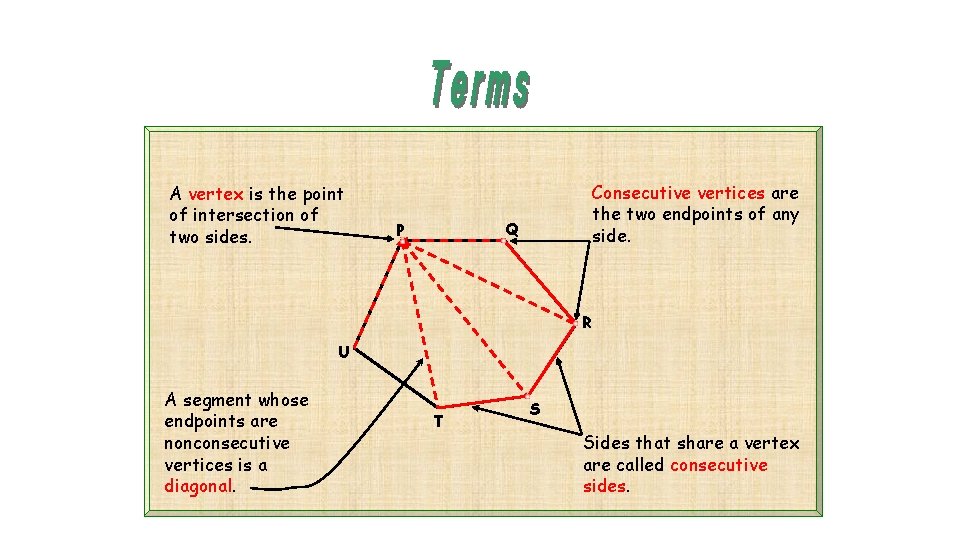
Naming Polygons closed figure in a plane formed by segments, called sides(edge). A polygon is a _______ angles A polygon is named by the number of its sides _____ or ______.
Naming Polygons A vertex is the point of intersection of two sides. Consecutive vertices are the two endpoints of any side. Q P R U A segment whose endpoints are nonconsecutive vertices is a diagonal. T S Sides that share a vertex are called consecutive sides.
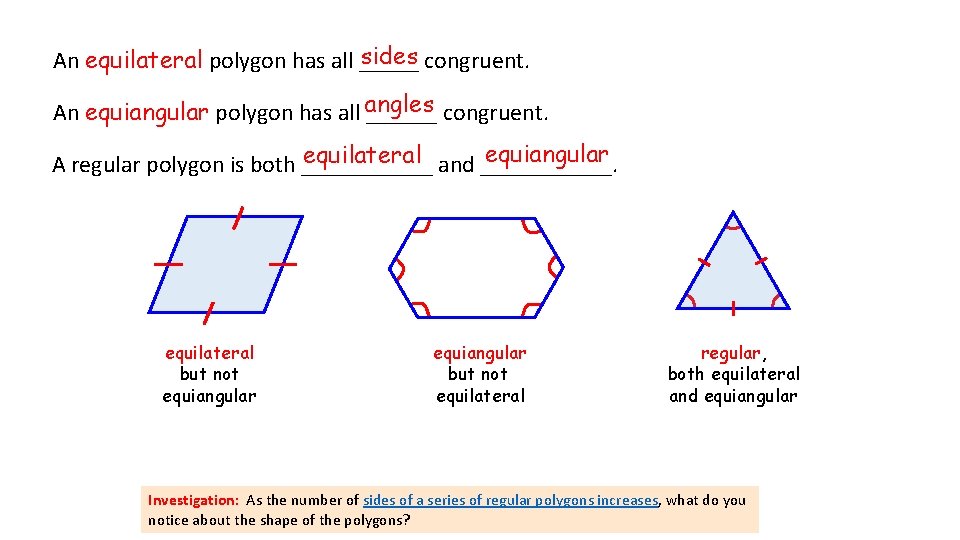
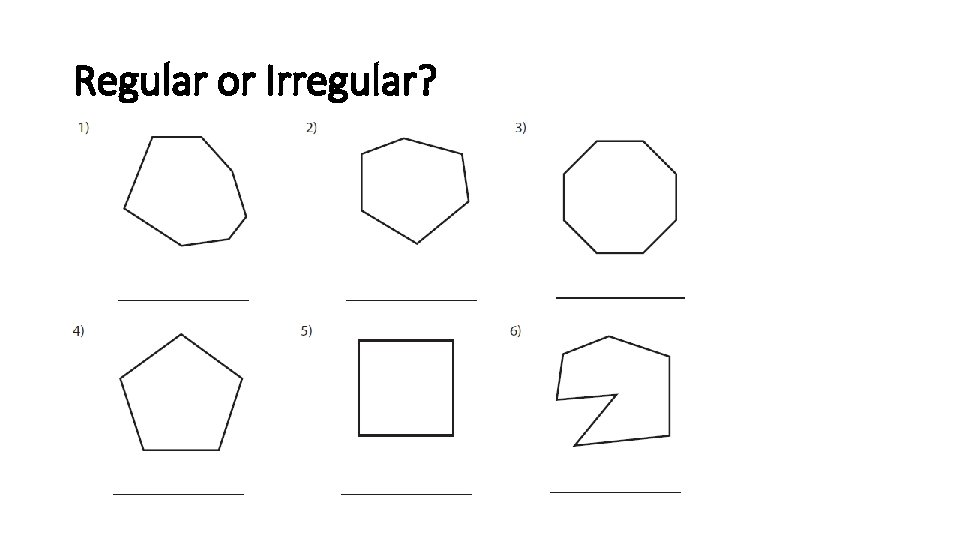
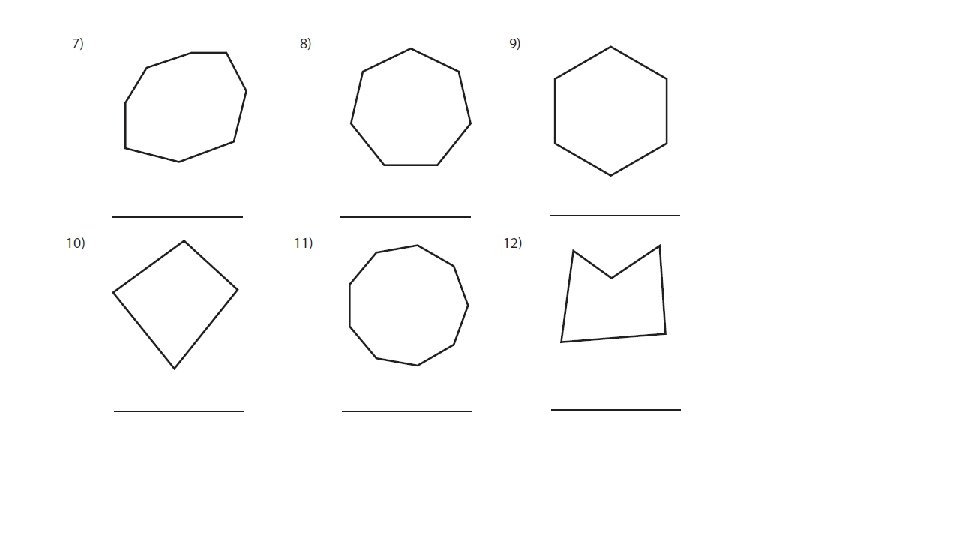
sides congruent. An equilateral polygon has all _____ An equiangular polygon has all angles ______ congruent. equiangular equilateral and ______. A regular polygon is both ______ equilateral but not equiangular but not equilateral regular, both equilateral and equiangular Investigation: As the number of sides of a series of regular polygons increases, what do you notice about the shape of the polygons?
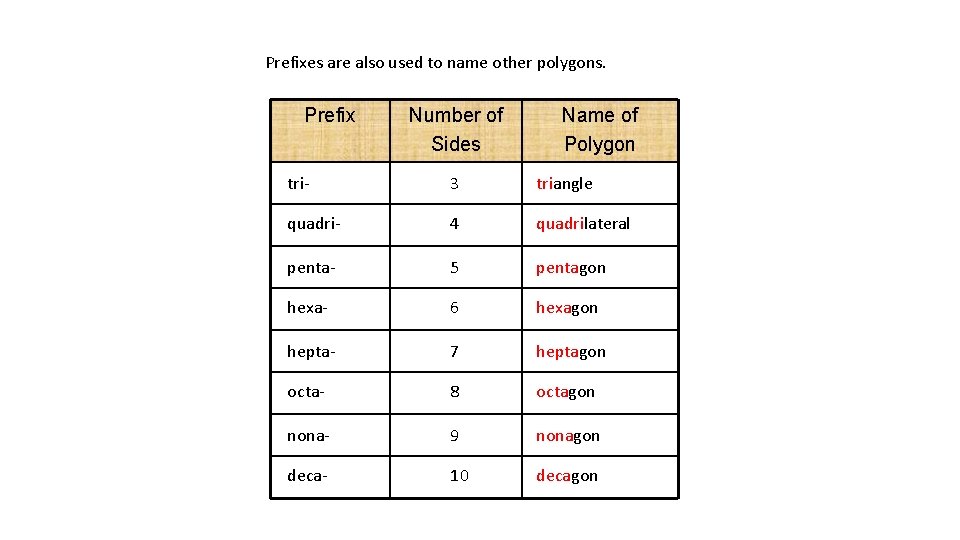
Naming Polygons Prefixes are also used to name other polygons. Prefix Number of Sides Name of Polygon tri- 3 triangle quadri- 4 quadrilateral penta- 5 pentagon hexa- 6 hexagon hepta- 7 heptagon octa- 8 octagon nona- 9 nonagon deca- 10 decagon
Angles of Polygon Investigation. 1. Each partner will have a POSTER and a DIAGRAM. 2. WRITE your NAME on the poster. (Horizontal) 3. You have 10 minutes to COPY the chart, DRAW the diagram, and WRITE the answers on the poster. 4. PRESENT the poster to the class.
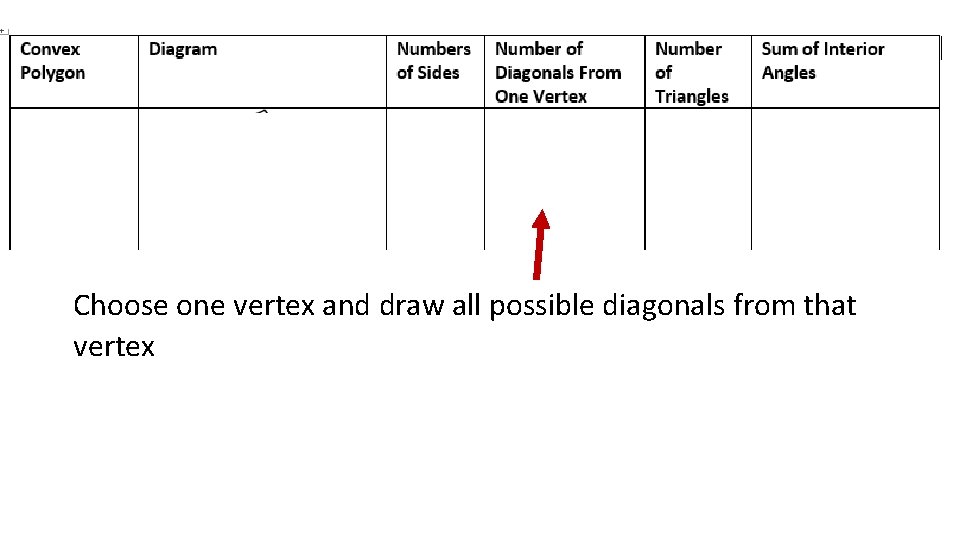
Choose one vertex and draw all possible diagonals from that vertex
Expectations for Presentation?
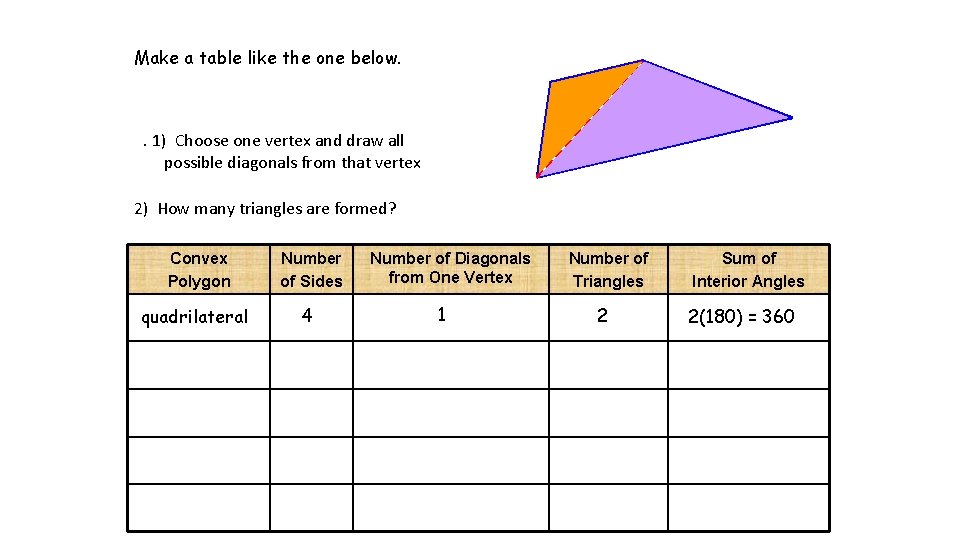
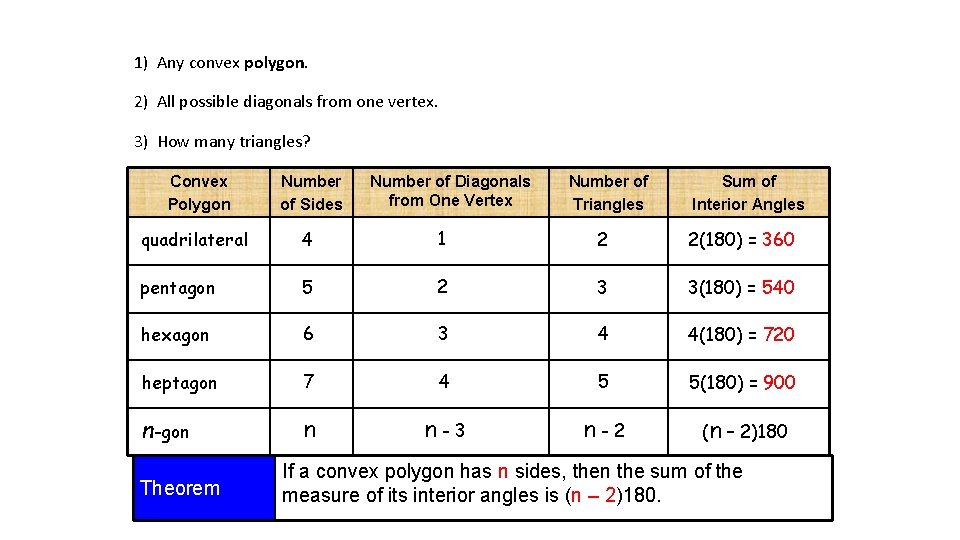
Diagonals and Angle Measure Make a table like the one below. . 1) Choose one vertex and draw all possible diagonals from that vertex 2) How many triangles are formed? Convex Polygon Number of Sides quadrilateral 4 Number of Diagonals from One Vertex 1 Number of Triangles 2 Sum of Interior Angles 2(180) = 360
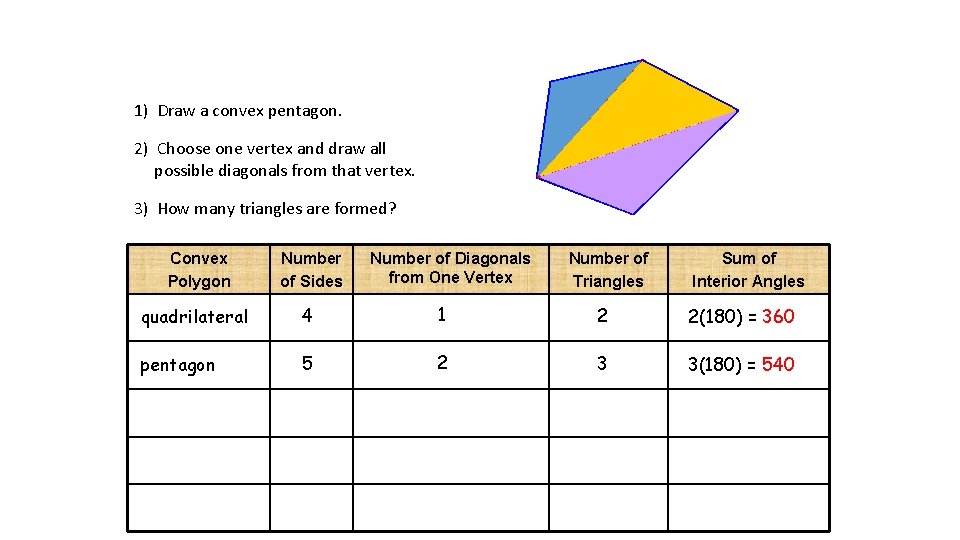
Diagonals and Angle Measure 1) Draw a convex pentagon. 2) Choose one vertex and draw all possible diagonals from that vertex. 3) How many triangles are formed? Convex Polygon Number of Sides Number of Diagonals from One Vertex Number of Triangles Sum of Interior Angles quadrilateral 4 1 2 2(180) = 360 pentagon 5 2 3 3(180) = 540
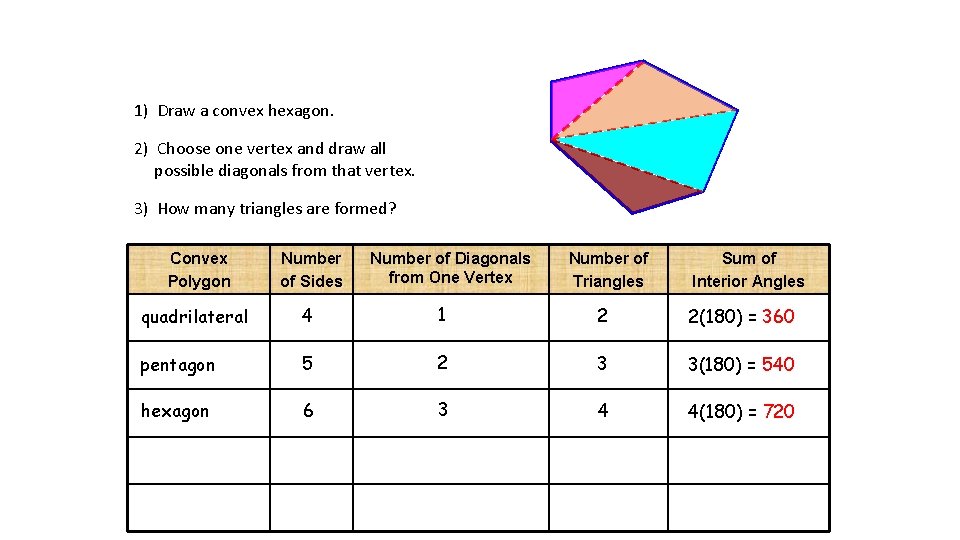
Diagonals and Angle Measure 1) Draw a convex hexagon. 2) Choose one vertex and draw all possible diagonals from that vertex. 3) How many triangles are formed? Convex Polygon Number of Sides Number of Diagonals from One Vertex Number of Triangles Sum of Interior Angles quadrilateral 4 1 2 2(180) = 360 pentagon 5 2 3 3(180) = 540 hexagon 6 3 4 4(180) = 720
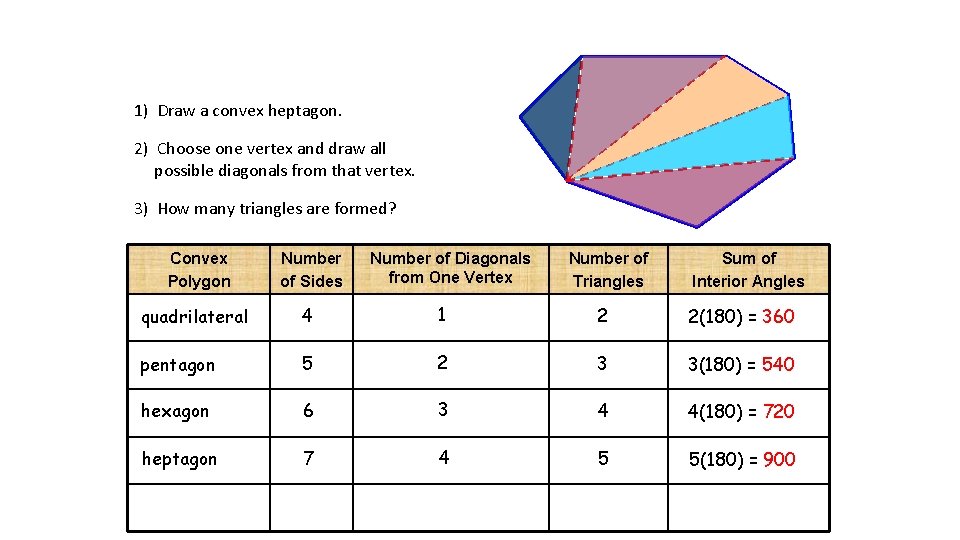
Diagonals and Angle Measure 1) Draw a convex heptagon. 2) Choose one vertex and draw all possible diagonals from that vertex. 3) How many triangles are formed? Convex Polygon Number of Sides Number of Diagonals from One Vertex Number of Triangles Sum of Interior Angles quadrilateral 4 1 2 2(180) = 360 pentagon 5 2 3 3(180) = 540 hexagon 6 3 4 4(180) = 720 heptagon 7 4 5 5(180) = 900
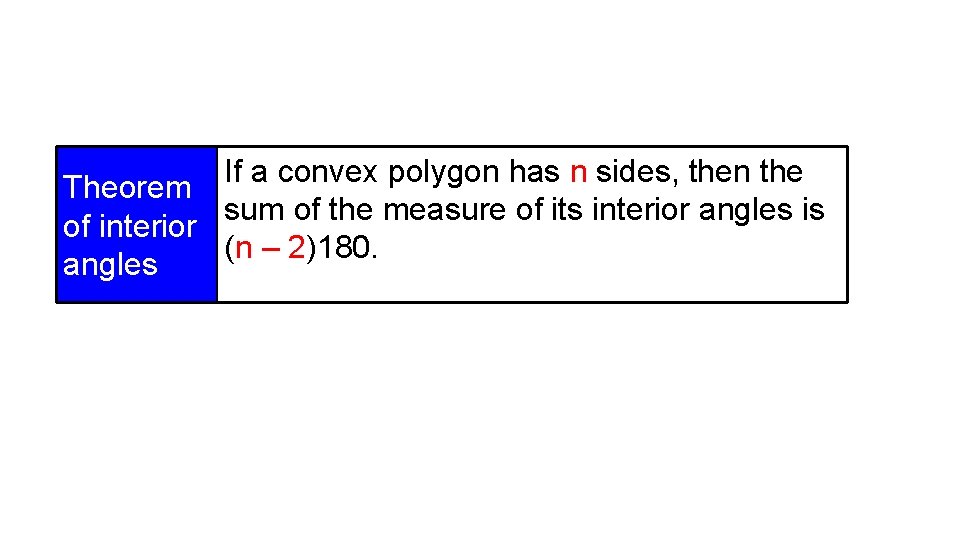
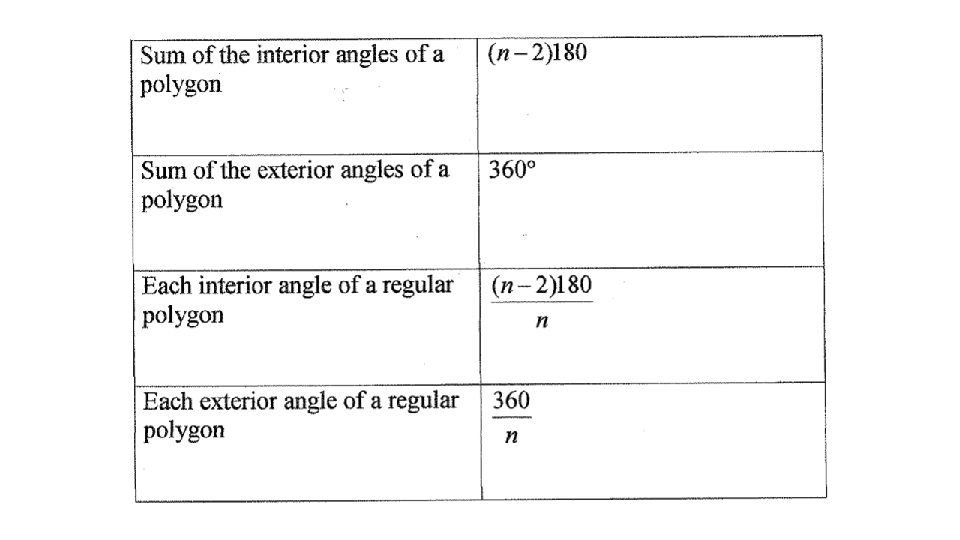
Diagonals and Angle Measure 1) Any convex polygon. 2) All possible diagonals from one vertex. 3) How many triangles? Convex Polygon Number of Sides quadrilateral 4 1 2 2(180) = 360 pentagon 5 2 3 3(180) = 540 hexagon 6 3 4 4(180) = 720 heptagon 7 4 5 5(180) = 900 n-gon n n-3 n-2 (n – 2)180 Theorem Number of Diagonals from One Vertex Number of Triangles Sum of Interior Angles If a convex polygon has n sides, then the sum of the measure of its interior angles is (n – 2)180.
Regular Polygons vs Irregular Polygons https: //www. mathsisfun. com/definitions/irregular-polygon. html
Regular or Irregular?
You. Tube: interior angles of polygons https: //www. youtube. com/watch? v=G 44 l. R 8 y. R 3 Vk https: //www. youtube. com/watch? v=m 1 BXp. An. D-1 Q https: //www. youtube. com/watch? v=j 5 jk. WFy 323 U Practice problems http: //www. mathworksheets 4 kids. com/polygon. php
If a convex polygon has n sides, then the Theorem sum of the measure of its interior angles is of interior (n – 2)180. angles
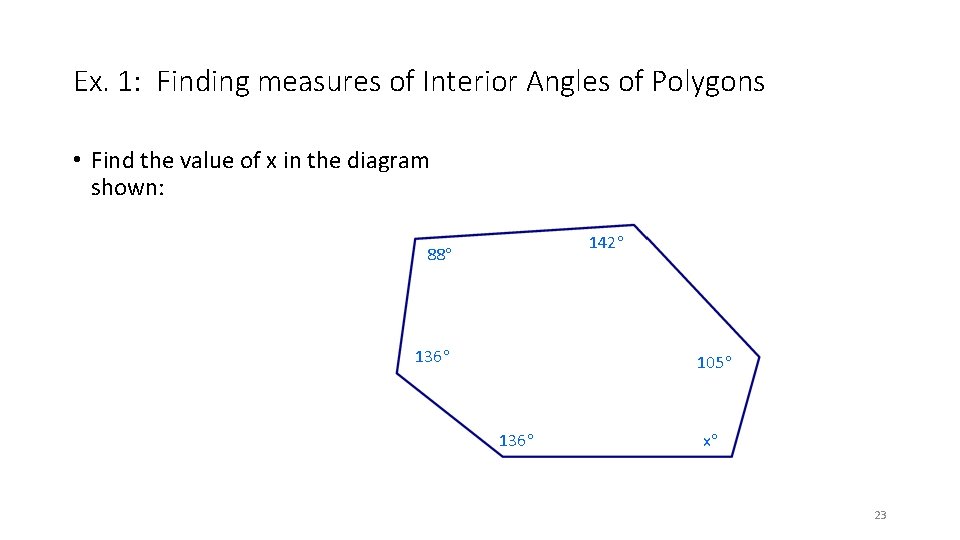
Ex. 1: Finding measures of Interior Angles of Polygons • Find the value of x in the diagram shown: 142 88 136 105 136 x 23
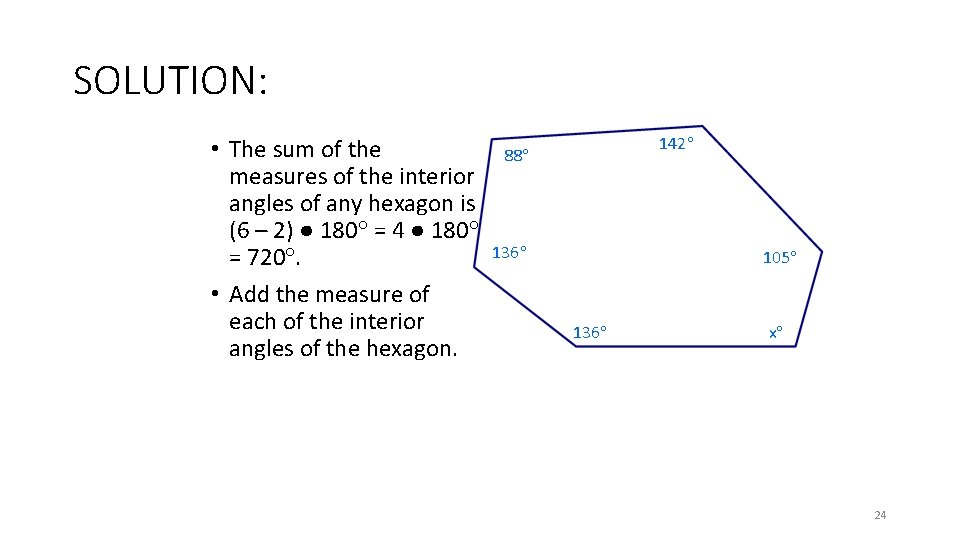
SOLUTION: • The sum of the measures of the interior angles of any hexagon is (6 – 2) ● 180 = 4 ● 180 = 720. • Add the measure of each of the interior angles of the hexagon. 142 88 136 105 136 x 24
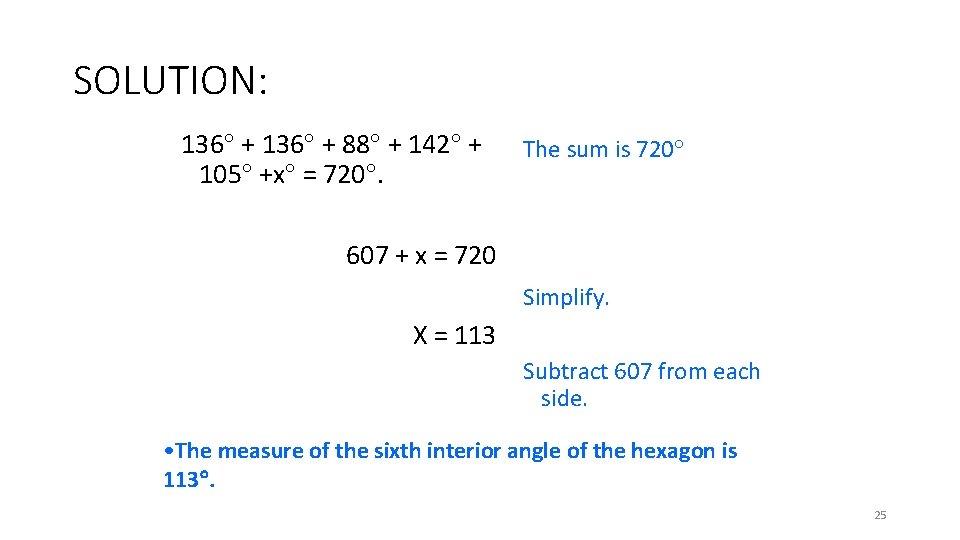
SOLUTION: 136 + 88 + 142 + 105 +x = 720. The sum is 720 607 + x = 720 Simplify. X = 113 Subtract 607 from each side. • The measure of the sixth interior angle of the hexagon is 113. 25
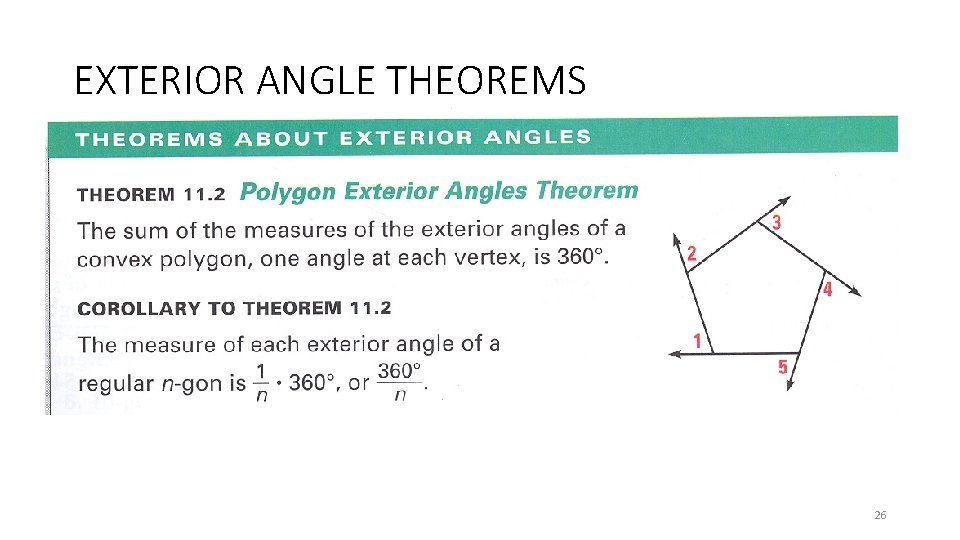
EXTERIOR ANGLE THEOREMS 26
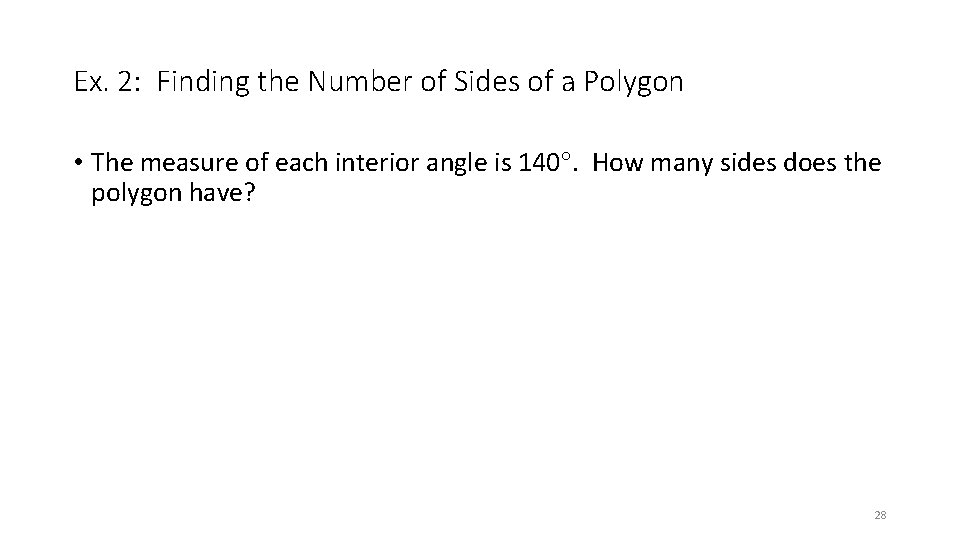
Ex. 2: Finding the Number of Sides of a Polygon • The measure of each interior angle is 140. How many sides does the polygon have? 28
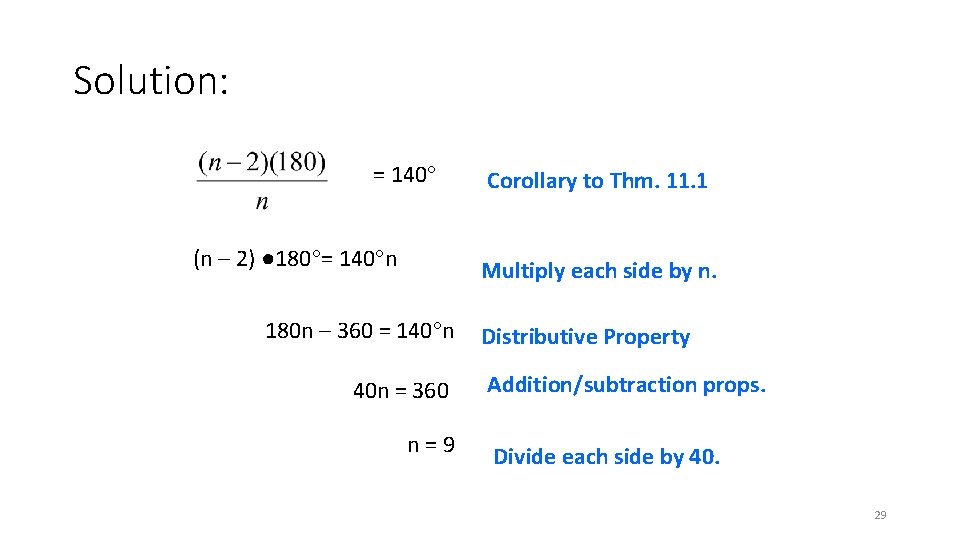
Solution: = 140 (n – 2) ● 180 = 140 n Corollary to Thm. 11. 1 Multiply each side by n. 180 n – 360 = 140 n 40 n = 360 n=9 Distributive Property Addition/subtraction props. Divide each side by 40. 29
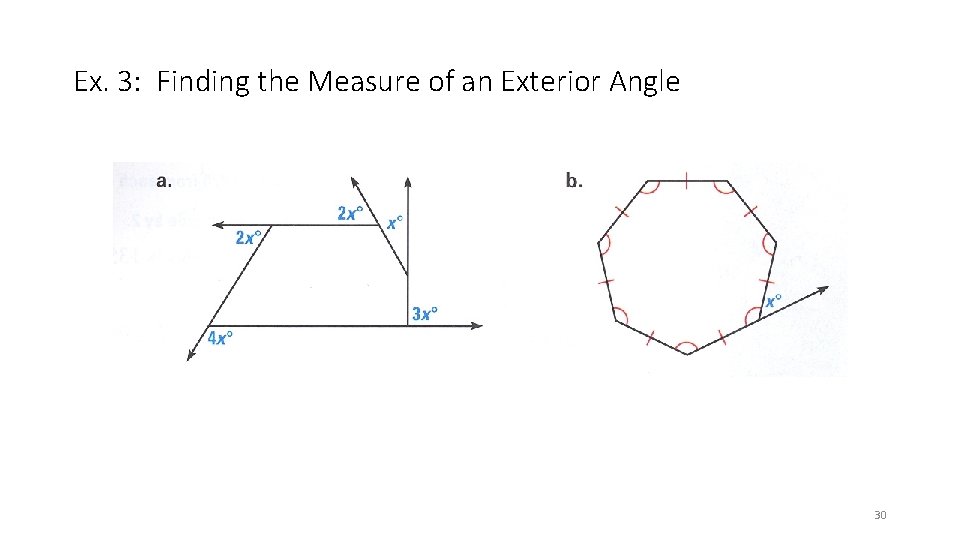
Ex. 3: Finding the Measure of an Exterior Angle 30
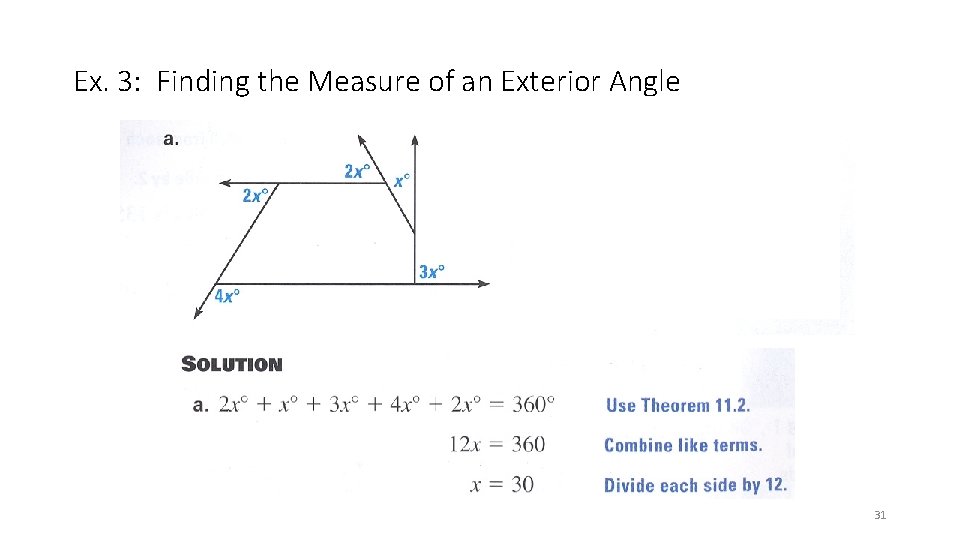
Ex. 3: Finding the Measure of an Exterior Angle 31
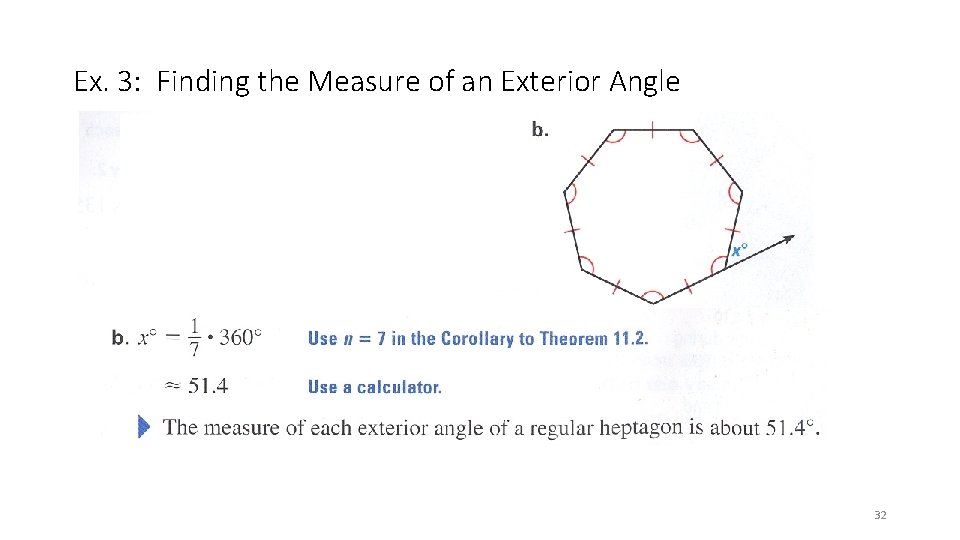
Ex. 3: Finding the Measure of an Exterior Angle 32
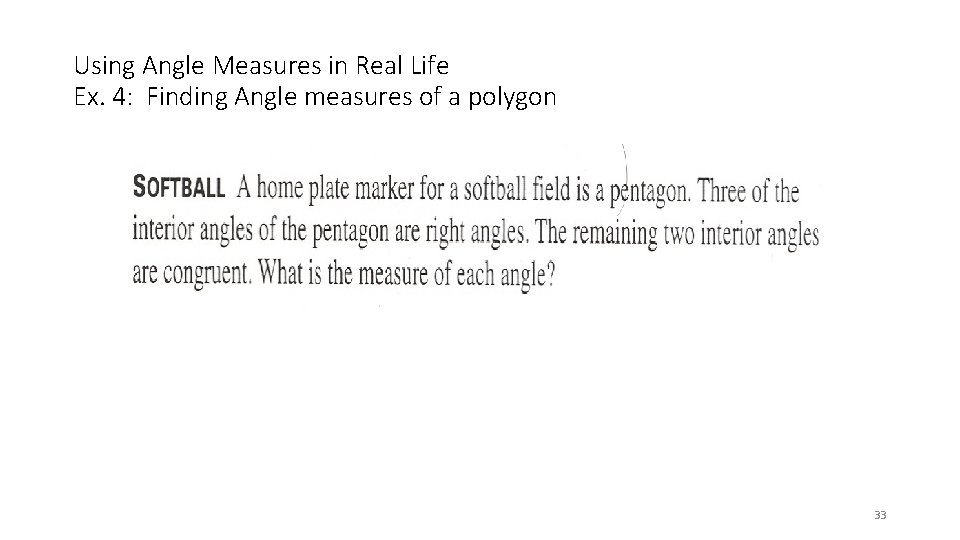
Using Angle Measures in Real Life Ex. 4: Finding Angle measures of a polygon 33
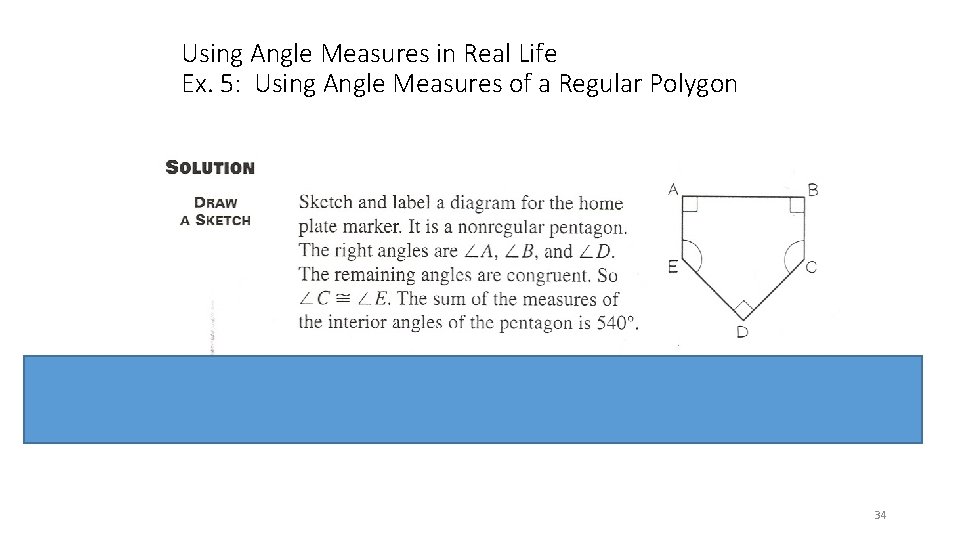
Using Angle Measures in Real Life Ex. 5: Using Angle Measures of a Regular Polygon 34
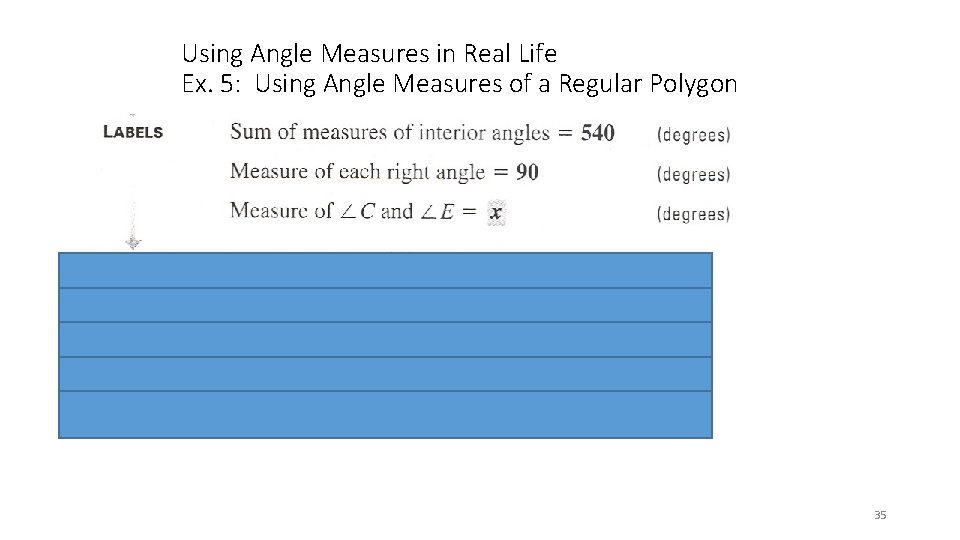
Using Angle Measures in Real Life Ex. 5: Using Angle Measures of a Regular Polygon 35
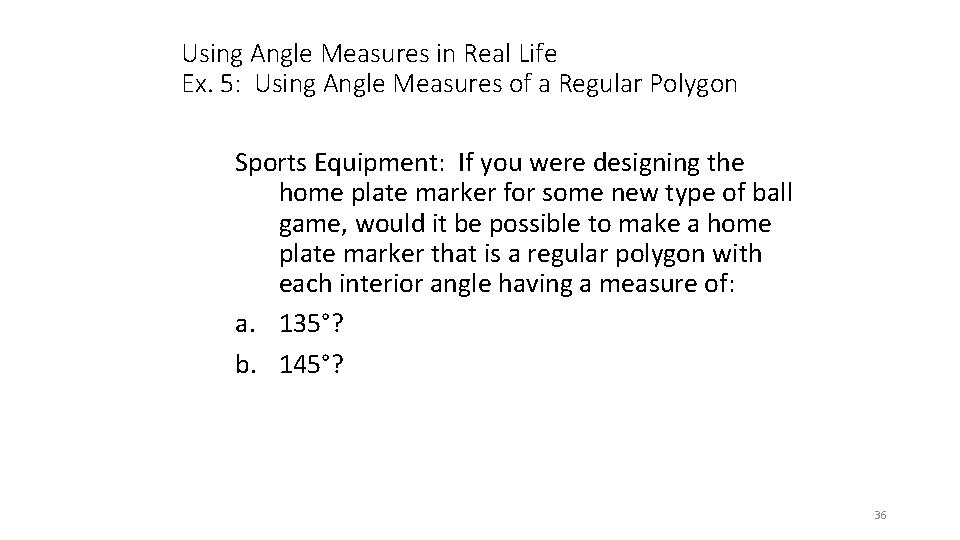
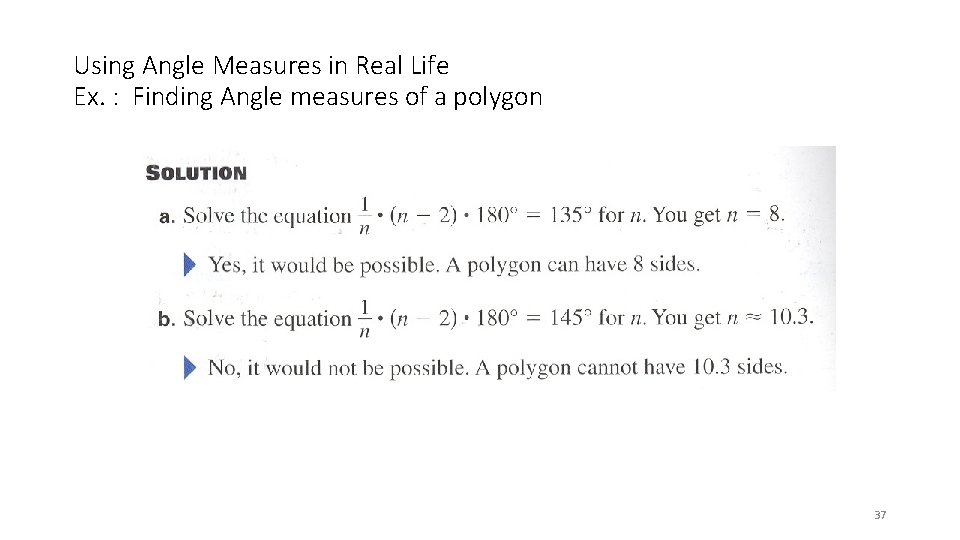
Using Angle Measures in Real Life Ex. 5: Using Angle Measures of a Regular Polygon Sports Equipment: If you were designing the home plate marker for some new type of ball game, would it be possible to make a home plate marker that is a regular polygon with each interior angle having a measure of: a. 135°? b. 145°? 36
Using Angle Measures in Real Life Ex. : Finding Angle measures of a polygon 37