
Stallings Wireless Communications Networks Second Edition 2005 Pearson
- Slides: 20
Stallings, Wireless Communications & Networks, Second Edition, © 2005 Pearson Education, Inc. All rights reserved. 0 -13 -191835 -4 Wireless LAN Technology Chapter 13
Stallings, Wireless Communications & Networks, Second Edition, © 2005 Pearson Education, Inc. All rights reserved. 0 -13 -191835 -4 Wireless LAN Applications n n LAN Extension Cross-building interconnect Nomadic Access Ad hoc networking
Stallings, Wireless Communications & Networks, Second Edition, © 2005 Pearson Education, Inc. All rights reserved. 0 -13 -191835 -4 LAN Extension n Wireless LAN linked into a wired LAN on same premises n Wired LAN n n n Backbone Support servers and stationary workstations Wireless LAN n n Stations in large open areas Manufacturing plants, stock exchange trading floors, and warehouses
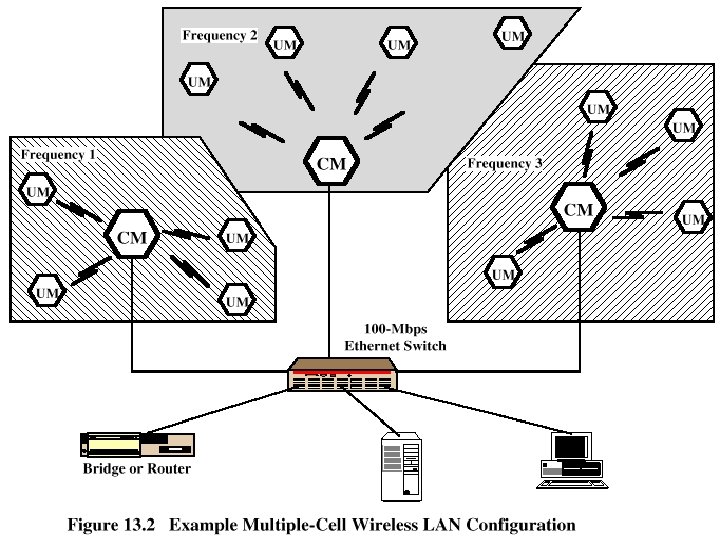
Multiple-cell Wireless LAN
Stallings, Wireless Communications & Networks, Second Edition, © 2005 Pearson Education, Inc. All rights reserved. 0 -13 -191835 -4 Cross-Building Interconnect n Connect LANs in nearby buildings n n n Wired or wireless LANs Point-to-point wireless link is used Devices connected are typically bridges or routers
Stallings, Wireless Communications & Networks, Second Edition, © 2005 Pearson Education, Inc. All rights reserved. 0 -13 -191835 -4 Nomadic Access n Wireless link between LAN hub and mobile data terminal equipped with antenna n n Laptop computer or notepad computer Uses: n n Transfer data from portable computer to office server Extended environment such as campus
Stallings, Wireless Communications & Networks, Second Edition, © 2005 Pearson Education, Inc. All rights reserved. 0 -13 -191835 -4 Ad Hoc Networking n n Temporary peer-to-peer network set up to meet immediate need Example: n Group of employees with laptops convene for a meeting; employees link computers in a temporary network for duration of meeting
Stallings, Wireless Communications & Networks, Second Edition, © 2005 Pearson Education, Inc. All rights reserved. 0 -13 -191835 -4 Wireless LAN Requirements n n n n n Throughput Number of nodes Connection to backbone LAN Service area Battery power consumption Transmission robustness and security Collocated network operation License-free operation Handoff/roaming Dynamic configuration
Stallings, Wireless Communications & Networks, Second Edition, © 2005 Pearson Education, Inc. All rights reserved. 0 -13 -191835 -4 Wireless LAN Categories n n n Infrared (IR) LANs Spread spectrum LANs Narrowband microwave
Stallings, Wireless Communications & Networks, Second Edition, © 2005 Pearson Education, Inc. All rights reserved. 0 -13 -191835 -4 Strengths of Infrared Over Microwave Radio n Spectrum for infrared virtually unlimited n n Infrared spectrum unregulated Equipment inexpensive and simple Reflected by light-colored objects n n Possibility of high data rates Ceiling reflection for entire room coverage Doesn’t penetrate walls n n More easily secured against eavesdropping Less interference between different rooms
Stallings, Wireless Communications & Networks, Second Edition, © 2005 Pearson Education, Inc. All rights reserved. 0 -13 -191835 -4 Drawbacks of Infrared Medium n Indoor environments experience infrared background radiation n Sunlight and indoor lighting Ambient radiation appears as noise in an infrared receiver Transmitters of higher power required n n Limited by concerns of eye safety and excessive power consumption Limits range
Stallings, Wireless Communications & Networks, Second Edition, © 2005 Pearson Education, Inc. All rights reserved. 0 -13 -191835 -4 IR Data Transmission Techniques n n n Directed Beam Infrared Ominidirectional Diffused
Stallings, Wireless Communications & Networks, Second Edition, © 2005 Pearson Education, Inc. All rights reserved. 0 -13 -191835 -4 Directed Beam Infrared n n n Used to create point-to-point links Range depends on emitted power and degree of focusing Focused IR data link can have range of kilometers n Cross-building interconnect between bridges or routers
Stallings, Wireless Communications & Networks, Second Edition, © 2005 Pearson Education, Inc. All rights reserved. 0 -13 -191835 -4 Ominidirectional n n n Single base station within line of sight of all other stations on LAN Station typically mounted on ceiling Base station acts as a multiport repeater n n Ceiling transmitter broadcasts signal received by IR transceivers transmit with directional beam aimed at ceiling base unit
Stallings, Wireless Communications & Networks, Second Edition, © 2005 Pearson Education, Inc. All rights reserved. 0 -13 -191835 -4 Diffused n n All IR transmitters focused and aimed at a point on diffusely reflecting ceiling IR radiation strikes ceiling n n Reradiated omnidirectionally Picked up by all receivers
Stallings, Wireless Communications & Networks, Second Edition, © 2005 Pearson Education, Inc. All rights reserved. 0 -13 -191835 -4 Spread Spectrum LAN Configuration n Multiple-cell arrangement (Figure 13. 2) Within a cell, either peer-to-peer or hub Peer-to-peer topology n n No hub Access controlled with MAC algorithm n n CSMA Appropriate for ad hoc LANs
Stallings, Wireless Communications & Networks, Second Edition, © 2005 Pearson Education, Inc. All rights reserved. 0 -13 -191835 -4 Spread Spectrum LAN Configuration n Hub topology n n n Mounted on the ceiling and connected to backbone May control access May act as multiport repeater Automatic handoff of mobile stations Stations in cell either: n n Transmit to / receive from hub only Broadcast using omnidirectional antenna
Stallings, Wireless Communications & Networks, Second Edition, © 2005 Pearson Education, Inc. All rights reserved. 0 -13 -191835 -4 Narrowband Microwave LANs n n Use of a microwave radio frequency band for signal transmission Relatively narrow bandwidth Licensed Unlicensed
Stallings, Wireless Communications & Networks, Second Edition, © 2005 Pearson Education, Inc. All rights reserved. 0 -13 -191835 -4 Licensed Narrowband RF n n Licensed within specific geographic areas to avoid potential interference Motorola - 600 licenses in 18 -GHz range n n n Covers all metropolitan areas Can assure that independent LANs in nearby locations don’t interfere Encrypted transmissions prevent eavesdropping
Stallings, Wireless Communications & Networks, Second Edition, © 2005 Pearson Education, Inc. All rights reserved. 0 -13 -191835 -4 Unlicensed Narrowband RF n Radio. LAN introduced narrowband wireless LAN in 1995 n n Uses unlicensed ISM spectrum Used at low power (0. 5 watts or less) Operates at 10 Mbps in the 5. 8 -GHz band Range = 50 m to 100 m