
Stalin Questions 1 2 3 4 5 How




- Slides: 20
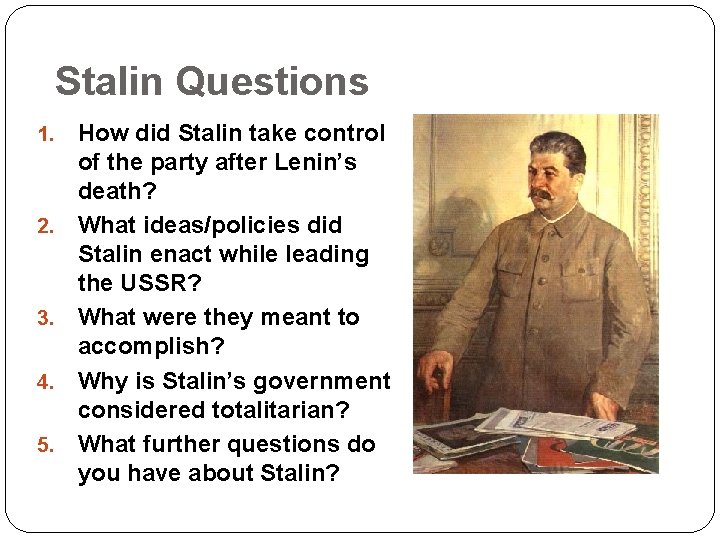
Stalin Questions 1. 2. 3. 4. 5. How did Stalin take control of the party after Lenin’s death? What ideas/policies did Stalin enact while leading the USSR? What were they meant to accomplish? Why is Stalin’s government considered totalitarian? What further questions do you have about Stalin?
Thesis After the creation of the USSR and ensuing power struggle, Joseph Stalin emerged as the dominant political force through a mixture of false alliances and lies. Continuing this style of ruling—and seeing what he, and therefore others, could and would do to keep power— caused Stalin to become both paranoid and vindictive. This manifested itself multiple times throughout the course of his terror, beginning with Holodomor in Ukraine and the Great Purges of the early USSR.
Stalin – Man of Steel 1879 -1953
Totalitarianism • Government control over all aspects of economic, social, political, cultural, and intellectual life • The subordination of the individual to the state, and the insistence that the masses be actively involved in the regime’s goals – – Enforced through propaganda through state-controlled mass media A single political party that controls the state Cult of Personality Regulation/restriction of free speech, use of mass surveillance, and widespread use of terrorism • Origins in total warfare – even democratic nations took control of economic, political, and personal freedom to gain victory – But most prominent in Stalin’s USSR, Nazi Germany, and Fascist Italy
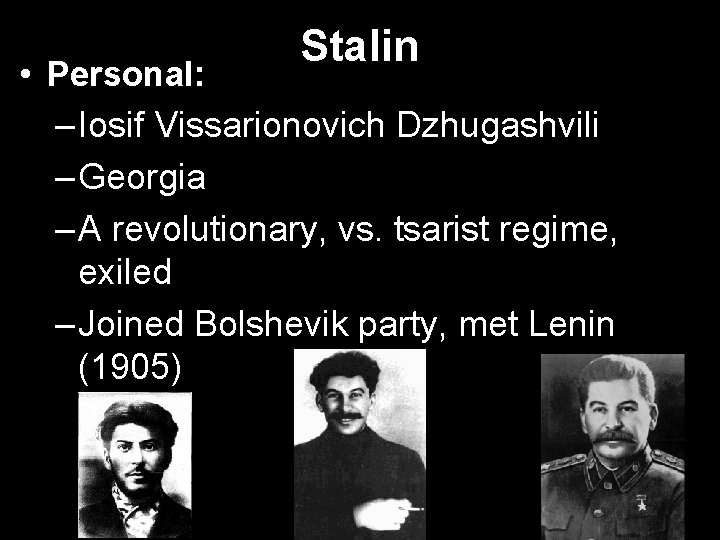
Stalin • Personal: – Iosif Vissarionovich Dzhugashvili – Georgia – A revolutionary, vs. tsarist regime, exiled – Joined Bolshevik party, met Lenin (1905)
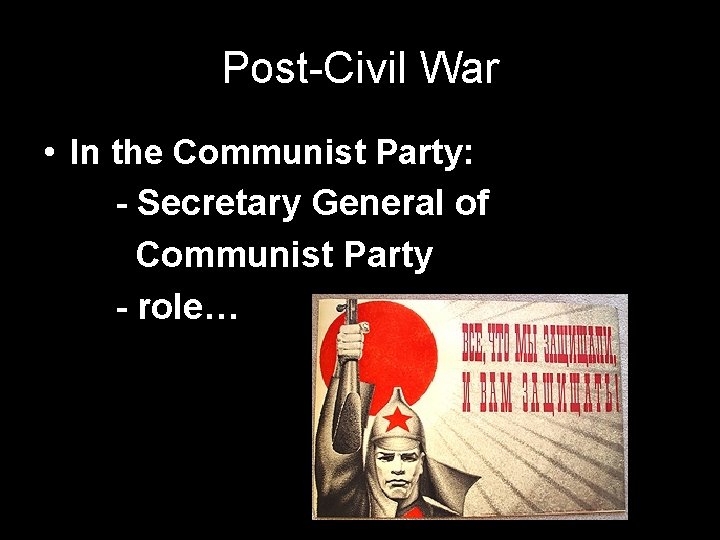
Post-Civil War • In the Communist Party: - Secretary General of Communist Party - role…
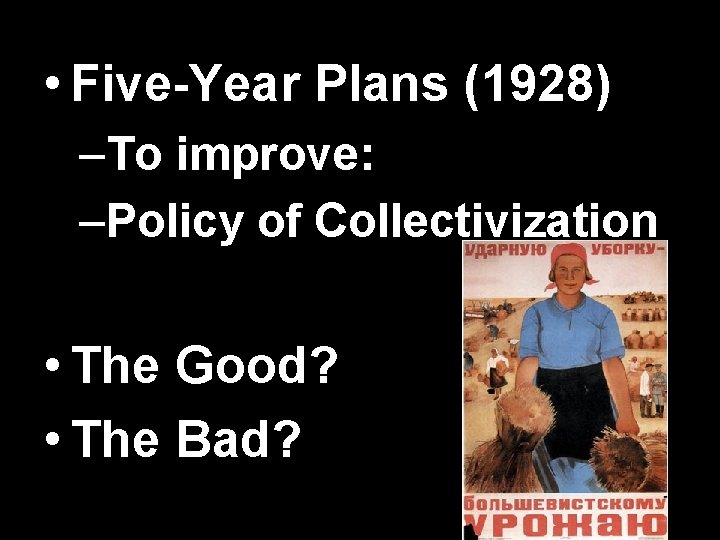
• Five-Year Plans (1928) –To improve: –Policy of Collectivization • The Good? • The Bad?
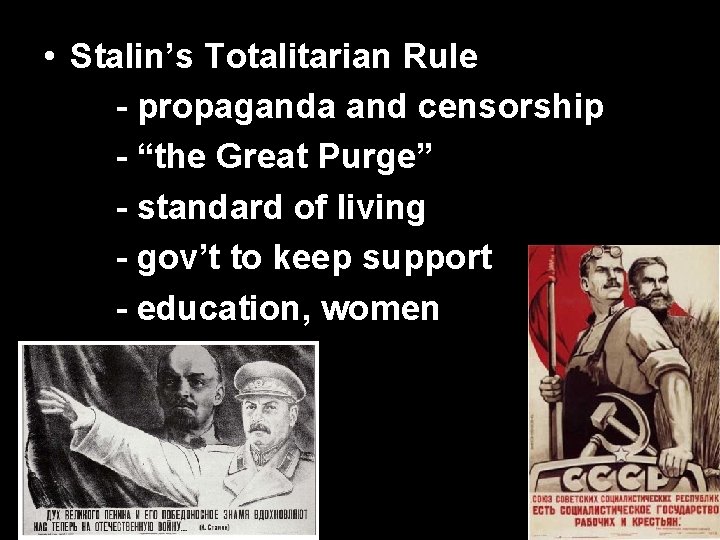
• Stalin’s Totalitarian Rule - propaganda and censorship - “the Great Purge” - standard of living - gov’t to keep support - education, women
• Foreign/Worldwide Role - Comintern (Communist International) - US (1933) - League of Nations (1934)
Trotsky v. Stalin
Creation of the USSR • Old grievances stem from the Treaty of Brest-Litovsk • 1919 -1921 USSR and Ukraine communists fight war against Polish and Ukrainian nationalists. – – Trotsky in charge; Stalin’s segment of army disobeys him Polish kick their butt; Treaty of Riga splits territory Two countries sign nonaggression pact Temporarily ends USSR expansion (Trotsky’s argument) • Ukraine (the rest of it), Belarus, Transcaucasia and Russia unite to form USSR in 1922 • These two events leaves a variety of different ethic peoples transplanted into different areas and no one happy about it (ripe for ethnic violence) • Stalin assumes full power by 1927, expelling Trotsky • Initiates first 5 -year plan in 1928
(1 st) Five-year plan • Reaction to the “failed” NEP (New Economic Policy) • Stalin “steals” Trotsky’s idea of industrialization • Involved command economy with emphasis on collective farms and heavy industrialization – Side goal = to destroy kulaks as a class • People were relocated sometimes based on old skills and profession, sometimes not; industry consolidated • With command economy creativity and incentives got lost • To ensure work ridiculous quotas (average of +250%), with strict punishments put into place – Workers were allowed to sell extra goods, but quotas were too high to do this
Soviet starvation • Forced collectivization and dekulakization (most kulaks in fertile farms of Ukraine) + – Results of less work incentive, sale of valuables • Stock market crash 10/29/29 hurts entire world + • No money and nowhere to sell the excess • Quota system w/ penalties = starvation • Leads to less people farming w/ same quotas • Law of Spikelets claims all farming stuff for the state, makes offenses as drastic as execution • Authorities blame kolkhozs and accuse them of sabotage – Won’t lower quotas or give them food, leads to starvation • Government denies it exists and still sells grain so capitalists won’t see a failing communist society • Occurs mainly in Ukraine and the Caucuses
Holodomor • Means “killing by hunger” • Steps: 1. 2. 3. 4. 5. 6. 7. 1931: Farmers have promised excess grain from incentives seized Those who fail quotas lose livestock and 15 times their grain and get blacklisted and cannot trade Stalinists look for way to get revenge on Ukraine from war Ukraine given ridiculous quota (1/3 of USSRs food) Citizens don’t meet quota in 1932 Moscow claims reason is nationalistic, class sabotage; seals borders Moscow limits food to Ukraine severely; sells excess to Germany; continues to collect even when quota is met • Moscow then requires a quota round up/deportation/execution of “kulaks” on top of this – At this point kulak means anyone the gov’t doesn’t like • Starving begins in cities with bread lines; spreads to country • 6 -7 million die (some death tolls up to 10 million)
National Terror • Still upset at loss to Poles (1919 -1921 talked about yesterday), Stalinists exact revenge and begins purging based on historical ethnic background – More Soviet Poles (600, 000) ostracized than German Jews (400, 000) during 1930 s • Begins during famines (only real Russians should eat) and continues during Great Purges of 1930 s • New NKVD leader Nikolai Yezhov invents “Polish Military Organization” and claims Poles are being funneled money and weapons by relatives or other capitalists – Stalin is, as always paranoid and sees conspiracies everywhere – Yezhov wanted to use this to consolidate and get rid of NKVD rivals • US/UK want peace and don’t intervene, Poland tries to honor its nonaggression pact • Issues order NKVD 00485 = most sent to Gulags in Siberia, some executed by NKVD – Even come up with quota system for arrests, imprisonments and executions
True Stories by Lev Razgon 1. Is this a primary or secondary source? What might you put on an OPCVL? 2. Who was treated more harshly – political prisoners or criminals? Why? 3. How “solid” were the convictions of the political prisoners? Give examples to support your answer. 4. What in the reading “fits” with how we defined Totalitarian governments earlier in the week? 5. How are these stories similar to what you have learned about the Holocaust?
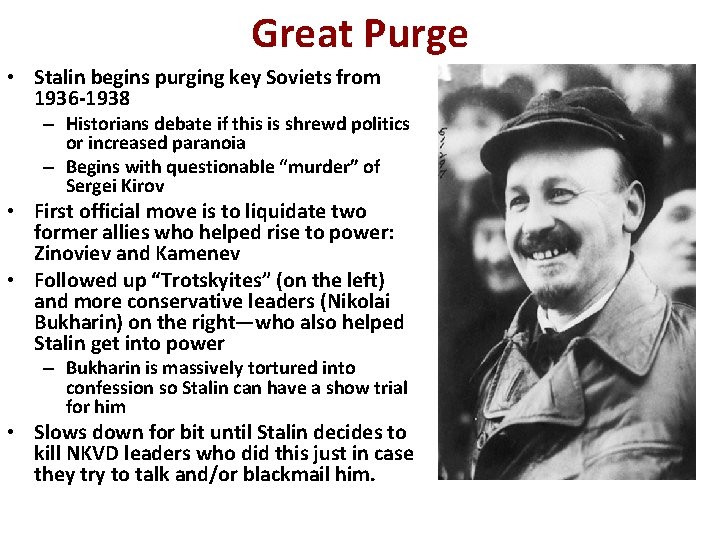
Great Purge • Stalin begins purging key Soviets from 1936 -1938 – Historians debate if this is shrewd politics or increased paranoia – Begins with questionable “murder” of Sergei Kirov • First official move is to liquidate two former allies who helped rise to power: Zinoviev and Kamenev • Followed up “Trotskyites” (on the left) and more conservative leaders (Nikolai Bukharin) on the right—who also helped Stalin get into power – Bukharin is massively tortured into confession so Stalin can have a show trial for him • Slows down for bit until Stalin decides to kill NKVD leaders who did this just in case they try to talk and/or blackmail him.
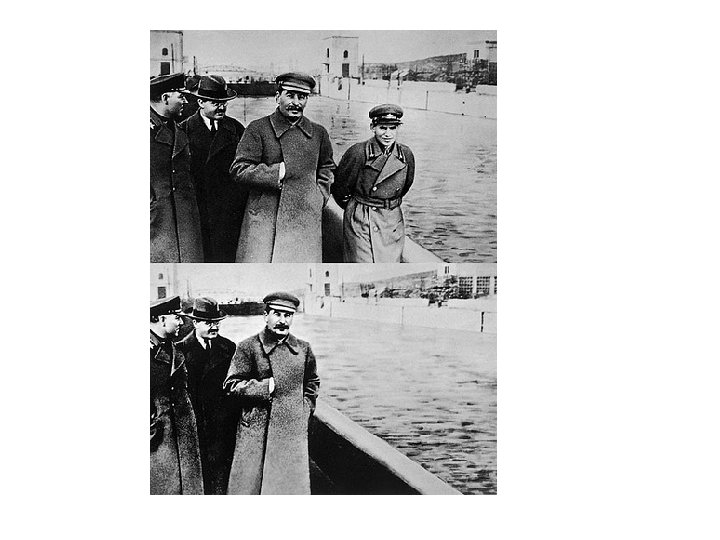
Great Purge • Picks back up with murder of intelligentsia (too bourgeoisie) and purge of army generals (could control army and challenge Stalin) and finally all remaining kulaks (for good measure) • Virtually all people accused did nothing wrong; all confessions obtained via torture – Quite a few were so in love with Stalin’s cult of personality they went to their grave with “his name on their lips” • Ends with second purge of NKVD and new leader Yezhov (who he unpersons) • Final blow is death of Trotsky in Mexico City 1940
Is it Genocide? • This begins the massive death toll of 1930 -1945 Europe; ranges from 25 -75 million • Genocide is systematic attempt to eliminate a group of people • UN defines it as an eight stage process, which is a good place to start 1. 2. 3. 4. 5. 6. 7. 8. Classification Symbolization Dehumanization Organization Polarization Preparation Extermination Denial • Big debate among historians is what parts of the 1933 -1945 Europe are genocides and which ones are not