
Stalin and Totalitarianism In this lesson students will


- Slides: 24
Stalin and Totalitarianism ¡ In this lesson, students will be able to define the following terms: ¡Joseph Stalin ¡Totalitarianism ¡Changes Under Stalin ¡Five-Year Plans ¡Gulags Cy- Ranch
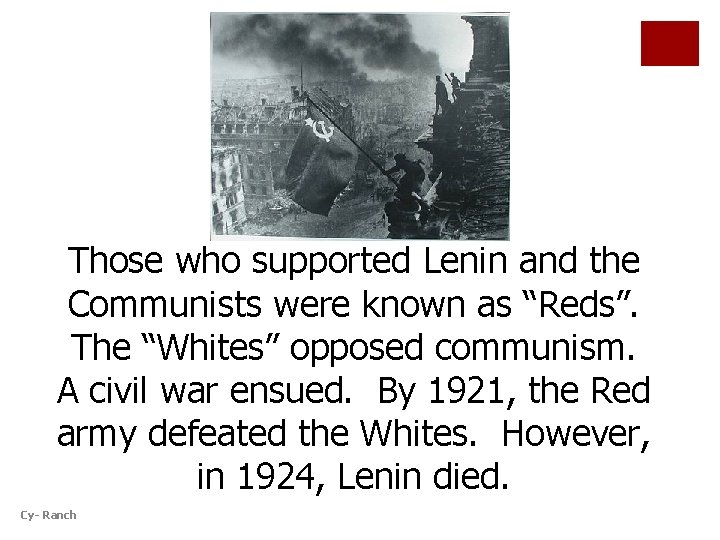
Those who supported Lenin and the Communists were known as “Reds”. The “Whites” opposed communism. A civil war ensued. By 1921, the Red army defeated the Whites. However, in 1924, Lenin died. Cy- Ranch
Lenin died in 1924 Who would take power? Trotsky or Stalin
Joseph Stalin and Leon Trotsky competed to succeed Lenin as leader of the Soviet Union. Stalin gained control of the government, expelled Trotsky, and eventually had Trotsky murdered. Cy- Ranch
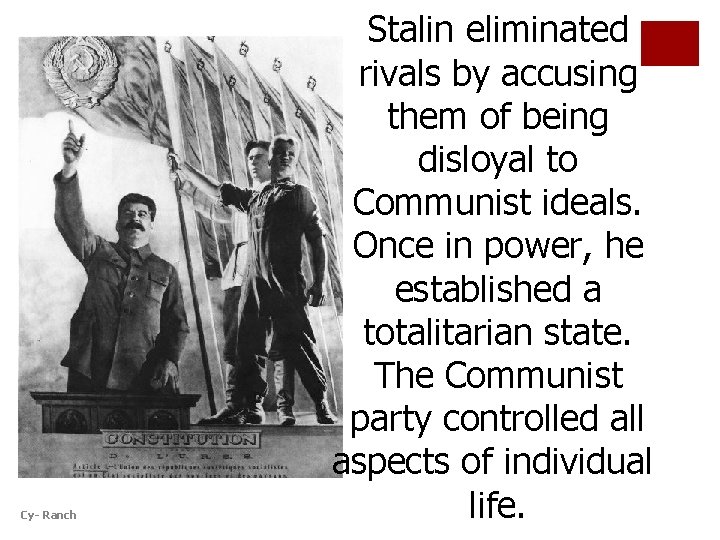
Cy- Ranch Stalin eliminated rivals by accusing them of being disloyal to Communist ideals. Once in power, he established a totalitarian state. The Communist party controlled all aspects of individual life.
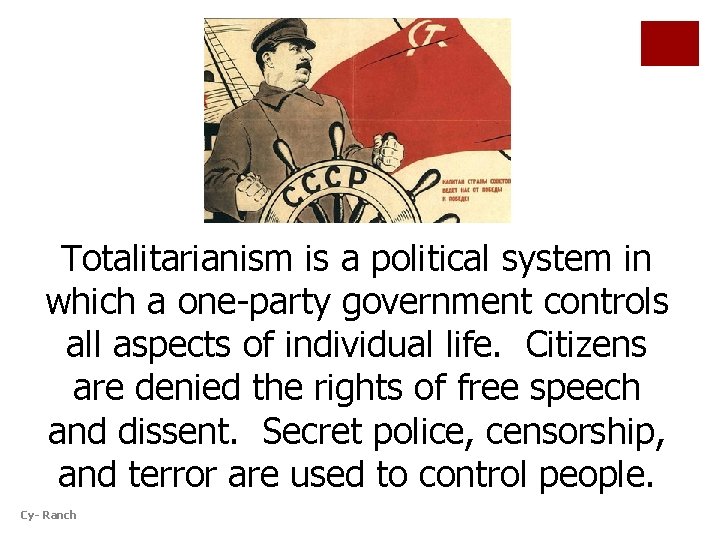
Totalitarianism is a political system in which a one-party government controls all aspects of individual life. Citizens are denied the rights of free speech and dissent. Secret police, censorship, and terror are used to control people. Cy- Ranch
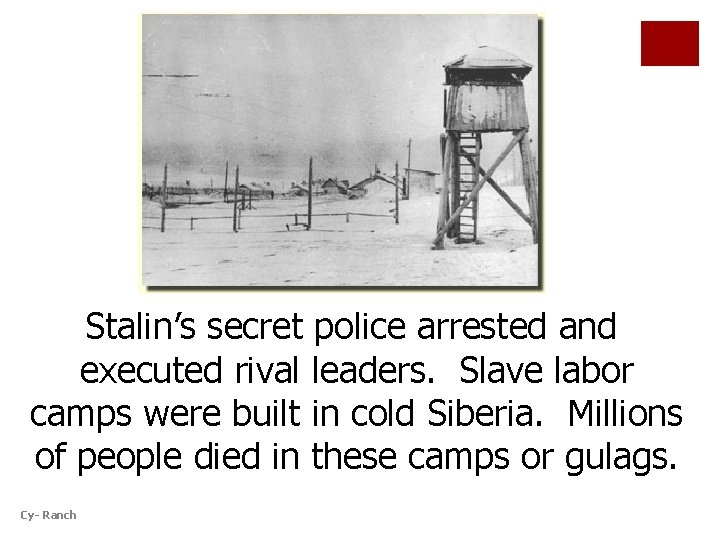
Stalin’s secret police arrested and executed rival leaders. Slave labor camps were built in cold Siberia. Millions of people died in these camps or gulags. Cy- Ranch
A Leader’s Statistics: - millions imprisoned or exiled - 6 to 7 million killed by a forced famine -millions executed -4 to 6 million dispatched to forced labor camps Final Death Toll is unknown but estimated to be between 20 -60 Million
The fundamental task of the five-year plan was to transfer our country, with its backward, and in part medieval, technology, on to the lines of new, modern technology. The fundamental task of the five-year plan was to create in our country an industry that would be capable of re-equipping and reorganizing, not only industry as a whole, but also transport and agriculture—on the basis of socialism. Joint Plenum of the C. C. and C. C. C. , C. P. S. U. (B. ) 1 January 7 -12, 1933 The Results of the First Five-Year Plan Report Delivered on January 7, 1933 https: //www. marxists. org/reference/archive/stalin/works/1933/01/07. htm
Stalin Takes Power ¡The name Stalin means Man of Steel ¡Once in power, Stalin set out to make the Soviet Union a Modern Industrial Nation. ¡Stalin’s plan to industrialize the USSR was known as the Five Year Plan
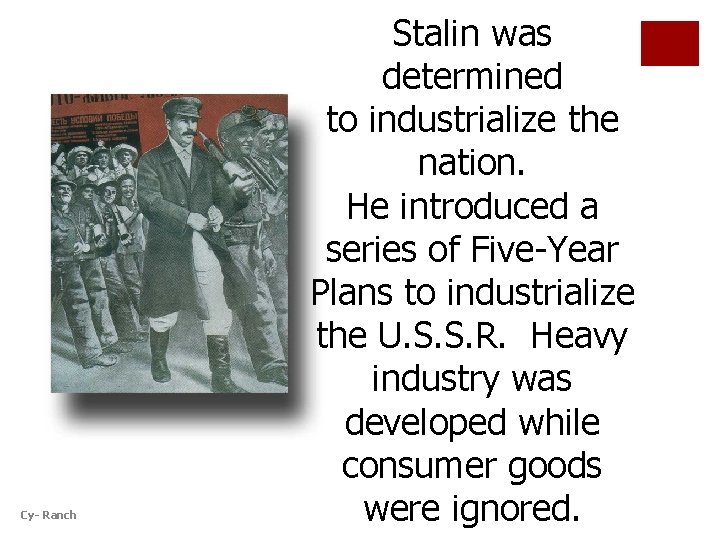
Cy- Ranch Stalin was determined to industrialize the nation. He introduced a series of Five-Year Plans to industrialize the U. S. S. R. Heavy industry was developed while consumer goods were ignored.
Stalin’s Five-Year Plans ¡Aimed at building heavy industry, transportation and increase farm output ¡Brought all economic activities under government control ¡Stalin set goals that must be met (quotas). Workers who succeeded received bonuses. Workers who did not were punished.
n. During the 1930 s, oil, steel and coal production grew. New railroads were built across the Soviet Union. n. Stalin set goals that must be met (quotas). Workers who succeeded received bonuses. Workers who did not were punished. n. During the 1930 s, oil, steel and coal production grew. New railroads were built across the Soviet Union.
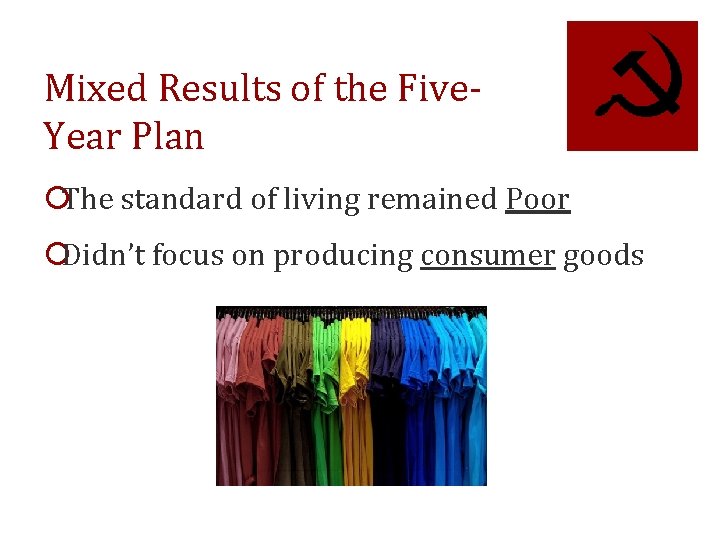
Mixed Results of the Five. Year Plan ¡The standard of living remained Poor ¡Didn’t focus on producing consumer goods
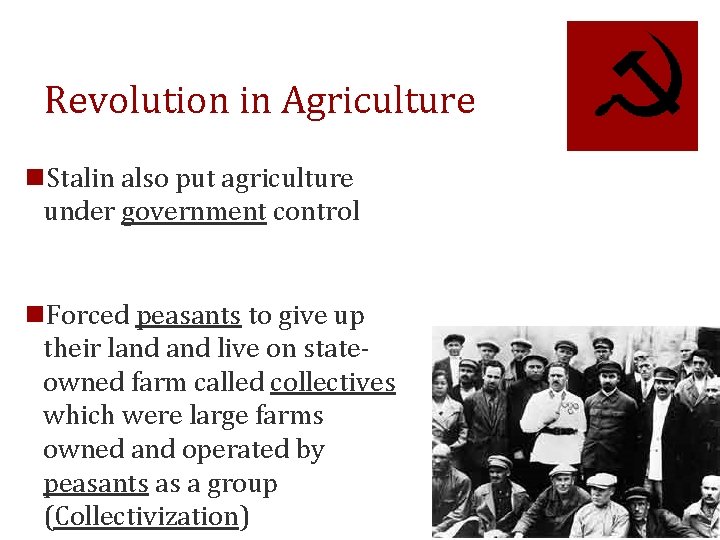
Revolution in Agriculture n. Stalin also put agriculture under government control n. Forced peasants to give up their land live on stateowned farm called collectives which were large farms owned and operated by peasants as a group (Collectivization)
n. Peasants were allowed to keep their personal possessions but had to turn over all farm animals and farm tools to the government. n. The government set prices and quotas n. Peasants resisted collectivization by killing animals, destroying tools and equipment and burning crops.
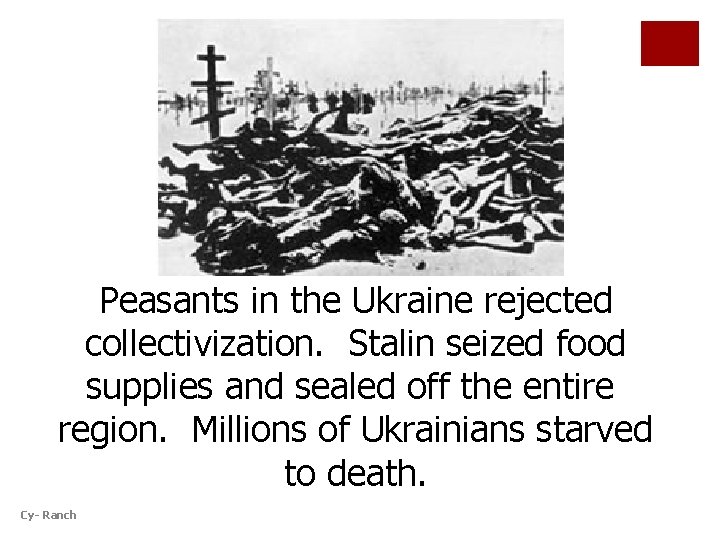
Peasants in the Ukraine rejected collectivization. Stalin seized food supplies and sealed off the entire region. Millions of Ukrainians starved to death. Cy- Ranch
Results of Collectivization ¡The government responded with brutal force ¡Forced Famine 1932 -1933 – 7, 000 Deaths ¡Increased Stalin’s control, but did not improve farm output ¡It was the official policy of the Soviet Union to deny the existence of a famine and thus to refuse any outside assistance. Anyone claiming that there was in fact a famine was accused of spreading anti-Soviet propaganda. Inside the Soviet Union, a person could be arrested for even using the word 'famine' or 'hunger' or 'starvation' in a sentence.
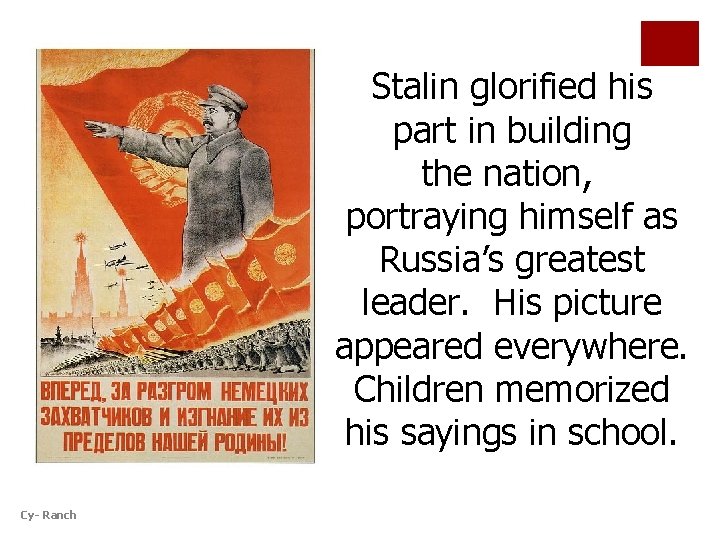
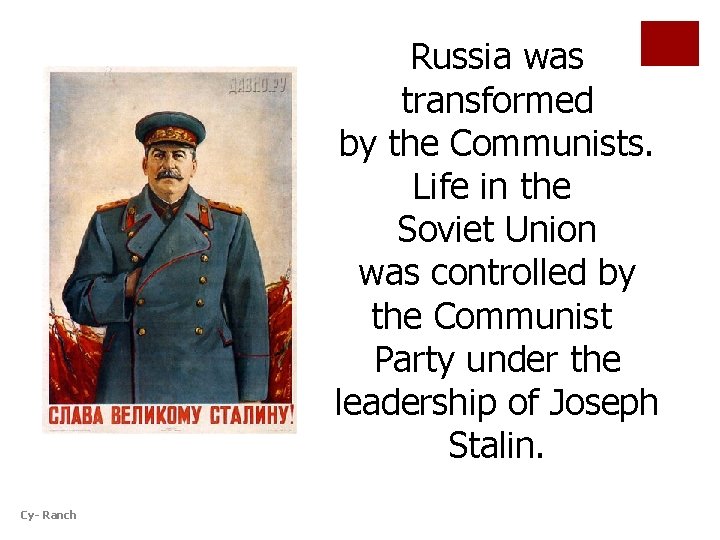
Stalin glorified his part in building the nation, portraying himself as Russia’s greatest leader. His picture appeared everywhere. Children memorized his sayings in school. Cy- Ranch
The Great Purge To Purge means to Eliminate opposition ¡In the 1930’s, out of fear that other Communist party members were plotting against him, Stalin launched The Great Purge ¡During the Great Purge, Stalin accused thousands of people of crimes against the government (treason)
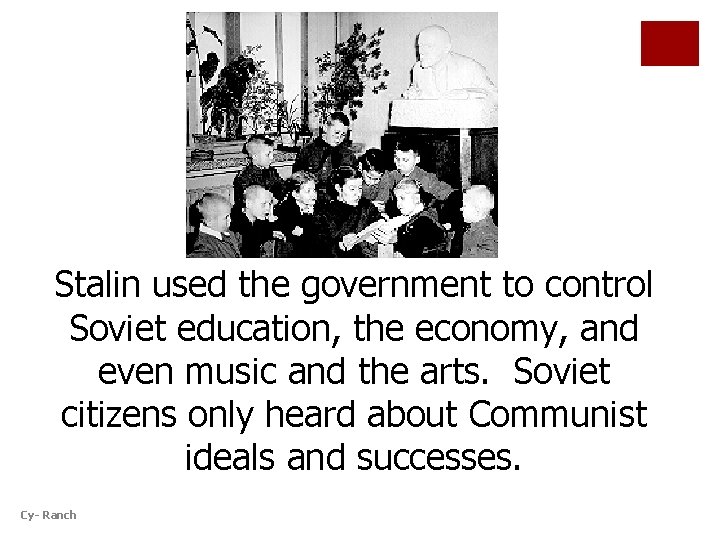
Stalin used the government to control Soviet education, the economy, and even music and the arts. Soviet citizens only heard about Communist ideals and successes. Cy- Ranch
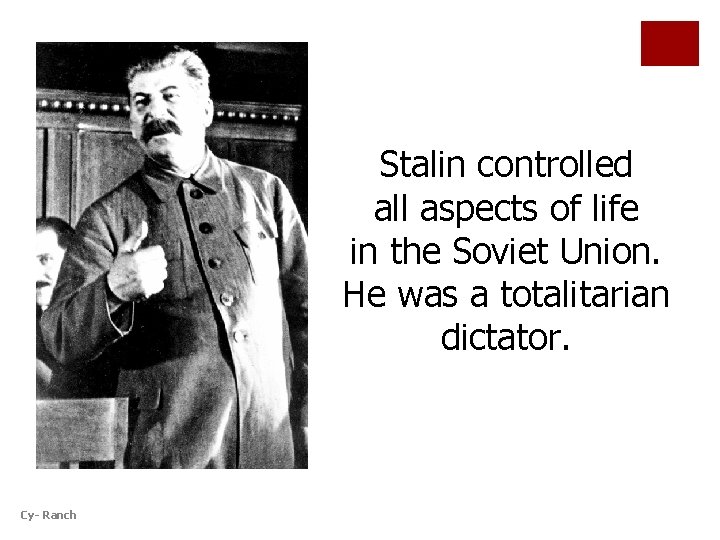
Stalin controlled all aspects of life in the Soviet Union. He was a totalitarian dictator. Cy- Ranch
Russia was transformed by the Communists. Life in the Soviet Union was controlled by the Communist Party under the leadership of Joseph Stalin. Cy- Ranch
n. Stalin targeted writers, teachers, army heroes and Bolsheviks through a Reign of Terror n. During the Great Purge, Stalin tried these people in public. These trials were called show trials. n. Many of the accused were tortured, executed or sent to prison camps