
STAKEHOLDERS Anyone who affects or is affected by
STAKEHOLDERS Anyone who affects or is affected by an organisation
Shareholders – l l Invested their wealth in company Benefits from doing well – l Share value rise Dividends increase if profits improve Could lose all of the value of their investment if the business fails
Directors l l l Jobs will depend upon success Remuneration depends on success of firm May vary according to bonuses related to the financial success of the firm
Employees l l l l Jobs depend on success Nature of work may vary Competitive environment will change role Level of responsibility may change Job security Working conditions Level of wages
Customers l l Competitive market may benefit customers through lower prices Customers may look for different things – – – Service After sales Esteem Quality Value
Suppliers l l l Look for regular orders Single source Preferred supplier Retain margins Customer loyalty Positive relationships
Creditors l l l Want to get money back Make a profit from deal Could be mutually profitable If company fails creditor could be left with bad debt Charge according to risk, credit rating and value of loan
Government l l l Corporation tax from profits VAT from sales Interest in maintaining employment levels Give advice and aid Development areas (regional aid) International development
Society l l l Trade in a responsible manner Minimise damage to public Minimise damage to environment Ethical trading Cost cutting may compromise Pressure groups
Local community l l Dependence of local businesses Local employment Local standard of living Local business activity – – Pubs Restaurants Sandwich shops Newsagents
Financial institutions l l Loan finance Investment Fund and portfolio management Trade - financial transfers
International Trading Blocs l l EU NAFTA ASEAN OPEC
Activity 1. 2. 3. Identify the main stakeholders in an international organisation as opposed to a domestic organisation. Using the ‘Power Dynamism’ and ‘Power Interest’ matrices, position the stakeholders you have identified Outline how each stakeholder might be affected by an external shock – eg world wide recession.
Conflict of stakeholder expectations l Organisations dependence on stakeholders: – – – Supply key resources or components Supply key skills - knowledge of worker Suppliers of finance Dependence on customer attitudes and values Ability and willingness to buy Make demands , for example, Trade Union and the media
Conflict examples l Favour some groups of stakeholders over others How much of profits should be distributed to shareholders – Give employees more say in decision making – Personal aims of autocratic employer – Growth into an area of natural beauty Exercise 1 In groups list some local conflicts –
Conflict l l l Interpretations of who the organisation should serve – Building Societies Deliberate misinterpretation of objectives – further own interests, increase power and prestige Changes in strategies and policies need to be communicated and agreed by all stakeholders Internal politics – Clashes within organisation and between organisation and external stakeholders Bad Management Lack of shared priorities – different aspirations and understandings
Coalitions between stakeholders l l l Marketing Orientation – treating all stakeholders as customers and seeking to satisfy their aspirations and needs to win loyalty and commitment Create open communication channels Sophisticated research techniques to find out exactly what each and every stakeholder seeks
Achieving stakeholder satisfaction l Identification of aspirations – – Do employees want more say in decision making? – employee appraisal Do customers want more environmentally friendly products? – market research Do creditors want to be paid more quickly? – creditor surveys What do people who come into contact with the organisation want to see happening? – open forums, public meetings
The power–dynamism matrix l l Helps assess in a new strategy where ‘political effort’ might be needed to influence key stakeholders Focuses on amount of power (high or low)that groups of stakeholders have and the predictability of their views (high or low) in relation to key changes in business policy
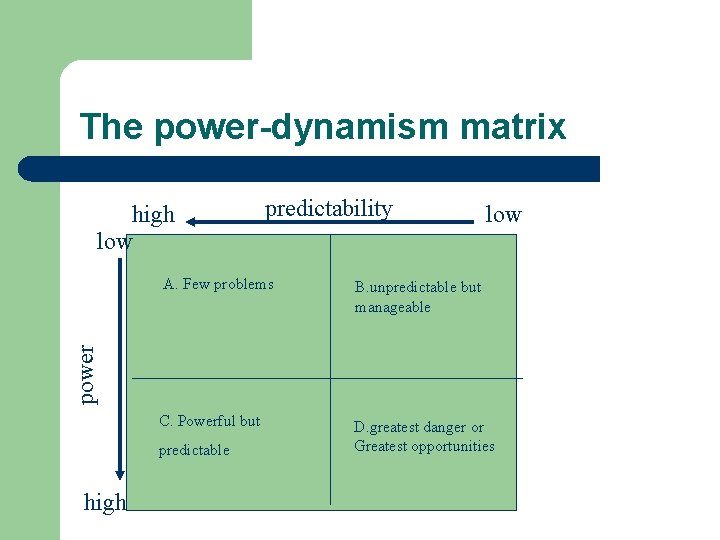
The power-dynamism matrix high low predictability low B. unpredictable but manageable C. Powerful but D. greatest danger or Greatest opportunities power A. Few problems predictable high
stakeholders l l l Stakeholders in the A and B group have low power but they can still influence other stakeholders Stakeholders in the C group offer few surprises Stakeholders in the D group are the most difficult to influence or persuade and their views are most difficult to predict. Therefore it is important to pay considerable attention to this group in order to seek their support for change
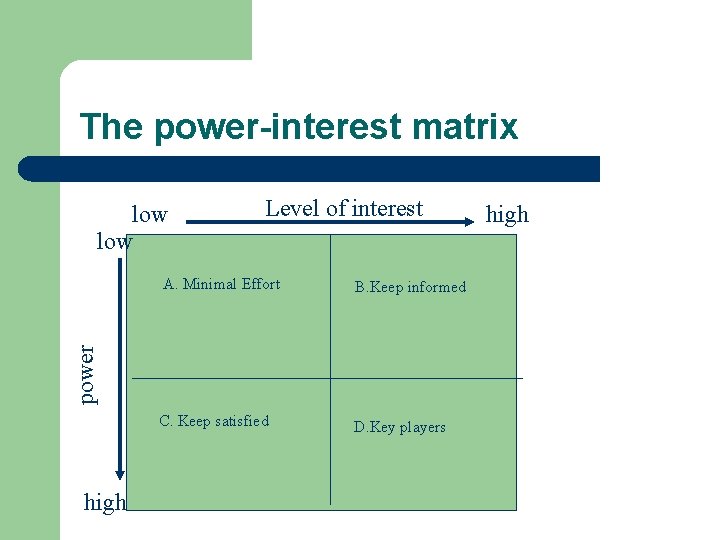
The power-interest matrix low Level of interest B. Keep informed C. Keep satisfied D. Key players power A. Minimal Effort high

Satisfying stakeholder objectives: bargaining options Ignore stakeholders interest completely l Fight the stakeholder l Appease the stakeholder – make concessions l Persuade - open up a dialogue l Form a coalition – special relationship l Let stakeholder take part in developing strategy l Let stakeholder take control Exercise 2 What are the possible consequences of taking each of the above courses of action l
- Slides: 23