
Stakeholder Perception of Assessment and How States Are

- Slides: 27
Stakeholder Perception of Assessment and How States Are Engaging Stakeholders in Ongoing Assessment Planning on Flexibility and Options Under ESSA NCSA 2017 1
Moderator: Kelly Goodrich Vice President of Policy and Advocacy, NWEA Presenters: Brandon Busteed Executive Director of Education, Gallup Salam Noor, Ph. D. Deputy Superintendent of Public Instruction, Oregon Department of Education Louis M. (Lou) Fabrizio, Ph. D. Director of Data, Research and Federal Policy, NC Department of Public Instruction 2
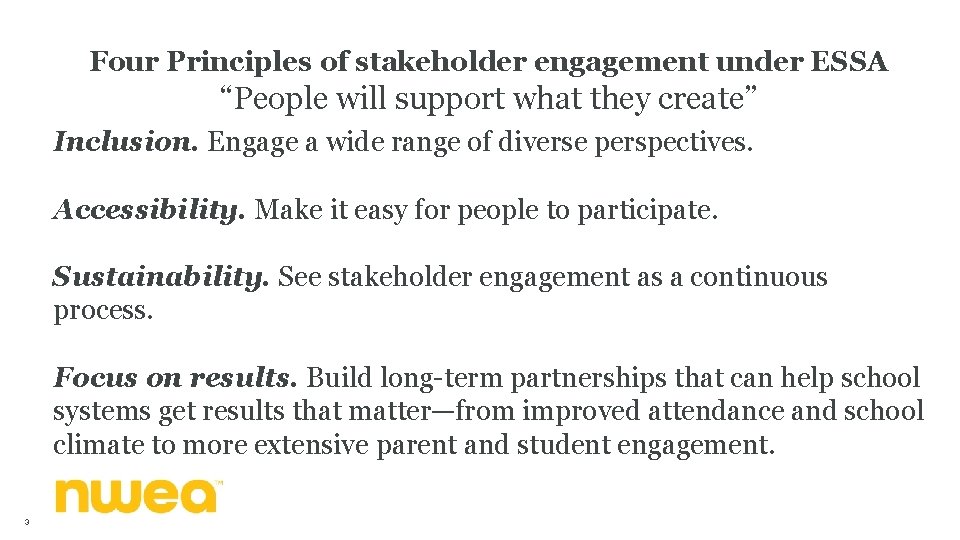
Four Principles of stakeholder engagement under ESSA “People will support what they create” Inclusion. Engage a wide range of diverse perspectives. Accessibility. Make it easy for people to participate. Sustainability. See stakeholder engagement as a continuous process. Focus on results. Build long-term partnerships that can help school systems get results that matter—from improved attendance and school climate to more extensive parent and student engagement. 3
Make Assessment Work for All Students: Multiple Measures Matter Views From Teachers, Superintendents, Principals, Parents and Students
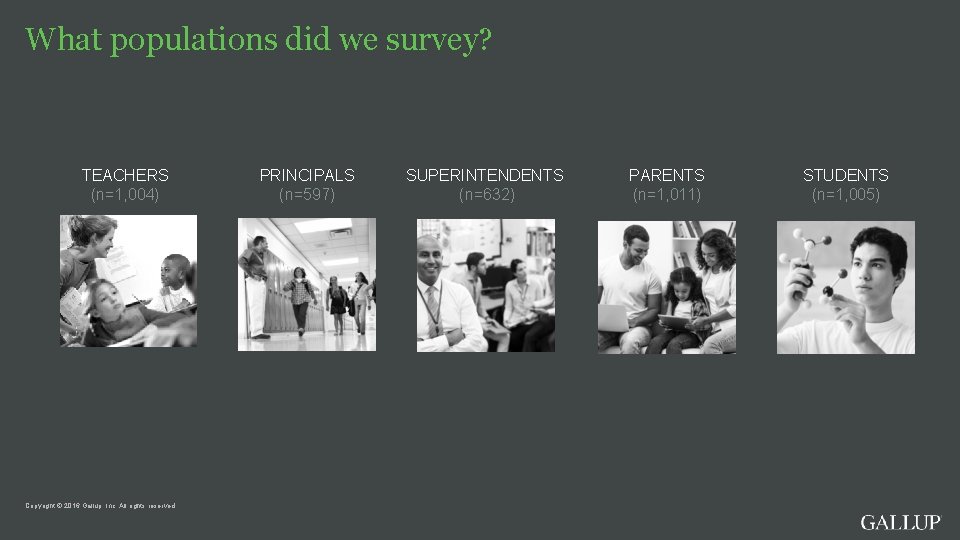
What populations did we survey? TEACHERS (n=1, 004) Copyright © 2016 Gallup, Inc. All rights reserved. PRINCIPALS (n=597) SUPERINTENDENTS (n=632) PARENTS (n=1, 011) STUDENTS (n=1, 005)
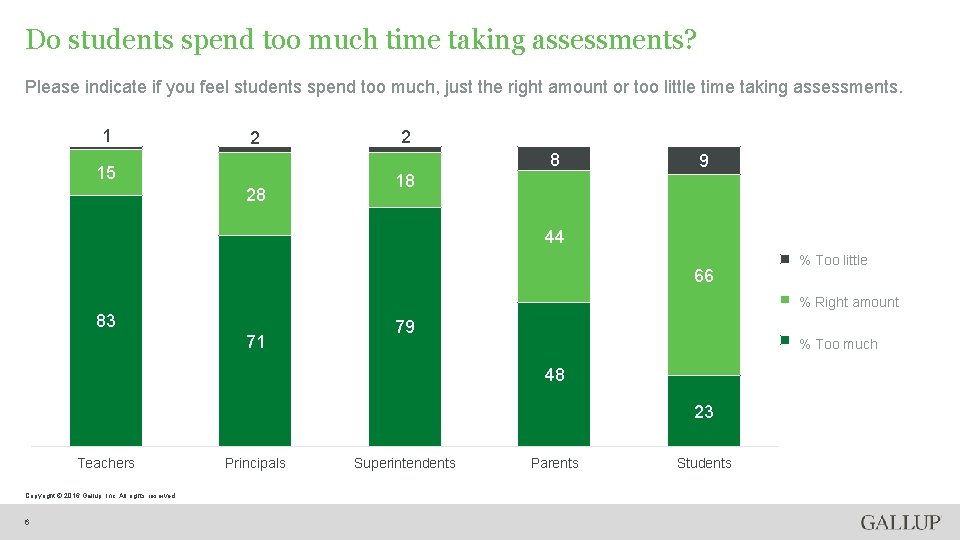
Do students spend too much time taking assessments? Please indicate if you feel students spend too much, just the right amount or too little time taking assessments. 1 2 2 8 15 28 18 9 44 66 Too little % Too little Right amount % Right amount 83 71 79 Too much % Too much 48 23 Teachers Copyright © 2016 Gallup, Inc. All rights reserved. 6 Principals Superintendents Parents Students
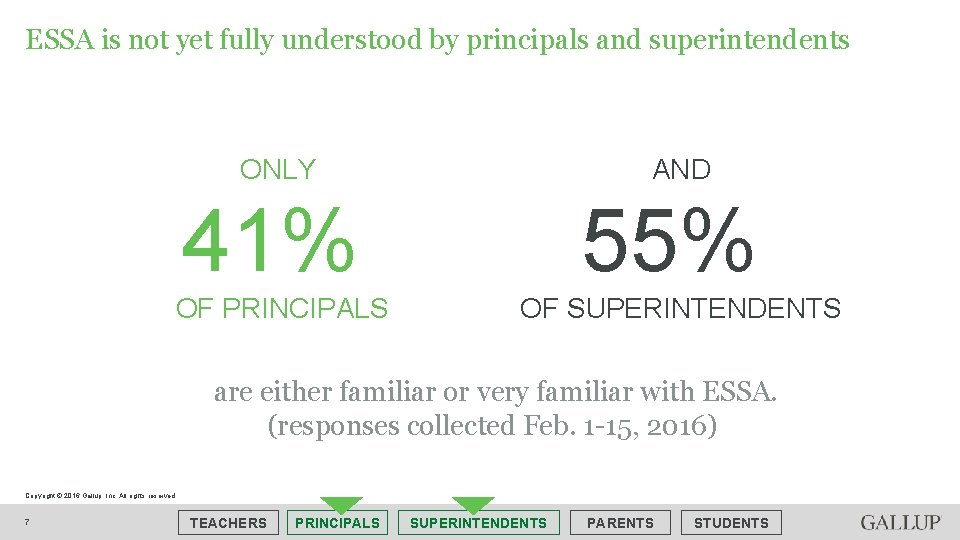
ESSA is not yet fully understood by principals and superintendents ONLY AND 41% OF PRINCIPALS 55% OF SUPERINTENDENTS are either familiar or very familiar with ESSA. (responses collected Feb. 1 -15, 2016) Copyright © 2016 Gallup, Inc. All rights reserved. 7 TEACHERS PRINCIPALS SUPERINTENDENTS PARENTS STUDENTS
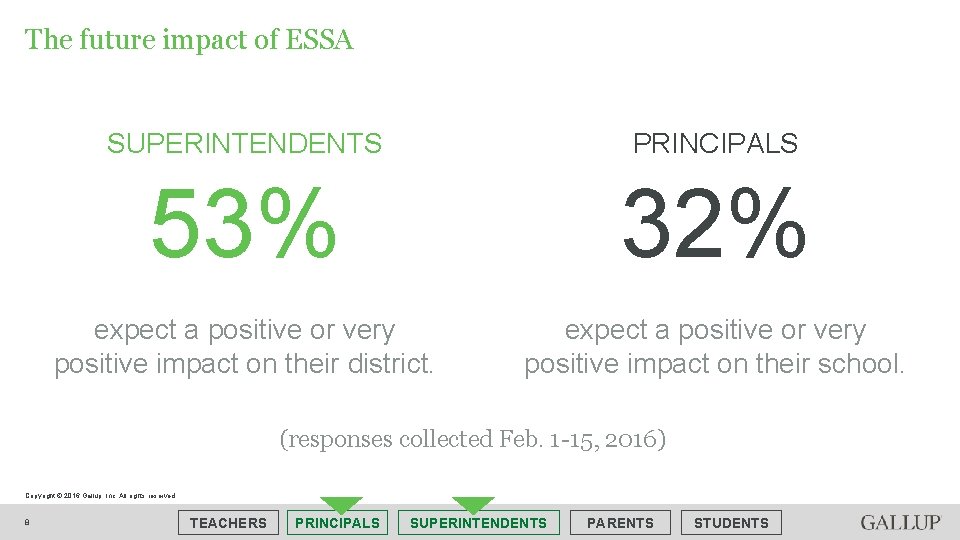
The future impact of ESSA SUPERINTENDENTS PRINCIPALS 53% 32% expect a positive or very positive impact on their district. expect a positive or very positive impact on their school. (responses collected Feb. 1 -15, 2016) Copyright © 2016 Gallup, Inc. All rights reserved. 8 TEACHERS PRINCIPALS SUPERINTENDENTS PARENTS STUDENTS
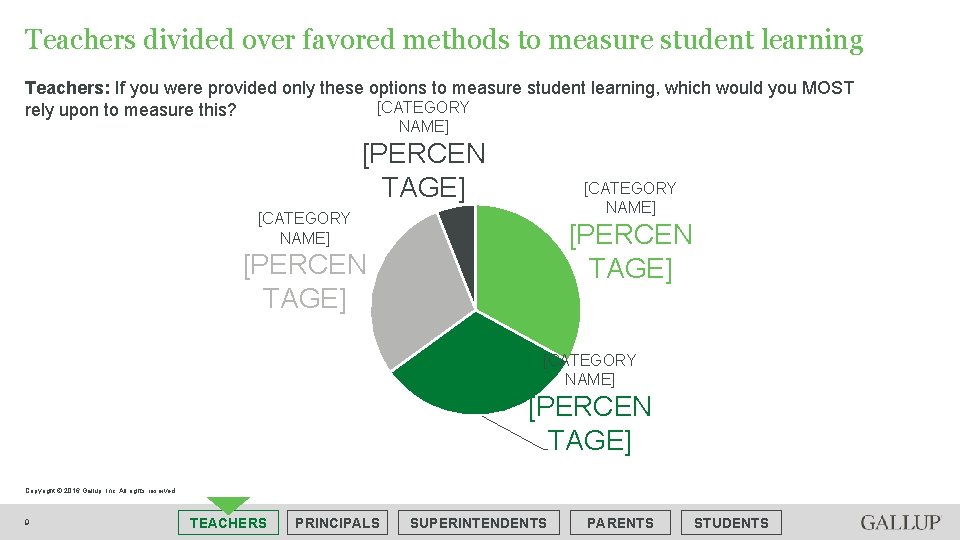
Teachers divided over favored methods to measure student learning Teachers: If you were provided only these options to measure student learning, which would you MOST [CATEGORY rely upon to measure this? NAME] [PERCEN TAGE] [CATEGORY NAME] [PERCEN TAGE] Copyright © 2016 Gallup, Inc. All rights reserved. 9 TEACHERS PRINCIPALS SUPERINTENDENTS PARENTS STUDENTS
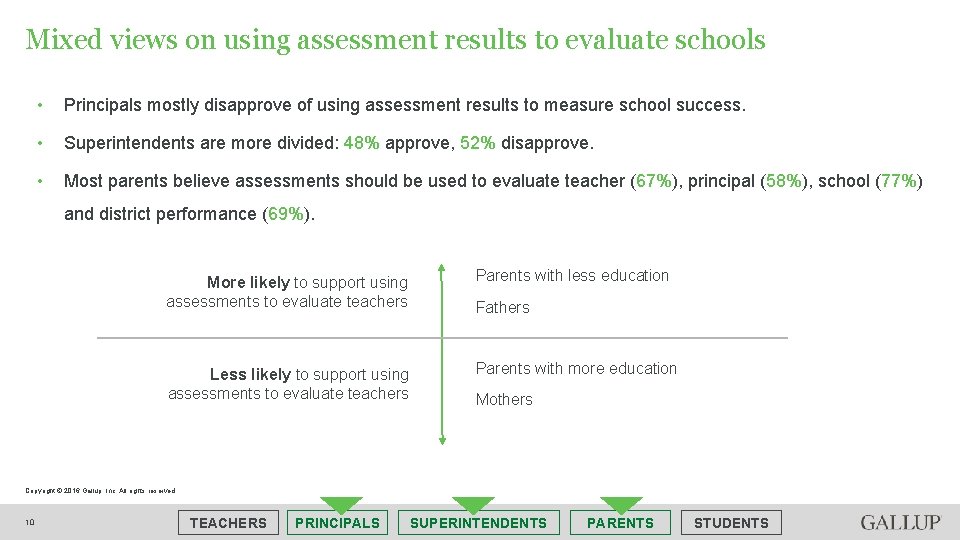
Mixed views on using assessment results to evaluate schools • Principals mostly disapprove of using assessment results to measure school success. • Superintendents are more divided: 48% approve, 52% disapprove. • Most parents believe assessments should be used to evaluate teacher (67%), principal (58%), school (77%) and district performance (69%). More likely to support using assessments to evaluate teachers Parents with less education Less likely to support using assessments to evaluate teachers Parents with more education Fathers Mothers Copyright © 2016 Gallup, Inc. All rights reserved. 10 TEACHERS PRINCIPALS SUPERINTENDENTS PARENTS STUDENTS
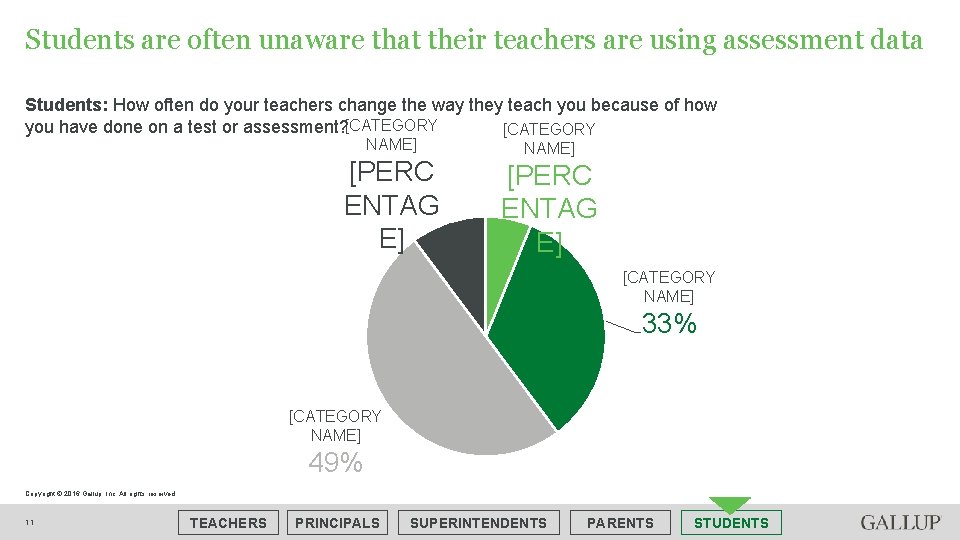
Students are often unaware that their teachers are using assessment data Students: How often do your teachers change the way they teach you because of how you have done on a test or assessment? [CATEGORY NAME] [PERC ENTAG E] [CATEGORY NAME] 33% [CATEGORY NAME] 49% Copyright © 2016 Gallup, Inc. All rights reserved. 11 TEACHERS PRINCIPALS SUPERINTENDENTS PARENTS STUDENTS
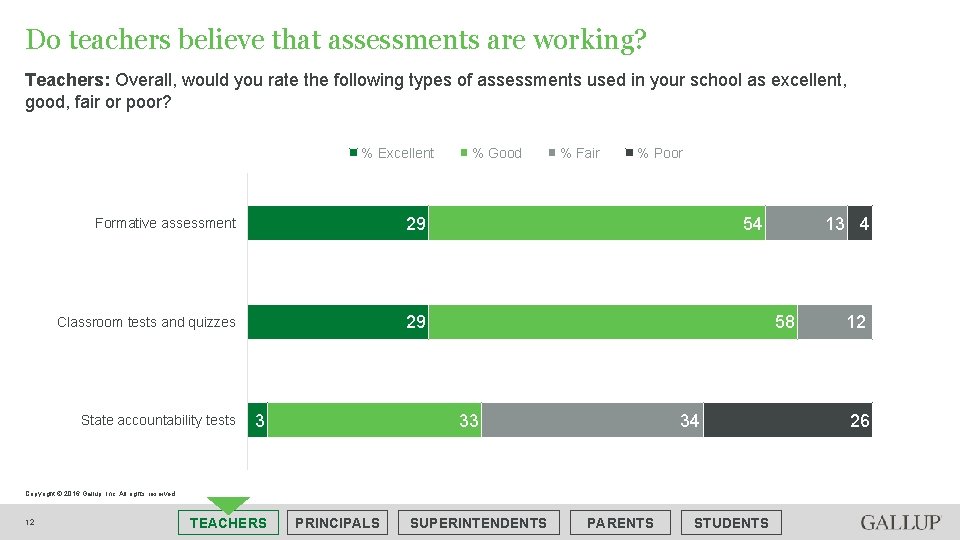
Do teachers believe that assessments are working? Teachers: Overall, would you rate the following types of assessments used in your school as excellent, good, fair or poor? % Excellent Formative assessment 29 Classroom tests and quizzes 29 State accountability tests 3 % Good % Fair % Poor 54 58 33 34 Copyright © 2016 Gallup, Inc. All rights reserved. 12 TEACHERS PRINCIPALS 13 4 SUPERINTENDENTS PARENTS STUDENTS 12 26
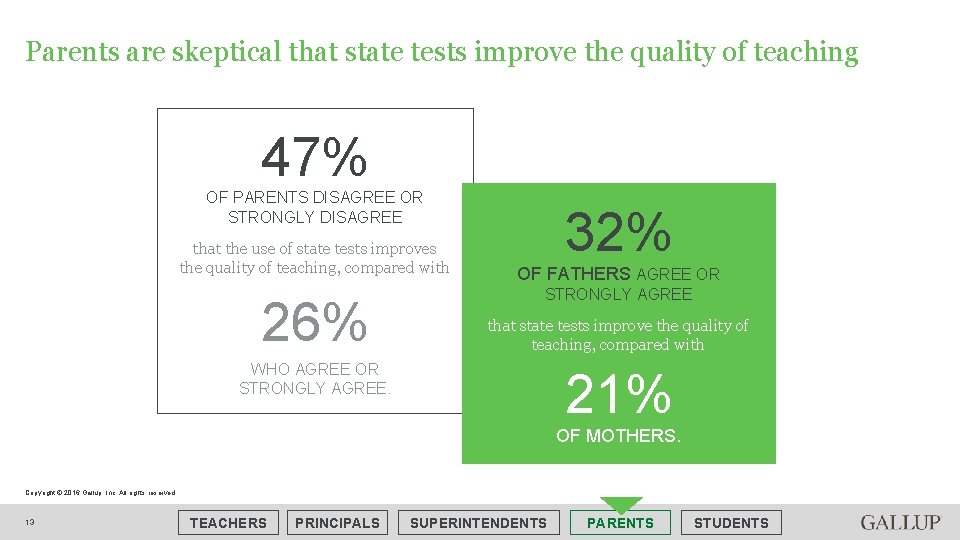
Parents are skeptical that state tests improve the quality of teaching 47% OF PARENTS DISAGREE OR STRONGLY DISAGREE that the use of state tests improves the quality of teaching, compared with 26% 32% OF FATHERS AGREE OR STRONGLY AGREE that state tests improve the quality of teaching, compared with WHO AGREE OR STRONGLY AGREE. 21% OF MOTHERS. Copyright © 2016 Gallup, Inc. All rights reserved. 13 TEACHERS PRINCIPALS SUPERINTENDENTS PARENTS STUDENTS
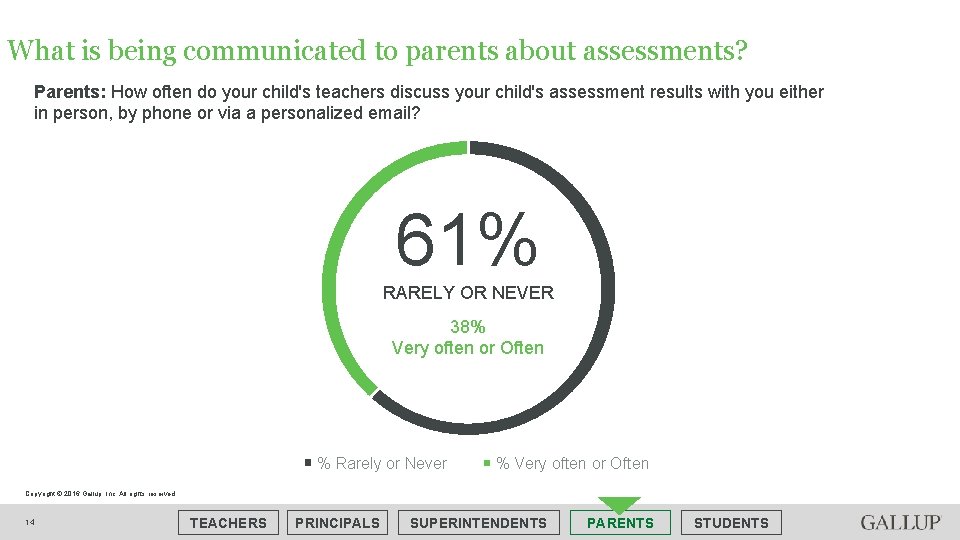
What is being communicated to parents about assessments? Parents: How often do your child's teachers discuss your child's assessment results with you either in person, by phone or via a personalized email? 61% RARELY OR NEVER 38% Very often or Often % Rarely or Never % Very often or Often Copyright © 2016 Gallup, Inc. All rights reserved. 14 TEACHERS PRINCIPALS SUPERINTENDENTS PARENTS STUDENTS
15
National Conference on Student Assessment (NCSA) Salam A. Noor, Ph. D. Oregon Deputy Superintendent of Public Instruction 16
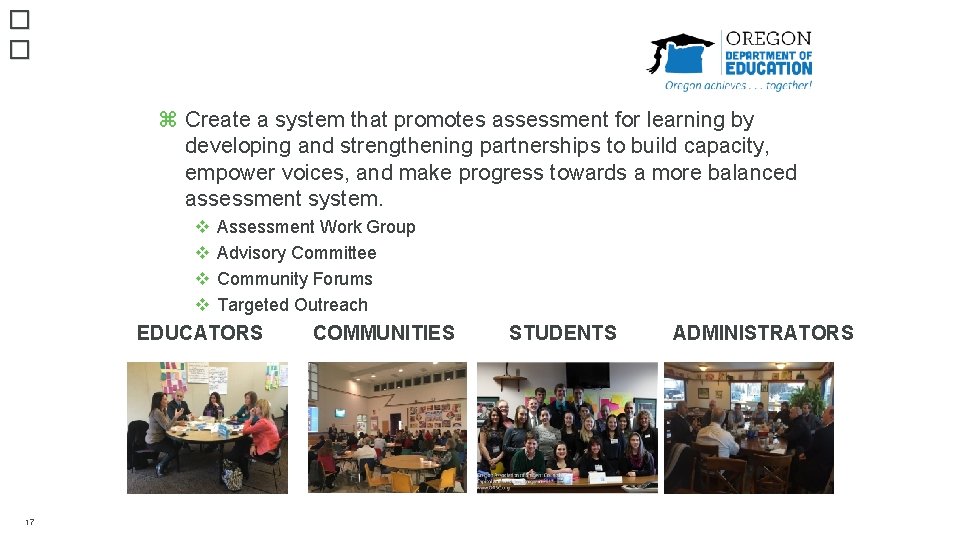
� � z Create a system that promotes assessment for learning by developing and strengthening partnerships to build capacity, empower voices, and make progress towards a more balanced assessment system. v v Assessment Work Group Advisory Committee Community Forums Targeted Outreach EDUCATORS 17 COMMUNITIES STUDENTS ADMINISTRATORS
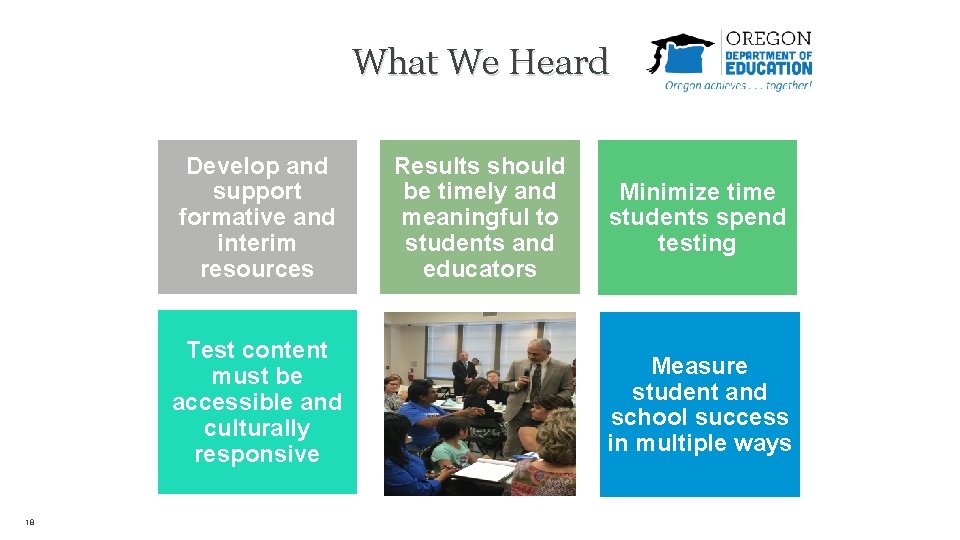
What We Heard Develop and support formative and interim resources Test content must be accessible and culturally responsive 18 Results should be timely and meaningful to students and educators Minimize time students spend testing Measure student and school success in multiple ways
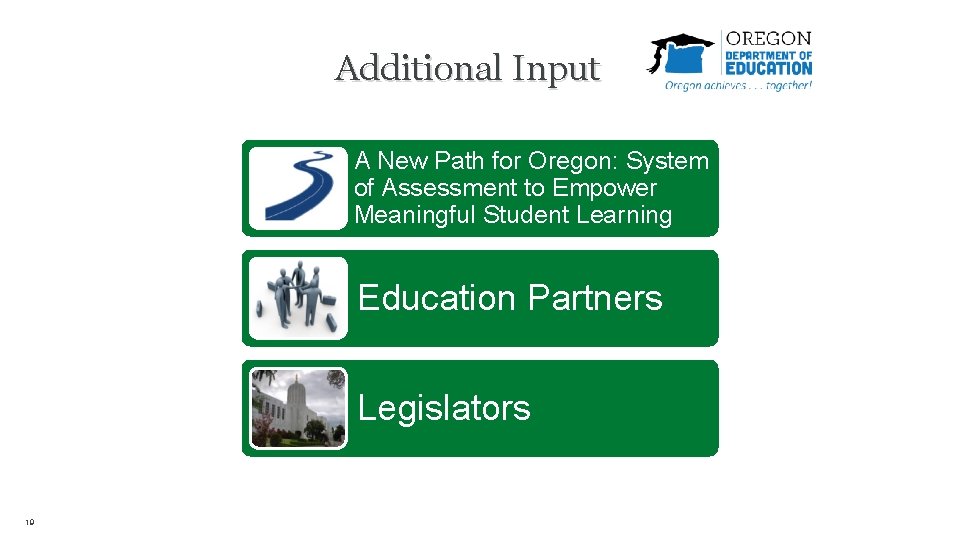
Additional Input A New Path for Oregon: System of Assessment to Empower Meaningful Student Learning Education Partners Legislators 19
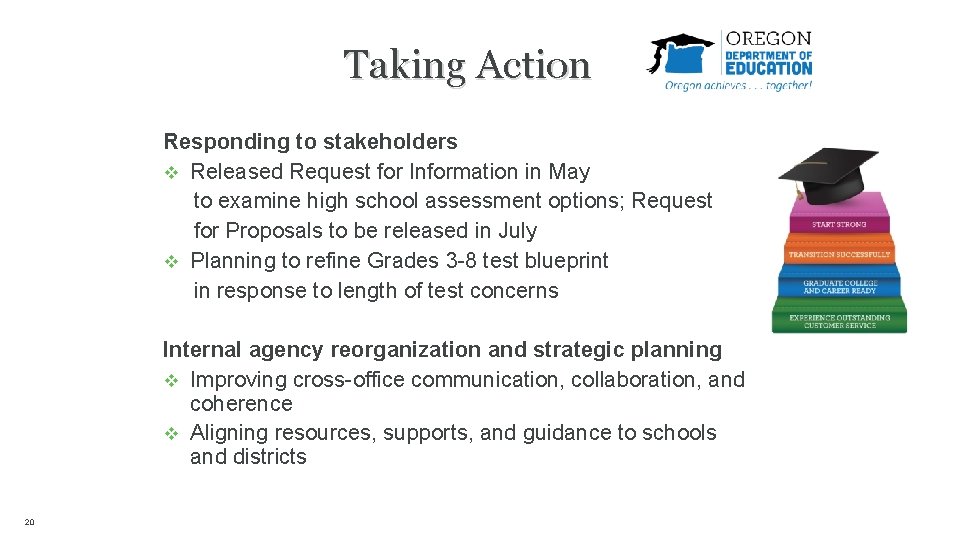
Taking Action Responding to stakeholders v Released Request for Information in May to examine high school assessment options; Request for Proposals to be released in July v Planning to refine Grades 3 -8 test blueprint in response to length of test concerns Internal agency reorganization and strategic planning v Improving cross-office communication, collaboration, and coherence v Aligning resources, supports, and guidance to schools and districts 20
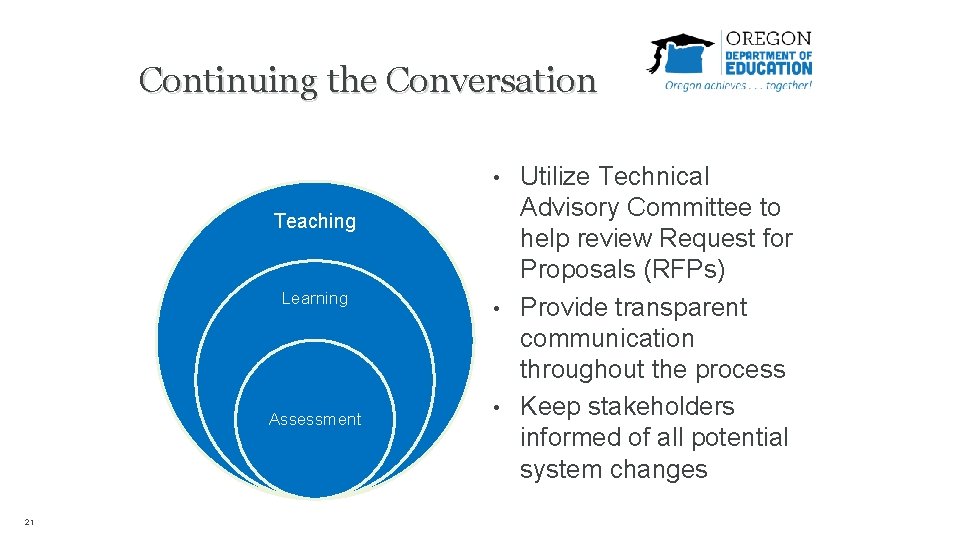
Continuing the Conversation Utilize Technical Advisory Committee to help review Request for Proposals (RFPs) • Provide transparent communication throughout the process • Keep stakeholders informed of all potential system changes • Teaching Learning Assessment 21
National Conference on Student Assessment (NCSA) Louis M. (Lou) Fabrizio, Ph. D. Federal Policy Director NC Department of Public Instruction 22
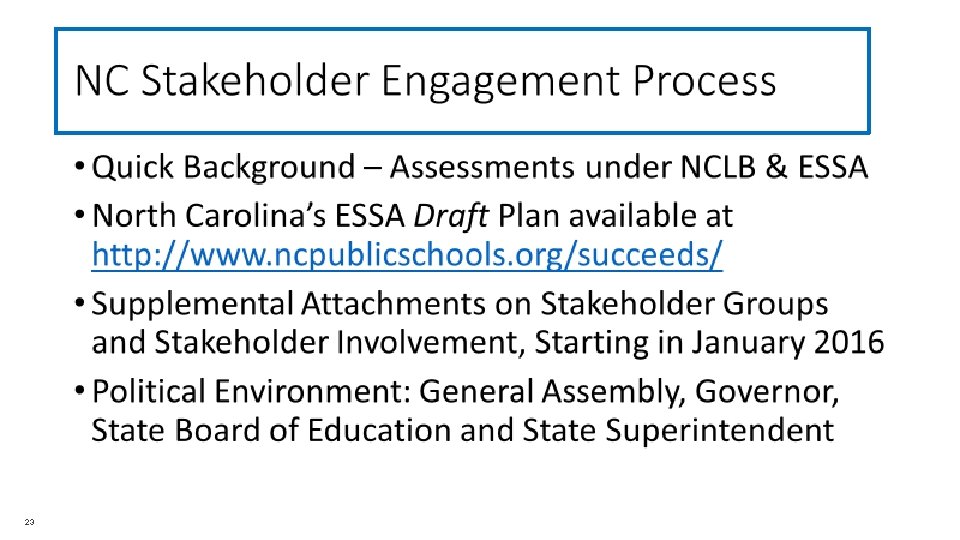
NC Stakeholder Engagement Process 23
NC Stakeholder Engagement Process • I n p u t o n 24 I
NC Stakeholder Engagement Process • 25 S B E S t a k e
Questions for the Panelists 26
Audience Questions 27