
Stakeholder Participation in Standardisation within ISO with special

- Slides: 16
Stakeholder Participation in Standardisation within ISO (with special reference to consumers) Caroline Warne Chair ISO/COPOLCO (ISO Committee on Consumer Policy) Brussels December 2005 cw/13756595 1
What I shall Cover n The ISO Model n Barriers to effective participation n Ongoing initiatives to improve stakeholder participation cw/13756595 2
The ISO Model- Commitments which Support Stakeholder Participation ISO’s Code of ethics n ISO’s Strategic Plan 2005 -2010 n ISO standards recognised by WTO n For Consumers n ISO/IEC Policy Statement on Consumer participation in Standardization Work u ISO/COPOLCO u cw/13756595 3
The ISO Model - Where Stakeholders Participation Stakeholders can participate asn Part of a national delegation (limited number) u u n Observers from Liaison organisations u n On Technical Committees On Subcommittees Observers have no vote At Working Group level as individual ‘experts’ cw/13756595 4
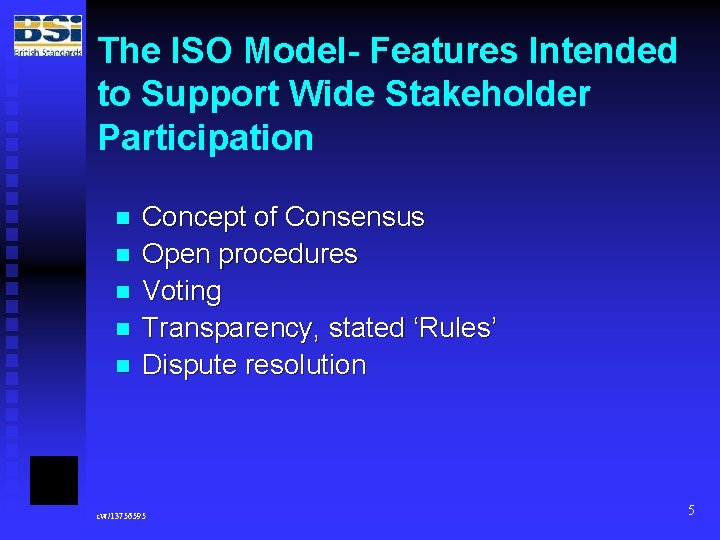
The ISO Model- Features Intended to Support Wide Stakeholder Participation n n Concept of Consensus Open procedures Voting Transparency, stated ‘Rules’ Dispute resolution cw/13756595 5
The ISO Model - Is there Broad Stakeholder participation? NOCurrently, in almost all ISO’s technical work some groups of stakeholders, such as consumers, are grossly under-represented. cw/13756595 6
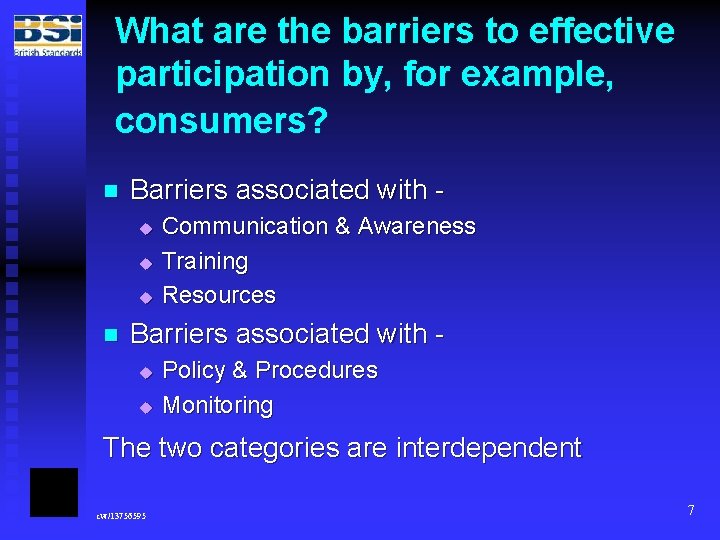
What are the barriers to effective participation by, for example, consumers? n Barriers associated with u u u n Communication & Awareness Training Resources Barriers associated with u u Policy & Procedures Monitoring The two categories are interdependent cw/13756595 7
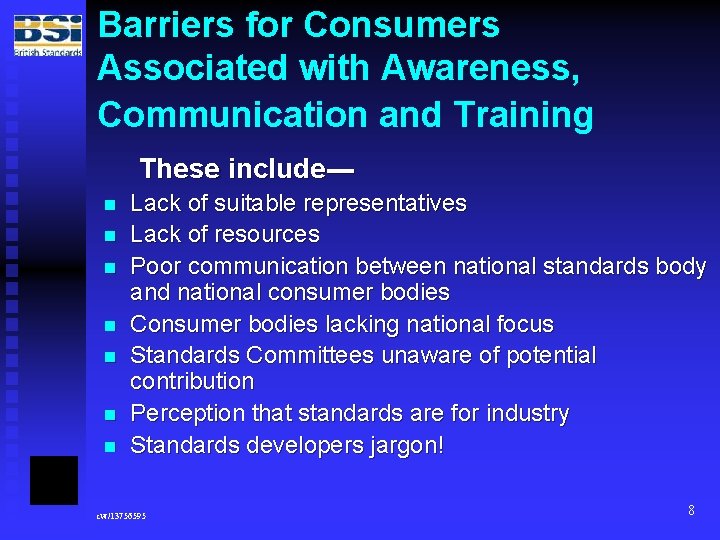
Barriers for Consumers Associated with Awareness, Communication and Training These include--n n n n Lack of suitable representatives Lack of resources Poor communication between national standards body and national consumer bodies Consumer bodies lacking national focus Standards Committees unaware of potential contribution Perception that standards are for industry Standards developers jargon! cw/13756595 8
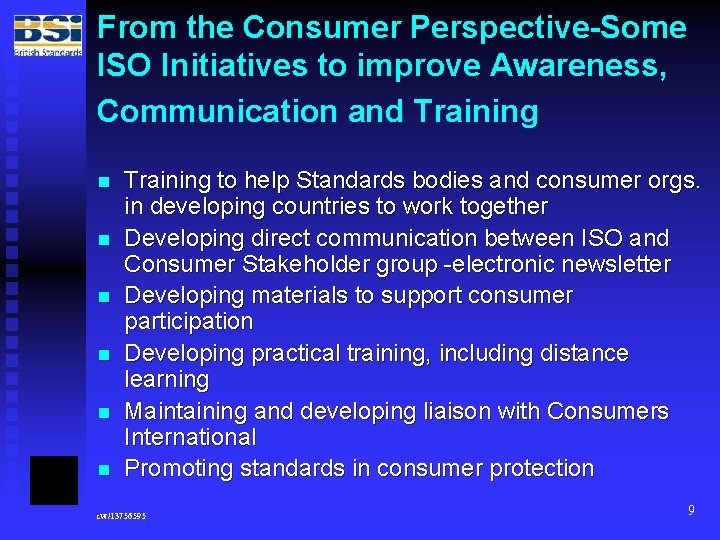
From the Consumer Perspective-Some ISO Initiatives to improve Awareness, Communication and Training n n n Training to help Standards bodies and consumer orgs. in developing countries to work together Developing direct communication between ISO and Consumer Stakeholder group -electronic newsletter Developing materials to support consumer participation Developing practical training, including distance learning Maintaining and developing liaison with Consumers International Promoting standards in consumer protection cw/13756595 9
Barriers to Consumers Participation Associated with Procedures and Policy These include--n n n n The concept of consensus - consensus largely depends on being present. Voting procedures Lack of monitoring of stakeholder affiliations of participants Definitions for the stakeholder groups Traditions and ‘culture’ of standards developers Responsibilities of ISO members Resources cw/13756595 10
Current ISO TC Policy and Procedural Initiatives ISO 207 -Environmental Management n n n Recognised special representational issues for NGO’s (including Consumers) 1999/2000 - Established NGO Contact group 2001 - became NGO Forum (only open to NGO reps) 2003 - NGO Forum Document ‘Increasing the Effectiveness of NGO Participation in ISO 207’ 2003 -Established NGO/CAG Task Force with 4 NGO reps and 4 from the 207 Chairs Advisory Group u Explore scope for improvement within the ISO/IEC directive’s cw/13756595 11
Current ISO TC Policy and Procedural Initiatives ISO 207 -Environmental Management n cw/13756595 Issues recognised by the NGO/CAG task Force u Bias implicit in consensus, voting, liaisons u NGO role in delegations cf as experts in WG u No required registration or affiliation u No definitions of different stakeholders u No monitoring of participation u Lack of Guidance on best practice for stakeholder participation at the national level 12
Current ISO Policy and Procedural Initiatives. Social Responsibility WG n n n Late 2004 SR WG established, ie outside the Technical Committee structure u WG members are individual experts u 6 Task Groups -One devoted to funding Funding (not ongoing) for developing countries Representatives record their stakeholder affiliation ISO CS ask for stakeholder affiliations before agreeing attendance Delegation -max size is defined & no more than 2 from any one stakeholder group Monitoring cw/13756595 13
Current ISO Policy and Procedural Initiatives- Social Responsibility WG Achievements from the consumer perspective n n n n WG processes allow representatives to participate as individuals Funding (not ongoing) raised for developing country participation Representatives declare a stakeholder affinity Definitions for the stakeholder groups agreed, allowing monitoring CI co-ordinated consumer reps- presence in all task groups, briefings, news bulletins etc 25 of the 300 reps are consumers More balanced participation leads to increased credibility overall. cw/13756595 14
To Conclude……. . ISO is exploring initiatives to develop procedures and policies to improve stakeholder representation n n Supported by funding and training Commitment from the top and the CS Monitoring the involvement of all stakeholders in Standards work at all levels (TC, SC and WG or other group) in key areas is necessary. Adopting definitions for the stakeholder groups will be an important step forward. Permanent changes will take time as new measures need to be evaluated cw/13756595 15
…… and finally How can such initiatives be applied more widely in the future? Are they relevant to this meeting? Thank you cw/13756595 16