
Stakeholder Engagement Sustainability Committee Working Group 1 Kota
Stakeholder Engagement Sustainability Committee Working Group 1 Kota Kinabalu, 8 -10 September 2015

Objective • • Members’ Introduction to Working Group 1 : Stakeholder Engagement Brainstorm on WG 1 scope of work & plans for the triennium Logistics – Communication mode – Any other matters 2
Members Introduction • Name • Organization & current role in organization 3
Sustainability Committee Objective Our Role: § Advocate for the development of natural gas as a key fuel for sustainable energy mix. § Improve public acceptance of the development of unconventional gas, through stakeholder engagement and applying common standards and proper technologies to address environmental concerns. § Promote natural gas as partner of renewable energies. 4
Program WG 1: Community Engagement in addressing concerns about Unconventional Gas Development Social License to operate is one of the strategic focus area in this triennium. Our industry has a long history of safe and responsible gas production and transport, but increasing public scrutiny and concern requires that we remain diligent in our efforts to continuously improve the way we do and communicate on our business. The establishment of this workgroup will thus focus on addressing matters which may impact social license to operate resulted by increasing unconventional/ shale gas development by: • Learning from success stories within the industry on engaging communities across the diverse geographic areas. • Integrating best practices employed industry-wide. • Identifying primary concerns raised by the communities and efforts undertaken by industry players in achieving mutually beneficial outcomes. The workgroup shall closely cooperate with the marketing and communications committee. 5
Environmental Concerns (2009 – 2012 Triennium): 1. 2. 3. 4. 5. 6. 7. 8. 6 Shale gas drilling takes up a larger land use footprint than conventional energy production. Hydraulic fracturing can have adverse effects on drinking water. Hydraulic fracturing uses enormous quantities of water. Hydraulic fracturing contains dangerous chemicals that aren’t disclosed to the public. Hydraulic fracturing and associated wastewater disposal causes earthquakes. Disposal of wastewater harms the environment. Air emissions related to shale gas production are worse than those created by burning coal. Shale gas extraction is not regulated.
Key questions to be addressed • What are the key communities’ concerns with regards to unconventional development • Where are the current key areas of developments and next hotspots? • How does stakeholders engagement add value ? • Examples of best practices • What is our best medium of communication for this triennium ? 7
Brainstorming Exercise 8
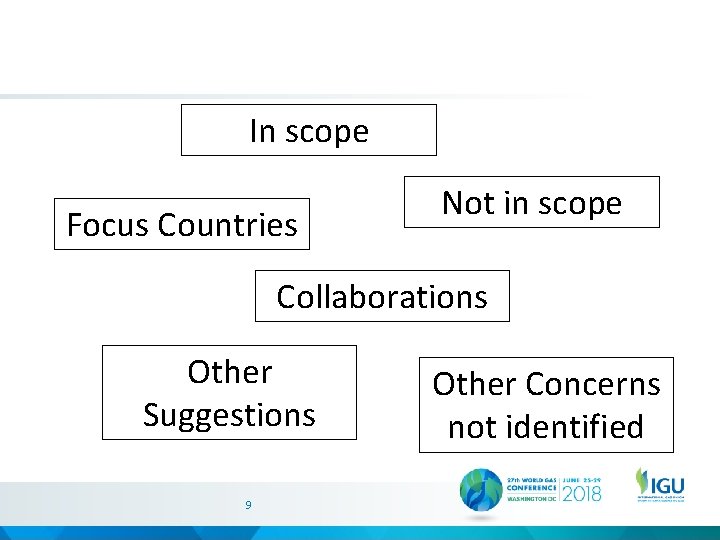
In scope Focus Countries Not in scope Collaborations Other Suggestions 9 Other Concerns not identified
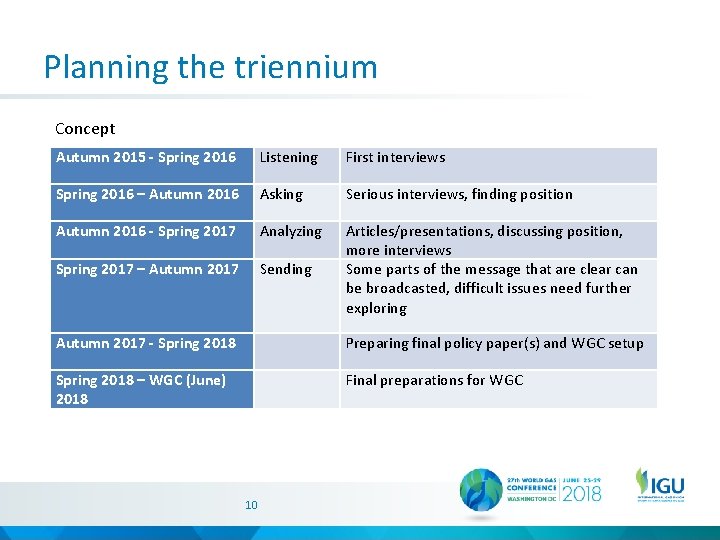
Planning the triennium Concept Autumn 2015 - Spring 2016 Listening First interviews Spring 2016 – Autumn 2016 Asking Serious interviews, finding position Autumn 2016 - Spring 2017 Analyzing Spring 2017 – Autumn 2017 Sending Articles/presentations, discussing position, more interviews Some parts of the message that are clear can be broadcasted, difficult issues need further exploring Autumn 2017 - Spring 2018 Preparing final policy paper(s) and WGC setup Spring 2018 – WGC (June) 2018 Final preparations for WGC 10
Personal planning for the next 6 months • Fifteen minutes to write down what are you going to do in the next months. • Make it as concrete as possible by identifying who you are going to interview (or what organization) or what articles/reports you are going to summarize. 11
How to communicate By what means? Mails/telephone/conference calls/whatsapp/lync/gmailchat? By what frequency? Weekly/monthly/random 12
- Slides: 12