
Staining Techniques use in microbiology Objective To examine

Staining Techniques use in microbiology

Objective Ø To examine the morphology Ø To classify and identify Ø To examine the different structure
Preparation of bacterial culture smear • • Place a drop of water on a clean glass slide. Take loopful culture Allow the smear air dry Fix the smear by passing on the flame
Types of staining methods A. Simple staining methods B. Differential staining methods C. Special staining method
A. Simple staining methods: v only one dye is used v Use: to study the morphology as well as to presence or absence of bacteria in smear
Methylene blue method • Procedure: Pour the stain solution on smear allow to act for 1 minute Rinse with water blot and examine under the oil immersion lens Result • Bacteria appear blue in colour
Leishman’s method Procedure: • Pour the stain over the smear and allow for 1 min • Pour double quantity of buffered distilled water and allow for 10 minute. • Wash the smear with distilled water, blot & examine Result Organism appear blue in colour Use: HS and Anthrax organisms are stain by this method
Negative staining method Instead of staining the bacteria only their background is stained. Method ü Mix loopful of the culture with equal quantity of stain on the slide and prepare a thin, uniform smear. ü Allow it to air dry and examine. Result • The bacteria appear colorless.
B. Differential staining methods. • useful in identification • Useful in classification • more than one dye is used.
Gram’s staining method Procedure • smear fix over flame. • crystal violet stain --- for 2 minutes • Wash with tap water • Gram’s iodine for 1 minute • Wash with tap water • acetone ---------2 -3 second • Wash with tap water • Safranin --------1 minute • Wash with water blot and examine.
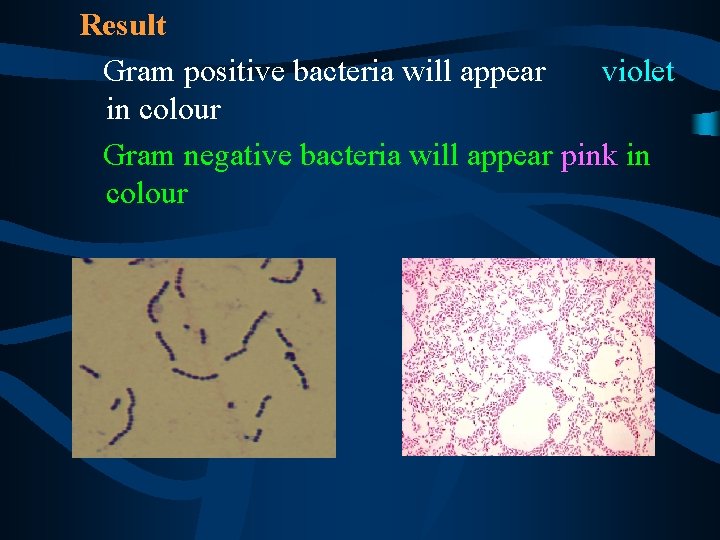
Result Gram positive bacteria will appear violet in colour Gram negative bacteria will appear pink in colour
Acid-Fast staining Procedure • Prepare the bacterial smear and fix over the flame. • ZN Carbon fuschsin ------- heat--- 10 min Wash with water. • Acid alcohol -------------- 20 seconds • malachite green ----- 1 minute • Wash with water
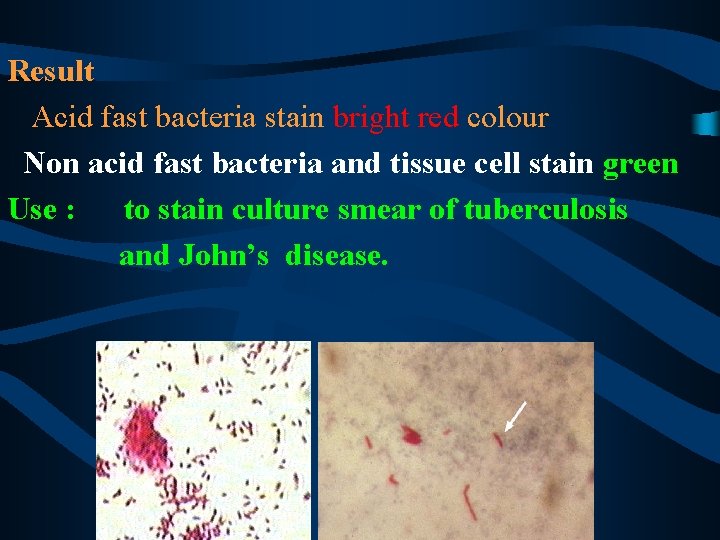
Result Acid fast bacteria stain bright red colour Non acid fast bacteria and tissue cell stain green Use : to stain culture smear of tuberculosis and John’s disease.
Modified Z-N stain Procedure: • Fix the smear in methanol. • carbol fuchsin ----- 10 minute • Wash with water • acetic acid -------- 30 seconds • Wash with water • methylene blue ----- 20 seconds
Result Organism take red color. Back ground take blue color. Use: For staining the organism like Brucella abortus, Coxiella burneti, Chlamidia psittaci
MACCHIAVELLO STAIN Procedure : • Prepare a thin smear of yolk sac tissue free of yolk fluid , air dry fix with heat, • cover with 0. 25% aqueous basic fuschin for 5 minutes and drain, • Cover with 0. 5%citric acid solution and wash immediately, • Counter stain with 1% aqueous methylene blue for 20 -40 seconds, rinse and dry. Use : to stain Rickettsia
Result : • Rickettsia will be stain bright red • Back ground will be blue • Most of bacteria stain blue but some retain the red color.
Other stains used GABBETTS STAIN METHOD for acid fast organism for KOSTER STAIN for Brucella organism BARBEITO-LEPEZ TRICHROME STAIN for connective tissue
C. Special staining methods • This staining methods are used to demonstrate the presence of certain bacterial structure like spores, capsules, flagella and metachromatic granules.
Schaeffer & Fulton's method spore staining Procedure – make bacterial smear and fix over flame. – Pour Malachite green and heat the slide to steaming for 5 minutes. – Allow to cool it for 5 minutes. – Wash with water. – Apply counter stain Saffranin 1 minute. – Wash with water, blot and examine.
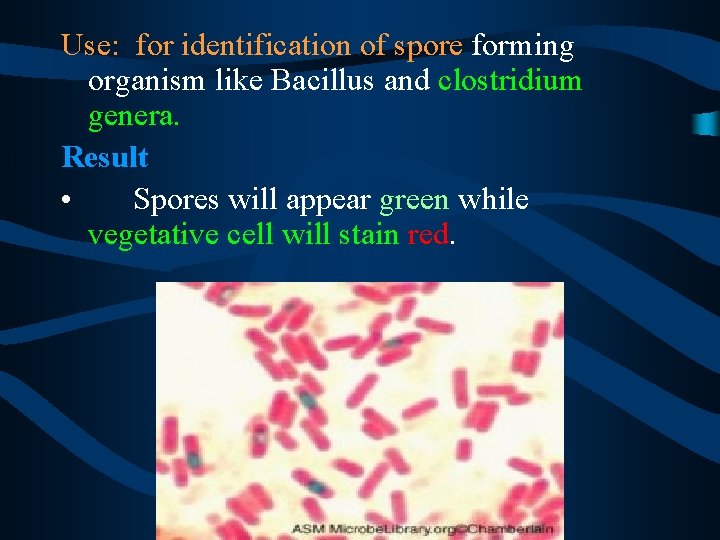
Use: for identification of spore forming organism like Bacillus and clostridium genera. Result • Spores will appear green while vegetative cell will stain red.
Capsule stain • Use: for identification of capsular organism like klebsiella, pneumococci, B. anthracis etc.
Loeffler’s alkaline methylene blue (LAMB) method Use: To demonstrate the capsulated Anthrax bacilli in blood smear. Procedure Fix the smear with alcohol. Pour LAMB stain and allow for 2 -3 minute. Wash with water, blot and examine.
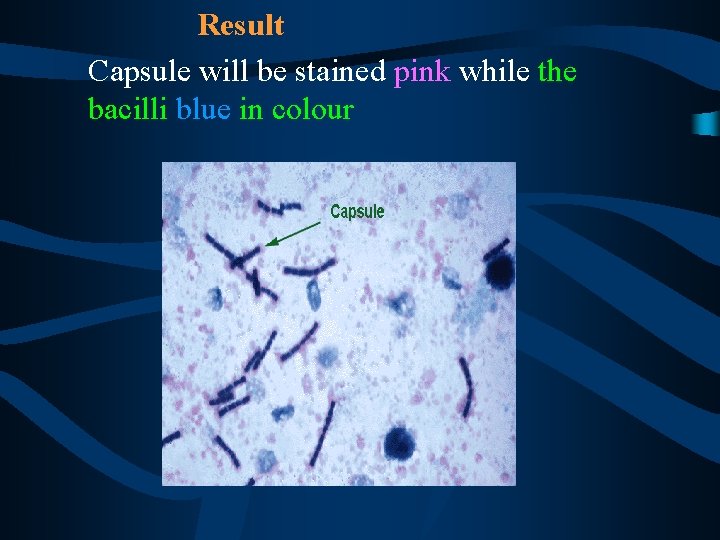
Result Capsule will be stained pink while the bacilli blue in colour
Flagella stain Leifson method • • • Use : to examine the flagella organism Procedure wash the cell twice by centrifuging. suspend the cells and incubate for 10 minute at 37 0 C. Mark area of about 1 x 1. 5 sq. inch on clean glass slide, place loopful of the washed bacterial suspension, dry in air. Apply stain till there is formation of the precipitate in the stain. Remove stain with gentle stream of water. Counter stain with methylene blue for 1 minute. Wash with water, air dry and examine.
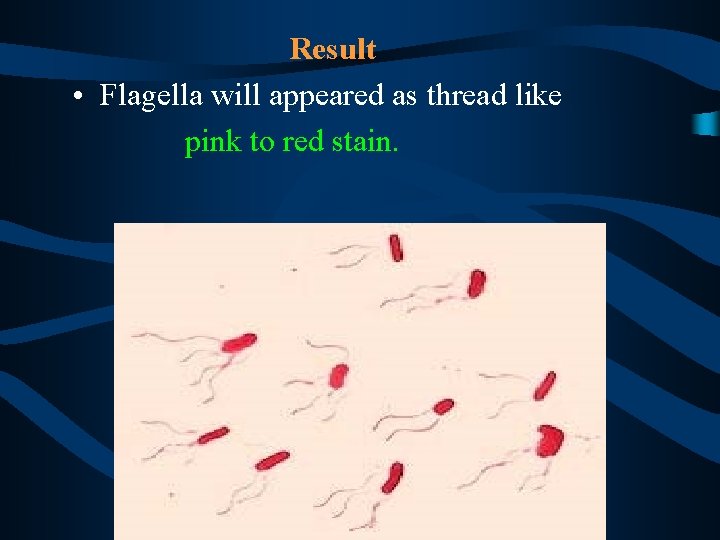
Result • Flagella will appeared as thread like pink to red stain.
staining inclusion bodies • Phloxine-tartrazine stain • Neisser stain for metachromatic granules
Stain use for fungus Lacto phenol cotton blue stain Method -Place a drop of stain on slide and in this gently tease small portion of culture using a mounting needle. -Place a No 1 cover slip on top avoiding formation of air bubble and remove excess stain around the edges of the cover slip. -Examine under microscope.
Stains Use for Virus Acridine Orange • Procedure: Wash cover slip cultures in three changes of phosphate • • buffer saline Fix in carnoy’s fixative for 1 -2 minuts. 95%, 70%, 50%, 30% ethyl alcohol 2 min respectively Rinse in de-ionized water Stain in Acridine orange solution for 5 min Rinse with buffer for 5 min Mount Examine under U. V Microscope • Result – DNA fluoresces yellow • RNA fluoresces Flame red.
Feulgin stain Producer: Wash cover slip cultures in three changes of phosphate buffer saline Fix in carnoy’s fixative for 20 ml • 90%, 70%, ethyl alcohol for 2 min respectively, • Wash under tap-water for 2 min • 0. 1 N HCL for 2 min • Transfer to 0. 1 N HCL, pre-warmed to 600 C for 10 -20 min • 0. 1 N HCL at room temperature for 2 min • Wash quickly in tap water • Transfer to schiff reagent for 30 min. • Wash in running water for 15 min. • Counter stain with 0. 5% light green if desited, and wash in tap-water. • Dehydrate rapidly in 70% ethyl alcohol • Two rapid changes in 95% ethyl alcohol • Two rapid changes in 100% ethyl alcohol • Clean in xylol • Mount
Result • Nuclei and DNA containing material stain a reddish purple colour
Seller stain Use: Excellent stain for demonstrating the cytoplasmic inclusions (Negri bodies) associated with rabies virus infection. Procedure: -Prepare impression smear immediately immerse it in the stain for 1 -5 sec. -Rinse quickly in running water. -Drain and dry in air, without blotting. -Mount
Result • Negribody stain magenta and appear heterogeneous in structure.

THANK YOU
- Slides: 34