
Staining Isolation of Bacteria l Most bacterial samples
Staining
Isolation of Bacteria l Most bacterial samples have numerous different bacterium l Identification requires testing on an individual type of bacteria l Two methods for isolating are the Streak plate and the Spread plate
Streak Plate l Transfer bacteria to a small area of agar plate l Get increasingly smaller amounts of bacteria on successive sections of the plate by sterilizing the loop and spreading the previous area l When you get a small enough quantity of bacteria in an area, they will be able to grow in individual colonies

Streak Plate continued l Objective: isolate single colonies of bacteria from a mixed culture l Draw procedure diagram off of board l Flame loop between each quadrant, but do NOT dip the loop back in the broth tube l Each student will do their own. This is worth 3 points (1 pt labeling, 1 pt technique, 1 pt isolation)
Spread Plate l Transfer a big drop of bacteria to the plate, then spread in all over l Series of dilutions required to get a sample with few enough bacterial cells to produce individual colonies. ¡ We will not perform the dilutions in this lab. We will just learn the spreading technique.
Spread Plate continued l Objective: isolate single colonies of bacteria from a mixed culture (or at least learn the technique that you would use) l After transferring a couple of drops mixed culture to the agar plate, sterilize spreader ¡ Dip in ethanol ¡ Flame (do NOT dip back in ethanol) ¡ Let cool
Stain Categories l Morphological ¡ Simple stain and Negative stain l Differential ¡ Gram – size, shape, arrangement – cell wall composition stain and Acid-fast stain l Structural – cell structures ¡ Endospore stain and Capsule stain
Stains l Basic stains (+) – react with acidic (-) parts of the cell ¡ ex. l crystal violet, safranin, methylene blue i. e. stains that get inside the cell l Acidic stains (-) – are repelled by the negatively charged cell surface ¡ Ex. Congo red and india ink ¡ Stains the background, not the cells
Simple Stain l Objective: Determine morphology and arrangement l All bacteria will be stained l Make a smear prep ¡ Method of getting bacteria adhered to the slide ¡ see next slide for procedure l Each pair of student will do a simple stain on M. luteus

Smear Prep
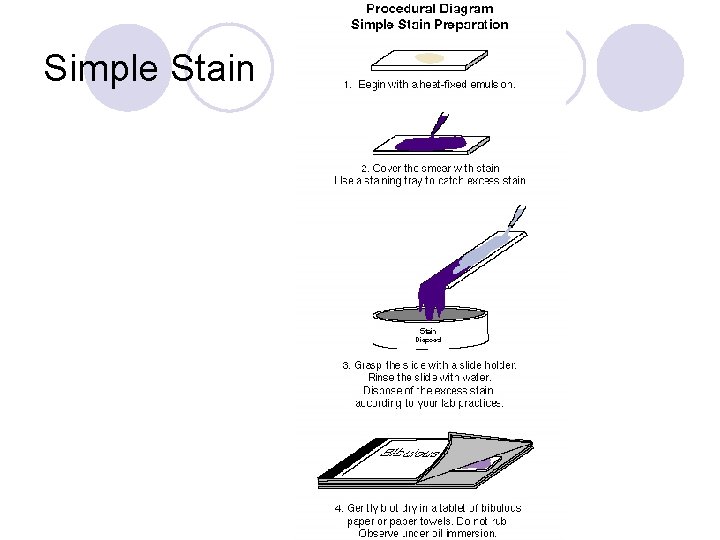
Simple Stain
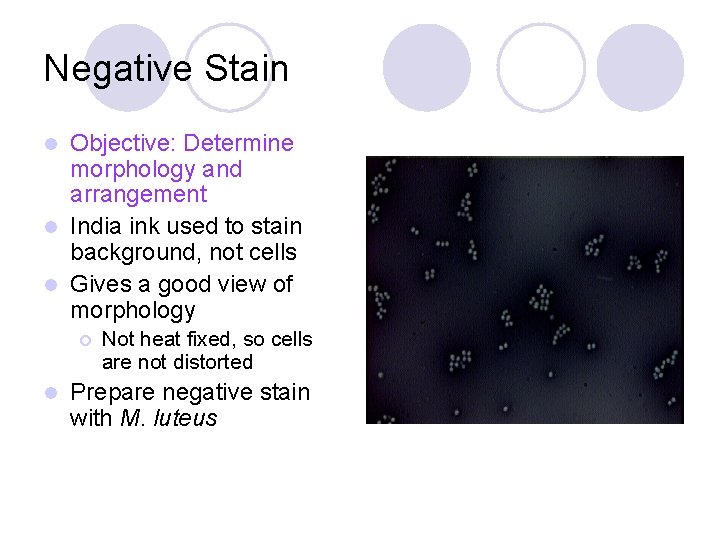
Negative Stain Objective: Determine morphology and arrangement l India ink used to stain background, not cells l Gives a good view of morphology l ¡ l Not heat fixed, so cells are not distorted Prepare negative stain with M. luteus

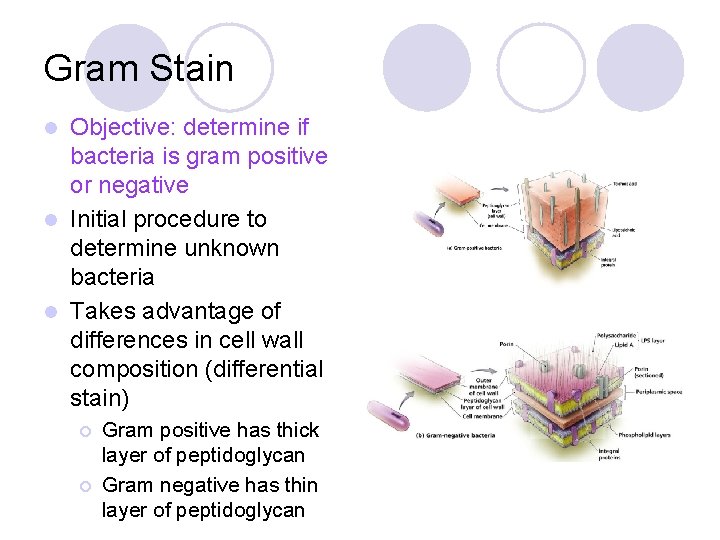
Gram Stain Objective: determine if bacteria is gram positive or negative l Initial procedure to determine unknown bacteria l Takes advantage of differences in cell wall composition (differential stain) l ¡ ¡ Gram positive has thick layer of peptidoglycan Gram negative has thin layer of peptidoglycan
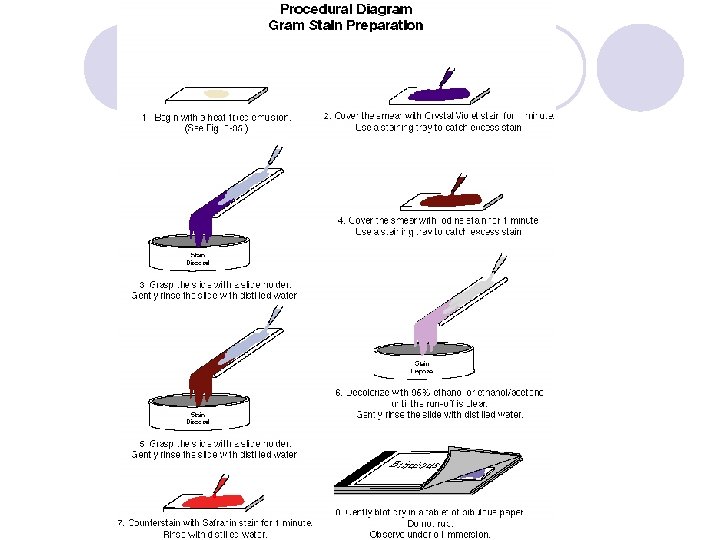
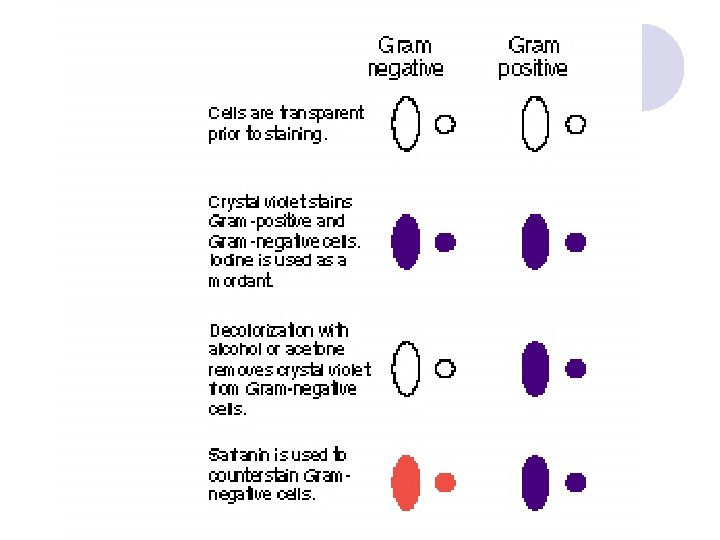
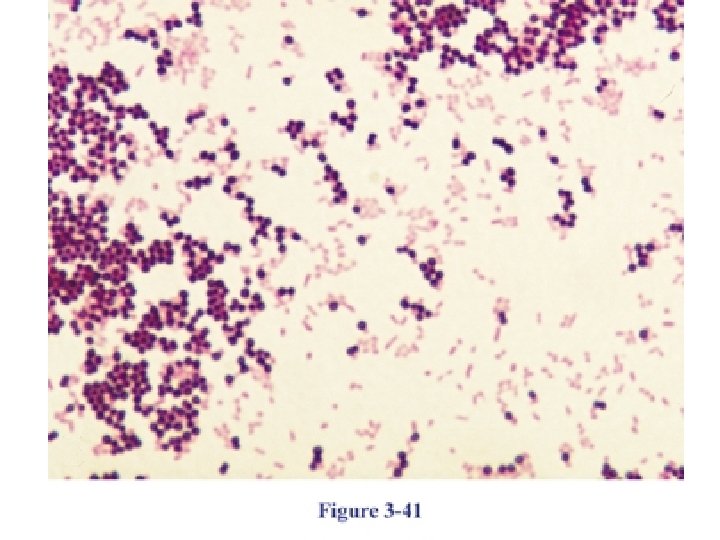
Gram Stain l Gram stain: ¡ E. coli ¡ S. aureus ¡ E. coli/S. aureus mixture l Remember, next week you will be doing a gram stain for points, so get it down today!
- Slides: 18