
Staheli 2012 Toeing and Bowing Patrick Parenzin PAC
Staheli 2012 Toeing and Bowing Patrick Parenzin PA-C Orthopedics & Sports Medicine
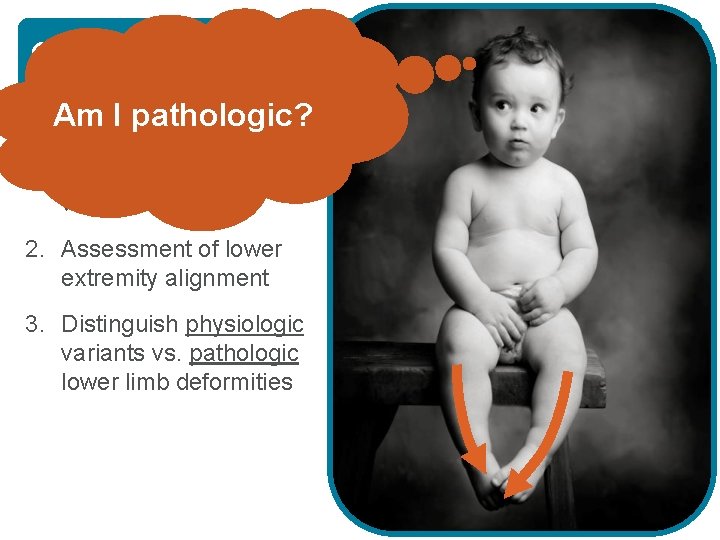
Objectives Am I pathologic? 1. Understand the normal progression of rotational variations 2. Assessment of lower extremity alignment 3. Distinguish physiologic variants vs. pathologic lower limb deformities Orthopedics & Sports Medicine
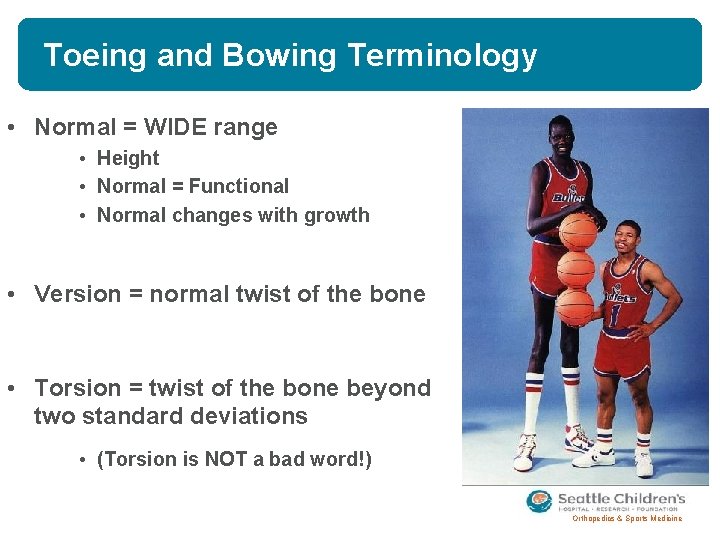
Toeing and Bowing Terminology • Normal = WIDE range • Height • Normal = Functional • Normal changes with growth • Version = normal twist of the bone • Torsion = twist of the bone beyond two standard deviations • (Torsion is NOT a bad word!) Orthopedics & Sports Medicine
Multiple Causes (and Rule Outs) of Toeing and Bowing • Physiologic/structural: • from hip, leg, foot or toe • Other structural-Tibia Vara, DDH, Clubfoot • Neuromuscular disease- muscle imbalance, spasticity, cerebral palsy • Metabolic bone disease - rickets • Skeletal dysplasia • Post-traumatic/post-infectious, SCFE, septic hip Orthopedics & Sports Medicine
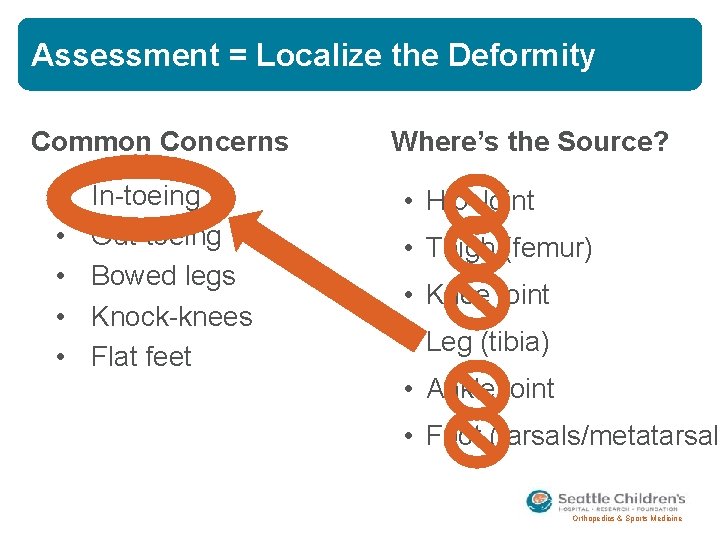
Assessment = Localize the Deformity Common Concerns • • • In-toeing Out-toeing Bowed legs Knock-knees Flat feet Where’s the Source? • Hip Joint • Thigh (femur) • Knee joint • Leg (tibia) • Ankle joint • Foot (tarsals/metatarsals Orthopedics & Sports Medicine
In-toeing Assume a normal healthy toddler or child (age 1 -7) Orthopedics & Sports Medicine
Step 1: History I. Who II. What III. Where IV. Other Orthopedics & Sports Medicine
Step 1: History I. THE WHO • Who is concerned? • Family History? Orthopedics & Sports Medicine
Step 1: History II. THE WHAT • What’s the concern? • aka Chief Complaint • Onset? • Gradual vs. Acute • Duration? • Painful? • Night Pain? !!!!! • AM vs. PM • Severity/Type (Subjective) • Improving or getting worse? • What makes worse/better? • Manifest? • Developmental Delay? • EFFECT ON ACTIVITY • “Can Little Johnny keep up with other kids his age? ” Orthopedics & Sports Medicine
Step 1: History III. THE WHERE • Location: • “Point with one finger” • Radiation Orthopedics & Sports Medicine
Step 1: History IV. OTHER (but still important) • Past Medical History • Diagnosis • Surgery • Hospitalization • • • Family History Social History Medication Allergies ROS Orthopedics & Sports Medicine
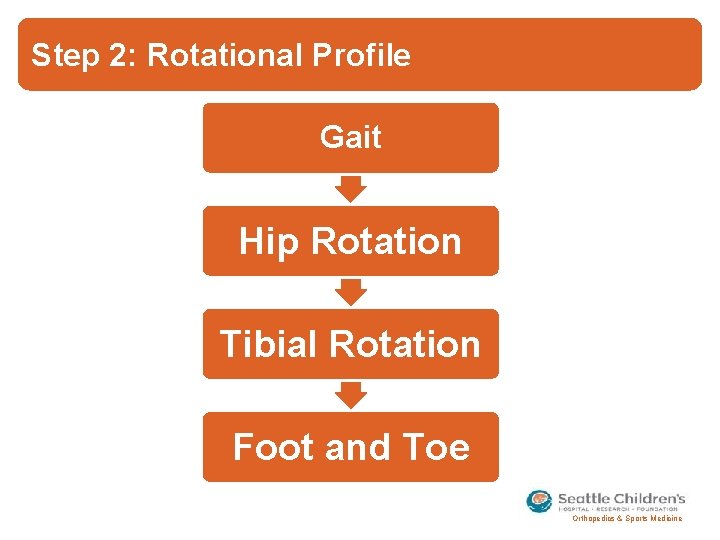
Step 2: Rotational Profile Gait Hip Rotation Tibial Rotation Foot and Toe Orthopedics & Sports Medicine
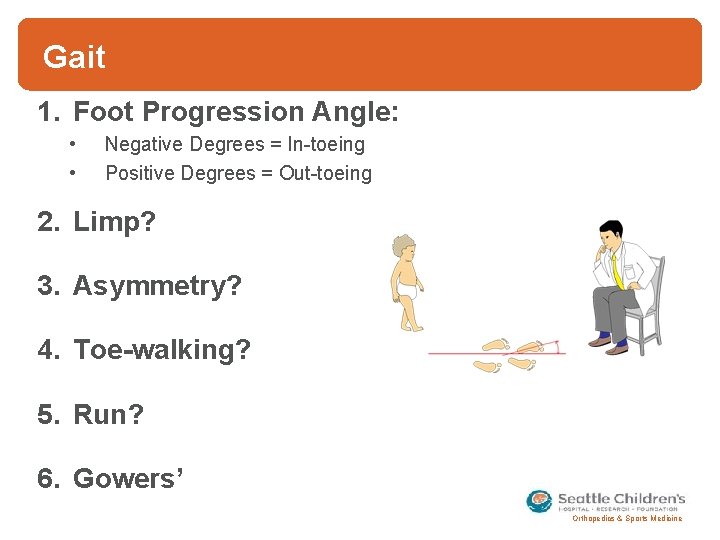
Gait 1. Foot Progression Angle: • • Negative Degrees = In-toeing Positive Degrees = Out-toeing 2. Limp? 3. Asymmetry? 4. Toe-walking? 5. Run? 6. Gowers’ Orthopedics & Sports Medicine
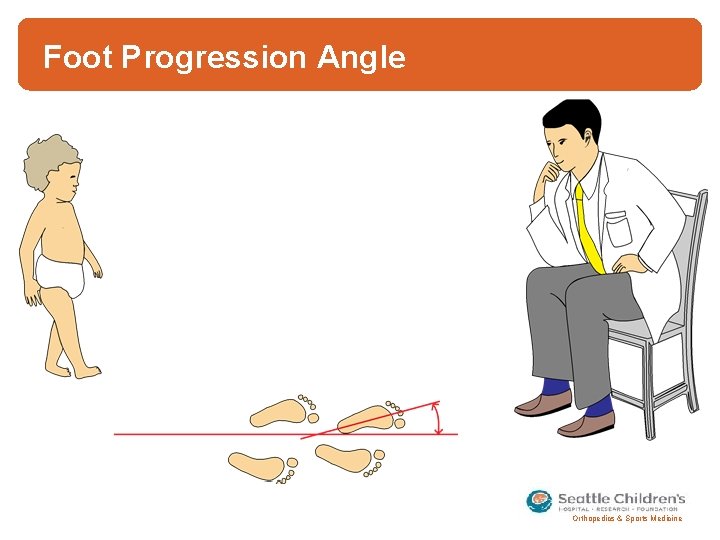
Foot Progression Angle Orthopedics & Sports Medicine
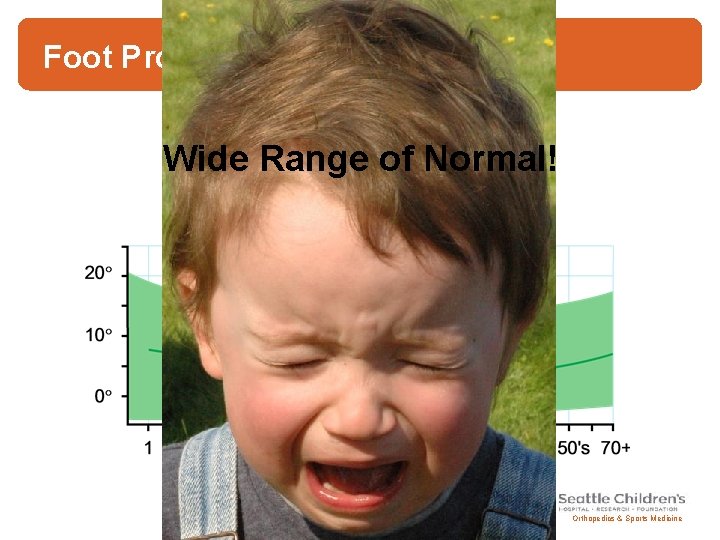
Foot Progression Angle cont. Wide Range of Normal! Orthopedics & Sports Medicine
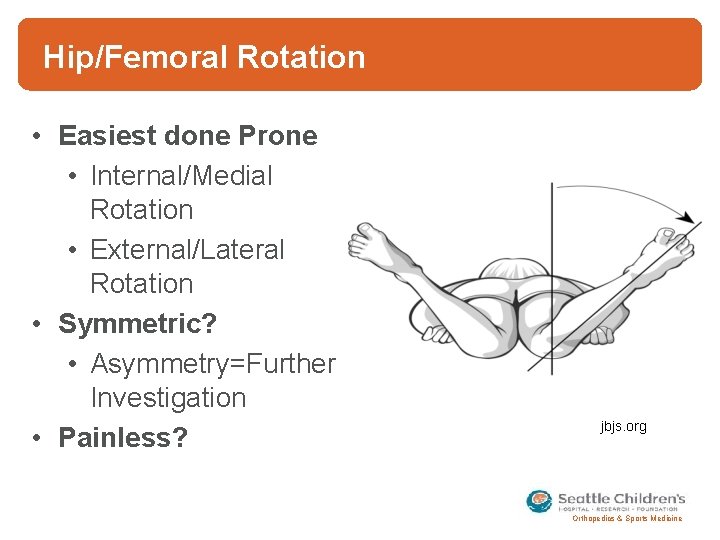
Hip/Femoral Rotation • Easiest done Prone • Internal/Medial Rotation • External/Lateral Rotation • Symmetric? • Asymmetry=Further Investigation • Painless? jbjs. org Orthopedics & Sports Medicine
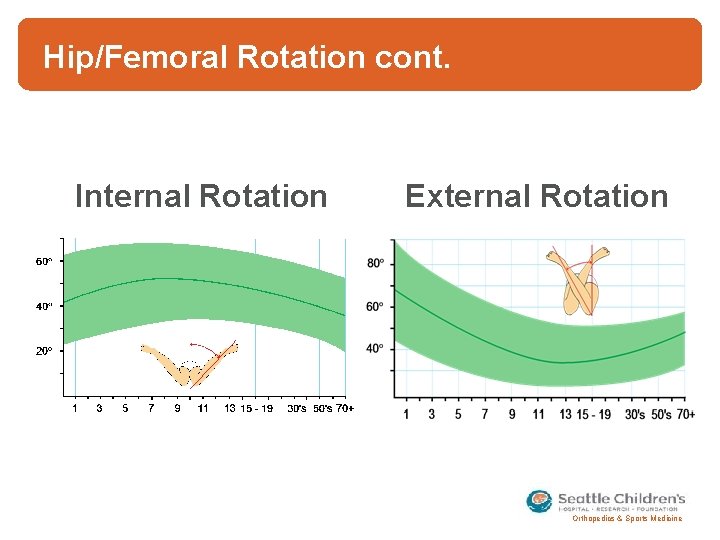
Hip/Femoral Rotation cont. Internal Rotation External Rotation Orthopedics & Sports Medicine
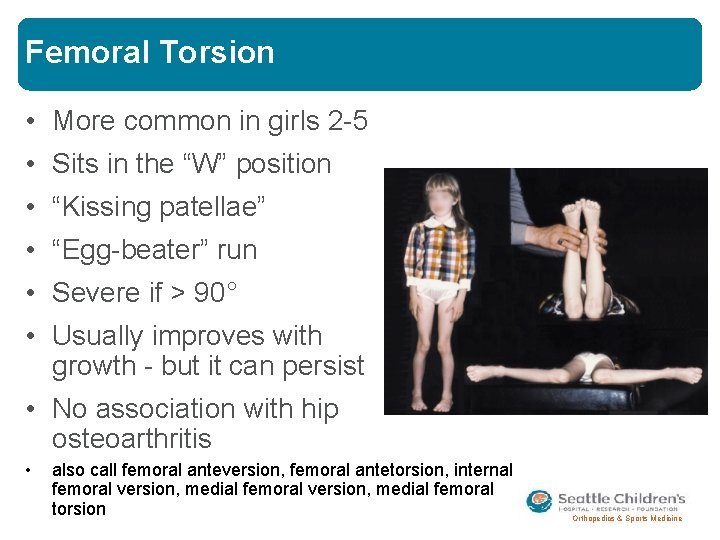
Femoral Torsion • More common in girls 2 -5 • Sits in the “W” position • “Kissing patellae” • “Egg-beater” run • Severe if > 90° • Usually improves with growth - but it can persist • No association with hip osteoarthritis • also call femoral anteversion, femoral antetorsion, internal femoral version, medial femoral torsion Orthopedics & Sports Medicine
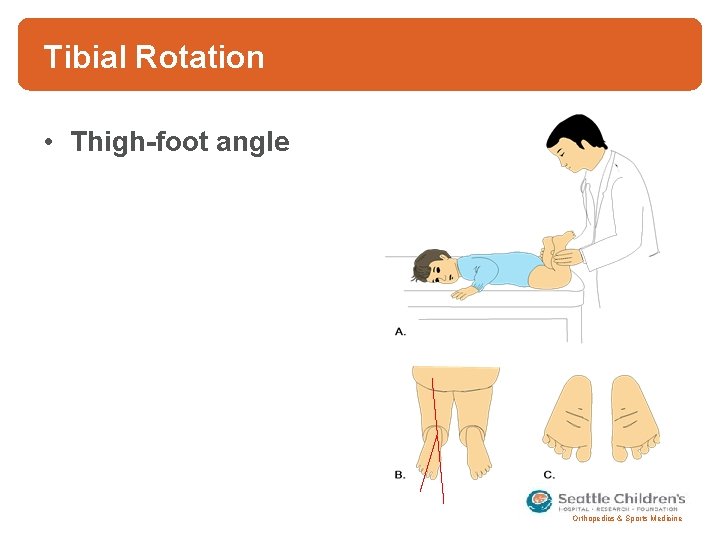
Tibial Rotation • Thigh-foot angle Orthopedics & Sports Medicine
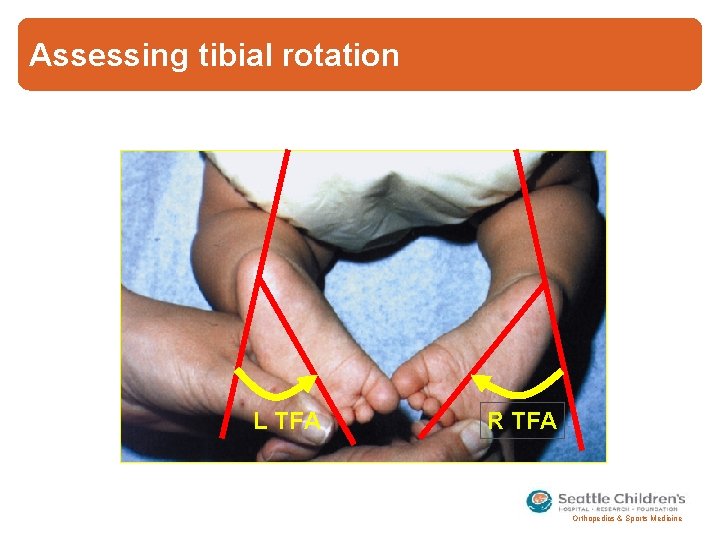
Assessing tibial rotation L TFA R TFA Orthopedics & Sports Medicine
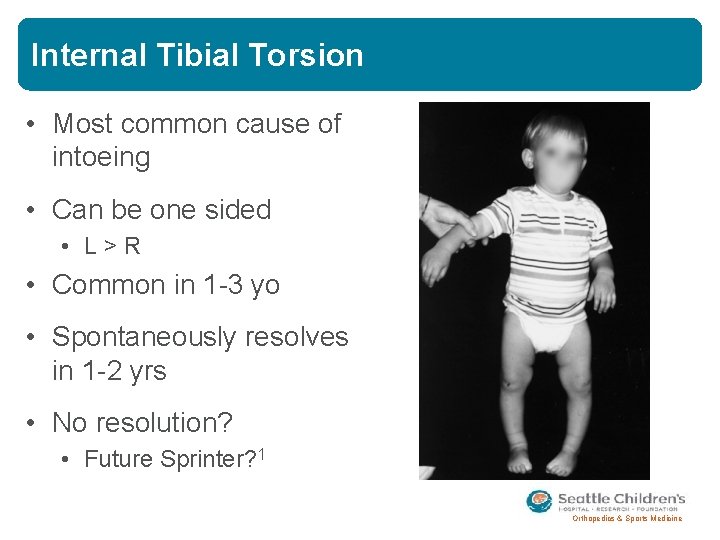
Internal Tibial Torsion • Most common cause of intoeing • Can be one sided • L>R • Common in 1 -3 yo • Spontaneously resolves in 1 -2 yrs • No resolution? • Future Sprinter? 1 Orthopedics & Sports Medicine
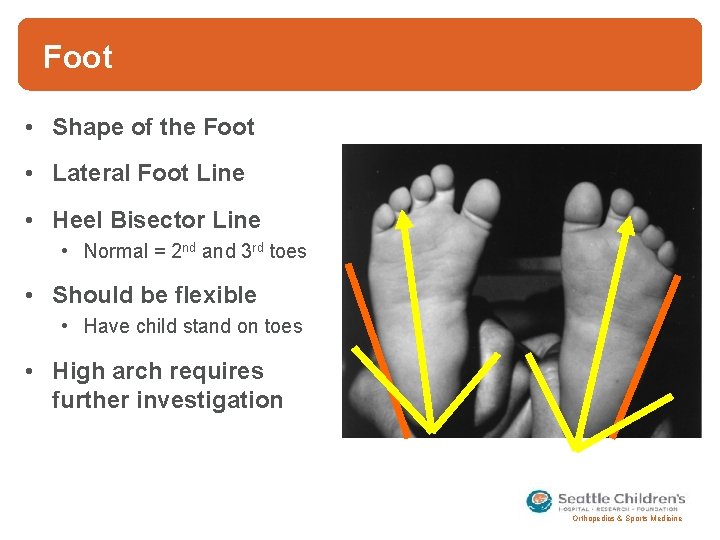
Foot • Shape of the Foot • Lateral Foot Line • Heel Bisector Line • Normal = 2 nd and 3 rd toes • Should be flexible • Have child stand on toes • High arch requires further investigation Orthopedics & Sports Medicine
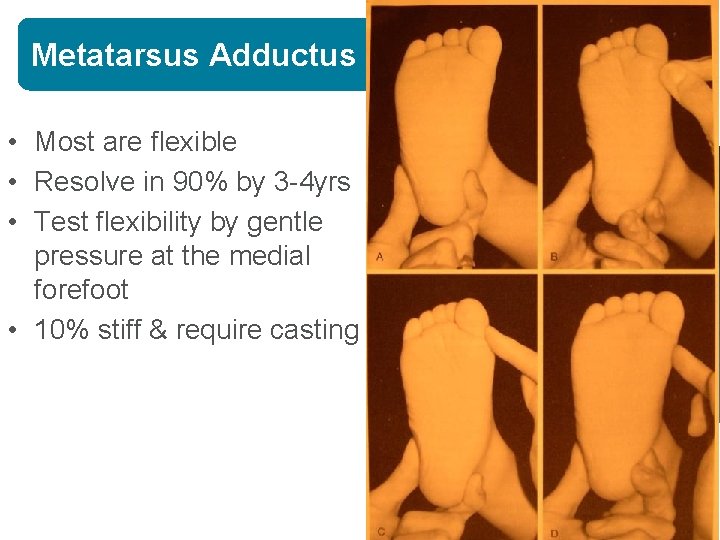
Metatarsus Adductus • Most are flexible • Resolve in 90% by 3 -4 yrs • Test flexibility by gentle pressure at the medial forefoot • 10% stiff & require casting Orthopedics & Sports Medicine
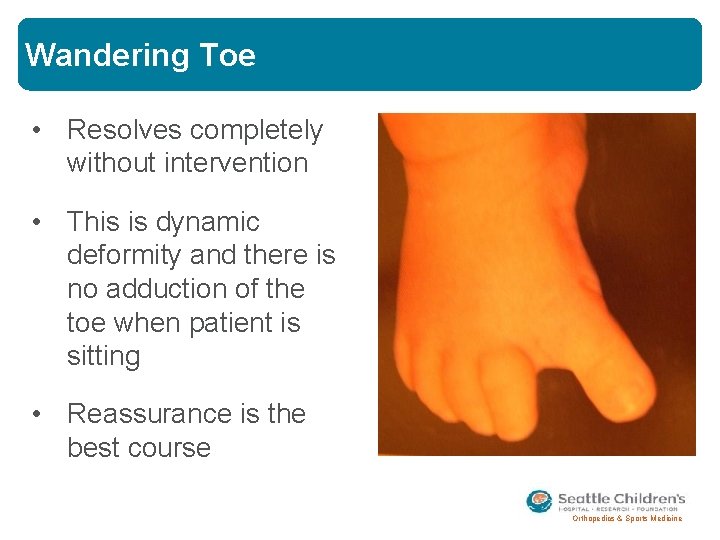
Wandering Toe • Resolves completely without intervention • This is dynamic deformity and there is no adduction of the toe when patient is sitting • Reassurance is the best course Orthopedics & Sports Medicine
In-toeing Summary YOU can determine the source: • Excessive medial rotation of hips = femoral torsion • Medially rotated thigh foot angle = medial tibial torsion • Curved foot = metatarsus adductus • Searching or wandering great toe produces dynamic intoeing Orthopedics & Sports Medicine
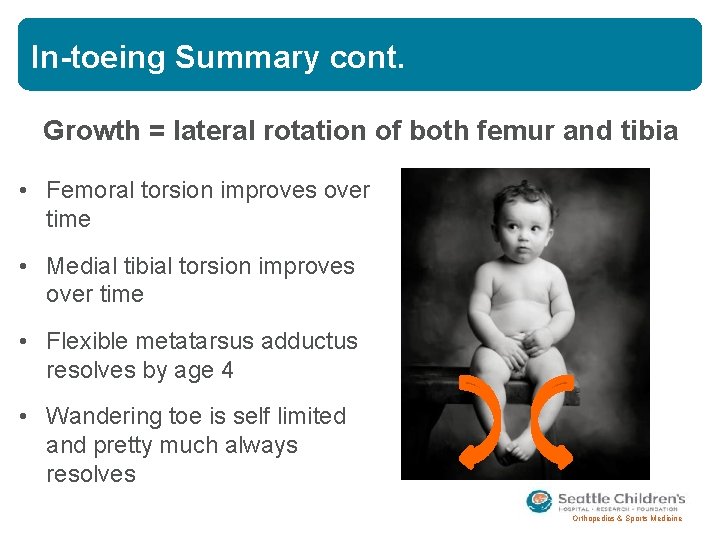
In-toeing Summary cont. Growth = lateral rotation of both femur and tibia • Femoral torsion improves over time • Medial tibial torsion improves over time • Flexible metatarsus adductus resolves by age 4 • Wandering toe is self limited and pretty much always resolves Orthopedics & Sports Medicine
Out-toeing Orthopedics & Sports Medicine
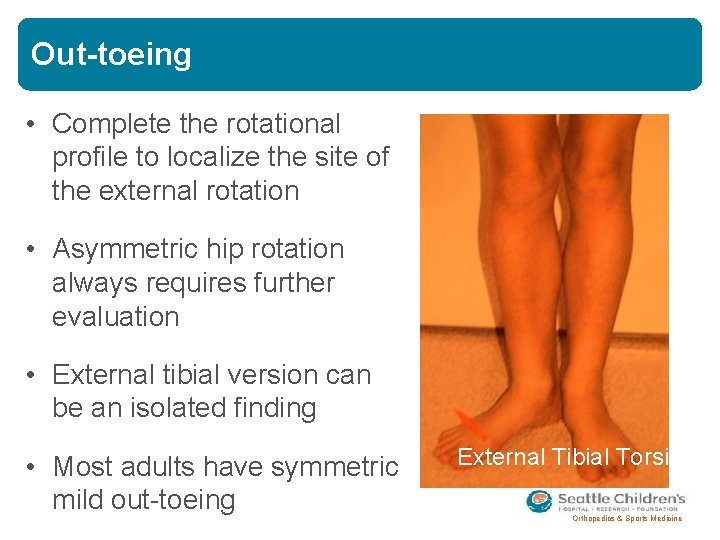
Out-toeing • Complete the rotational profile to localize the site of the external rotation • Asymmetric hip rotation always requires further evaluation • External tibial version can be an isolated finding • Most adults have symmetric mild out-toeing External Tibial Torsion Orthopedics & Sports Medicine
Angular Deformities Genu Varum and Genu Valgum Orthopedics & Sports Medicine
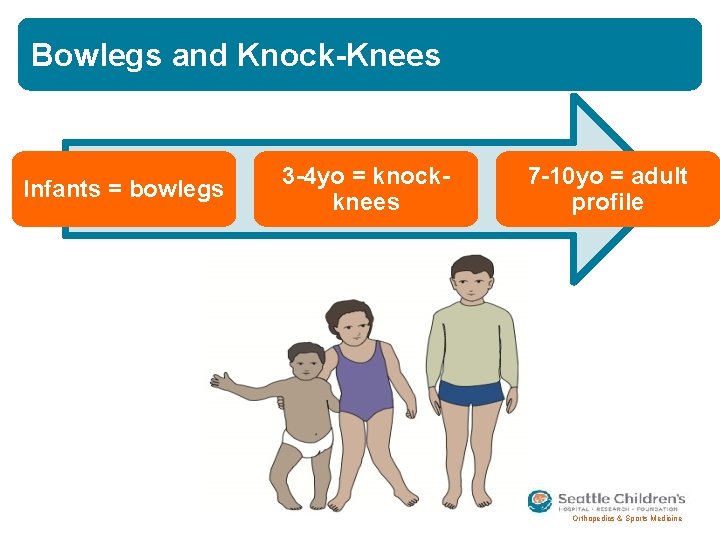
Bowlegs and Knock-Knees Infants = bowlegs 3 -4 yo = knockknees 7 -10 yo = adult profile Orthopedics & Sports Medicine
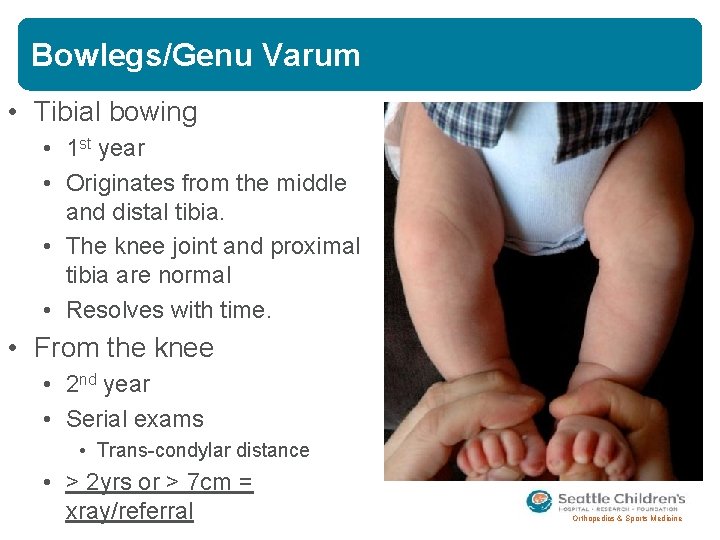
Bowlegs/Genu Varum • Tibial bowing • 1 st year • Originates from the middle and distal tibia. • The knee joint and proximal tibia are normal • Resolves with time. • From the knee • 2 nd year • Serial exams • Trans-condylar distance • > 2 yrs or > 7 cm = xray/referral Orthopedics & Sports Medicine

Pathologic Bowing • Blount’s Disease • (Tibia Vara) • Vit-D deficient/resistant rickets • Trauma or infection • Skeletal dysplasias • Neurofibromatosis Orthopedics & Sports Medicine
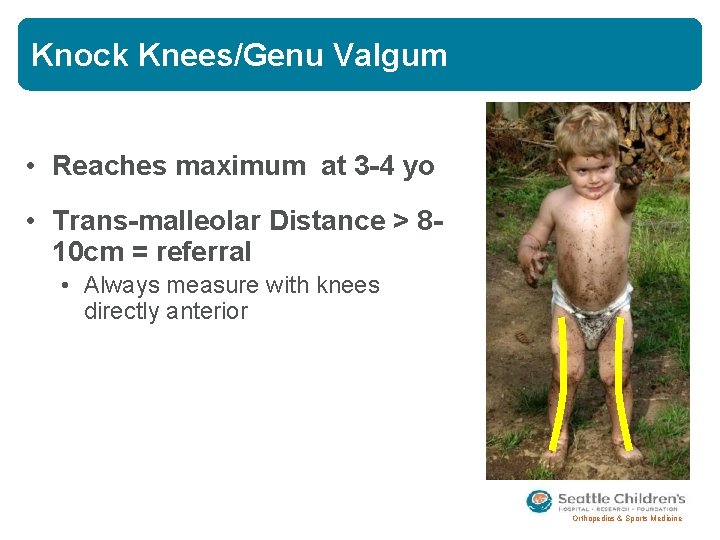
Knock Knees/Genu Valgum • Reaches maximum at 3 -4 yo • Trans-malleolar Distance > 810 cm = referral • Always measure with knees directly anterior Orthopedics & Sports Medicine
Pathologic Genu Valgum • Is the child healthy, normal height and weight, normal activity and development? • Rickets - later onset such as with renal osteodystrophy, (because the disease is active when knock knees are the norm) • Valgus Deformity after Tibial Fracture • Skeletal dysplasias • Diastrophic dysplasia • Morquio’s syndrome • Ellis-van Creveld or chondroectodermal dysplasia • Spondyloepiphyseal and multiple epiphyseal dysplasias Orthopedics & Sports Medicine
Summary • The vast majority of rotational deformities are variations of normal, are benign, and resolve with time. • Use history and exam to R/O the pathologic causes -Normal growth and development and no pain or limp with activity • With a healthy young child use the rotational profile to help diagnose the location of the deformity. (Try not to get to bogged down in numbers). • Evaluate asymmetric hip rotation esp. asymmetric loss of internal rotation Orthopedics & Sports Medicine
Who might benefit from a referral? • Parent/Guardian needs more reassurance • Over 7 yrs with persistent in-toeing or out-toeing • Stiff metatarsus adductus: Consider referral at 6 months of age • Any asymmetry of hip rotation • Bowing • below the 5 th percentile for height • over 2 -3 yrs of age with true genu varum Orthopedics & Sports Medicine
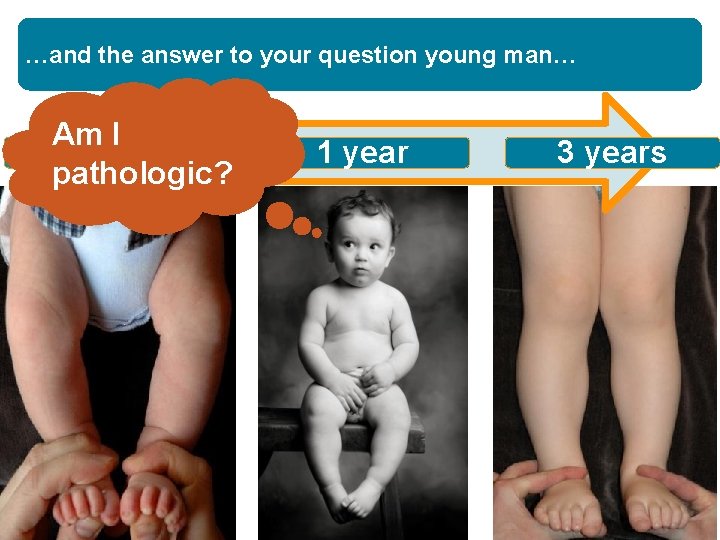
…and the answer to your question young man… Am I Newborn pathologic? 1 year 3 years Orthopedics & Sports Medicine
Thank you. • Dr. Staheli • Dr. Thomas Jinguji • Dr. Greg Schmale Orthopedics & Sports Medicine
Bibliography 1. Fuchs R, Staheli L. Journal of Pediatric Orthopaedics: 1996 July/August; 16(4): 489 -491. 2. Staheli L, Mosca V. What Parents Should Know About Flatfeet, Intoeing, Bent Legs and Shoes for Children. Global-HELP publication. Copyright 1979 by Staheli, Inc. 3. Staheli, LT: Practice of Pediatric Orthopedics, Lippincott, 2002. 4. Global-Help: http: //www. globalhelp. org/publications/book_whatparentsflatfeet. html Orthopedics & Sports Medicine
- Slides: 39