
Stages of the Oral Presentation Process l l

- Slides: 23
Stages of the Oral Presentation Process l l l l Consider the audience Choose/narrow a topic Research the topic Select support material Organize and outline Develop an effective introduction and conclusion Rehearse and deliver your speech
Choose a Topic l Is it important to you? l Is it important to your audience? l Will it hold the audience’s attention? l Is it manageable in the time available? 5 – 10 minutes l Is it appropriate for oral presentation? l Is it clear?
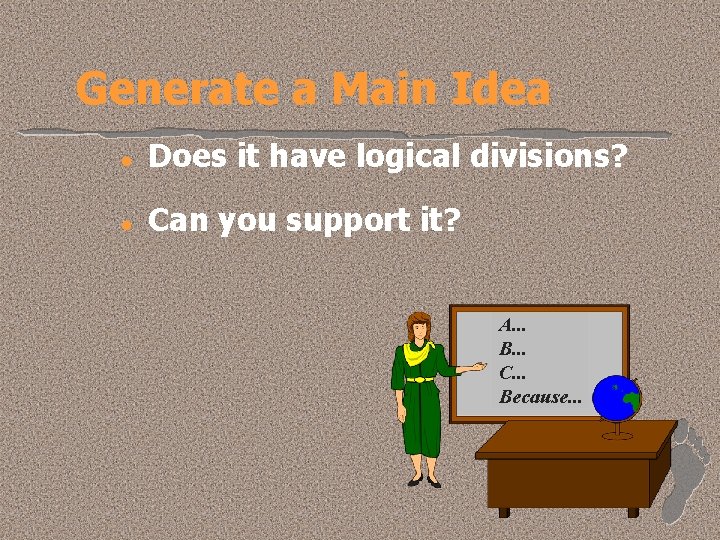
Generate a Main Idea l Does it have logical divisions? l Can you support it? A. . . B. . . C. . . Because. . .
Narrow the Topic The Divine Wind Love Across Racial Boundaries Friendship Lost and Found Hartley Penrose
Research the Topic Carefully l Take Accurate Notes When Researching l Record Complete Source Citations l Credit Source of Ideas l When in Doubt, Cite Source
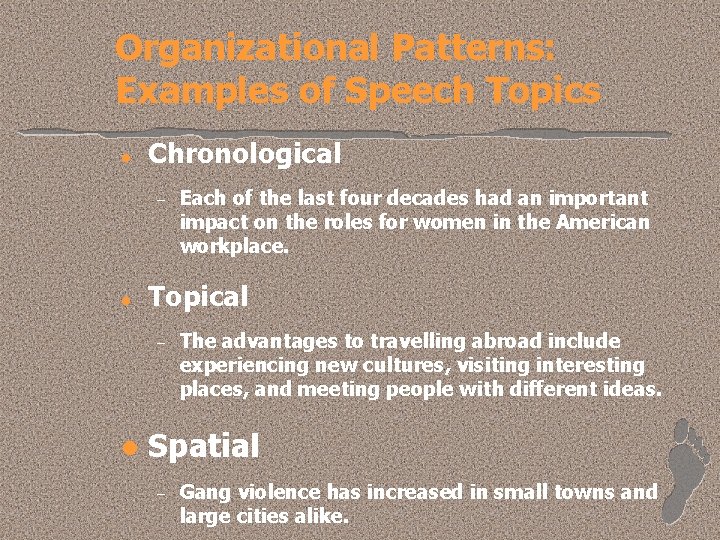
Organizational Patterns: Examples of Speech Topics l Chronological – l Topical – l Each of the last four decades had an important impact on the roles for women in the American workplace. The advantages to travelling abroad include experiencing new cultures, visiting interesting places, and meeting people with different ideas. Spatial – Gang violence has increased in small towns and large cities alike.
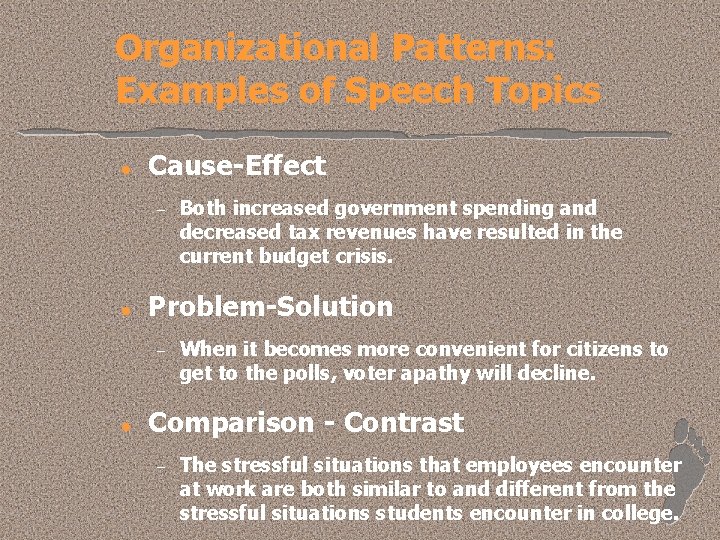
Organizational Patterns: Examples of Speech Topics l Cause-Effect – l Problem-Solution – l Both increased government spending and decreased tax revenues have resulted in the current budget crisis. When it becomes more convenient for citizens to get to the polls, voter apathy will decline. Comparison - Contrast – The stressful situations that employees encounter at work are both similar to and different from the stressful situations students encounter in college.
Functions of Introduction l Get the Audience’s Attention l Introduce the Topic l Provide Motivation to Listen l Establish Credibility l Provide Logical Orientation l Provide Overview
Types of Introductions l Anecdotal Story l Rhetorical Question l Quotation l Humour l Statement of Purpose
Types of Introductions (cont’d) l Statement of Importance of Topic l Identification with Audience l Reference to Situation l Surprise Audience with Claim or Statistic
Types of Introductions l Statement of Importance of Topic l Identification with Audience l Reference to Situation l Surprise Audience with Claim or Statistic
Functions of Conclusions l l Summarise Speech Re-emphasise Main Idea Motivate Response Provide Closure
Types of Conclusion l l l l Refer to Introduction Personal reference Challenge to Audience Vision of the Future Quotation Anecdotal Story Rhetorical Question Humour
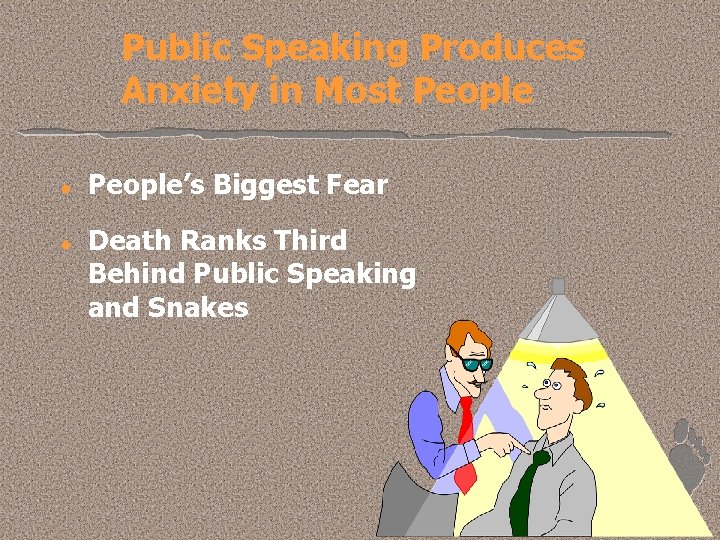
Public Speaking Produces Anxiety in Most People l l People’s Biggest Fear Death Ranks Third Behind Public Speaking and Snakes
Overcoming Speech Anxiety l l Acknowledge Your Fear Act Confidently Prepare Carefully and Well Channel Nervous Energy
Rehearse Your Speech l Simulate the Speech Setting l Practise with Visual Aids l Practise Without Memorizing l Time the Speech l Practise Out Loud
Rehearse Your Speech (cont’d) l Practise Standing Up l Watch Yourself l Practise Gestures l l Practise Eye Contact with Audience Practise Volume, Tone, and Rate
Methods of Delivery l Manuscript Reading l Limited Notes l Memorized
Beginning Your Speech l Walk Calmly with Confidence to Performance Space l Establish Eye Contact l Smile Naturally l Deliver Introduction
During Your Speech l Use Effective Eye Contact l Use Effective Language l Use Effective Gestures l Be Enthusiastic l Be Conversational l Use Notes as Needed
Elements of Vocal Delivery l Speech Rate and Pauses l Volume l Inflection, Pitch, and Tone l Quality of Voice l Pronunciation, Enunciation, and Articulation
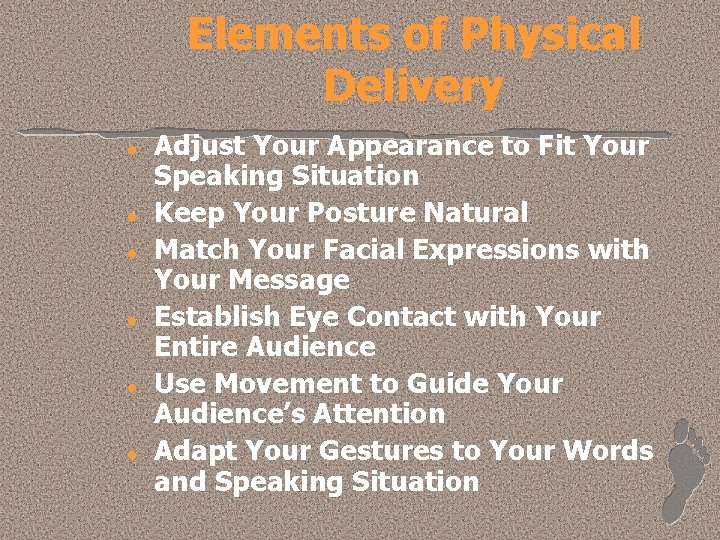
Elements of Physical Delivery l l l Adjust Your Appearance to Fit Your Speaking Situation Keep Your Posture Natural Match Your Facial Expressions with Your Message Establish Eye Contact with Your Entire Audience Use Movement to Guide Your Audience’s Attention Adapt Your Gestures to Your Words and Speaking Situation
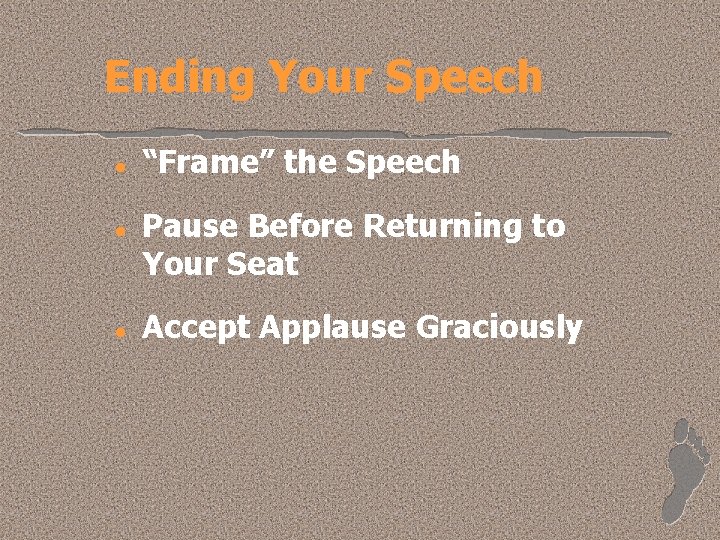
Ending Your Speech l l l “Frame” the Speech Pause Before Returning to Your Seat Accept Applause Graciously