
Stages of regulatory control and activities of each

- Slides: 22
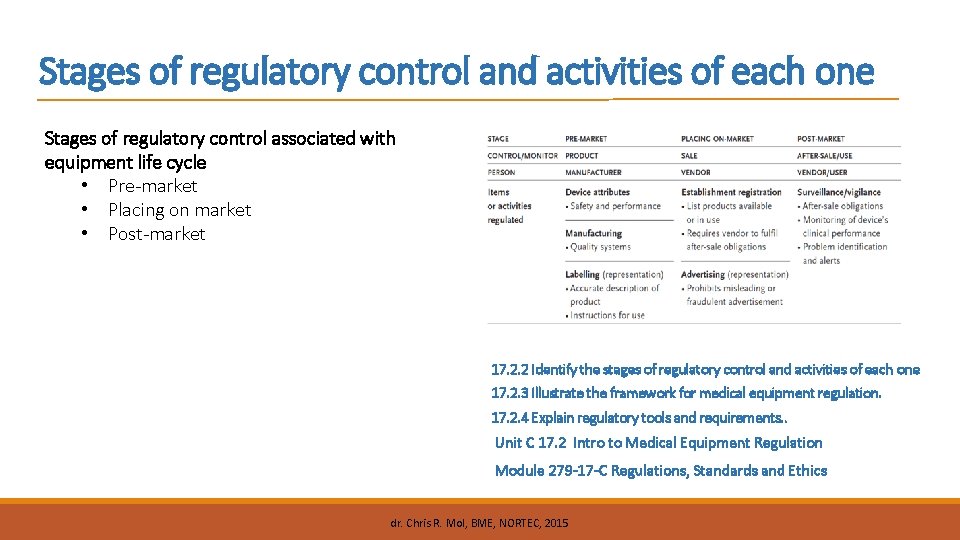
Stages of regulatory control and activities of each one Stages of regulatory control associated with equipment life cycle • Pre-market • Placing on market • Post-market 17. 2. 2 Identify the stages of regulatory control and activities of each one 17. 2. 3 Illustrate the framework for medical equipment regulation. 17. 2. 4 Explain regulatory tools and requirements. . Unit C 17. 2 Intro to Medical Equipment Regulation Module 279 -17 -C Regulations, Standards and Ethics dr. Chris R. Mol, BME, NORTEC, 2015
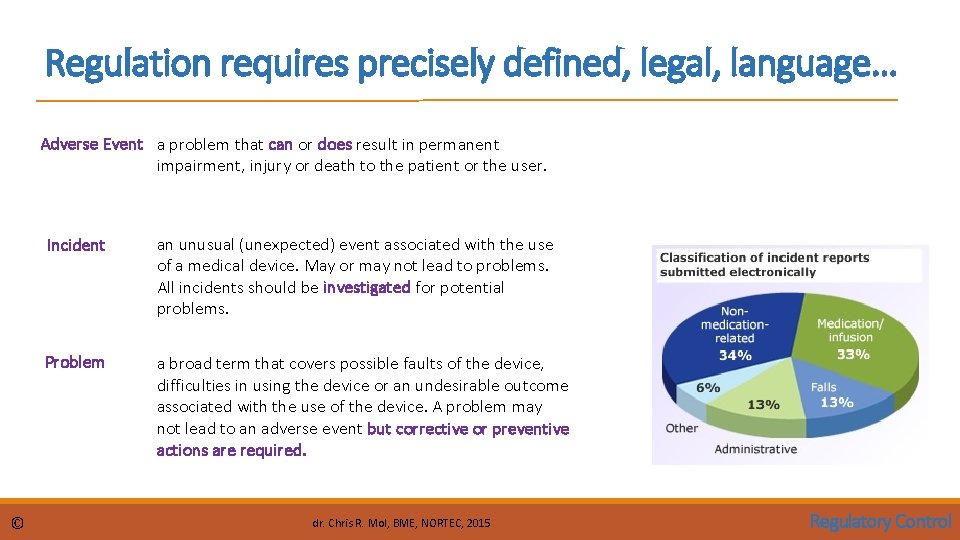
Regulation requires precisely defined, legal, language… Adverse Event a problem that can or does result in permanent impairment, injury or death to the patient or the user. © Incident an unusual (unexpected) event associated with the use of a medical device. May or may not lead to problems. All incidents should be investigated for potential problems. Problem a broad term that covers possible faults of the device, difficulties in using the device or an undesirable outcome associated with the use of the device. A problem may not lead to an adverse event but corrective or preventive actions are required. dr. Chris R. Mol, BME, NORTEC, 2015 Regulatory Control
Regulation requires precisely defined, legal, language… Effectiveness a device is clinically effective when it produces the effect intended by the manufacturer relative to the medical conditions. For example, if a device is intended for pain relief, one expects the device to actually relieve pain and would also expect the manufacturer to possess objective evidence, such as clinical test results, that the device does in fact relieve pain. Performance means technical performance plus effectiveness Manufacturer any person who produces medical devices. Vendor © any person who sells medical devices. This person could be a manufacturer, an importer, a distributor, a wholesaler, or a retailer. dr. Chris R. Mol, BME, NORTEC, 2015 Regulatory Control
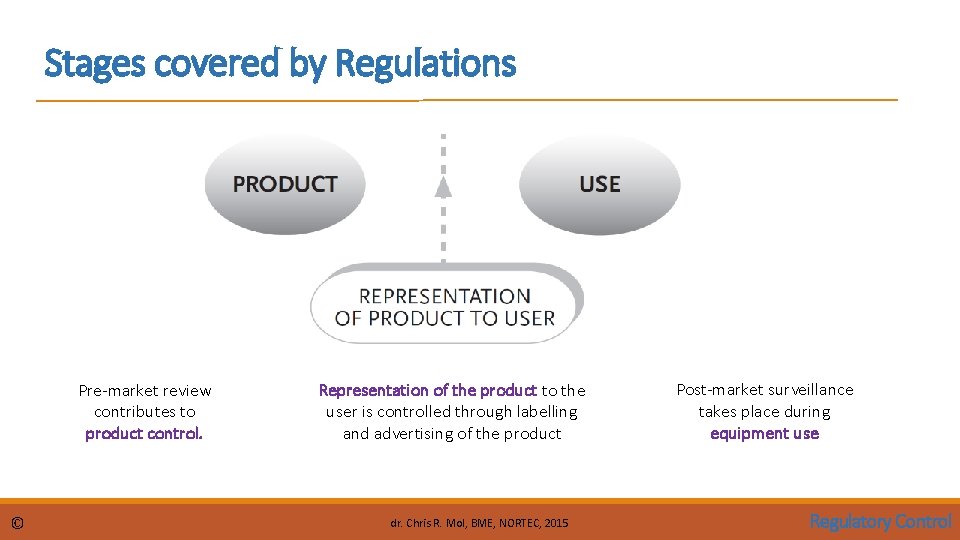
Stages covered by Regulations Pre-market review contributes to product control. © Representation of the product to the user is controlled through labelling and advertising of the product dr. Chris R. Mol, BME, NORTEC, 2015 Post-market surveillance takes place during equipment use Regulatory Control
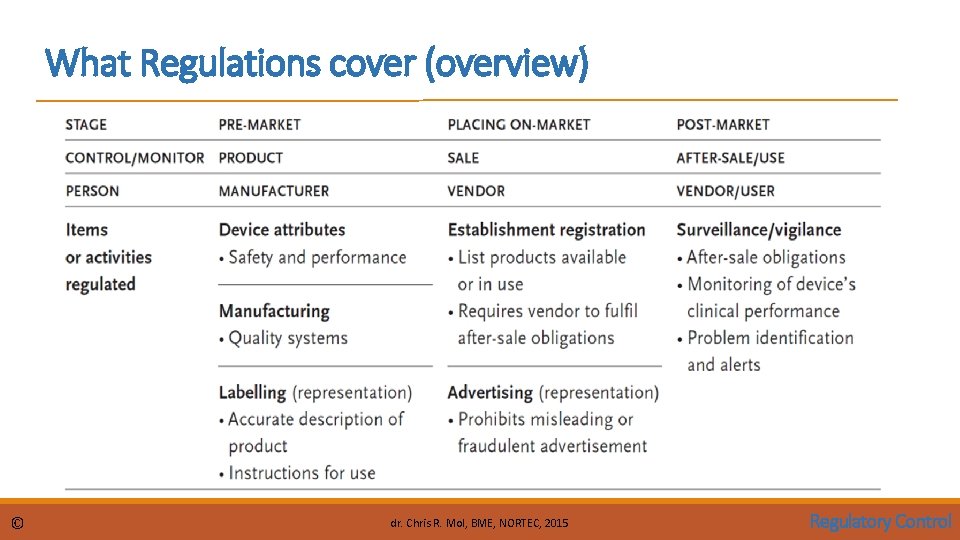
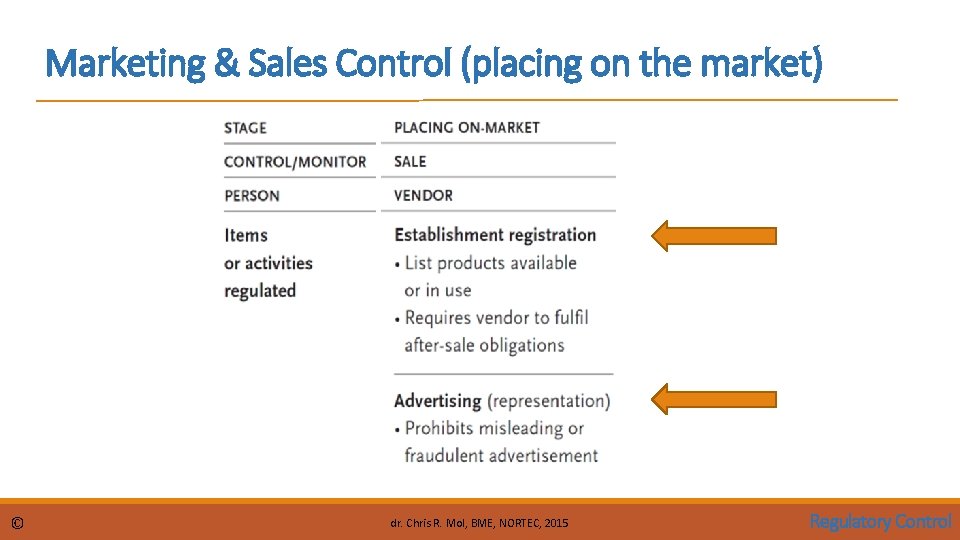
Stages covered by Regulations Pre-market control is performed to ensure that the product to be placed on market complies with regulatory requirements. Labelling and Advertising control regulates correct product representation. Placing-on-market control includes establishment registration, device listing and after-sale obligations. Post-market surveillance/vigilance ensures the continued safety and performance of devices in use. © dr. Chris R. Mol, BME, NORTEC, 2015 Regulatory Control
What Regulations cover (overview) © dr. Chris R. Mol, BME, NORTEC, 2015 Regulatory Control
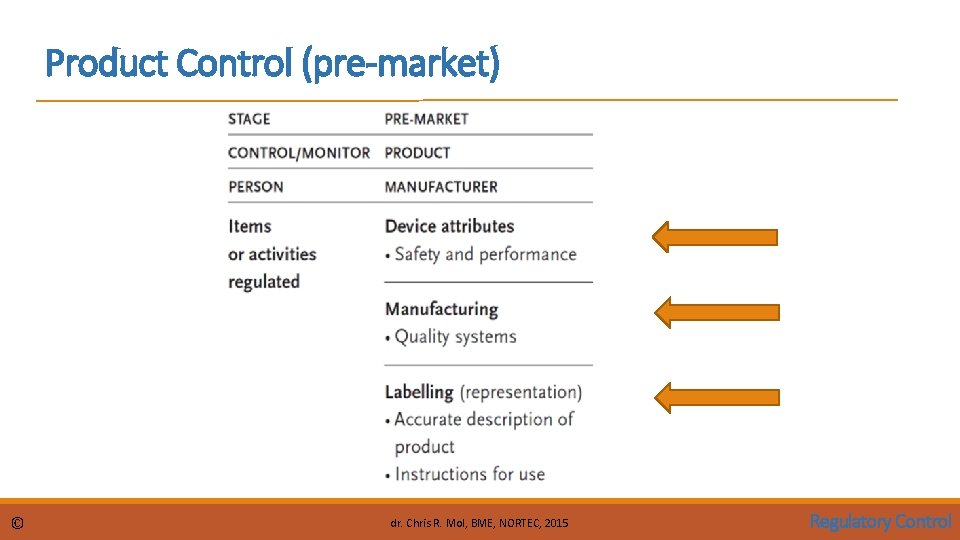
Product Control (pre-market) © dr. Chris R. Mol, BME, NORTEC, 2015 Regulatory Control
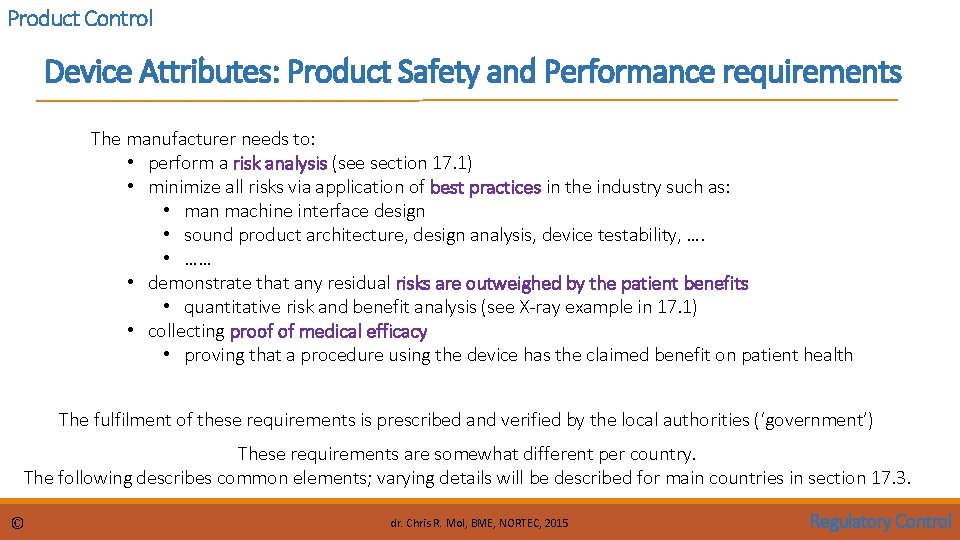
Product Control Device Attributes: Product Safety and Performance requirements The manufacturer needs to: • perform a risk analysis (see section 17. 1) • minimize all risks via application of best practices in the industry such as: • man machine interface design • sound product architecture, design analysis, device testability, …. • …… • demonstrate that any residual risks are outweighed by the patient benefits • quantitative risk and benefit analysis (see X-ray example in 17. 1) • collecting proof of medical efficacy • proving that a procedure using the device has the claimed benefit on patient health The fulfilment of these requirements is prescribed and verified by the local authorities (‘government’) These requirements are somewhat different per country. The following describes common elements; varying details will be described for main countries in section 17. 3. © dr. Chris R. Mol, BME, NORTEC, 2015 Regulatory Control
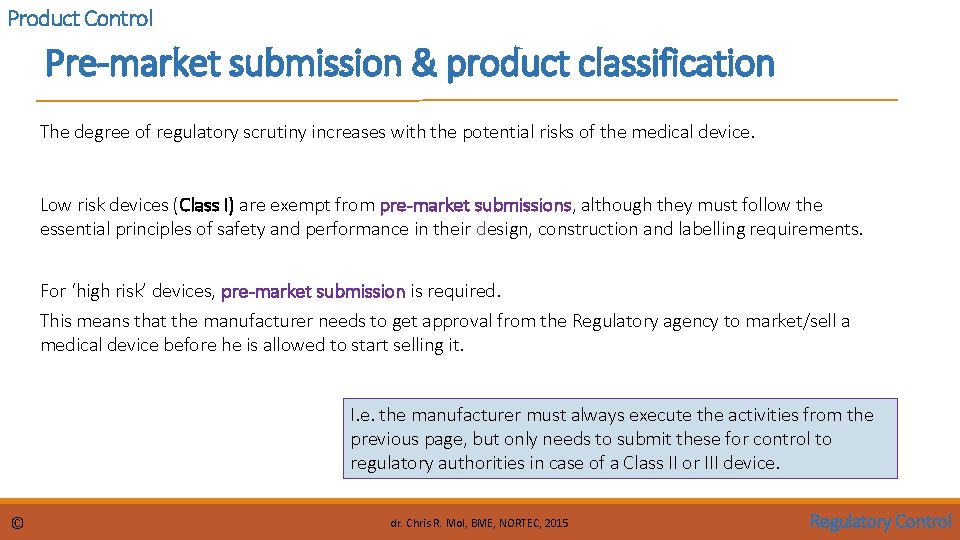
Product Control Pre-market submission & product classification The degree of regulatory scrutiny increases with the potential risks of the medical device. Low risk devices (Class I) are exempt from pre-market submissions, although they must follow the essential principles of safety and performance in their design, construction and labelling requirements. For ‘high risk’ devices, pre-market submission is required. This means that the manufacturer needs to get approval from the Regulatory agency to market/sell a medical device before he is allowed to start selling it. I. e. the manufacturer must always execute the activities from the previous page, but only needs to submit these for control to regulatory authorities in case of a Class II or III device. © dr. Chris R. Mol, BME, NORTEC, 2015 Regulatory Control
Product Control Manufacturing Good Manufacturing Practices (GMP) contains an enormous amount of regulations on how a manufacturing operation needs to be run to deliver consistent quality and continuous improvement of processes. For example: descriptions must be available of • all (construction) work, • all testing work, • when to approve a product, • when to repair or throw away, • how suppliers are managed, • how product problems in the field should be investigated in manufacturing, • …. . © dr. Chris R. Mol, BME, NORTEC, 2015 Regulatory Control
Product Control Packaging standards Medical device packaging is highly regulated. Often medical devices and products are sterilized in the package. Sterility must be maintained throughout distribution to allow immediate use by physicians. A series of special packaging tests measure the ability of the package to maintain sterility. Relevant standards include (examples only): • ASTM D 1585 – Guide for Integrity Testing of Porous Medical Packages • ASTM F 2097 – Standard Guide for Design and Evaluation of Primary Flexible Packaging for Medical Products • EN 868 Packaging materials and systems for medical devices to be sterilized, General requirements and test methods • ISO 11607 Packaging for terminally sterilized medical devices © dr. Chris R. Mol, BME, NORTEC, 2015 Regulatory Control
Product Control Labelling & Instructions for Use The medium, format, content, legibility, and location of the label and instructions for use should be appropriate to the particular device, its intended purpose and the technical knowledge, experience, education or training of the intended user(s). (EU) In particular, instructions for use should be written in terms readily understood by the intended user and, where appropriate, supplemented with drawings and diagrams. Some devices may include separate information for the professional user and the lay person. See further in section 17 -3 for specific EU/USA regulations. ‘Labelling’ also includes Advertising! See under ‘Placing on the market’. © dr. Chris R. Mol, BME, NORTEC, 2015 Regulatory Control
All regulations for manufacturers combined in ISO 13485 The international quality system standards for medical devices are issued by the International Organization for Standardization (ISO): ISO 13485. It covers the methods, facilities and controls used by the manufacturer of medical devices in the • design (although design control is normally not required in medium- to low-risk devices) • manufacture • packaging • labelling • storage • installation • servicing • post-market handling Every manufacturer of medical devices needs to comply with this standard in order to allow to sell in regulated countries in the world. This compliance is subject to periodic audit by governmental or third party agencies. More on this standard in later sections © dr. Chris R. Mol, BME, NORTEC, 2015 Regulatory Control
Marketing & Sales Control (placing on the market) © dr. Chris R. Mol, BME, NORTEC, 2015 Regulatory Control
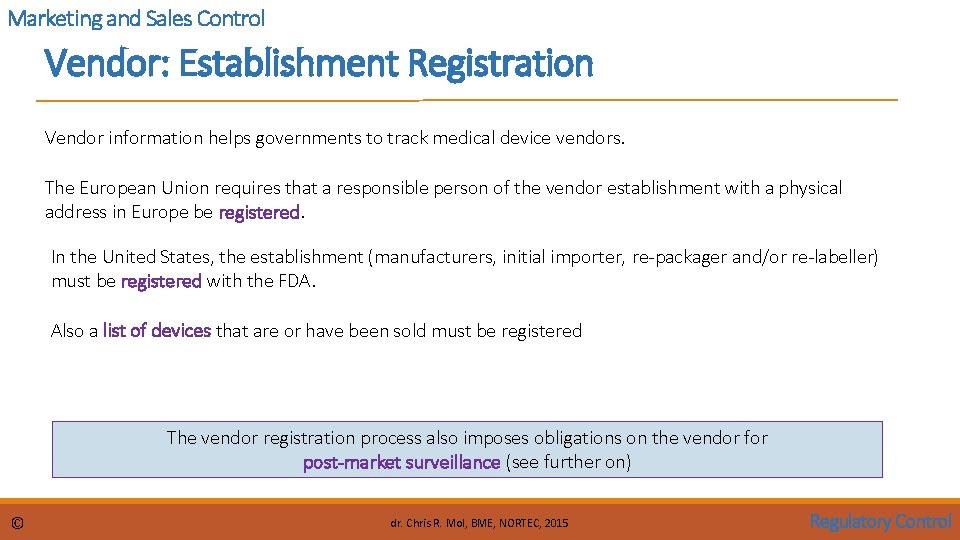
Marketing and Sales Control Vendor: Establishment Registration Vendor information helps governments to track medical device vendors. The European Union requires that a responsible person of the vendor establishment with a physical address in Europe be registered. In the United States, the establishment (manufacturers, initial importer, re-packager and/or re-labeller) must be registered with the FDA. Also a list of devices that are or have been sold must be registered The vendor registration process also imposes obligations on the vendor for post-market surveillance (see further on) © dr. Chris R. Mol, BME, NORTEC, 2015 Regulatory Control
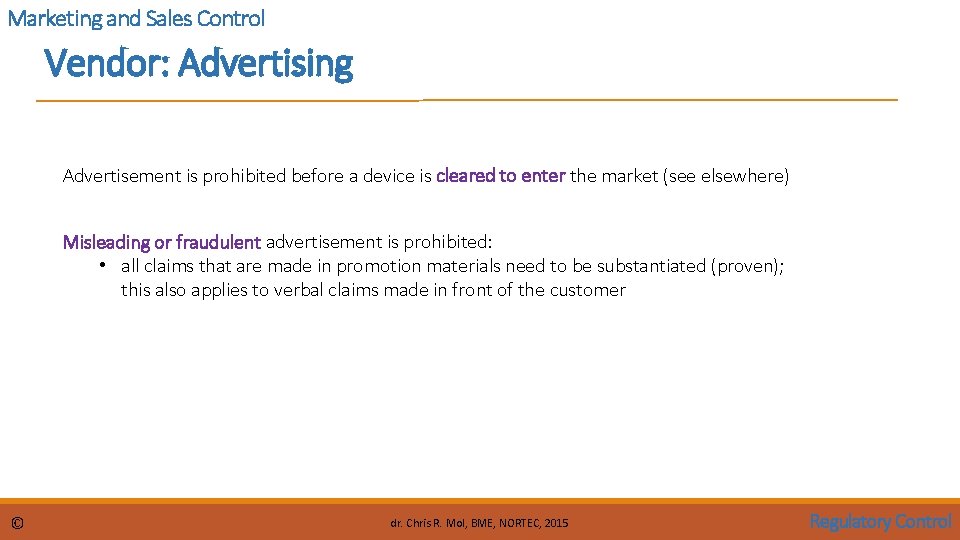
Marketing and Sales Control Vendor: Advertising Advertisement is prohibited before a device is cleared to enter the market (see elsewhere) Misleading or fraudulent advertisement is prohibited: • all claims that are made in promotion materials need to be substantiated (proven); this also applies to verbal claims made in front of the customer © dr. Chris R. Mol, BME, NORTEC, 2015 Regulatory Control
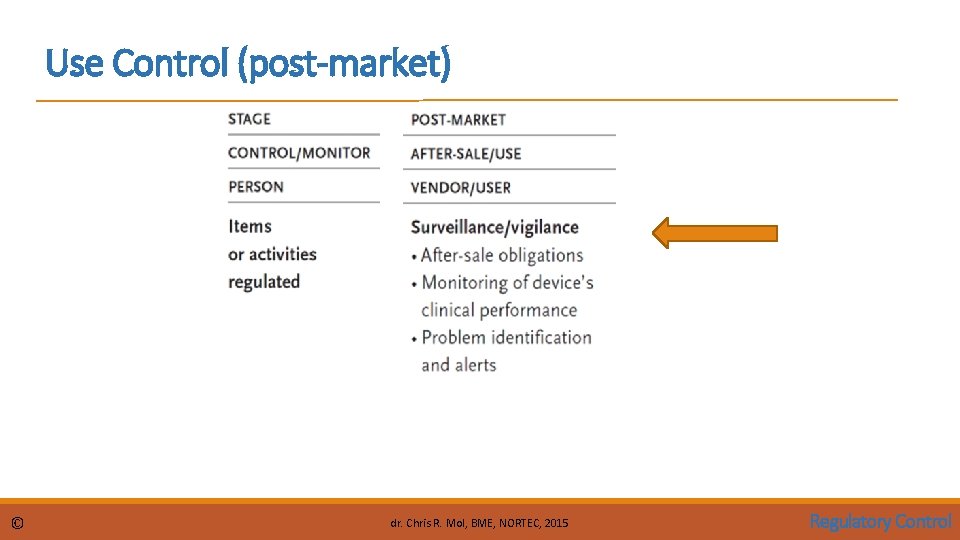
Use Control (post-market) © dr. Chris R. Mol, BME, NORTEC, 2015 Regulatory Control
After Sale Obligations Medical devices often require specialized training from the manufacturer for proper use and service; therefore, the vendor should make training a condition to the manufacturer or importer in accepting to sell the device. In turn, vendors should take responsibility in supporting or training their customers. The manufacturer may be responsible for: • after sales support: training, spare parts delivery. • disposal: take back the product to dispose of it. The user may be responsible for: • after sales support: training, maintenance, … • safe disposal. © dr. Chris R. Mol, BME, NORTEC, 2017 Participants Roles
Use Control Post Market Surveillance / Vigilance It is important that the safety and performance of medical devices are continually assessed when they are in use, as these characteristics can only be proven if one measures how a device stands up in these conditions. No amount of rigour in the pre-marketing review process can predict all possible device failures or incidents arising from device misuse. It is through actual use that unforeseen problems related to safety and performance can occur. © Common requirements include: • problem reporting • implant registration • distribution records • recall procedure • complaint handling Learning can only take place if the actual situation is monitored and mishaps lead to improvement action. . . dr. Chris R. Mol, BME, NORTEC, 2015 Regulatory Control
Use Control Post Market Surveillance / Vigilance Post-market surveillance is a broad term that covers all monitoring activities of medical devices in use. The two principal activities within surveillance are “post-market surveillance studies” and “adverse event reporting”. In post-market surveillance studies, structured data collections are required of the manufacturer 1. as a condition of product approval, or 2. to re-affirm product safety when post-market adverse event reports suggest that premarket safety claims are inconsistent with actual use and result in unacceptable risk. Adverse event reporting requires the registration and investigation of adverse events relating to the use of a device. It is mandatory for vendors or manufacturers to report all device-related events that have resulted, or could result, in serious injury or death. The regulatory authority has the right to oblige the manufacturer to recall or modify a defective device. The vendor must make arrangements for processing complaint/incident reports In many countries, mandatory adverse event reporting is also extended to users. © dr. Chris R. Mol, BME, NORTEC, 2015 Regulatory Control
Use Control Role of BMET in Vigilance on Medical Devices Statistics show that many adverse events arise from low-risk devices, such as those used for injection, drainage and suction. Adverse events from low-risk devices can be just as fatal as those from high-risk devices. In those countries where mandatory problem reporting extends to users, this has become a controversial issue. Problem reports may turn back on the user (incorrect use of the device) or on inadequate maintenance. Since equipment safety is the responsibility of the BMET, (s)he is in a good position to conduct an investigation when an ‘adverse event’ has happened. • if user error is found, user training should be improved • if a device problem is found, this should be reported to the manufacturer and the regulator Such reporting is often not executed to avoid a ‘people blaming culture’ (‘who was responsible for the adverse event? ’) with potentially severe legal consequences. When reporting is not done, the learning potential of errors is not used for continuous improvement of medical equipment safety. © dr. Chris R. Mol, BME, NORTEC, 2015 Regulatory Control
END The creation of this presentation was supported by a grant from THET: see https: //www. thet. org/