
Stages of Learning To learn a pairedassociate list
- Slides: 17
Stages of Learning To learn a paired-associate list, 3 tasks must be accomplished: 1. Stimulus Discrimination: There must be something distinctive about each stimulus item so that the right one can be selected and associated with the response item. For example, when learning word recognition skills through the phonics approach, children are required to associate one sound with the letter b and another with the letter d. They are more likely to confuse these two letters than the letters b and h.
Stages of Learning To learn a paired-associate list, 3 tasks must be accomplished: 2. Response Learning: When the stimulus is presented, we usually have to pronounce the response. This is easier to do if the response items are familiar words than if they are foreign words or nonsense syllables. For example, the German word for “train station” is bahnhof. It would be easier to get bahnhof as the stimulus and respond with train station than get train station as the stimulus and respond with bahnhof.
Stages of Learning To learn a paired-associate list, 3 tasks must be accomplished: 3. S-R Association: Connecting the stimulus to the response is faster if the two items are conceptually related or if we can think of a meaningful relationship. The process of thinking of words or images to connect two items is called mediation. It’s a form of “elaborative rehearsal”. For example, it would be easier to associate the nonsense syllable BOK with the word GIFT if BOK prompted us to think of BOX, which could then act as a mediator and remind us of GIFT.
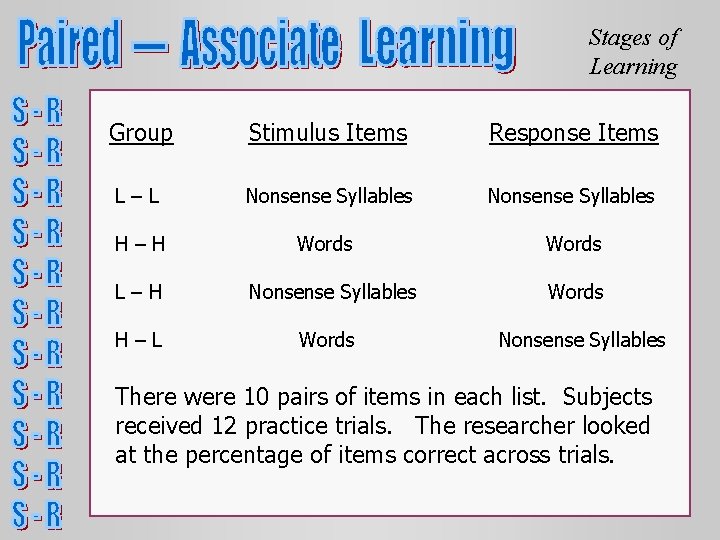
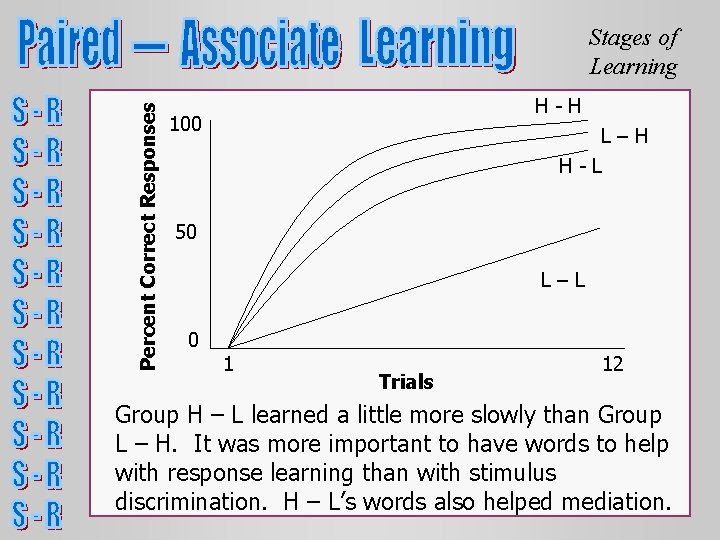
Stages of Learning A general principle of verbal learning is that items that are high in meaningfulness are learned faster than items that are low in meaningfulness. Paired-associate lists allow us to analyze the reasons why meaningfulness facilitates learning. In one study, subjects were divided into 4 groups according to the types of items they received as stimulus and response items. An item could be either a word (high meaningfulness) or nonsense syllable (low meaningfulness).
Stages of Learning Group Stimulus Items Response Items L–L Nonsense Syllables H–H Words L–H Nonsense Syllables H–L Words Nonsense Syllables There were 10 pairs of items in each list. Subjects received 12 practice trials. The researcher looked at the percentage of items correct across trials.
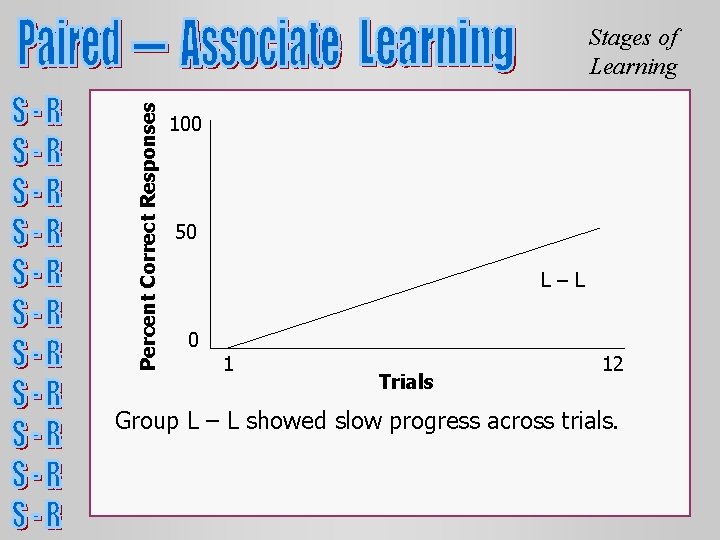
Percent Correct Responses Stages of Learning 100 50 L–L 0 1 Trials 12 Group L – L showed slow progress across trials.
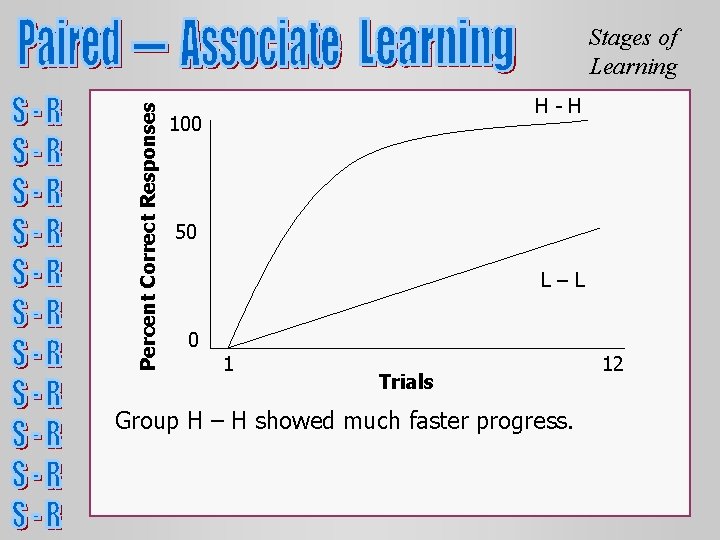
Percent Correct Responses Stages of Learning H-H 100 50 L–L 0 1 Trials Group H – H showed much faster progress. 12
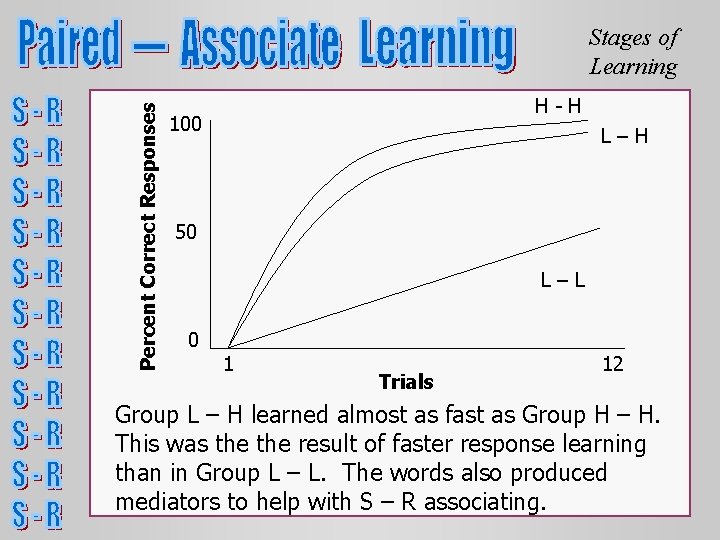
Percent Correct Responses Stages of Learning H-H 100 L–H 50 L–L 0 1 Trials 12 Group L – H learned almost as fast as Group H – H. This was the result of faster response learning than in Group L – L. The words also produced mediators to help with S – R associating.
Percent Correct Responses Stages of Learning H-H 100 L–H H-L 50 L–L 0 1 Trials 12 Group H – L learned a little more slowly than Group L – H. It was more important to have words to help with response learning than with stimulus discrimination. H – L’s words also helped mediation.
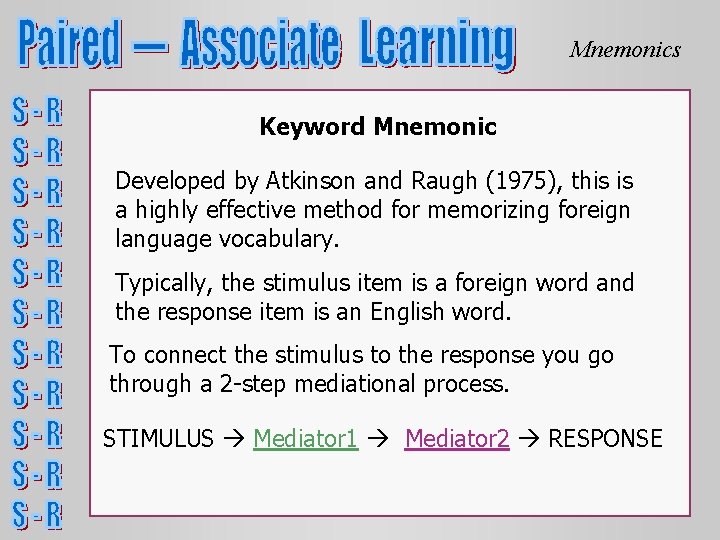
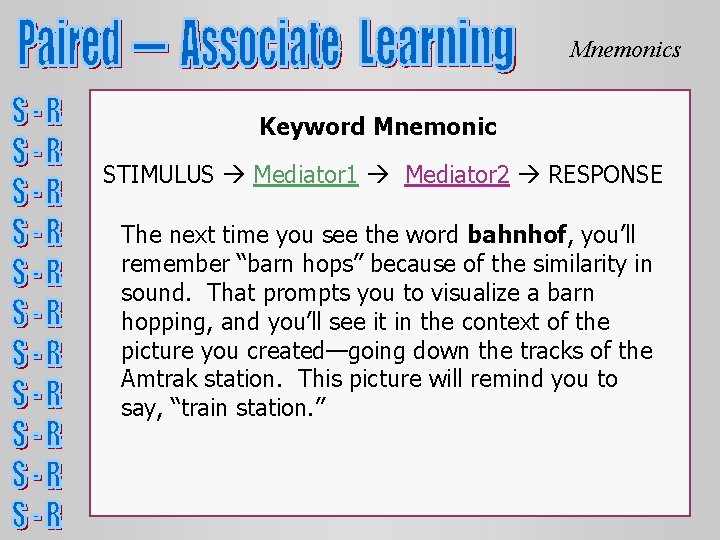
Mnemonics Keyword Mnemonic Developed by Atkinson and Raugh (1975), this is a highly effective method for memorizing foreign language vocabulary. Typically, the stimulus item is a foreign word and the response item is an English word. To connect the stimulus to the response you go through a 2 -step mediational process. STIMULUS Mediator 1 Mediator 2 RESPONSE
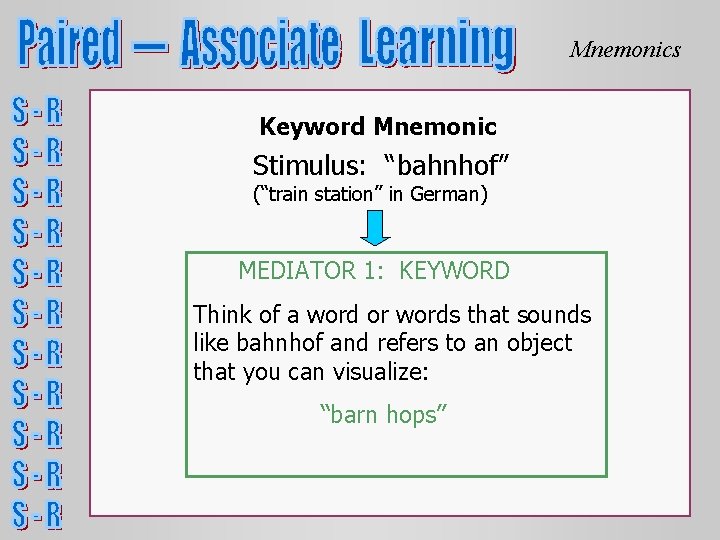
Mnemonics Keyword Mnemonic Stimulus: “bahnhof” (“train station” in German) MEDIATOR 1: KEYWORD Think of a word or words that sounds like bahnhof and refers to an object that you can visualize: “barn hops”
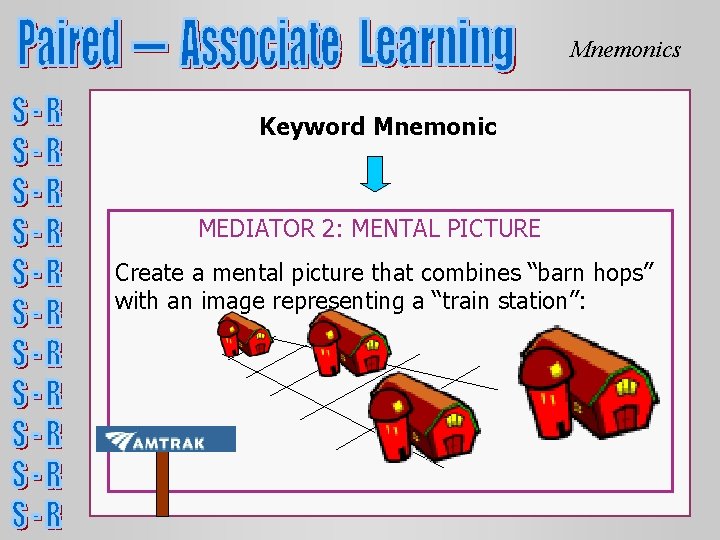
Mnemonics Keyword Mnemonic MEDIATOR 2: MENTAL PICTURE Create a mental picture that combines “barn hops” with an image representing a “train station”:
Mnemonics Keyword Mnemonic STIMULUS Mediator 1 Mediator 2 RESPONSE The next time you see the word bahnhof, you’ll remember “barn hops” because of the similarity in sound. That prompts you to visualize a barn hopping, and you’ll see it in the context of the picture you created—going down the tracks of the Amtrak station. This picture will remind you to say, “train station. ”
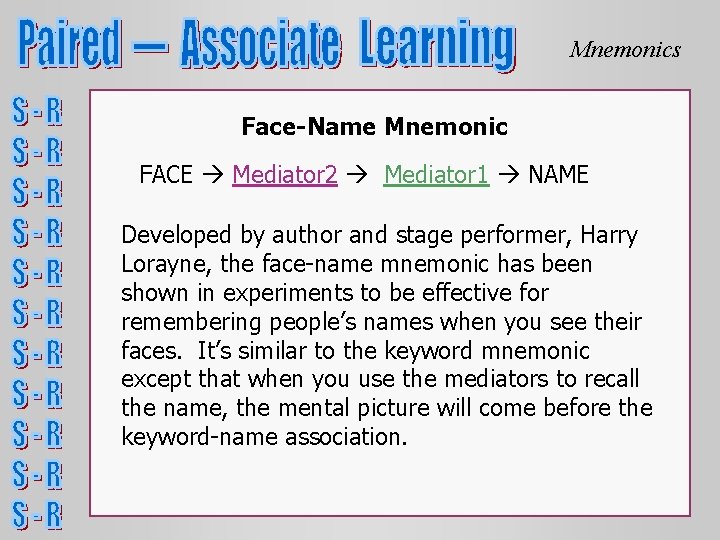
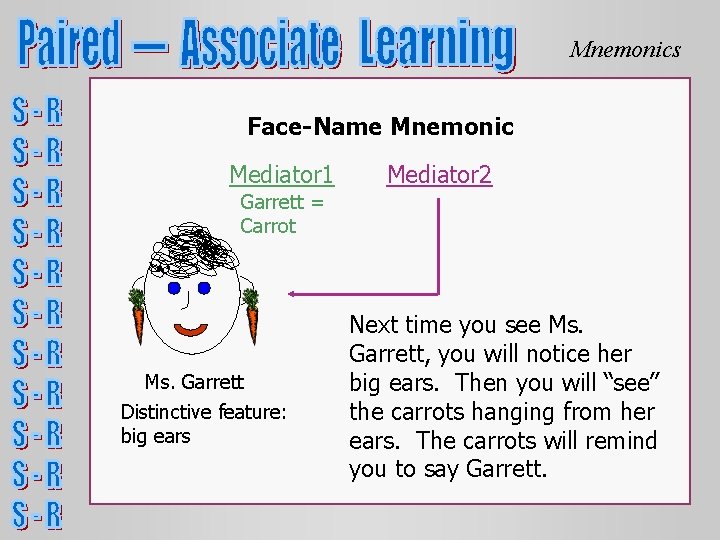
Mnemonics Face-Name Mnemonic FACE Mediator 2 Mediator 1 NAME Developed by author and stage performer, Harry Lorayne, the face-name mnemonic has been shown in experiments to be effective for remembering people’s names when you see their faces. It’s similar to the keyword mnemonic except that when you use the mediators to recall the name, the mental picture will come before the keyword-name association.
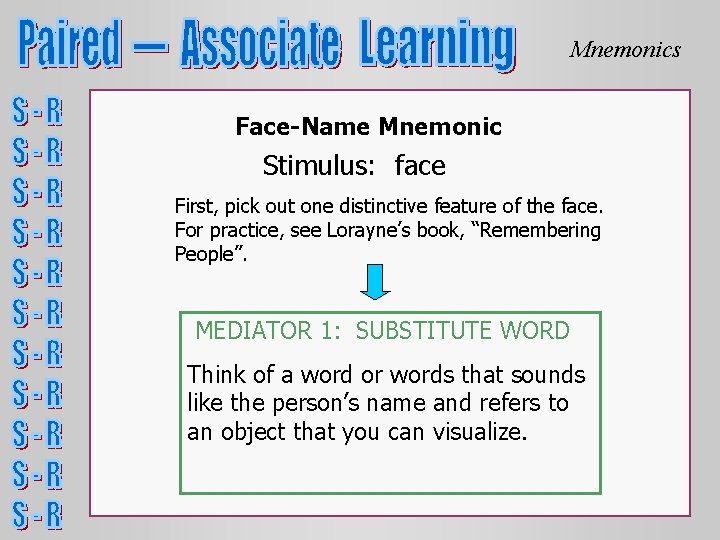
Mnemonics Face-Name Mnemonic Stimulus: face First, pick out one distinctive feature of the face. For practice, see Lorayne’s book, “Remembering People”. MEDIATOR 1: SUBSTITUTE WORD Think of a word or words that sounds like the person’s name and refers to an object that you can visualize.
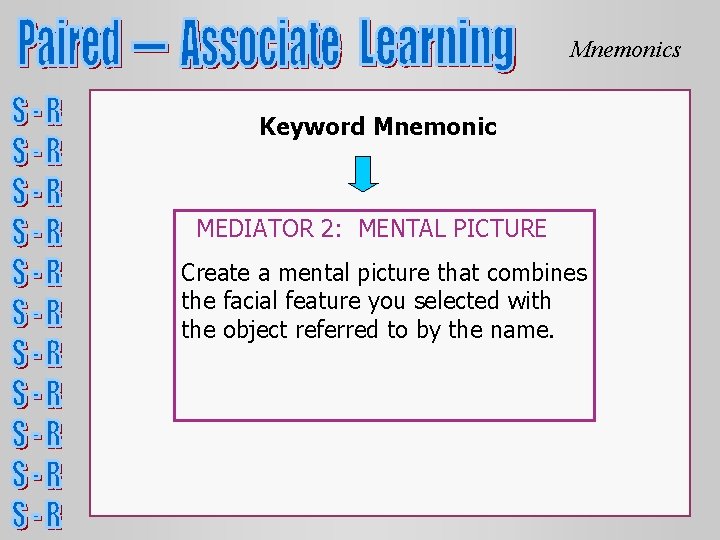
Mnemonics Keyword Mnemonic MEDIATOR 2: MENTAL PICTURE Create a mental picture that combines the facial feature you selected with the object referred to by the name.
Mnemonics Face-Name Mnemonic Mediator 1 Mediator 2 Garrett = Carrot Ms. Garrett Distinctive feature: big ears Next time you see Ms. Garrett, you will notice her big ears. Then you will “see” the carrots hanging from her ears. The carrots will remind you to say Garrett.