
Stages of Formation of a Company Promotion Registration
- Slides: 18
Stages of Formation of a Company • • Promotion Registration or incorporation Capital Subscription Commencement of Business
Promotion – Promotion is the first stage in the formation of a company. It refers to the entire process by which a company is brought into existence. – It starts with the conceptualization of the birth a company and determination of the purpose for which it is to be formed. • Promoters – The persons who conceive the company and invest the initial funds are known as the promoters of the company. – The promoters enter into preliminary contracts with vendors and make arrangements for the preparation, advertisement and the circulation of prospectus and placement of capital. – However, a person who merely acts in his professional capacity on behalf of the promoter (e. g. lawyer, CA, etc) for drawing up the agreement or other documents or prepares the figures on behalf of the promoter and whom the promoter pays is not a promoter. • Pre-Incorporation or Preliminary Contracts – The promoters of a company usually enter into contract to acquire some property or right for the company, which is yet to be incorporated. – Such contracts are called Pre-Incorporation or Preliminary Contracts.
Duties of Promoters �He must not make any secret profit out of the promotion of the company. Secret profit is made by entering into a transaction on his own behalf and then sell to concerned property to the company at a profit without making disclosure of the profit to the company or its members. �He must make full disclosure to the company of all relevant facts including to any profit made by him in transaction with the company. �If the promoter duties are not fulfilled, company may ü Rescind or cancel the contract made and if he has made profit on any related transaction, that profit also may be recovered ü Retain the property paying no more for it then what the promoter has paid for it depriving him of the secret profit ü The company can sue him to for breach of trust. Damages up to the difference between the market value of the property and the contract price can be recovered from him
Reward to Promoters ü The company may to pay some remuneration for the services rendered ü The promoter may make profits on transactions entered by him with the company after making full disclosure to the company and its members ü The promoter may sell his property for fully paid shares in the company after making full disclosures ü The promoter may be given an option to buy further shares in the company ü The promoter may be given commission on shares sold ü The articles of the Company may provide for fixed sum to be paid by the company to him. However, such provision has no legal effect and the promoter cannot sue to enforce it but if the company makes such payment, it cannot recover it back
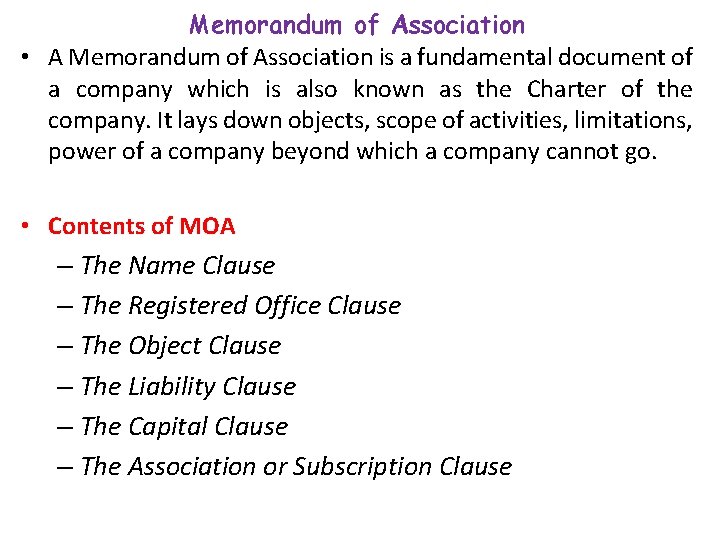
Memorandum of Association • A Memorandum of Association is a fundamental document of a company which is also known as the Charter of the company. It lays down objects, scope of activities, limitations, power of a company beyond which a company cannot go. • Contents of MOA – The Name Clause – The Registered Office Clause – The Object Clause – The Liability Clause – The Capital Clause – The Association or Subscription Clause
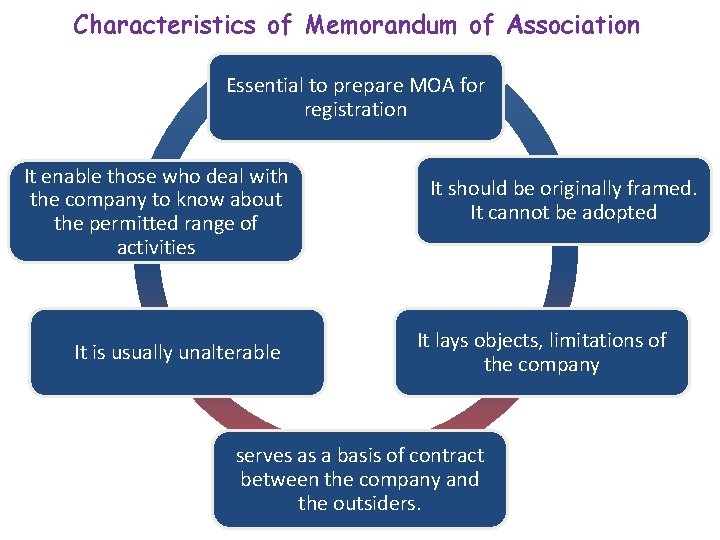
Characteristics of Memorandum of Association Essential to prepare MOA for registration It enable those who deal with the company to know about the permitted range of activities It is usually unalterable It should be originally framed. It cannot be adopted It lays objects, limitations of the company serves as a basis of contract between the company and the outsiders.
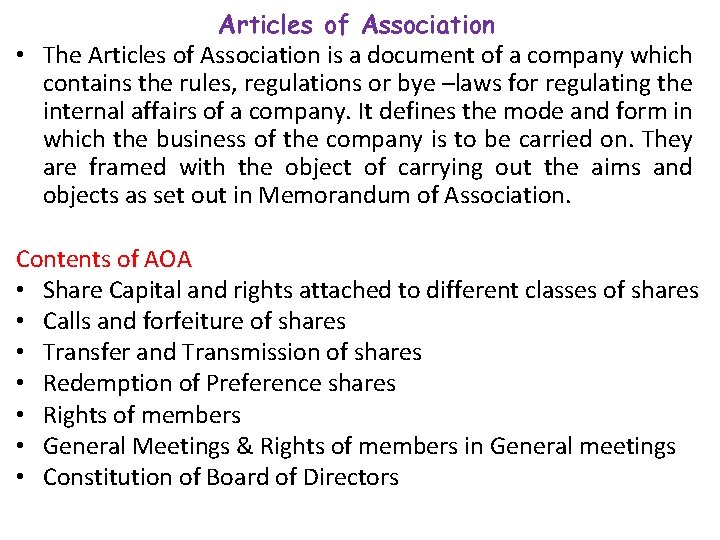
Articles of Association • The Articles of Association is a document of a company which contains the rules, regulations or bye –laws for regulating the internal affairs of a company. It defines the mode and form in which the business of the company is to be carried on. They are framed with the object of carrying out the aims and objects as set out in Memorandum of Association. Contents of AOA • Share Capital and rights attached to different classes of shares • Calls and forfeiture of shares • Transfer and Transmission of shares • Redemption of Preference shares • Rights of members • General Meetings & Rights of members in General meetings • Constitution of Board of Directors
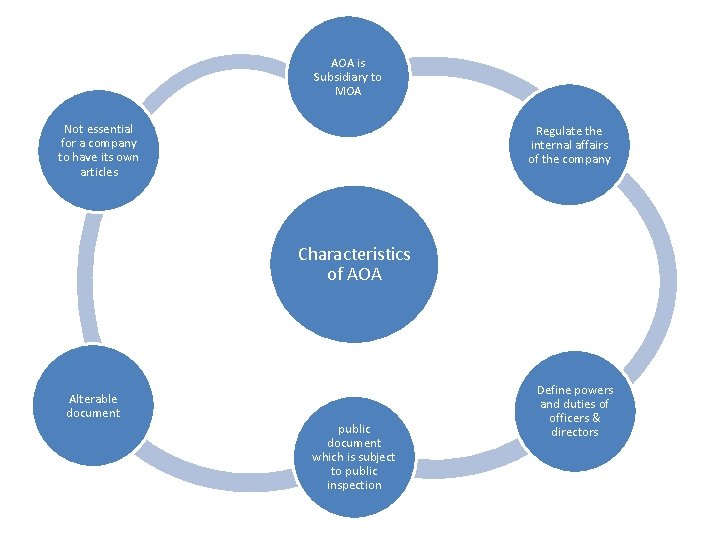
AOA is Subsidiary to MOA Not essential for a company to have its own articles Regulate the internal affairs of the company Characteristics of AOA Alterable document public document which is subject to public inspection Define powers and duties of officers & directors
Registration of the Company ü ü Once the documents have been prepared, vetted, stamped and signed, they must be filed with the Registrar of Companies for incorporating the Company. The following documents must be filed in this connection: The Memorandum of Association duly signed by subscribers and the Articles of Association, if any signed by subscribers to the Memorandum of Association An agreement, if any, which the company proposes to enter into with any individual for appointment as its managing director or whole-time director or manager Following documents should also be submitted: q Form 1 declaration of compliance with the requirements of Companies Act 2013 q Form 10 - notice of situation/ change of situation q Form 32 - Appointment of Directors q Form 29 - Consent to act as Director
Raising Share Capital ü A company may raise capital through q Private Placement q Issue of Prospectus ü Earning onto an agreement with underwriters ü Applying to the stock exchange for listing of shares ü Issue of prospectus inviting public to subscribe ü Allotting shares
Prospectus • According to Companies Act, “prospectus" means any document described or issued as a prospectus and includes any notice, circular, advertisement or other document inviting deposits from the public or inviting offers from the public for the subscription or purchase of any shares in, or debentures of, a body corporate. • If No Public Issue, then a company shall issue a “Statement in lieu of Prospectus” • A private company does not issues prospectus because is prohibited from making any invitation to the public
Certificate of Incorporation • Once all the above documents have been filed and they are found to be in order, the Registrar of Companies will issue Certificate of Incorporation of the Company. • This document is the birth certificate of the company and is proof of the existence of the company. • Once, this certificate is issued, the company cannot cease its existence unless it is dissolved by order of the Court. Certificate of commencement of Business • A certificate of commencement of business is issued by registrar after filing of a declaration by a director or secretary stating that the company has collected the minimum subscription stated in the prospectus and that the directors have taken the qualification shares
Commence of Business • Where a company has issued a prospectus: A company cannot commence business or exercise borrowing powers unless: (a) shares up to the amount of the minimum subscription have been allotted by the company; (b) every director of the company has paid to the company, on each of the shares taken or contracted to be taken by him and for which he is liable to pay in cash, the same proportion as is payable on application and allotment on the shares, offered for public subscription; (c) no money is, or may become, liable to be repaid to the applicants for shares or debentures offered for public subscription, for failure to obtain permission for the shares to be dealt in on any recognised stock exchange;
Alteration of Memorandum • The 2013 Act imposes additional restriction on the alteration of the object clause of the memorandum for a company which had raised money from the public for one or more objects mentioned in the prospectus and has any unutilised money. The 2013 Act specifies that along with obtaining an approval by way of a special resolution, a company would be required to ensure following if it intends to alter its object clause: Ø Publishing the notice of the aforesaid resolution stating the justification of variation in two newspapers Ø Exit option can be given to dissenting shareholders by the promoters and shareholders having control in accordance with the regulations to be specified by the Securities and Exchange Board of India (SEBI)
ü ü • Winding Up of Companies Winding up of a company is defined as a process by which the life of a company is brought to an end and its property administered for the benefit of its members and creditors. An administrator, called the liquidator, is appointed and takes control of the company, collects its assets, pays debts and finally distributes any surplus among the members in accordance with their rights. After winding up, the company will have no assets or liabilities. When the affairs of a company are completely wound up, the dissolution of the company takes place. On dissolution, the company's name is struck off the register of the companies and its legal personality as a corporation comes to an end. Ways of Winding up of Companies Registered Company – Compulsory Winding – Voluntary Winding • Unregistered Company
Compulsory Winding Up of a Registered Company ü If the company has, by a Special Resolution, resolved that the company be wound up by the Tribunal. ü If default is made in delivering the statutory report to the Registrar or in holding the statutory meeting. ü If the company fails to commence its business within one year of its incorporation, or suspends its business for a whole year. ü If the number of members is reduced below the statutory minimum. ü If the company is unable to pay its debts. ü If the tribunal is of the opinion that it is just and equitable that the company should be wound up. ü Tribunal may inquire into the revival and rehabilitation of sick units. It its revival is unlikely, the tribunal can order its winding up. ü If company has made default in filing with the Registrar its balance sheet and P&L account or annual return for any 5 consecutive financial years ü If the company has acted against the interests of the sovereignty and integrity of India, the security of the State, friendly relations with foreign States, public order, decency or morality
Voluntary Winding Up of a Registered Company ü When a company is wound up by the members or the creditors without the intervention of Tribunal, it is called as voluntary winding up. It may take place by: ü By passing an ordinary resolution in the general meeting if : (i) the period fixed for the duration of the company by the articles has expired; or (ii) some event on the happening of which company is to be dissolved, has happened. ü By passing a special resolution to wind up voluntarily for any reason whatsoever. ü Within 14 days of passing the resolution, whether ordinary or special, it must be advertised in the Official Gazette and also in some important newspaper circulating in the district of the registered office of the company.
Winding Up of an Unregistered Company ü an unregistered company includes any partnership, association, or company consisting of more than seven persons at the time when petition for winding up is presented. ü If the company has been dissolved or has ceased to carry on business or is carrying on business only for the purpose of winding up its affairs. ü If the company is unable to pay its debts. ü If the Tribunal regards it as just and equitable to wind up the company.