
Stages of Development PERSONALITY Piagets Stages of Cognitive



- Slides: 12
Stages of Development PERSONALITY
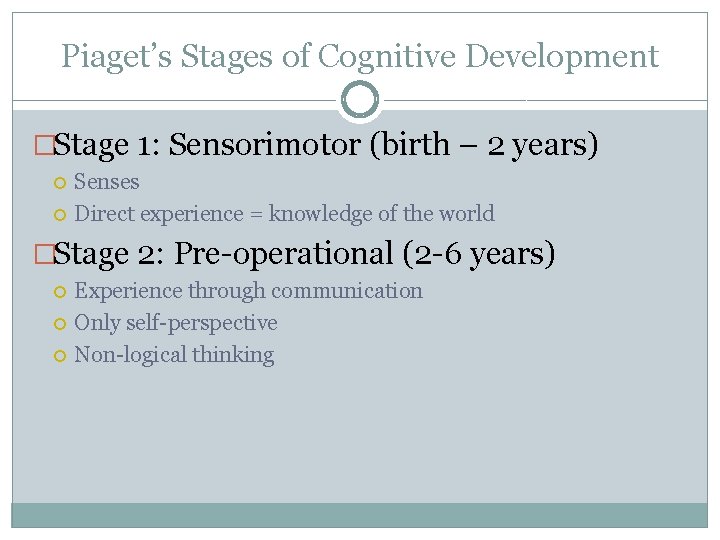
Piaget’s Stages of Cognitive Development �Stage 1: Sensorimotor (birth – 2 years) Senses Direct experience = knowledge of the world �Stage 2: Pre-operational (2 -6 years) Experience through communication Only self-perspective Non-logical thinking
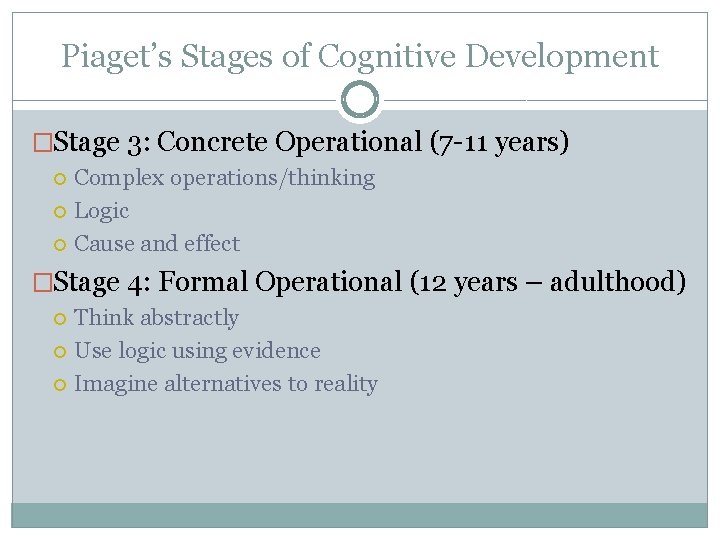
Piaget’s Stages of Cognitive Development �Stage 3: Concrete Operational (7 -11 years) Complex operations/thinking Logic Cause and effect �Stage 4: Formal Operational (12 years – adulthood) Think abstractly Use logic using evidence Imagine alternatives to reality
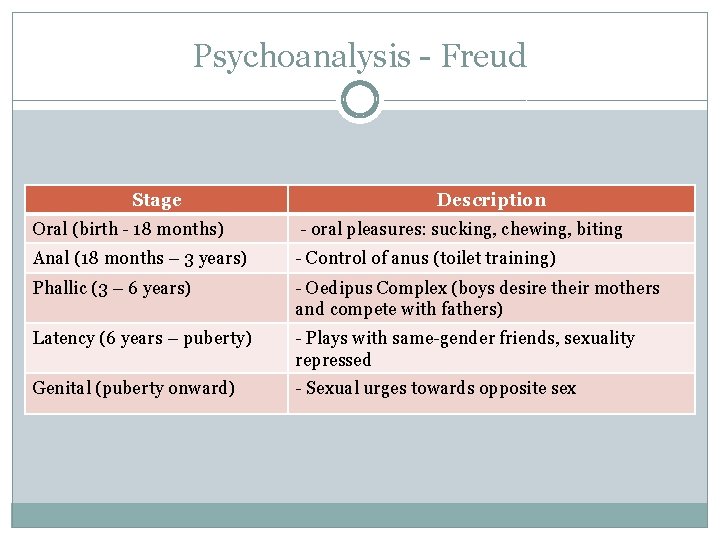
Psychoanalysis - Freud Stage Description Oral (birth - 18 months) - oral pleasures: sucking, chewing, biting Anal (18 months – 3 years) - Control of anus (toilet training) Phallic (3 – 6 years) - Oedipus Complex (boys desire their mothers and compete with fathers) Latency (6 years – puberty) - Plays with same-gender friends, sexuality repressed Genital (puberty onward) - Sexual urges towards opposite sex
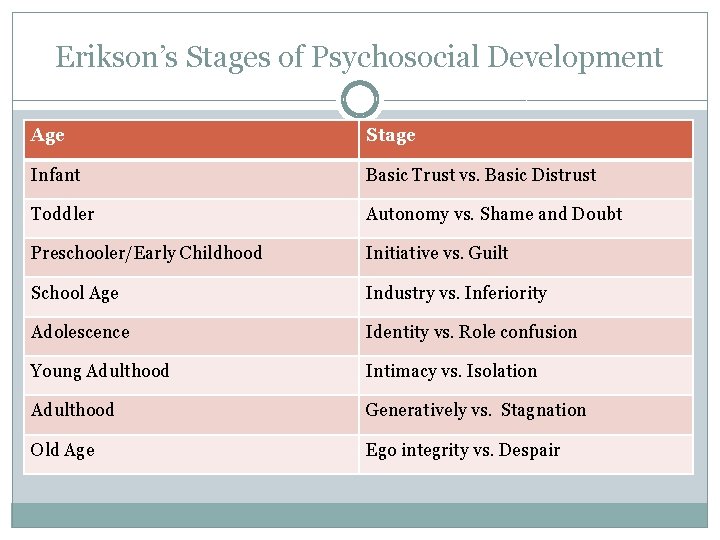
Erikson’s Stages of Psychosocial Development Age Stage Infant Basic Trust vs. Basic Distrust Toddler Autonomy vs. Shame and Doubt Preschooler/Early Childhood Initiative vs. Guilt School Age Industry vs. Inferiority Adolescence Identity vs. Role confusion Young Adulthood Intimacy vs. Isolation Adulthood Generatively vs. Stagnation Old Age Ego integrity vs. Despair
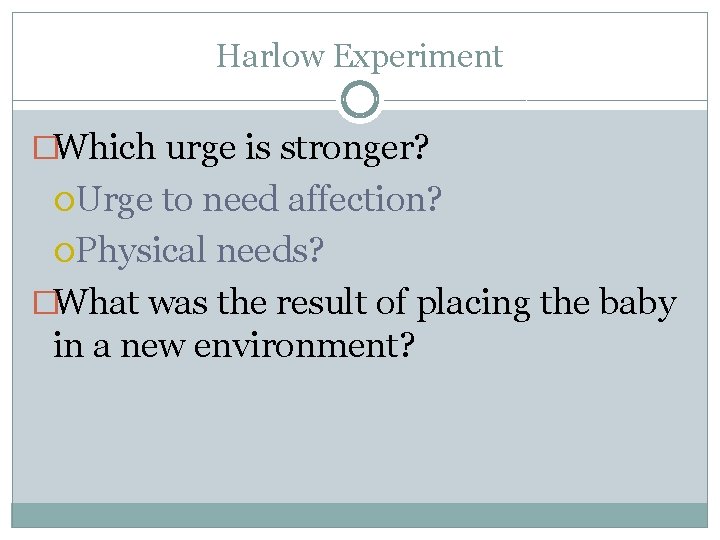
Harlow Experiment �Which urge is stronger? Urge to need affection? Physical needs? �What was the result of placing the baby in a new environment?
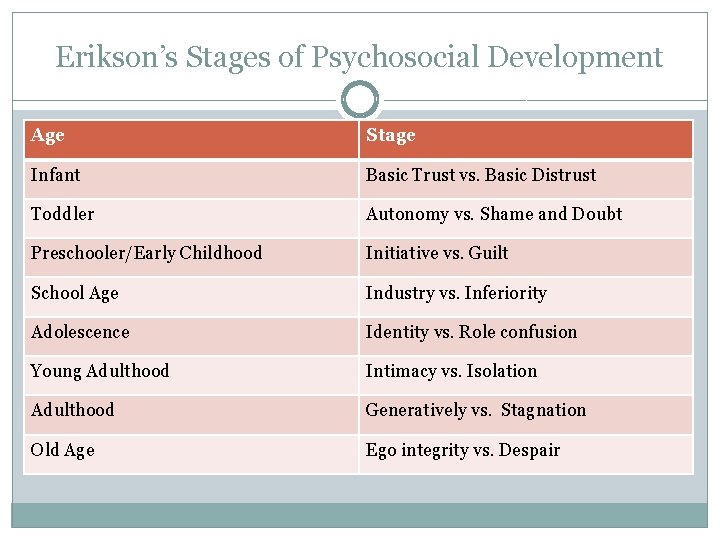
Erikson’s Stages of Psychosocial Development Age Stage Infant Basic Trust vs. Basic Distrust Toddler Autonomy vs. Shame and Doubt Preschooler/Early Childhood Initiative vs. Guilt School Age Industry vs. Inferiority Adolescence Identity vs. Role confusion Young Adulthood Intimacy vs. Isolation Adulthood Generatively vs. Stagnation Old Age Ego integrity vs. Despair
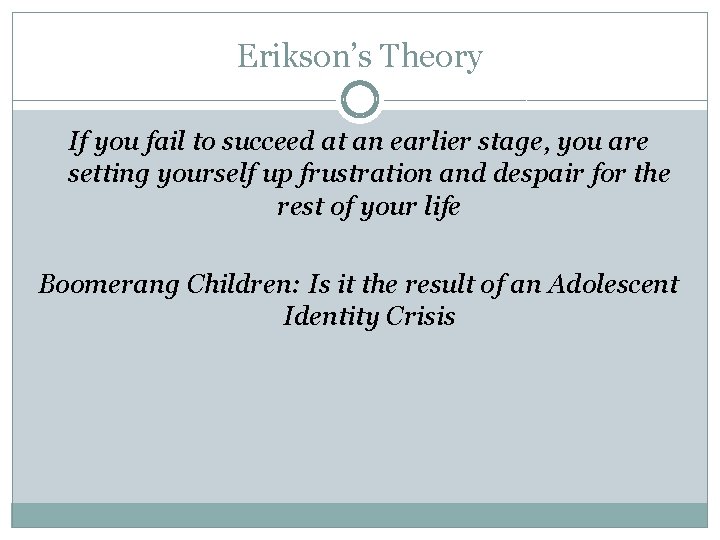
Erikson’s Theory If you fail to succeed at an earlier stage, you are setting yourself up frustration and despair for the rest of your life Boomerang Children: Is it the result of an Adolescent Identity Crisis
Sources �Sproule, Wayne. Our Social World: An Introduction to Anthropology, Psychology and Sociology. Toronto: Prentice Hall, 2001. �Weiten, Wayne and Doug Mc. Cann. Psychology: Themes and Variations. Toronto: Thomas Canada Limited, 2007. �Haskings-Winner, Jan. Social Science: An Introduction. Toronto: Mc. Graw-Hill Ryerson Ltd, 2011.