
Stages of Collaboration Begins with interaction participants show
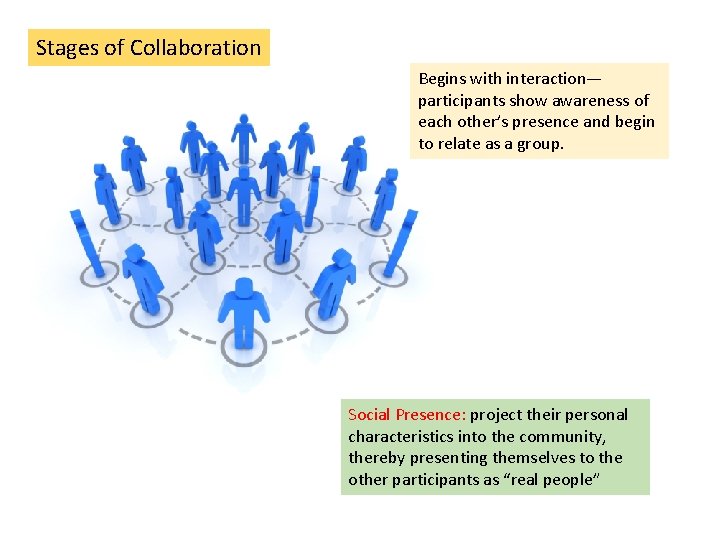
Stages of Collaboration Begins with interaction— participants show awareness of each other’s presence and begin to relate as a group. Social Presence: project their personal characteristics into the community, thereby presenting themselves to the other participants as “real people”
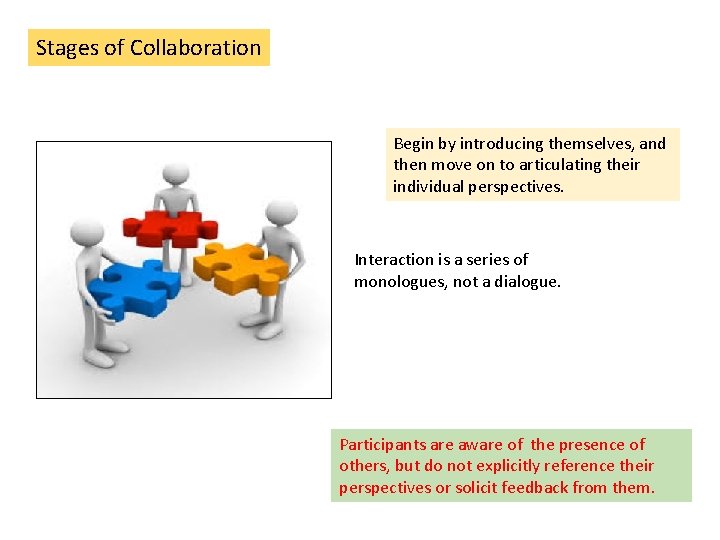
Stages of Collaboration Begin by introducing themselves, and then move on to articulating their individual perspectives. Interaction is a series of monologues, not a dialogue. Participants are aware of the presence of others, but do not explicitly reference their perspectives or solicit feedback from them.
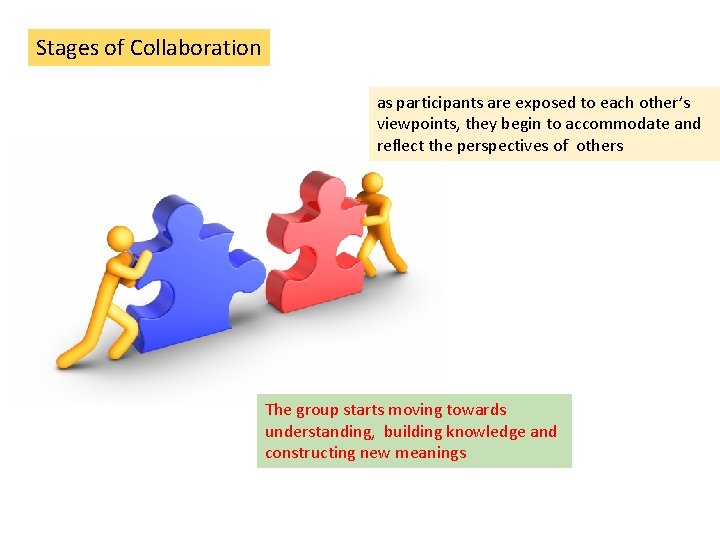
Stages of Collaboration as participants are exposed to each other’s viewpoints, they begin to accommodate and reflect the perspectives of others The group starts moving towards understanding, building knowledge and constructing new meanings

Stages of Collaboration As participants articulate and externalise their perspectives, areas of differences, disagreement or conflict become explicit. When individuals’ perspectives are challenged, they must work together to produce shared meanings Questioning, evaluating and criticising other's perspectives, beliefs and assumptions allows participants to restructure their thinking.
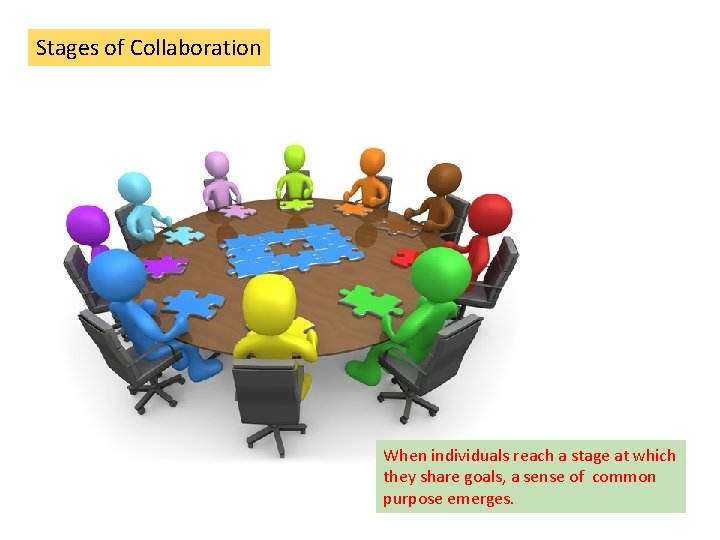
Stages of Collaboration When individuals reach a stage at which they share goals, a sense of common purpose emerges.

Stages of Collaboration It is at this point that individuals give up their individuality to work together. ‘To collaborate (co-labour) means to work together, which implies a concept of shared goals’ (Kaye, 1992)

Stages of Collaboration True collaboration in not four individuals working in the same place, but four people producing something greater than they could ever achieve on their own. No matter good you are at football, you cannot win a game by yourself. No matter how many gifted players you have they won’t win unless they play as a team.
That’s why businesses value collaboration and want people who can work as a team. Technology does not produce collaboration, it provides an environment in which collaboration can occur. It has to be managed.
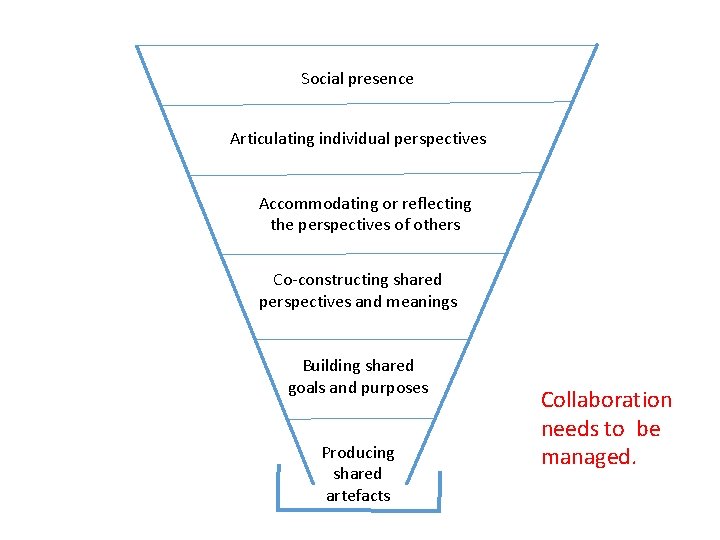
Social presence Articulating individual perspectives Accommodating or reflecting the perspectives of others Co-constructing shared perspectives and meanings Building shared goals and purposes Producing shared artefacts Collaboration needs to be managed.

Sources Murphy, E. (2004). Recognising and Promoting Collaboration in an Online Asynchronous Discussion. British Journal of Educational Technology, 35 (4) 421431.
- Slides: 10