
Stage 2 English External Study External Assessment 30
- Slides: 9
Stage 2 English External Study
External Assessment (30%) • Assessment Type 3: Comparative Analysis • Students complete a written comparative analysis of two texts and evaluate how the language features, stylistic features, and conventions in these texts are used to represent ideas, perspectives, and/or aspects of culture, and to influence audiences.
Comparative Analysis 30% • These texts can be selected from one or more of the following categories: • extended texts: a novel, a graphic novel, a collection of short stories, a biography, or other non-fiction prose text • poetry: a poet study, anthology, theme study or song lyrics • drama texts: a drama text or performance • film texts: a feature film • media texts: television, advertisements, talkback radio programs, magazines, technical journals, news presentations, sports reporting, political commentary or cartoons, editorials, websites, social media, blogs, podcasts, gaming, and other forms of digital media.
Drawing on Prior Learning • In completing their comparative analysis students may draw on learning from, but must not use, texts read or viewed in other parts of the assessment program. However, students may use texts that are similar in type and purpose. • Students are equally encouraged to further develop their learning from school assessment which offers opportunities to develop their skills in comparative analysis: • Responding to Texts – One piece can compare one or more texts • Creating Texts – Writer’s Statement can draw comparison between two created texts
Independent Study • The comparative analysis must be a product of independent study, but it is appropriate for teachers to advise and support students in choosing texts to compare. Students must not complete the comparative analysis as a shared exercise.
Word Count • The comparative analysis should be a maximum of 2000 words. • Students need to state their word count at the end of their document. • There will also be a cover sheet for External Assessment available on the SACE Board website which will be attached to student work, similar to the one used previously for the Folio.
Performance Standards • Student achievement will be judged using all of the Performance Standards. • Knowledge and Understanding • Analysis • Application • Ensure you are using Performance Standards from 2017 and not 2016 as there are significant changes.
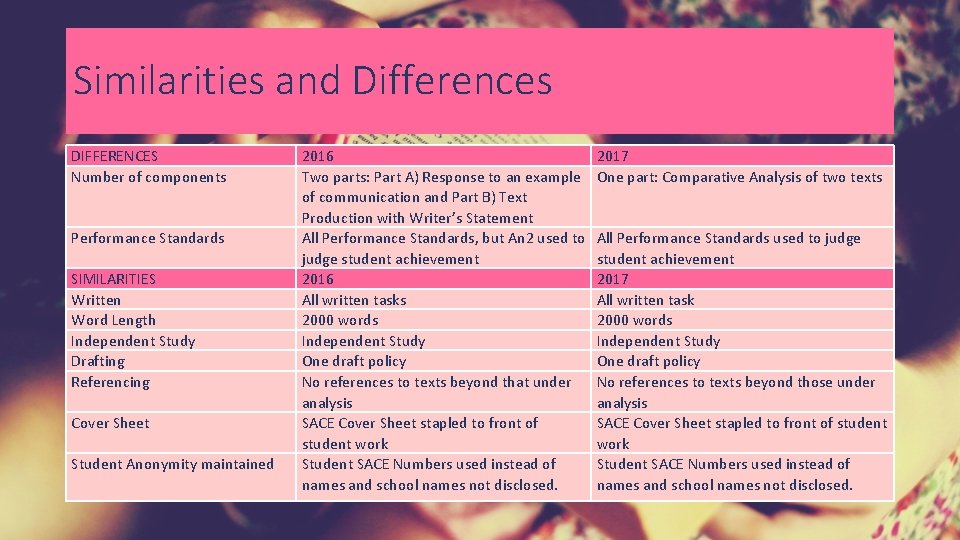
Similarities and Differences DIFFERENCES Number of components Performance Standards SIMILARITIES Written Word Length Independent Study Drafting Referencing Cover Sheet Student Anonymity maintained 2016 Two parts: Part A) Response to an example of communication and Part B) Text Production with Writer’s Statement All Performance Standards, but An 2 used to judge student achievement 2016 All written tasks 2000 words Independent Study One draft policy No references to texts beyond that under analysis SACE Cover Sheet stapled to front of student work Student SACE Numbers used instead of names and school names not disclosed. 2017 One part: Comparative Analysis of two texts All Performance Standards used to judge student achievement 2017 All written task 2000 words Independent Study One draft policy No references to texts beyond those under analysis SACE Cover Sheet stapled to front of student work Student SACE Numbers used instead of names and school names not disclosed.
Strategies • Suggestions about how to support students to complete their External Assessment. • • • Text choice Comparison Scaffolding Drafting Editing