
Stage 2 Disinfection Byproduct Rule Proposal Stage 1
Stage 2 Disinfection Byproduct Rule Proposal
Stage 1 Disinfection Byproducts Rule (DBPR) • DBP MCLs: – TTHM 80 ug/L as a running annual average (RAA) – HAA 5 60 ug/L as an RAA – Bromate 10 ug/L as a RAA • Enhanced Coagulation/Softening Treatment Technique requirement.
Stage 2 DBPR Regulatory Development Process • EPA negotiated with a Federal Advisory Committee which developed recommendations • FACA met from 3/30/99 to 9/6/00 • 21 members from different stakeholder groups • Data analysis – treatment and occurrence data: ICR, National Rural Water Survey, Supplemental Surveys, State data – Cost analysis • Focus of DBP health concern on reproductive & developmental health effects.
Why is the Stage 2 DBPR Needed? • DBP reproductive & developmental health effects – Epidemiology studies: miscarriage, stillbirth, birth defects, low birth weight. • Not enough data to prove causality or estimate dose levels but epidemiological studies suggest that DBPs are likely to be reproductive toxicants under appropriate exposure conditions. – Toxicology studies. • Toxicology screening studies suggest that some DBPs may be reproductive/developmental hazard • DBP cancer health effect risks • DBP levels at some sites regularly exceed MCL
Stage 2 M-DBPR Advisory Committee Recommendations • Stage 2 DBPR & LT 2 ESWTR negotiated together. • Agreement in Principle signed September 2000. – http: //www. epa. gov/fedrgstr/EPA-WATER/2000/December/Day-29/w 33306. htm • Consensus on Stage 2 DBPR recommendations • Phased MCLs: locational running annual average • LRAA = annual average at each monitoring site • Phase 1: TTHM/HAA 5 = 120/100 ug/L • Phase 2: TTHM/HAA 5 = 80/60 ug/L • Initial distribution system evaluation (IDSE) to find new compliance monitoring sites at points with highest DBP levels. • System compliance schedules
Basis for LRAA & IDSE • Intent of rule is to focus on DBP peaks • Peaks in DBP levels in distribution system when compliance based on RAA. – Populations in different parts of the distribution system will receive equitable health protection. • Do Stage 1 DBPR compliance sites capture the highest DBPs in the distribution system? • Maximum residence time locations do not always capture highest DBP occurrence. – TTHM & HAA 5 highest levels often occur in different places.
Who is Required to Comply with the Stage 2 DBPR? • Community and nontransient noncommunity water systems that add a primary or residual disinfectant other than ultraviolet light or deliver water that has been treated with a primary or residual disinfectant other than ultraviolet light.
System Compliance Requirements • Stage 2 DBPR is very similar to Stage 1 DBPR • Change in compliance calculation from RAA to LRAA – Routine monitoring on same schedule • Some systems will monitor at one extra site. • new sites determined by IDSE – Same type of reduced monitoring provisions for systems with low DBPs • IDSE – Monitoring for 1 year or site-specific data study – Opportunities for waivers and monitoring outs • Small systems consecutive to large systems are required to comply on the same schedule as the larger system.
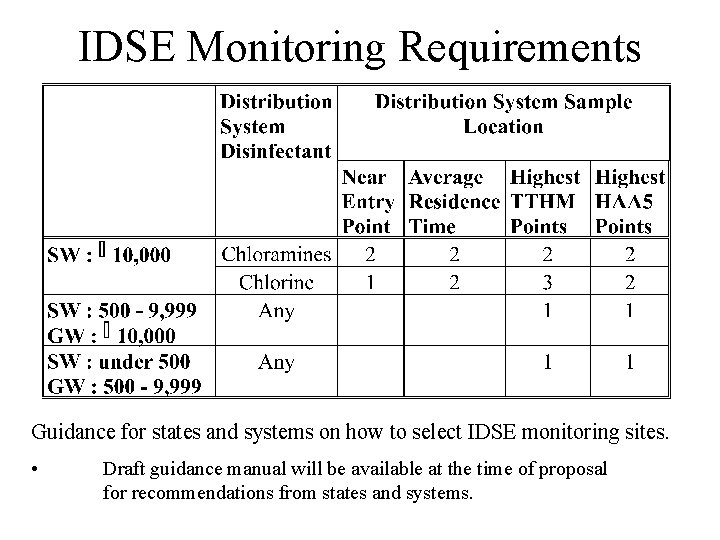
IDSE Monitoring Requirements Guidance for states and systems on how to select IDSE monitoring sites. • Draft guidance manual will be available at the time of proposal for recommendations from states and systems.
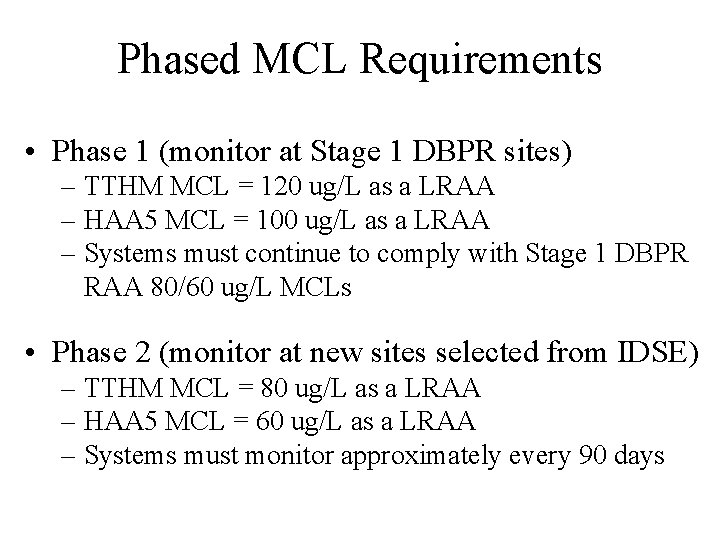
Phased MCL Requirements • Phase 1 (monitor at Stage 1 DBPR sites) – TTHM MCL = 120 ug/L as a LRAA – HAA 5 MCL = 100 ug/L as a LRAA – Systems must continue to comply with Stage 1 DBPR RAA 80/60 ug/L MCLs • Phase 2 (monitor at new sites selected from IDSE) – TTHM MCL = 80 ug/L as a LRAA – HAA 5 MCL = 60 ug/L as a LRAA – Systems must monitor approximately every 90 days
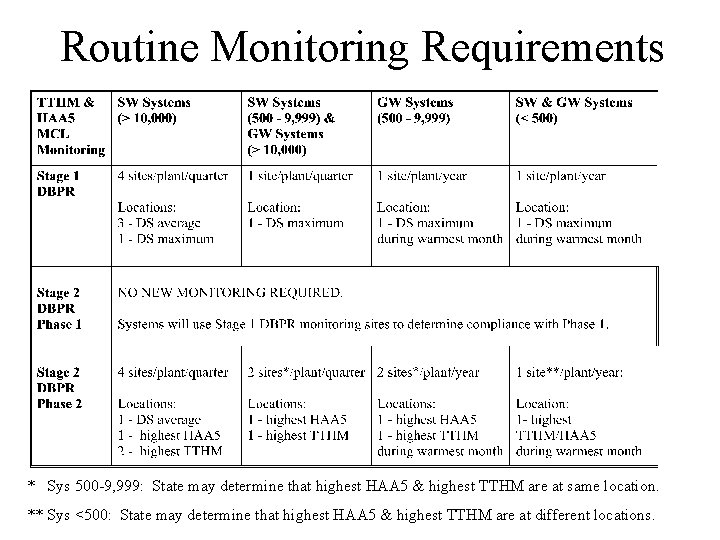
Routine Monitoring Requirements * Sys 500 -9, 999: State may determine that highest HAA 5 & highest TTHM are at same location. ** Sys <500: State may determine that highest HAA 5 & highest TTHM are at different locations.
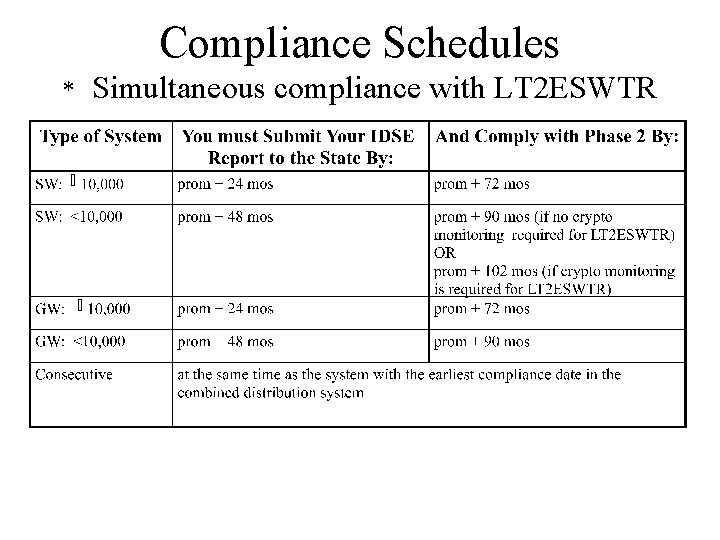
Compliance Schedules * Simultaneous compliance with LT 2 ESWTR
EPA Rule Development Schedule • • Draft Guidance Manual for IDSE at Proposal Late 2001 Final Rule Statutory Deadline May 2002 Consistent with statutory requirements for risk balancing, EPA will finalize a Long Term 2 Enhanced Surface Water Treatment Rule along with the Stage 2 Disinfectants and Disinfection Byproducts Rule, to ensure a proper balance between microbial and disinfection byproduct risks (Section 1412(b)(5)).
- Slides: 13