
Stage 2 Analysis of skills demand Identification of





- Slides: 28
Stage 2: Analysis of skills demand • Identification of the strengths and weaknesses in labour markets • Exploration of skill needs based on current and future demand • Insight into business and employer environments
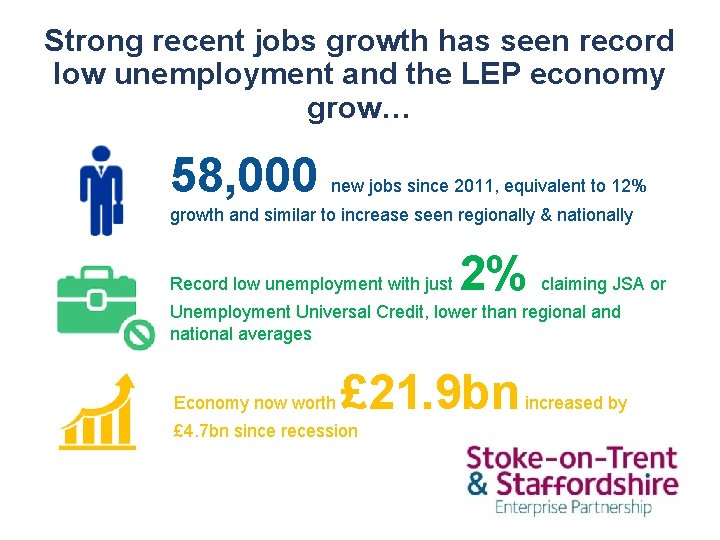
Strong recent jobs growth has seen record low unemployment and the LEP economy grow… 58, 000 new jobs since 2011, equivalent to 12% growth and similar to increase seen regionally & nationally Record low unemployment with just 2% claiming JSA or Unemployment Universal Credit, lower than regional and national averages Economy now worth £ 21. 9 bn £ 4. 7 bn since recession increased by
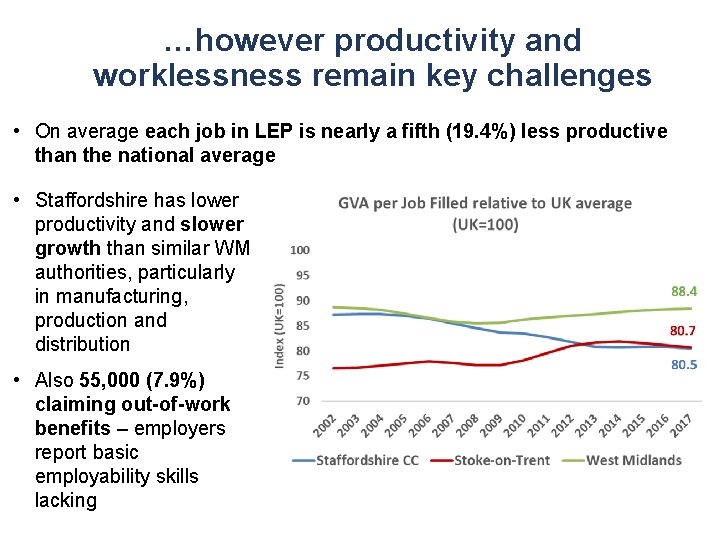
…however productivity and worklessness remain key challenges • On average each job in LEP is nearly a fifth (19. 4%) less productive than the national average • Staffordshire has lower productivity and slower growth than similar WM authorities, particularly in manufacturing, production and distribution • Also 55, 000 (7. 9%) claiming out-of-work benefits – employers report basic employability skills lacking
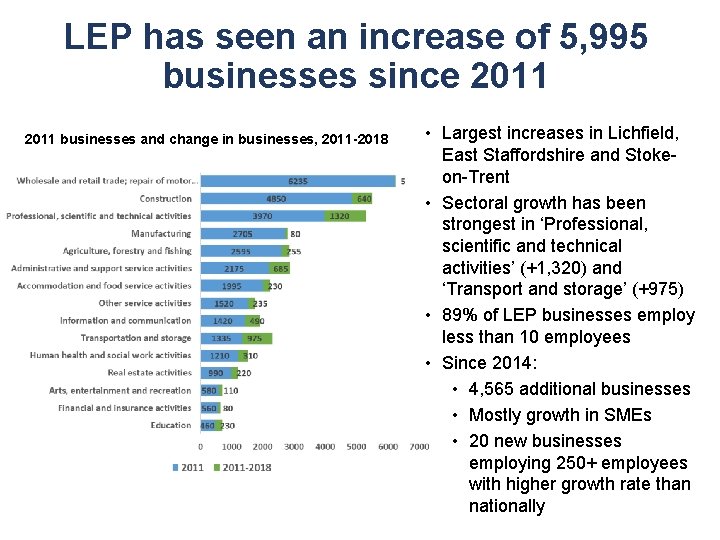
LEP has seen an increase of 5, 995 businesses since 2011 businesses and change in businesses, 2011 -2018 • Largest increases in Lichfield, East Staffordshire and Stokeon-Trent • Sectoral growth has been strongest in ‘Professional, scientific and technical activities’ (+1, 320) and ‘Transport and storage’ (+975) • 89% of LEP businesses employ less than 10 employees • Since 2014: • 4, 565 additional businesses • Mostly growth in SMEs • 20 new businesses employing 250+ employees with higher growth rate than nationally
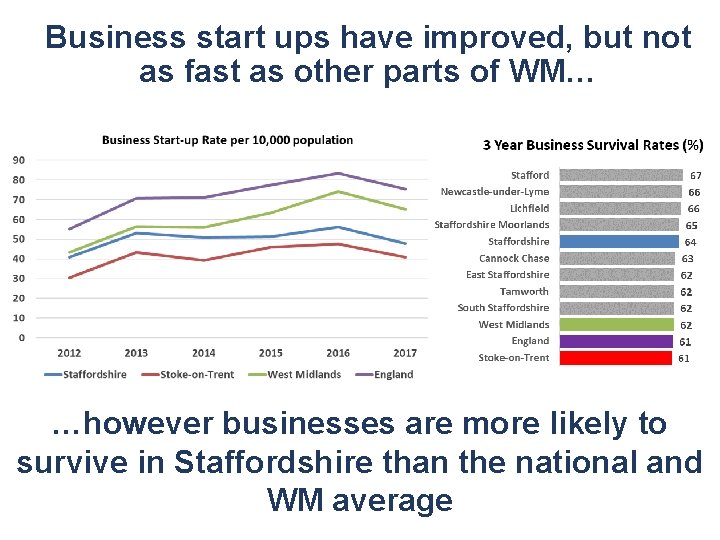
Business start ups have improved, but not as fast as other parts of WM… …however businesses are more likely to survive in Staffordshire than the national and WM average
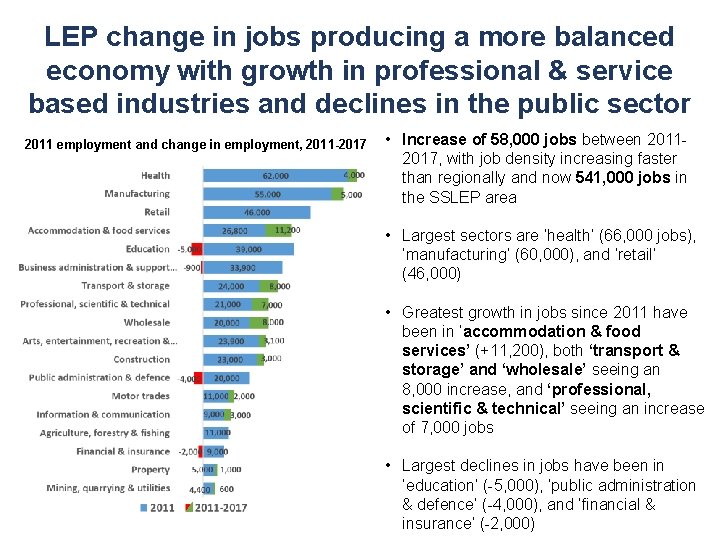
LEP change in jobs producing a more balanced economy with growth in professional & service based industries and declines in the public sector 2011 employment and change in employment, 2011 -2017 • Increase of 58, 000 jobs between 20112017, with job density increasing faster than regionally and now 541, 000 jobs in the SSLEP area • Largest sectors are ‘health’ (66, 000 jobs), ‘manufacturing’ (60, 000), and ‘retail’ (46, 000) • Greatest growth in jobs since 2011 have been in ‘accommodation & food services’ (+11, 200), both ‘transport & storage’ and ‘wholesale’ seeing an 8, 000 increase, and ‘professional, scientific & technical’ seeing an increase of 7, 000 jobs • Largest declines in jobs have been in ‘education’ (-5, 000), ‘public administration & defence’ (-4, 000), and ‘financial & insurance’ (-2, 000)
How likely are residents to be economically active and in employment? • Staffordshire has a higher proportion (81%) of people who are economically active and participating in the labour market than the regional (77%) and national (79%) averages • Staffordshire’s employment rate (79%) is also higher than both the regional (73%) and national (75%) averages, while the unemployment is lower than seen regionally and nationally • In contrast Stoke-on-Trent has economic activity and employment rates below the regional and national averages, with unemployment higher • Of those economically inactive, Staffordshire and Stoke-on-Trent have lower proportions of residents who want a job than the regional and national averages
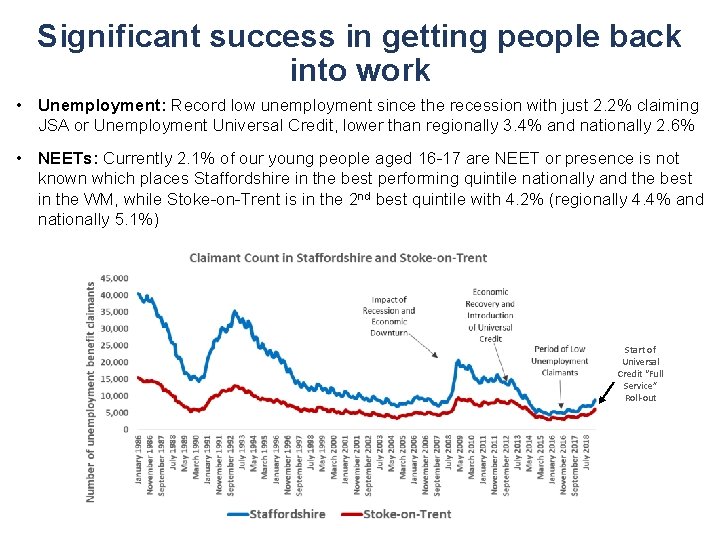
Significant success in getting people back into work • Unemployment: Record low unemployment since the recession with just 2. 2% claiming JSA or Unemployment Universal Credit, lower than regionally 3. 4% and nationally 2. 6% • NEETs: Currently 2. 1% of our young people aged 16 -17 are NEET or presence is not known which places Staffordshire in the best performing quintile nationally and the best in the WM, while Stoke-on-Trent is in the 2 nd best quintile with 4. 2% (regionally 4. 4% and nationally 5. 1%) Start of Universal Credit “Full Service” Roll-out
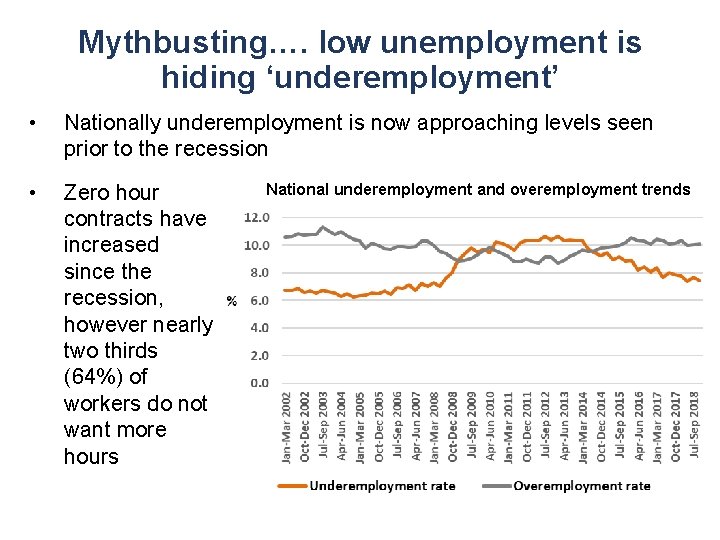
Mythbusting…. low unemployment is hiding ‘underemployment’ • Nationally underemployment is now approaching levels seen prior to the recession • Zero hour contracts have increased since the recession, however nearly two thirds (64%) of workers do not want more hours National underemployment and overemployment trends
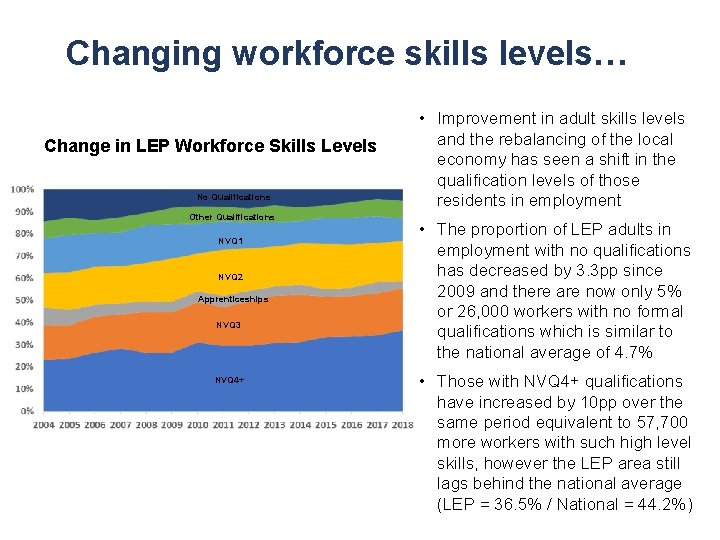
Changing workforce skills levels… Change in LEP Workforce Skills Levels No Qualifications Other Qualifications NVQ 1 NVQ 2 Apprenticeships NVQ 3 NVQ 4+ • Improvement in adult skills levels and the rebalancing of the local economy has seen a shift in the qualification levels of those residents in employment • The proportion of LEP adults in employment with no qualifications has decreased by 3. 3 pp since 2009 and there are now only 5% or 26, 000 workers with no formal qualifications which is similar to the national average of 4. 7% • Those with NVQ 4+ qualifications have increased by 10 pp over the same period equivalent to 57, 700 more workers with such high level skills, however the LEP area still lags behind the national average (LEP = 36. 5% / National = 44. 2%)
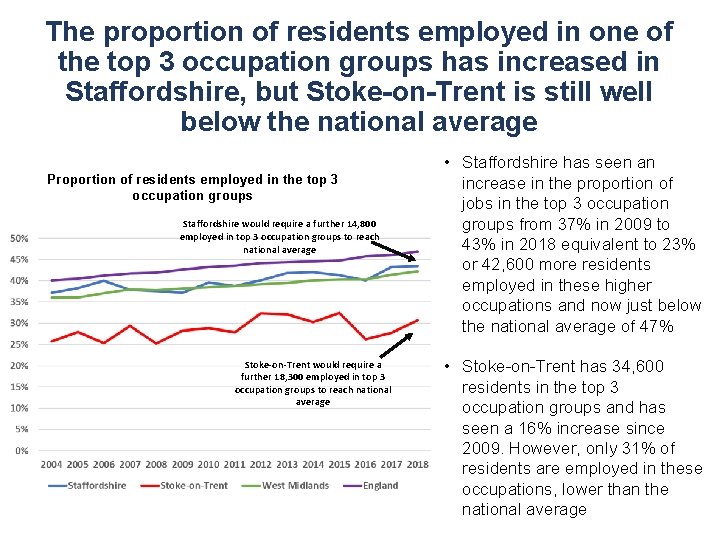
The proportion of residents employed in one of the top 3 occupation groups has increased in Staffordshire, but Stoke-on-Trent is still well below the national average Proportion of residents employed in the top 3 occupation groups Staffordshire would require a further 14, 800 employed in top 3 occupation groups to reach national average Stoke-on-Trent would require a further 18, 300 employed in top 3 occupation groups to reach national average • Staffordshire has seen an increase in the proportion of jobs in the top 3 occupation groups from 37% in 2009 to 43% in 2018 equivalent to 23% or 42, 600 more residents employed in these higher occupations and now just below the national average of 47% • Stoke-on-Trent has 34, 600 residents in the top 3 occupation groups and has seen a 16% increase since 2009. However, only 31% of residents are employed in these occupations, lower than the national average
Improving wages levels but still lower than average… Resident Earnings • Resident earnings in Staffordshire now stand at £ 28, 407 and have grown by £ 3, 370 or 13. 5% since 2011 (Stoke-on-Trent £ 24, 907 up 17. 4%) • Staffordshire workplace earnings are currently £ 26, 442 and have grown by £ 3, 068 or 13. 1% since 2011 – indication of better paid jobs in Staffordshire which is likely to be a key factor in the growth of resident earnings (Stoke-on-Trent £ 26, 186 up 15. 4%) • For both measures Staffordshire has seen faster growth than nationally however still below the national averages and for workplace earnings below the regional average • Stoke-on-Trent has seen faster growth in both measures than the growth seen regionally and nationally, but remains well below both the regional and national averages Workplace Earnings
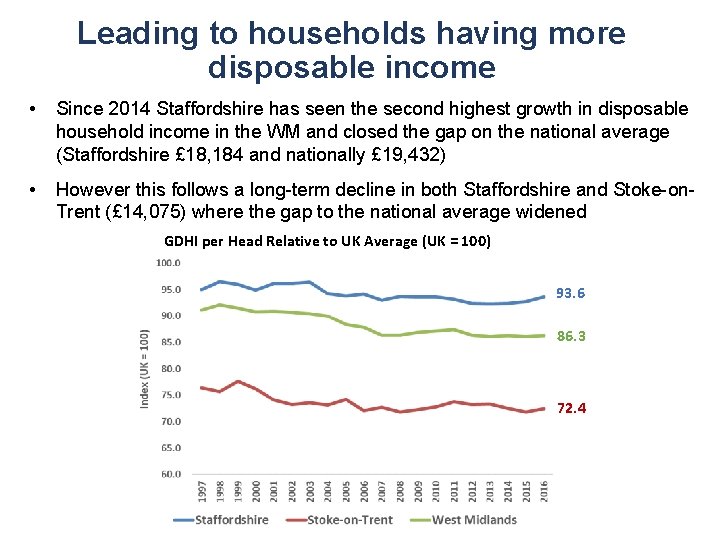
Leading to households having more disposable income • Since 2014 Staffordshire has seen the second highest growth in disposable household income in the WM and closed the gap on the national average (Staffordshire £ 18, 184 and nationally £ 19, 432) • However this follows a long-term decline in both Staffordshire and Stoke-on. Trent (£ 14, 075) where the gap to the national average widened GDHI per Head Relative to UK Average (UK = 100) 93. 6 86. 3 72. 4
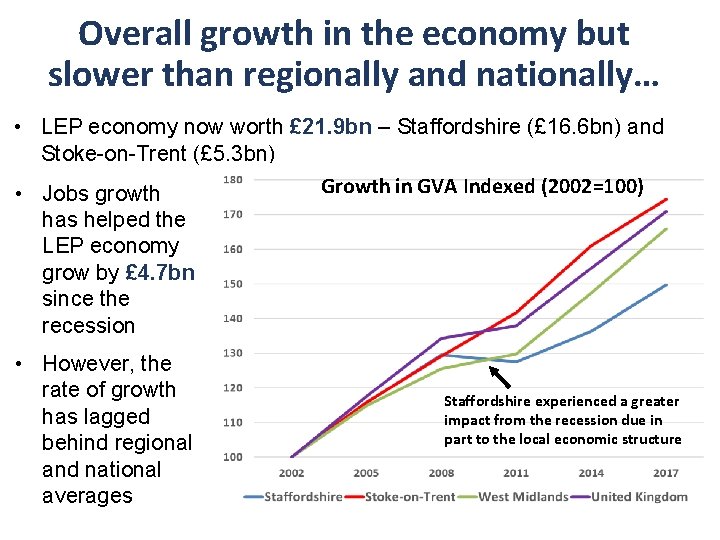
Overall growth in the economy but slower than regionally and nationally… • LEP economy now worth £ 21. 9 bn – Staffordshire (£ 16. 6 bn) and Stoke-on-Trent (£ 5. 3 bn) Growth in GVA Indexed (2002=100) • Jobs growth has helped the LEP economy grow by £ 4. 7 bn since the recession • However, the rate of growth has lagged behind regional and national averages Staffordshire experienced a greater impact from the recession due in part to the local economic structure
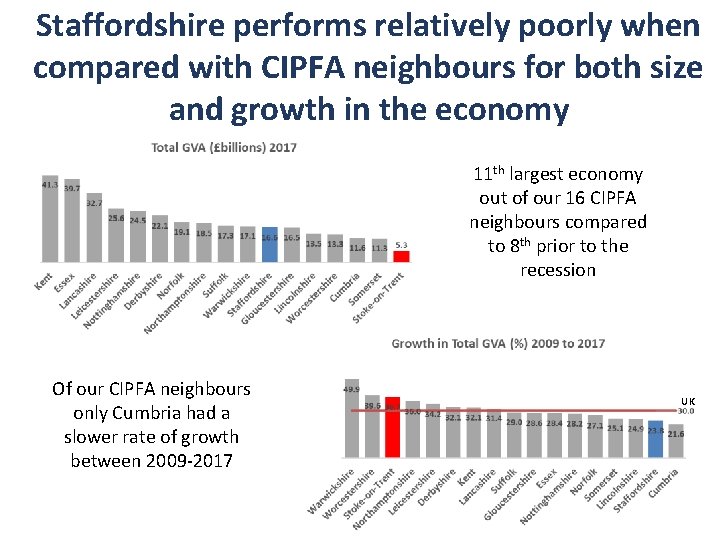
Staffordshire performs relatively poorly when compared with CIPFA neighbours for both size and growth in the economy 11 th largest economy out of our 16 CIPFA neighbours compared to 8 th prior to the recession Of our CIPFA neighbours only Cumbria had a slower rate of growth between 2009 -2017 UK
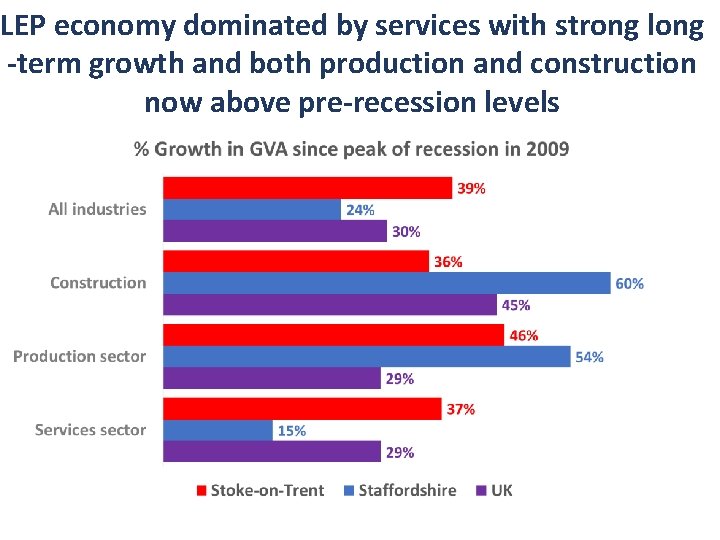
LEP economy dominated by services with strong long -term growth and both production and construction now above pre-recession levels • Services contribute nearly 3 quarters (72. 7% or £ 15. 9 billion) of total GVA • Production generates just under a fifth (19. 5% or £ 4. 3 billion) • The remaining 7. 9% or £ 1. 7 billion comes from Construction
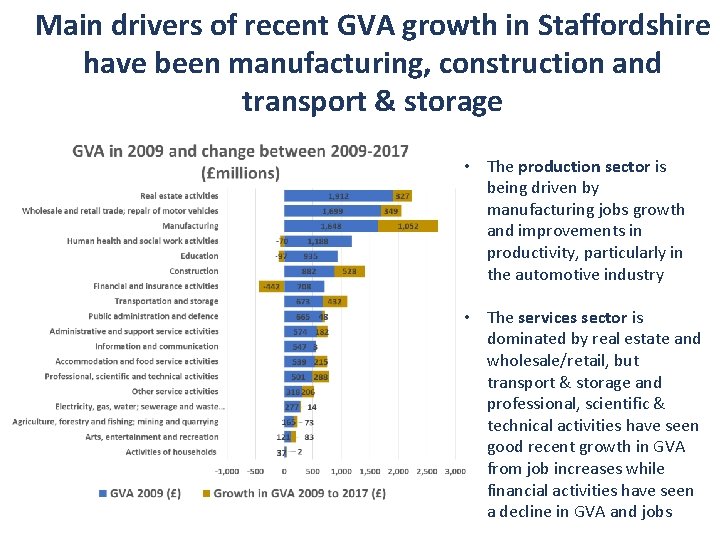
Main drivers of recent GVA growth in Staffordshire have been manufacturing, construction and transport & storage • The production sector is being driven by manufacturing jobs growth and improvements in productivity, particularly in the automotive industry • The services sector is dominated by real estate and wholesale/retail, but transport & storage and professional, scientific & technical activities have seen good recent growth in GVA from job increases while financial activities have seen a decline in GVA and jobs
Main drivers of recent GVA growth in Stoke-on. Trent have been manufacturing, health & social care and retail • The production sector is being driven by manufacturing jobs growth and improvements in productivity, particularly in the manufacture of petroleum, chemicals and other minerals • The services sector is dominated by wholesale/retail and health & social care, with both seeing good recent growth in GVA. Also accommodation & food and information & communications have seen fast proportion growth, while financial activities have seen a decline in GVA
Wide variation in the economic contribution of Staffordshire districts/boroughs WM = 36. 9% UK = 30%
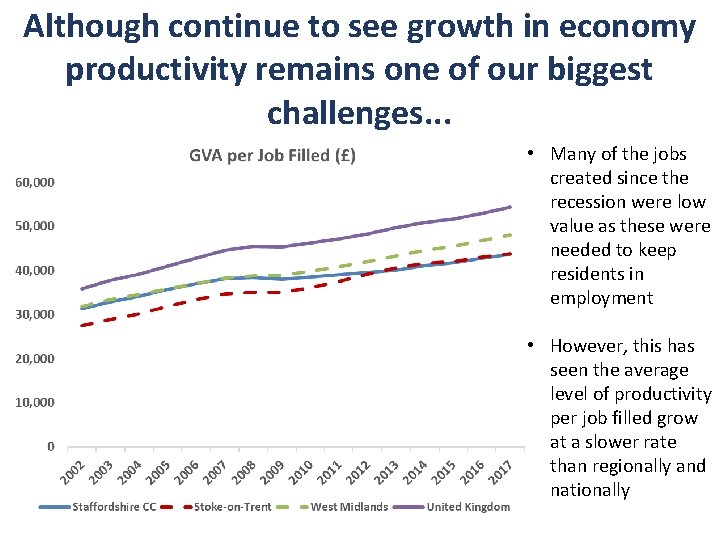
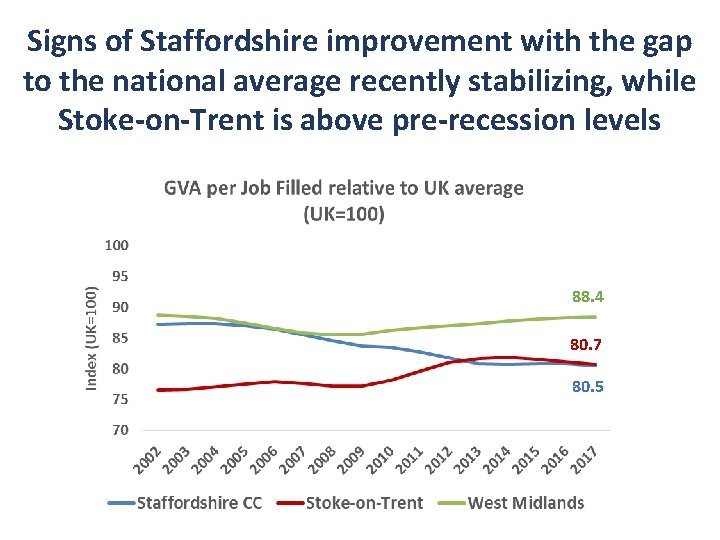
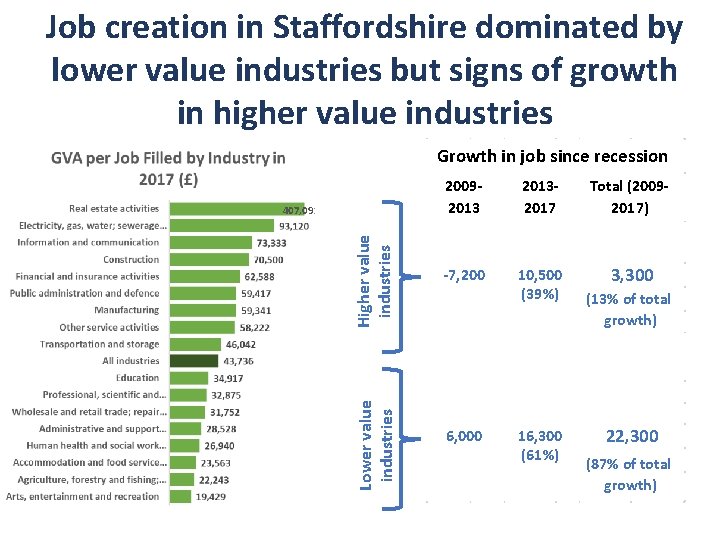
Although continue to see growth in economy productivity remains one of our biggest challenges. . . • Many of the jobs created since the recession were low value as these were needed to keep residents in employment • However, this has seen the average level of productivity per job filled grow at a slower rate than regionally and nationally
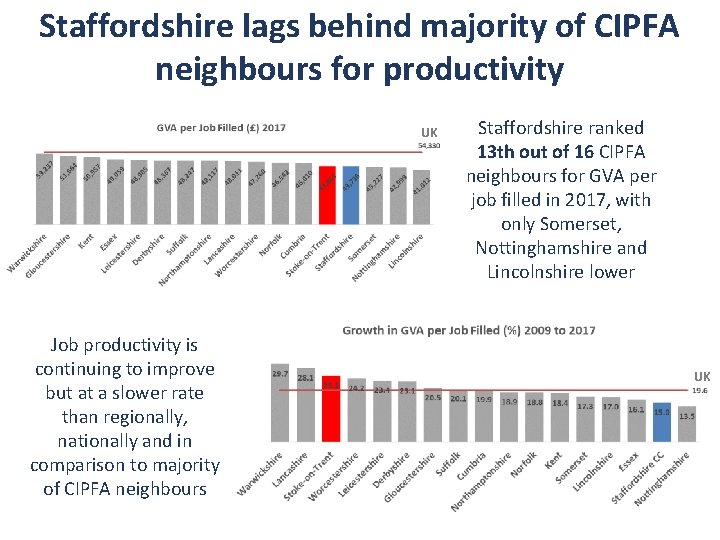
Staffordshire lags behind majority of CIPFA neighbours for productivity UK Job productivity is continuing to improve but at a slower rate than regionally, nationally and in comparison to majority of CIPFA neighbours Staffordshire ranked 13 th out of 16 CIPFA neighbours for GVA per job filled in 2017, with only Somerset, Nottinghamshire and Lincolnshire lower UK
Signs of Staffordshire improvement with the gap to the national average recently stabilizing, while Stoke-on-Trent is above pre-recession levels 88. 4 80. 7 80. 5
Job creation in Staffordshire dominated by lower value industries but signs of growth in higher value industries Growth in job since recession 20092013 Total (20092013 Jobs 2017)chart vs Productivity Lower value industries Higher value industries 407, 091 -7, 200 6, 000 10, 500 (39%) 16, 300 (61%) 3, 300 (13% of total growth) 22, 300 (87% of total growth)
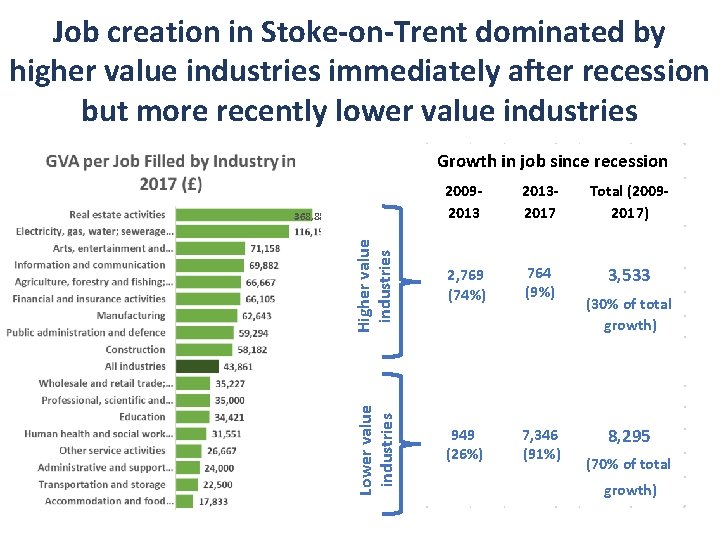
Job creation in Stoke-on-Trent dominated by higher value industries immediately after recession but more recently lower value industries Growth in job since recession 20092013 Total (20092013 Jobs 2017)chart vs Productivity Higher value industries 2, 769 (74%) 764 (9%) Lower value industries 368, 889 949 (26%) 7, 346 (91%) 3, 533 (30% of total growth) 8, 295 (70% of total growth)
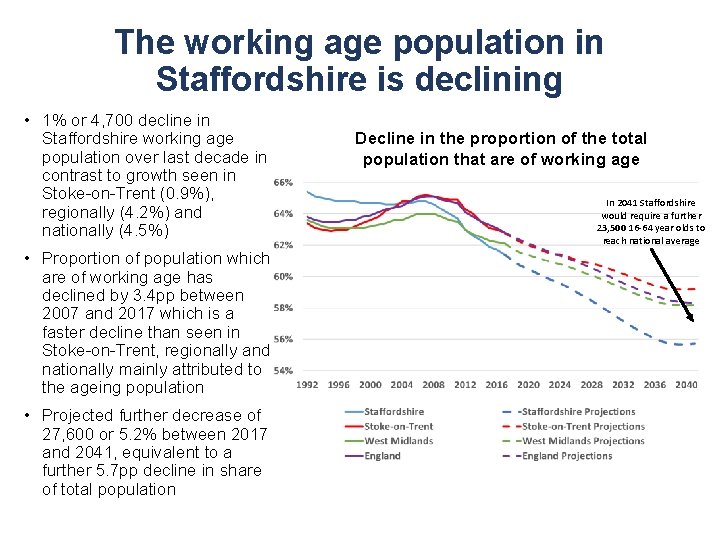
The working age population in Staffordshire is declining • 1% or 4, 700 decline in Staffordshire working age population over last decade in contrast to growth seen in Stoke-on-Trent (0. 9%), regionally (4. 2%) and nationally (4. 5%) • Proportion of population which are of working age has declined by 3. 4 pp between 2007 and 2017 which is a faster decline than seen in Stoke-on-Trent, regionally and nationally mainly attributed to the ageing population • Projected further decrease of 27, 600 or 5. 2% between 2017 and 2041, equivalent to a further 5. 7 pp decline in share of total population Decline in the proportion of the total population that are of working age In 2041 Staffordshire would require a further 23, 500 16 -64 year olds to reach national average
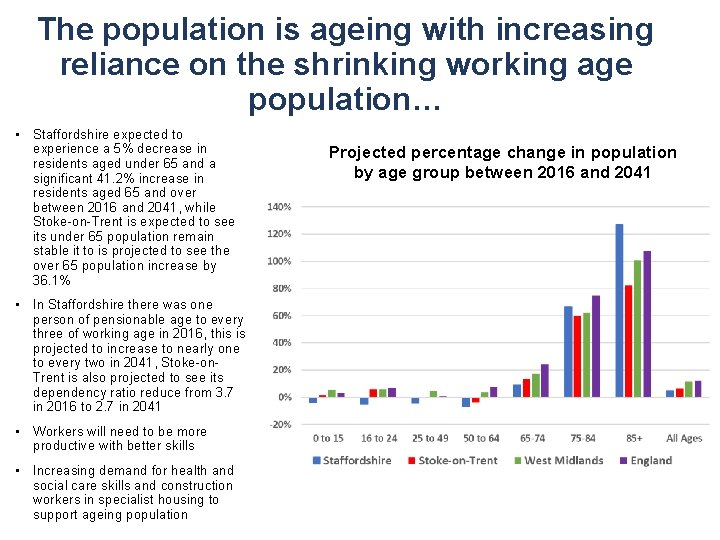
The population is ageing with increasing reliance on the shrinking working age population… • Staffordshire expected to experience a 5% decrease in residents aged under 65 and a significant 41. 2% increase in residents aged 65 and over between 2016 and 2041, while Stoke-on-Trent is expected to see its under 65 population remain stable it to is projected to see the over 65 population increase by 36. 1% • In Staffordshire there was one person of pensionable age to every three of working age in 2016, this is projected to increase to nearly one to every two in 2041, Stoke-on. Trent is also projected to see its dependency ratio reduce from 3. 7 in 2016 to 2. 7 in 2041 • Workers will need to be more productive with better skills • Increasing demand for health and social care skills and construction workers in specialist housing to support ageing population Projected percentage change in population by age group between 2016 and 2041
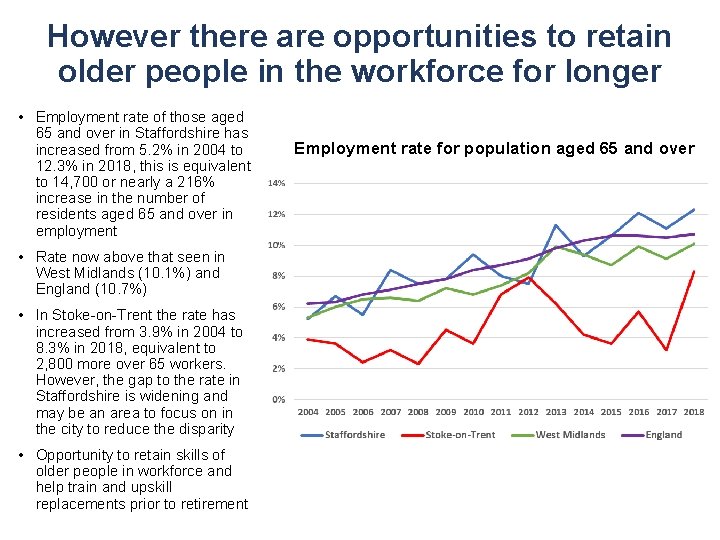
However there are opportunities to retain older people in the workforce for longer • Employment rate of those aged 65 and over in Staffordshire has increased from 5. 2% in 2004 to 12. 3% in 2018, this is equivalent to 14, 700 or nearly a 216% increase in the number of residents aged 65 and over in employment • Rate now above that seen in West Midlands (10. 1%) and England (10. 7%) • In Stoke-on-Trent the rate has increased from 3. 9% in 2004 to 8. 3% in 2018, equivalent to 2, 800 more over 65 workers. However, the gap to the rate in Staffordshire is widening and may be an area to focus on in the city to reduce the disparity • Opportunity to retain skills of older people in workforce and help train and upskill replacements prior to retirement Employment rate for population aged 65 and over
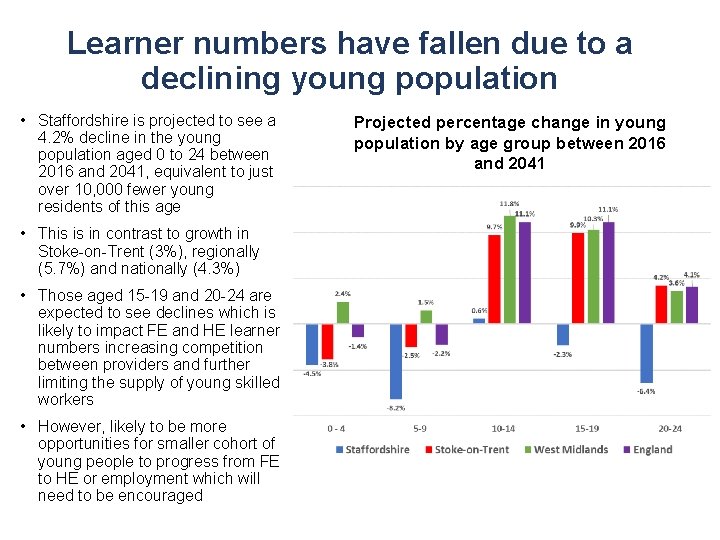
Learner numbers have fallen due to a declining young population • Staffordshire is projected to see a 4. 2% decline in the young population aged 0 to 24 between 2016 and 2041, equivalent to just over 10, 000 fewer young residents of this age • This is in contrast to growth in Stoke-on-Trent (3%), regionally (5. 7%) and nationally (4. 3%) • Those aged 15 -19 and 20 -24 are expected to see declines which is likely to impact FE and HE learner numbers increasing competition between providers and further limiting the supply of young skilled workers • However, likely to be more opportunities for smaller cohort of young people to progress from FE to HE or employment which will need to be encouraged Projected percentage change in young population by age group between 2016 and 2041