
Staffing level estimation Once the effort required to
- Slides: 4
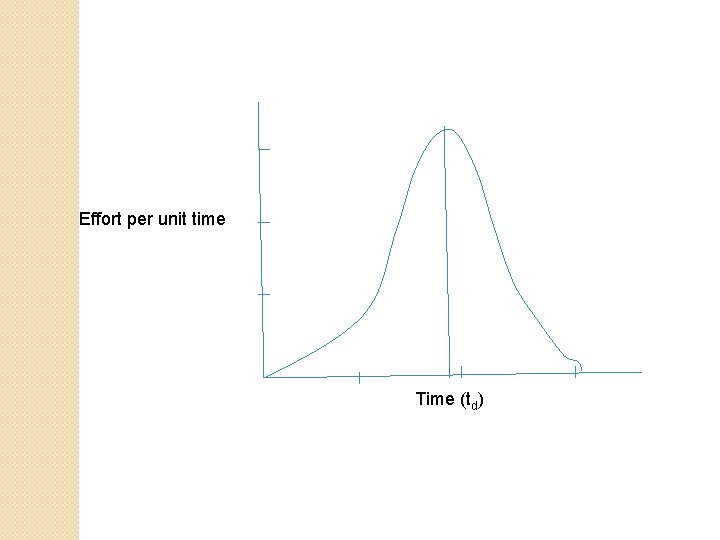
Staffing level estimation Once the effort required to develop a software has been determined, it is necessary to determine the staffing requirement for the project. Putnam first studied the problem of what should be a proper staffing pattern for software projects. He extended the work of Norden who had earlier investigated the staffing pattern of research and development (R&D) type of projects. In order to appreciate the staffing pattern of software projects, Norden’s and Putnam’s results must be understood. Norden’s Work Norden studied the staffing patterns of several R & D projects. He found that the staffing pattern can be approximated by the Rayleigh distribution curve. Norden represented the Rayleigh curve by the following equation: E = K/t²d * t * e-t² / 2 t²d
Effort per unit time Time (td)
Where e is the effort required at time t. E is an indication of the number of engineers (or the staffing level) at any particular time during the duration of the project, K is the area under the curve, and td is the time at which the curve attains its maximum value. It must be remembered that the results of Norden are applicable to general R & D projects and were not meant to model the staffing pattern of software development projects. Putnam’s Work Putnam studied the problem of staffing of software projects and found that the software development has characteristics very similar to other R & D projects studied by Norden and that the Rayleigh-Norden curve can be used to relate the number of delivered lines of code to the effort and the time required to develop the project. By analyzing a large number of army projects, Putnam derived the following expression: L = Ck K 1/3 td 4/3
The various terms of this expression are as follows: • K is the total effort expended (in PM) in the product development and L is the product size in KLOC. • td corresponds to the time of system and integration testing. Therefore, td can be approximately considered as the time required to develop the software. Ck is the state of technology constant and reflects constraints that impede the progress of the programmer. Typical values of Ck = 2 for poor development environment (no methodology, poor documentation, and review, etc. ), Ck = 8 for good software development environment (software engineering principles are adhered to), Ck = 11 for an excellent environment (in addition to following software engineering principles, automated tools and techniques are used). The exact value of Ck for a specific project can be computed from the historical data of the organization developing it.