
Staffing Guidelines Presented by Karen Harris MSN RN
Staffing Guidelines Presented by Karen Harris, MSN, RN, WHNP-BC 1
Objectives • Outline AWHONN’s staffing guidelines. • Discuss process of staffing evaluation. © 2016 AWHONN 2
AWHONN IS WORKING TO IMPROVE THE HEALTH OF WOMEN AND NEWBORNS! © 2013 AWHONN 3
Standard Bearing Organization for Nursing Practice AWHONN is the standard-bearing and foremost nursing authority that advances the health care of women and newborns through evidence-based nursing practice. © 2014 AWHONN 4
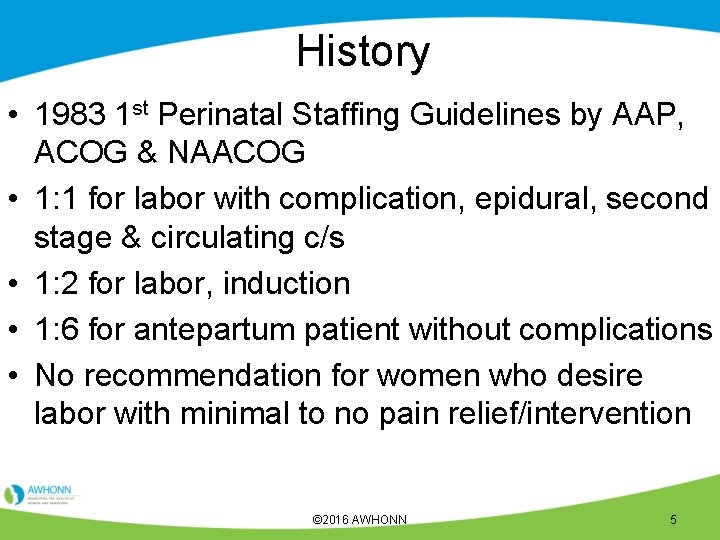
History • 1983 1 st Perinatal Staffing Guidelines by AAP, ACOG & NAACOG • 1: 1 for labor with complication, epidural, second stage & circulating c/s • 1: 2 for labor, induction • 1: 6 for antepartum patient without complications • No recommendation for women who desire labor with minimal to no pain relief/intervention © 2016 AWHONN 5
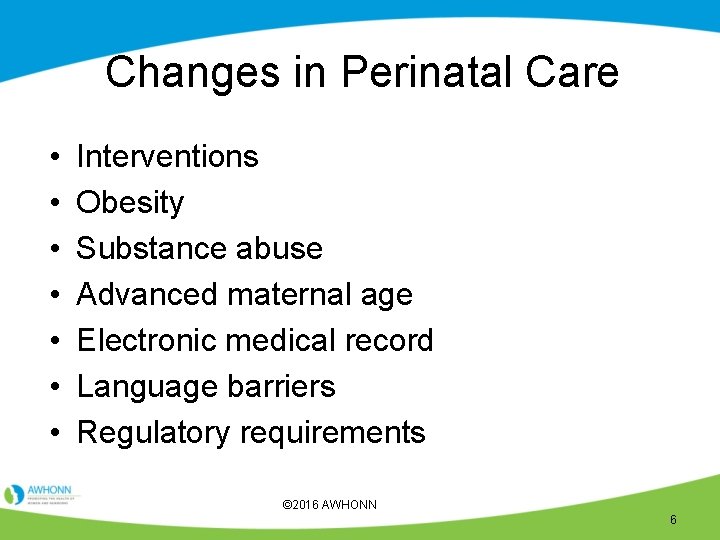
Changes in Perinatal Care • • Interventions Obesity Substance abuse Advanced maternal age Electronic medical record Language barriers Regulatory requirements © 2016 AWHONN 6
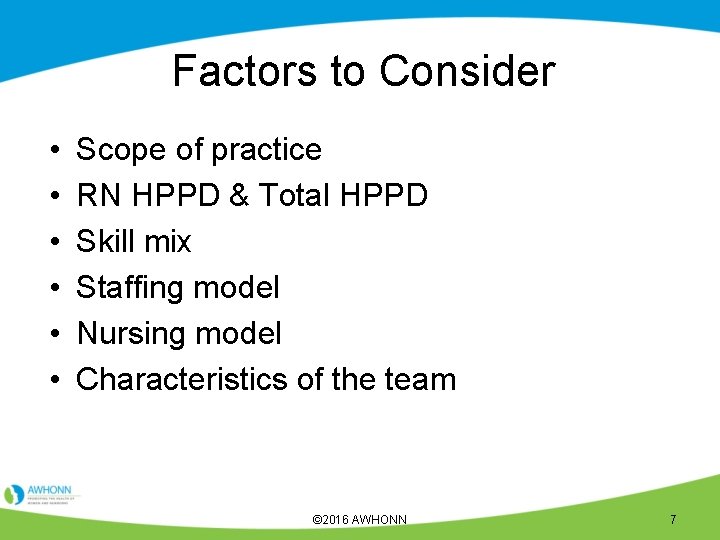
Factors to Consider • • • Scope of practice RN HPPD & Total HPPD Skill mix Staffing model Nursing model Characteristics of the team © 2016 AWHONN 7
Education • Training • Simulation • Debriefs © 2013 AWHONN 8
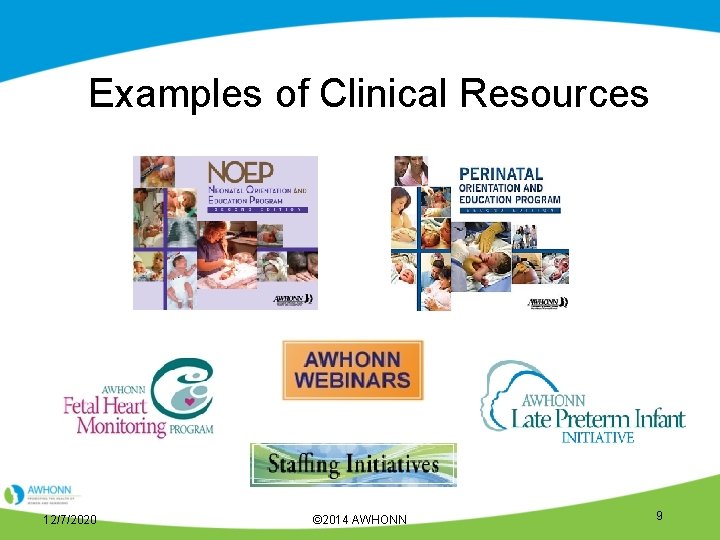
Examples of Clinical Resources 12/7/2020 © 2014 AWHONN 9
Staffing Plan • Admissions/discharges • Triage considerations • Intermittent auscultation © 2016 AWHONN 10
The power of nurse and patient caring relationships “Triaging of problems impact the timing of delivery and often the outcome of the pregnancy. ” © 2014 AWHONN 11
AWHONN Maternal Fetal Triage Index (MFTI) A five-level acuity classification index used to prioritize a pregnant woman’s urgency for evaluation by the qualified medical provider. MFTI Education – Interactive online learning modules designed to teach perinatal nurses about obstetric triage basics. Available through the new AWHONN Online Learning Center. MFTI Pilot Community – 85 hospital-based nurse champions working with AWHONN in implementing the MFTI into their facility’s electronic medical record. Three EMR companies are expected to participate in the pilot community. Visit the AWHONN You. Tube channel for quick video on MFTI. ©AWHONN 2016 12
Intrapartum Guideline Opportunities • Women receiving oxytocin during labor • Women laboring with little to no pain relief or medical intervention • Women whose fetus is being monitored via an intermittent auscultation protocol © 2016 AWHONN 13
Intermittent Auscultation • Approximately 15% • Every 30 minutes without risk in active phase of 1 st stage • Every 15 minutes in 2 nd stage • With risk every 15 minutes in active phase of 1 st stage & every 5 minutes in 2 nd stage • See JOGNN for full position statement on fetal monitoring in references for more details. © 2016 AWHONN 14
Framework • System • Process • Outcome © 2016 AWHONN 15
6 AIMS from IOM • • • Safe Timely Effective Efficient Equitable Patient Centered Institute of Medicine. Crossing the quality chasm: A new health system for the 21 st century. National Academy of Sciences, Washington, DC; 2001 16
“The actions of nurses have significant effects on patient outcomes. ” AWHONN Position Statement, Nursing Care Measurement Published, JOGNN 2013 © 2014 AWHONN 17
Failure to Rescue or Missed Care • Effect to outcomes • Pain & suffering • Increased morbidity & mortality © 2016 AWHONN 18
Benchmarking
Impact to Costs • Quality outcomes • Patient satisfaction • Organizational goals • Nurse retention © 2016 AWHONN 20
There is a 17 -year lag from knowing to doing! © 2014 AWHONN 21
“Nurses’ expert knowledge shapes the care environment and influences the decisions of patients. ” AWHONN Position Statement, Nursing Care Measurement Published, JOGNN 2013 © 2014 AWHONN 22
Supportive Public Comment “…I am a very strong advocate for this measure…I have observed many labor nurses…A large number of these nurses sit at the nurses station and analyze the fetal heart monitor tracings. Infrequently they look in on the patients and ask how they are doing. To me, that is not providing nursing care. Rather, it is being a technician. Labor care should be holistic; the nurse certainly must assess the fetus and mother physiologically and intervene when complications develop. Labor, however can be painful and lonely. When nurses truly care for their patients, giving [a] massage, providing emotional support, labor becomes manageable and even can be remembered positively. ” © 2013 AWHONN 23
Comments about implementation considerations – Understand the evidence – Limitation of electronic medical records – IA reduces equipment need – Lack of adequate nurse staffing-MAKE the CASE © 2013 AWHONN

The down & dirty of staffing but certainly don’t want to leave you feeling frazzled!
References Association of Women’s Health, Obstetric and Neonatal Nurses. (2013). Women’s health and perinatal nursing care quality draft measures specifications. Washington, DC: Author. AWHONN Position Statement, Fetal Heart Monitoring, JOGNN, 44, 683 -686; 2015. Aiken, L. H. , Clarke, S. P. , Sloane, D. M. , Sochalski, J. , and Silber, J. H. Hospital nurse staffing and patient mortality, nurse burnout, and job dissatisfaction. Journal of the American Medical Association. 2002; 288: 1987– 1993 Bingham, D. , & Ruhl, C. Planning and evaluating evidence-based perinatal staffing. JOGNN, 44, 290 -308; 2015. Callaghan, W. M. , Creanga, A. A. , and Kuklina, E. V. Severe maternal morbidity among delivery and postpartum hospitalizations in the United States. Obstetrics & Gynecology. 2012; 120: 1029– 1036 Institute of Medicine. Crossing the quality chasm: A new health system for the 21 st century. National Academy of Sciences, Washington, DC; 2001 Kalisch, B. J. , Tschannen, D. , and Lee, K. H. Do staffing levels predict missed nursing care. International Journal for Quality in Health Care. 2011; 23: 302– 308 Lyndon, A. , Zlatnik, M. G. , Maxfield, D. G. , Lewis, A. , Mc. Millan, C. , and Kennedy, H. P. Contributions of clinical disconnections and unresolved conflict to failures in intrapartum safety. Journal of Obstetric, Gynecologic, & Neonatal Nursing. 2014; 43: 2– 12 Needleman, J. , Buerhaus, P. , Pankratz, V. S. , Leibson, C. L. , Stevens, S. R. , and Harris, M. Nurse staffing and inpatient hospital mortality. New England Journal of Medicine. 2011; 364: 1037– 1045 Scheich, B. , & Bingham, D. , (2015). Key findings from the AWHONN perinatal staffing data collaborative. Journal of Obstetric, Gynecologic, and Neonatal Nursing. 2015; 44: 317 -328. © 2014 AWHONN 26
- Slides: 26