
Staff with good levels of SEND The SEND

- Slides: 8
Staff with good levels of SEND
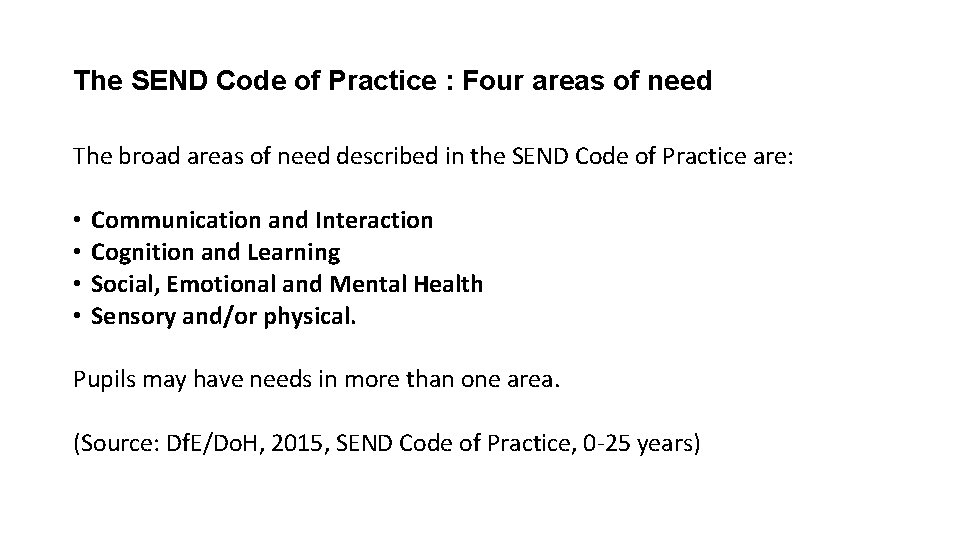
The SEND Code of Practice : Four areas of need The broad areas of need described in the SEND Code of Practice are: • • Communication and Interaction Cognition and Learning Social, Emotional and Mental Health Sensory and/or physical. Pupils may have needs in more than one area. (Source: Df. E/Do. H, 2015, SEND Code of Practice, 0 -25 years)
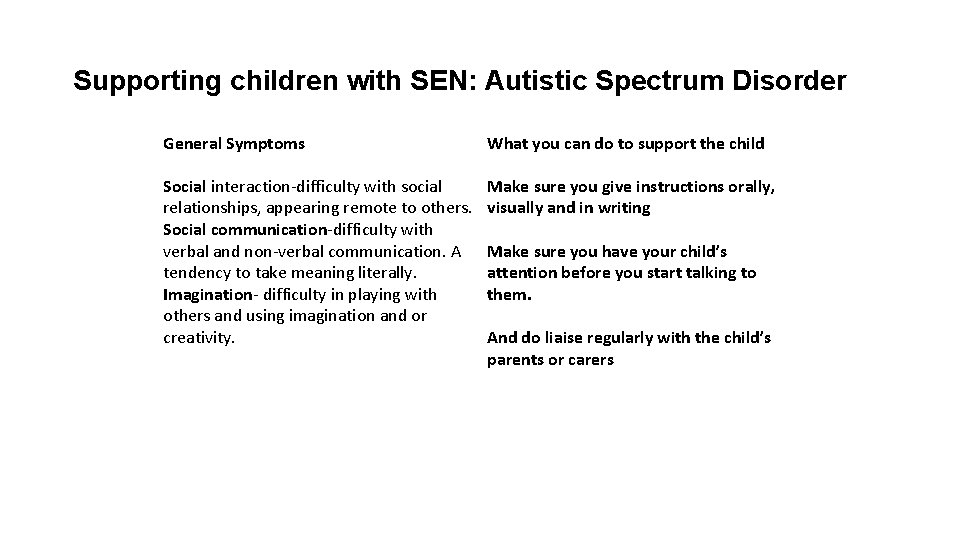
Supporting children with SEN: Autistic Spectrum Disorder General Symptoms What you can do to support the child Social interaction-difficulty with social relationships, appearing remote to others. Social communication-difficulty with verbal and non-verbal communication. A tendency to take meaning literally. Imagination- difficulty in playing with others and using imagination and or creativity. Make sure you give instructions orally, visually and in writing Make sure you have your child’s attention before you start talking to them. And do liaise regularly with the child’s parents or carers
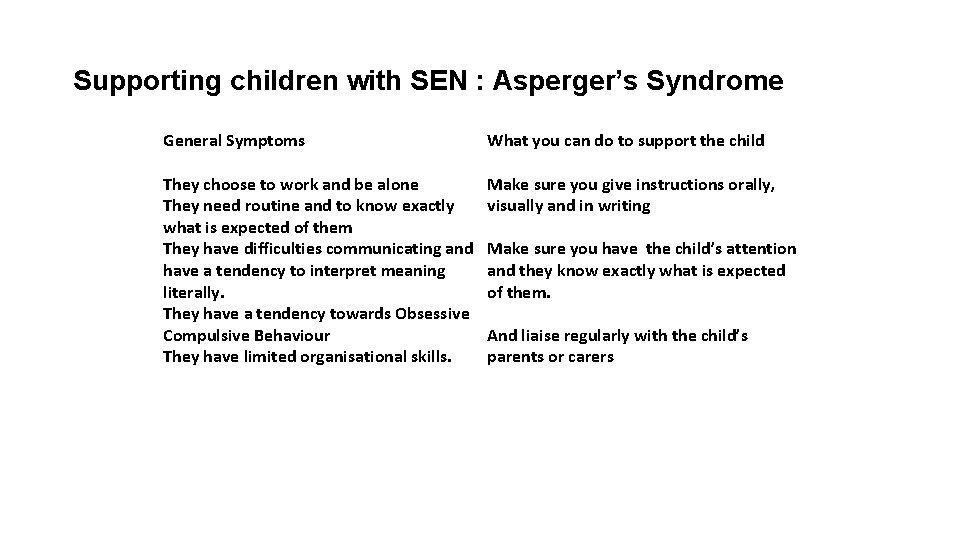
Supporting children with SEN : Asperger’s Syndrome General Symptoms What you can do to support the child They choose to work and be alone They need routine and to know exactly what is expected of them They have difficulties communicating and have a tendency to interpret meaning literally. They have a tendency towards Obsessive Compulsive Behaviour They have limited organisational skills. Make sure you give instructions orally, visually and in writing Make sure you have the child’s attention and they know exactly what is expected of them. And liaise regularly with the child’s parents or carers
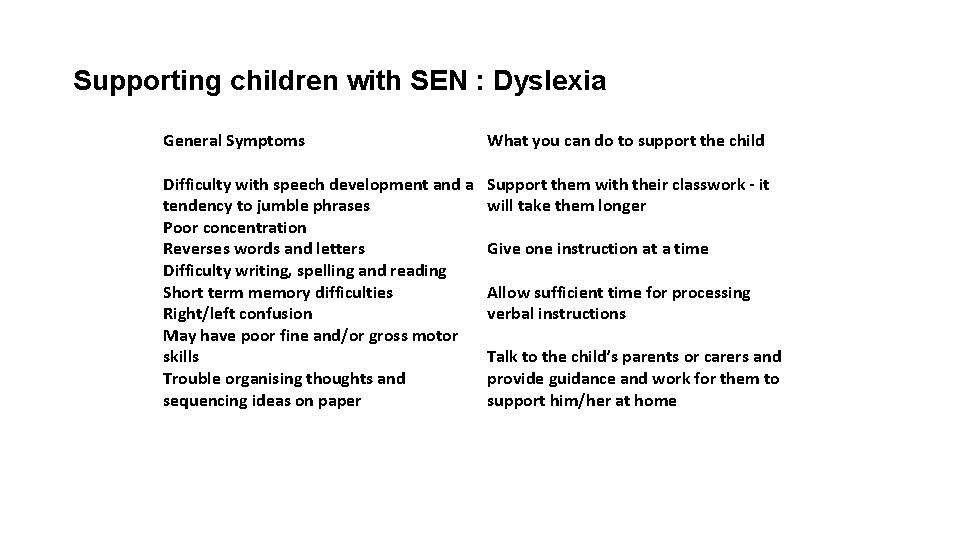
Supporting children with SEN : Dyslexia General Symptoms What you can do to support the child Difficulty with speech development and a tendency to jumble phrases Poor concentration Reverses words and letters Difficulty writing, spelling and reading Short term memory difficulties Right/left confusion May have poor fine and/or gross motor skills Trouble organising thoughts and sequencing ideas on paper Support them with their classwork - it will take them longer Give one instruction at a time Allow sufficient time for processing verbal instructions Talk to the child’s parents or carers and provide guidance and work for them to support him/her at home
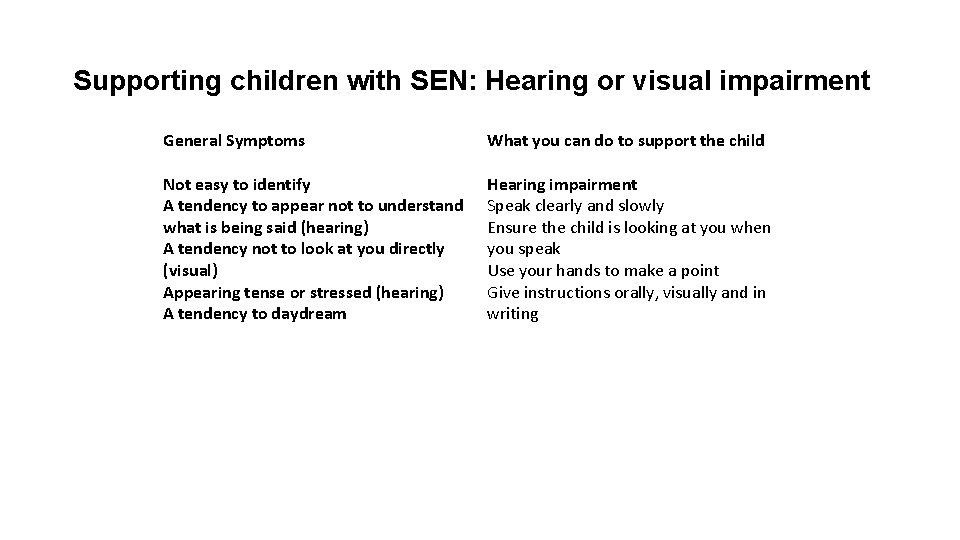
Supporting children with SEN: Hearing or visual impairment General Symptoms What you can do to support the child Not easy to identify A tendency to appear not to understand what is being said (hearing) A tendency not to look at you directly (visual) Appearing tense or stressed (hearing) A tendency to daydream Hearing impairment Speak clearly and slowly Ensure the child is looking at you when you speak Use your hands to make a point Give instructions orally, visually and in writing
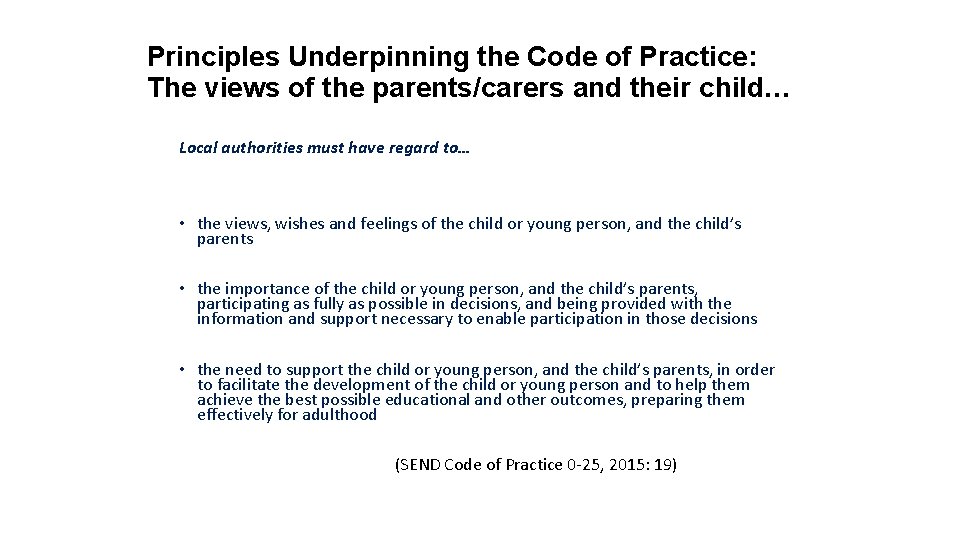
Principles Underpinning the Code of Practice: The views of the parents/carers and their child… Local authorities must have regard to… • the views, wishes and feelings of the child or young person, and the child’s parents • the importance of the child or young person, and the child’s parents, participating as fully as possible in decisions, and being provided with the information and support necessary to enable participation in those decisions • the need to support the child or young person, and the child’s parents, in order to facilitate the development of the child or young person and to help them achieve the best possible educational and other outcomes, preparing them effectively for adulthood (SEND Code of Practice 0 -25, 2015: 19)
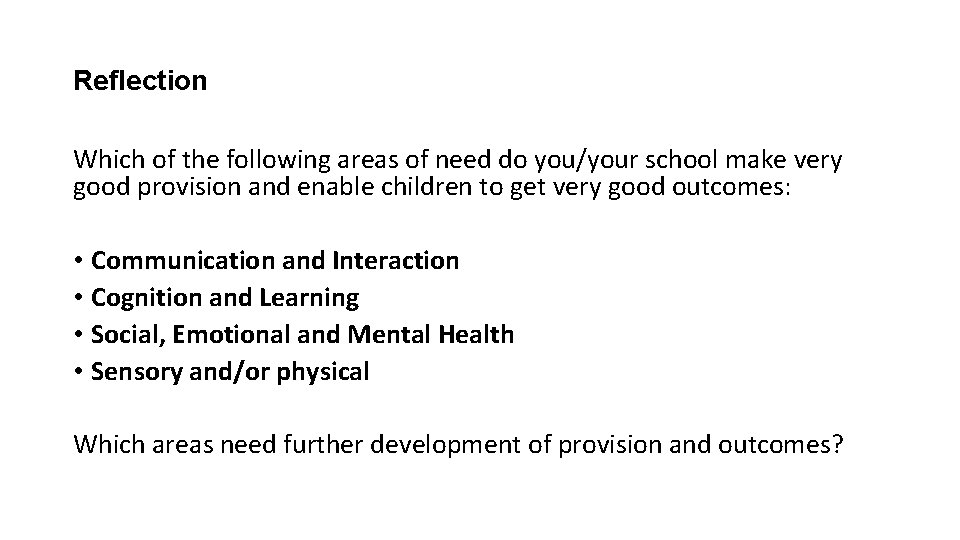
Reflection Which of the following areas of need do you/your school make very good provision and enable children to get very good outcomes: • Communication and Interaction • Cognition and Learning • Social, Emotional and Mental Health • Sensory and/or physical Which areas need further development of provision and outcomes?