
Staff Training June South Lake Leisure Centre Lifeguard
- Slides: 44
Staff Training June South Lake Leisure Centre
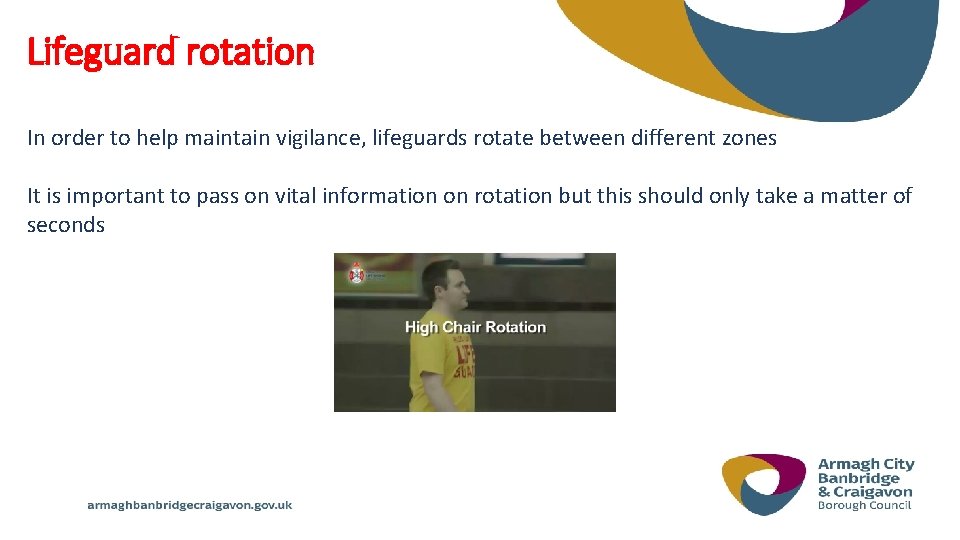
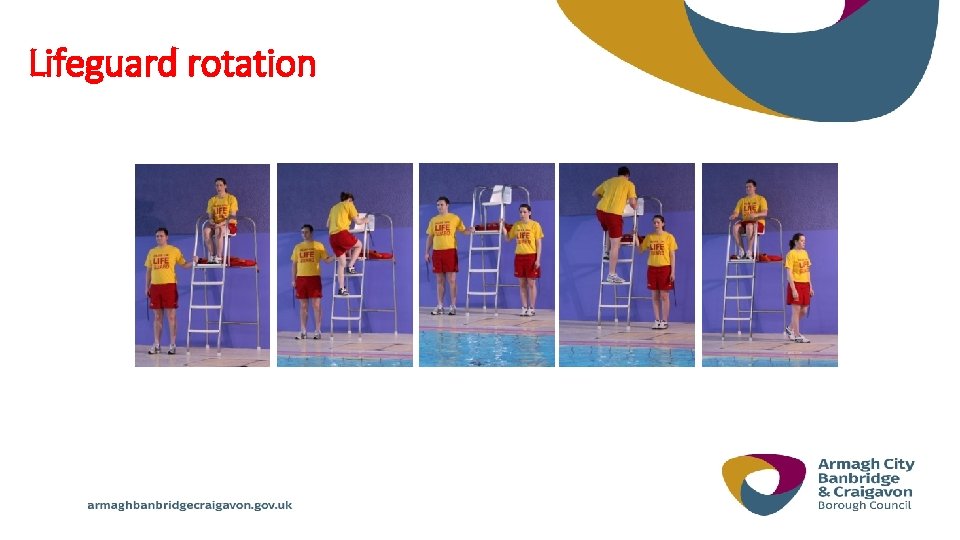
Lifeguard rotation In order to help maintain vigilance, lifeguards rotate between different zones It is important to pass on vital information on rotation but this should only take a matter of seconds
Lifeguard rotation
Communication on poolside Communication is essential whether for normal day-to-day operations or in an emergency Without good and effective communication between the lifeguards and team within the whole leisure centre, the ability to intervene early, react and respond to emergencies would be compromised Communication is one of the most important tools that a lifeguard will use
Types of Communication Whistle Verbal Hand signals Communication equipment Alarms
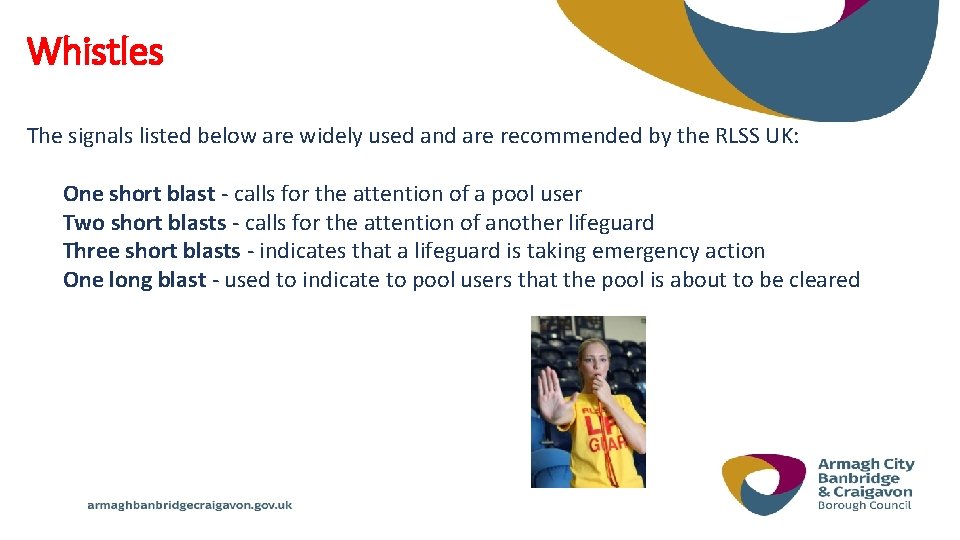
Whistles The signals listed below are widely used and are recommended by the RLSS UK: One short blast - calls for the attention of a pool user Two short blasts - calls for the attention of another lifeguard Three short blasts - indicates that a lifeguard is taking emergency action One long blast - used to indicate to pool users that the pool is about to be cleared
Verbal Using your voice may not be practical in a loud busy pool and it is essential that verbal communication between lifeguards is kept to a minimum It is also important for the lifeguards to educate pool users with regard to dangerous practices or general information to maintain the safety of the pool environment Language barriers – remember not to assume that all customers speak or understand your language
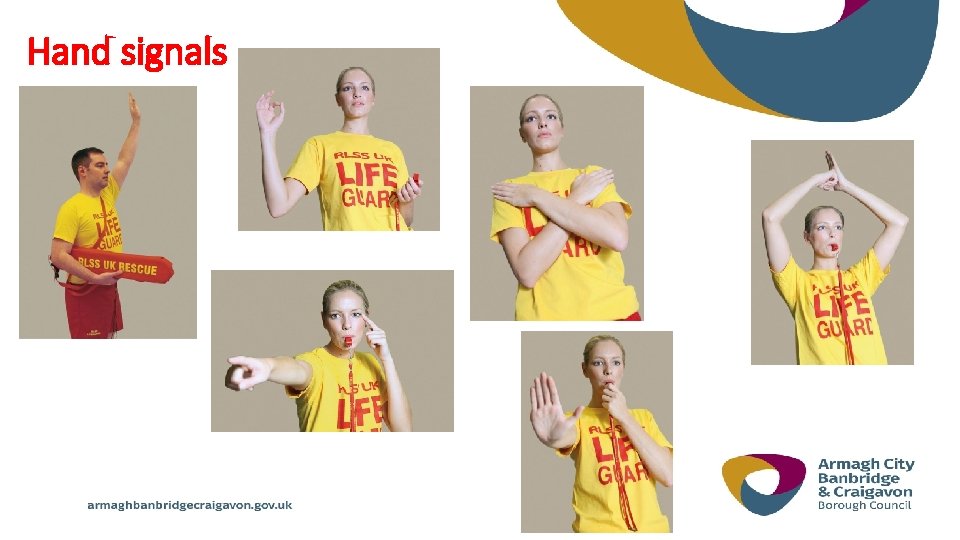
Hand signals are very useful when background noise makes it hard to hear someone speaking They are also useful when there is considerable distance between lifeguards
Hand signals
Communication equipment and alarms Lifeguards can draw on a range of equipment to aid with communication They include: Two way radio systems Telephones Alarm systems
Two-way radio systems The use of portable, two-way radios is common in many leisure facilities, especially in larger leisure centres They can be really useful, especially as they can be used almost anywhere in the building even if there is a lot of noise
Telephones are of limited use for lifeguard-to-lifeguard communication Benefits: Allows information in an emergency to be passed on quickly and effectively Means of attracting support to poolside to ensure that you are not distracted from your duties
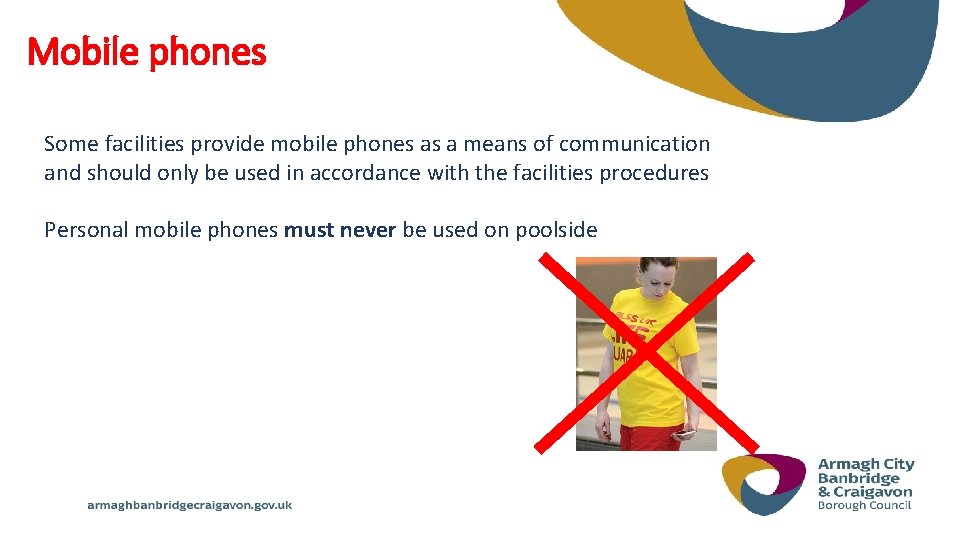
Mobile phones Some facilities provide mobile phones as a means of communication and should only be used in accordance with the facilities procedures Personal mobile phones must never be used on poolside
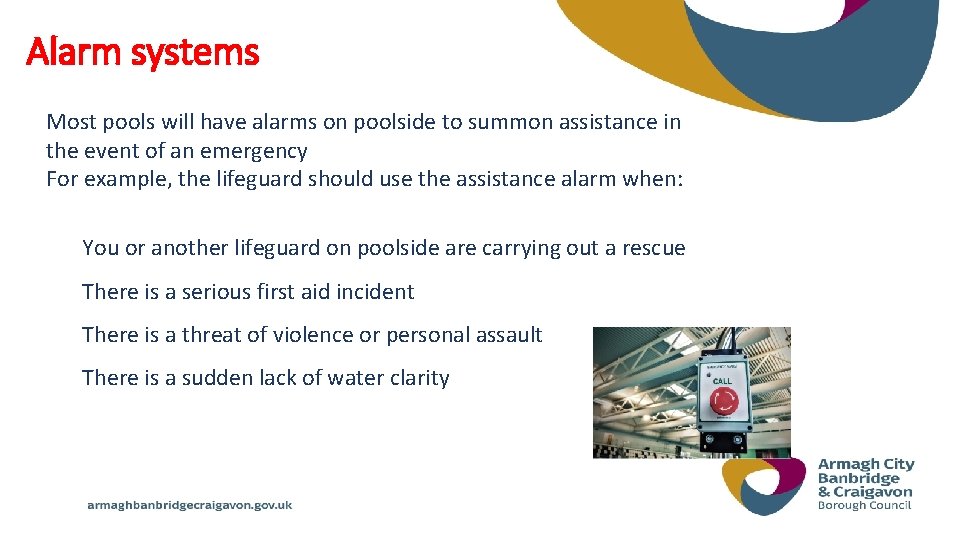
Alarm systems Most pools will have alarms on poolside to summon assistance in the event of an emergency For example, the lifeguard should use the assistance alarm when: You or another lifeguard on poolside are carrying out a rescue There is a serious first aid incident There is a threat of violence or personal assault There is a sudden lack of water clarity
Evacuation alarm Only use fire / evacuation alarms in accordance with your training as they will normally denote a full evacuation of the building. Examples of when a lifeguard may use the evacuation alarm include when: There is a fire There is a serious structural failure There is a toxic gas emission
Visibility These are some of things that might affect lifeguard visibility of their zones including: Reflection Glare Blind spots Pool lighting Turbulence Water clarity It is essential that if any of the above impact on your ability to supervise the pool effectively, you must inform your line manager immediately so suitable action can be taken to ensure swimmers safety.
Reflection and glare (natural light) Sunlight falling directly onto the water can make the surface seem almost like a mirror (reflection) and it may be difficult, maybe even impossible, to see through the water to the bottom of the pool or anyone below the surface Be aware of the problems of reflection and glare The NOP will detail your lifeguard positions for optimum visibility
Reflection and glare (natural light) Sunlight falling directly onto the water can make the surface seem almost like a mirror (reflection) and it may be difficult, maybe even impossible, to see through the water to the bottom of the pool or anyone below the surface Be aware of the problems of reflection and glare The NOP will detail your lifeguard positions for optimum visibility
SCIM - care and teamwork during CPR Particular care must be taken during handling and CPR to maintain alignment of the: • Head • Neck • Chest Support and assistance from other team members will be needed
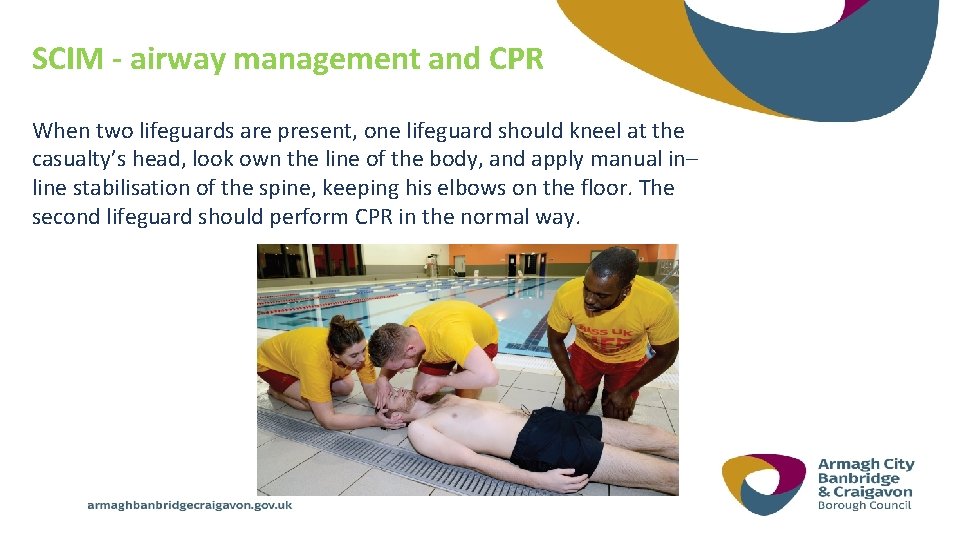
SCIM - airway management and CPR • When opening the airway, attempt to use chin lift alone to avoid injury to the spine. If this is unsuccessful, add head tilt, but only the minimum needed to obtain a clear airway • If the casualty is on a rescue board you may have to release the head or chest strap (or both) to allow effective chest compression and rescue breathing. • When two lifeguards are present, one lifeguard should kneel at the casualty’s head, look down the line of the body, and apply manual in–line stabilisation of the spine, keeping his elbows on the floor. The second lifeguard should perform CPR in the normal way.
SCIM - airway management and CPR When two lifeguards are present, one lifeguard should kneel at the casualty’s head, look own the line of the body, and apply manual in– line stabilisation of the spine, keeping his elbows on the floor. The second lifeguard should perform CPR in the normal way.
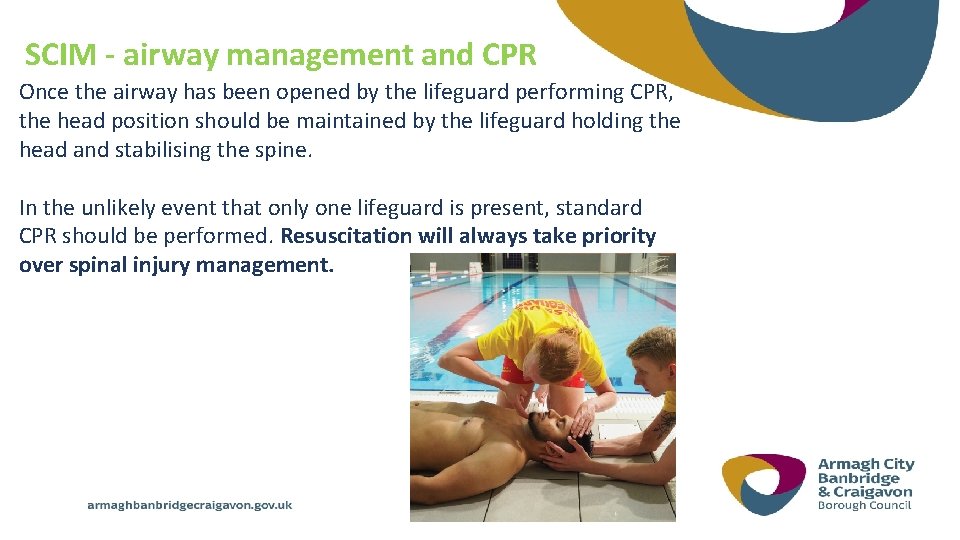
SCIM - airway management and CPR Once the airway has been opened by the lifeguard performing CPR, the head position should be maintained by the lifeguard holding the head and stabilising the spine. In the unlikely event that only one lifeguard is present, standard CPR should be performed. Resuscitation will always take priority over spinal injury management.
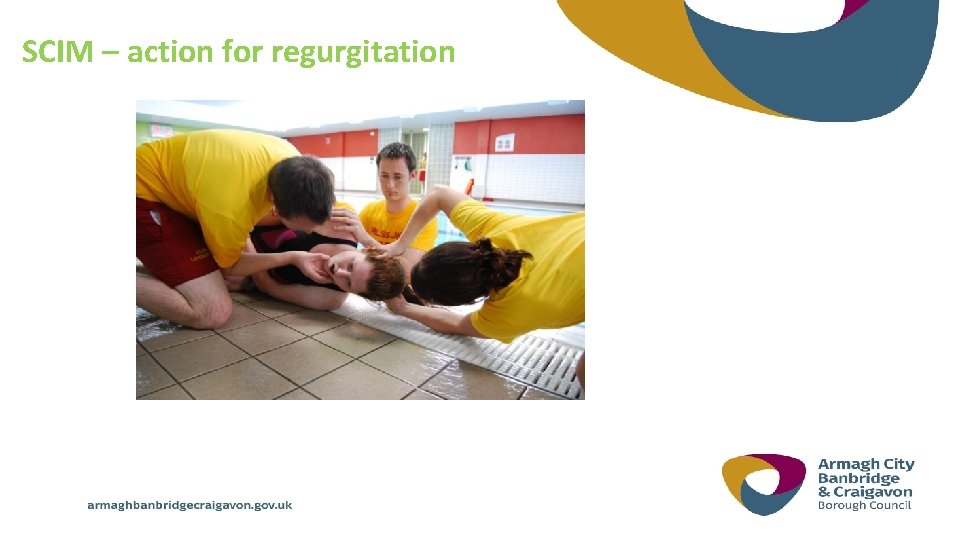
SCIM Regurgitation of stomach contents If you need to turn the casualty onto their side due to vomit during CPR the same principles apply: If there is a lifeguard providing manual in-line stabilisation of the head, ensure effective communication to roll the casualty while keeping the head, neck and chest in-line Where there additional trained team members they can assist with the roll of the casualty on or off the rescue board In the unlikely event that you are on your own, carry out management of regurgitation in the normal way taking care to minimise any head and neck movement
SCIM – action for regurgitation
Seizures occur when normal brain activity is suddenly disrupted. This can be caused by a number of different illnesses or injuries. Some casualties may be diagnosed with epilepsy which is currently defined as a tendency to have recurrent seizures. Some individuals that have been diagnosed may sense a seizure is coming on.
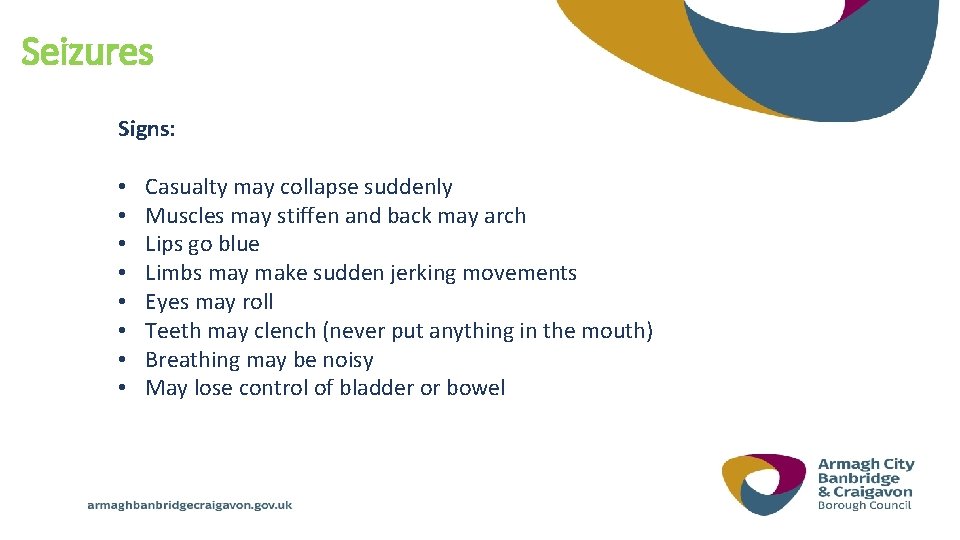
Seizures Signs: • • Casualty may collapse suddenly Muscles may stiffen and back may arch Lips go blue Limbs may make sudden jerking movements Eyes may roll Teeth may clench (never put anything in the mouth) Breathing may be noisy May lose control of bladder or bowel
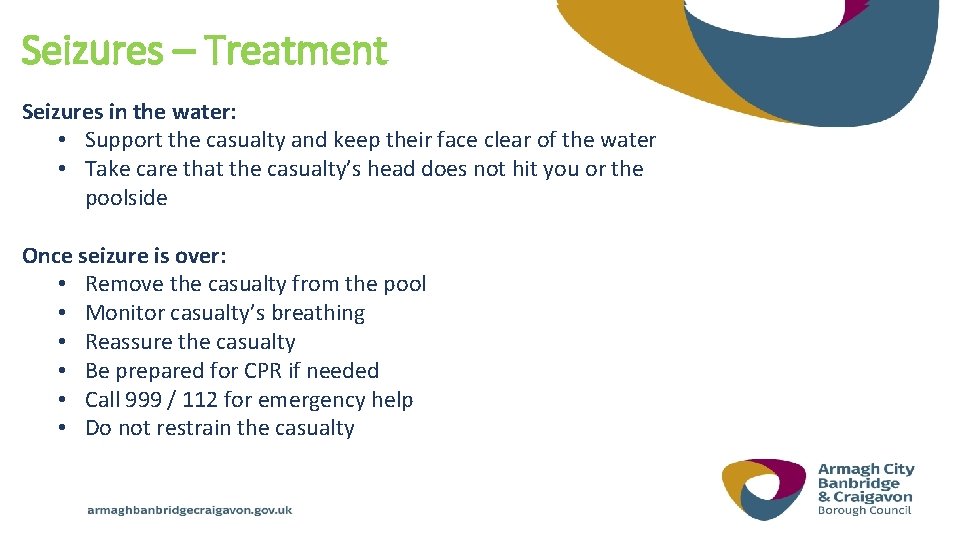
Seizures – Treatment Seizures in the water: • Support the casualty and keep their face clear of the water • Take care that the casualty’s head does not hit you or the poolside Once seizure is over: • Remove the casualty from the pool • Monitor casualty’s breathing • Reassure the casualty • Be prepared for CPR if needed • Call 999 / 112 for emergency help • Do not restrain the casualty
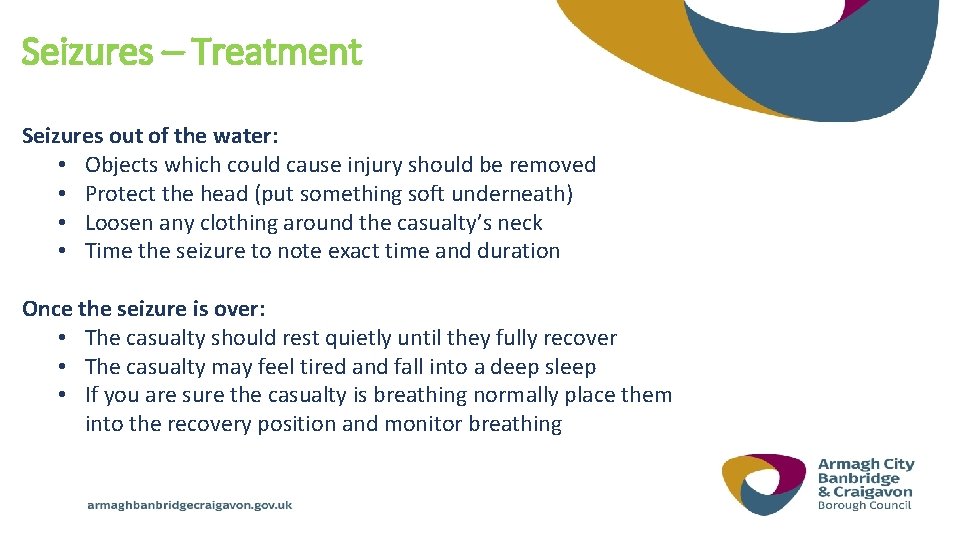
Seizures – Treatment Seizures out of the water: • Objects which could cause injury should be removed • Protect the head (put something soft underneath) • Loosen any clothing around the casualty’s neck • Time the seizure to note exact time and duration Once the seizure is over: • The casualty should rest quietly until they fully recover • The casualty may feel tired and fall into a deep sleep • If you are sure the casualty is breathing normally place them into the recovery position and monitor breathing
When to call 999 / 112 • If the seizure lasts for longer than 5 minutes • The casualty has a second seizure • The casualty has injured themselves • The casualty’s first seizure • If they do not wake up after 10 minutes of recovery • If the seizure lasts longer then normal • If you are unsure
Absence seizures appear as if the casualty is day dreaming and are common in children. This may last for just a few seconds and the casualty may often be unaware that it has happened. Symptoms and signs: Jerking or twitching Plucking at their clothes Swallowing repeatedly Lips smacking Wondering around appearing dazed Treatment: • Support the casualty with their head above the water • Keep away from danger • Sit or lie them down in a quiet place • Reassure • Stay with the casualty until they are fully alert
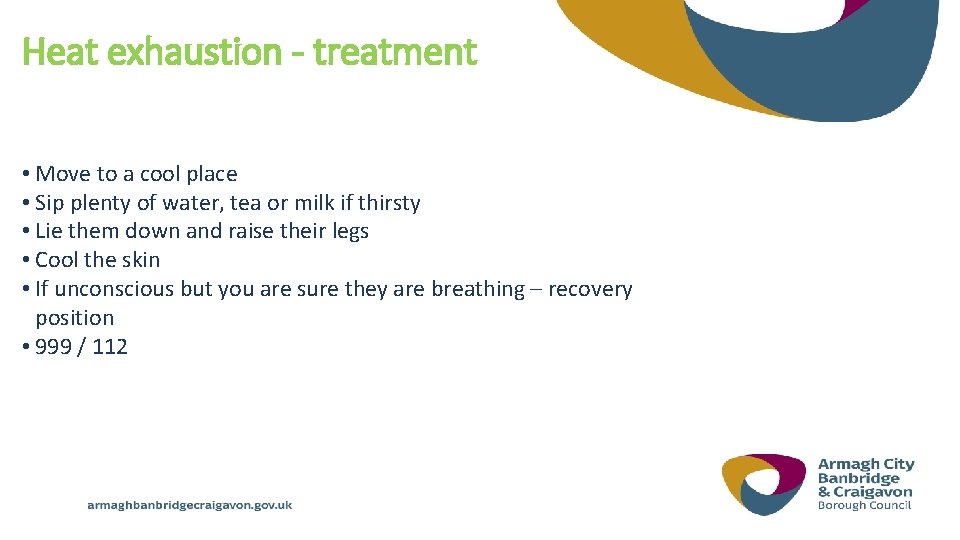
Heat and cold injuries Heat exhaustion usually develops gradually and results from loss of salt and water from the body by excessive sweating Hypothermia Medically, hypothermia starts when the casualty’s core body temperature falls below 35°C
Heat exhaustion Symptoms: Nausea Loss of appetite Headache Dizziness or confusion Rapid weakening pulse and breathing Muscle cramp Signs: • Sweating • Pale clammy skin
Heat exhaustion - treatment • Move to a cool place • Sip plenty of water, tea or milk if thirsty • Lie them down and raise their legs • Cool the skin • If unconscious but you are sure they are breathing – recovery position • 999 / 112
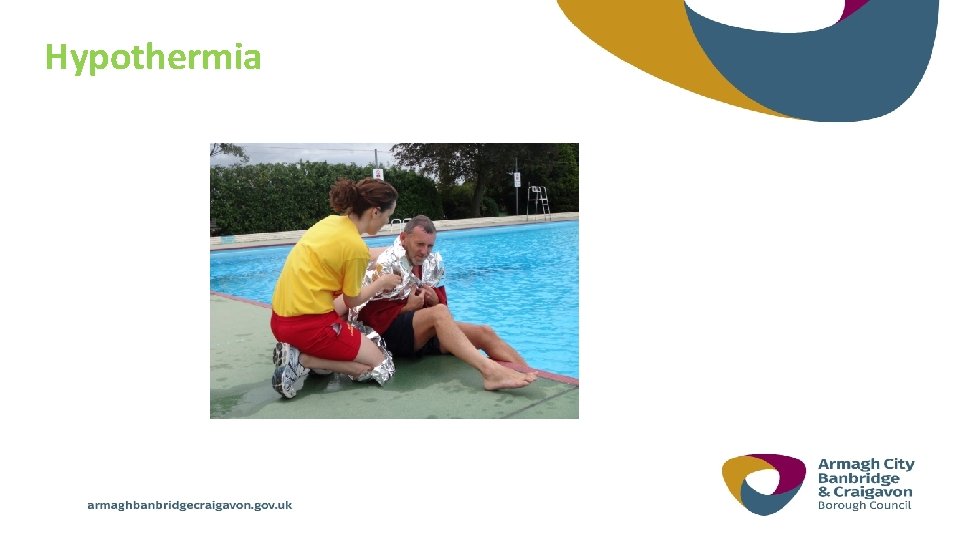
Hypothermia
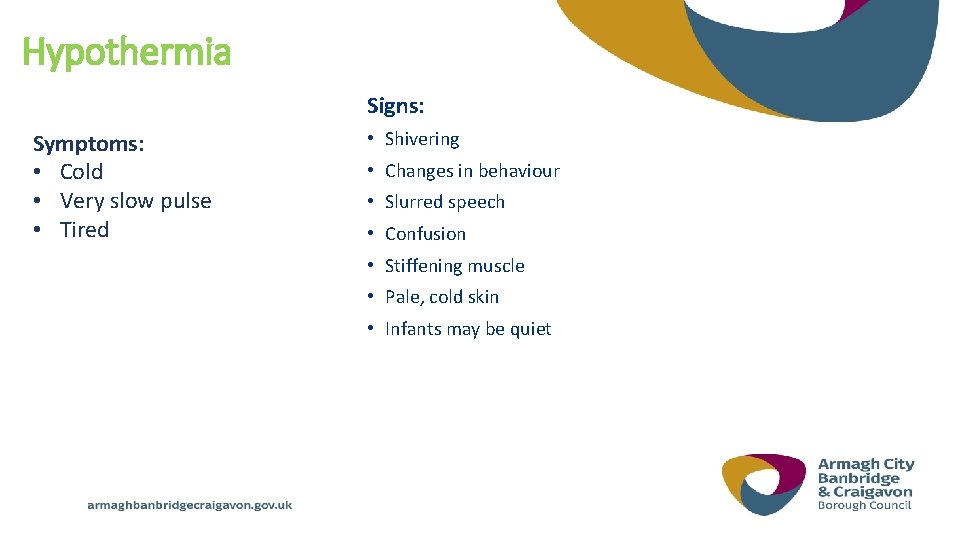
Hypothermia Signs: Symptoms: • Cold • Very slow pulse • Tired • Shivering • Changes in behaviour • Slurred speech • Confusion • Stiffening muscle • Pale, cold skin • Infants may be quiet
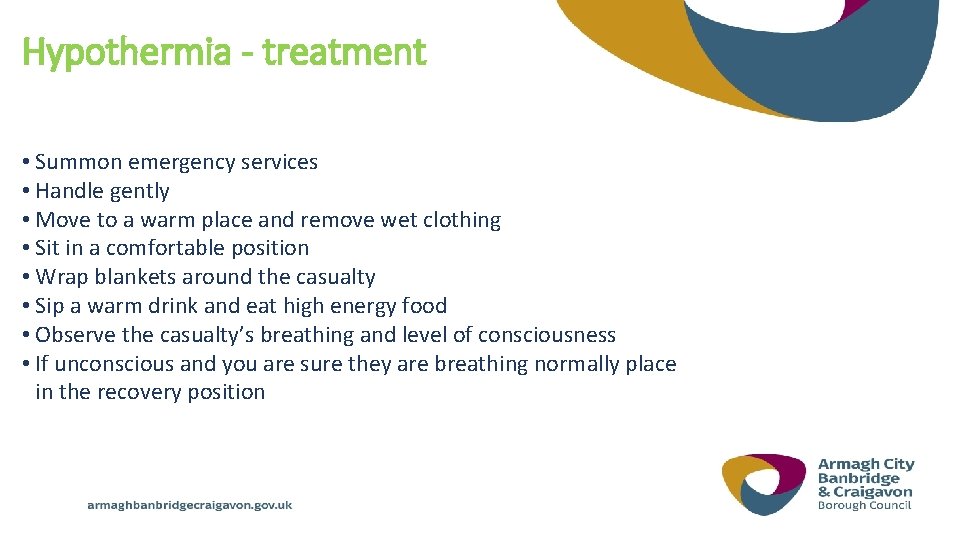
Hypothermia - treatment • Summon emergency services • Handle gently • Move to a warm place and remove wet clothing • Sit in a comfortable position • Wrap blankets around the casualty • Sip a warm drink and eat high energy food • Observe the casualty’s breathing and level of consciousness • If unconscious and you are sure they are breathing normally place in the recovery position
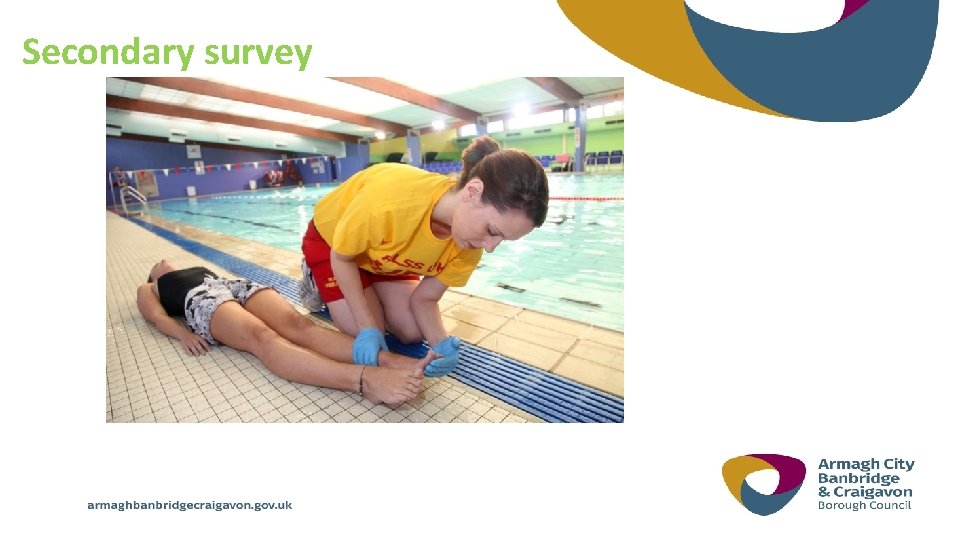
Secondary survey The secondary survey is a process to check for injuries and illnesses Look for: Use all your senses: • History • Look • Symptoms • Listen • Signs • Feel • Smell
Secondary survey • Ask permission of the casualty • Ask the casualty if they have any pain and if so where? • Protect privacy of the casualty • Protect yourself – gloves • Do not move the casualty more than is strictly necessary • Check with the casualty about any medical conditions • Check with the casualty about any medication they may be taking
Secondary survey • Check on all parts of body: • Bleeding • Bruising/swelling • Protruding bones • Deformity/fracture • Casualty reaction • Pain Whilst carrying out a secondary survey it is important to return to the primary survey and check for normal breathing frequently and treat appropriately.
Secondary survey
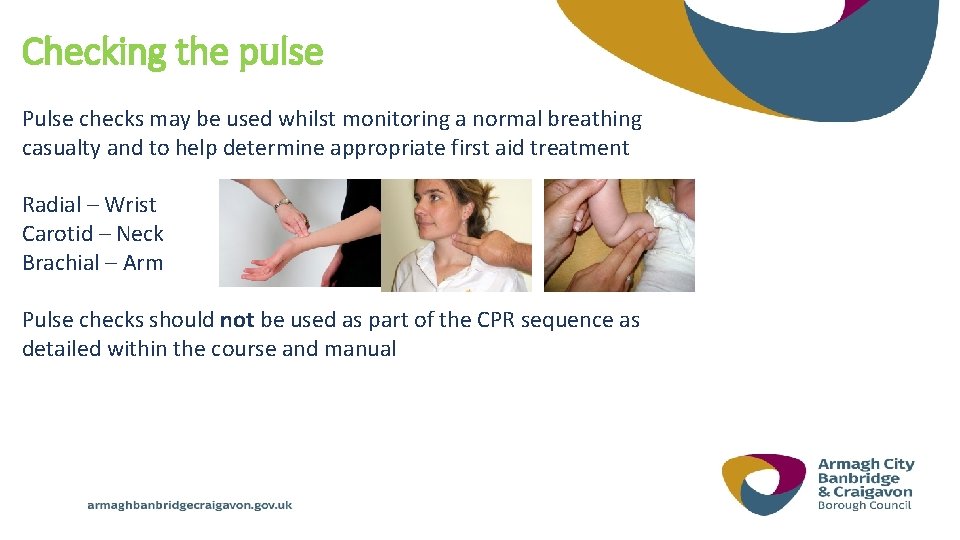
Checking the pulse Pulse checks may be used whilst monitoring a normal breathing casualty and to help determine appropriate first aid treatment Radial – Wrist Carotid – Neck Brachial – Arm Pulse checks should not be used as part of the CPR sequence as detailed within the course and manual
After the accident/incident • Clean up • Fill up • Write up • RIDDOR
Practical Assessment CPR and Injury to Spine • Airway Management and CPR • Managing Regurgitation of Stomach Contents More than One Rescuer and CPR use Pocket mask AED
Click here to start ASSESSMENT