
Staff Training A way to strengthen integrated prevention
![Quotations from participants “[The training is] already affecting my work; I’m implementing my skills,](https://slidetodoc.com/presentation_image_h2/d32f2396ac5f11c336fc3edf77475cc8/image-14.jpg "Quotations from participants “[The training is] already affecting my work; I’m implementing my skills,")
- Slides: 18
Staff Training A way to strengthen integrated prevention and health care for MSM Matthias Kuske Barrie Dwyer
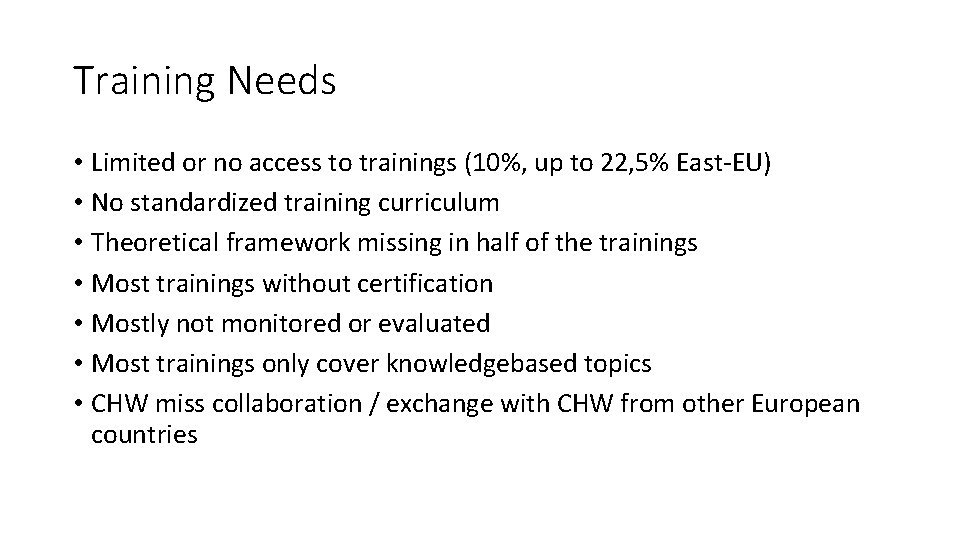
Training Needs • Limited or no access to trainings (10%, up to 22, 5% East-EU) • No standardized training curriculum • Theoretical framework missing in half of the trainings • Most trainings without certification • Mostly not monitored or evaluated • Most trainings only cover knowledgebased topics • CHW miss collaboration / exchange with CHW from other European countries
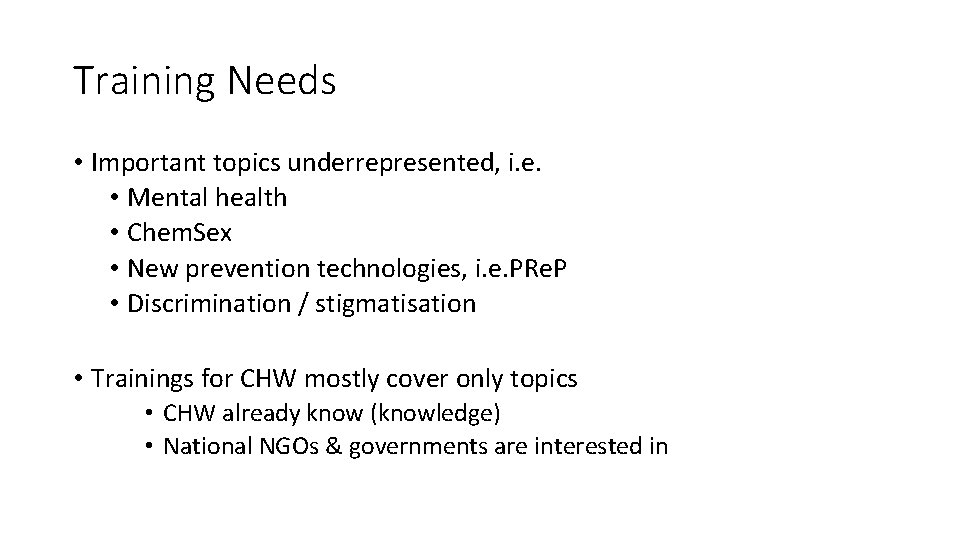
Training Needs • Important topics underrepresented, i. e. • Mental health • Chem. Sex • New prevention technologies, i. e. PRe. P • Discrimination / stigmatisation • Trainings for CHW mostly cover only topics • CHW already know (knowledge) • National NGOs & governments are interested in
Training Needs • Gaps especially in regards of • Attitudes • Skills, i. e. • • Communication Interpersonal Service coordination Capacity building • Cultural competencies in regards of gay/MSM life, sexuality, (sub-) communities • Management (monitoring & evaluation)
Training Recommendations • Emphasis on competency-based rather than knowledge- based trainings • Integrated conceptual and pedagocial approach strongly recommended • Include innovative approaches (E-Learning) • Core common (European) training protocols -> adapted to local context and enriched by local, national material • Focus on Eastern Europe (most training gaps)
Training Material Development • Development of a draft toolbox curriculum including four modules, each with their own aim Aim One: To increase the access to prevention, including testing services for HIV, STI’s and Viral Hepatitis among MSM and priority sub-groups. Aim Two: To improve the linkage and retention in care, as well as quality of care, including treatment for HIV/AIDS, STI’s and Viral Hepatitis. Aim Three: To improve the integration of services to ensure patient centred care, including inpatient and out-patient facilities, including Community & Prison Health Services. Aim Four: To reduce stigma and discrimination due to sexual orientation and of people living with HIV/AIDS in healthcare settings, including prison health services and in the community.
Training Materials Training modules developed to meet these aims include: • Cultural Competency strategies to remove barriers to access; improve quality of services and retention into care; Patient Involvement; Peer Mentoring; Capacity Building and Community Engagement. • Vulnerable MSM subgroups and subsequent sexual health needs: MSM Youth; MSM Migrants; Non Gay/Bi identified MSM; MSM from ethnic or cultural minority groups; Trans* MSM; MSM with drug (Chemsex) and alcohol needs; MSM in prison settings. • The epidemiological dynamics of HIV infection among MSM in Europe. • Syndemic Production Model on intertwining factors for poor sexual health for MSM. • New Prevention Technologies: Tas. P; PEP; Pr. EP; Self Sampling/Self Testing
Training of Trainer Workshops (To. T) • 4 To. T Workshops: Berlin, Warsaw, Vilnius, Athens • 61 participants from 27 countries • All EU member countries except Luxembourg, Malta, Slovakia • 2 weekends each • Selected ESTICOM material & excercises • Needs Assessment • Preparation for National Pilot Trainings • Training facilitation
To. T evaluation • Perceived as useful for working as CHW and as trainer • Would recommend the ESTICOM trainings to colleagues • Training material found useful, some participants already use ESTICOM material • In the work as CHW with their clients • In their trainings • Better understand the challenges to work as CHW • Changes in mind and skill-set (sexual attitudes & needs of MSM, nonjudgemental services etc. ) • Exchange / learning from each other / building a CHW network
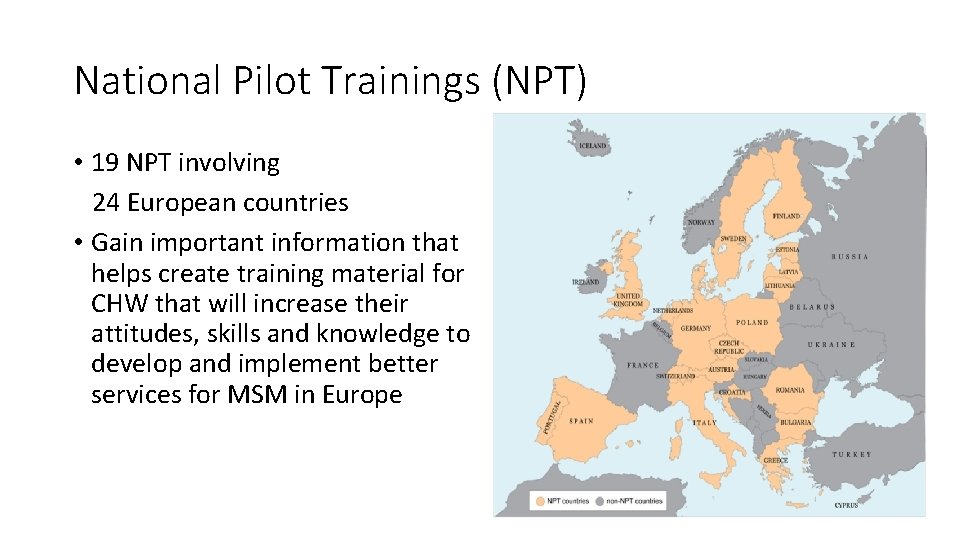
National Pilot Trainings (NPT) • 19 NPT involving 24 European countries • Gain important information that helps create training material for CHW that will increase their attitudes, skills and knowledge to develop and implement better services for MSM in Europe
NPT evaluation • Implementation of the Pilot Training Programme was successful • Average score was 8. 7 (6 – 9. 7 range; 1 -10 scale) • Interactive, participatory and reflective character highly appreciated by participants • Participants highly valued the NPT‘s and rated them as useful for their work • Need for a Europeanwide training material confirmed • General desire of the participants to continue ESTICOM/CHW‘s trainings • Recommendation: Future training for CHWs, similar to the ESTICOM NPT’s, should be continued
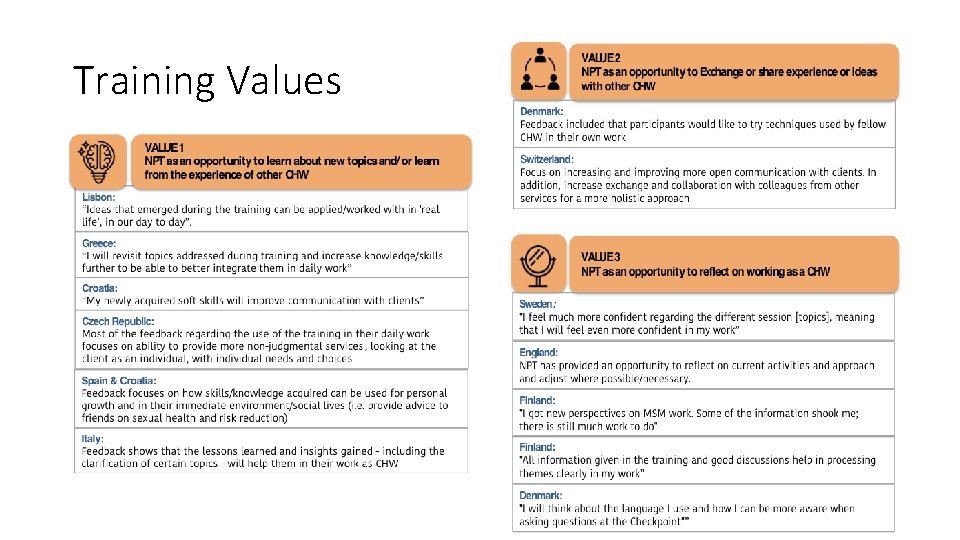
Training Values
Quotations from participants “[The training is] already affecting my work; I’m implementing my skills, using tools and plan to ‘grab’ some parts [of the training materials] to train my association. ” “The training was an inspiration for me, so I will try to disseminate this inspiration and the info gained to the rest of my colleagues and all together work towards further ameliorating our prevention services. ”
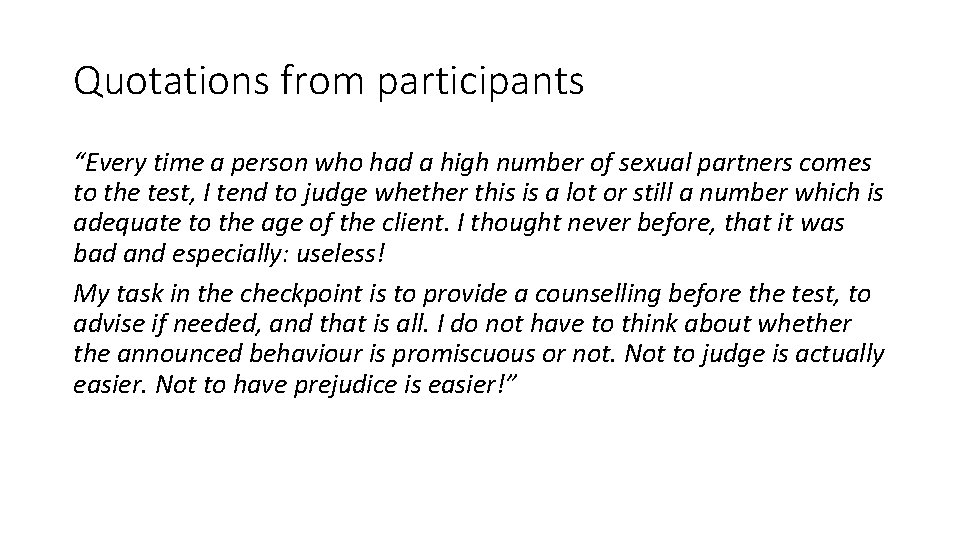
Quotations from participants “Every time a person who had a high number of sexual partners comes to the test, I tend to judge whether this is a lot or still a number which is adequate to the age of the client. I thought never before, that it was bad and especially: useless! My task in the checkpoint is to provide a counselling before the test, to advise if needed, and that is all. I do not have to think about whether the announced behaviour is promiscuous or not. Not to judge is actually easier. Not to have prejudice is easier!”
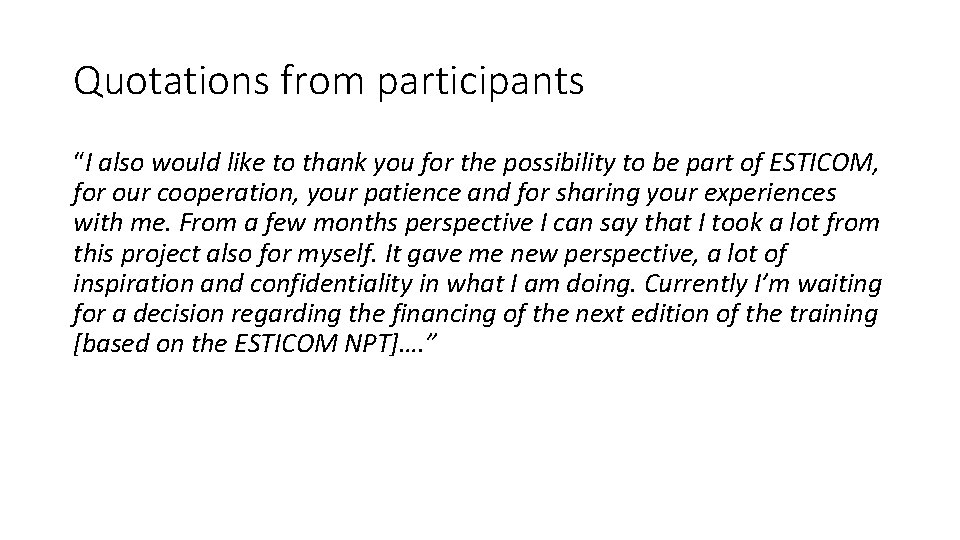
Quotations from participants “I also would like to thank you for the possibility to be part of ESTICOM, for our cooperation, your patience and for sharing your experiences with me. From a few months perspective I can say that I took a lot from this project also for myself. It gave me new perspective, a lot of inspiration and confidentiality in what I am doing. Currently I’m waiting for a decision regarding the financing of the next edition of the training [based on the ESTICOM NPT]…. ”
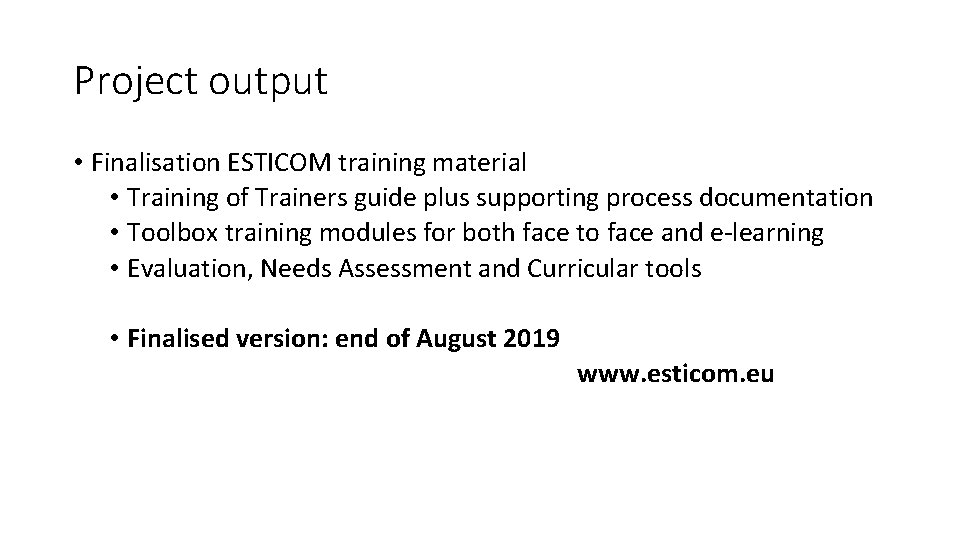
Project output • Finalisation ESTICOM training material • Training of Trainers guide plus supporting process documentation • Toolbox training modules for both face to face and e-learning • Evaluation, Needs Assessment and Curricular tools • Finalised version: end of August 2019 www. esticom. eu
Acknowledgements We would like to thank the European Commission, CHAFEA, the ESTICOM partners and Advisory board for the expertise and support provided A special thanks goes to Aryanti Radyowijati and Marije Veenstra from Resultsin. Health for the close and helpful cooperation in evaluating the Pilot Training Programme. In particular, we thank all more than 60 participants in the Training of Trainer Workshops, the organisations from 24 countries who organised National Pilot Trainings and the more than 40 trainers who conducted these pilot trainings in their countries. Without their energy, support and work the implementation of the Pilot Training Programme would not have been possible.