
Stacks Their Applications PostfixInfix Computer Science Department University
- Slides: 60
Stacks & Their Applications (Postfix/Infix) Computer Science Department University of Central Florida COP 3502 – Computer Science I
Outline n Stacks n What are they and how they work n Stack Applications n Infix to Postfix conversion n Evaluation of Postfix expressions © Jonathan Cazalas Stacks & Their Applications page 2
Stacks – An Overview n Abstract Data Type (ADT): n What is an Abstract Data Type? n To answer this, let us ask the negative of this: n What is NOT an Abstract Data Type (in C)? § int is a built-in type in the C language § double is a built-in type in the C language n © Jonathan Cazalas § There are certainly many others we can list These data types are already built into the language. Stacks & Their Applications page 3
Stacks – An Overview n Abstract Data Type (ADT): n So again, what is an Abstract Data Type? n n It is a data type that is NOT built into the language It is a data type that we will “build” § We will specify what it is, how it is used, etc. n n Nice definition from Wikipedia: n n © Jonathan Cazalas It is often defined in terms of its behavior rather than its implemented representation An abstract data type is defined indirectly, only by the operations that may be performed on it (i. e. behavior) http: //en. wikipedia. org/wiki/Abstract_data_type Stacks & Their Applications page 4
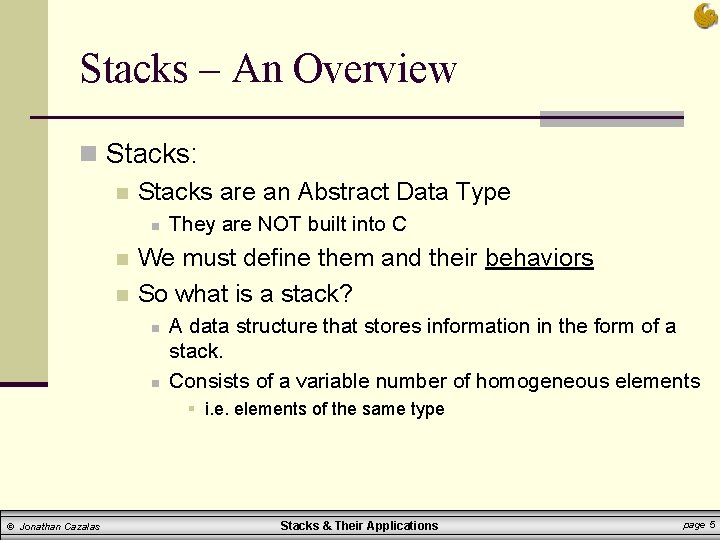
Stacks – An Overview n Stacks: n Stacks are an Abstract Data Type n n n They are NOT built into C We must define them and their behaviors So what is a stack? n n A data structure that stores information in the form of a stack. Consists of a variable number of homogeneous elements § i. e. elements of the same type © Jonathan Cazalas Stacks & Their Applications page 5
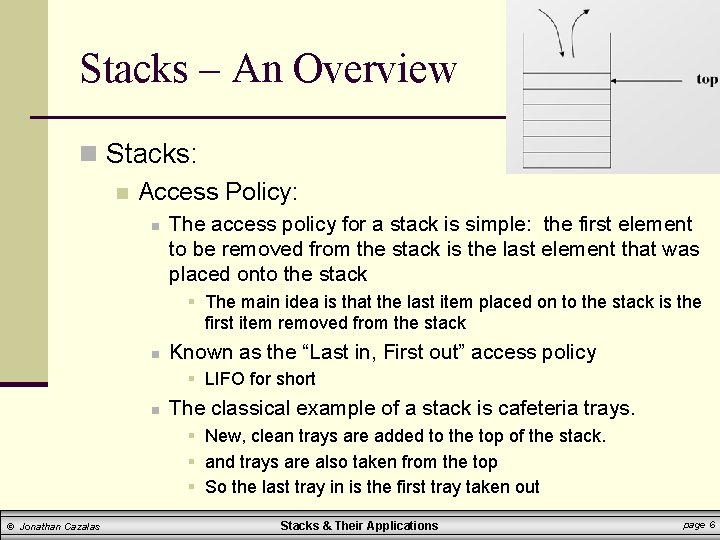
Stacks – An Overview n Stacks: n Access Policy: n The access policy for a stack is simple: the first element to be removed from the stack is the last element that was placed onto the stack § The main idea is that the last item placed on to the stack is the first item removed from the stack n Known as the “Last in, First out” access policy § LIFO for short n The classical example of a stack is cafeteria trays. § New, clean trays are added to the top of the stack. § and trays are also taken from the top § So the last tray in is the first tray taken out © Jonathan Cazalas Stacks & Their Applications page 6
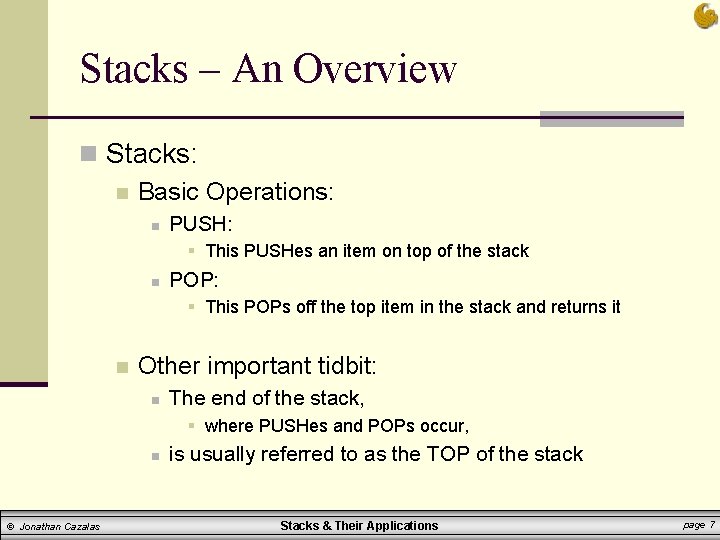
Stacks – An Overview n Stacks: n Basic Operations: n PUSH: § This PUSHes an item on top of the stack n POP: § This POPs off the top item in the stack and returns it n Other important tidbit: n The end of the stack, § where PUSHes and POPs occur, n © Jonathan Cazalas is usually referred to as the TOP of the stack Stacks & Their Applications page 7
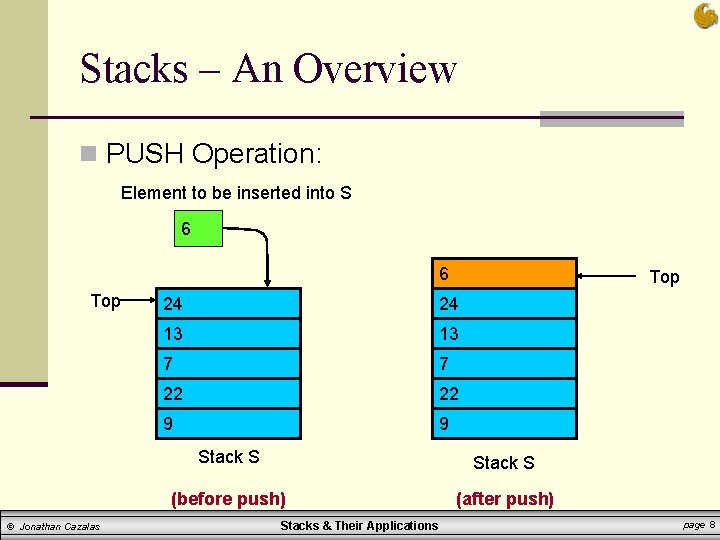
Stacks – An Overview n PUSH Operation: Element to be inserted into S 6 6 Top © Jonathan Cazalas Top 24 24 13 13 7 7 22 22 9 9 Stack S (before push) (after push) Stacks & Their Applications page 8
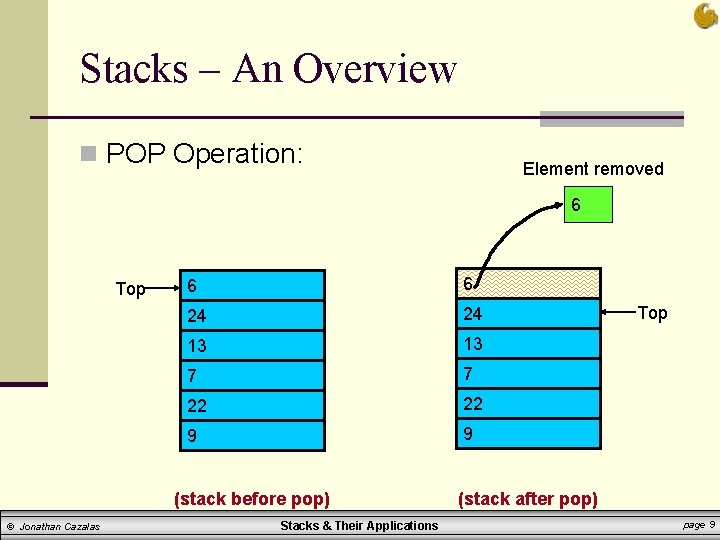
Stacks – An Overview n POP Operation: Element removed 6 Top 6 6 24 24 13 13 7 7 22 22 9 9 (stack before pop) © Jonathan Cazalas Stacks & Their Applications Top (stack after pop) page 9
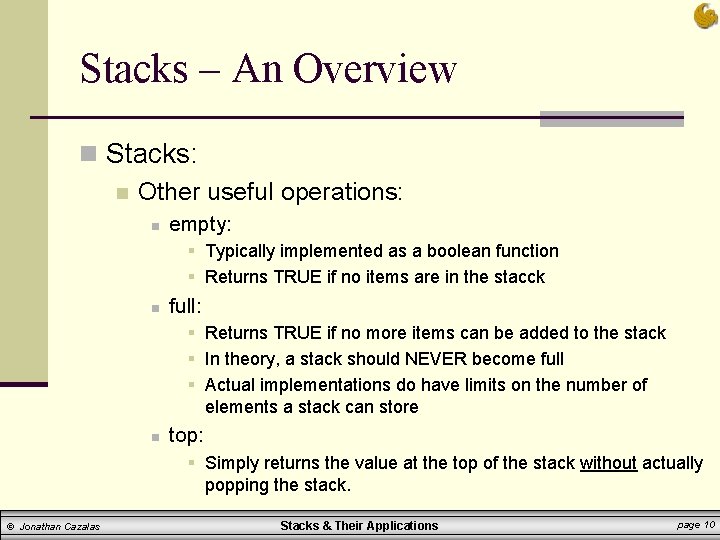
Stacks – An Overview n Stacks: n Other useful operations: n empty: § Typically implemented as a boolean function § Returns TRUE if no items are in the stacck n full: § Returns TRUE if no more items can be added to the stack § In theory, a stack should NEVER become full § Actual implementations do have limits on the number of elements a stack can store n top: § Simply returns the value at the top of the stack without actually popping the stack. © Jonathan Cazalas Stacks & Their Applications page 10
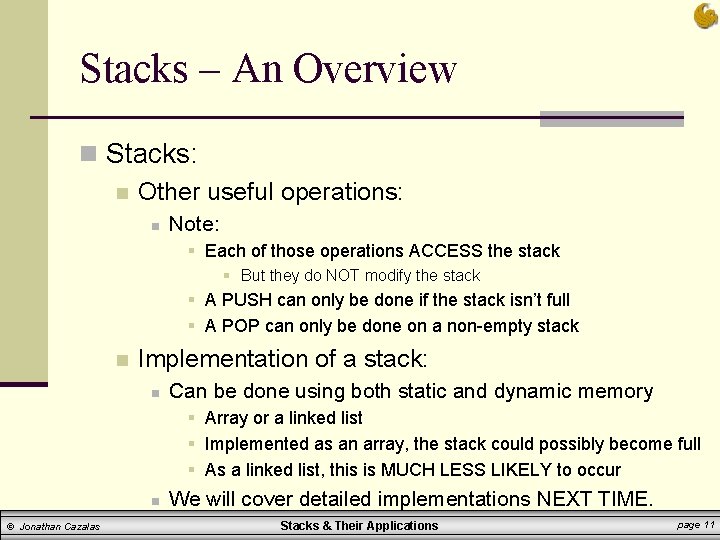
Stacks – An Overview n Stacks: n Other useful operations: n Note: § Each of those operations ACCESS the stack § But they do NOT modify the stack § A PUSH can only be done if the stack isn’t full § A POP can only be done on a non-empty stack n Implementation of a stack: n Can be done using both static and dynamic memory § Array or a linked list § Implemented as an array, the stack could possibly become full § As a linked list, this is MUCH LESS LIKELY to occur n © Jonathan Cazalas We will cover detailed implementations NEXT TIME. Stacks & Their Applications page 11
Using Stacks n So when is stack useful? n When data needs to be stored and then retrieved in reverse order n There are several examples/applications outside the scope of this class n n For now, we go over two classical examples… n © Jonathan Cazalas Be patient and they will come up This examples help facilitate learning about stacks and their operations. Stacks & Their Applications page 12
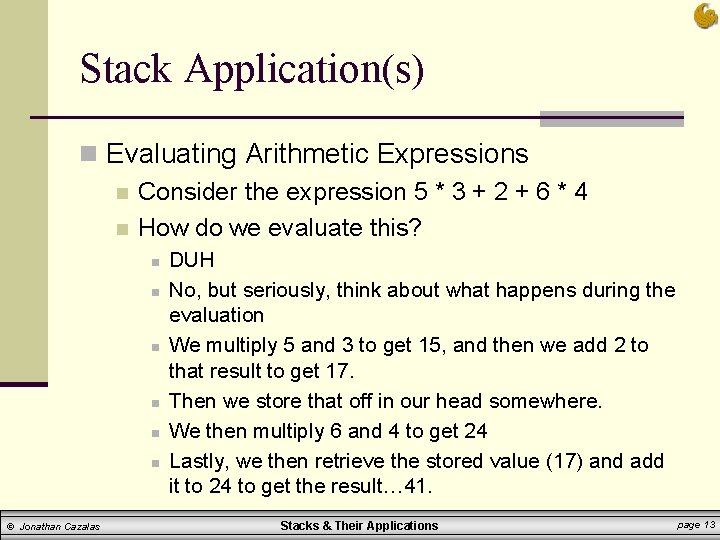
Stack Application(s) n Evaluating Arithmetic Expressions n Consider the expression 5 * 3 + 2 + 6 * 4 n How do we evaluate this? n n n © Jonathan Cazalas DUH No, but seriously, think about what happens during the evaluation We multiply 5 and 3 to get 15, and then we add 2 to that result to get 17. Then we store that off in our head somewhere. We then multiply 6 and 4 to get 24 Lastly, we then retrieve the stored value (17) and add it to 24 to get the result… 41. Stacks & Their Applications page 13
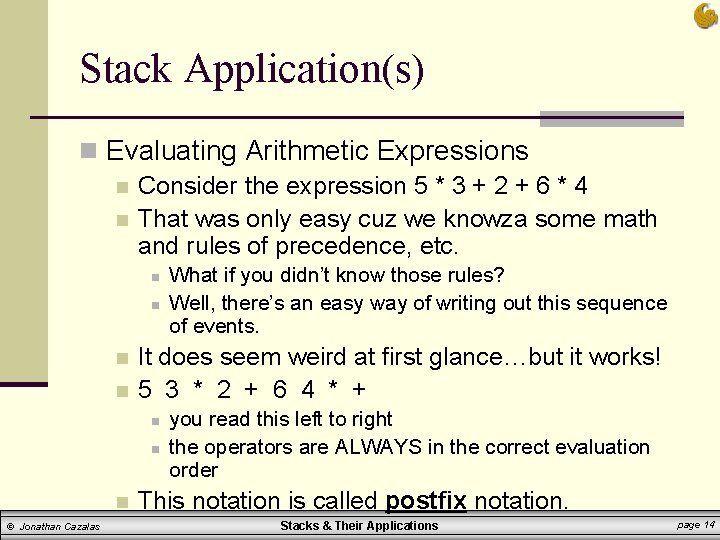
Stack Application(s) n Evaluating Arithmetic Expressions n Consider the expression 5 * 3 + 2 + 6 * 4 n That was only easy cuz we knowza some math and rules of precedence, etc. n n It does seem weird at first glance…but it works! 5 3 * 2 + 6 4 * + n n n © Jonathan Cazalas What if you didn’t know those rules? Well, there’s an easy way of writing out this sequence of events. you read this left to right the operators are ALWAYS in the correct evaluation order This notation is called postfix notation. Stacks & Their Applications page 14
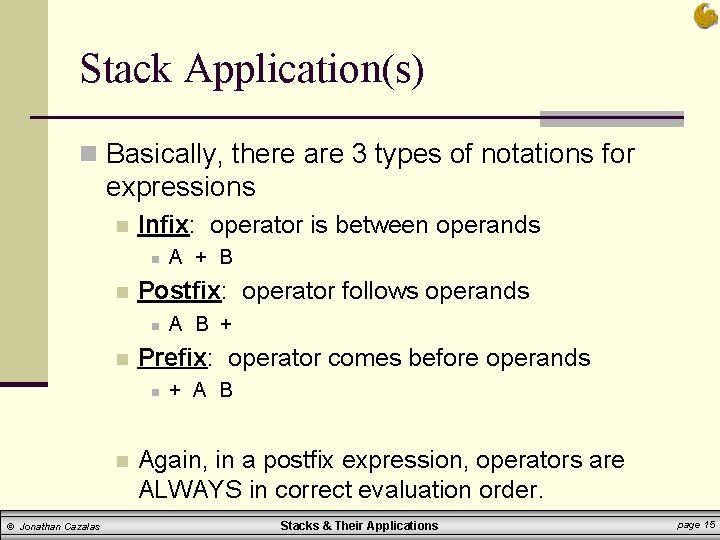
Stack Application(s) n Basically, there are 3 types of notations for expressions n Infix: operator is between operands n n Postfix: operator follows operands n n © Jonathan Cazalas A B + Prefix: operator comes before operands n n A + B + A B Again, in a postfix expression, operators are ALWAYS in correct evaluation order. Stacks & Their Applications page 15
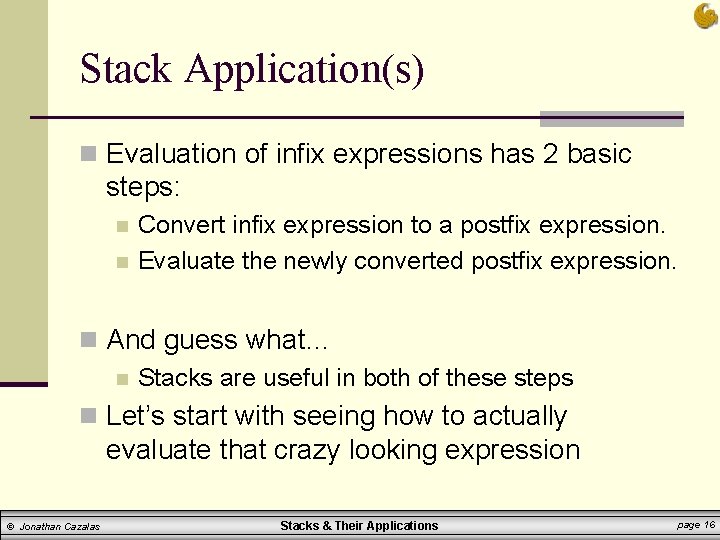
Stack Application(s) n Evaluation of infix expressions has 2 basic steps: n n Convert infix expression to a postfix expression. Evaluate the newly converted postfix expression. n And guess what… n Stacks are useful in both of these steps n Let’s start with seeing how to actually evaluate that crazy looking expression © Jonathan Cazalas Stacks & Their Applications page 16
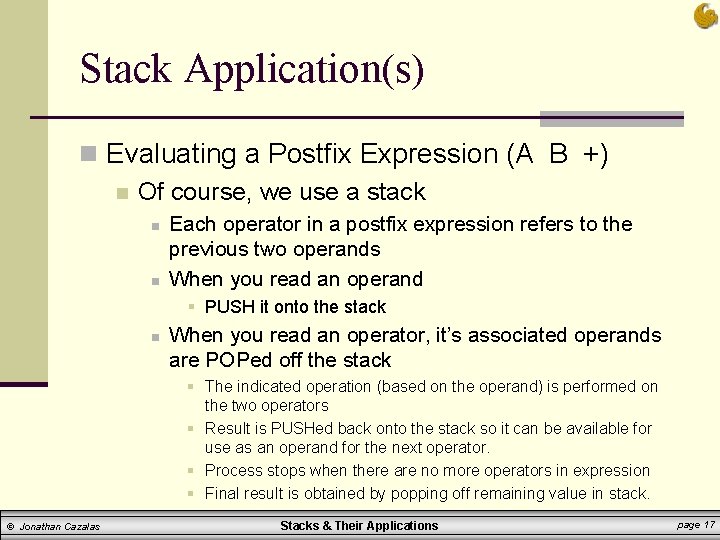
Stack Application(s) n Evaluating a Postfix Expression (A B +) n Of course, we use a stack n n Each operator in a postfix expression refers to the previous two operands When you read an operand § PUSH it onto the stack n When you read an operator, it’s associated operands are POPed off the stack § The indicated operation (based on the operand) is performed on the two operators § Result is PUSHed back onto the stack so it can be available for use as an operand for the next operator. § Process stops when there are no more operators in expression § Final result is obtained by popping off remaining value in stack. © Jonathan Cazalas Stacks & Their Applications page 17
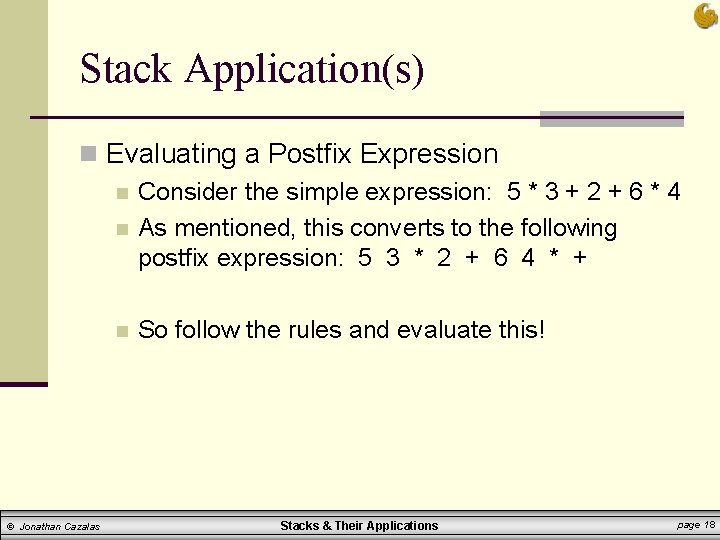
Stack Application(s) n Evaluating a Postfix Expression n Consider the simple expression: 5 * 3 + 2 + 6 * 4 n As mentioned, this converts to the following postfix expression: 5 3 * 2 + 6 4 * + n © Jonathan Cazalas So follow the rules and evaluate this! Stacks & Their Applications page 18
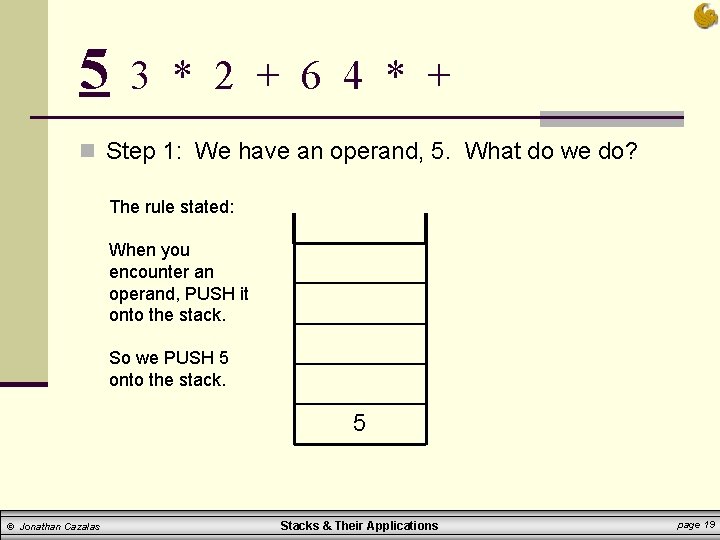
5 3 * 2 + 6 4 * + n Step 1: We have an operand, 5. What do we do? The rule stated: When you encounter an operand, PUSH it onto the stack. So we PUSH 5 onto the stack. 5 © Jonathan Cazalas Stacks & Their Applications page 19
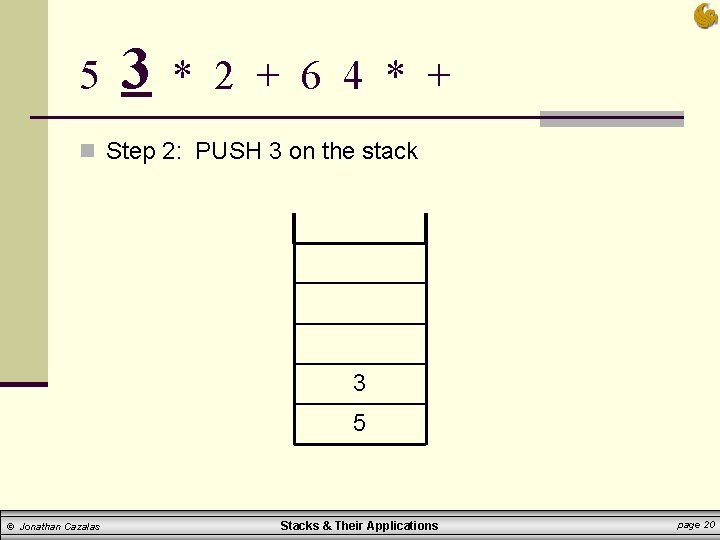
5 3 * 2 + 6 4 * + n Step 2: PUSH 3 on the stack 3 5 © Jonathan Cazalas Stacks & Their Applications page 20
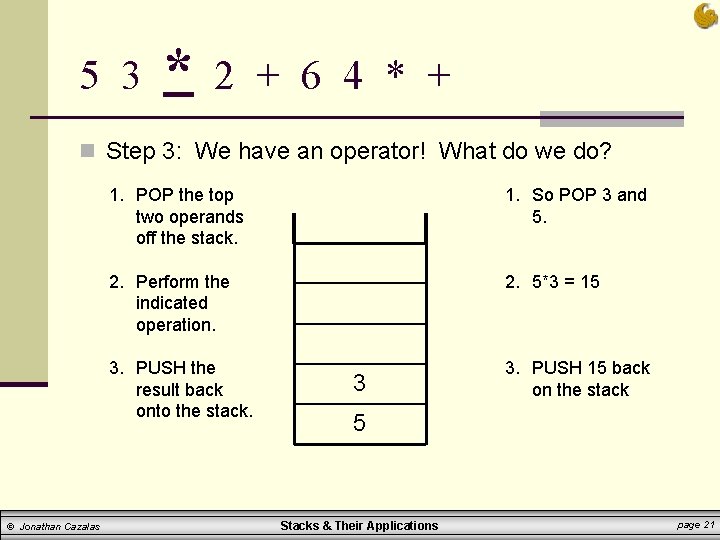
5 3 * 2 + 6 4 * + n Step 3: We have an operator! What do we do? © Jonathan Cazalas 1. POP the top two operands off the stack. 1. So POP 3 and 5. 2. Perform the indicated operation. 2. 5*3 = 15 3. PUSH the result back onto the stack. 3. PUSH 15 back on the stack 3 5 Stacks & Their Applications page 21
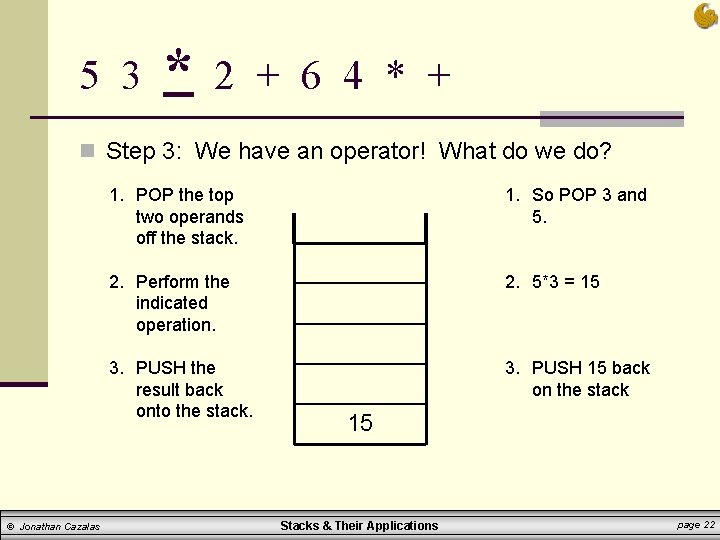
5 3 * 2 + 6 4 * + n Step 3: We have an operator! What do we do? © Jonathan Cazalas 1. POP the top two operands off the stack. 1. So POP 3 and 5. 2. Perform the indicated operation. 2. 5*3 = 15 3. PUSH the result back onto the stack. 3. PUSH 15 back on the stack 15 Stacks & Their Applications page 22
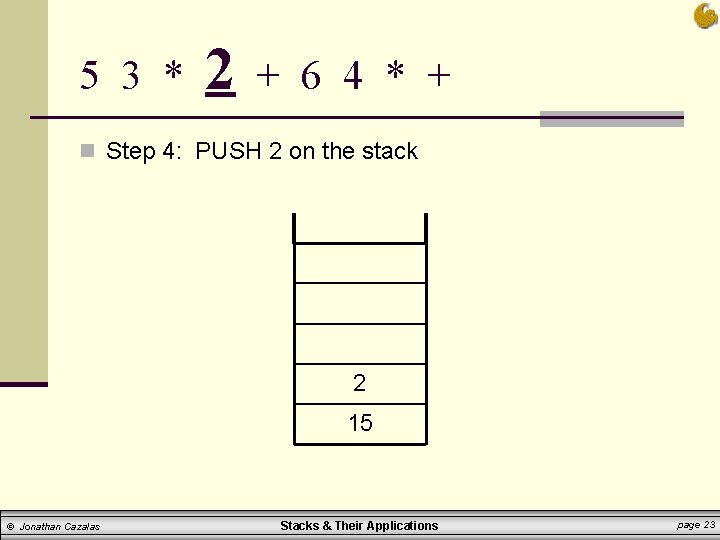
5 3 * 2 + 6 4 * + n Step 4: PUSH 2 on the stack 2 15 © Jonathan Cazalas Stacks & Their Applications page 23
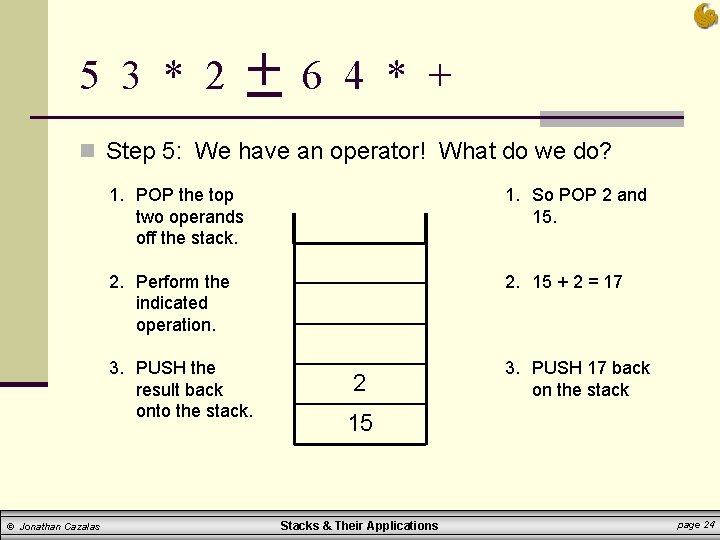
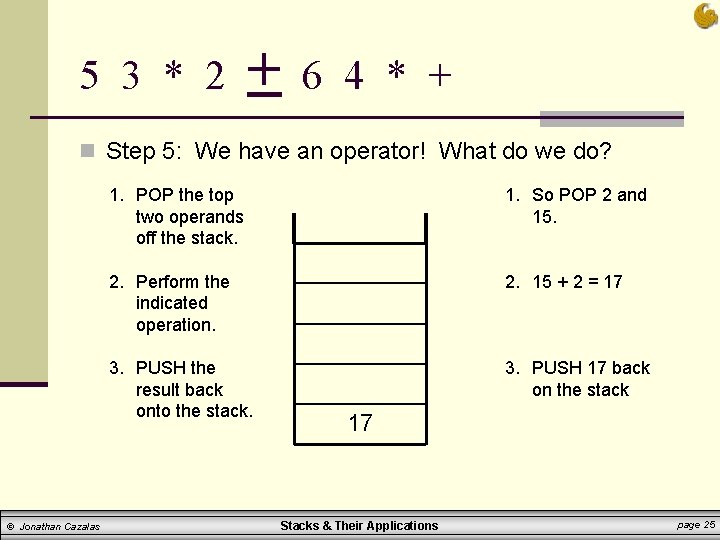
5 3 * 2 + 6 4 * + n Step 5: We have an operator! What do we do? © Jonathan Cazalas 1. POP the top two operands off the stack. 1. So POP 2 and 15. 2. Perform the indicated operation. 2. 15 + 2 = 17 3. PUSH the result back onto the stack. 3. PUSH 17 back on the stack 2 15 Stacks & Their Applications page 24
5 3 * 2 + 6 4 * + n Step 5: We have an operator! What do we do? © Jonathan Cazalas 1. POP the top two operands off the stack. 1. So POP 2 and 15. 2. Perform the indicated operation. 2. 15 + 2 = 17 3. PUSH the result back onto the stack. 3. PUSH 17 back on the stack 17 Stacks & Their Applications page 25
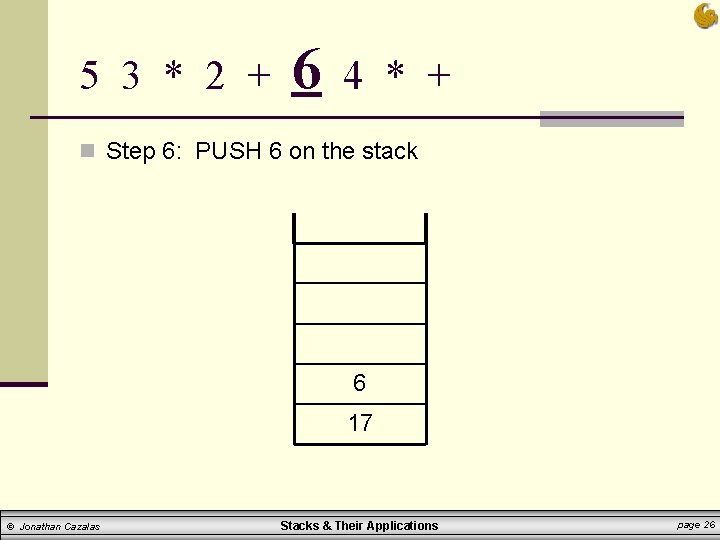
5 3 * 2 + 6 4 * + n Step 6: PUSH 6 on the stack 6 17 © Jonathan Cazalas Stacks & Their Applications page 26
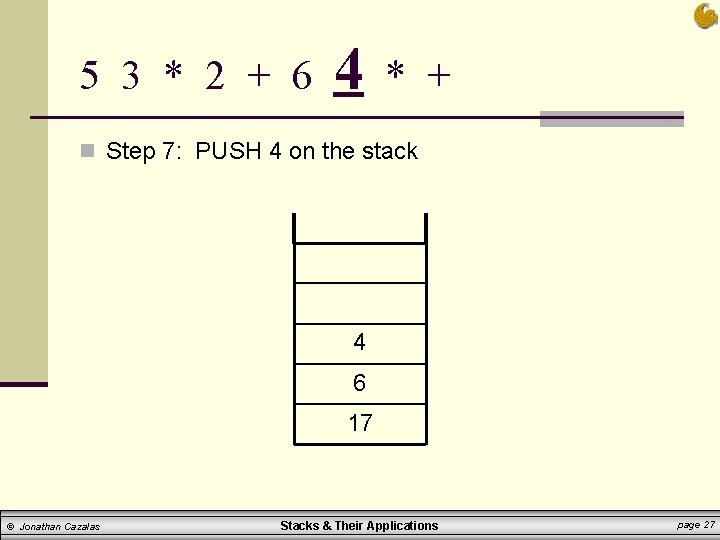
5 3 * 2 + 6 4 * + n Step 7: PUSH 4 on the stack 4 6 17 © Jonathan Cazalas Stacks & Their Applications page 27
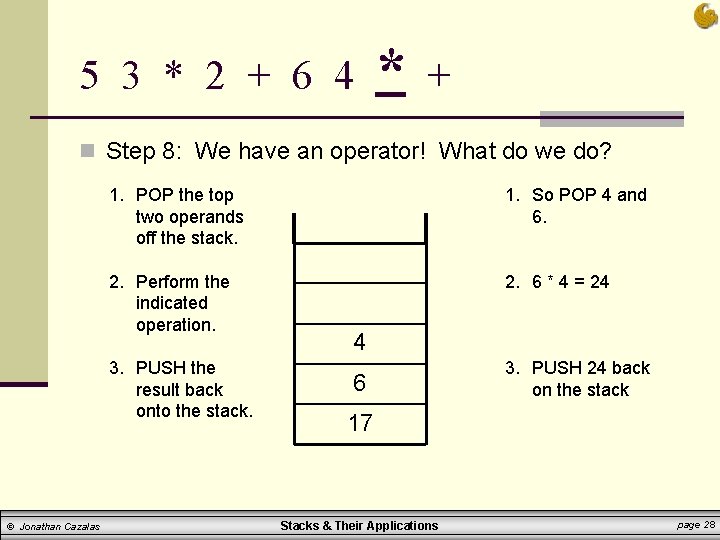
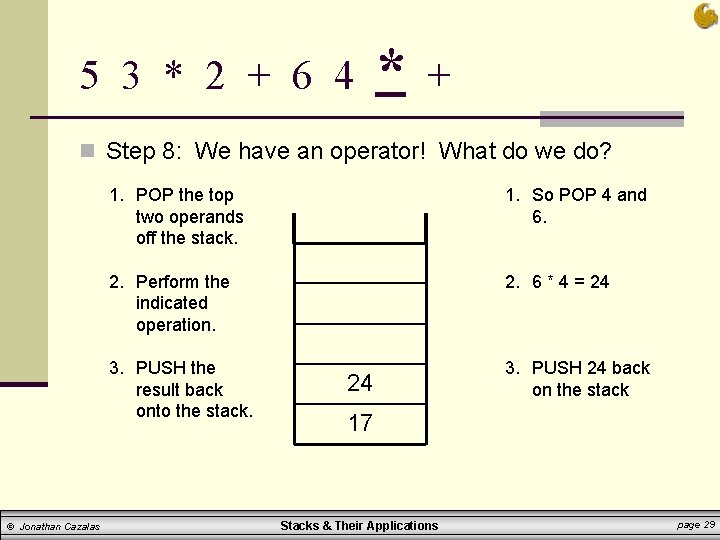
5 3 * 2 + 6 4 * + n Step 8: We have an operator! What do we do? 1. POP the top two operands off the stack. 1. So POP 4 and 6. 2. Perform the indicated operation. 2. 6 * 4 = 24 3. PUSH the result back onto the stack. © Jonathan Cazalas 4 6 3. PUSH 24 back on the stack 17 Stacks & Their Applications page 28
5 3 * 2 + 6 4 * + n Step 8: We have an operator! What do we do? © Jonathan Cazalas 1. POP the top two operands off the stack. 1. So POP 4 and 6. 2. Perform the indicated operation. 2. 6 * 4 = 24 3. PUSH the result back onto the stack. 3. PUSH 24 back on the stack 24 17 Stacks & Their Applications page 29
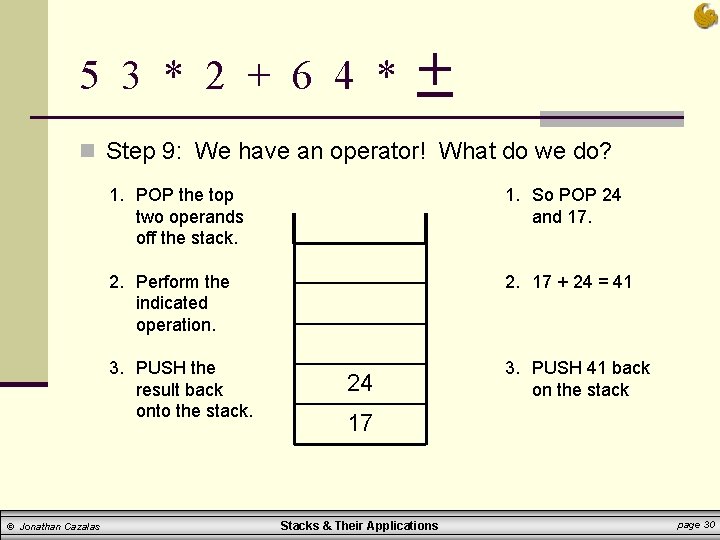
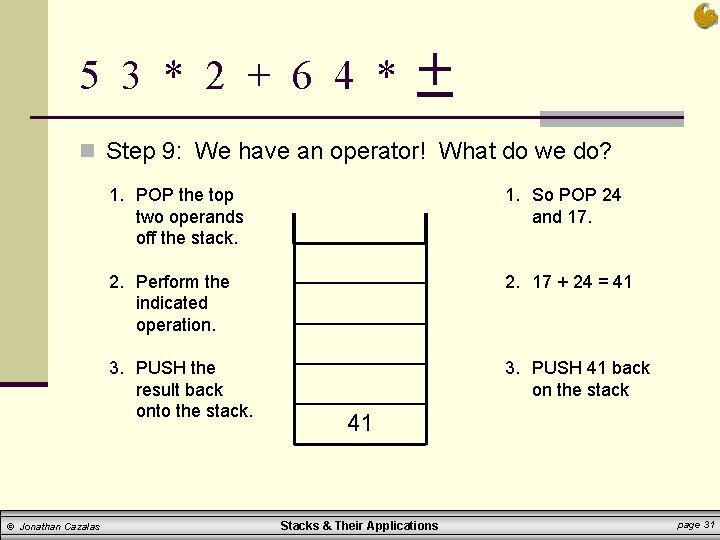
5 3 * 2 + 6 4 * + n Step 9: We have an operator! What do we do? © Jonathan Cazalas 1. POP the top two operands off the stack. 1. So POP 24 and 17. 2. Perform the indicated operation. 2. 17 + 24 = 41 3. PUSH the result back onto the stack. 3. PUSH 41 back on the stack 24 17 Stacks & Their Applications page 30
5 3 * 2 + 6 4 * + n Step 9: We have an operator! What do we do? © Jonathan Cazalas 1. POP the top two operands off the stack. 1. So POP 24 and 17. 2. Perform the indicated operation. 2. 17 + 24 = 41 3. PUSH the result back onto the stack. 3. PUSH 41 back on the stack 41 Stacks & Their Applications page 31
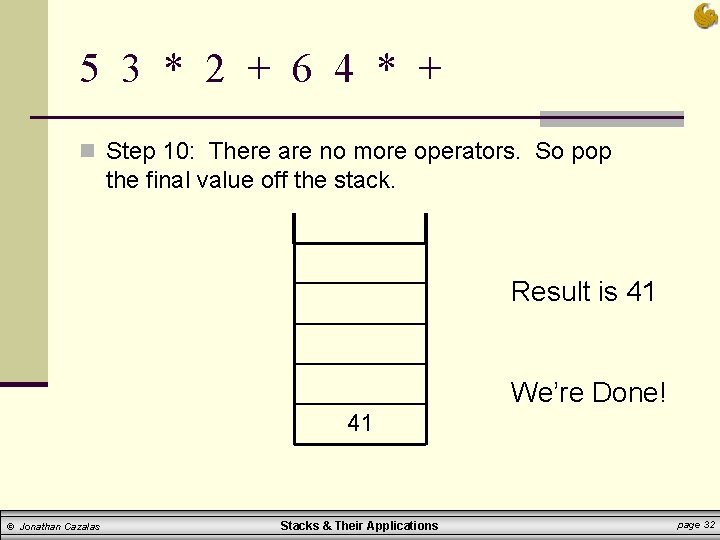
5 3 * 2 + 6 4 * + n Step 10: There are no more operators. So pop the final value off the stack. Result is 41 We’re Done! 41 © Jonathan Cazalas Stacks & Their Applications page 32
Brief Interlude: Human Stupidity © Jonathan Cazalas Stacks & Their Applications page 33
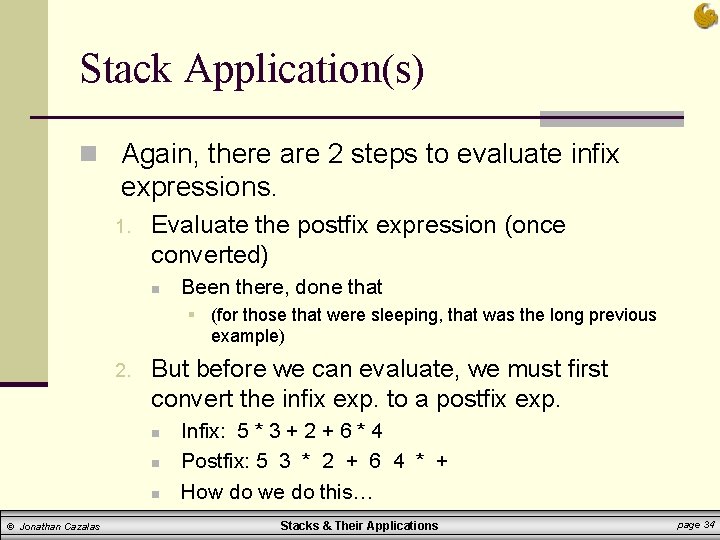
Stack Application(s) n Again, there are 2 steps to evaluate infix expressions. 1. Evaluate the postfix expression (once converted) n Been there, done that § (for those that were sleeping, that was the long previous example) 2. But before we can evaluate, we must first convert the infix exp. to a postfix exp. n n n © Jonathan Cazalas Infix: 5 * 3 + 2 + 6 * 4 Postfix: 5 3 * 2 + 6 4 * + How do we do this… Stacks & Their Applications page 34
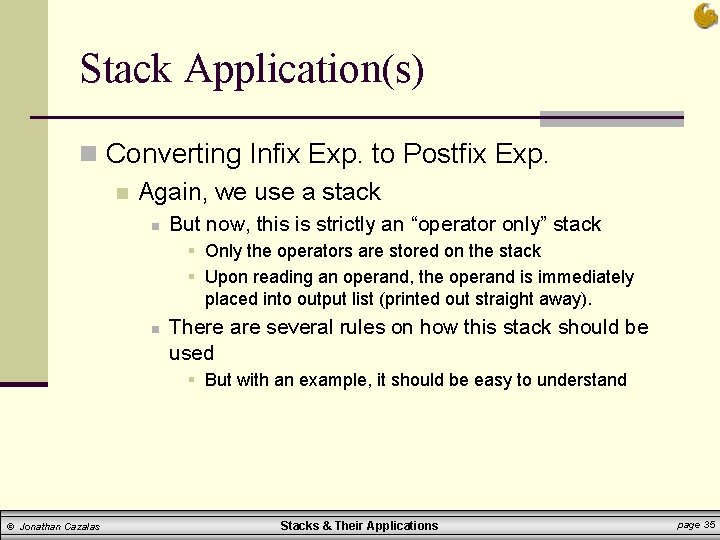
Stack Application(s) n Converting Infix Exp. to Postfix Exp. n Again, we use a stack n But now, this is strictly an “operator only” stack § Only the operators are stored on the stack § Upon reading an operand, the operand is immediately placed into output list (printed out straight away). n There are several rules on how this stack should be used § But with an example, it should be easy to understand © Jonathan Cazalas Stacks & Their Applications page 35
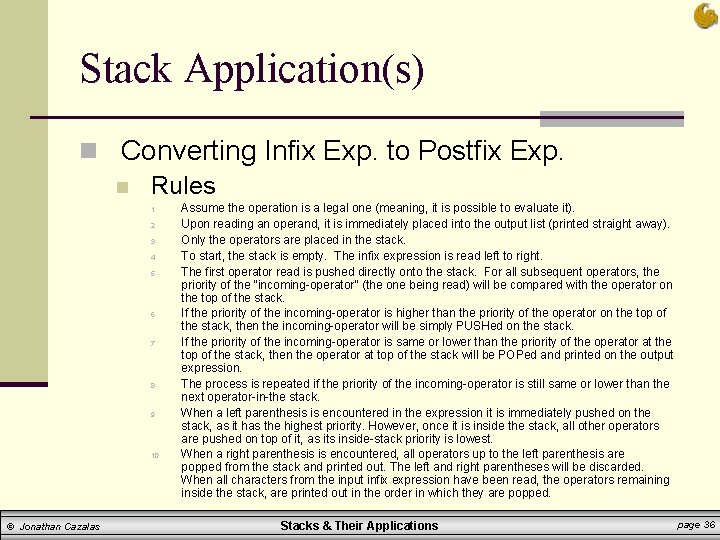
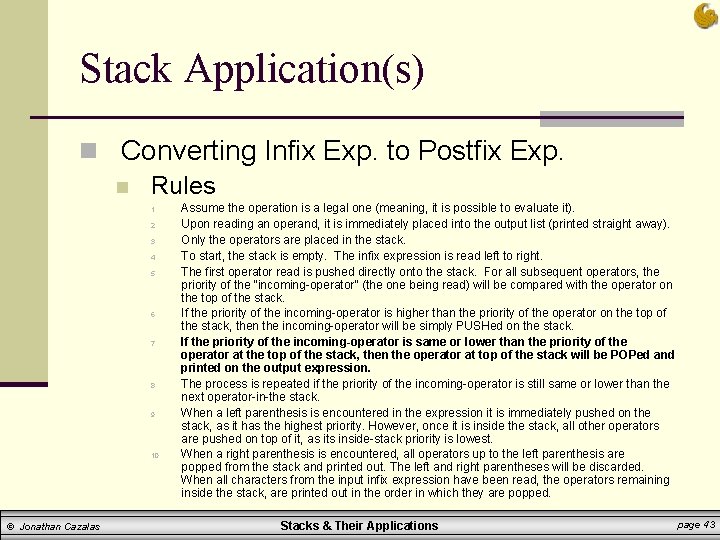
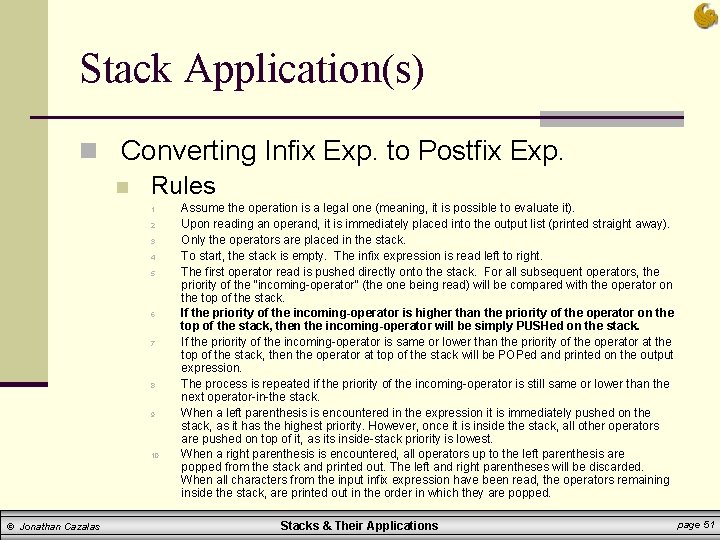
Stack Application(s) n Converting Infix Exp. to Postfix Exp. n Rules 1. 2. 3. 4. 5. 6. 7. 8. 9. 10. © Jonathan Cazalas Assume the operation is a legal one (meaning, it is possible to evaluate it). Upon reading an operand, it is immediately placed into the output list (printed straight away). Only the operators are placed in the stack. To start, the stack is empty. The infix expression is read left to right. The first operator read is pushed directly onto the stack. For all subsequent operators, the priority of the “incoming-operator” (the one being read) will be compared with the operator on the top of the stack. If the priority of the incoming-operator is higher than the priority of the operator on the top of the stack, then the incoming-operator will be simply PUSHed on the stack. If the priority of the incoming-operator is same or lower than the priority of the operator at the top of the stack, then the operator at top of the stack will be POPed and printed on the output expression. The process is repeated if the priority of the incoming-operator is still same or lower than the next operator-in-the stack. When a left parenthesis is encountered in the expression it is immediately pushed on the stack, as it has the highest priority. However, once it is inside the stack, all other operators are pushed on top of it, as its inside-stack priority is lowest. When a right parenthesis is encountered, all operators up to the left parenthesis are popped from the stack and printed out. The left and right parentheses will be discarded. When all characters from the input infix expression have been read, the operators remaining inside the stack, are printed out in the order in which they are popped. Stacks & Their Applications page 36
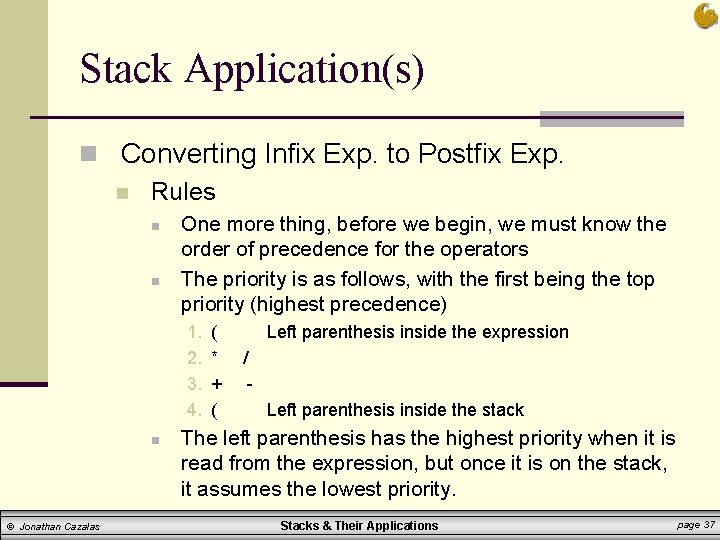
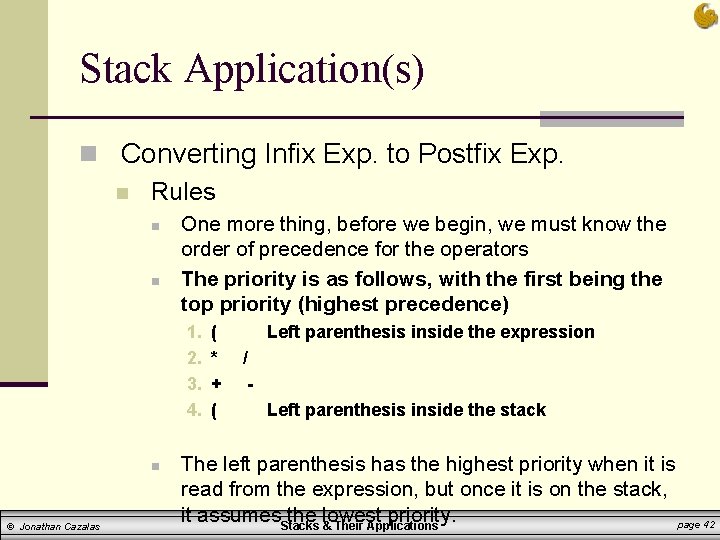
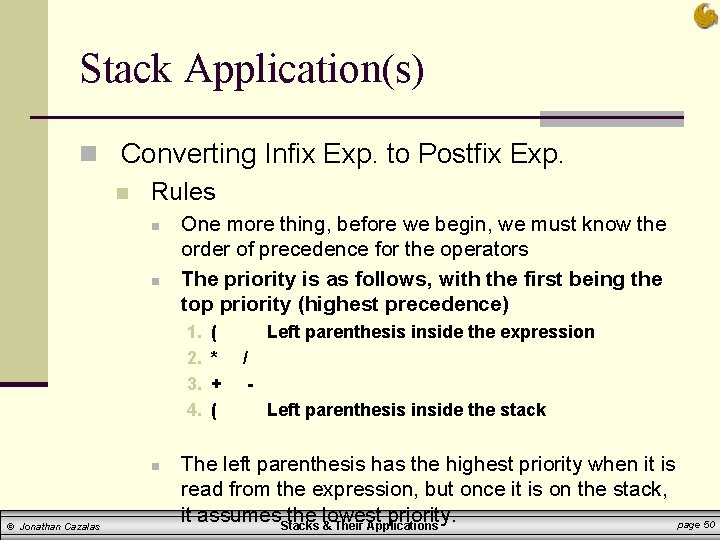
Stack Application(s) n Converting Infix Exp. to Postfix Exp. n Rules n n One more thing, before we begin, we must know the order of precedence for the operators The priority is as follows, with the first being the top priority (highest precedence) 1. 2. 3. 4. n © Jonathan Cazalas ( * + ( Left parenthesis inside the expression / Left parenthesis inside the stack The left parenthesis has the highest priority when it is read from the expression, but once it is on the stack, it assumes the lowest priority. Stacks & Their Applications page 37
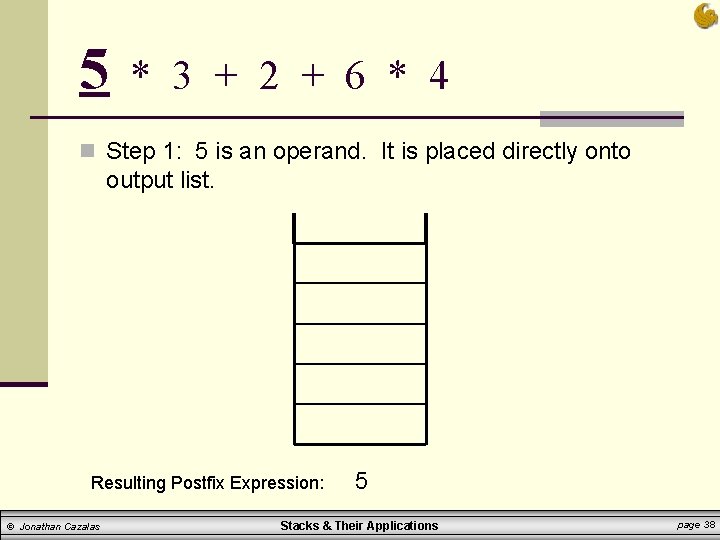
5 * 3 + 2 + 6 * 4 n Step 1: 5 is an operand. It is placed directly onto output list. Resulting Postfix Expression: © Jonathan Cazalas 5 Stacks & Their Applications page 38
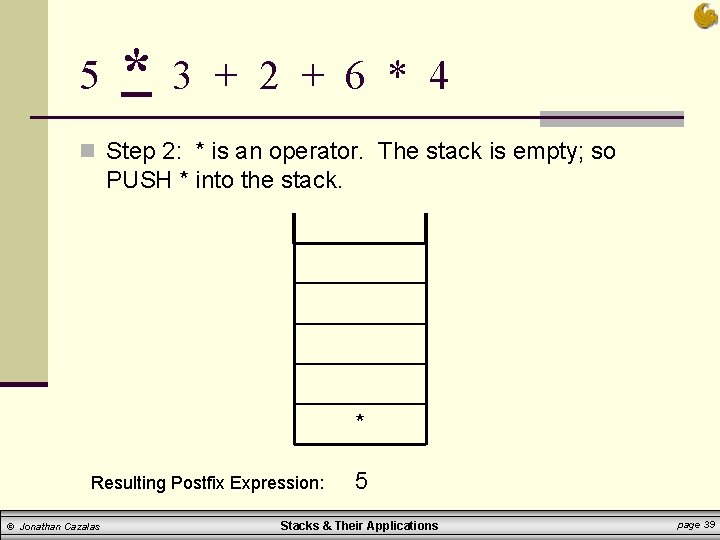
5 * 3 + 2 + 6 * 4 n Step 2: * is an operator. The stack is empty; so PUSH * into the stack. * Resulting Postfix Expression: © Jonathan Cazalas 5 Stacks & Their Applications page 39
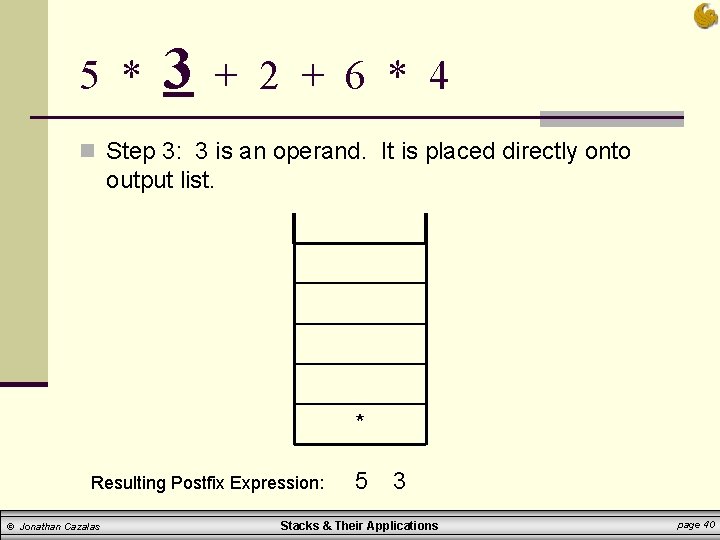
5 * 3 + 2 + 6 * 4 n Step 3: 3 is an operand. It is placed directly onto output list. * Resulting Postfix Expression: © Jonathan Cazalas 5 3 Stacks & Their Applications page 40
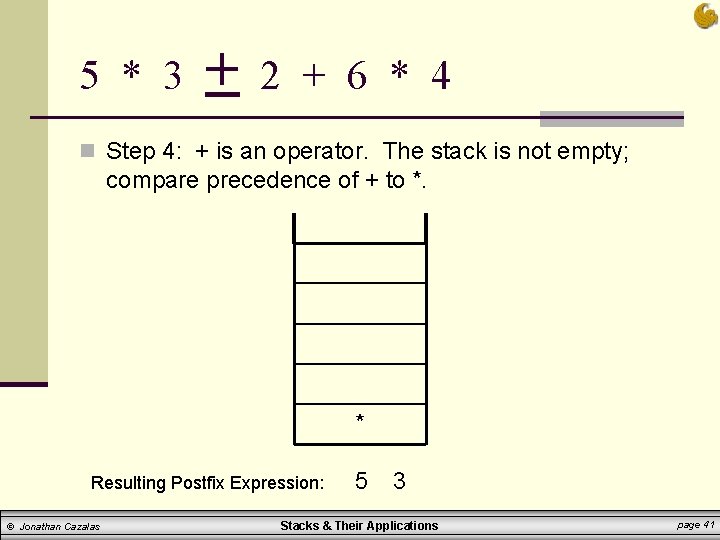
5 * 3 + 2 + 6 * 4 n Step 4: + is an operator. The stack is not empty; compare precedence of + to *. * Resulting Postfix Expression: © Jonathan Cazalas 5 3 Stacks & Their Applications page 41
Stack Application(s) n Converting Infix Exp. to Postfix Exp. n Rules n n One more thing, before we begin, we must know the order of precedence for the operators The priority is as follows, with the first being the top priority (highest precedence) 1. 2. 3. 4. n © Jonathan Cazalas ( * + ( Left parenthesis inside the expression / Left parenthesis inside the stack The left parenthesis has the highest priority when it is read from the expression, but once it is on the stack, it assumes. Stacks the lowest priority. page 42 & Their Applications
Stack Application(s) n Converting Infix Exp. to Postfix Exp. n Rules 1. 2. 3. 4. 5. 6. 7. 8. 9. 10. © Jonathan Cazalas Assume the operation is a legal one (meaning, it is possible to evaluate it). Upon reading an operand, it is immediately placed into the output list (printed straight away). Only the operators are placed in the stack. To start, the stack is empty. The infix expression is read left to right. The first operator read is pushed directly onto the stack. For all subsequent operators, the priority of the “incoming-operator” (the one being read) will be compared with the operator on the top of the stack. If the priority of the incoming-operator is higher than the priority of the operator on the top of the stack, then the incoming-operator will be simply PUSHed on the stack. If the priority of the incoming-operator is same or lower than the priority of the operator at the top of the stack, then the operator at top of the stack will be POPed and printed on the output expression. The process is repeated if the priority of the incoming-operator is still same or lower than the next operator-in-the stack. When a left parenthesis is encountered in the expression it is immediately pushed on the stack, as it has the highest priority. However, once it is inside the stack, all other operators are pushed on top of it, as its inside-stack priority is lowest. When a right parenthesis is encountered, all operators up to the left parenthesis are popped from the stack and printed out. The left and right parentheses will be discarded. When all characters from the input infix expression have been read, the operators remaining inside the stack, are printed out in the order in which they are popped. Stacks & Their Applications page 43
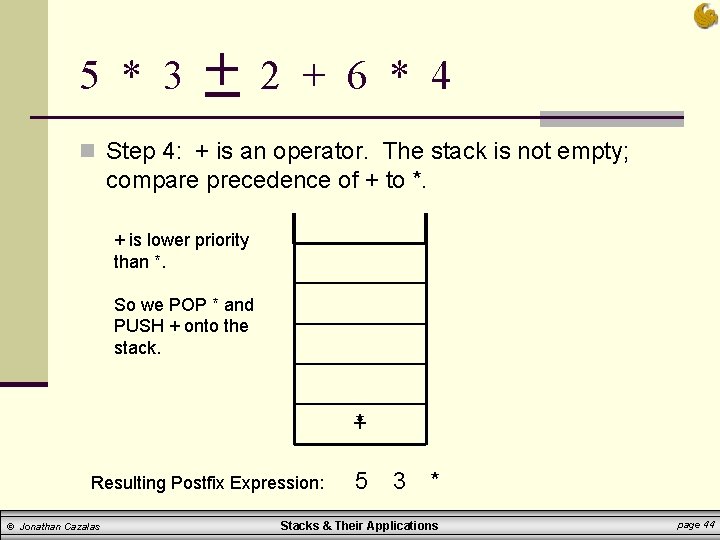
5 * 3 + 2 + 6 * 4 n Step 4: + is an operator. The stack is not empty; compare precedence of + to *. + is lower priority than *. So we POP * and PUSH + onto the stack. +* Resulting Postfix Expression: © Jonathan Cazalas 5 3 * Stacks & Their Applications page 44
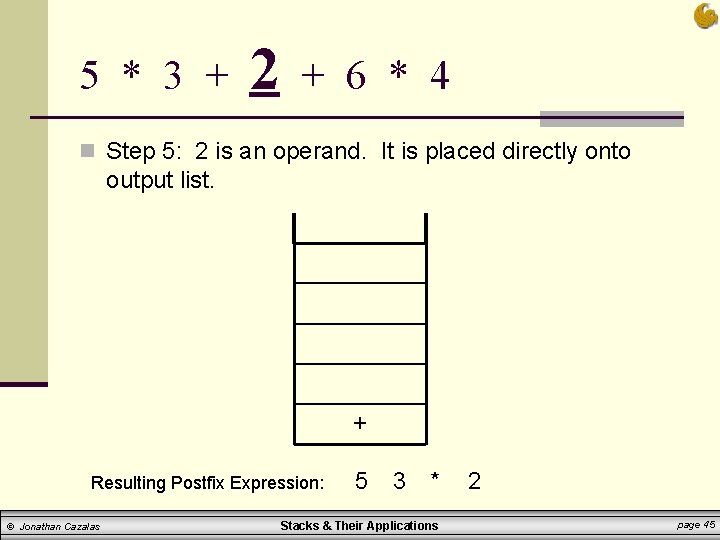
5 * 3 + 2 + 6 * 4 n Step 5: 2 is an operand. It is placed directly onto output list. + Resulting Postfix Expression: © Jonathan Cazalas 5 3 * Stacks & Their Applications 2 page 45
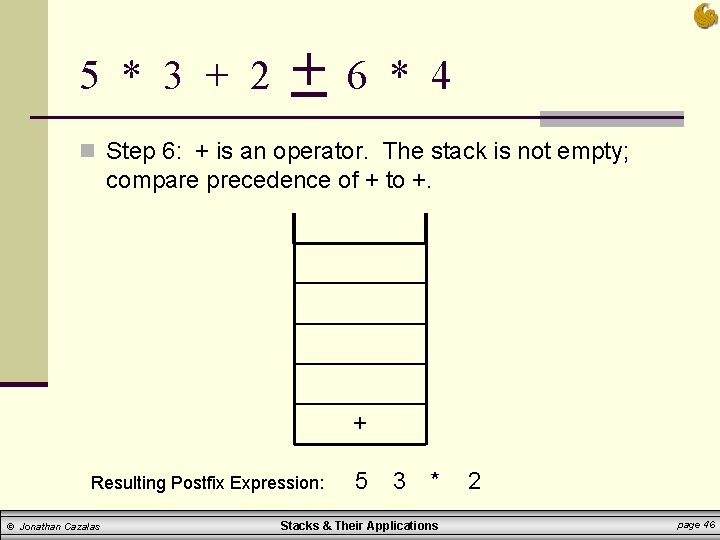
5 * 3 + 2 + 6 * 4 n Step 6: + is an operator. The stack is not empty; compare precedence of + to +. + Resulting Postfix Expression: © Jonathan Cazalas 5 3 * Stacks & Their Applications 2 page 46
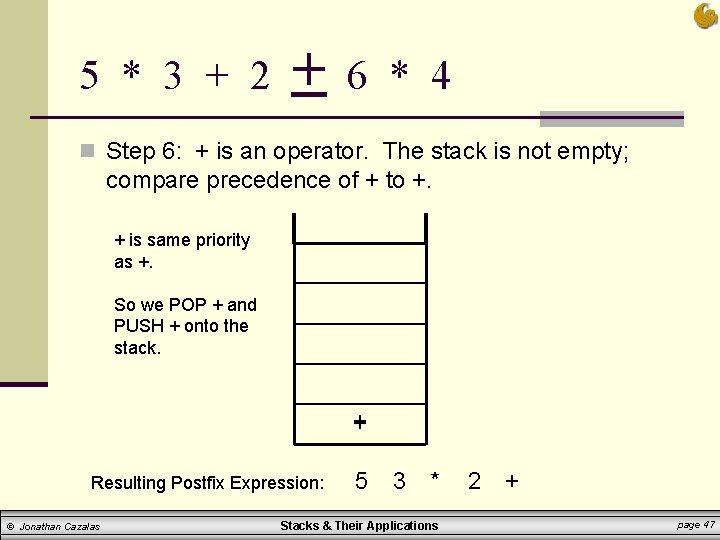
5 * 3 + 2 + 6 * 4 n Step 6: + is an operator. The stack is not empty; compare precedence of + to +. + is same priority as +. So we POP + and PUSH + onto the stack. + Resulting Postfix Expression: © Jonathan Cazalas 5 3 * Stacks & Their Applications 2 + page 47
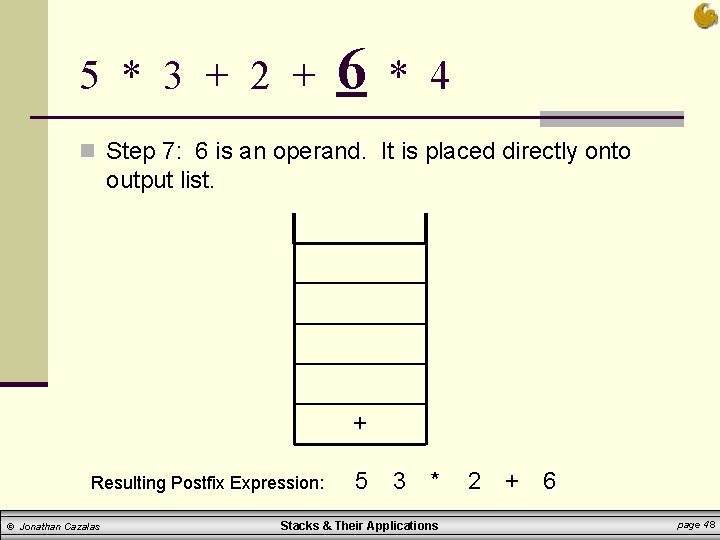
5 * 3 + 2 + 6 * 4 n Step 7: 6 is an operand. It is placed directly onto output list. + Resulting Postfix Expression: © Jonathan Cazalas 5 3 * Stacks & Their Applications 2 + 6 page 48
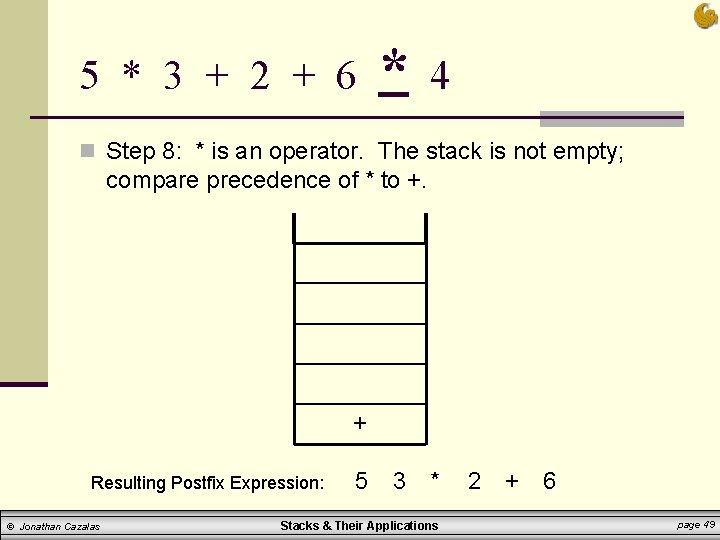
5 * 3 + 2 + 6 * 4 n Step 8: * is an operator. The stack is not empty; compare precedence of * to +. + Resulting Postfix Expression: © Jonathan Cazalas 5 3 * Stacks & Their Applications 2 + 6 page 49
Stack Application(s) n Converting Infix Exp. to Postfix Exp. n Rules n n One more thing, before we begin, we must know the order of precedence for the operators The priority is as follows, with the first being the top priority (highest precedence) 1. 2. 3. 4. n © Jonathan Cazalas ( * + ( Left parenthesis inside the expression / Left parenthesis inside the stack The left parenthesis has the highest priority when it is read from the expression, but once it is on the stack, it assumes. Stacks the lowest priority. page 50 & Their Applications
Stack Application(s) n Converting Infix Exp. to Postfix Exp. n Rules 1. 2. 3. 4. 5. 6. 7. 8. 9. 10. © Jonathan Cazalas Assume the operation is a legal one (meaning, it is possible to evaluate it). Upon reading an operand, it is immediately placed into the output list (printed straight away). Only the operators are placed in the stack. To start, the stack is empty. The infix expression is read left to right. The first operator read is pushed directly onto the stack. For all subsequent operators, the priority of the “incoming-operator” (the one being read) will be compared with the operator on the top of the stack. If the priority of the incoming-operator is higher than the priority of the operator on the top of the stack, then the incoming-operator will be simply PUSHed on the stack. If the priority of the incoming-operator is same or lower than the priority of the operator at the top of the stack, then the operator at top of the stack will be POPed and printed on the output expression. The process is repeated if the priority of the incoming-operator is still same or lower than the next operator-in-the stack. When a left parenthesis is encountered in the expression it is immediately pushed on the stack, as it has the highest priority. However, once it is inside the stack, all other operators are pushed on top of it, as its inside-stack priority is lowest. When a right parenthesis is encountered, all operators up to the left parenthesis are popped from the stack and printed out. The left and right parentheses will be discarded. When all characters from the input infix expression have been read, the operators remaining inside the stack, are printed out in the order in which they are popped. Stacks & Their Applications page 51
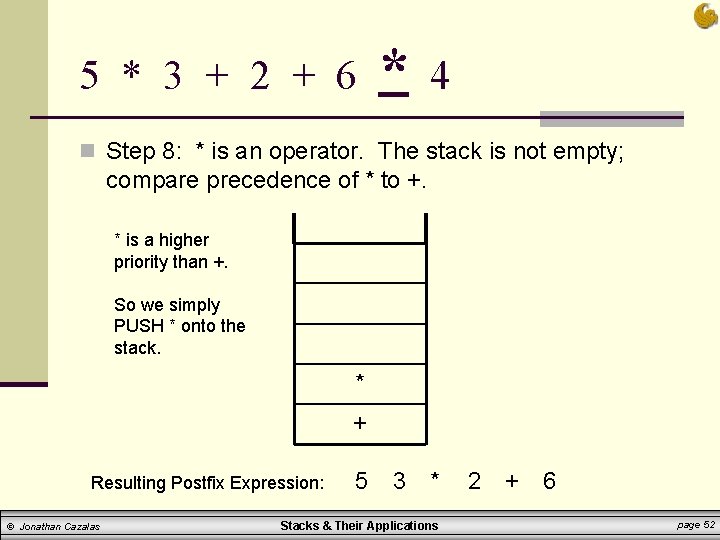
5 * 3 + 2 + 6 * 4 n Step 8: * is an operator. The stack is not empty; compare precedence of * to +. * is a higher priority than +. So we simply PUSH * onto the stack. * + Resulting Postfix Expression: © Jonathan Cazalas 5 3 * Stacks & Their Applications 2 + 6 page 52
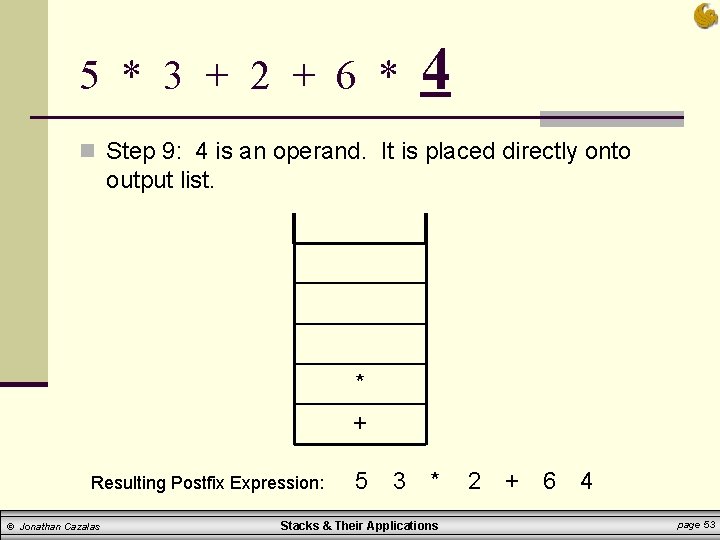
5 * 3 + 2 + 6 * 4 n Step 9: 4 is an operand. It is placed directly onto output list. * + Resulting Postfix Expression: © Jonathan Cazalas 5 3 * Stacks & Their Applications 2 + 6 4 page 53
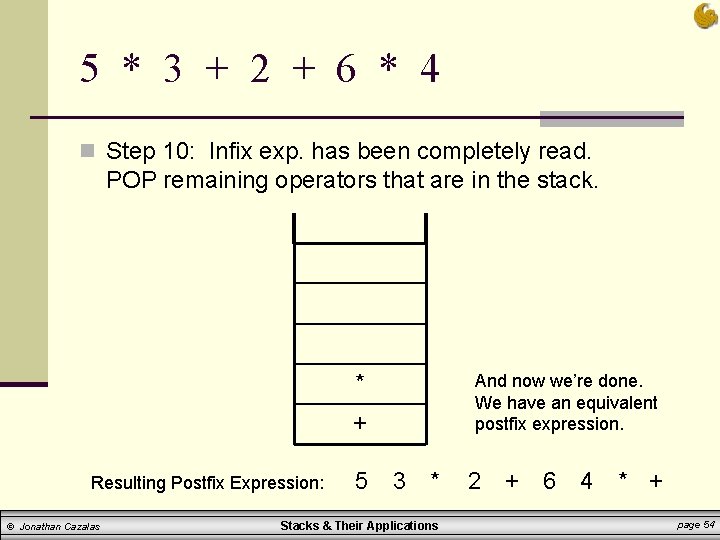
5 * 3 + 2 + 6 * 4 n Step 10: Infix exp. has been completely read. POP remaining operators that are in the stack. * And now we’re done. We have an equivalent postfix expression. + Resulting Postfix Expression: © Jonathan Cazalas 5 3 * Stacks & Their Applications 2 + 6 4 * + page 54
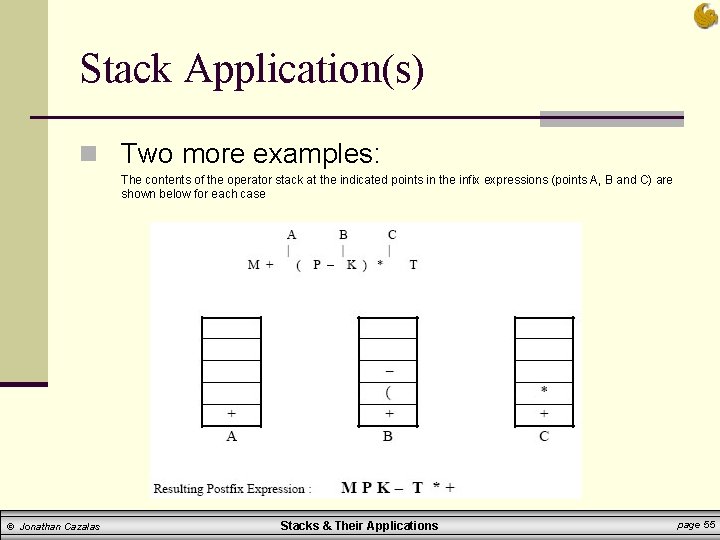
Stack Application(s) n Two more examples: The contents of the operator stack at the indicated points in the infix expressions (points A, B and C) are shown below for each case © Jonathan Cazalas Stacks & Their Applications page 55
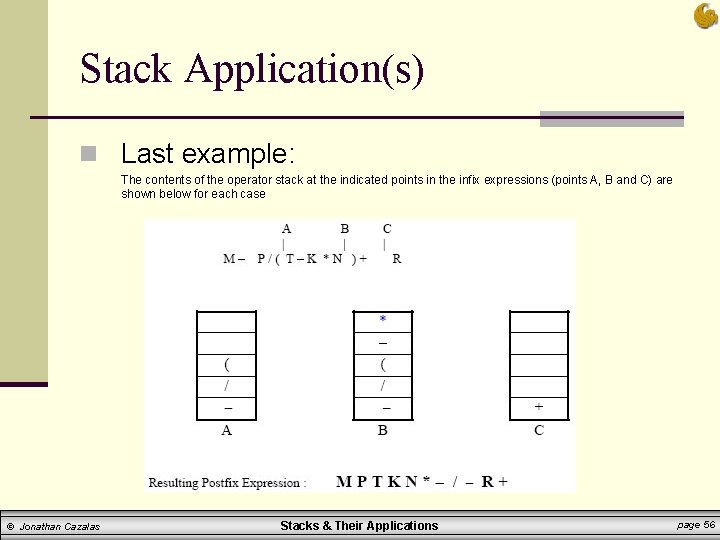
Stack Application(s) n Last example: The contents of the operator stack at the indicated points in the infix expressions (points A, B and C) are shown below for each case © Jonathan Cazalas Stacks & Their Applications page 56
Stack Application(s) n You now know how to: 1. Convert an Infix expression to a Postfix expression 2. And then evaluate that resulting expression © Jonathan Cazalas Stacks & Their Applications page 57
Stack Application(s) WASN’T THAT DANDY! © Jonathan Cazalas Stacks & Their Applications page 58
Daily Demotivator © Jonathan Cazalas Stacks & Their Applications page 59
Stacks & Their Applications (Postfix/Infix) Computer Science Department University of Central Florida COP 3502 – Computer Science I