
Stacked Sequential Learning William W Cohen Vitor Carvalho
- Slides: 30
Stacked Sequential Learning William W. Cohen Vitor Carvalho Center for Automated Learning and Discovery Carnegie Mellon University Language Technology Institute Carnegie Mellon University
Outline • Motivation: – MEMMs don’t work on segmentation tasks • New method: – Stacked sequential Max. Ent – Stacked sequential Anything • Results • More results. . . • Conclusions
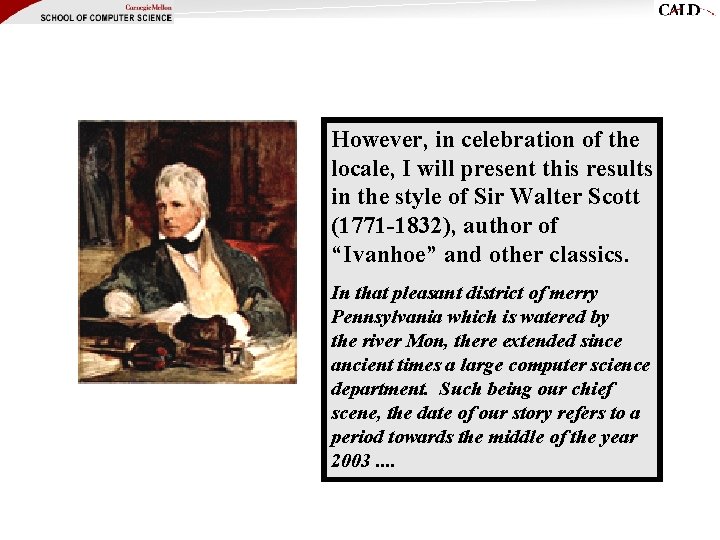
However, in celebration of the locale, I will present this results in the style of Sir Walter Scott (1771 -1832), author of “Ivanhoe” and other classics. In that pleasant district of merry Pennsylvania which is watered by the river Mon, there extended since ancient times a large computer science department. Such being our chief scene, the date of our story refers to a period towards the middle of the year 2003. .
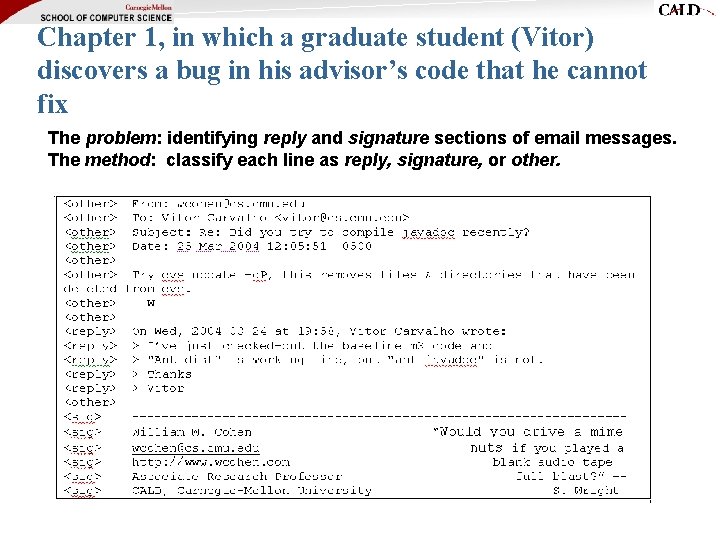
Chapter 1, in which a graduate student (Vitor) discovers a bug in his advisor’s code that he cannot fix The problem: identifying reply and signature sections of email messages. The method: classify each line as reply, signature, or other.
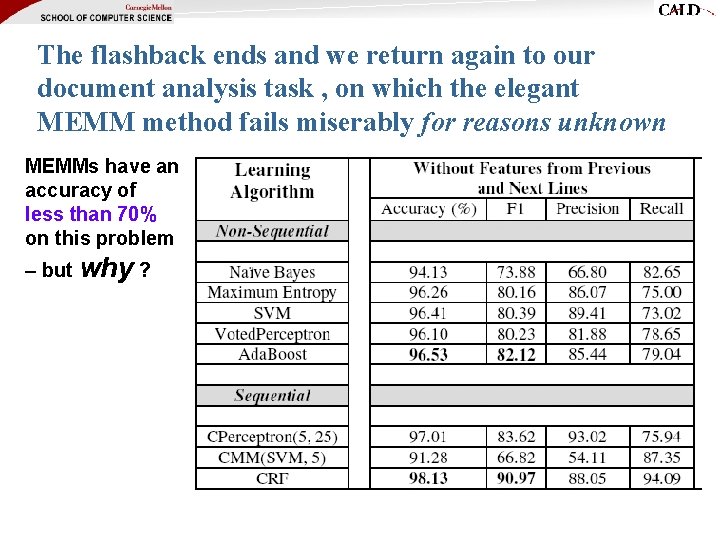
Chapter 1, in which a graduate student discovers a bug in his advisor’s code that he cannot fix The problem: identifying reply and signature sections of email messages. The method: classify each line as reply, signature, or other. The warmup: classify each line is signature or nonsignature, using learning methods from Minorthird, and dataset of 600+ messages The results: from [CEAS-2004, Carvalho & Cohen]. .
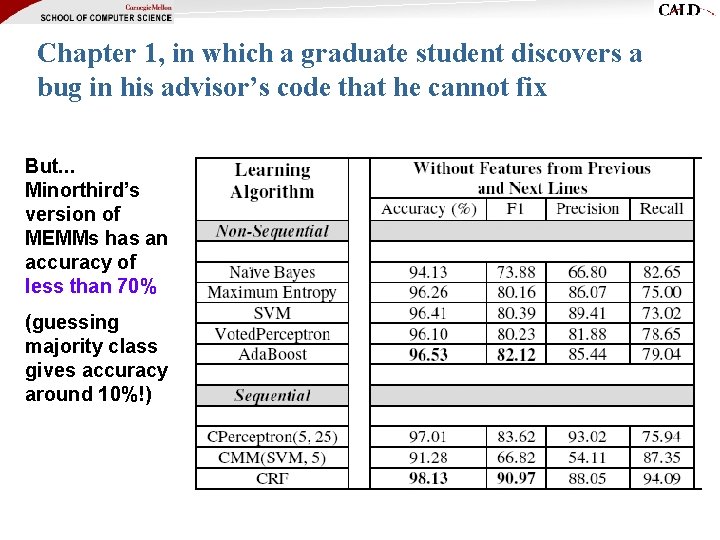
Chapter 1, in which a graduate student discovers a bug in his advisor’s code that he cannot fix But. . . Minorthird’s version of MEMMs has an accuracy of less than 70% (guessing majority class gives accuracy around 10%!)
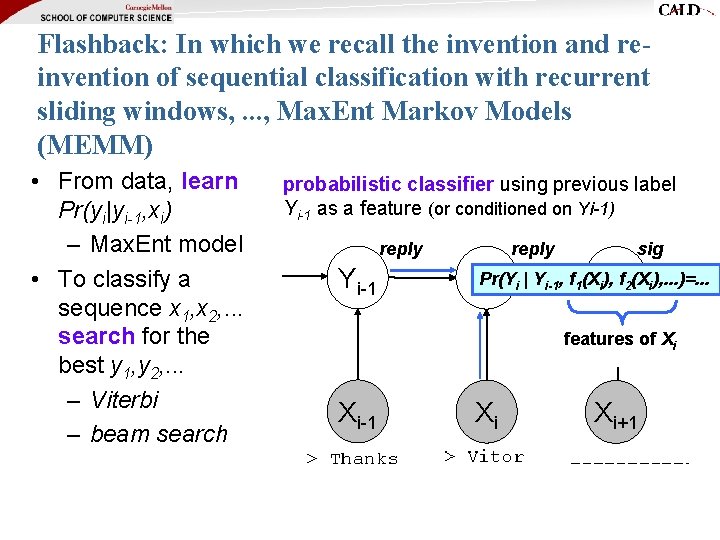
Flashback: In which we recall the invention and reinvention of sequential classification with recurrent sliding windows, . . . , Max. Ent Markov Models (MEMM) • From data, learn Pr(yi|yi-1, xi) – Max. Ent model • To classify a sequence x 1, x 2, . . . search for the best y 1, y 2, . . . – Viterbi – beam search probabilistic classifier using previous label Yi-1 as a feature (or conditioned on Yi-1) reply Yi-1 reply sig Pr(Yi | Yi-1, f 1(XY f 2(Xi), . . . )=. . . Y i), i+1 i features of Xi Xi-1 Xi Xi+1
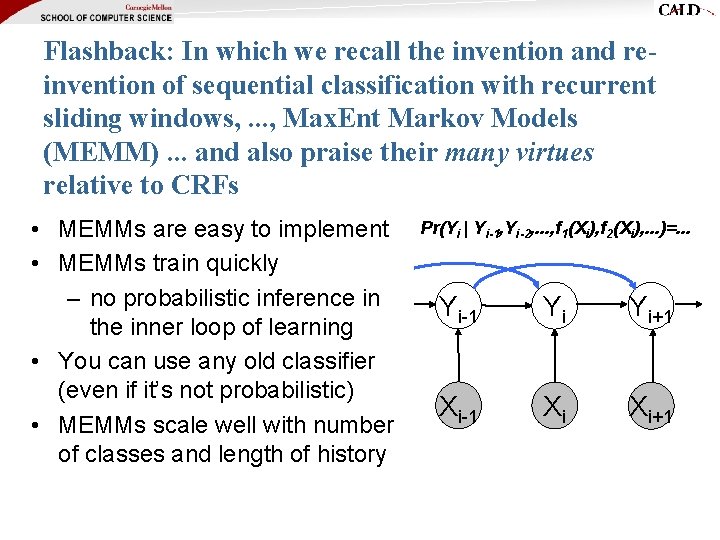
Flashback: In which we recall the invention and reinvention of sequential classification with recurrent sliding windows, . . . , Max. Ent Markov Models (MEMM). . . and also praise their many virtues relative to CRFs • MEMMs are easy to implement • MEMMs train quickly – no probabilistic inference in the inner loop of learning • You can use any old classifier (even if it’s not probabilistic) • MEMMs scale well with number of classes and length of history Pr(Yi | Yi-1, Yi-2, . . . , f 1(Xi), f 2(Xi), . . . )=. . . Yi-1 Yi Yi+1 Xi-1 Xi Xi+1
The flashback ends and we return again to our document analysis task , on which the elegant MEMM method fails miserably for reasons unknown MEMMs have an accuracy of less than 70% on this problem – but why ?
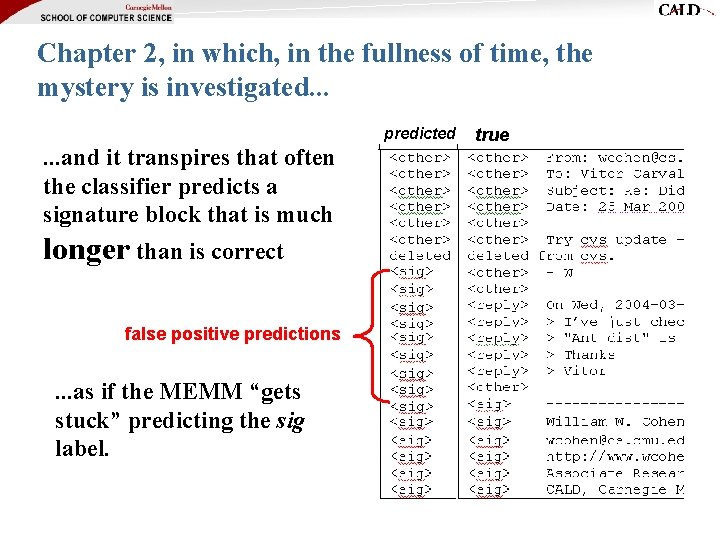
Chapter 2, in which, in the fullness of time, the mystery is investigated. . . predicted . . . and it transpires that often the classifier predicts a signature block that is much longer than is correct false positive predictions . . . as if the MEMM “gets stuck” predicting the sig label. true
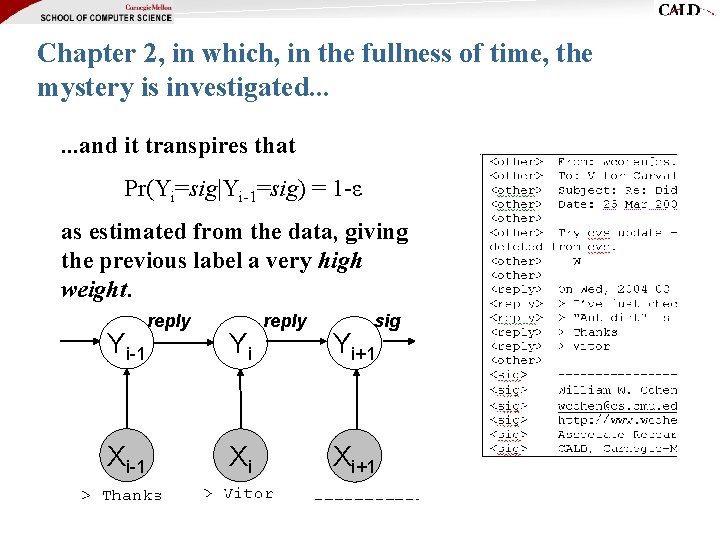
Chapter 2, in which, in the fullness of time, the mystery is investigated. . . and it transpires that Pr(Yi=sig|Yi-1=sig) = 1 -ε as estimated from the data, giving the previous label a very high weight. Yi-1 Xi-1 reply Yi Xi reply sig Yi+1 Xi+1
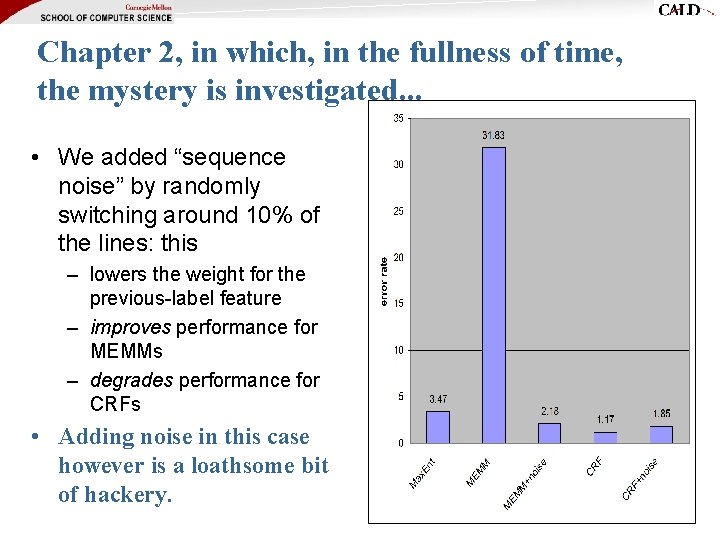
Chapter 2, in which, in the fullness of time, the mystery is investigated. . . • We added “sequence noise” by randomly switching around 10% of the lines: this – lowers the weight for the previous-label feature – improves performance for MEMMs – degrades performance for CRFs • Adding noise in this case however is a loathsome bit of hackery.
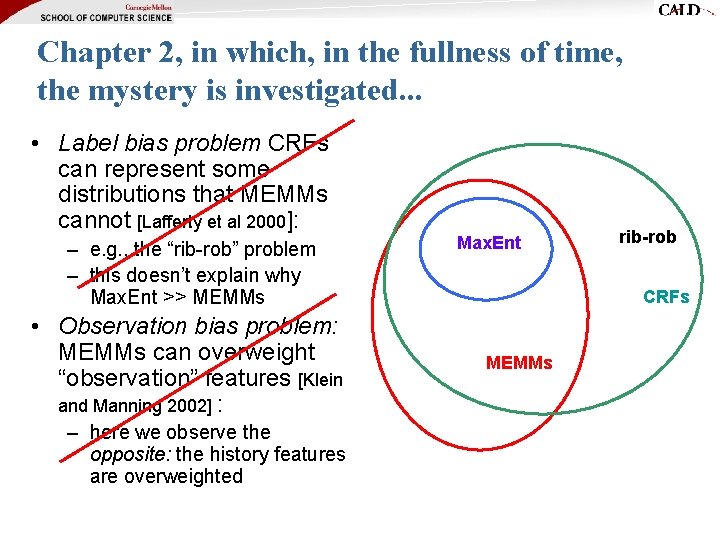
Chapter 2, in which, in the fullness of time, the mystery is investigated. . . • Label bias problem CRFs can represent some distributions that MEMMs cannot [Lafferty et al 2000]: – e. g. , the “rib-rob” problem – this doesn’t explain why Max. Ent >> MEMMs • Observation bias problem: MEMMs can overweight “observation” features [Klein and Manning 2002] : – here we observe the opposite: the history features are overweighted Max. Ent rib-rob CRFs MEMMs
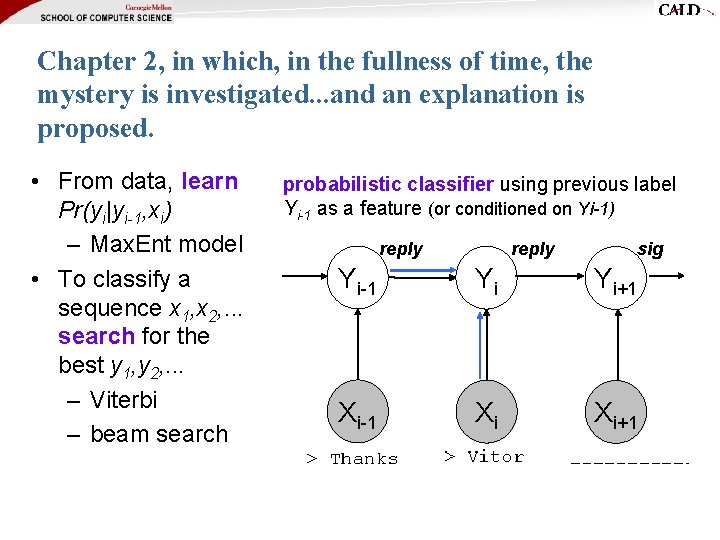
Chapter 2, in which, in the fullness of time, the mystery is investigated. . . and an explanation is proposed. • From data, learn Pr(yi|yi-1, xi) – Max. Ent model • To classify a sequence x 1, x 2, . . . search for the best y 1, y 2, . . . – Viterbi – beam search probabilistic classifier using previous label Yi-1 as a feature (or conditioned on Yi-1) reply sig Yi-1 Yi Yi+1 Xi-1 Xi Xi+1
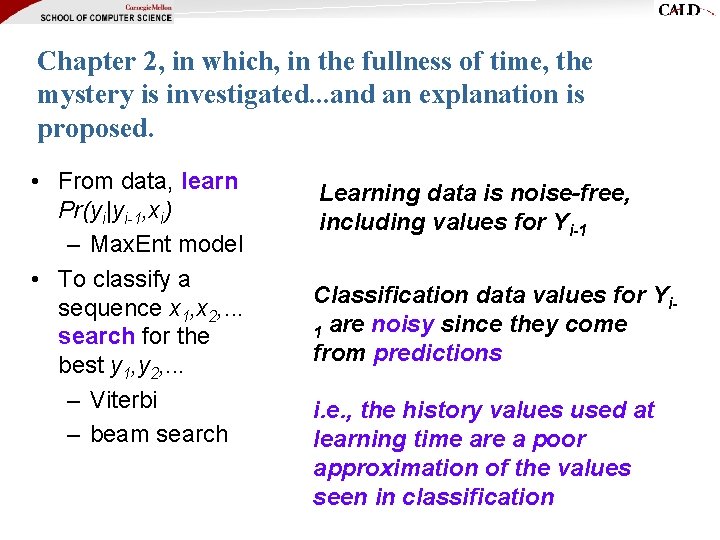
Chapter 2, in which, in the fullness of time, the mystery is investigated. . . and an explanation is proposed. • From data, learn Pr(yi|yi-1, xi) – Max. Ent model • To classify a sequence x 1, x 2, . . . search for the best y 1, y 2, . . . – Viterbi – beam search Learning data is noise-free, including values for Yi-1 Classification data values for Yi 1 are noisy since they come from predictions i. e. , the history values used at learning time are a poor approximation of the values seen in classification
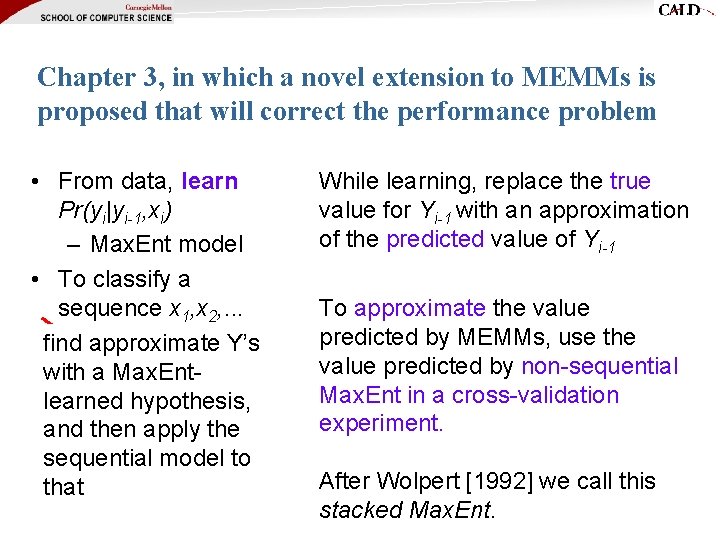
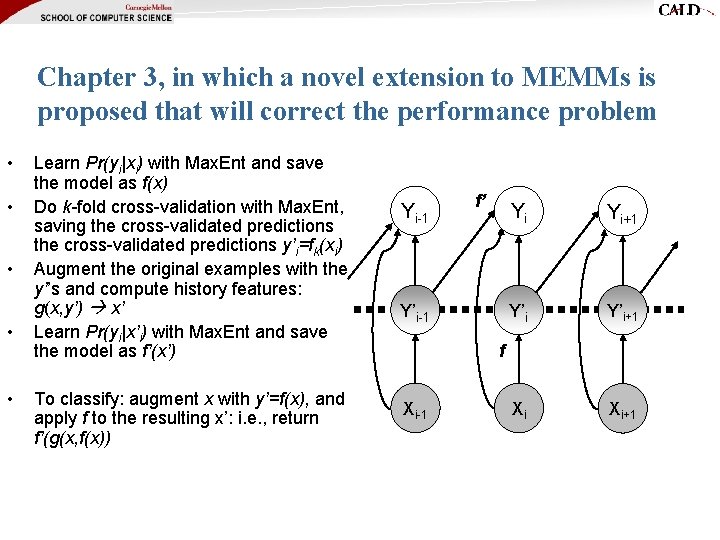
Chapter 3, in which a novel extension to MEMMs is proposed that will correct the performance problem • From data, learn Pr(yi|yi-1, xi) – Max. Ent model • To classify a sequence x 1, x 2, . . . search for the Y’s find approximate besta y. Max. Ent 1, y 2, . . . with – Viterbi learned hypothesis, and then apply the – beam search sequential model to that While learning, replace the true value for Yi-1 with an approximation of the predicted value of Yi-1 To approximate the value predicted by MEMMs, use the value predicted by non-sequential Max. Ent in a cross-validation experiment. After Wolpert [1992] we call this stacked Max. Ent.
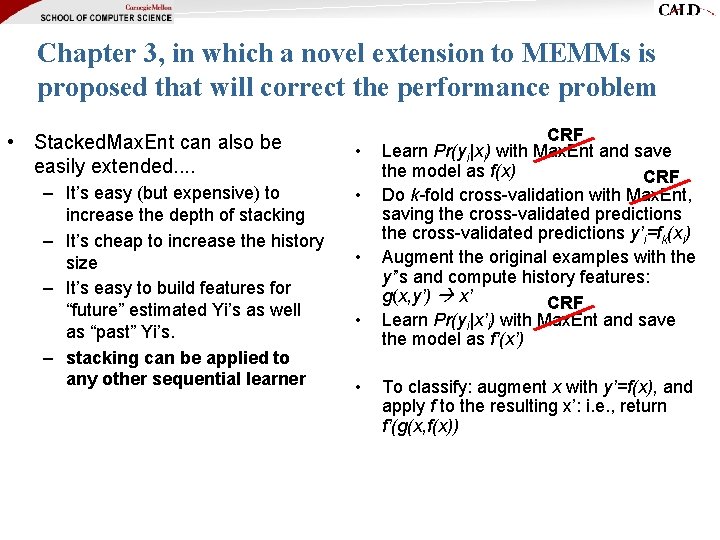
Chapter 3, in which a novel extension to MEMMs is proposed that will correct the performance problem • • • Learn Pr(yi|xi) with Max. Ent and save the model as f(x) Do k-fold cross-validation with Max. Ent, saving the cross-validated predictions y’i=fk(xi) Augment the original examples with the y’’s and compute history features: g(x, y’) x’ Learn Pr(yi|x’i) with Max. Ent and save the model as f’(x’) To classify: augment x with y’=f(x), and apply f to the resulting x’: i. e. , return f’(g(x, f(x)) Yi-1 f’ Y’i-1 Yi Yi+1 Y’i+1 Xi Xi+1 f Xi-1
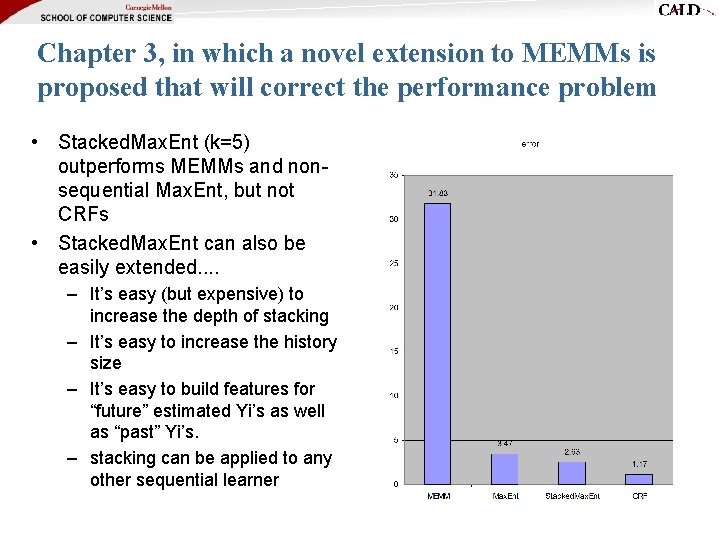
Chapter 3, in which a novel extension to MEMMs is proposed that will correct the performance problem • Stacked. Max. Ent (k=5) outperforms MEMMs and nonsequential Max. Ent, but not CRFs • Stacked. Max. Ent can also be easily extended. . – It’s easy (but expensive) to increase the depth of stacking – It’s easy to increase the history size – It’s easy to build features for “future” estimated Yi’s as well as “past” Yi’s. – stacking can be applied to any other sequential learner
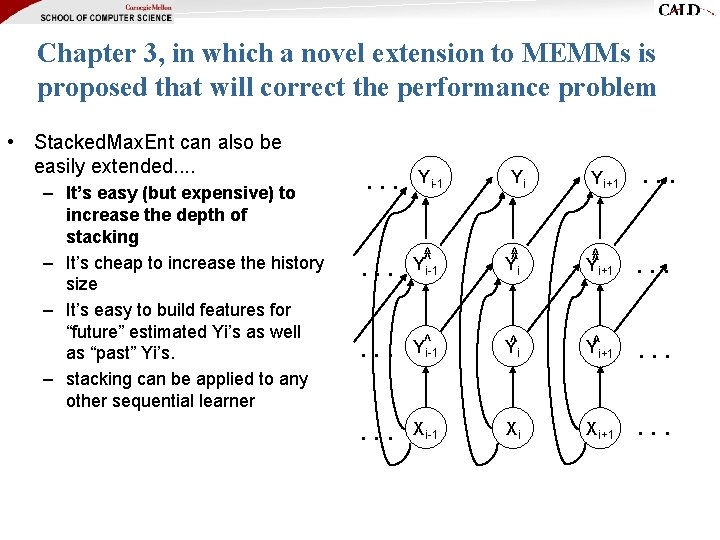
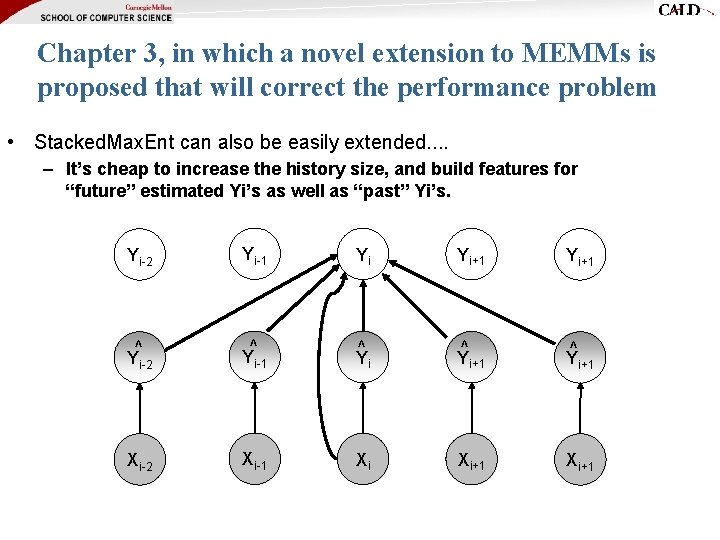
Chapter 3, in which a novel extension to MEMMs is proposed that will correct the performance problem • Stacked. Max. Ent can also be easily extended. . – It’s easy (but expensive) to increase the depth of stacking – It’s cheap to increase the history size – It’s easy to build features for “future” estimated Yi’s as well as “past” Yi’s. – stacking can be applied to any other sequential learner . . . Yi-1 Yi Yi+1 . . . ^ Y^i-1 ^ Y^i+1 . . . Y^i-1 Y^i+1 . . . Xi-1 Xi Xi+1 . . .
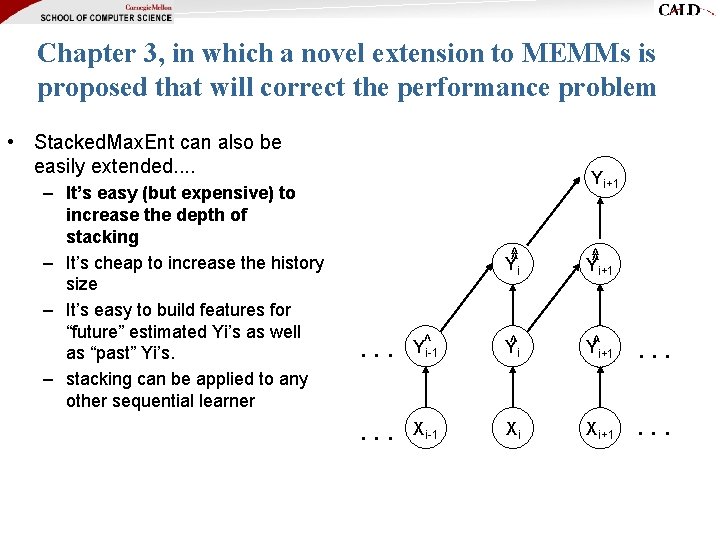
Chapter 3, in which a novel extension to MEMMs is proposed that will correct the performance problem • Stacked. Max. Ent can also be easily extended. . – It’s easy (but expensive) to increase the depth of stacking – It’s cheap to increase the history size – It’s easy to build features for “future” estimated Yi’s as well as “past” Yi’s. – stacking can be applied to any other sequential learner Yi+1 ^ Y^i+1 . . . Y^i-1 Y^i+1 . . . Xi-1 Xi Xi+1 . . .
Chapter 3, in which a novel extension to MEMMs is proposed that will correct the performance problem • Stacked. Max. Ent can also be easily extended. . – It’s cheap to increase the history size, and build features for “future” estimated Yi’s as well as “past” Yi’s. Yi-2 Yi-1 Yi Yi+1 ^ Yi-2 ^ Yi-1 ^ Yi+1 Xi-2 Xi-1 Xi Xi+1
Chapter 3, in which a novel extension to MEMMs is proposed that will correct the performance problem • Stacked. Max. Ent can also be easily extended. . – It’s easy (but expensive) to increase the depth of stacking – It’s cheap to increase the history size – It’s easy to build features for “future” estimated Yi’s as well as “past” Yi’s. – stacking can be applied to any other sequential learner • • • CRF Learn Pr(yi|xi) with Max. Ent and save the model as f(x) CRF Do k-fold cross-validation with Max. Ent, saving the cross-validated predictions y’i=fk(xi) Augment the original examples with the y’’s and compute history features: g(x, y’) x’ CRF Learn Pr(yi|x’i) with Max. Ent and save the model as f’(x’) To classify: augment x with y’=f(x), and apply f to the resulting x’: i. e. , return f’(g(x, f(x))
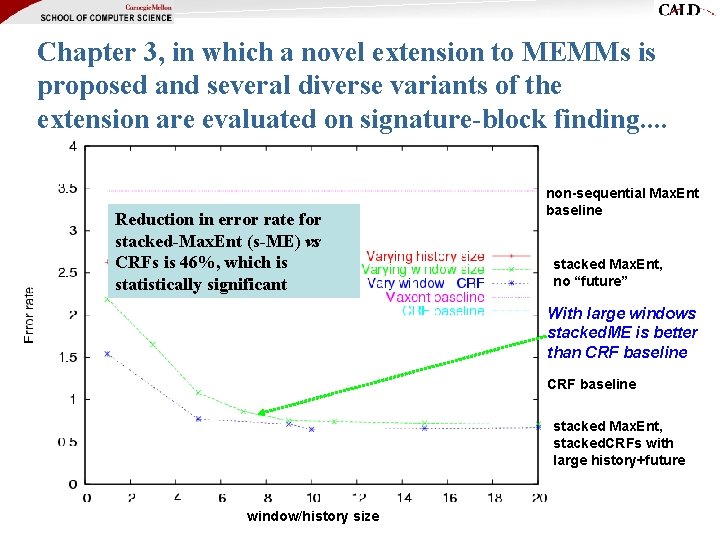
Chapter 3, in which a novel extension to MEMMs is proposed and several diverse variants of the extension are evaluated on signature-block finding. . Reduction in error rate for stacked-Max. Ent (s-ME) vs CRFs is 46%, which is statistically significant non-sequential Max. Ent baseline stacked Max. Ent, no “future” With large windows stacked. ME is better than CRF baseline stacked Max. Ent, stacked. CRFs with large history+future window/history size
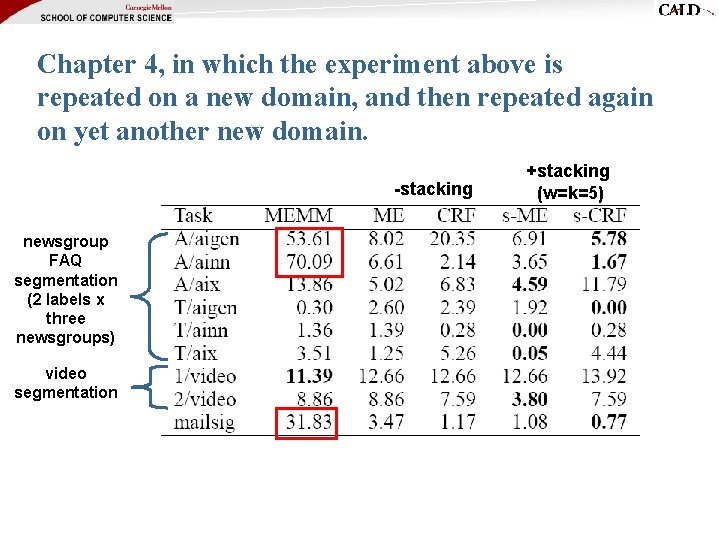
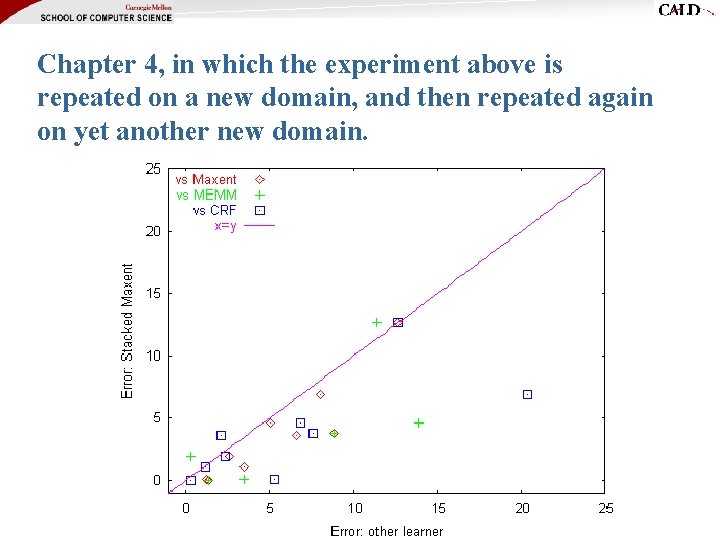
Chapter 4, in which the experiment above is repeated on a new domain, and then repeated again on yet another new domain. -stacking newsgroup FAQ segmentation (2 labels x three newsgroups) video segmentation +stacking (w=k=5)
Chapter 4, in which the experiment above is repeated on a new domain, and then repeated again on yet another new domain.
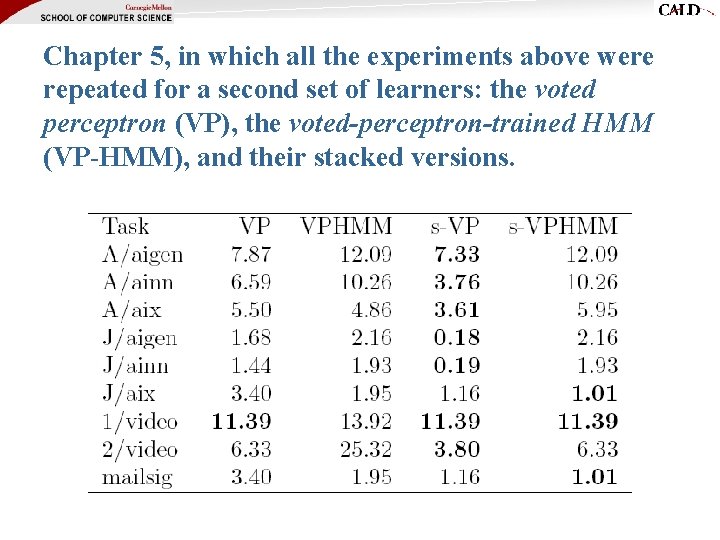
Chapter 5, in which all the experiments above were repeated for a second set of learners: the voted perceptron (VP), the voted-perceptron-trained HMM (VP-HMM), and their stacked versions.
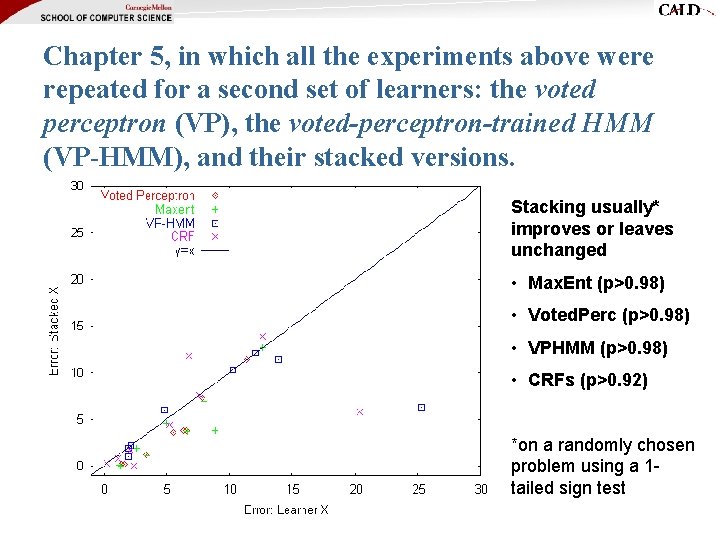
Chapter 5, in which all the experiments above were repeated for a second set of learners: the voted perceptron (VP), the voted-perceptron-trained HMM (VP-HMM), and their stacked versions. Stacking usually* improves or leaves unchanged • Max. Ent (p>0. 98) • Voted. Perc (p>0. 98) • VPHMM (p>0. 98) • CRFs (p>0. 92) *on a randomly chosen problem using a 1 tailed sign test
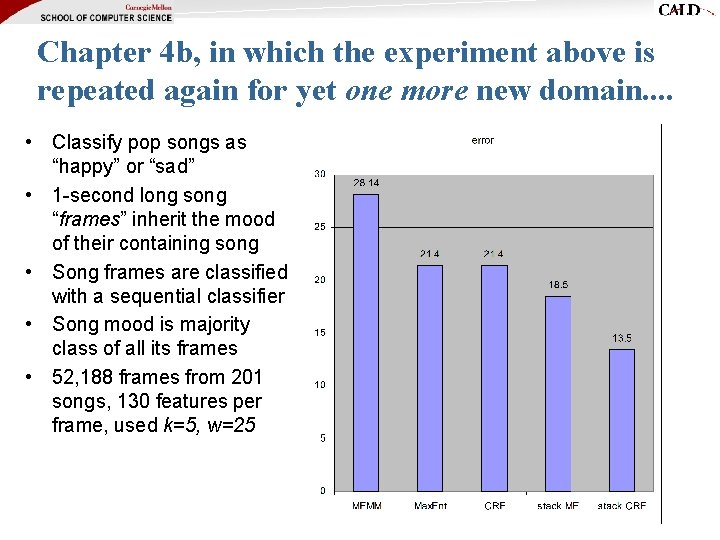
Chapter 4 b, in which the experiment above is repeated again for yet one more new domain. . • Classify pop songs as “happy” or “sad” • 1 -second long song “frames” inherit the mood of their containing song • Song frames are classified with a sequential classifier • Song mood is majority class of all its frames • 52, 188 frames from 201 songs, 130 features per frame, used k=5, w=25
Epilog: in which the speaker discusses certain issues of possible interest to the listener, who is now fully informed of the technical issues (or it may be, only better rested) and thus receptive to such commentary • Scope: – we considered only segmentation tasks— sequences with long runs of identical labels—and 2 -class problems. – MEMM fails here. • Issue: – learner is brittle w. r. t. assumptions – training data for local model is assumed to be error-free, which is systematically wrong • Solution: sequential stacking – model-free way to improve robustness – stacked Max. Ent outperforms or ties CRFs on 8/10 tasks; stacked VP outperforms CRFs on 8/9 tasks. – a meta-learning method applies to any base learner, and can also reduce error of CRF substantially – experiments with nonsegmentation problems (NER) had no large gains
Epilog: in which the speaker discusses certain issues of possible interest to the listener, who is now fully informed of the technical issues (or it may be, only better rested) and thus receptive to such commentary. . . and in which finally, the speaker realizes that the structure of the epic Sir W. Scott romantic knowledge is ill. R. I. P. suited to talks of this ilk, and perhaps even the very medium of Power. Point itself, but none-the-less persists with a final animation. . .