
Stack Behaviour ADT October 16 2017 Hassan Khosravi
Stack Behaviour ADT October 16, 2017 Hassan Khosravi / Geoffrey Tien 1
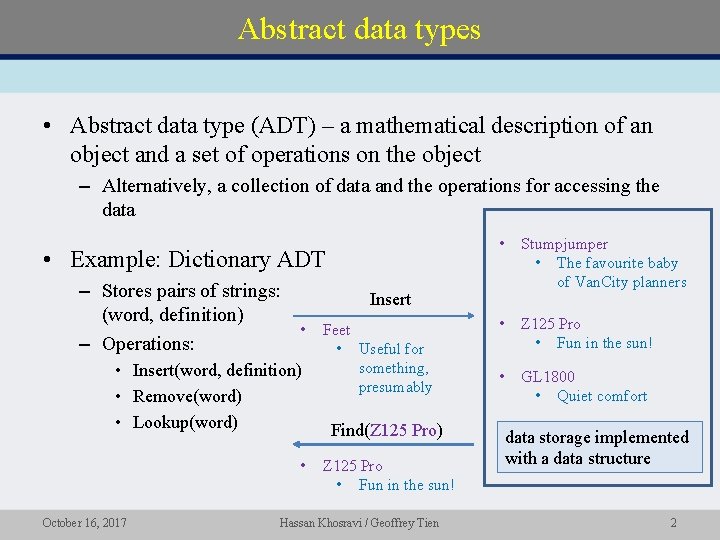
Abstract data types • Abstract data type (ADT) – a mathematical description of an object and a set of operations on the object – Alternatively, a collection of data and the operations for accessing the data • Example: Dictionary ADT – Stores pairs of strings: (word, definition) • – Operations: • Insert(word, definition) • Remove(word) • Lookup(word) • October 16, 2017 • Stumpjumper • The favourite baby of Van. City planners • Z 125 Pro • Fun in the sun! • GL 1800 • Quiet comfort Insert Feet • Useful for something, presumably Find(Z 125 Pro) Z 125 Pro • Fun in the sun! Hassan Khosravi / Geoffrey Tien data storage implemented with a data structure 2

Implementing ADTs Using data structures • Theoretically (in programming languages that support OOP) – abstract base class describes ADT (operations etc. ) – inherited implementations apply data structures – data structure can be changed transparently (to client code) • Practice – performance of a data structure may influence form of client code • time vs space, one operation vs another October 16, 2017 Hassan Khosravi / Geoffrey Tien 3
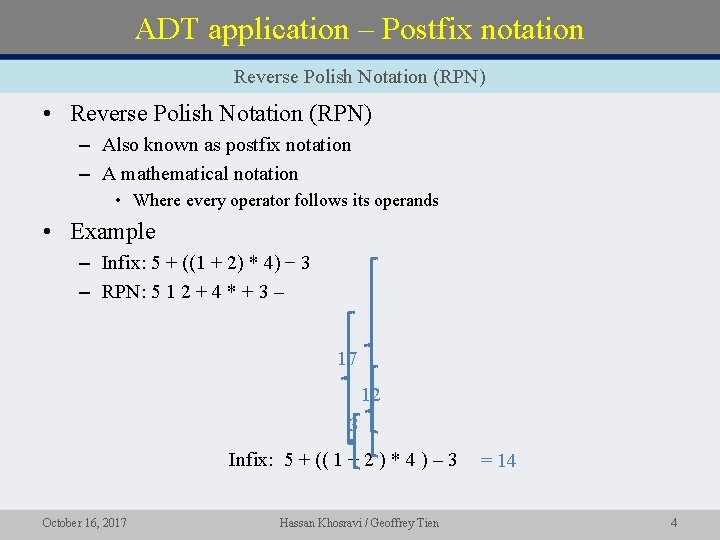
ADT application – Postfix notation Reverse Polish Notation (RPN) • Reverse Polish Notation (RPN) – Also known as postfix notation – A mathematical notation • Where every operator follows its operands • Example – Infix: 5 + ((1 + 2) * 4) − 3 – RPN: 5 1 2 + 4 * + 3 – 17 12 3 Infix: 5 + (( 1 + 2 ) * 4 ) – 3 October 16, 2017 Hassan Khosravi / Geoffrey Tien = 14 4

RPN example • 512+4*+3– To evaluate a postfix expression, read it from left to right Store Apply ‘+’ Store ‘ 2’ Apply to‘*’ ‘ 4’ last Apply Store ‘+’ to last to‘–’ ‘ 3’ last to last Store ‘ 5’‘ 1’ two operands twotwo operands 42 Note: the postfix string contains integers and characters, but the data collection contains only integers 12 31 17 14 5 October 16, 2017 Retrieve result Hassan Khosravi / Geoffrey Tien 5
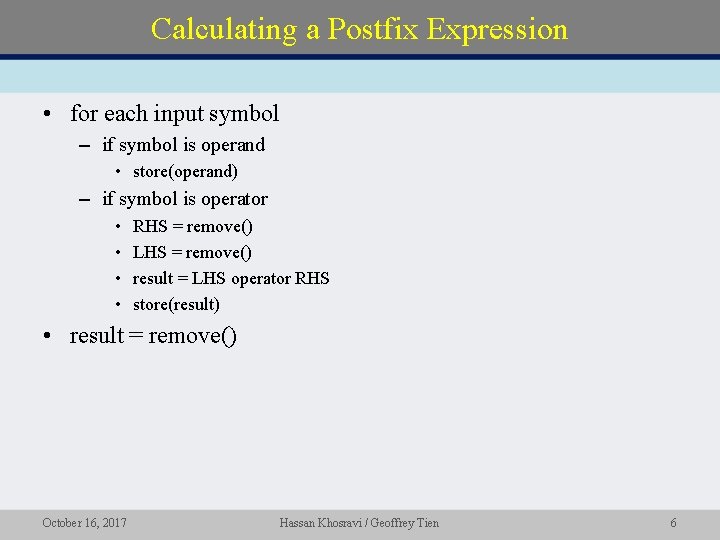
Calculating a Postfix Expression • for each input symbol – if symbol is operand • store(operand) – if symbol is operator • • RHS = remove() LHS = remove() result = LHS operator RHS store(result) • result = remove() October 16, 2017 Hassan Khosravi / Geoffrey Tien 6
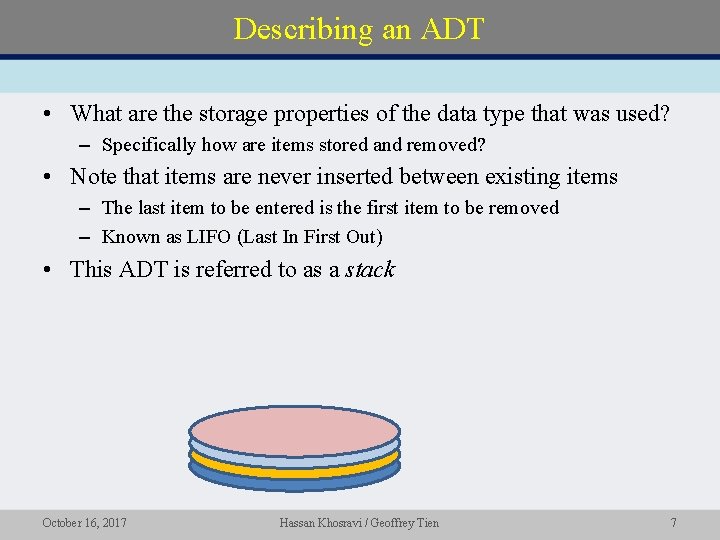
Describing an ADT • What are the storage properties of the data type that was used? – Specifically how are items stored and removed? • Note that items are never inserted between existing items – The last item to be entered is the first item to be removed – Known as LIFO (Last In First Out) • This ADT is referred to as a stack October 16, 2017 Hassan Khosravi / Geoffrey Tien 7
The Stack ADT • A stack only allows items to be inserted and removed at one end – We call this end the top of the stack – The other end is called the bottom • Access to other items in the stack is not allowed • A stack can be used to naturally store data for postfix notation – Operands are stored at the top of the stack – And removed from the top of the stack • Notice that we have not (yet) discussed how a stack should be implemented – Just what it does • An example of an Abstract Data Type October 16, 2017 Hassan Khosravi / Geoffrey Tien 8
Stack behaviour • A stack ADT should support at least the first two of these operations: – push – insert an item at the top of the stack – pop – remove and return the top item – peek – return the top item – is. Empty – does the stack contain any items • ADT operations should be performed efficiently – The definition of efficiency varies from ADT to ADT – The order of the items in a stack is based solely on the order in which they arrive October 16, 2017 Hassan Khosravi / Geoffrey Tien 9
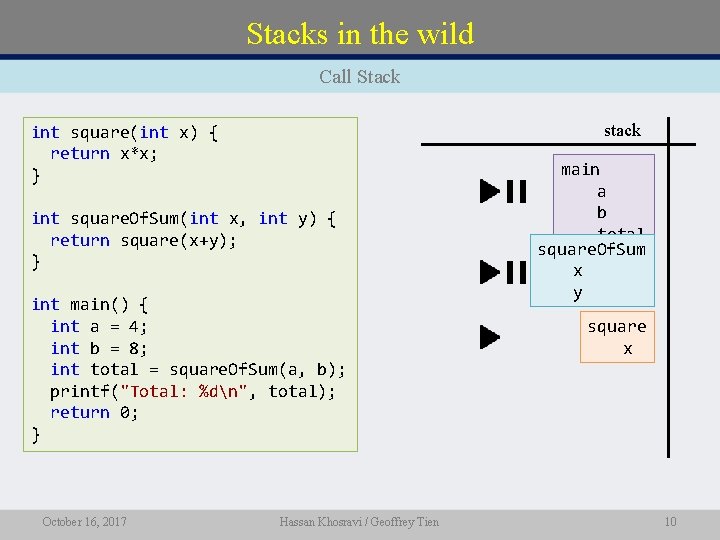
Stacks in the wild Call Stack stack int square(int x) { return x*x; } int square. Of. Sum(int x, int y) { return square(x+y); } int main() { int a = 4; int b = 8; int total = square. Of. Sum(a, b); printf("Total: %dn", total); return 0; } October 16, 2017 Hassan Khosravi / Geoffrey Tien main a a b b total square. Of. Sum x y square x 10
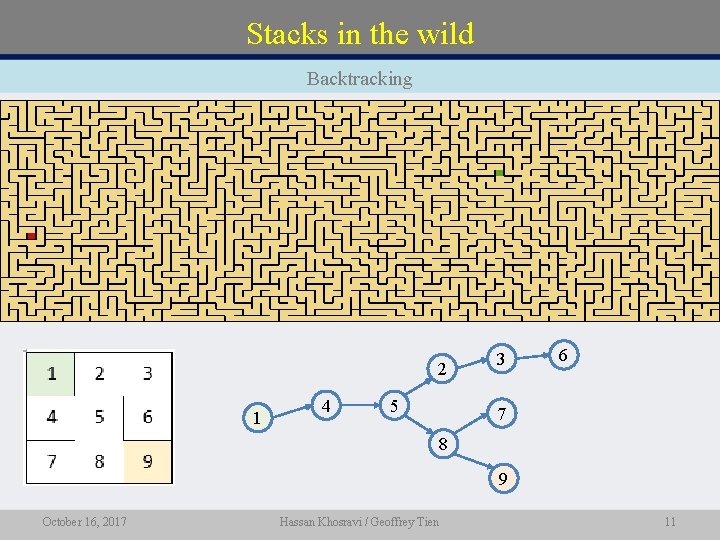
Stacks in the wild Backtracking 2 1 4 5 3 6 7 8 9 October 16, 2017 Hassan Khosravi / Geoffrey Tien 11
Stack Implementation • The stack ADT can be implemented using a variety of data structures, e. g. – Arrays – Linked Lists • Both implementations must implement all the stack operations – In constant time (time that is independent of the number of items in the stack) October 16, 2017 Hassan Khosravi / Geoffrey Tien 12
Stack implementation Using an array • Suppose we use an array which does not contain any gaps between elements – We can add and remove elements at the right side, as long as we know which element is the last item • Treat the last element of the array as the "top" of the stack – Information to track: • index of top item • maximum size of the array October 16, 2017 Hassan Khosravi / Geoffrey Tien 13
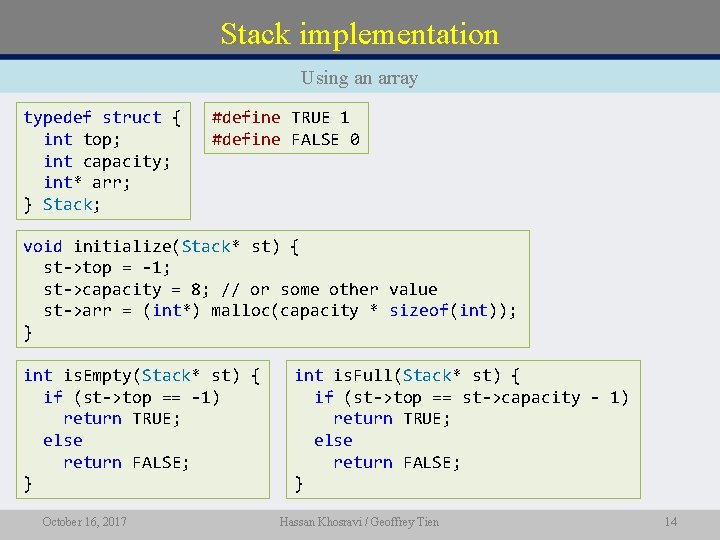
Stack implementation Using an array typedef struct { int top; int capacity; int* arr; } Stack; #define TRUE 1 #define FALSE 0 void initialize(Stack* st) { st->top = -1; st->capacity = 8; // or some other value st->arr = (int*) malloc(capacity * sizeof(int)); } int is. Empty(Stack* st) { if (st->top == -1) return TRUE; else return FALSE; } October 16, 2017 int is. Full(Stack* st) { if (st->top == st->capacity - 1) return TRUE; else return FALSE; } Hassan Khosravi / Geoffrey Tien 14
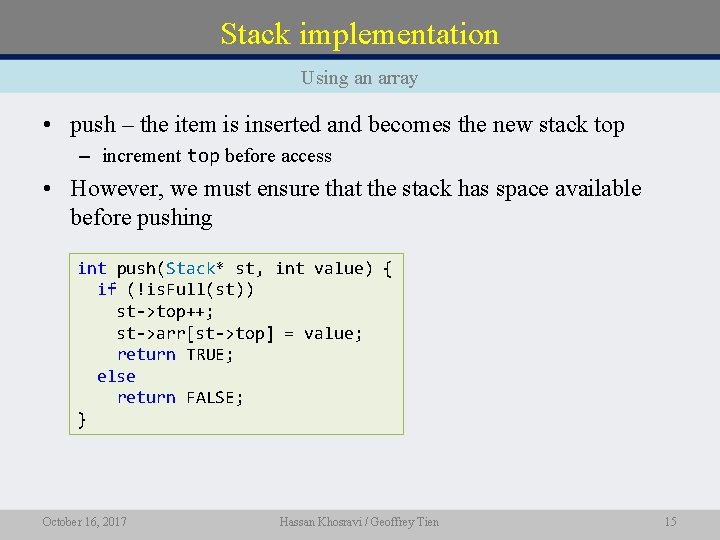
Stack implementation Using an array • push – the item is inserted and becomes the new stack top – increment top before access • However, we must ensure that the stack has space available before pushing int push(Stack* st, int value) { if (!is. Full(st)) st->top++; st->arr[st->top] = value; return TRUE; else return FALSE; } October 16, 2017 Hassan Khosravi / Geoffrey Tien 15
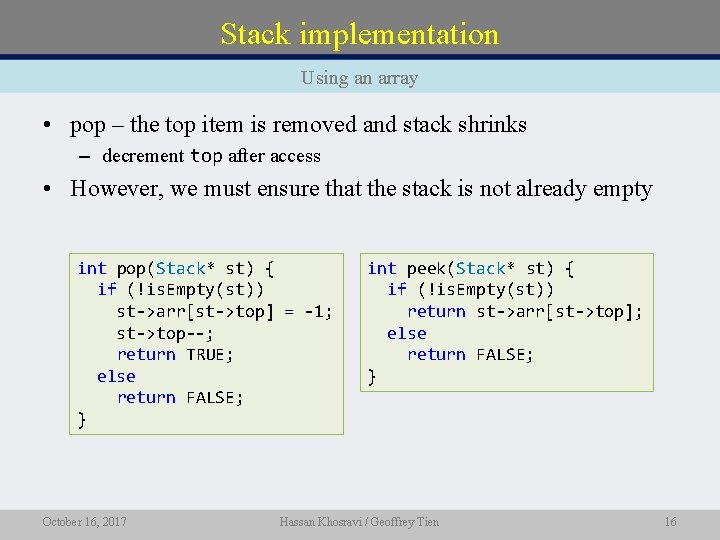
Stack implementation Using an array • pop – the top item is removed and stack shrinks – decrement top after access • However, we must ensure that the stack is not already empty int pop(Stack* st) { if (!is. Empty(st)) st->arr[st->top] = -1; st->top--; return TRUE; else return FALSE; } October 16, 2017 int peek(Stack* st) { if (!is. Empty(st)) return st->arr[st->top]; else return FALSE; } Hassan Khosravi / Geoffrey Tien 16
Readings for this lesson • Thareja – Chapter 7. 1 – 7. 3 • Stack demo: – http: //visualgo. net/en/list? slide=4 • Next class – Thareja chapter 7, 8. 1 – 8. 2 October 16, 2017 Hassan Khosravi / Geoffrey Tien 17
- Slides: 17