
STACK An ordered collection of items New items
![EXAMPLE Consider the following program segment static void Main(string[] args) { int a=3; int](https://slidetodoc.com/presentation_image_h2/6ad5e54c97f176fa3c372fb8260e06ab/image-42.jpg "EXAMPLE Consider the following program segment static void Main(string[] args) { int a=3; int")
- Slides: 47
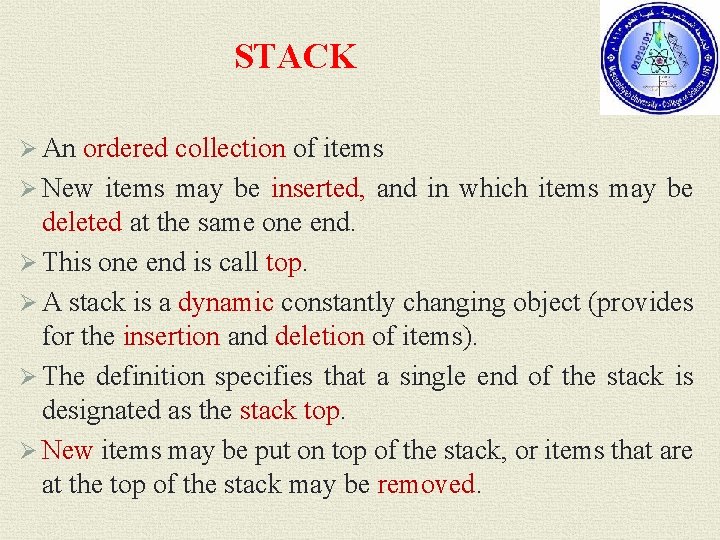
STACK Ø An ordered collection of items Ø New items may be inserted, and in which items may be deleted at the same one end. Ø This one end is call top. Ø A stack is a dynamic constantly changing object (provides for the insertion and deletion of items). Ø The definition specifies that a single end of the stack is designated as the stack top. Ø New items may be put on top of the stack, or items that are at the top of the stack may be removed.
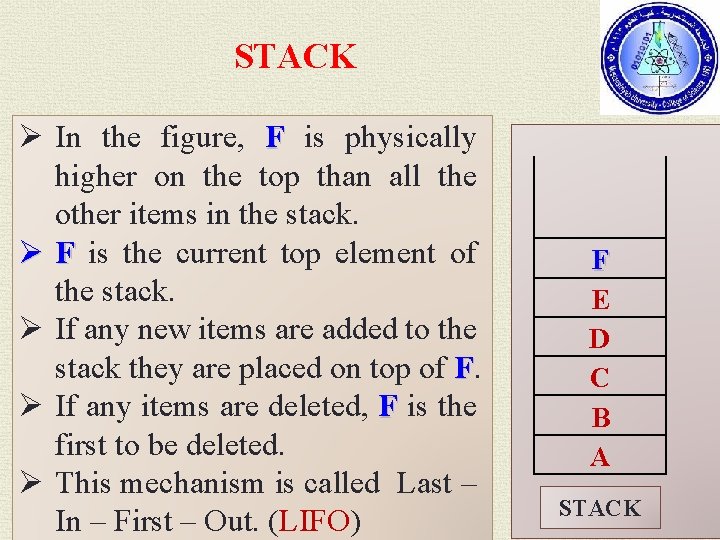
STACK Ø In the figure, F is physically higher on the top than all the other items in the stack. Ø F is the current top element of the stack. Ø If any new items are added to the stack they are placed on top of F. Ø If any items are deleted, F is the first to be deleted. Ø This mechanism is called Last – In – First – Out. (LIFO) F E D C B A STACK
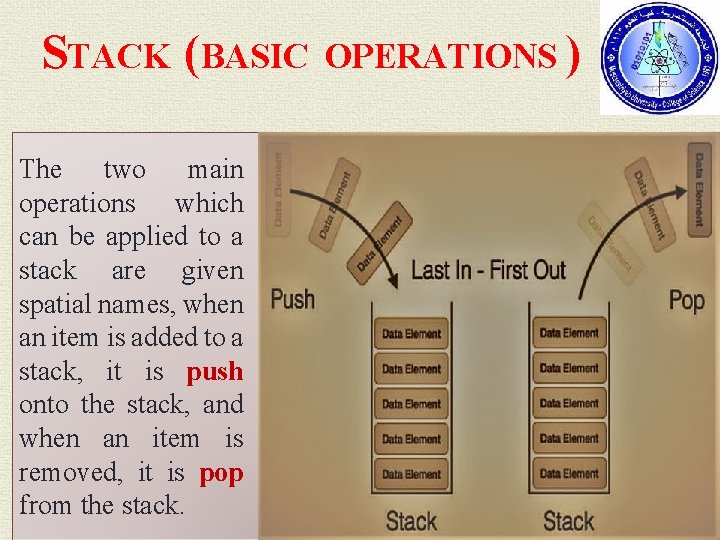
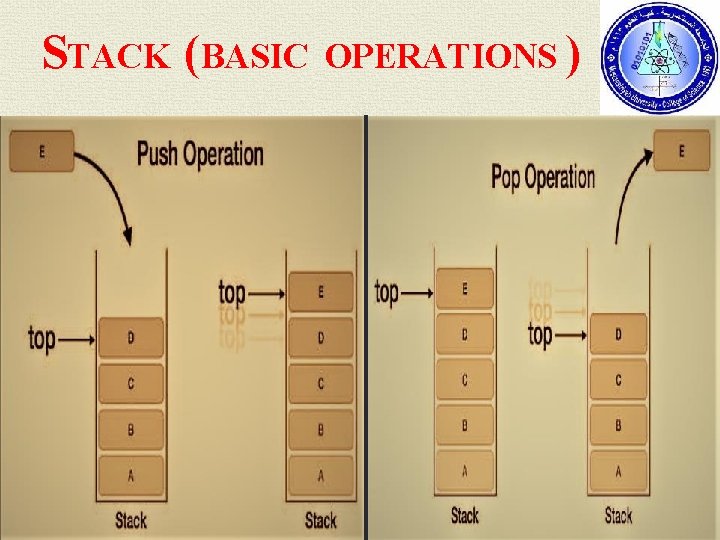
STACK (BASIC The two main operations which can be applied to a stack are given spatial names, when an item is added to a stack, it is push onto the stack, and when an item is removed, it is pop from the stack. OPERATIONS )
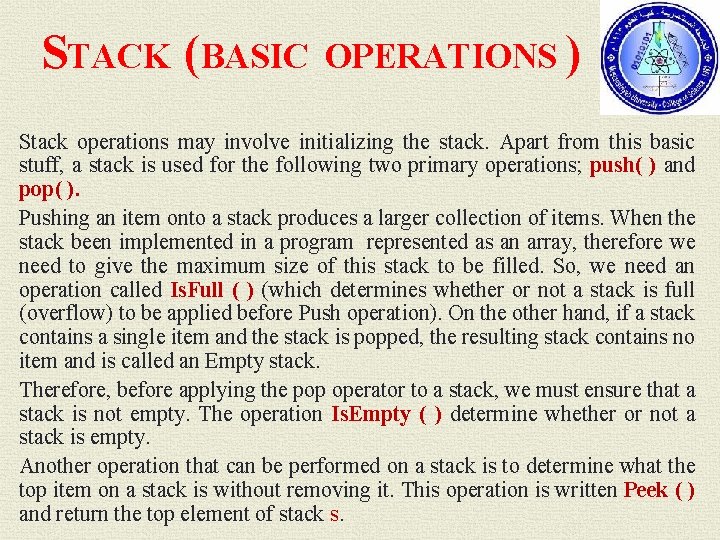
STACK (BASIC OPERATIONS ) Stack operations may involve initializing the stack. Apart from this basic stuff, a stack is used for the following two primary operations; push( ) and pop( ). Pushing an item onto a stack produces a larger collection of items. When the stack been implemented in a program represented as an array, therefore we need to give the maximum size of this stack to be filled. So, we need an operation called Is. Full ( ) (which determines whether or not a stack is full (overflow) to be applied before Push operation). On the other hand, if a stack contains a single item and the stack is popped, the resulting stack contains no item and is called an Empty stack. Therefore, before applying the pop operator to a stack, we must ensure that a stack is not empty. The operation Is. Empty ( ) determine whether or not a stack is empty. Another operation that can be performed on a stack is to determine what the top item on a stack is without removing it. This operation is written Peek ( ) and return the top element of stack s.
STACK (BASIC OPERATIONS ) In general; Peek( ) get the top data element of the stack, without removing it. Is. Full( ) check if stack is full. Is. Empty( ) check if stack is empty. At all times, we maintain a pointer to the last PUSHed data on the stack. This pointer always represents the top of the stack, hence named top. The top pointer provides the top value of the stack without actually removing it.
STACK (BASIC OPERATIONS )
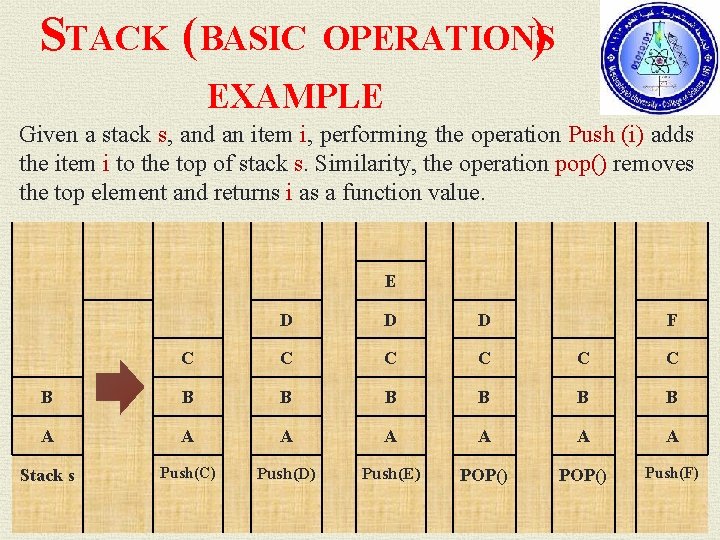
STACK (BASIC OPERATIONS ) EXAMPLE Given a stack s, and an item i, performing the operation Push (i) adds the item i to the top of stack s. Similarity, the operation pop() removes the top element and returns i as a function value. E D D D F C C C B B B B A A A A Stack s Push(C) Push(D) Push(E) POP() Push(F)
NOTES Ø There is no upper limit on the number of items that may be kept in a stack. Ø Pushing another item onto a stack produces a larger collection of items. Ø A stack is represented as an array. Ø The maximum size of the stack to be filled is very important when the stack Ø Ø Ø has been implemented in a program. Is. Full ( ) is needed before Push operation. If a stack contains a single item and the stack is popped, the resulting stack contains no item and is called an Empty stack. Before applying the pop operator to a stack, we must ensure that a stack is not empty. The operation Is. Empty () determines whether or not a stack is empty. The operation Peek () returns the top element of stack s, which can be performed on a stack is to determine what the top item on a stack is without removing it (i= Peek () ).
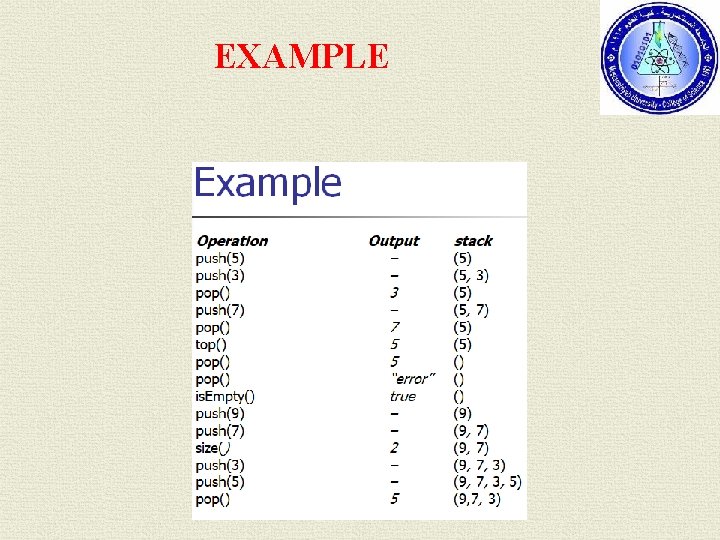
EXAMPLE
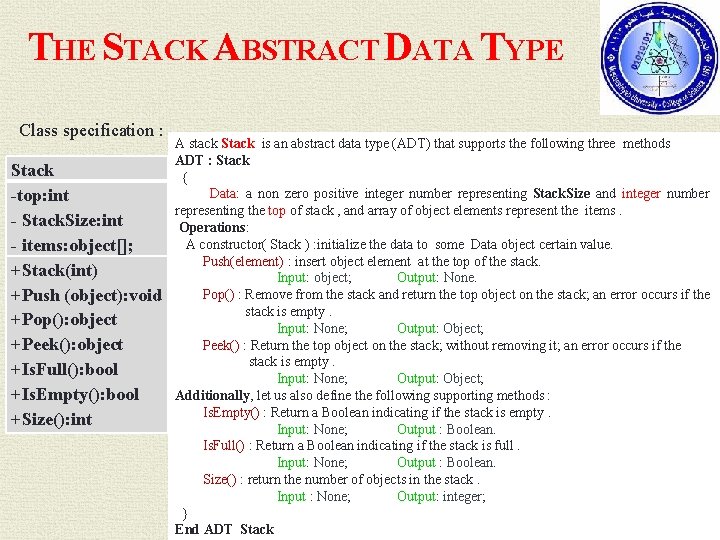
THE STACK ABSTRACT DATA TYPE Class specification : Stack -top: int - Stack. Size: int - items: object[]; +Stack(int) +Push (object): void +Pop(): object +Peek(): object +Is. Full(): bool +Is. Empty(): bool +Size(): int A stack Stack is an abstract data type (ADT) that supports the following three methods ADT : Stack { Data: a non zero positive integer number representing Stack. Size and integer number representing the top of stack , and array of object elements represent the items. Operations: A constructor( Stack ) : initialize the data to some Data object certain value. Push(element) : insert object element at the top of the stack. Input: object; Output: None. Pop() : Remove from the stack and return the top object on the stack; an error occurs if the stack is empty. Input: None; Output: Object; Peek() : Return the top object on the stack; without removing it; an error occurs if the stack is empty. Input: None; Output: Object; Additionally, let us also define the following supporting methods : Is. Empty() : Return a Boolean indicating if the stack is empty. Input: None; Output : Boolean. Is. Full() : Return a Boolean indicating if the stack is full. Input: None; Output : Boolean. Size() : return the number of objects in the stack. Input : None; Output: integer; } End ADT Stack
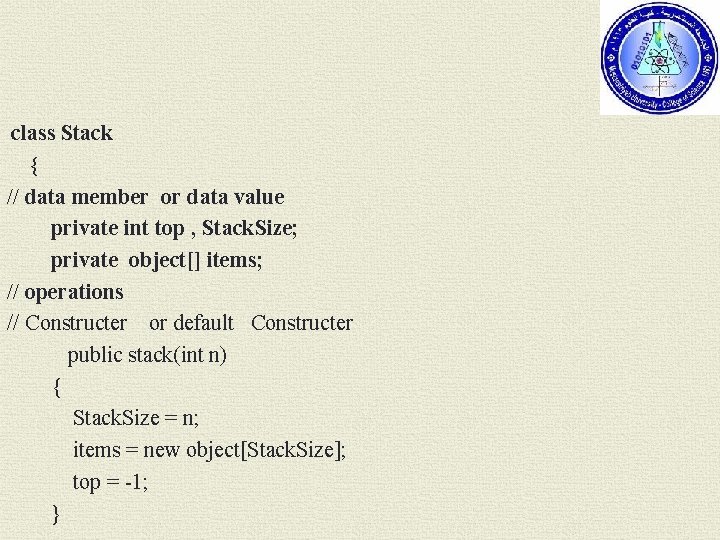
class Stack { // data member or data value private int top , Stack. Size; private object[] items; // operations // Constructer or default Constructer public stack(int n) { Stack. Size = n; items = new object[Stack. Size]; top = -1; }
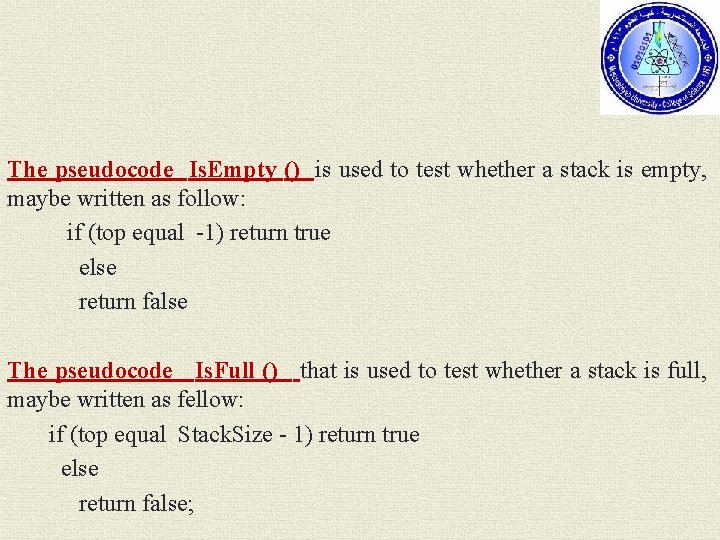
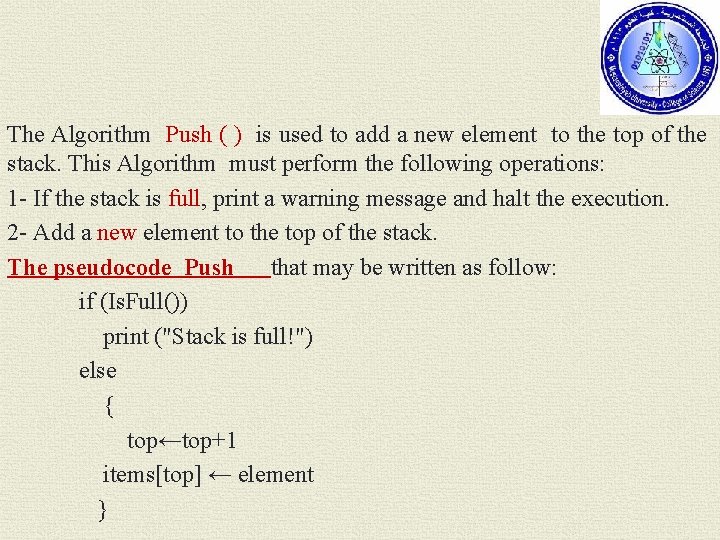
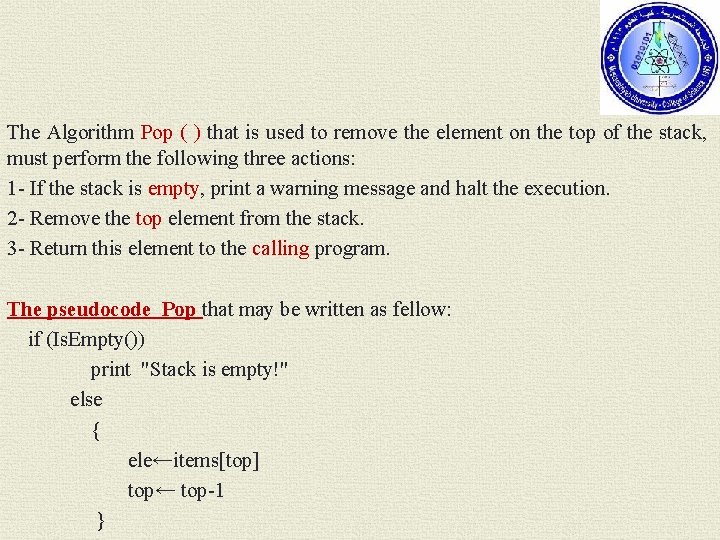
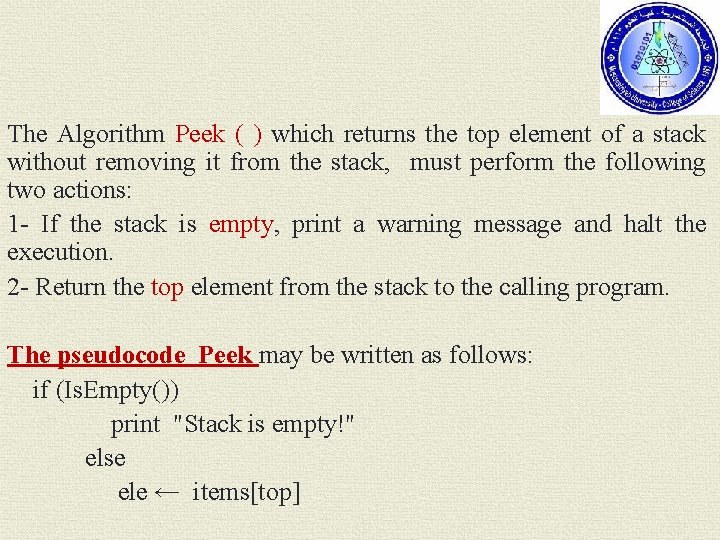
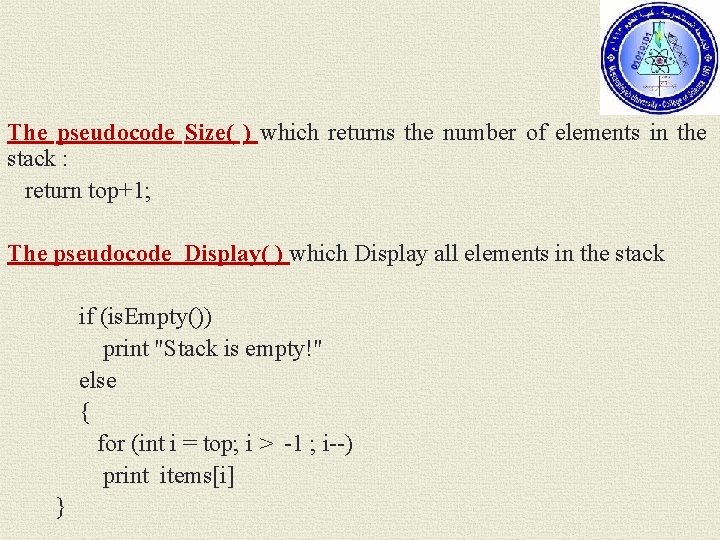
The pseudocode Is. Empty () is used to test whether a stack is empty, maybe written as follow: if (top equal -1) return true else return false The pseudocode Is. Full () that is used to test whether a stack is full, maybe written as fellow: if (top equal Stack. Size - 1) return true else return false;
The Algorithm Push ( ) is used to add a new element to the top of the stack. This Algorithm must perform the following operations: 1 - If the stack is full, print a warning message and halt the execution. 2 - Add a new element to the top of the stack. The pseudocode Push that may be written as follow: if (Is. Full()) print ("Stack is full!") else { top←top+1 items[top] ← element }
The Algorithm Pop ( ) that is used to remove the element on the top of the stack, must perform the following three actions: 1 - If the stack is empty, print a warning message and halt the execution. 2 - Remove the top element from the stack. 3 - Return this element to the calling program. The pseudocode Pop that may be written as fellow: if (Is. Empty()) print "Stack is empty!" else { ele←items[top] top← top-1 }
The Algorithm Peek ( ) which returns the top element of a stack without removing it from the stack, must perform the following two actions: 1 - If the stack is empty, print a warning message and halt the execution. 2 - Return the top element from the stack to the calling program. The pseudocode Peek may be written as follows: if (Is. Empty()) print "Stack is empty!" else ele ← items[top]
The pseudocode Size( ) which returns the number of elements in the stack : return top+1; The pseudocode Display( ) which Display all elements in the stack if (is. Empty()) print "Stack is empty!" else { for (int i = top; i > -1 ; i--) print items[i] }
The table shows the running times of methods in the realization of a stack by an array Method Size is. Empty isfull push pop peek Display Time O(1) O(1) O(n)
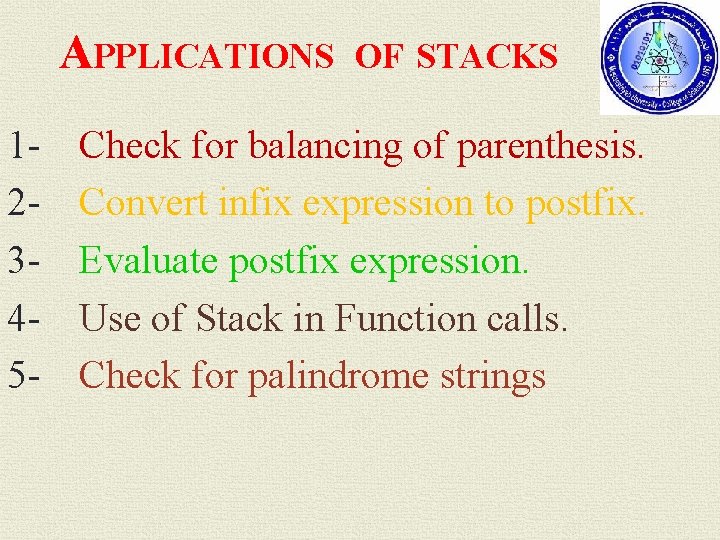
APPLICATIONS 12345 - OF STACKS Check for balancing of parenthesis. Convert infix expression to postfix. Evaluate postfix expression. Use of Stack in Function calls. Check for palindrome strings
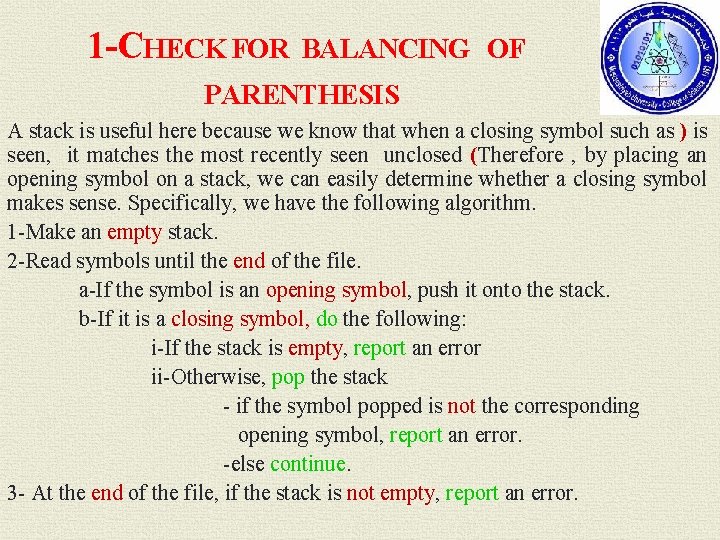
1 -CHECK FOR BALANCING OF PARENTHESIS A stack is useful here because we know that when a closing symbol such as ) is seen, it matches the most recently seen unclosed (Therefore , by placing an opening symbol on a stack, we can easily determine whether a closing symbol makes sense. Specifically, we have the following algorithm. 1 -Make an empty stack. 2 -Read symbols until the end of the file. a-If the symbol is an opening symbol, push it onto the stack. b-If it is a closing symbol, do the following: i-If the stack is empty, report an error ii-Otherwise, pop the stack - if the symbol popped is not the corresponding opening symbol, report an error. -else continue. 3 - At the end of the file, if the stack is not empty, report an error.
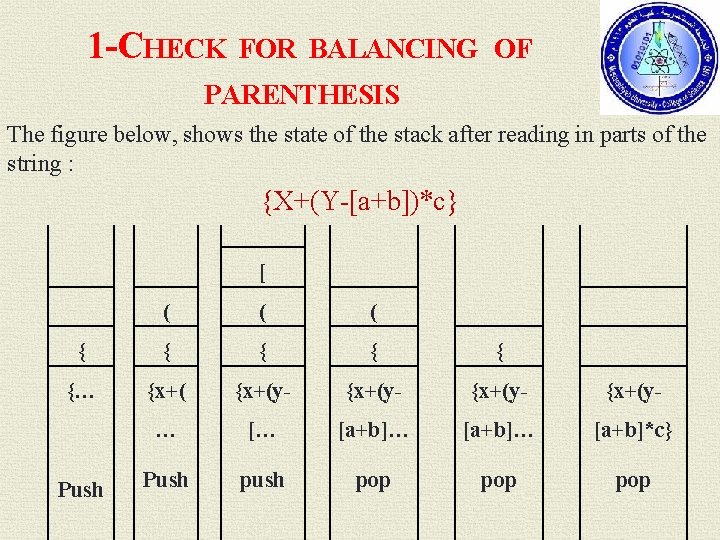
1 -CHECK FOR BALANCING OF PARENTHESIS The figure below, shows the state of the stack after reading in parts of the string : {X+(Y-[a+b])*c} [ ( ( ( { { {… {x+(y- {x+(y- … [… [a+b]… [a+b]*c} Push pop pop Push
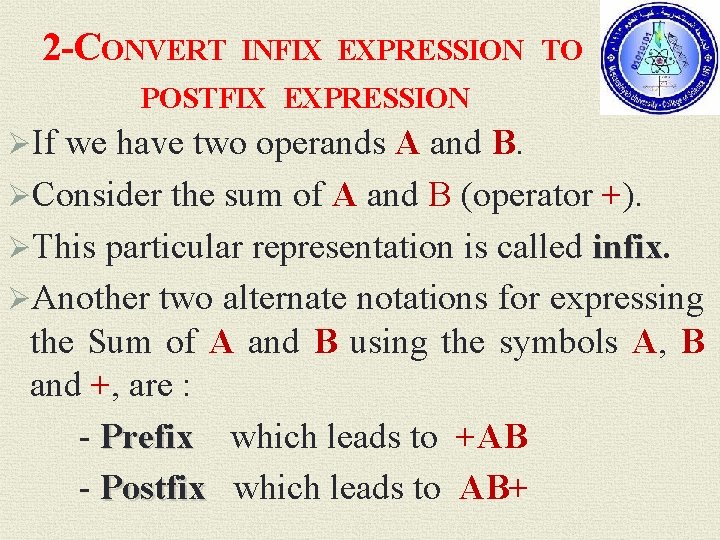
2 -CONVERT INFIX EXPRESSION TO POSTFIX EXPRESSION ØIf we have two operands A and B. ØConsider the sum of A and B (operator +). ØThis particular representation is called infix ØAnother two alternate notations for expressing the Sum of A and B using the symbols A, B and +, are : - Prefix which leads to +AB - Postfix which leads to AB+
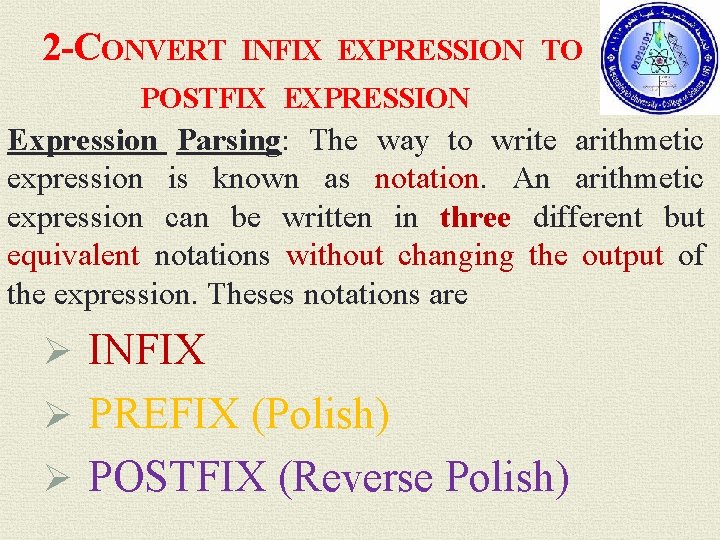
2 -CONVERT INFIX EXPRESSION TO POSTFIX EXPRESSION Expression Parsing: The way to write arithmetic expression is known as notation. An arithmetic expression can be written in three different but equivalent notations without changing the output of the expression. Theses notations are Ø INFIX Ø PREFIX (Polish) Ø POSTFIX (Reverse Polish)
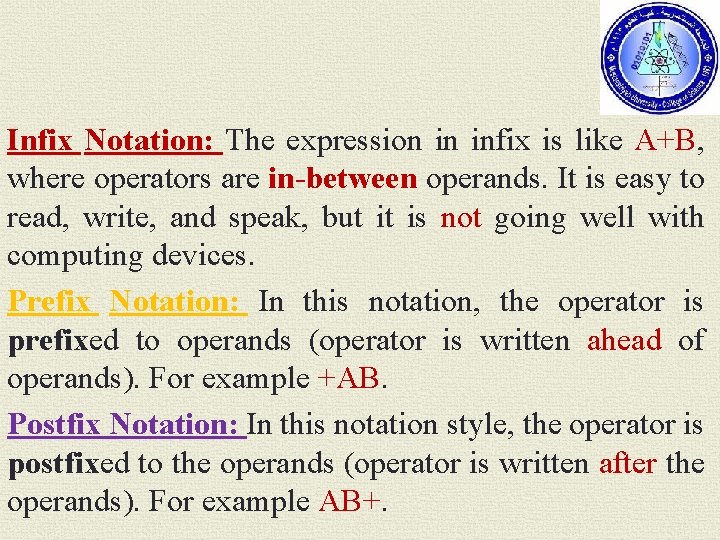
Infix Notation: The expression in infix is like A+B, where operators are in-between operands. It is easy to read, write, and speak, but it is not going well with computing devices. Prefix Notation: In this notation, the operator is prefixed to operands (operator is written ahead of operands). For example +AB. Postfix Notation: In this notation style, the operator is postfixed to the operands (operator is written after the operands). For example AB+.
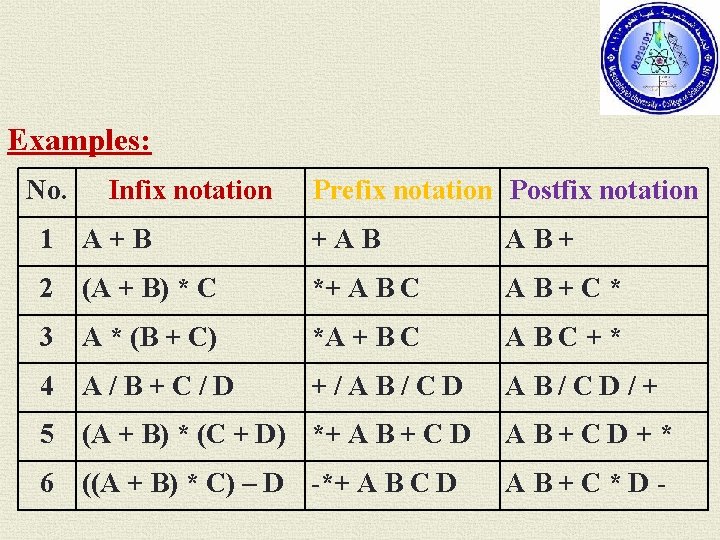
Examples: No. Infix notation Prefix notation Postfix notation 1 A+B +AB AB+ 2 (A + B) * C *+ A B C AB+C* 3 A * (B + C) *A + B C ABC+* 4 A/B+C/D +/AB/CD/+ 5 (A + B) * (C + D) *+ A B + C D AB+CD+* 6 ((A + B) * C) – D -*+ A B C D AB+C*D-
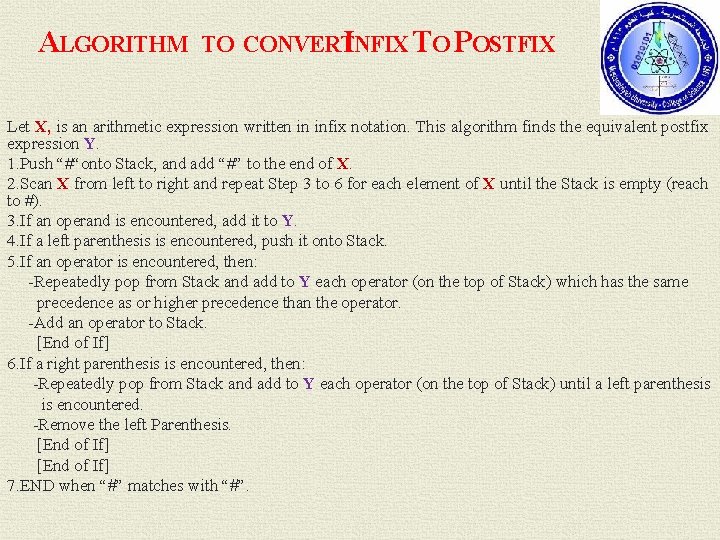
ALGORITHM TO CONVERT INFIX TO POSTFIX Let X, is an arithmetic expression written in infix notation. This algorithm finds the equivalent postfix expression Y. 1. Push “#“onto Stack, and add “#” to the end of X. 2. Scan X from left to right and repeat Step 3 to 6 for each element of X until the Stack is empty (reach to #). 3. If an operand is encountered, add it to Y. 4. If a left parenthesis is encountered, push it onto Stack. 5. If an operator is encountered, then: -Repeatedly pop from Stack and add to Y each operator (on the top of Stack) which has the same precedence as or higher precedence than the operator. -Add an operator to Stack. [End of If] 6. If a right parenthesis is encountered, then: -Repeatedly pop from Stack and add to Y each operator (on the top of Stack) until a left parenthesis is encountered. -Remove the left Parenthesis. [End of If] 7. END when “#” matches with “#”.
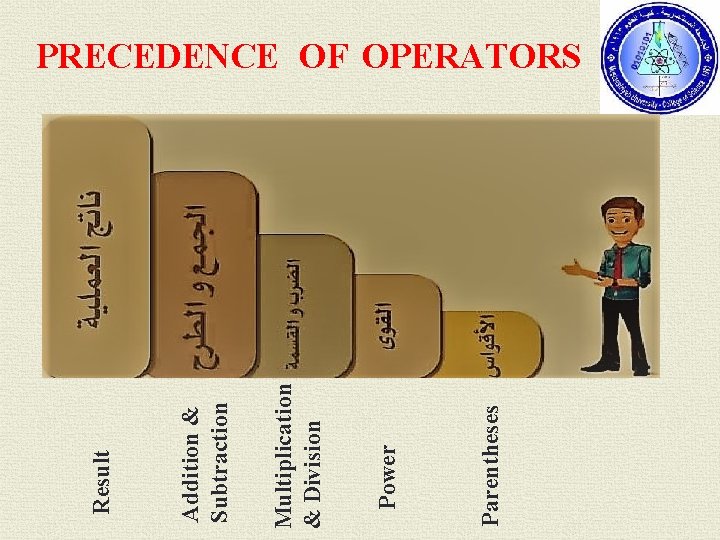
Parentheses Power Multiplication & Division Addition & Subtraction Result PRECEDENCE OF OPERATORS
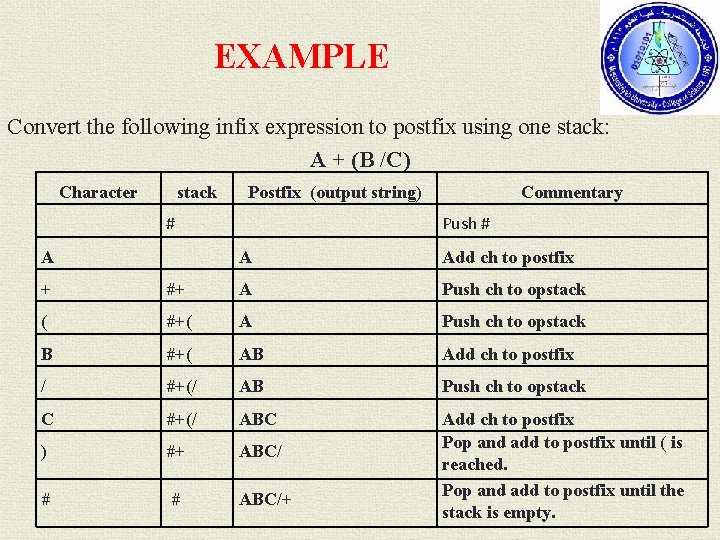
EXAMPLE Convert the following infix expression to postfix using one stack: A + (B /C) Character stack Postfix (output string) # A Commentary Push # A Add ch to postfix + #+ A Push ch to opstack ( #+( A Push ch to opstack B #+( AB Add ch to postfix / #+(/ AB Push ch to opstack C #+(/ ABC ) #+ ABC/ # # ABC/+ Add ch to postfix Pop and add to postfix until ( is reached. Pop and add to postfix until the stack is empty.
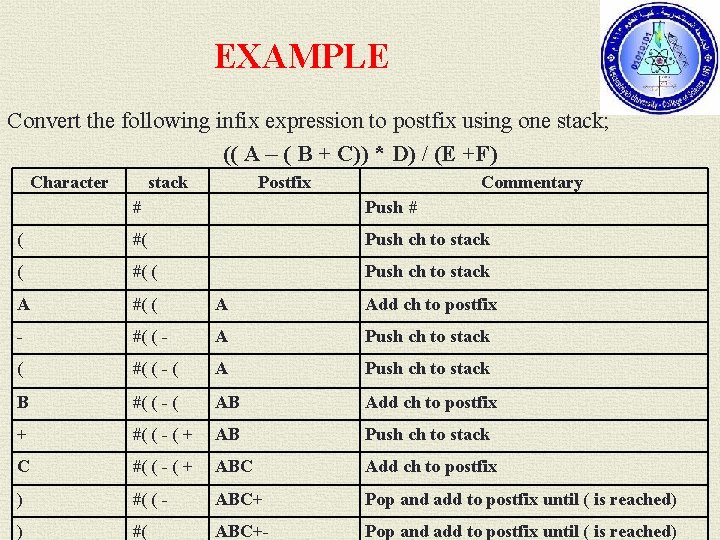
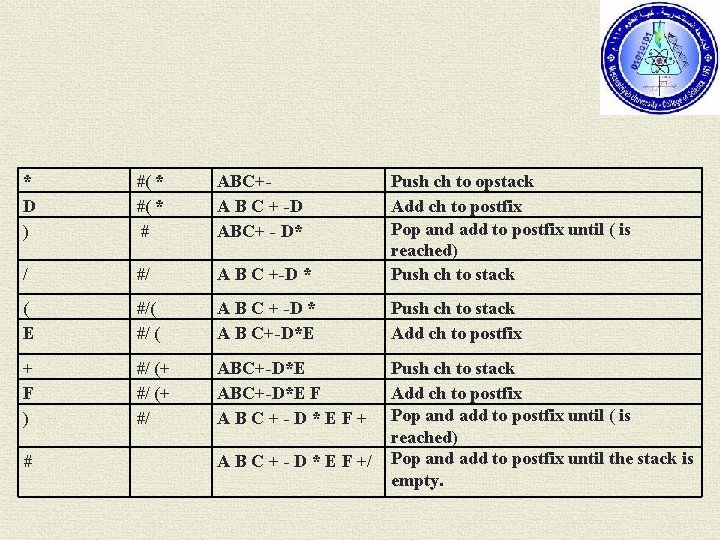
EXAMPLE Convert the following infix expression to postfix using one stack; (( A – ( B + C)) * D) / (E +F) Character stack Postfix Commentary # Push # ( #( Push ch to stack ( #( ( Push ch to stack A #( ( A Add ch to postfix - #( ( - A Push ch to stack ( #( ( - ( A Push ch to stack B #( ( - ( AB Add ch to postfix + #( ( - ( + AB Push ch to stack C #( ( - ( + ABC Add ch to postfix ) #( ( - ABC+ Pop and add to postfix until ( is reached) ) #( ABC+- Pop and add to postfix until ( is reached)
* D ) #( * # ABC+A B C + -D ABC+ - D* / #/ A B C +-D * Push ch to opstack Add ch to postfix Pop and add to postfix until ( is reached) Push ch to stack ( E #/( #/ ( A B C + -D * A B C+-D*E Push ch to stack Add ch to postfix + F ) #/ (+ #/ ABC+-D*E F ABC+-D*EF+ Push ch to stack Add ch to postfix Pop and add to postfix until ( is reached) Pop and add to postfix until the stack is empty. # A B C + - D * E F +/
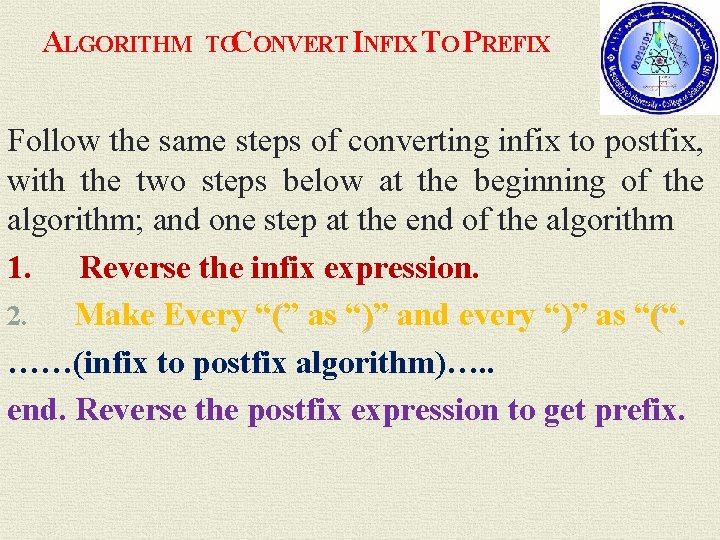
ALGORITHM TOCONVERT INFIX TO PREFIX Follow the same steps of converting infix to postfix, with the two steps below at the beginning of the algorithm; and one step at the end of the algorithm 1. Reverse the infix expression. 2. Make Every “(” as “)” and every “)” as “(“. ……(infix to postfix algorithm)…. . end. Reverse the postfix expression to get prefix.
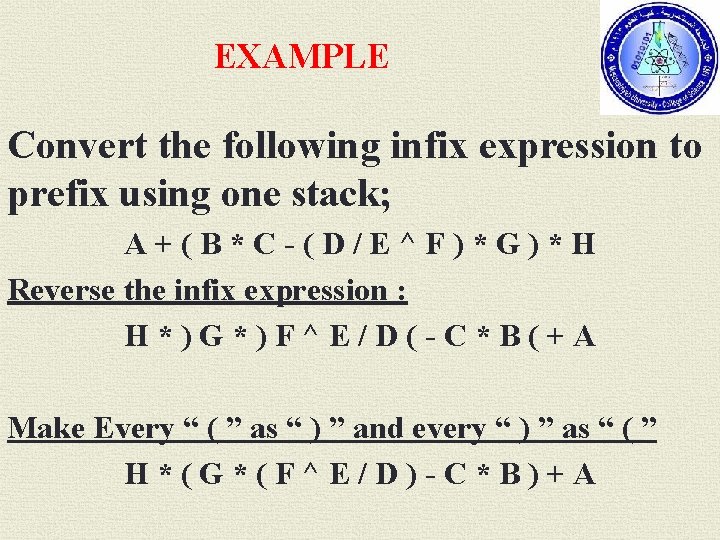
EXAMPLE Convert the following infix expression to prefix using one stack; A+(B*C-(D/E^F)*G)*H Reverse the infix expression : H*)G*)F^E/D(-C*B(+A Make Every “ ( ” as “ ) ” and every “ ) ” as “ ( ” H*(G*(F^E/D)-C*B)+A
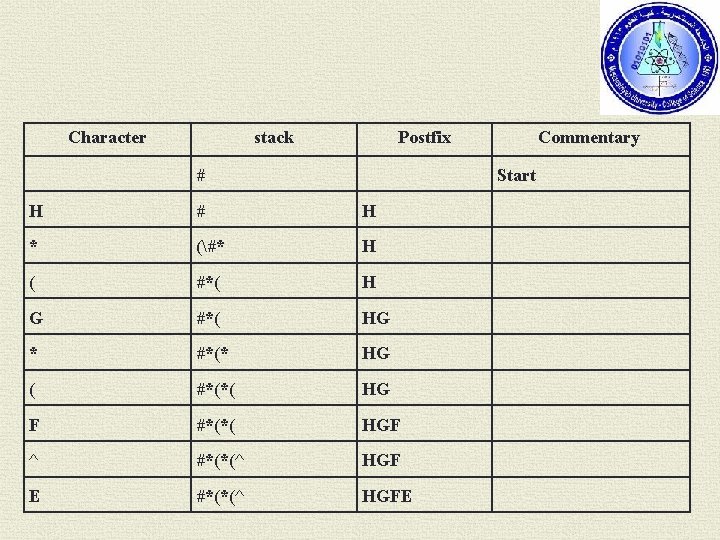
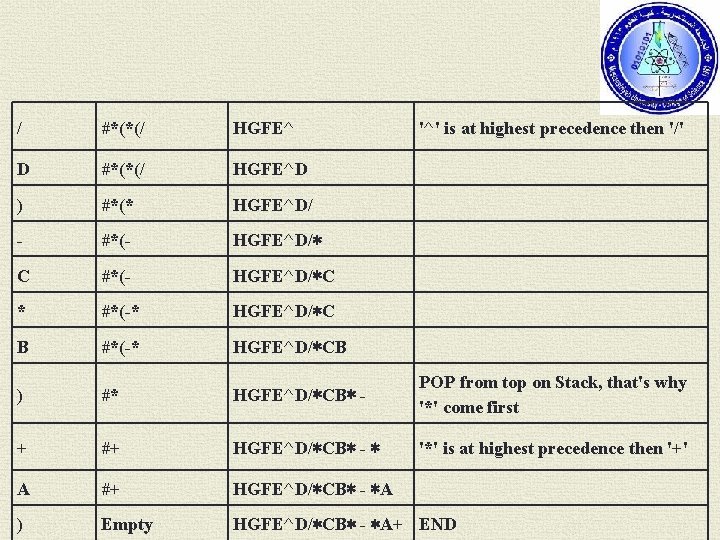
Character stack Postfix # Commentary Start H # H * (#* H ( #*( H G #*( HG * #*(* HG ( #*(*( HG F #*(*( HGF ^ #*(*(^ HGF E #*(*(^ HGFE
/ #*(*(/ HGFE^ '^' is at highest precedence then '/' D #*(*(/ HGFE^D ) #*(* HGFE^D/ - #*(- HGFE^D/∗ C #*(- HGFE^D/∗C * #*(-* HGFE^D/∗C B #*(-* HGFE^D/∗CB ) #* HGFE^D/∗CB∗ - POP from top on Stack, that's why '*' come first + #+ HGFE^D/∗CB∗ - ∗ '*' is at highest precedence then '+' A #+ HGFE^D/∗CB∗ - ∗A ) Empty HGFE^D/∗CB∗ - ∗A+ END
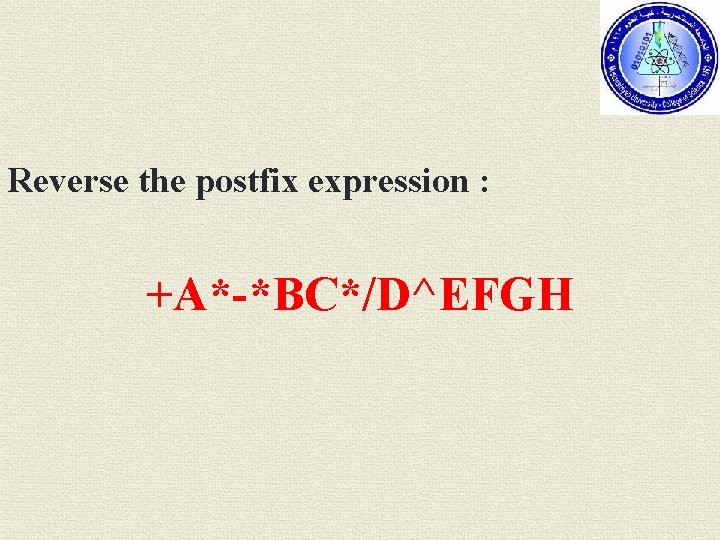
Reverse the postfix expression : +A*-*BC*/D^EFGH
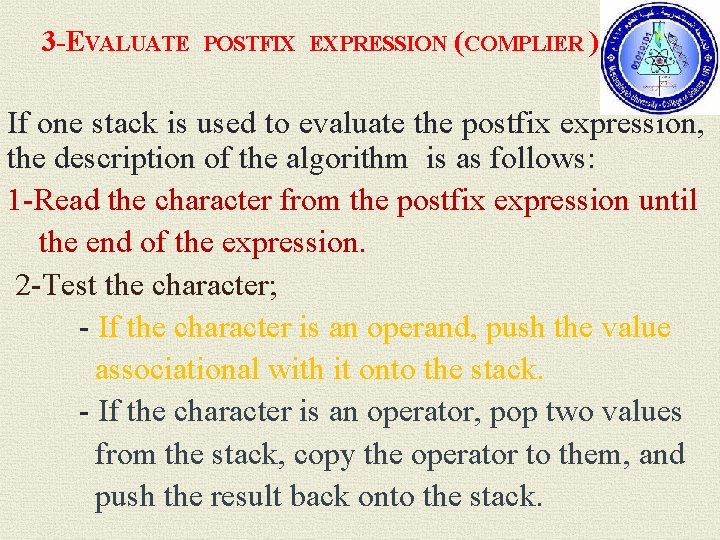
3 -EVALUATE POSTFIX EXPRESSION (COMPLIER ) If one stack is used to evaluate the postfix expression, the description of the algorithm is as follows: 1 -Read the character from the postfix expression until the end of the expression. 2 -Test the character; - If the character is an operand, push the value associational with it onto the stack. - If the character is an operator, pop two values from the stack, copy the operator to them, and push the result back onto the stack.
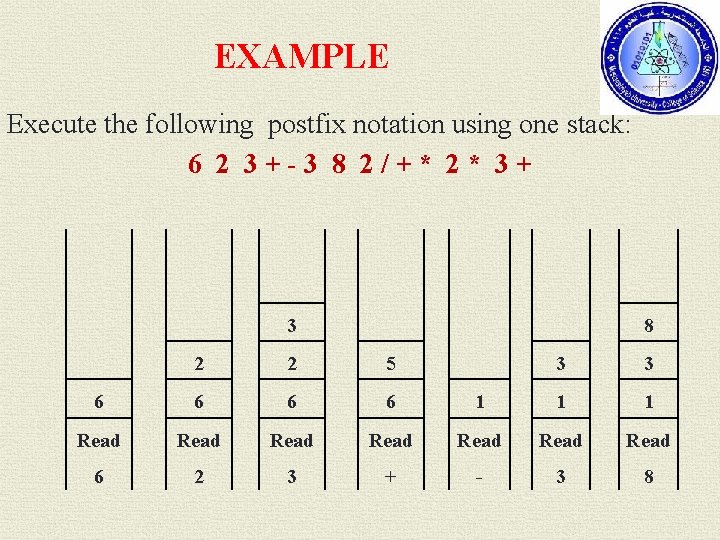
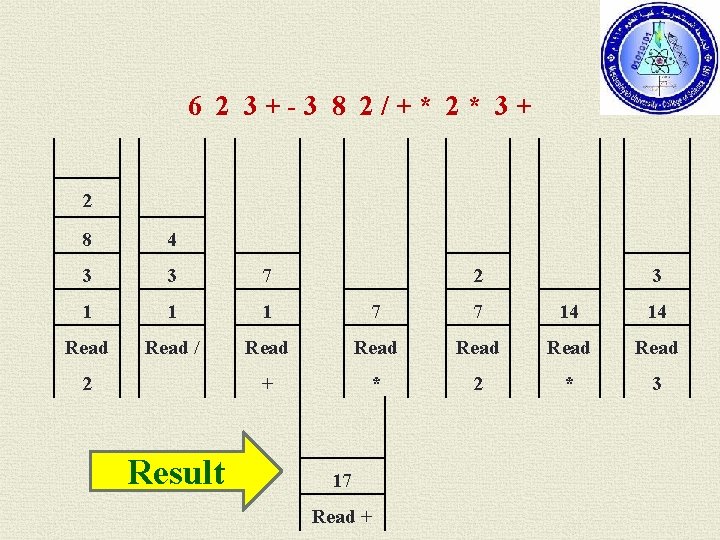
EXAMPLE Execute the following postfix notation using one stack: 6 2 3+-3 8 2/+* 2* 3+ 3 8 2 2 5 3 3 6 6 1 1 1 Read Read 6 2 3 + - 3 8
6 2 3+-3 8 2/+* 2* 3+ 2 8 4 3 3 7 1 1 1 7 7 14 14 Read / Read Read + * 2 * 3 2 Result 2 17 Read + 3
EVALUATE INFIX EXPRESSION (INTERPRETERS USING TWO STACKS ) Example: Execute the following infix notation using the two stack : 3 + 7*2 -6
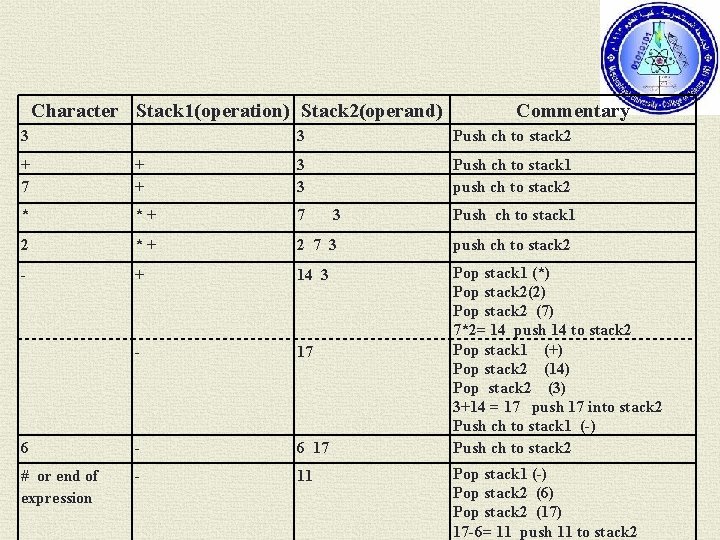
Character Stack 1(operation) Stack 2(operand) 3 Commentary 3 Push ch to stack 2 Push ch to stack 1 push ch to stack 2 + 7 + + 3 3 * *+ 7 2 *+ 2 7 3 push ch to stack 2 - + 14 3 - 17 6 - 6 17 Pop stack 1 (*) Pop stack 2(2) Pop stack 2 (7) 7*2= 14 push 14 to stack 2 Pop stack 1 (+) Pop stack 2 (14) Pop stack 2 (3) 3+14 = 17 push 17 into stack 2 Push ch to stack 1 (-) Push ch to stack 2 # or end of expression - 11 3 Push ch to stack 1 Pop stack 1 (-) Pop stack 2 (6) Pop stack 2 (17) 17 -6= 11 push 11 to stack 2
4 -USE OFSTACK INFUNCTION CALLS Ø Whenever a function begins execution, an activation record is created to store the current Ø Ø Ø environment for that function The current environment includes the v values of its parameters, v contents of registers, v the function’s return value, v local variables v address of the instruction to which execution is to return when the function finishes execution (If execution is interrupted by a call to another function) Functions may call other functions and thus interrupt their own execution, some data structure must be used to store these activation records so they can be recovered and the system can be reset when a function resumes execution. It is the fact that the last function interrupted is the first one reactivated It suggests that a stack can be used to store these activation records A stack is an appropriate structure, and since it is manipulated during execution, it is called the run-time stack
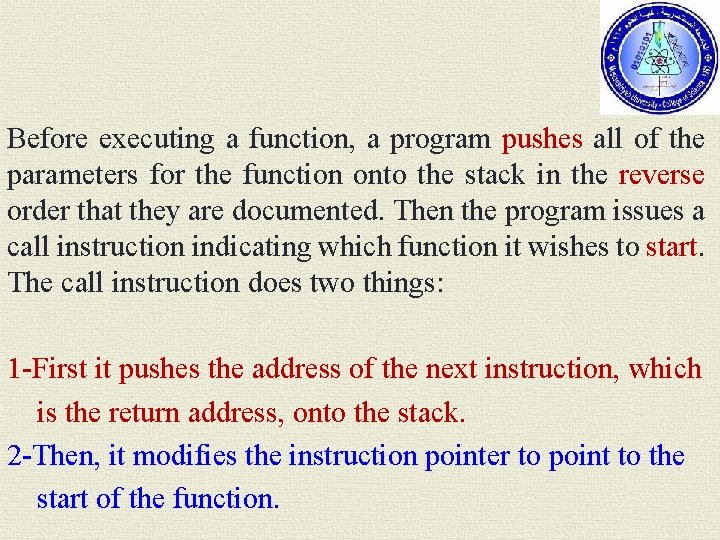
Before executing a function, a program pushes all of the parameters for the function onto the stack in the reverse order that they are documented. Then the program issues a call instruction indicating which function it wishes to start. The call instruction does two things: 1 -First it pushes the address of the next instruction, which is the return address, onto the stack. 2 -Then, it modifies the instruction pointer to point to the start of the function.
EXAMPLE Consider the following program segment static void Main(string[] args) { int a=3; int s 1= f 1(a); } int f 1(int x) { int s =( f 2(x+1)) ; return s; } int f 2(int p) { int q=f 3(p/2); return 2*q; } int f 3(int n) { return n*n+1; } ? Explanation
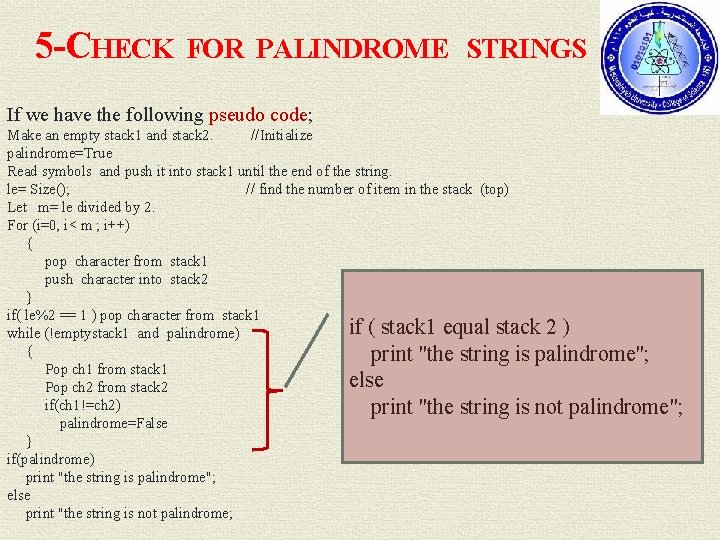
5 -CHECK FOR PALINDROME STRINGS If we have the following pseudo code; Make an empty stack 1 and stack 2. //Initialize palindrome=True Read symbols and push it into stack 1 until the end of the string. le= Size(); // find the number of item in the stack (top) Let m= le divided by 2. For (i=0, i< m ; i++) { pop character from stack 1 push character into stack 2 } if( le%2 == 1 ) pop character from stack 1 if ( stack 1 equal stack 2 ) while (!emptystack 1 and palindrome) { print "the string is palindrome"; Pop ch 1 from stack 1 else Pop ch 2 from stack 2 if(ch 1!=ch 2) print "the string is not palindrome"; palindrome=False } if(palindrome) print "the string is palindrome"; else print "the string is not palindrome;
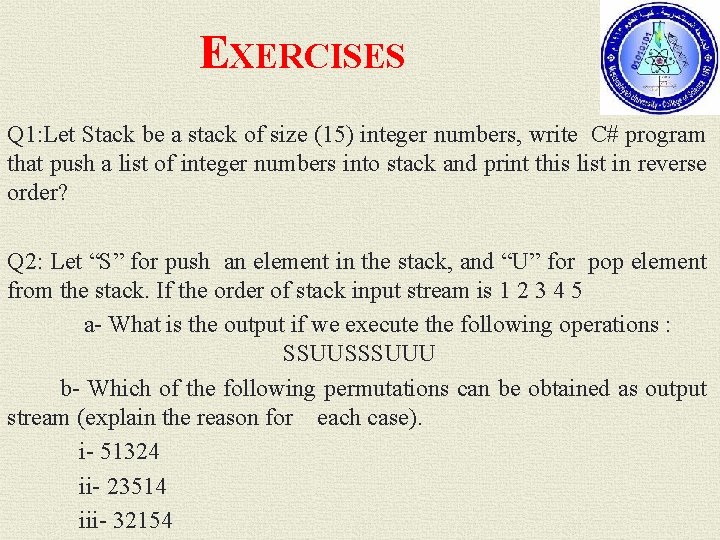
EXERCISES Q 1: Let Stack be a stack of size (15) integer numbers, write C# program that push a list of integer numbers into stack and print this list in reverse order? Q 2: Let “S” for push an element in the stack, and “U” for pop element from the stack. If the order of stack input stream is 1 2 3 4 5 a- What is the output if we execute the following operations : SSUUSSSUUU b- Which of the following permutations can be obtained as output stream (explain the reason for each case). i- 51324 ii- 23514 iii- 32154
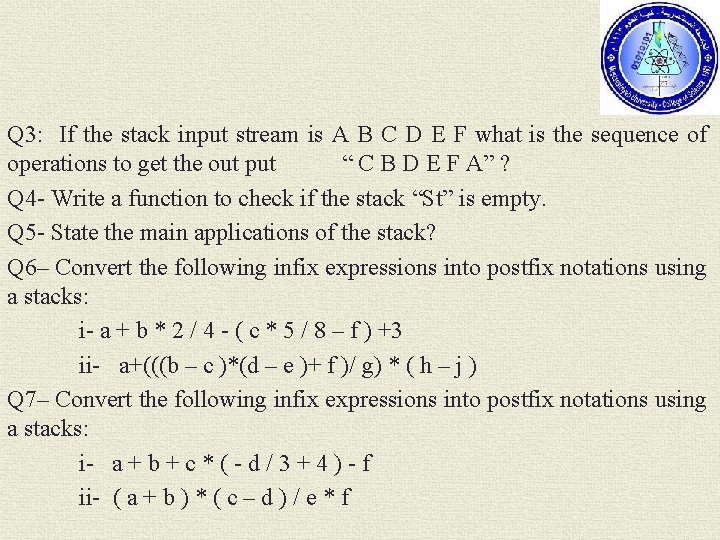
Q 3: If the stack input stream is A B C D E F what is the sequence of operations to get the out put “ C B D E F A” ? Q 4 - Write a function to check if the stack “St” is empty. Q 5 - State the main applications of the stack? Q 6– Convert the following infix expressions into postfix notations using a stacks: i- a + b * 2 / 4 - ( c * 5 / 8 – f ) +3 ii- a+(((b – c )*(d – e )+ f )/ g) * ( h – j ) Q 7– Convert the following infix expressions into postfix notations using a stacks: i- a + b + c * ( - d / 3 + 4 ) - f ii- ( a + b ) * ( c – d ) / e * f
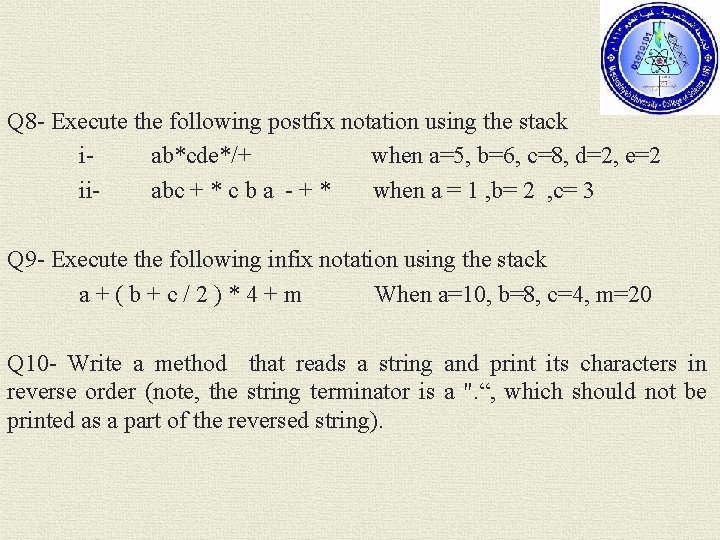
Q 8 - Execute the following postfix notation using the stack iab*cde*/+ when a=5, b=6, c=8, d=2, e=2 iiabc + * c b a - + * when a = 1 , b= 2 , c= 3 Q 9 - Execute the following infix notation using the stack a+(b+c/2)*4+m When a=10, b=8, c=4, m=20 Q 10 - Write a method that reads a string and print its characters in reverse order (note, the string terminator is a ". “, which should not be printed as a part of the reversed string).
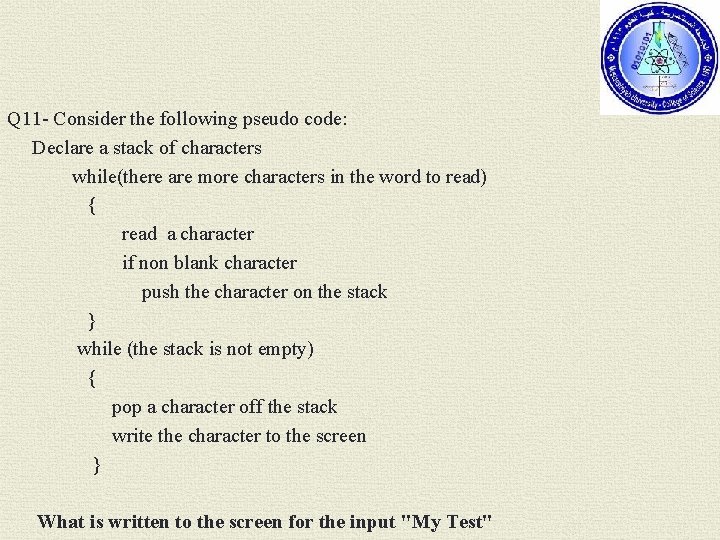
Q 11 - Consider the following pseudo code: Declare a stack of characters while(there are more characters in the word to read) { read a character if non blank character push the character on the stack } while (the stack is not empty) { pop a character off the stack write the character to the screen } What is written to the screen for the input "My Test"