
Stack ADT Modularity 2 implementations of the Stack
- Slides: 14
Stack ADT & Modularity 2 implementations of the Stack abstract data type: Array Linked List Program design: modularity, abstraction and information hiding
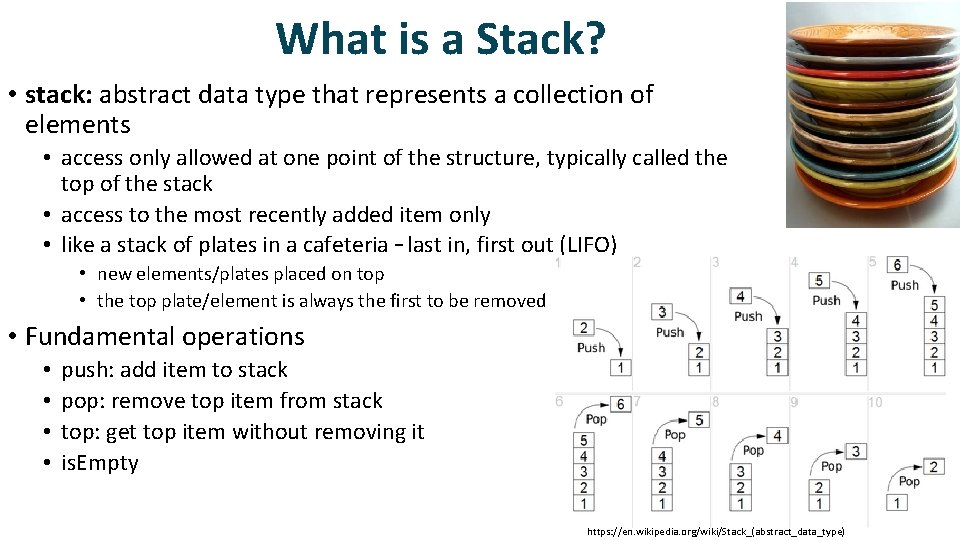
What is a Stack? • stack: abstract data type that represents a collection of elements • access only allowed at one point of the structure, typically called the top of the stack • access to the most recently added item only • like a stack of plates in a cafeteria – last in, first out (LIFO) • new elements/plates placed on top • the top plate/element is always the first to be removed • Fundamental operations • • push: add item to stack pop: remove top item from stack top: get top item without removing it is. Empty https: //en. wikipedia. org/wiki/Stack_(abstract_data_type)
Abstract Data Type (ADT) • Type with public interface & hidden implementation • User only knows the available operations • In C: public interface contains function prototypes in a header file • Implementation in separate. c file: function definitions • Client code can use type to declare variables & use provided operations • Implementation of ADT can change with no impact on client or change in interface
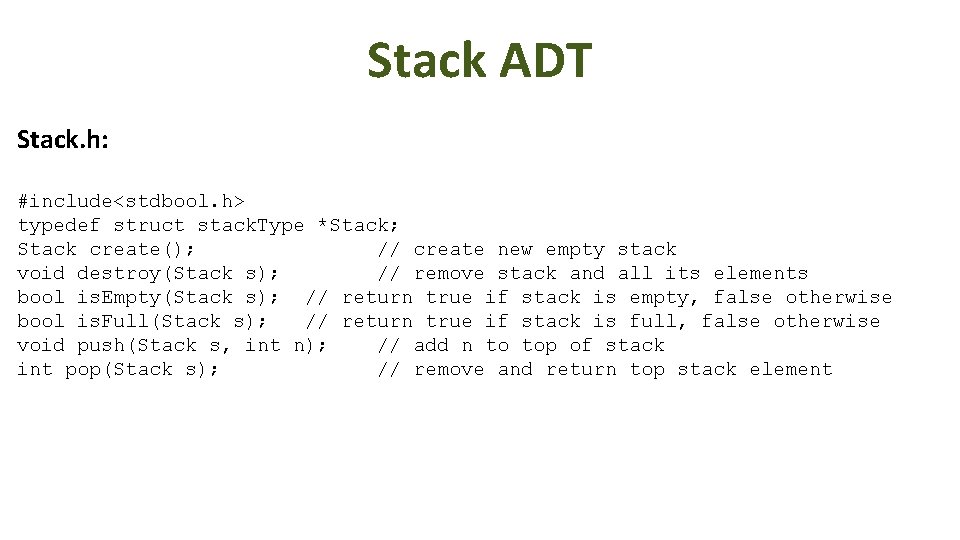
Stack ADT Stack. h: #include<stdbool. h> typedef struct stack. Type *Stack; Stack create(); // create new empty stack void destroy(Stack s); // remove stack and all its elements bool is. Empty(Stack s); // return true if stack is empty, false otherwise bool is. Full(Stack s); // return true if stack is full, false otherwise void push(Stack s, int n); // add n to top of stack int pop(Stack s); // remove and return top stack element
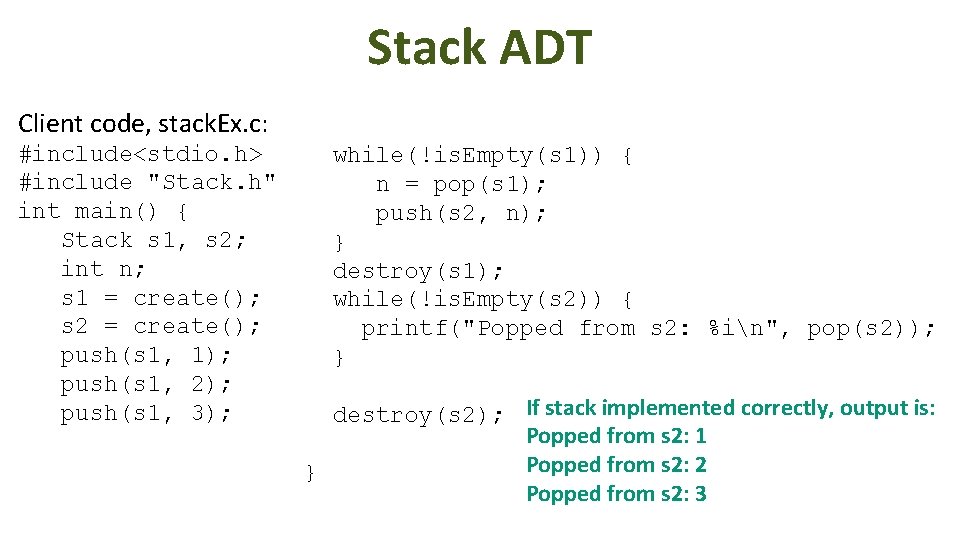
Stack ADT Client code, stack. Ex. c: #include<stdio. h> #include "Stack. h" int main() { Stack s 1, s 2; int n; s 1 = create(); s 2 = create(); push(s 1, 1); push(s 1, 2); push(s 1, 3); while(!is. Empty(s 1)) { n = pop(s 1); push(s 2, n); } destroy(s 1); while(!is. Empty(s 2)) { printf("Popped from s 2: %in", pop(s 2)); } destroy(s 2); If stack implemented correctly, output is: Popped from s 2: 1 Popped from s 2: 2 } Popped from s 2: 3
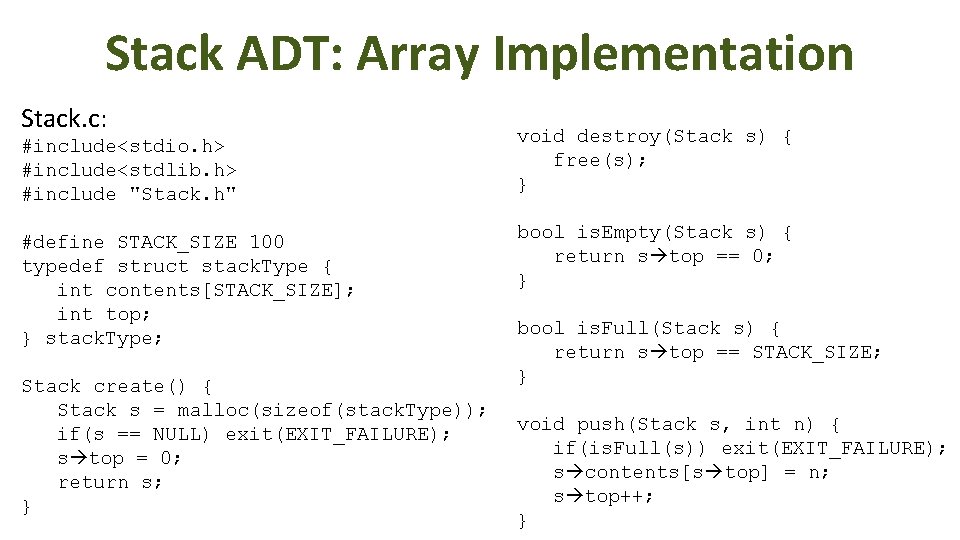
Stack ADT: Array Implementation Stack. c: #include<stdio. h> #include<stdlib. h> #include "Stack. h" #define STACK_SIZE 100 typedef struct stack. Type { int contents[STACK_SIZE]; int top; } stack. Type; Stack create() { Stack s = malloc(sizeof(stack. Type)); if(s == NULL) exit(EXIT_FAILURE); s top = 0; return s; } void destroy(Stack s) { free(s); } bool is. Empty(Stack s) { return s top == 0; } bool is. Full(Stack s) { return s top == STACK_SIZE; } void push(Stack s, int n) { if(is. Full(s)) exit(EXIT_FAILURE); s contents[s top] = n; s top++; }
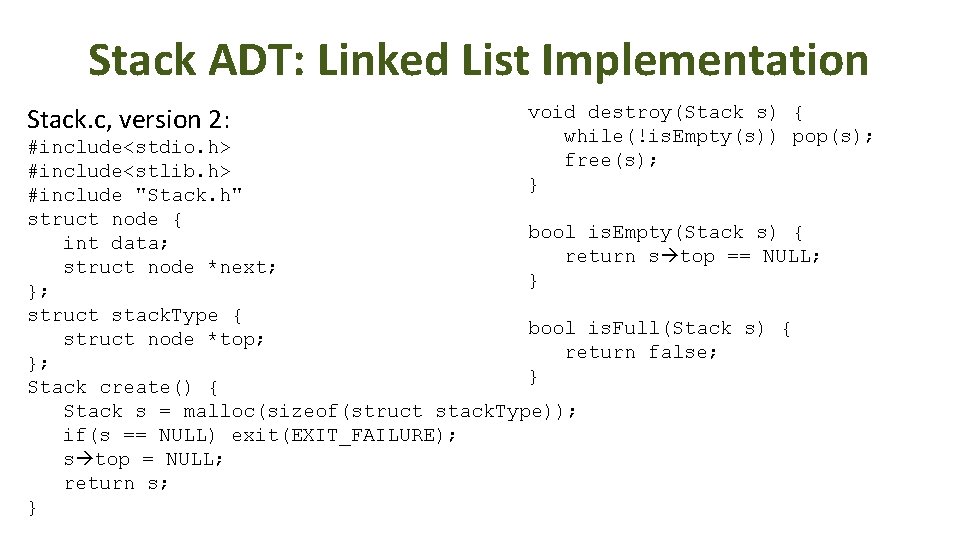
Stack ADT: Linked List Implementation Stack. c, version 2: void destroy(Stack s) { while(!is. Empty(s)) pop(s); free(s); } #include<stdio. h> #include<stlib. h> #include "Stack. h" struct node { bool is. Empty(Stack s) { int data; return s top == NULL; struct node *next; } }; struct stack. Type { bool is. Full(Stack s) { struct node *top; return false; }; } Stack create() { Stack s = malloc(sizeof(struct stack. Type)); if(s == NULL) exit(EXIT_FAILURE); s top = NULL; return s; }
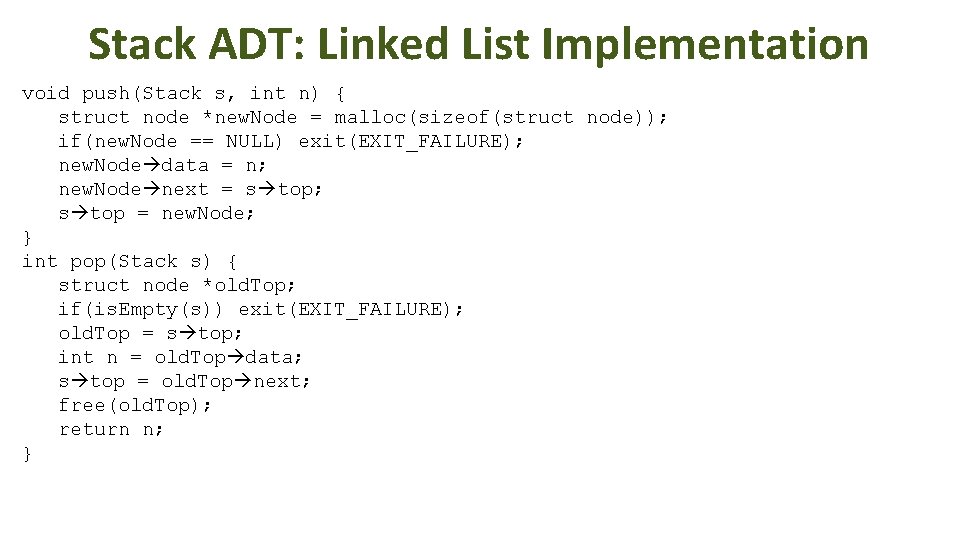
Stack ADT: Linked List Implementation void push(Stack s, int n) { struct node *new. Node = malloc(sizeof(struct node)); if(new. Node == NULL) exit(EXIT_FAILURE); new. Node data = n; new. Node next = s top; s top = new. Node; } int pop(Stack s) { struct node *old. Top; if(is. Empty(s)) exit(EXIT_FAILURE); old. Top = s top; int n = old. Top data; s top = old. Top next; free(old. Top); return n; }
Program Design
Introduction • Most full-featured programs are at least 100, 000 lines long. • Although C wasn’t designed for writing large programs, many large programs have been written in C. • Writing large programs is quite different from writing small ones. • Issues that are important when writing large programs: • • Style Documentation Maintenance Design • Your program design should make programs readable and maintainable.
Modules • Can view a program as a number of independent modules • Module: collection of services (functions) – some are made available to other parts of the program • Each module has: • interface: describes available services • header file containing prototypes, made available to clients • implementation: source code file – contains implementation of module's functions
Modules in C • The C library is a collection of modules • Each header in the library serves as interface to a module: • <stdio. h>: interface to module containing I/O functions • <string. h>: interface to module containing string-handling functions • Advantages of dividing program into modules: • abstraction – a distancing between ideas and details. We can use modules without knowing how they work. • reusability – a module can be reused in other programs. • maintainability – a bug is contained to a single module, making it easier to find and fix.
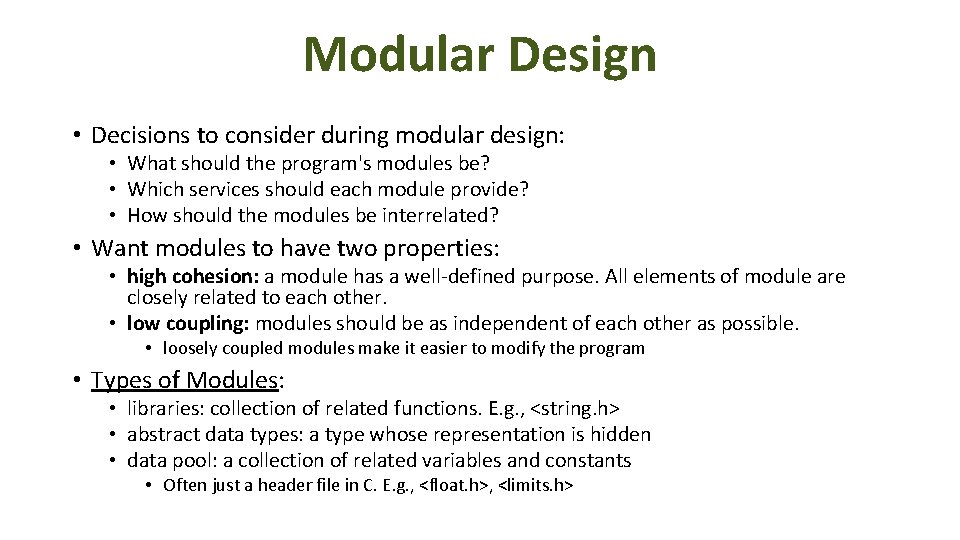
Modular Design • Decisions to consider during modular design: • What should the program's modules be? • Which services should each module provide? • How should the modules be interrelated? • Want modules to have two properties: • high cohesion: a module has a well-defined purpose. All elements of module are closely related to each other. • low coupling: modules should be as independent of each other as possible. • loosely coupled modules make it easier to modify the program • Types of Modules: • libraries: collection of related functions. E. g. , <string. h> • abstract data types: a type whose representation is hidden • data pool: a collection of related variables and constants • Often just a header file in C. E. g. , <float. h>, <limits. h>
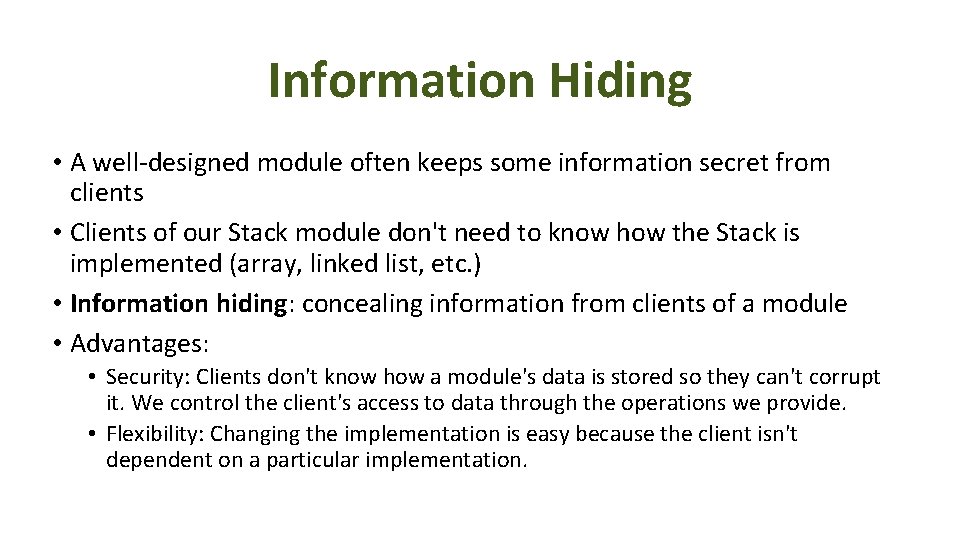
Information Hiding • A well-designed module often keeps some information secret from clients • Clients of our Stack module don't need to know how the Stack is implemented (array, linked list, etc. ) • Information hiding: concealing information from clients of a module • Advantages: • Security: Clients don't know how a module's data is stored so they can't corrupt it. We control the client's access to data through the operations we provide. • Flexibility: Changing the implementation is easy because the client isn't dependent on a particular implementation.