
Stable Cloth Animation By Matthew Fisher Overview Choose
Stable Cloth Animation By Matthew Fisher
Overview • Choose Underlying Model • Define Equations of State • Integrate Equations of State – Deal With Explosions • Deal With Collisions • Rendering Techniques
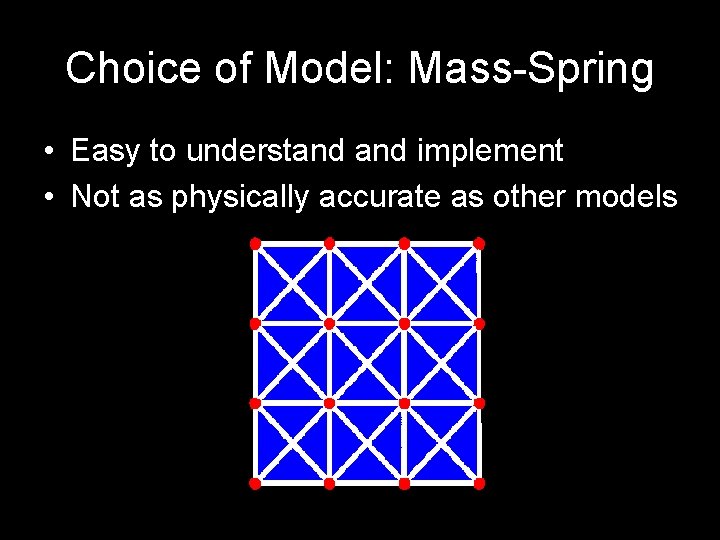
Choice of Model: Mass-Spring • Easy to understand implement • Not as physically accurate as other models
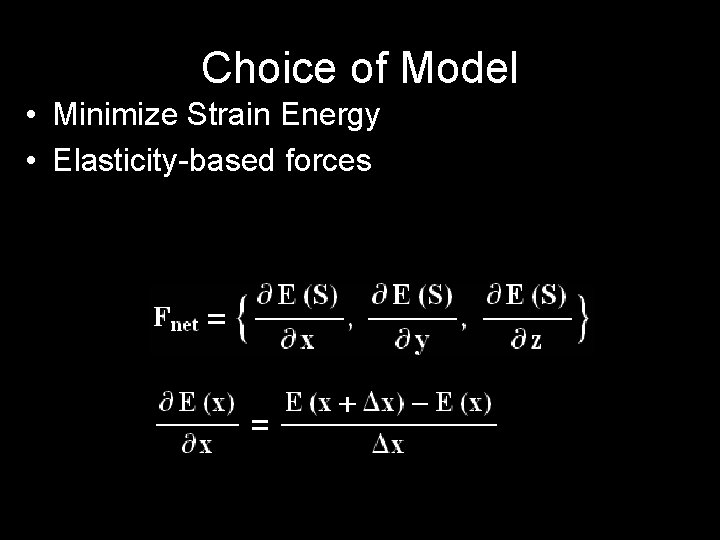
Choice of Model • Minimize Strain Energy • Elasticity-based forces
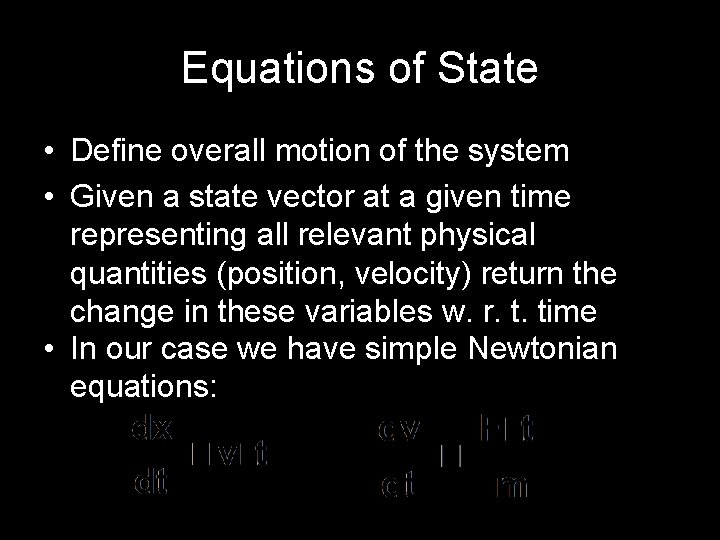
Equations of State • Define overall motion of the system • Given a state vector at a given time representing all relevant physical quantities (position, velocity) return the change in these variables w. r. t. time • In our case we have simple Newtonian equations:

Equations of State: Force • Fnet(v) = Mg + Fwind + Fair resistance –
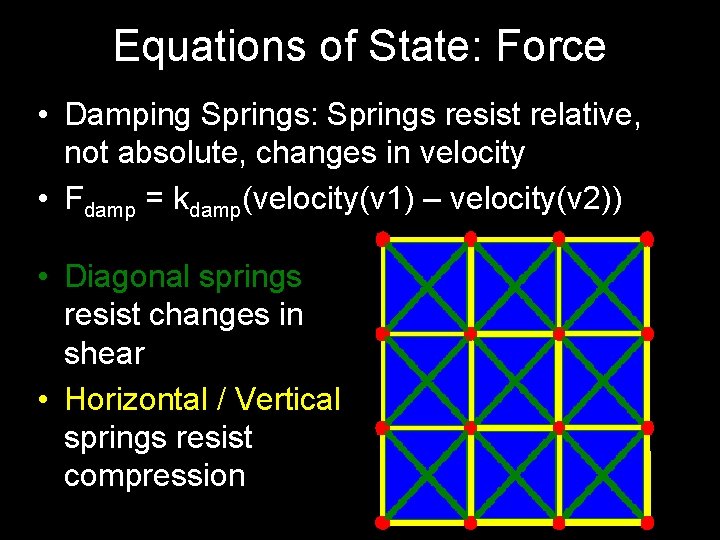
Equations of State: Force • Damping Springs: Springs resist relative, not absolute, changes in velocity • Fdamp = kdamp(velocity(v 1) – velocity(v 2)) • Diagonal springs resist changes in shear • Horizontal / Vertical springs resist compression
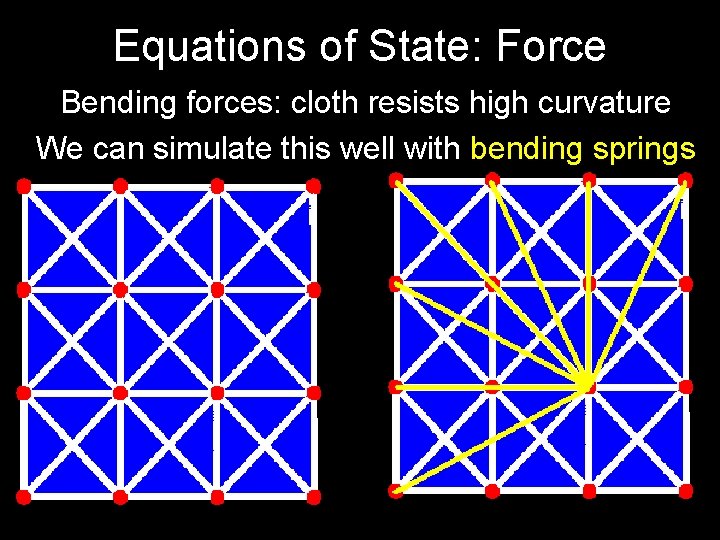
Equations of State: Force Bending forces: cloth resists high curvature We can simulate this well with bending springs
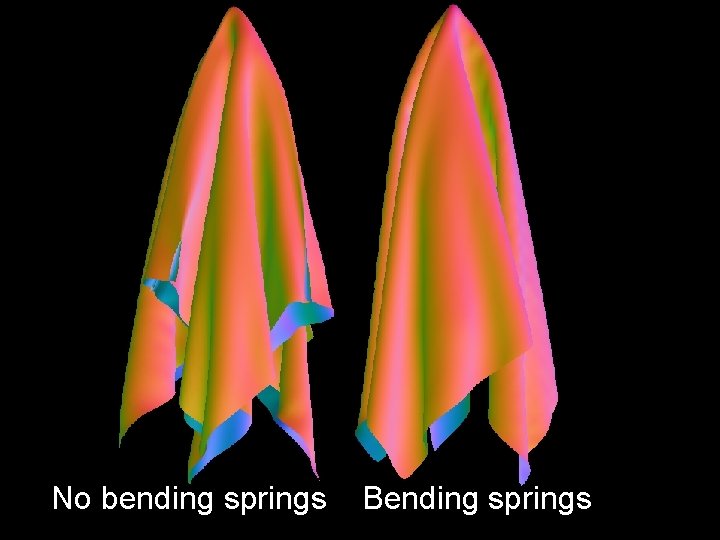
No bending springs Bending springs
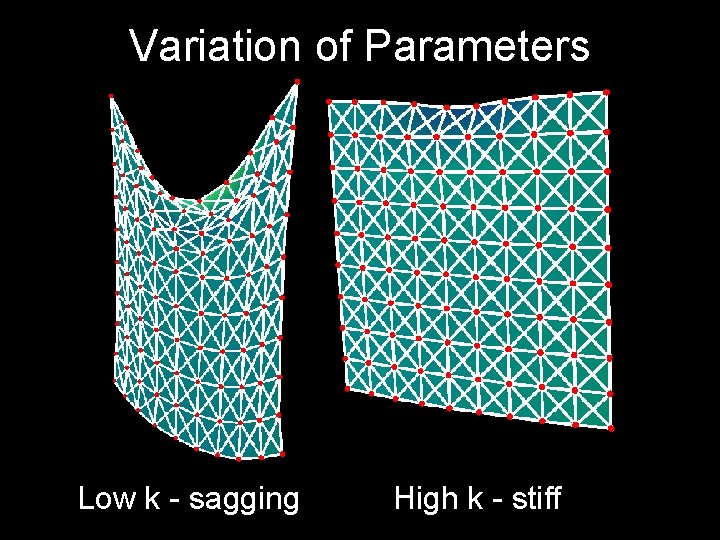
Variation of Parameters Low k - sagging High k - stiff

Integrating Equations of State • Explicit vs. Implicit vs. Symplectic • Euler’s Method (1 st order) • Runge Kutta (4 th order) • Verlet Algorithm

Integrating Equations of State • Implicit integrators are stable but slow and tedious to implement • Symplectic integrators are fast but hard to generalize • Explicit integrators are easy to implement but unstable

Integrating Equations of State • We can make an explicit integrator stable with an energy-corrective step, which restricts the total energy of the system • This step limits the maximum energy a spring can contain. If a spring exceeds this limit, we compress / expand it until it is at the limit, and repeat until all springs are corrected
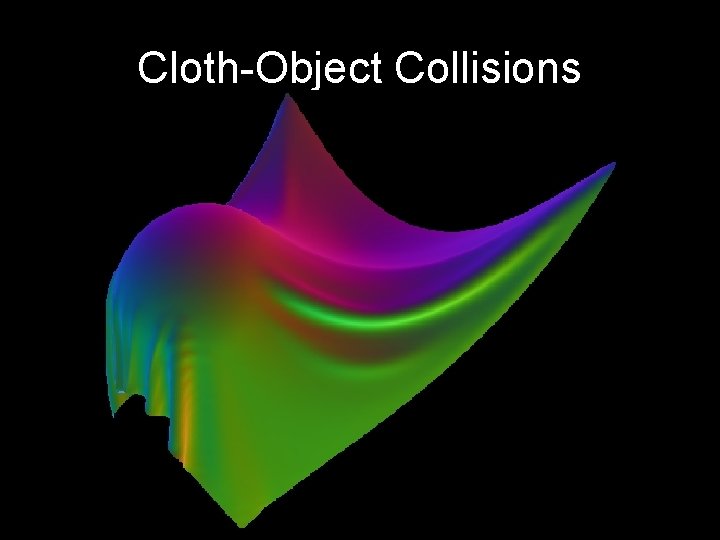
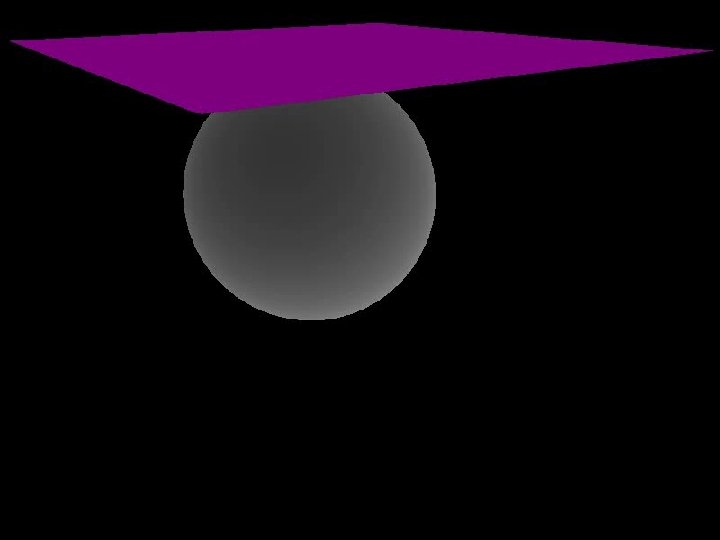
Cloth-Object Collisions
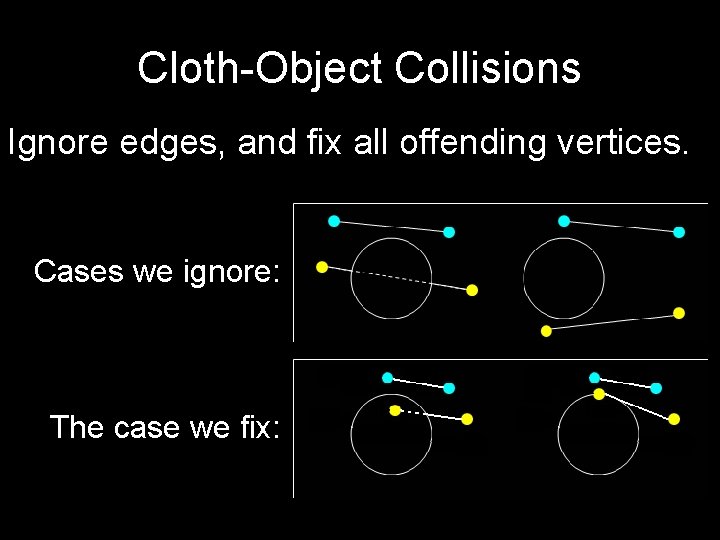
Cloth-Object Collisions Ignore edges, and fix all offending vertices. Cases we ignore: The case we fix:
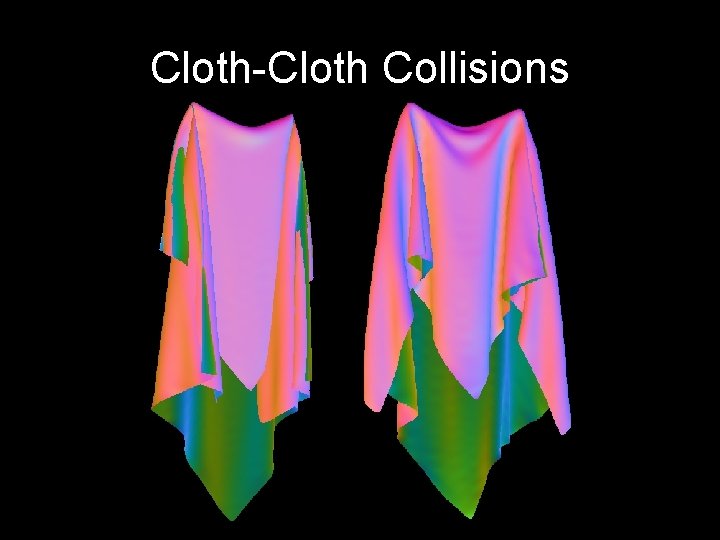
Cloth-Cloth Collisions
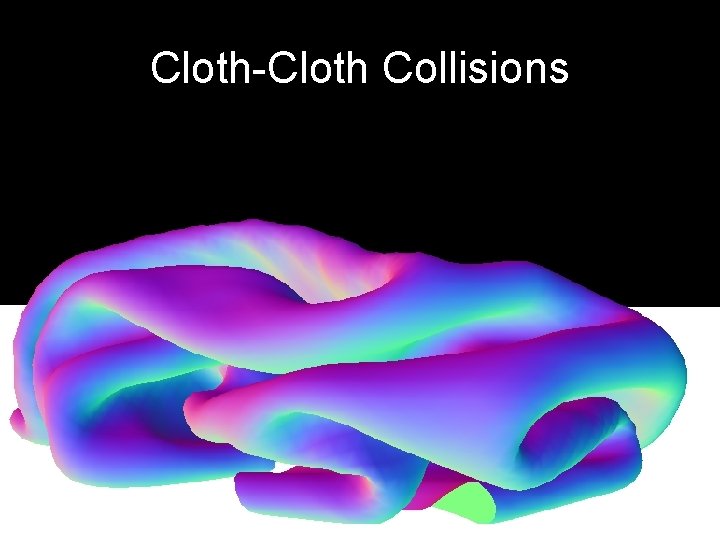
Cloth-Cloth Collisions • We imagine a virtual marble to be centered around each vertex • Marbles are not considered to be touching if their associated vertices are connected by a spring • If no two marbles pass through each other between t and t + dt, the cloth has not intersected itself • If the new positions contain vertices whose marbles are inside each other, back the vertices up such that this collision has not occurred (although we remain at the new time step. )
Cloth-Cloth Collisions
Rendering Techniques: Subdivision
Rendering Techniques: Subdivision
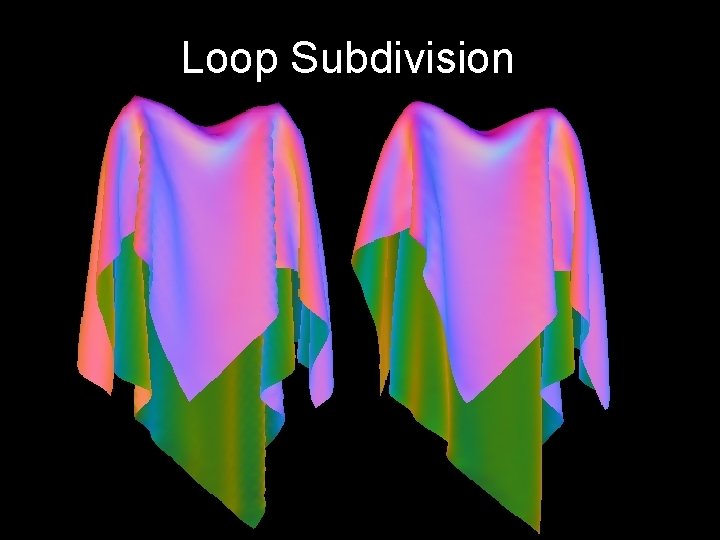
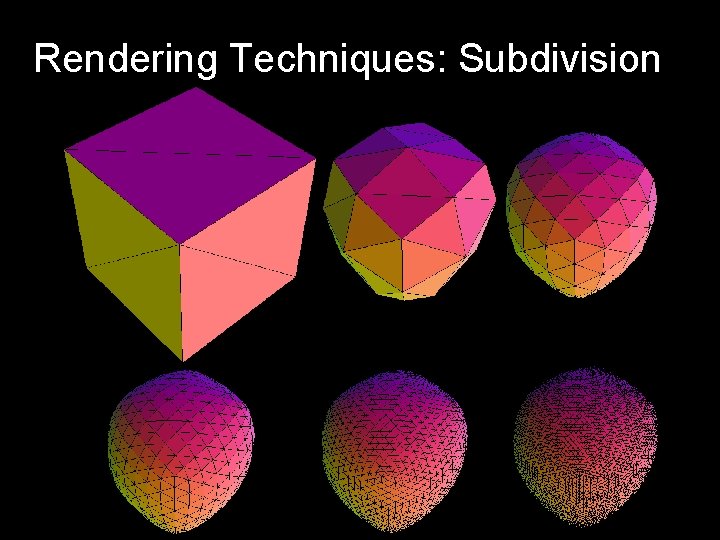
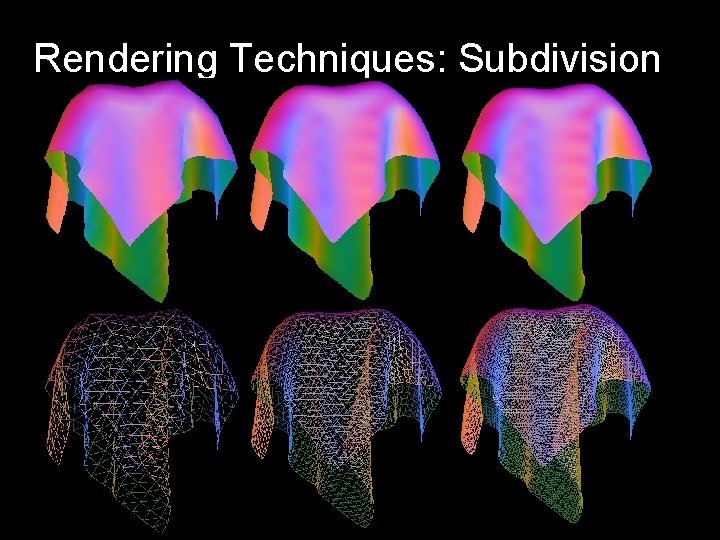
Loop Subdivision
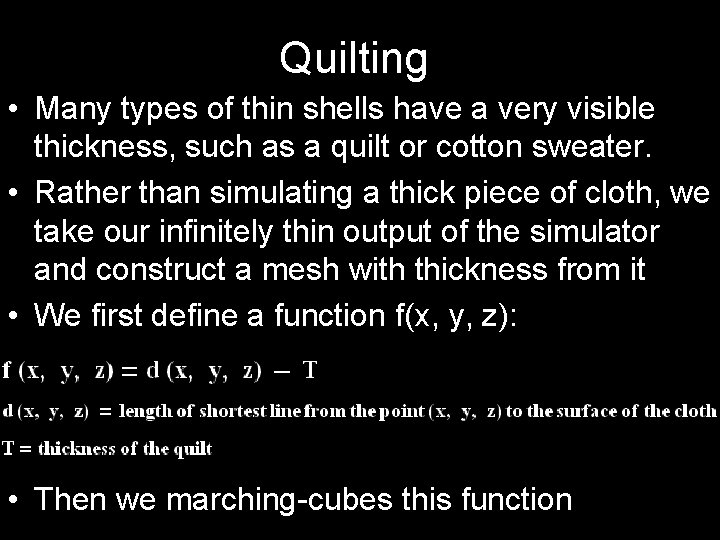
Quilting • Many types of thin shells have a very visible thickness, such as a quilt or cotton sweater. • Rather than simulating a thick piece of cloth, we take our infinitely thin output of the simulator and construct a mesh with thickness from it • We first define a function f(x, y, z): • Then we marching-cubes this function
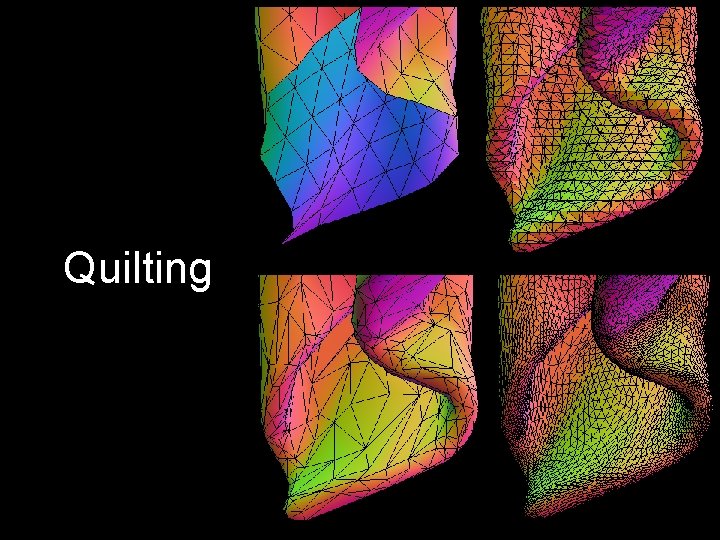
Quilting
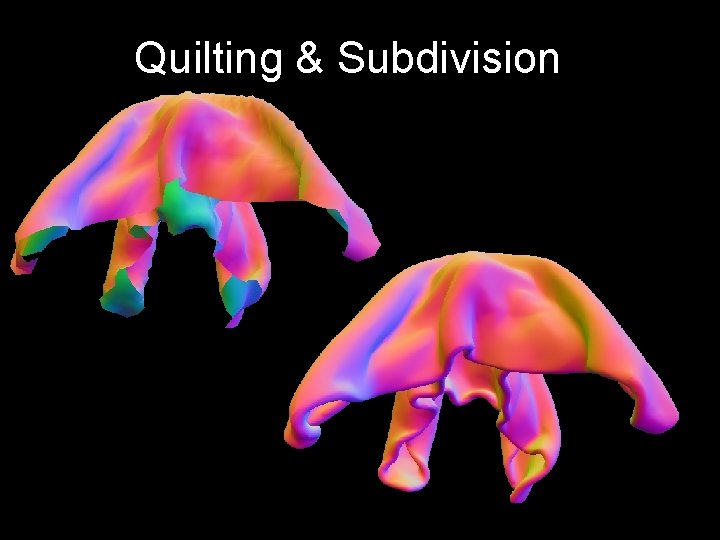
Quilting & Subdivision
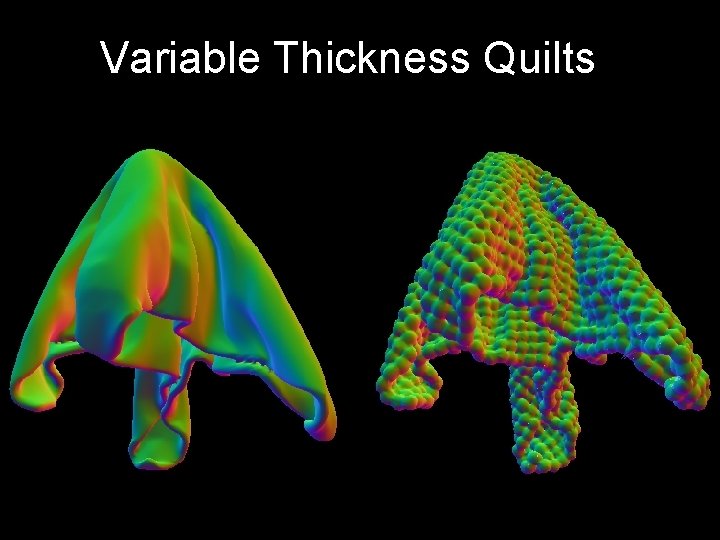
Variable Thickness Quilts

Videos…

Simple Hang

Cloth-Object Collision

Cloth-Cloth Collision Single Hold

Cloth-Cloth Collision Double Hold

Cape
- Slides: 36