
Stable Angina management according to NICE guidelines Primary
Stable Angina management according to NICE guidelines Primary Care Cardiac Service
Definition of Angina British Heart Foundation (https: //www. bhf. org. uk) • A pain or discomfort most commonly felt in chest, which may also be felt in the arms, neck, stomach or jaw. • Angina occurs when coronary arteries become narrowed and not enough oxygen rich blood can reach the heart muscle, particular when its demands are high, such as during exercise. Slide 2
Types of Angina • stable angina – Chronic medical condition where angina attacks are brought on by an obvious trigger (such as exercise) and improve with medication and rest. • unstable angina – where angina attacks are more unpredictable, occurring with no obvious trigger and continuing despite resting. Slide 3
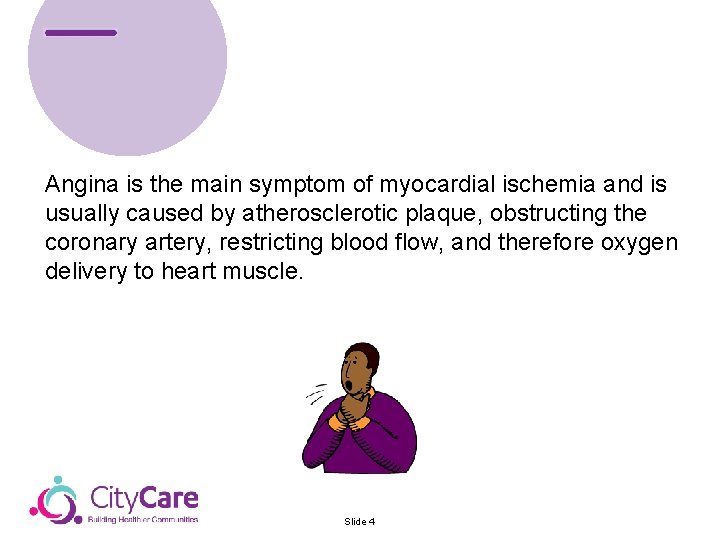
Angina is the main symptom of myocardial ischemia and is usually caused by atherosclerotic plaque, obstructing the • Provide advice & information about infections coronary artery, restricting blood flow, andissues therefore oxygen & infection prevention & control delivery to heart muscle. • Write & update infection prevention & control policies that are available on the POD • Provide training & education • Conduct audit Slide 4

Angina classification Canadian cardiovascular society angina classification • Class 1 Ordinary activity such as walking or climbing stairs does not precipitate angina • Class 11 Angina precipitated by emotion, cold weather or meals and by walking upstairs • Class 111 Marked limitation of ordinary physical activity • Class 1 V Inability to carry out any physical activity without discomfort-angina symptoms, may present at rest • (Campeau L. Grading of angina pectoris. Circulation 1976; 54(3): 522 -23 in sign guidelines) Slide 5
Statistics Team Number of cases: 71, 330 men and 48, 405 women in 2014. • Provide advice & information about infections & infection prevention & control issues Health survey for England in 2006 reported that 8% of men • Write & update infection prevention & control and 3% of women aged 55 -64 years had angina. Figures for that 14% aremen available the POD agespolicies 65 -74 were and 8%on women. • Provide training & education • • British Heart Foundation (https: //www. bhf. org. uk Conduct audit The population of the UK is 64. 1 million. • Guidance. nice. org. uk/cg 126 Slide 6
Effects • A diagnosis of Angina can have a significant impact on patients level of functioning - in one survey angina scored their general health as twice as poor as those who had a stroke. ( lyons, RA Lo SV, Littlepage BN Comparative health status with 11 common illnesses in Wales J Epideminol Community health 1994; 48(4): 388 -90 in sign guideline) • A Tayside study showed that patients with angina had high levels of anxiety and depression. (Smith K, Ross D, Connolly E investigating six month health outcomes of patients with angina discharged from chest pain service, European Journal cardiovascular nursing 2002; 1(4): 25364 in sign guideline) Slide 7
Living with Angina • In another survey patients had a low level of factual knowledge about their illness and poor medication adherence. (Mac Dermott AF Living with angina pectoris-a phenomenological study. European Journal of cardiovascular nursing 2002: 1(4): 265 -72 in sign guideline) Slide 8
Guidelines available Control Team Provide advice information infections • • Nice chest pain of recent&onset march 2010 about clinical guideline 95 guidance. nice. org. uk/cg 95 & infection prevention & control issues • • Management of stable angina December 2012 126 Write & update infection prevention guidance. nice. org. uk/cg 126 • • & control policies that are available on the POD Nice MI secondary prevention 2013 172 guidance. nice. org. uk/cg 172 • Provide training & education Management of stable angina 96 at www. sign. AC. UK • www. sign. AC. UK Conduct audit Slide 9
Symptoms that may lead to non angina diagnosis • Continuous or prolonged pain • Unrelated to activity • Brought on by breathing • Associated symptoms - dizziness, palpitations, tingling, difficulty swallowing Consider musculoskeletal or gastrointestinal Slide 10
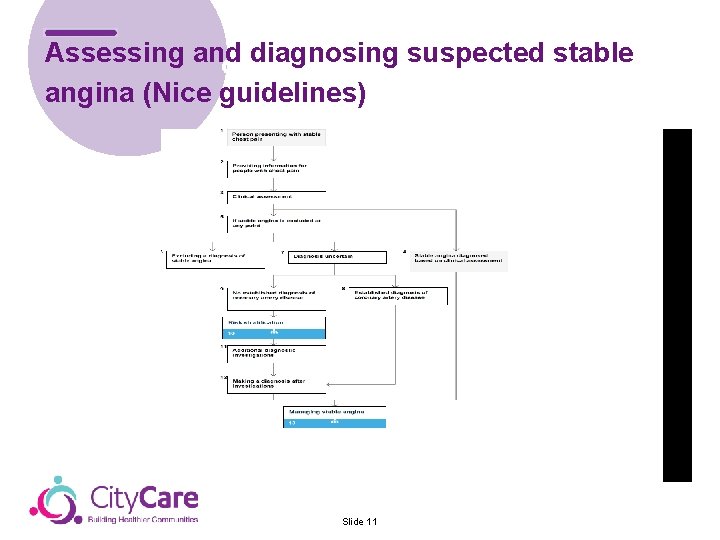
Assessing and suspected stable & diagnosing Control Team angina (Nice guidelines) • Provide advice & information about infections & infection prevention & control issues • Write & update infection prevention & control policies that are available on the POD • Provide training & education • Conduct audit Slide 11
Angina pathway GP diagnosis. Then to either: - 1. Accident and Emergency 2. Rapid access chest pain clinic Nottingham City Hospital for further investigations 3. If likelihood greater than 90% diagnostic investigation not required - manage as angina Slide 12
Diagnosis Team • Clinical assessment alone. • Provide advice & information about infections & infection prevention & control issues • Use table of people estimated to have coronary artery • disease Write according & updatetoinfection prevention & control typicality of symptoms, age, sex and policies risk factors. that are available on the POD • Provide trainingnumber & education Remember a significant of patients with chest pain may not have angina and assessment should try and identify alternative • Conduct audit diagnosis at an early stage • Clinical assessment plus diagnosis testing. Slide 13
Assessing chest pain & Control Team • Location. • Provide advice & information about infections & infection prevention & control issues • Severity. • Write & update infection prevention & control • Duration. policies that are available on the POD • • Frequency. Provide training & education • • Factors that provoke Conduct audit or relieve. • Radiation. Slide 14
Risk factors • Smoking • Hypertension • Diabetes • Family history Male <55, Female <65 first degree relative • Raised cholesterol • Overweight • Poor diet • Raised waist measurement • Lack of exercise Slide 15
More factors to consider • Anaemia • Glucose levels • Thyroid function tests • Depression and social isolation Slide 16
Making a diagnosis & Control Team • Angina pain is constricting discomfort in chest, neck, or arms. • shoulders, Providejaw advice & information about infections & infection & control issues • Precipitated by prevention physical exertion. Write &with update infection prevention & control • • Relieved GTN or rest policies that are available on the POD • 3 factors = typical angina • Provide training & education • 2 Factors= atypical angina • Conduct audit • 1 factor non angina chest pain Slide 17
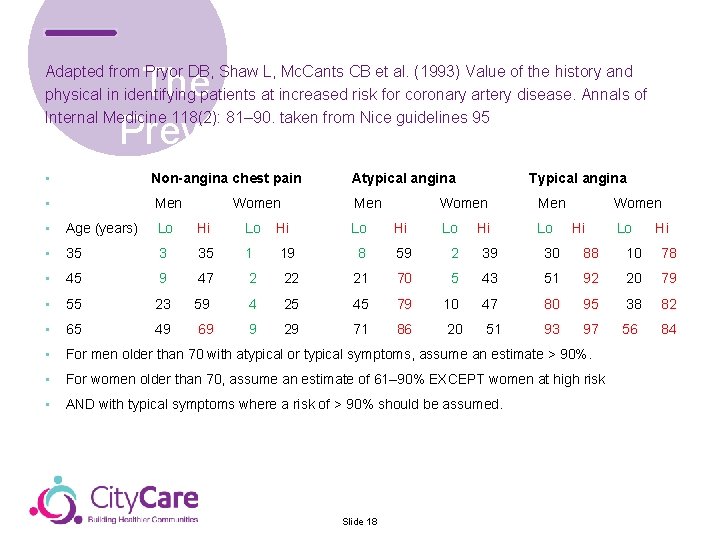
The Role of the Infection Prevention & Control Team Adapted from Pryor DB, Shaw L, Mc. Cants CB et al. (1993) Value of the history and physical in identifying patients at increased risk for coronary artery disease. Annals of Internal Medicine 118(2): 81– 90. taken from Nice guidelines 95 • Non-angina chest pain Atypical angina • Men • • Women Typical angina Men Women • Age. Provide advice & information about infections (years) Lo Hi Lo Hi issues 35 & infection 3 35 prevention 1 19 8& control 59 2 39 30 88 10 78 9 47 2 22 21 70 5 43 51 92 20 79 • 45 Write & update infection prevention & control 55 23 59 4 25 45 79 10 47 80 95 38 82 are available the 51 POD 93 97 56 84 65 policies 49 that 69 9 29 71 86 on 20 men older than 70 with atypical or typical symptoms, assume an estimate > 90%. • For Provide training & education For women older than 70, assume an estimate of 61– 90% EXCEPT women at high risk with typical symptoms where a risk of > 90% should be assumed. • ANDConduct audit Slide 18
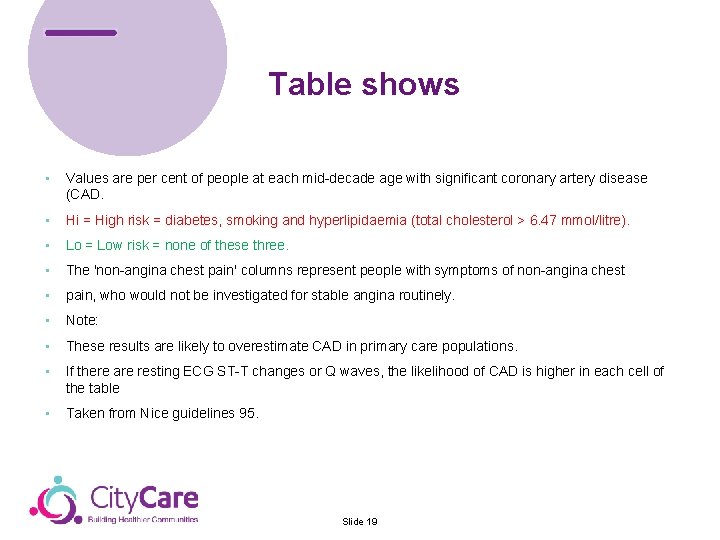
Table shows & Control Team • • • Values are per cent of people at each mid-decade age with significant coronary artery disease (CAD. • Hi =Provide advice about> 6. 47 infections High risk = diabetes, smoking & and information hyperlipidaemia (total cholesterol mmol/litre). Lo =& Low risk = none of these three. infection prevention & control issues The 'non-angina chest pain' columns represent people with symptoms of non-angina chest • pain, Write & control who would& notupdate be investigatedinfection for stable anginaprevention routinely. Note: policies that are available on the POD These results are likely to overestimate CAD in primary care populations. • If there Provide training &oreducation are resting ECG ST-T changes Q waves, the likelihood of CAD is higher in each cell of the table • Taken Conduct audit from Nice guidelines 95. Slide 19
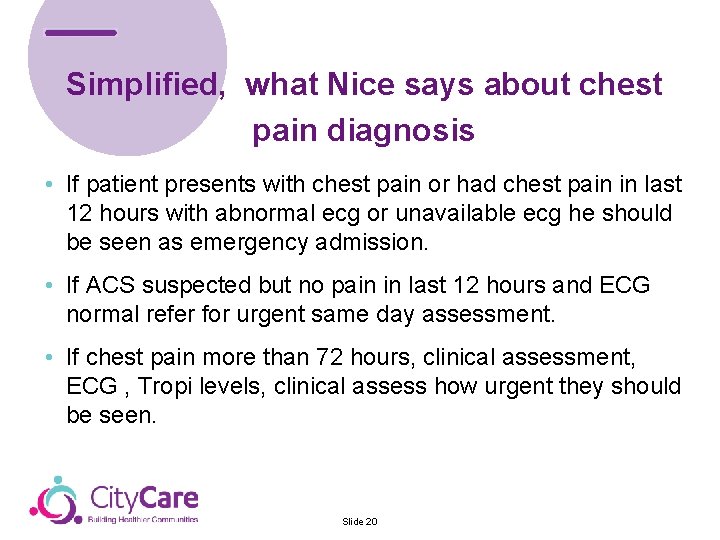
Simplified, what Nice says about chest & Control Team pain diagnosis • If patient presents with chest pain or had chest pain in last hours with abnormal ecg or unavailable he should • 12 Provide advice & information about ecg infections be&seen as emergency admission. infection prevention & control issues • • If ACS butinfection no pain inprevention last 12 hours ECG Writesuspected & update & and control normal referthat for urgent same dayon assessment. policies are available the POD • • If chest paintraining more than hours, clinical assessment, Provide & 72 education ECG , Tropi levels, clinical assess how urgent they should • be. Conduct audit seen. Slide 20
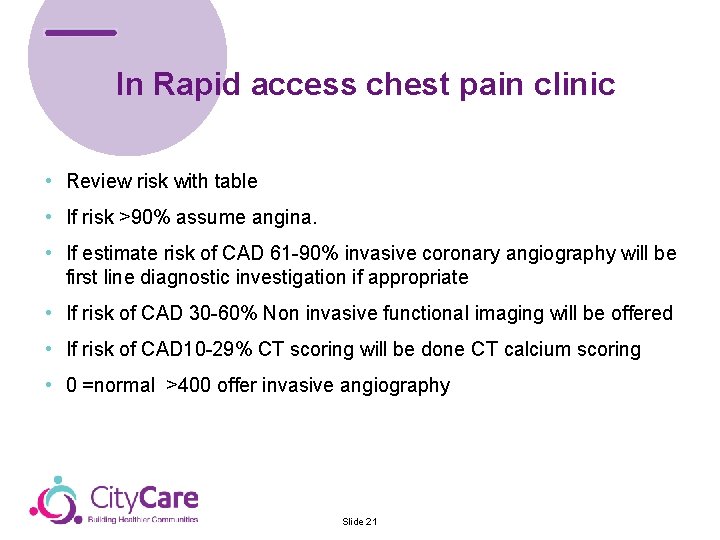
In Rapid access chest pain clinic & Control Team • Review risk with table Provide advice & information • • If risk >90% assume angina. • • about infections & infection prevention & control issues If estimate risk of CAD 61 -90% invasive coronary angiography will be line diagnostic investigation if appropriate • first. Write & update infection prevention & control If risk of CAD 30 -60% Nonavailable invasive functional policies that are on theimaging PODwill be offered of CAD 10 -29% CT scoring will be done CT calcium scoring • If risk Provide training & education 0 =normal >400 offer invasive angiography • Conduct audit Slide 21
Investigations • CT scan • Functional imaging • Stress Echo • MRI scan • Invasive angiography Slide 22
Management Aims & Control Team • To stop or minimise symptoms. • Provide advice & information about infections • Improve quality of life and long term morbidity and & infection prevention & control issues mortality. Write & update infection prevention & control • • Management options include lifestyle advice, drug policiesand that are available using on the POD treatment revascularisation percutaneous or techniques. • surgical Provide training & education • Conduct audit Slide 23
When angina diagnosed Team Management includes • Provide advice & information about infections & infection prevention & control issues • drug treatment or revascularisation using percutaneous • or Write & update infection prevention & control surgical techniques or combination policies that are available on the POD • Give the patient the information to safely manage their • condition Provide training & education • Conduct audit • lifestyle advice Slide 24
Analysis of comparative efficacy of treatments for people with stable angina • Analysis is difficult because of recent advances in revascularisation strategies over several • medication Provide and advice & information about infections decades & infection prevention & control issues • • Trials of drug treatments versusprevention coronary artery bypass Write & update infection & control surgery in patients were carried out than 25 years policies that are available on more the POD ago and showed a survival advantage with surgery in • patients Provide & education withtraining severe coronary artery bypass surgery, but was pre audit statins and other secondary prevention • this Conduct treatments and these treatments have had a significant effect on morbidity and mortality. Slide 25
Nice advises key priorities are to: & Control Team • Explore and address issues according to personal needs. Provide advice & information • • Self Management skills such as pacing theirabout activitiesinfections and goal setting, explore impact of stress, advice about physical & infection prevention & control issuesexertion • Offer optimal drug treatment consisting of 1 -2 antianginal drugs as • necessary Write & update infection prevention & control plus drugs for secondary prevention • policies that are available on the POD Revascularisation (CABG) or percutaneous coronary intervention for people with stable whose symptoms are not • (PCI) Provide training & angina education satisfactorily controlled with optimal medication • Conduct audit Slide 26
Primary Care Cardiac Service as part of the chest pain pathway Cardiac rehabilitation o ACS o Following Revascularisation o Stable heart failure o STABLE ANGINA o Post valve surgery, heart transplant, LVAD’s o TIA Slide 27
Who • Newly diagnosed patients can be referred once diagnosis confirmed • Any patients with existing stable angina can also be referred if they have had a recent change in their symptoms Slide 28
Why • There is overwhelming evidence that comprehensive Cardiac Rehabilitation reduces mortality. • There is emerging evidence that it is also associated with a reduction in morbidity and a reduction in unplanned readmissions. • It improves functional capacity and perceived quality of life and supports early return to work. • It aids the development of self management skills • Secondary prevention forms an integral part of the service Slide 29
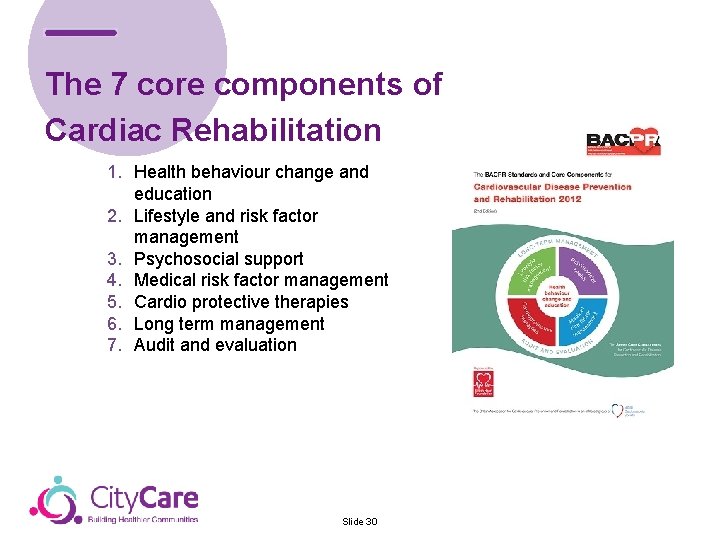
The 7 core components of Cardiac Rehabilitation 1. Health behaviour change and education 2. Lifestyle and risk factor management 3. Psychosocial support 4. Medical risk factor management 5. Cardio protective therapies 6. Long term management 7. Audit and evaluation Slide 30
We offer information and support for & Control Team people with stable angina • Explain stable angina and include factors that can provoke angina as exertion, emotional stress, exposureabout to cold, infections eating a heavy • such Provide advice & information meal. Discuss long term management. • • & infection prevention & control issues Advise to seek help if there is a sudden worsening of condition. • Discuss Writerisks & update infection prevention & control and benefits of treatment. policies that are available on the POD Assess lifestyle and offer interventions. • Provide training & education Explore individual needs. • Conduct audit Slide 31
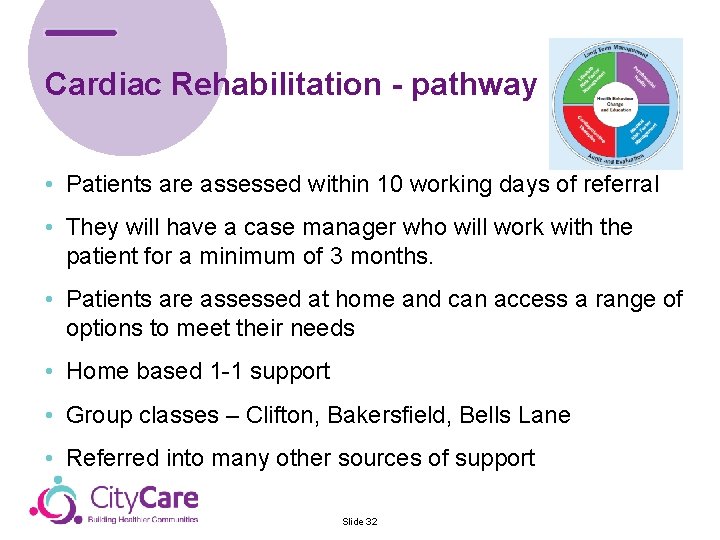
Cardiac Rehabilitation - pathway • Patients are assessed within 10 working days of referral • They will have a case manager who will work with the patient for a minimum of 3 months. • Patients are assessed at home and can access a range of options to meet their needs • Home based 1 -1 support • Group classes – Clifton, Bakersfield, Bells Lane • Referred into many other sources of support Slide 32
Expected outcomes • Maximise uptake of cardiac rehab by providing a personalised programme delivered at a choice of venues. • Improve physical health and quality of life. • Promote and equip patients to self-manage by encouraging goal setting and building on service users’ knowledge base about their condition. • Reduce hospital admissions • Reduce inequalities and improve access for hard to reach groups • Improve the experience and choice of patients by staff having a close working relationship with local GP’s and a depth of specialist knowledge. Slide 33
How to refer? • Via Nottingham City Health and Care Point • 0300 3333 and select option 5 • Online via https: //accesstoservices. citycare. org. uk Referrals cannot be made directly to the service although we are happy to speak to you about the suitability of any referral you wish to make Slide 34
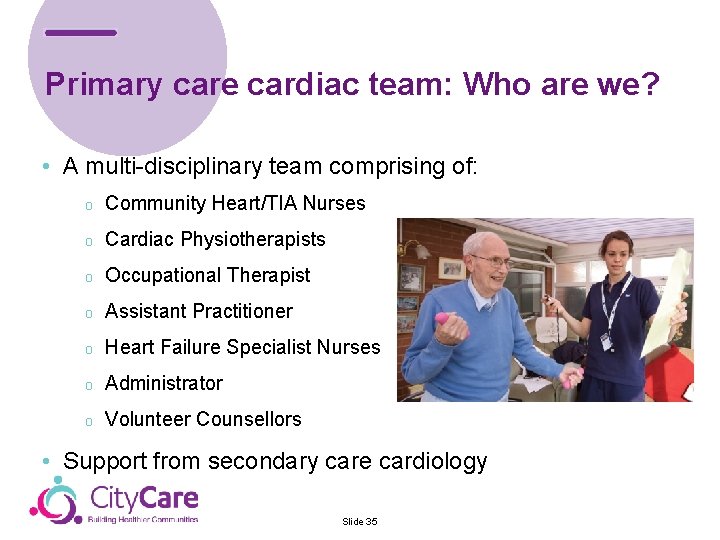
Primary care cardiac team: Who are we? • A multi-disciplinary team comprising of: o Community Heart/TIA Nurses o Cardiac Physiotherapists o Occupational Therapist o Assistant Practitioner o Heart Failure Specialist Nurses o Administrator o Volunteer Counsellors • Support from secondary care cardiology Slide 35

How to contact us • The service is based at New Brook House Room 29 385 Alfreton Road Radford Nottingham NG 7 5 LR • Tel: 0115 88 34733 Slide 36
Drugs Slide 37
Drugs for treating Angina as Nice & Control Team guidelines • Beta-blocker or calcium channel blocker first line decision based on coabout morbidities, • treatment, Providewith advice & information infections contraindications and persons & infection prevention & preference control issues • • If cannot tolerate either of theseprevention offer other option Write & update infection & control policies that are available on the PODswitching or • If symptoms not controlled on either consider bothtraining & education • offering Provide • Conduct audit Slide 38
Drugs for treating Angina & Control Team Nice says If neither beta-blocker or calcium channel blocker not monotherapy of about either infections • tolerated Provide consider advice & information & infection prevention & control issues • Long acting nitrate Write & update infection prevention & control • • Ivabradine policies that are available on the POD • Nicorandil • Provide training & education • Ranolazine • Conduct audit • Decision based on co morbidities, contraindications and persons preference and cost Slide 39
Nice recommends & Control Team • GTN spray • Consider Aspirin 75 mg taking into account risk of bleeding • • • Provide advice & information about infections Consider ACE & infection prevention & control issues Statin treatment • Offer Write & update infection prevention & control Offer treatment hypertension policies thatfor are available on the POD • Offer Provide & 1 -2 education optimaltraining treatment antianginal drugs • Conduct audit Slide 40
Discuss & Control Team • The aim of drugs how they work to offer secondary prevent episodes of angina • prevention Provide and advice & information about infections & infection prevention & control issues • Discuss side effects Write review & update infection prevention & control • • Arrange 2 -4 weeks later and titrate according to policiestothat are available the POD symptoms maximum tolerableon dose • Provide training & education • Conduct audit Slide 41
Nice says consider adding third anti Team angina only if…. • Symptoms are not satisfactorily controlled. • Provide advice & information about infections & infection prevention & control issuesor • Person awaiting revascularisation • revascularisation Write & update infection & control is not prevention considered policies thator areacceptable available on the POD appropriate • Provide training & education • Conduct audit Slide 42
Nice advises people with symptoms not & Control Team satisfactorily controlled with optimal medication. • Provide advice & information about infections & infection prevention & control issues • Will be considered for CABG or PCI. Write & update infection & control • • Angiography will be offeredprevention to guide strategy for policies that are available on the POD treatment. • Provide training & education • Conduct audit Slide 43
References • Nice chest pain of recent onset march 2010 clinical guideline 95 guidance. nice. org. uk/cg 95 • Management of stable angina December 2012 126 guidance. nice. org. uk/cg 126 • Nice MI secondary prevention 2013 172 guidance. nice. org. uk/cg 172 • Management of stable angina 96 at www. sign. AC. UK • British Heart Foundation (https: //www. bhf. org. uk • British National Formulary bnf. org • BACPR Cardiovascular diseases prevention and rehab 2012 Slide 44
Thank you for listening Slide 45

Nottingham City. Care Partnership CIC 1 Standard Court Park Row Nottingham NG 1 6 GN e: citycare@nottinghamcitycare. nhs. uk t : 0115 883 9600 www. nottinghamcitycare. nhs. uk
- Slides: 46