
Stability Problems in Op Amp Circuits Analysis Techniques
Stability Problems in Op Amp Circuits Analysis Techniques and Solutions Written by Tim Green (green_tim@ti. com) Senior Applications Engineer Presented by Marek Lis (lis_marek@ti. com) Senior Applications Engineer 1
ØLoop Stability: ØBasics ØOp Amp Output Impedance ØKey Tricks and Rules-of-Thumb ØStabilizing Capacitive Loads 2
3
4
5
6
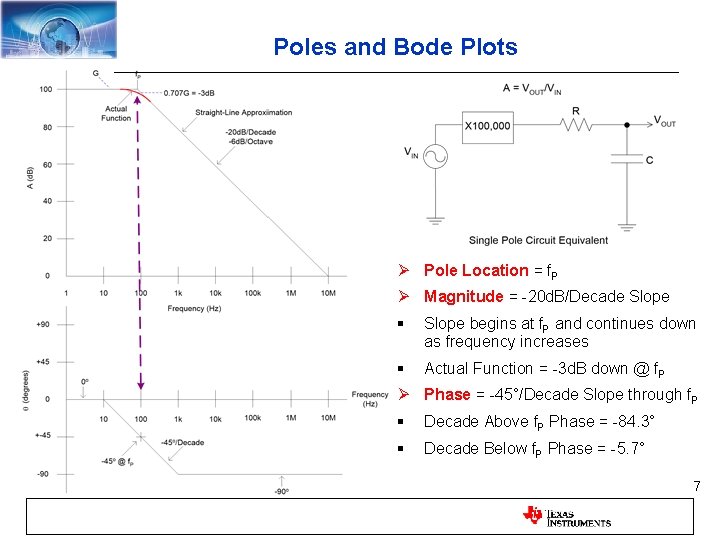
Poles and Bode Plots Ø Pole Location = f. P Ø Magnitude = -20 d. B/Decade Slope § Slope begins at f. P and continues down as frequency increases § Actual Function = -3 d. B down @ f. P Ø Phase = -45°/Decade Slope through f. P § Decade Above f. P Phase = -84. 3° § Decade Below f. P Phase = -5. 7° 7
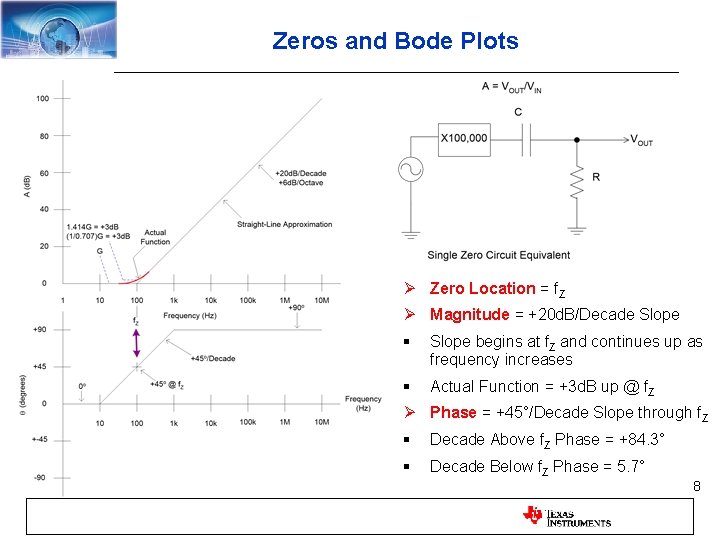
Zeros and Bode Plots Ø Zero Location = f. Z Ø Magnitude = +20 d. B/Decade Slope § Slope begins at f. Z and continues up as frequency increases § Actual Function = +3 d. B up @ f. Z Ø Phase = +45°/Decade Slope through f. Z § Decade Above f. Z Phase = +84. 3° § Decade Below f. Z Phase = 5. 7° 8
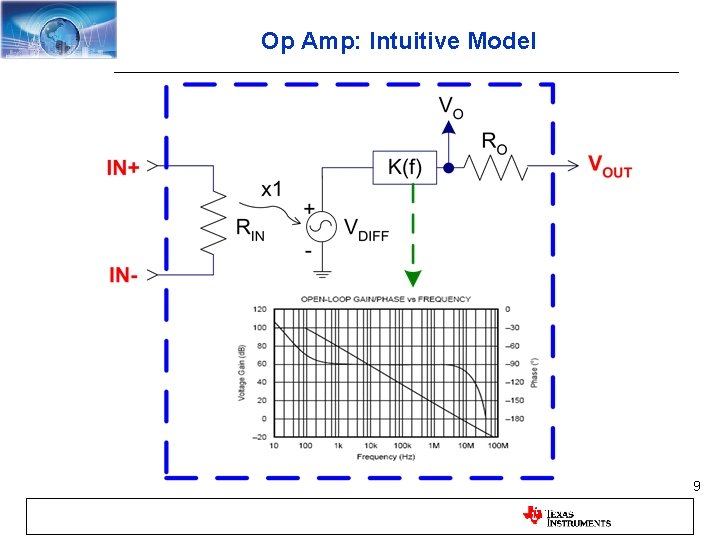
Op Amp: Intuitive Model 9
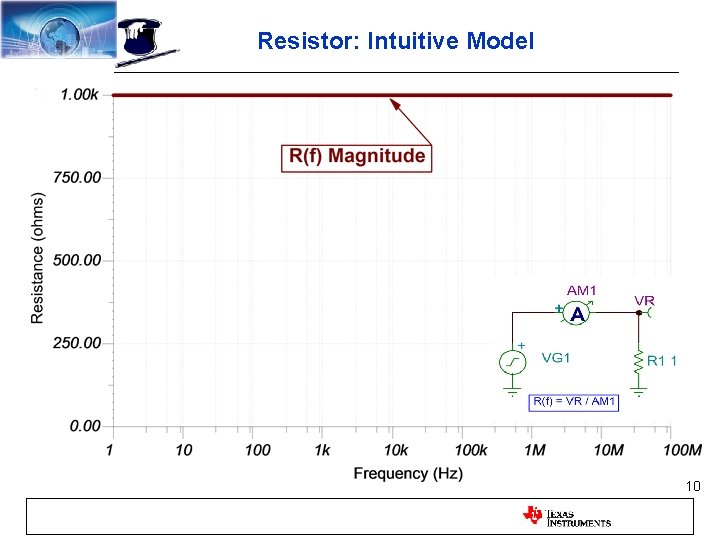
Resistor: Intuitive Model 10
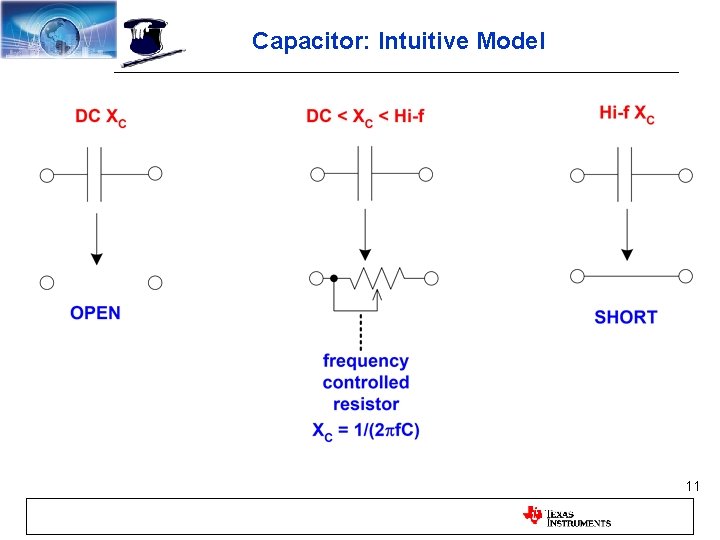
Capacitor: Intuitive Model 11
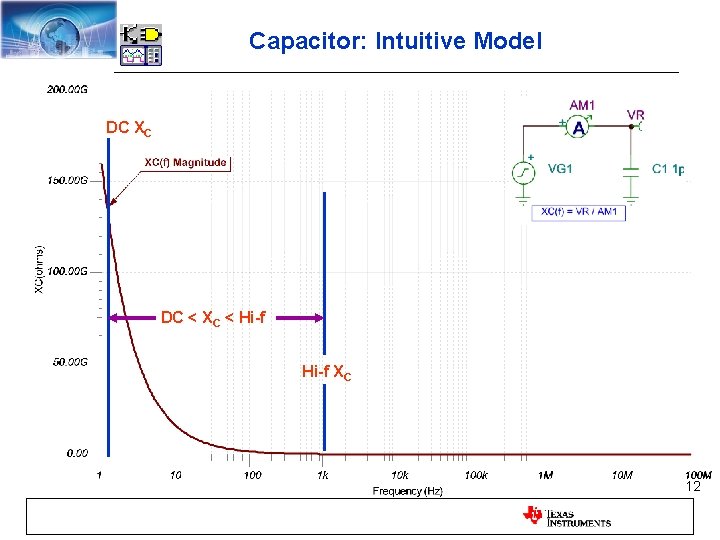
Capacitor: Intuitive Model DC XC DC < XC < Hi-f XC 12
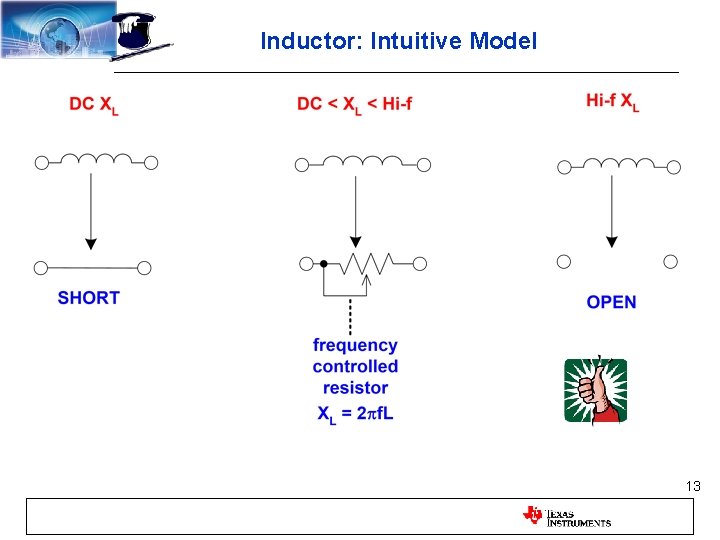
Inductor: Intuitive Model 13
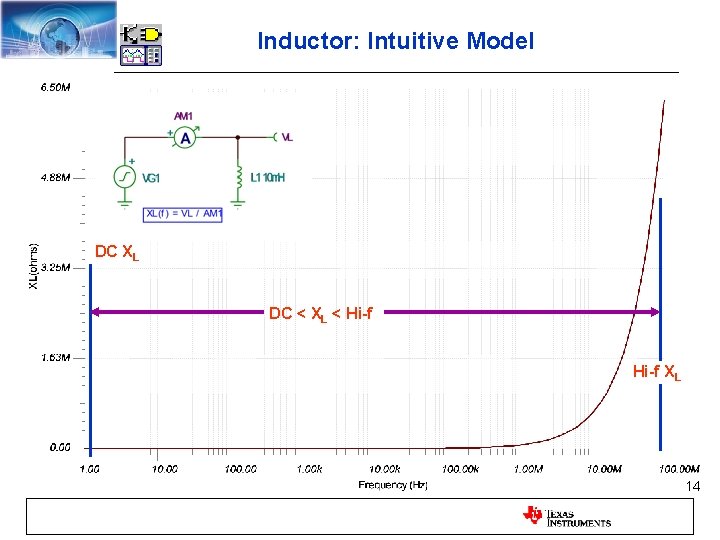
Inductor: Intuitive Model DC XL DC < XL < Hi-f XL 14
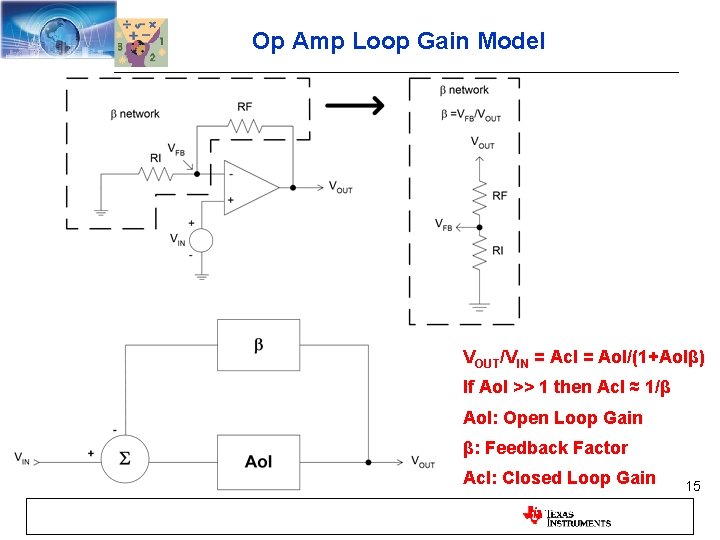
Op Amp Loop Gain Model VOUT/VIN = Acl = Aol/(1+Aolβ) If Aol >> 1 then Acl ≈ 1/β Aol: Open Loop Gain β: Feedback Factor Acl: Closed Loop Gain 15
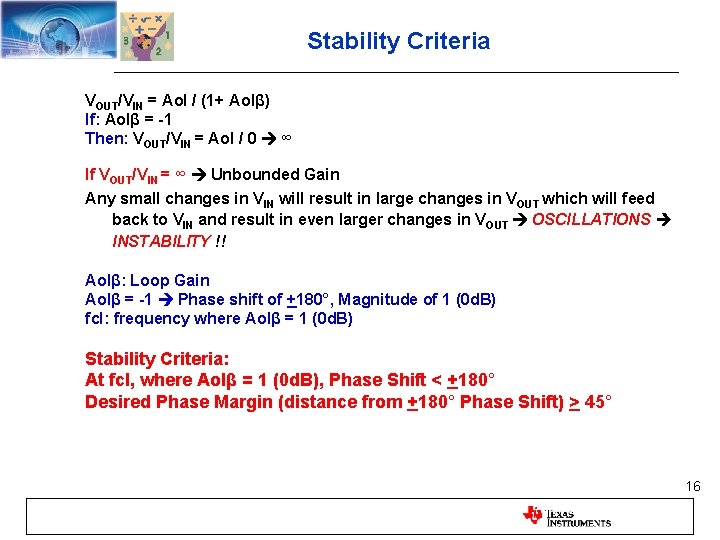
Stability Criteria VOUT/VIN = Aol / (1+ Aolβ) If: Aolβ = -1 Then: VOUT/VIN = Aol / 0 ∞ If VOUT/VIN = ∞ Unbounded Gain Any small changes in VIN will result in large changes in VOUT which will feed back to VIN and result in even larger changes in VOUT OSCILLATIONS INSTABILITY !! Aolβ: Loop Gain Aolβ = -1 Phase shift of +180°, Magnitude of 1 (0 d. B) fcl: frequency where Aolβ = 1 (0 d. B) Stability Criteria: At fcl, where Aolβ = 1 (0 d. B), Phase Shift < +180° Desired Phase Margin (distance from +180° Phase Shift) > 45° 16
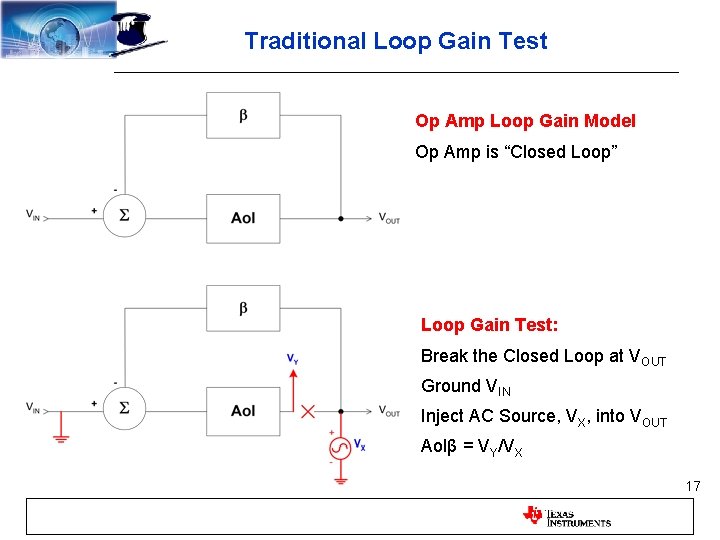
Traditional Loop Gain Test Op Amp Loop Gain Model Op Amp is “Closed Loop” Loop Gain Test: Break the Closed Loop at VOUT Ground VIN Inject AC Source, VX, into VOUT Aolβ = VY/VX 17
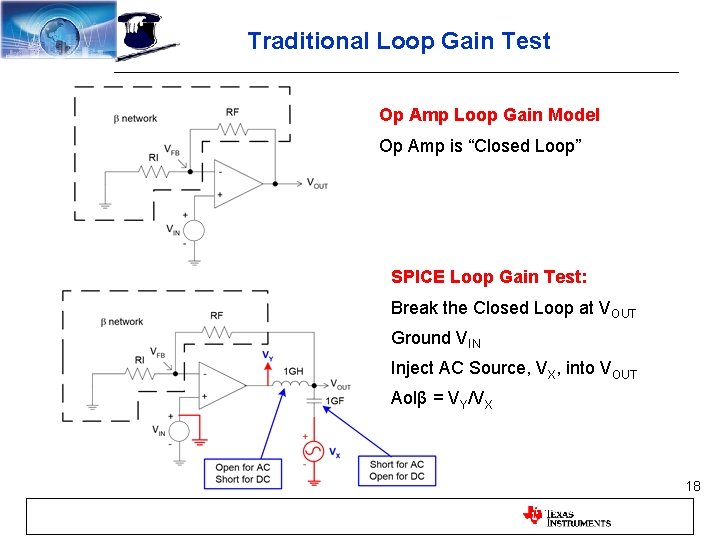
Traditional Loop Gain Test Op Amp Loop Gain Model Op Amp is “Closed Loop” SPICE Loop Gain Test: Break the Closed Loop at VOUT Ground VIN Inject AC Source, VX, into VOUT Aolβ = VY/VX 18
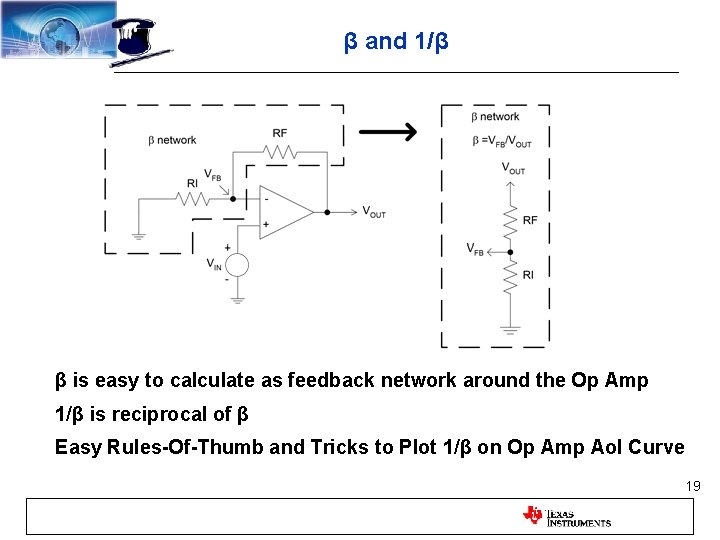
β and 1/β β is easy to calculate as feedback network around the Op Amp 1/β is reciprocal of β Easy Rules-Of-Thumb and Tricks to Plot 1/β on Op Amp Aol Curve 19
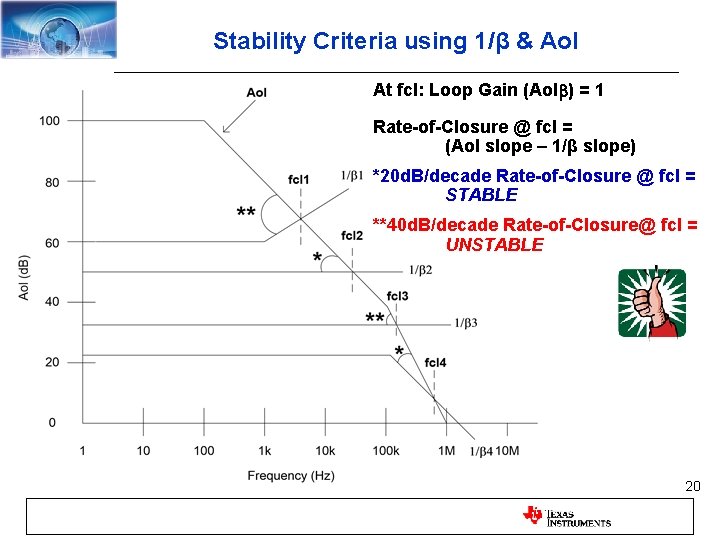
Stability Criteria using 1/β & Aol At fcl: Loop Gain (Aolb) = 1 Rate-of-Closure @ fcl = (Aol slope – 1/β slope) *20 d. B/decade Rate-of-Closure @ fcl = STABLE **40 d. B/decade Rate-of-Closure@ fcl = UNSTABLE 20
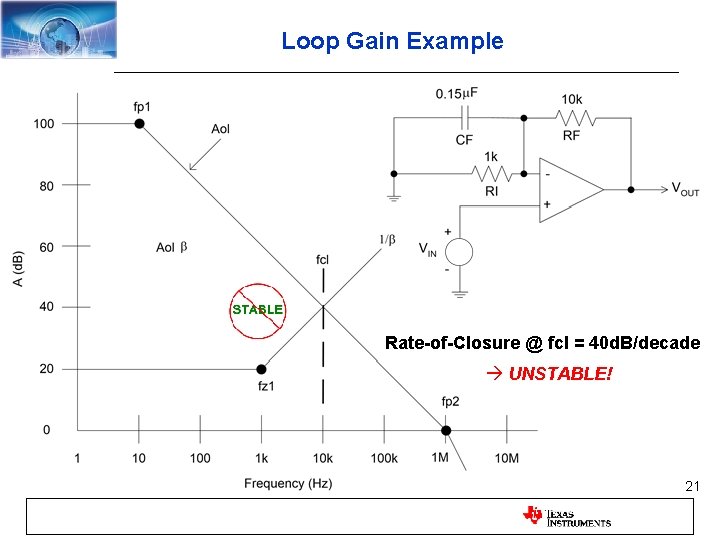
Loop Gain Example Rate-of-Closure @ fcl = 40 d. B/decade UNSTABLE! 21
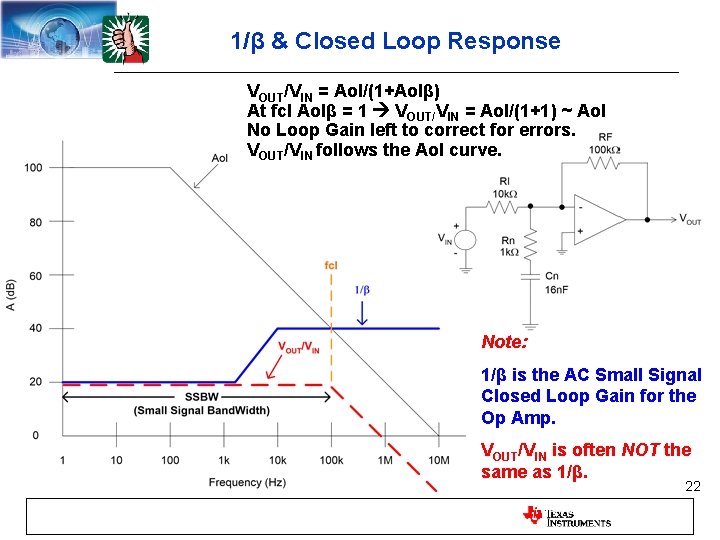
1/β & Closed Loop Response VOUT/VIN = Aol/(1+Aolβ) At fcl Aolβ = 1 VOUT/VIN = Aol/(1+1) ~ Aol No Loop Gain left to correct for errors. VOUT/VIN follows the Aol curve. Note: 1/β is the AC Small Signal Closed Loop Gain for the Op Amp. VOUT/VIN is often NOT the same as 1/β. 22
![SPICE Loop Gain Test Op Amp Aol Gain = d. B[VM(2) / VM(1)] Op](http://slidetodoc.com/presentation_image_h2/843b99d6810df4e18fbf5347e449151a/image-23.jpg "SPICE Loop Gain Test Op Amp Aol Gain = d. B[VM(2) / VM(1)] Op")
SPICE Loop Gain Test Op Amp Aol Gain = d. B[VM(2) / VM(1)] Op Amp Aol Phase = [VP(2)- VP(1)] Loop Gain = d. B[VM(2) / VM(3)] Loop Gain Phase = [VP(2) –VP(3)] 1/β = d. B[VM(3) / VM(1)] 1/β Phase = VP(3) – VP(1) 23
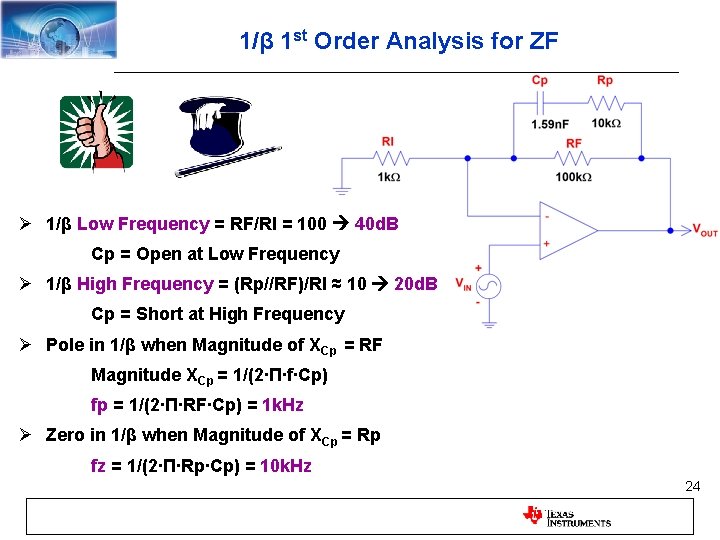
1/β 1 st Order Analysis for ZF Ø 1/β Low Frequency = RF/RI = 100 40 d. B Cp = Open at Low Frequency Ø 1/β High Frequency = (Rp//RF)/RI ≈ 10 20 d. B Cp = Short at High Frequency Ø Pole in 1/β when Magnitude of XCp = RF Magnitude XCp = 1/(2∙П∙f∙Cp) fp = 1/(2∙П∙RF∙Cp) = 1 k. Hz Ø Zero in 1/β when Magnitude of XCp = Rp fz = 1/(2∙П∙Rp∙Cp) = 10 k. Hz 24
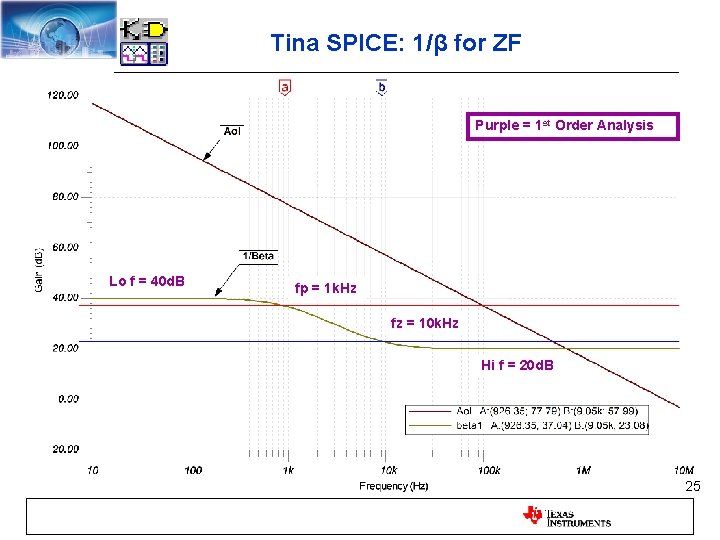
Tina SPICE: 1/β for ZF Purple = 1 st Order Analysis Lo f = 40 d. B fp = 1 k. Hz fz = 10 k. Hz Hi f = 20 d. B 25
ØLoop Stability: ØBasics ØOp Amp Output Impedance ØKey Tricks and Rules-of-Thumb ØStabilizing Capacitive Loads ØNon-Loop Stability 26
Op Amps and “Output Resistance” Definition of Terms: RO = Op Amp Open Loop Output Resistance ROUT = Op Amp Closed Loop Output Resistance 27
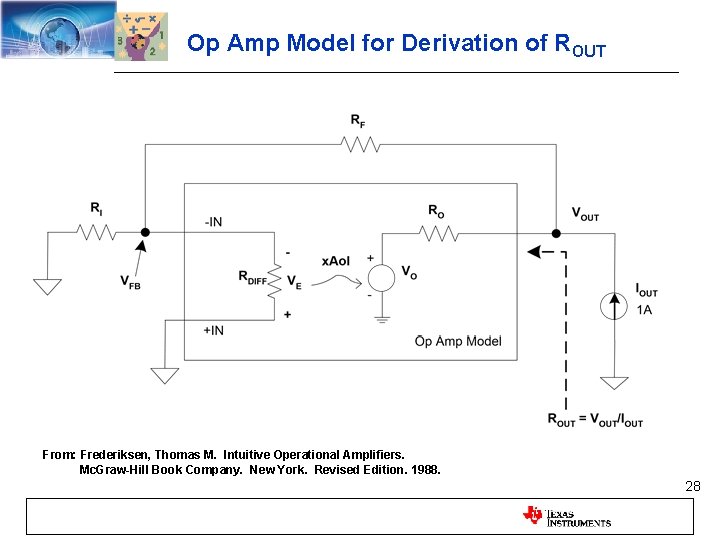
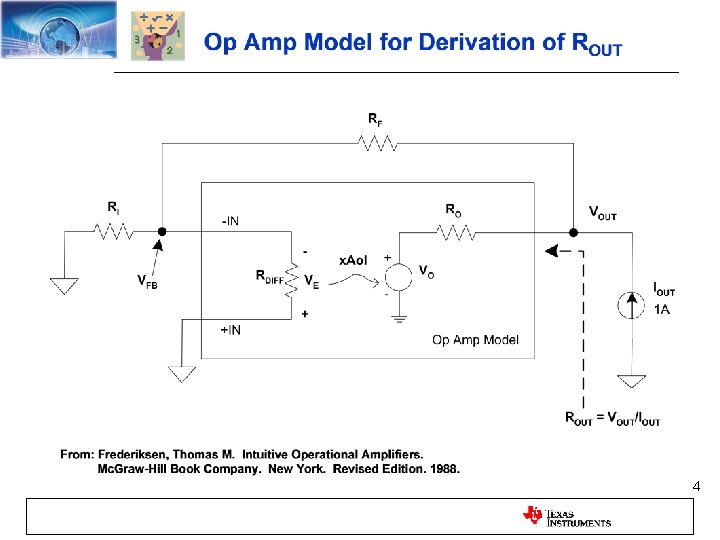
Op Amp Model for Derivation of ROUT From: Frederiksen, Thomas M. Intuitive Operational Amplifiers. Mc. Graw-Hill Book Company. New York. Revised Edition. 1988. 28
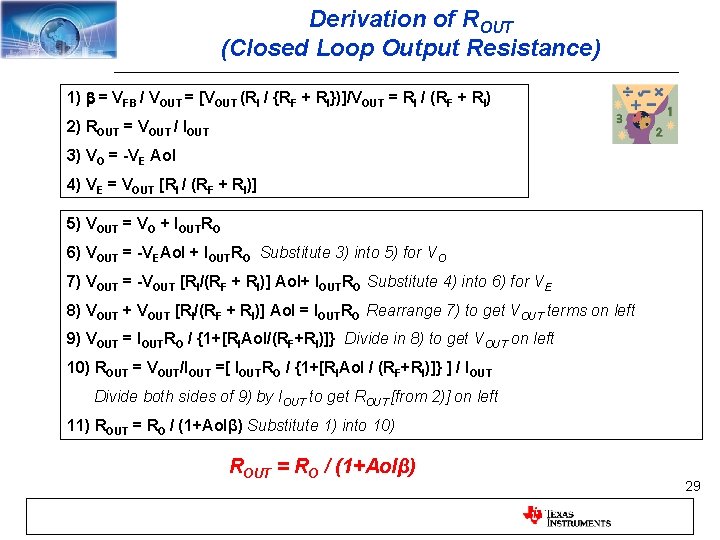
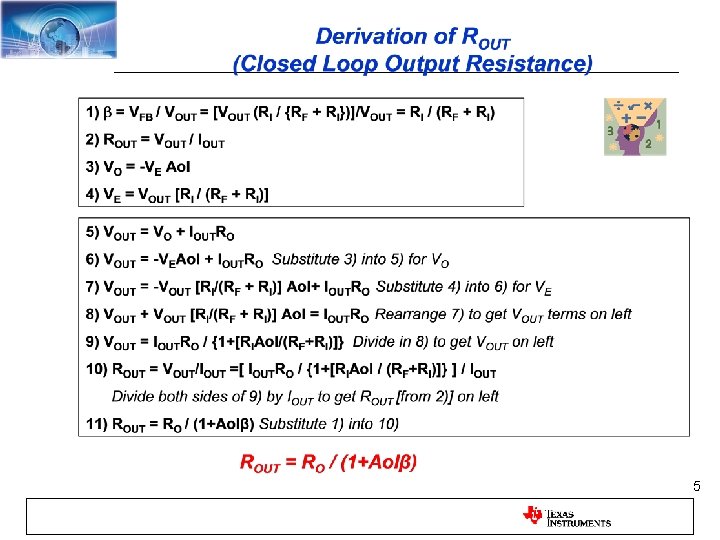
Derivation of ROUT (Closed Loop Output Resistance) 1) b = VFB / VOUT = [VOUT (RI / {RF + RI})]/VOUT = RI / (RF + RI) 2) ROUT = VOUT / IOUT 3) VO = -VE Aol 4) VE = VOUT [RI / (RF + RI)] 5) VOUT = VO + IOUTRO 6) VOUT = -VEAol + IOUTRO Substitute 3) into 5) for VO 7) VOUT = -VOUT [RI/(RF + RI)] Aol+ IOUTRO Substitute 4) into 6) for VE 8) VOUT + VOUT [RI/(RF + RI)] Aol = IOUTRO Rearrange 7) to get VOUT terms on left 9) VOUT = IOUTRO / {1+[RIAol/(RF+RI)]} Divide in 8) to get VOUT on left 10) ROUT = VOUT/IOUT =[ IOUTRO / {1+[RIAol / (RF+RI)]} ] / IOUT Divide both sides of 9) by IOUT to get ROUT [from 2)] on left 11) ROUT = RO / (1+Aolβ) Substitute 1) into 10) ROUT = RO / (1+Aolβ) 29

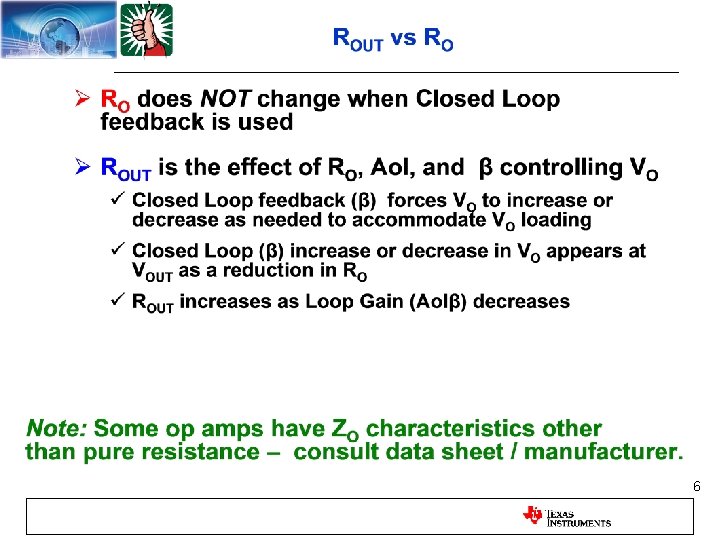
ROUT vs RO Ø RO does NOT change when Closed Loop feedback is used Ø ROUT is the effect of RO, Aol, and β controlling VO ü Closed Loop feedback (β) forces VO to increase or decrease as needed to accommodate VO loading ü Closed Loop (β) increase or decrease in VO appears at VOUT as a reduction in RO ü ROUT increases as Loop Gain (Aolβ) decreases Note: Some op amps have ZO characteristics other than pure resistance – consult data sheet / manufacturer. 30
ØLoop Stability: ØBasics ØOp Amp Output Impedance ØKey Tricks and Rules-of-Thumb ØStabilizing Capacitive Loads ØNon-Loop Stability 31
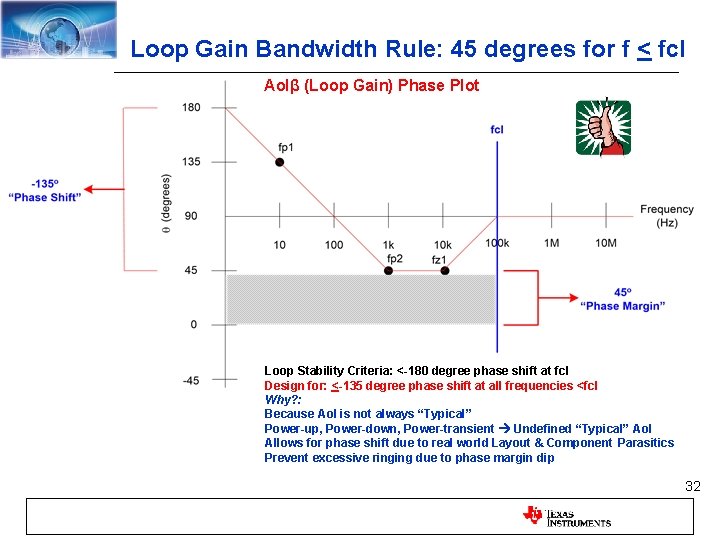
Loop Gain Bandwidth Rule: 45 degrees for f < fcl Aolβ (Loop Gain) Phase Plot Loop Stability Criteria: <-180 degree phase shift at fcl Design for: <-135 degree phase shift at all frequencies <fcl Why? : Because Aol is not always “Typical” Power-up, Power-down, Power-transient Undefined “Typical” Aol Allows for phase shift due to real world Layout & Component Parasitics Prevent excessive ringing due to phase margin dip 32
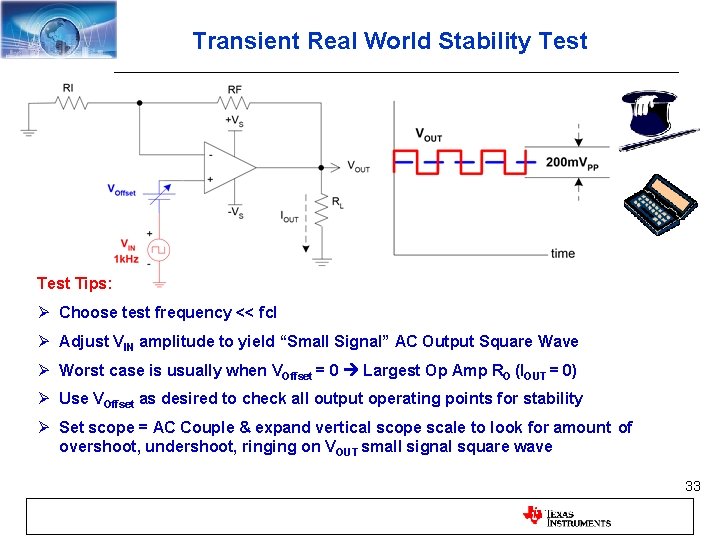
Transient Real World Stability Test Tips: Ø Choose test frequency << fcl Ø Adjust VIN amplitude to yield “Small Signal” AC Output Square Wave Ø Worst case is usually when VOffset = 0 Largest Op Amp RO (IOUT = 0) Ø Use VOffset as desired to check all output operating points for stability Ø Set scope = AC Couple & expand vertical scope scale to look for amount of overshoot, undershoot, ringing on VOUT small signal square wave 33
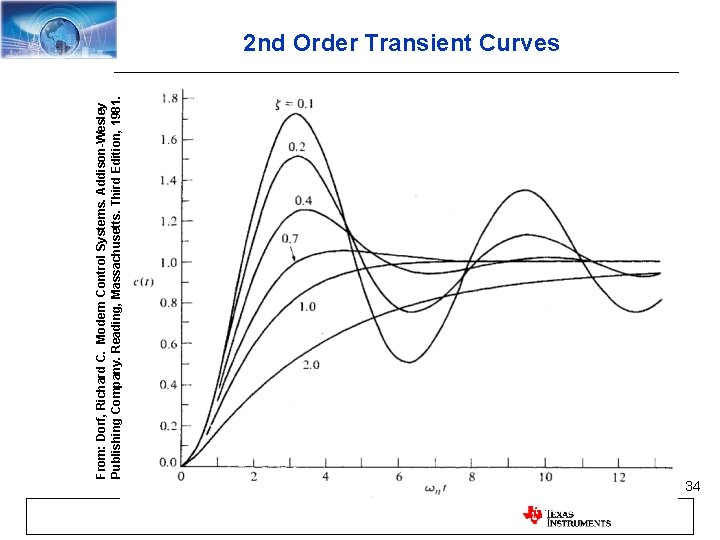
From: Dorf, Richard C. Modern Control Systems. Addison-Wesley Publishing Company. Reading, Massachusetts. Third Edition, 1981. 2 nd Order Transient Curves 34
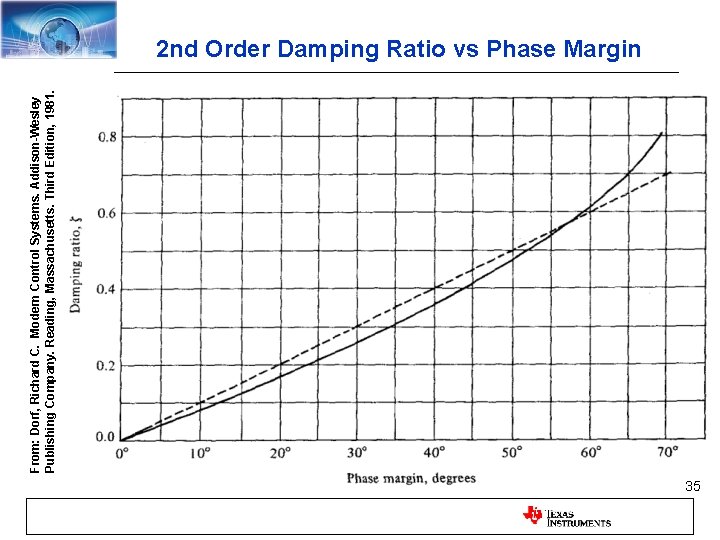
From: Dorf, Richard C. Modern Control Systems. Addison-Wesley Publishing Company. Reading, Massachusetts. Third Edition, 1981. 2 nd Order Damping Ratio vs Phase Margin 35
ØLoop Stability: ØBasics ØOp Amp Output Impedance ØKey Tricks and Rules-of-Thumb ØStabilizing Capacitive Loads ØNon-Loop Stability 36
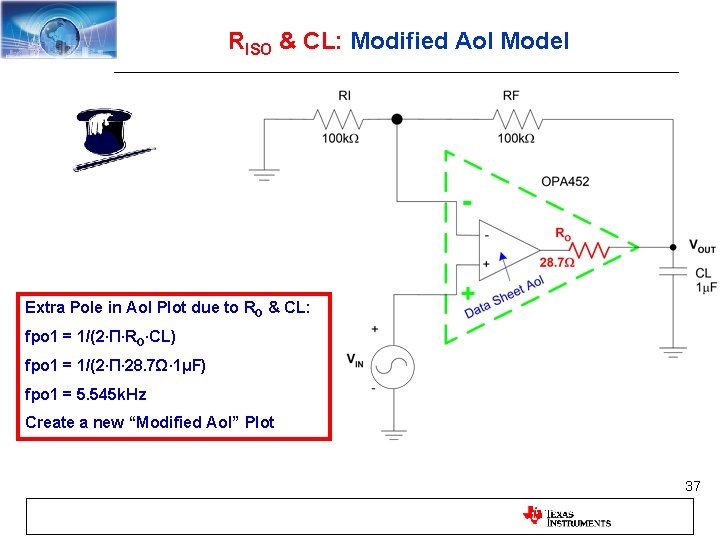
RISO & CL: Modified Aol Model Extra Pole in Aol Plot due to RO & CL: fpo 1 = 1/(2∙П∙RO∙CL) fpo 1 = 1/(2∙П∙ 28. 7Ω∙ 1μF) fpo 1 = 5. 545 k. Hz Create a new “Modified Aol” Plot 37
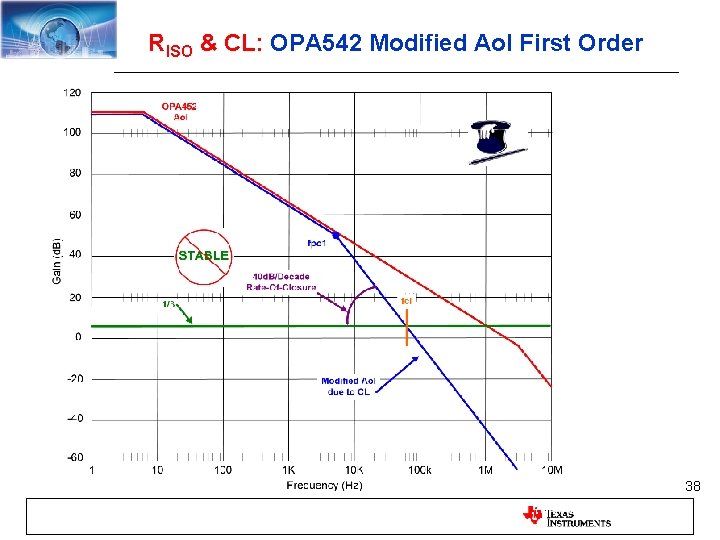
RISO & CL: OPA 542 Modified Aol First Order 38
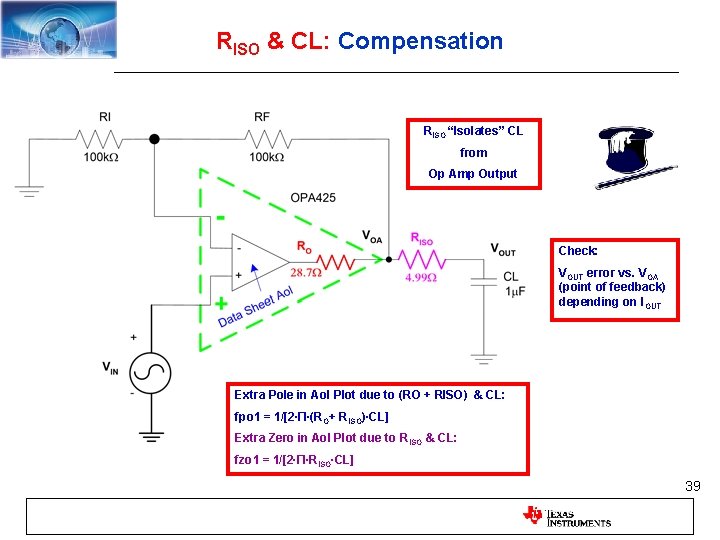
RISO & CL: Compensation RISO “Isolates” CL from Op Amp Output Check: VOUT error vs. VOA (point of feedback) depending on I OUT Extra Pole in Aol Plot due to (RO + RISO) & CL: fpo 1 = 1/[2∙П∙(RO+ RISO)∙CL] Extra Zero in Aol Plot due to R ISO & CL: fzo 1 = 1/[2∙П∙RISO∙CL] 39
![RISO & CL: Modified Aol fpo 1 = 1/[2∙П∙(RO+ RISO)∙CL] fpo 1 = 1/[2∙П∙(28.](http://slidetodoc.com/presentation_image_h2/843b99d6810df4e18fbf5347e449151a/image-40.jpg "RISO & CL: Modified Aol fpo 1 = 1/[2∙П∙(RO+ RISO)∙CL] fpo 1 = 1/[2∙П∙(28.")
RISO & CL: Modified Aol fpo 1 = 1/[2∙П∙(RO+ RISO)∙CL] fpo 1 = 1/[2∙П∙(28. 7Ω+ 4. 99Ω)∙ 1μF] fpo 1 = 4. 724 k. Hz fzo 1 = 1/[2∙П∙RISO∙CL] fzo 1 = 1/[2∙П∙ 4. 99Ω∙ 1μF] fzo 1 = 31. 89 k. Hz 40
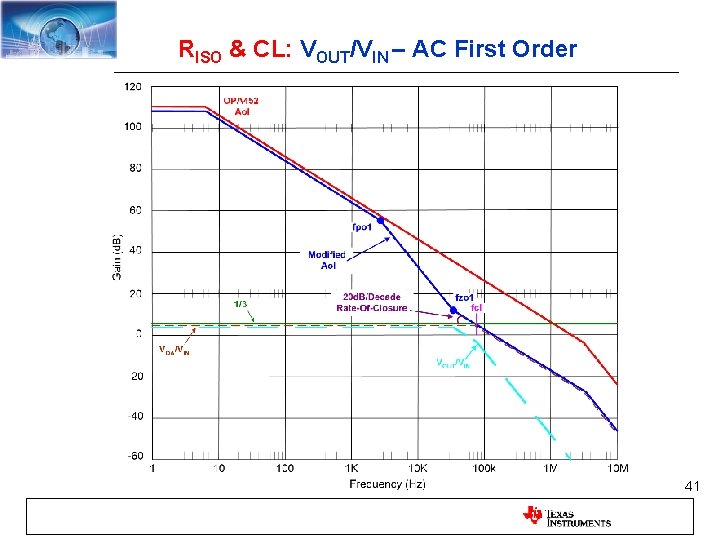
RISO & CL: VOUT/VIN – AC First Order 41

Thank You for Your Interest in Stability Problems: Op Amp Circuits Analysis Techniques and Solutions Comments, Questions, Technical Discussions Welcome: Marek Lis 520 -750 -2162 lis_marek@ti. com 42
- Slides: 42