
Stability of Discrete Systems CSE 421 Digital Control

Stability of Discrete Systems CSE 421 Digital Control Lecture 7 1
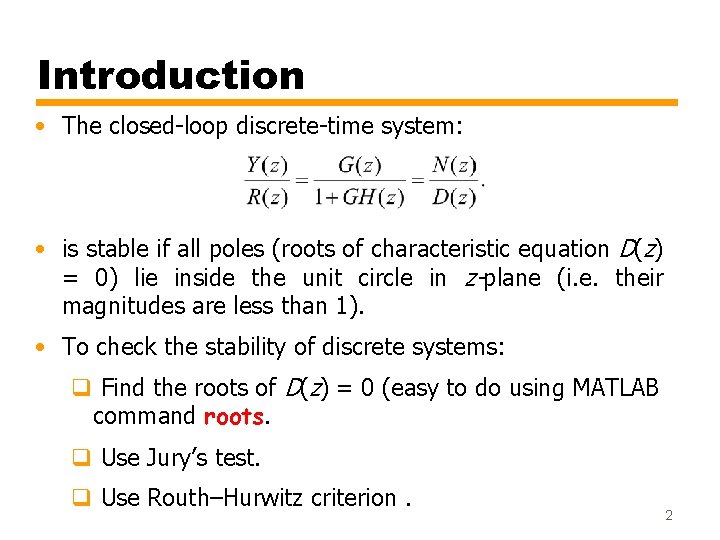
Introduction • The closed-loop discrete-time system: • is stable if all poles (roots of characteristic equation D(z) = 0) lie inside the unit circle in z-plane (i. e. their magnitudes are less than 1). • To check the stability of discrete systems: q Find the roots of D(z) = 0 (easy to do using MATLAB command roots. q Use Jury’s test. q Use Routh–Hurwitz criterion. 2

Example 1 • Find the value of T for which the following closed-loop discrete-time system is stable. Solution: • The transfer function of the closed-loop system is 3
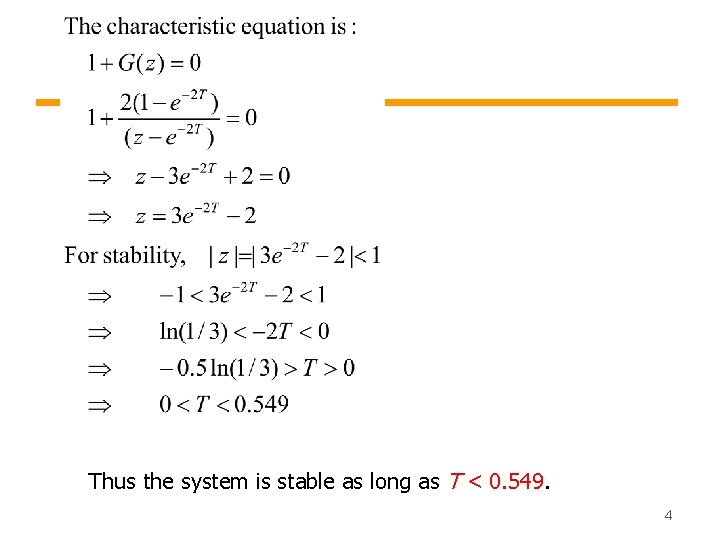
Thus the system is stable as long as T < 0. 549. 4
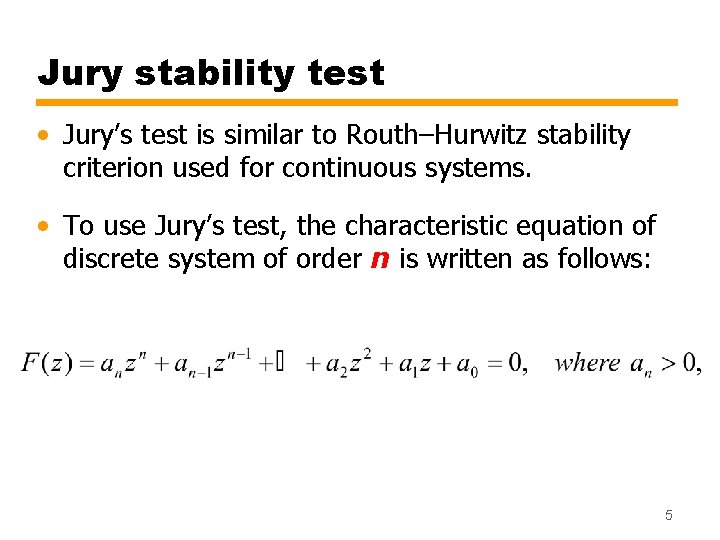
Jury stability test • Jury’s test is similar to Routh–Hurwitz stability criterion used for continuous systems. • To use Jury’s test, the characteristic equation of discrete system of order n is written as follows: 5
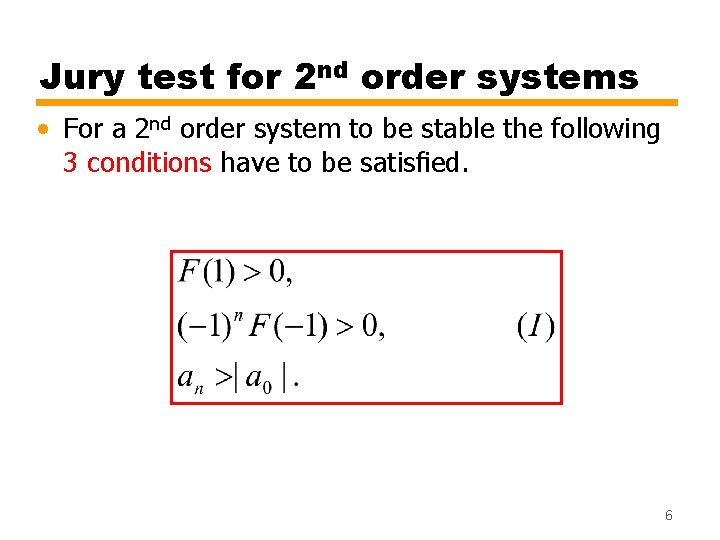
Jury test for 2 nd order systems • For a 2 nd order system to be stable the following 3 conditions have to be satisfied. 6
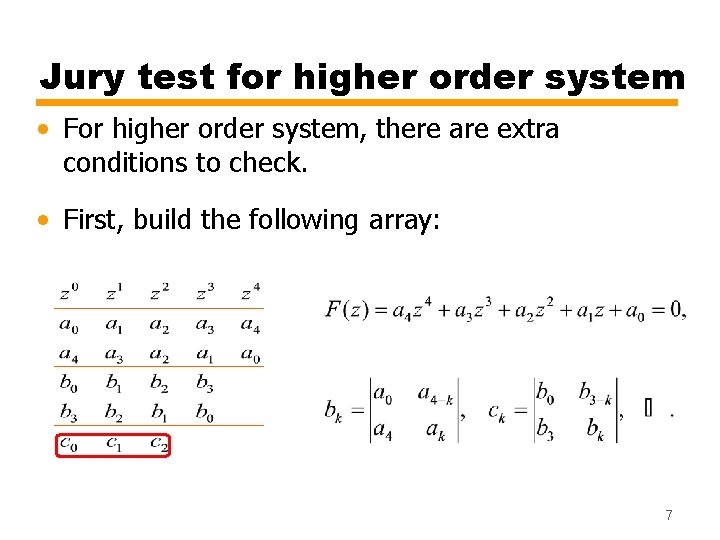
Jury test for higher order system • For higher order system, there are extra conditions to check. • First, build the following array: 7
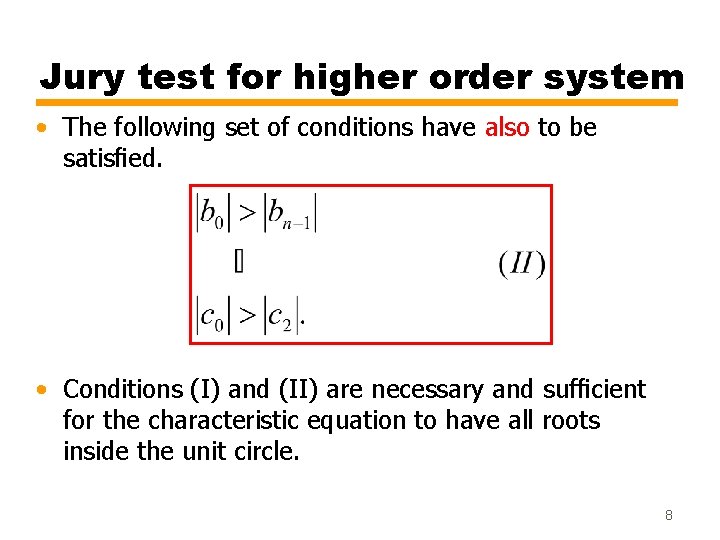
Jury test for higher order system • The following set of conditions have also to be satisfied. • Conditions (I) and (II) are necessary and sufficient for the characteristic equation to have all roots inside the unit circle. 8
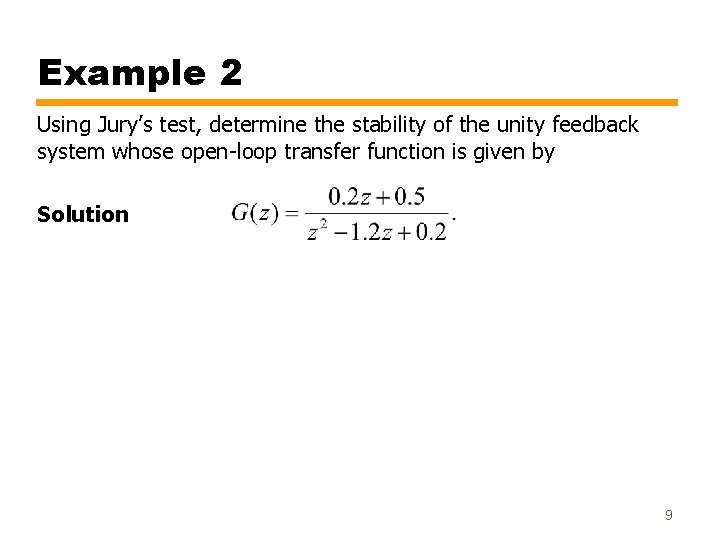
Example 2 Using Jury’s test, determine the stability of the unity feedback system whose open-loop transfer function is given by Solution 9
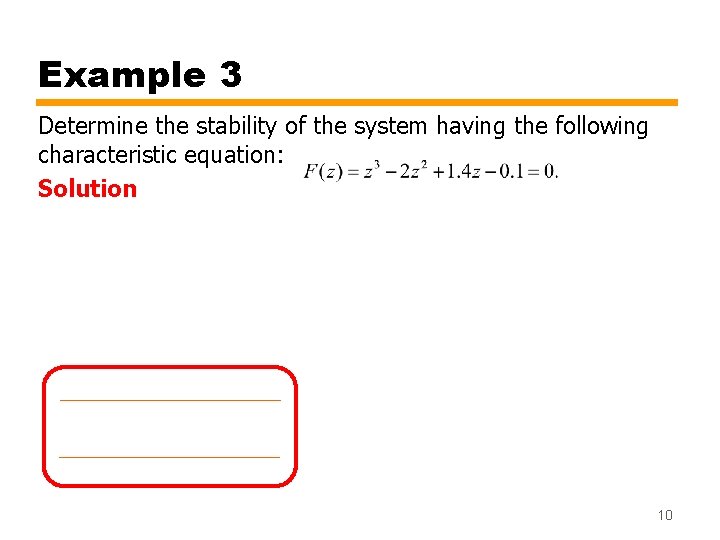
Example 3 Determine the stability of the system having the following characteristic equation: Solution 10
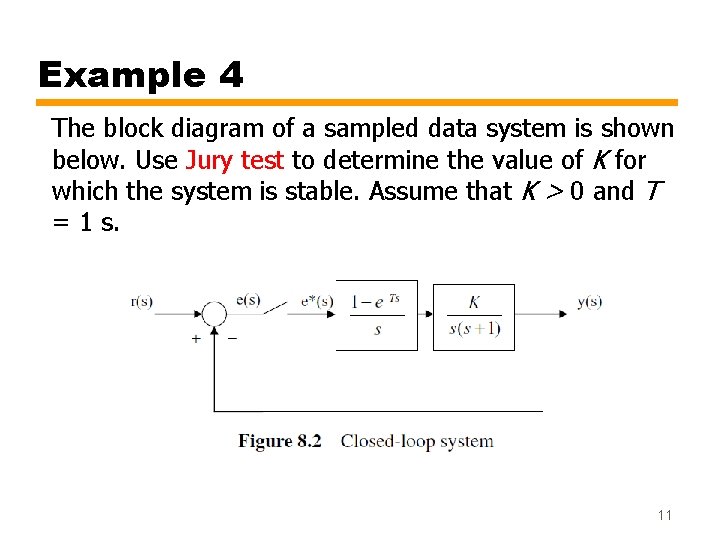
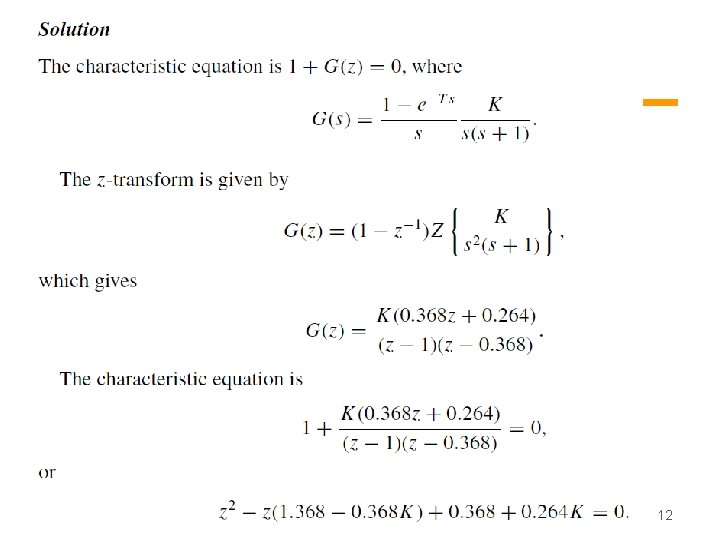
Example 4 The block diagram of a sampled data system is shown below. Use Jury test to determine the value of K for which the system is stable. Assume that K > 0 and T = 1 s. 11
12
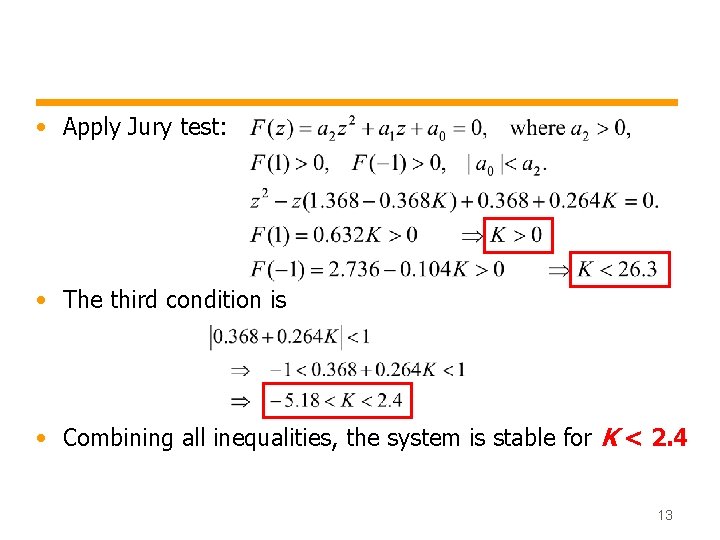
• Apply Jury test: • The third condition is • Combining all inequalities, the system is stable for K < 2. 4 13
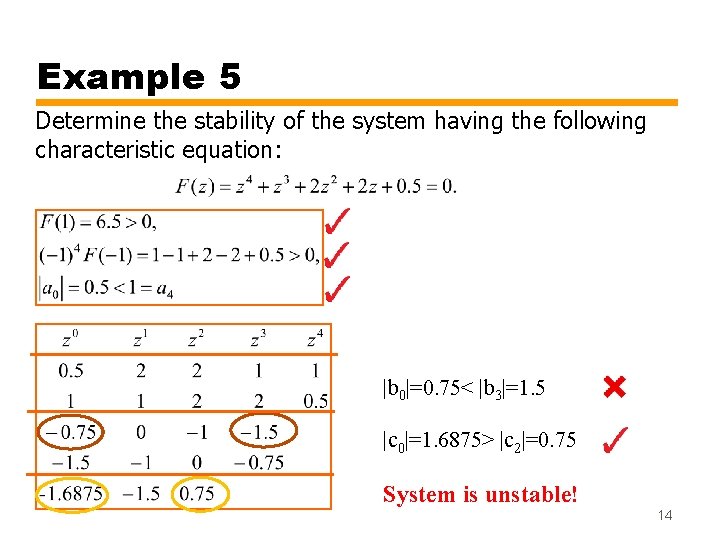
Example 5 Determine the stability of the system having the following characteristic equation: |b 0|=0. 75< |b 3|=1. 5 |c 0|=1. 6875> |c 2|=0. 75 System is unstable! 14
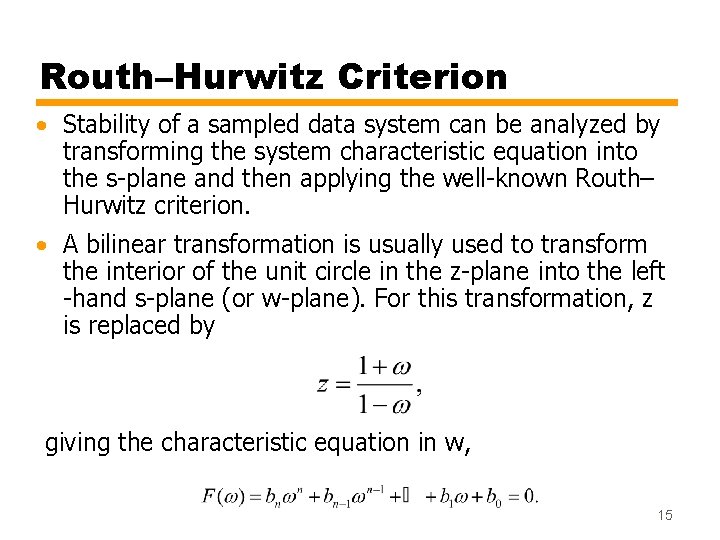
Routh–Hurwitz Criterion • Stability of a sampled data system can be analyzed by transforming the system characteristic equation into the s-plane and then applying the well-known Routh– Hurwitz criterion. • A bilinear transformation is usually used to transform the interior of the unit circle in the z-plane into the left -hand s-plane (or w-plane). For this transformation, z is replaced by giving the characteristic equation in w, 15
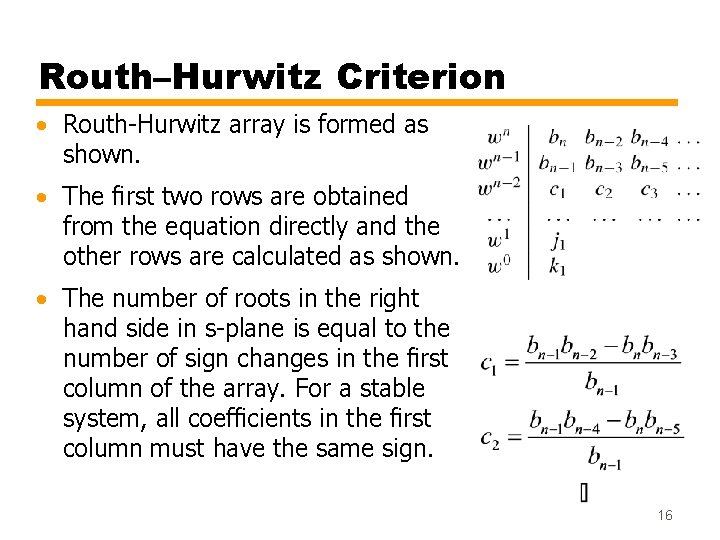
Routh–Hurwitz Criterion • Routh-Hurwitz array is formed as shown. • The first two rows are obtained from the equation directly and the other rows are calculated as shown. • The number of roots in the right hand side in s-plane is equal to the number of sign changes in the first column of the array. For a stable system, all coefficients in the first column must have the same sign. 16
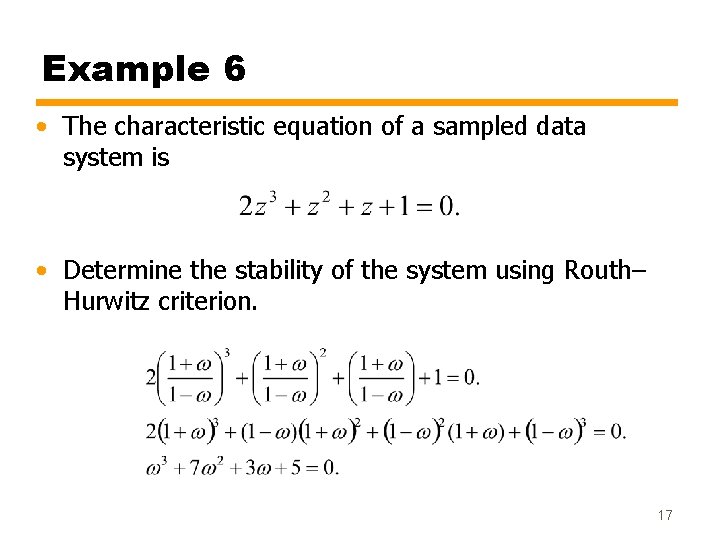
Example 6 • The characteristic equation of a sampled data system is • Determine the stability of the system using Routh– Hurwitz criterion. 17
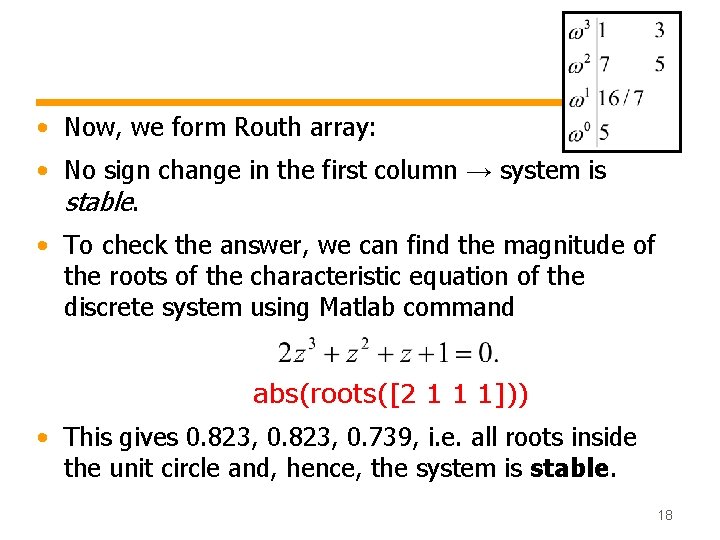
• Now, we form Routh array: • No sign change in the first column → system is stable. • To check the answer, we can find the magnitude of the roots of the characteristic equation of the discrete system using Matlab command abs(roots([2 1 1 1])) • This gives 0. 823, 0. 739, i. e. all roots inside the unit circle and, hence, the system is stable. 18
- Slides: 18