
STA 291 Lecture 7 Probability rules Working with
![STA 291 Lecture 7 • Probability [ rules ] • Working with events STA](https://slidetodoc.com/presentation_image_h2/86b8ac68f1a456e4cfba997831e1dabb/image-1.jpg "STA 291 Lecture 7 • Probability [ rules ] • Working with events STA")
STA 291 Lecture 7 • Probability [ rules ] • Working with events STA 291 - Lecture 7 1
![Review Probability: Basic Terminology • Sample Space: [ denoted by S ] The collection](http://slidetodoc.com/presentation_image_h2/86b8ac68f1a456e4cfba997831e1dabb/image-2.jpg "Review Probability: Basic Terminology • Sample Space: [ denoted by S ] The collection")
Review Probability: Basic Terminology • Sample Space: [ denoted by S ] The collection of all possible outcomes of an experiment. • Event: [ denoted by A, B, C, etc ] a specific collection of outcomes. • Simple Event: An event consisting of just one outcome. STA 291 - Lecture 7 2
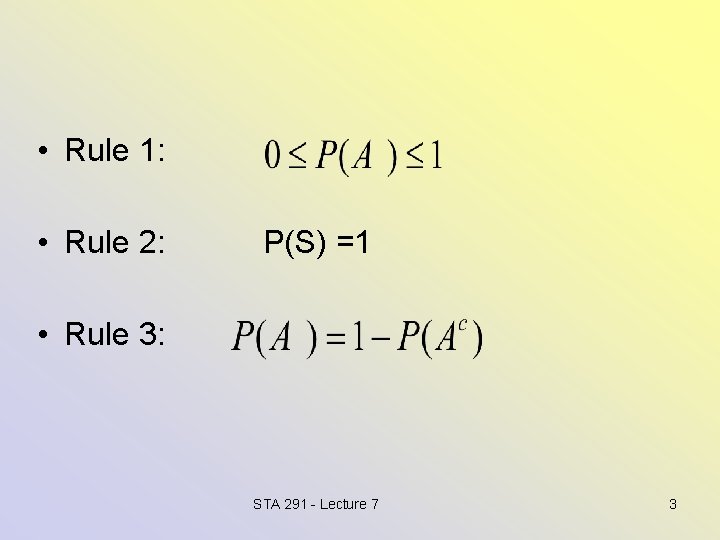
• Rule 1: • Rule 2: P(S) =1 • Rule 3: STA 291 - Lecture 7 3
Assigning Probabilities to Events • The probability of an event is nothing more than a value between 0 and 1. In particular: --- 0 implies that the event will not occur --- 1 implies that the event will occur for sure • Never have probability > 1, never < 0. STA 291 - Lecture 7 4
Equally Likely Approach • Examples: 1. A deck of 52 cards, well shuffled. Pick one. Let event A={ace, any suits}, P(A) = 2. Roll a fair die – The probability of the event “ 4 or above” is • Roll a fair die 2 times: there are 6 x 6=36 possible outcomes. Each one has 1/36 probability STA 291 - Lecture 7 5
Counting method • Suppose at every step, you always have k choices, and there are m steps • Total number of choices = k x k …k = k to m power • Example: pick 3 lotto [ 10 to 3 power ] • Roll a die 3 times [ 6 to 3 power ] STA 291 - Lecture 7 6
Example: using rule 3 • Flip a fair coin 7 times • A = { at least one head } • P(A) =1 – 1/128 = 127/128 STA 291 - Lecture 7 7
More rules • Rule for union/sum (a general rule and a simplified rule) • Rule for intersection/product (a general rule and a simplified rule) STA 291 - Lecture 7 8
Union and Intersection of events • Let A and B denote two events. • The union of two events: All the outcomes in S that belong to at least one of A or B or both. The union of A, B is denoted by • The intersection of two events: All the outcomes in S that belong to both A and B. The intersection of A and B is denoted by STA 291 - Lecture 7 9
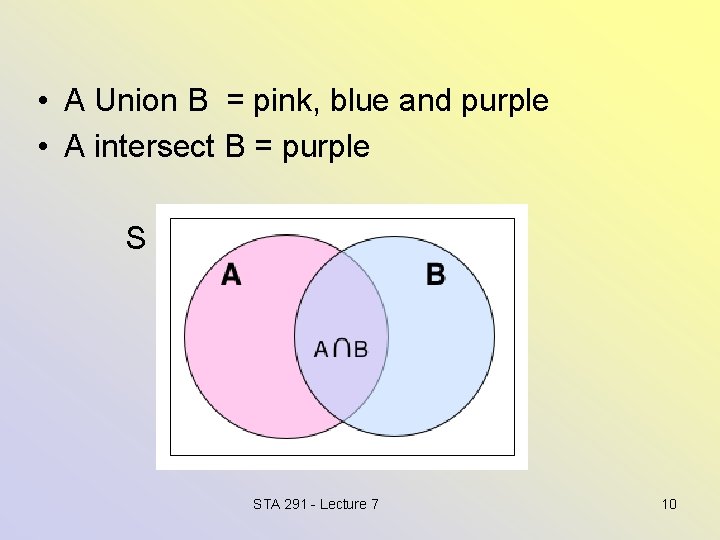
• A Union B = pink, blue and purple • A intersect B = purple S STA 291 - Lecture 7 10
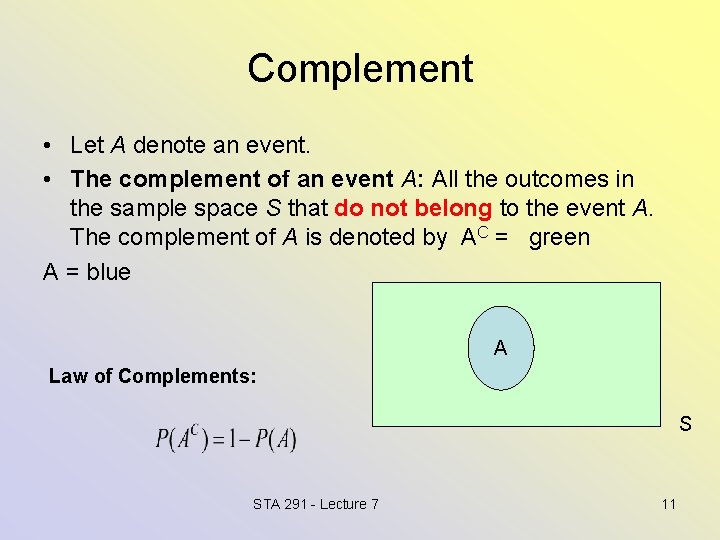
Complement • Let A denote an event. • The complement of an event A: All the outcomes in the sample space S that do not belong to the event A. The complement of A is denoted by AC = green A = blue A Law of Complements: S STA 291 - Lecture 7 11
• Example: If the probability of getting a “working” computer is 0. 85, • What is the probability of getting a defective computer? • Example if the probability of hitting the free throw is 0. 68, then what is the probability of missing? STA 291 - Lecture 7 12
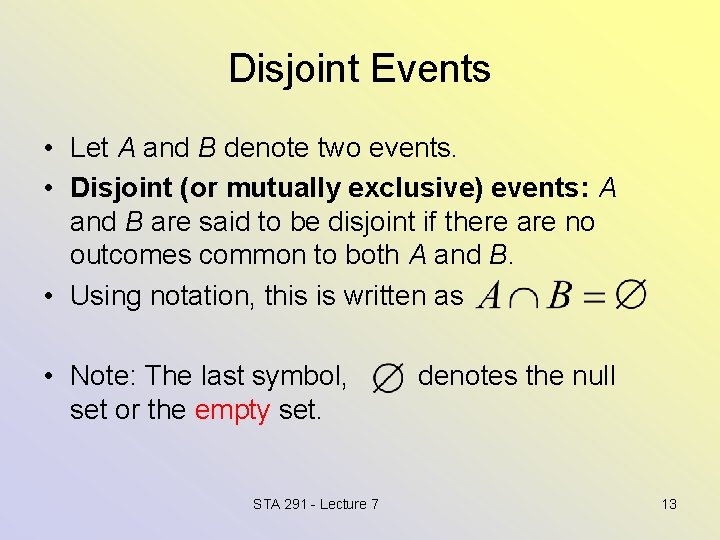
Disjoint Events • Let A and B denote two events. • Disjoint (or mutually exclusive) events: A and B are said to be disjoint if there are no outcomes common to both A and B. • Using notation, this is written as • Note: The last symbol, set or the empty set. STA 291 - Lecture 7 denotes the null 13
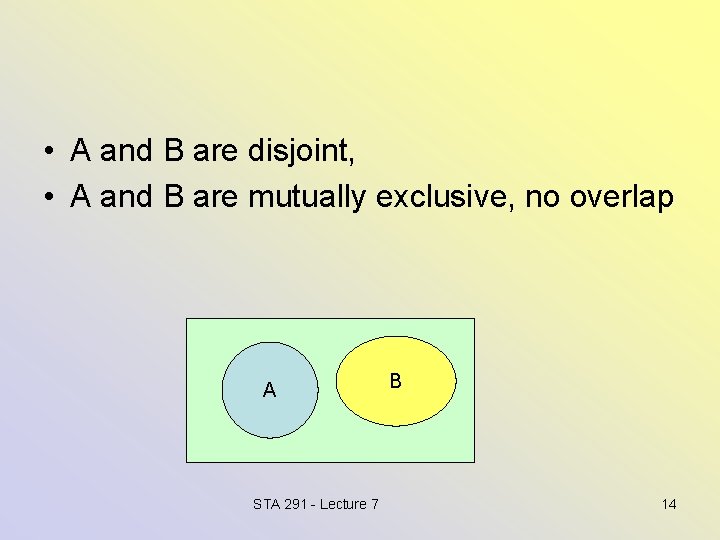
• A and B are disjoint, • A and B are mutually exclusive, no overlap A STA 291 - Lecture 7 B 14
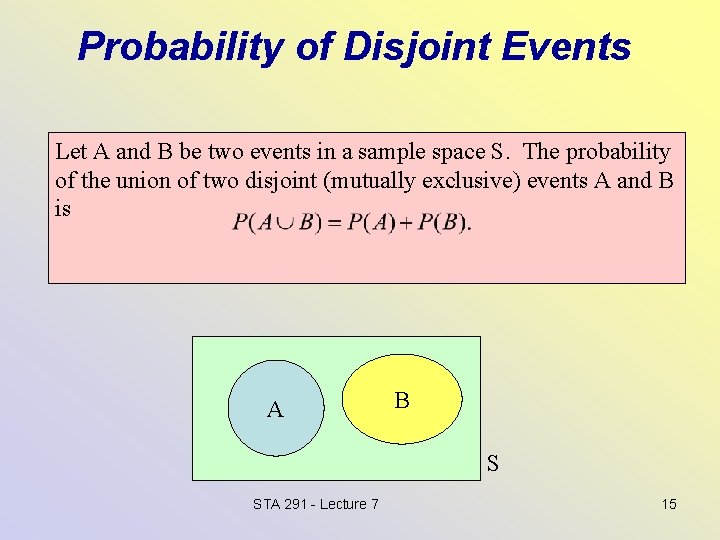
Probability of Disjoint Events Let A and B be two events in a sample space S. The probability of the union of two disjoint (mutually exclusive) events A and B is A B S STA 291 - Lecture 7 15
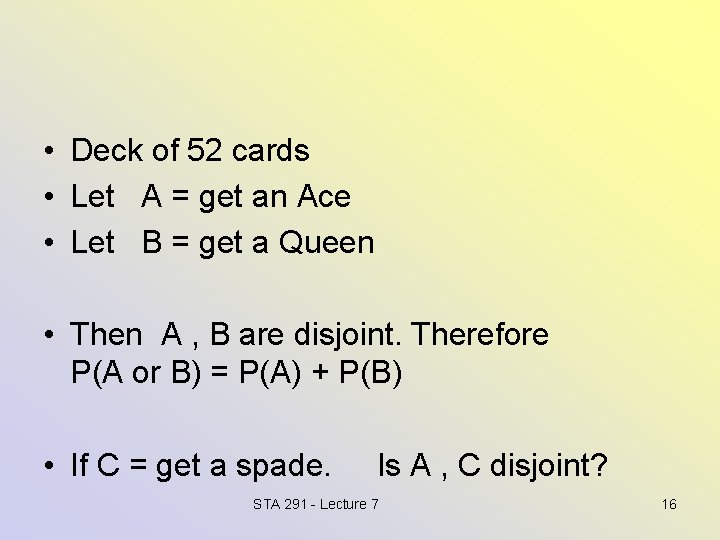
• Deck of 52 cards • Let A = get an Ace • Let B = get a Queen • Then A , B are disjoint. Therefore P(A or B) = P(A) + P(B) • If C = get a spade. Is A , C disjoint? STA 291 - Lecture 7 16
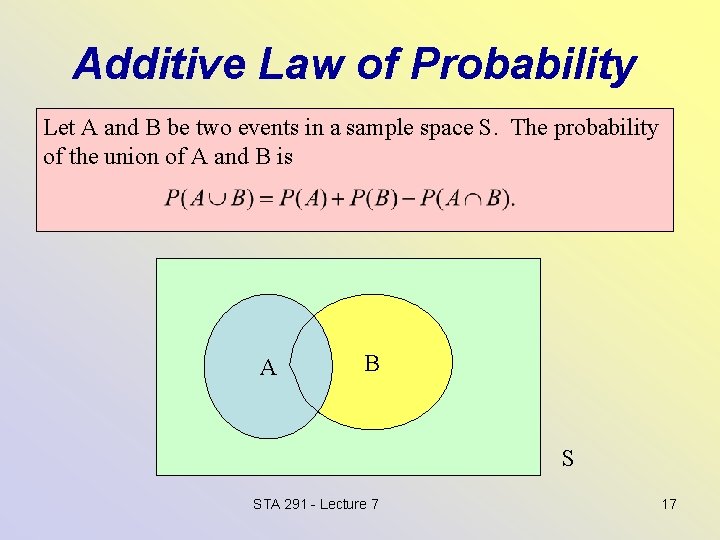
Additive Law of Probability Let A and B be two events in a sample space S. The probability of the union of A and B is A B S STA 291 - Lecture 7 17
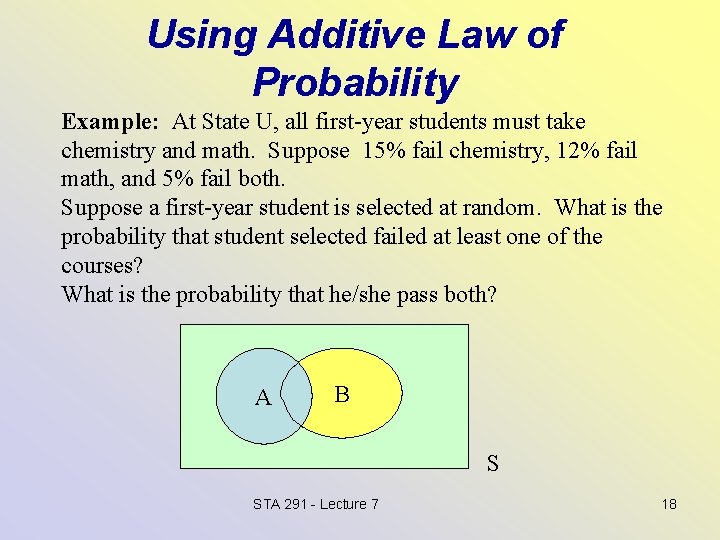
Using Additive Law of Probability Example: At State U, all first-year students must take chemistry and math. Suppose 15% fail chemistry, 12% fail math, and 5% fail both. Suppose a first-year student is selected at random. What is the probability that student selected failed at least one of the courses? What is the probability that he/she pass both? A B S STA 291 - Lecture 7 18
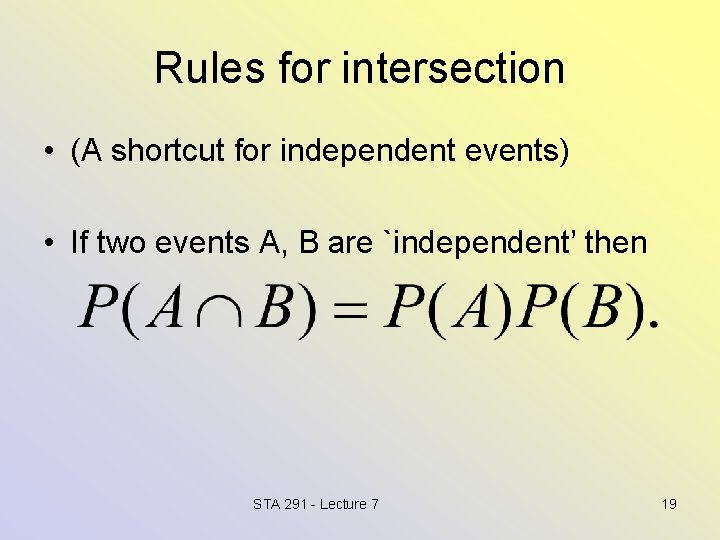
Rules for intersection • (A shortcut for independent events) • If two events A, B are `independent’ then STA 291 - Lecture 7 19
Independent • How do we know if events are independent? STA 291 - Lecture 7 20
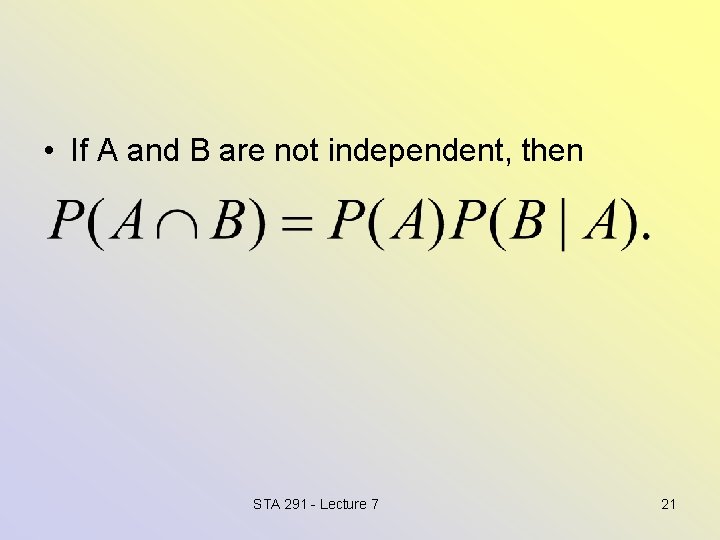
• If A and B are not independent, then STA 291 - Lecture 7 21
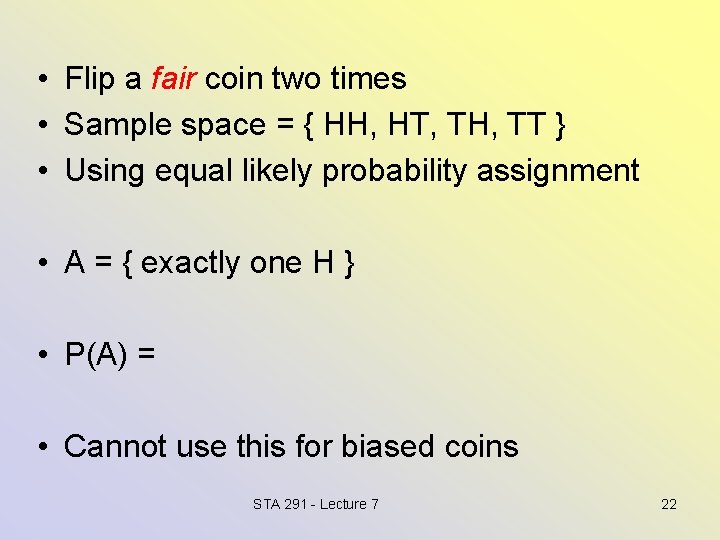
• Flip a fair coin two times • Sample space = { HH, HT, TH, TT } • Using equal likely probability assignment • A = { exactly one H } • P(A) = • Cannot use this for biased coins STA 291 - Lecture 7 22
• Outcomes, and their probabilities in a sample space may be given in a contingency table. (r x c table) • Example STA 291 - Lecture 7 23
• Last digit of your Social Security number [most likely random and equally likely to be 0, 1, 2, …, 9] STA 291 - Lecture 7 24
Attendance Survey Question 7 • On a 4”x 6” index card – Please write down your name and section number – Today’s Question: Your prediction of Super Bowl this Sunday ___Indianapolis ___New Orleans STA 291 - Lecture 7 25
- Slides: 25