
STA 291 Lecture 15 Normal Distributions Bell curve
STA 291 Lecture 15 – Normal Distributions (Bell curve) STA 291 - Lecture 15 1
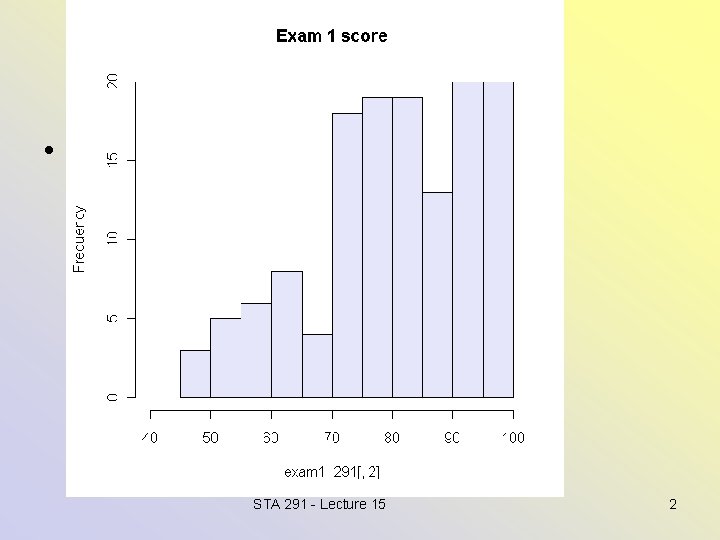
• Distribution of Exam 1 score STA 291 - Lecture 15 2
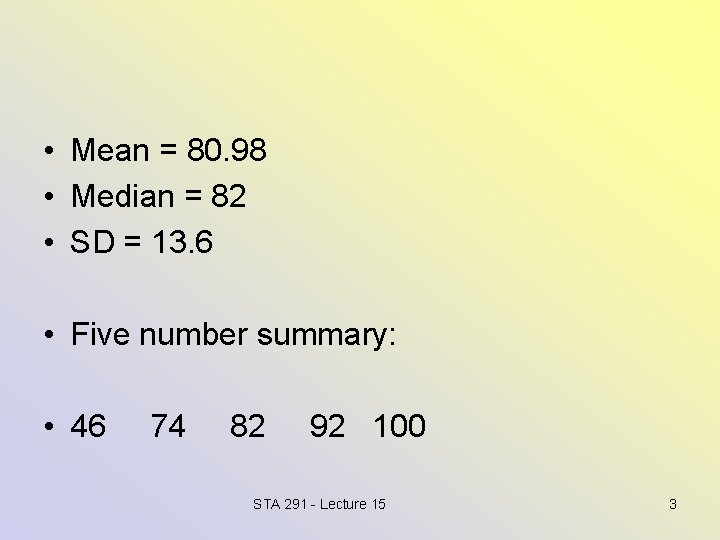
• Mean = 80. 98 • Median = 82 • SD = 13. 6 • Five number summary: • 46 74 82 92 100 STA 291 - Lecture 15 3
• There are many different shapes of continuous probability distributions… • We focus on one type – the Normal distribution, also known as Gaussian distribution or bell curve. STA 291 - Lecture 15 4

Carl F. Gauss STA 291 - Lecture 15 5
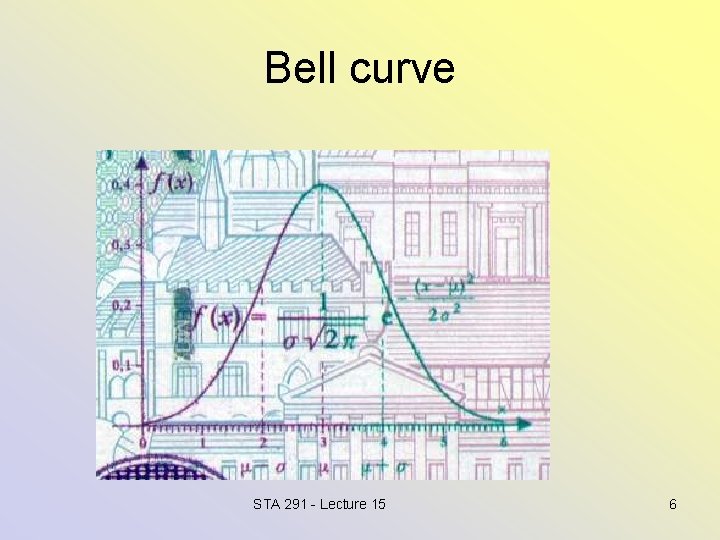
Bell curve STA 291 - Lecture 15 6
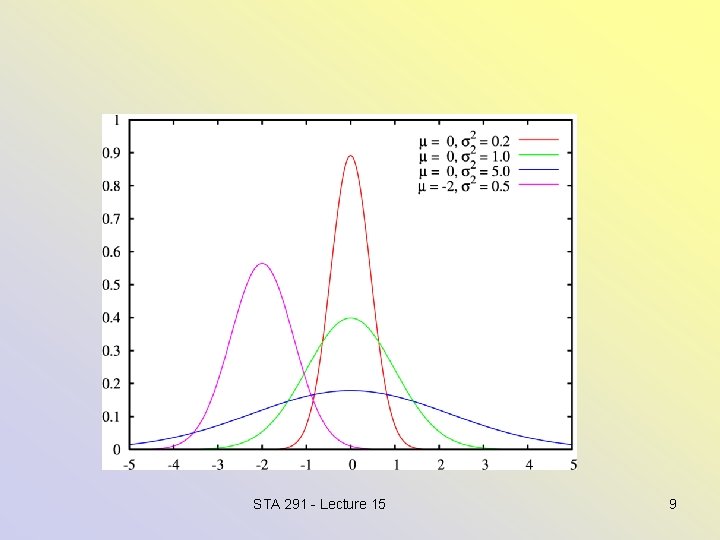
Normal distributions/densities • Again, this is a whole family of distributions, indexed by mean and SD. (location and scale) STA 291 - Lecture 15 7
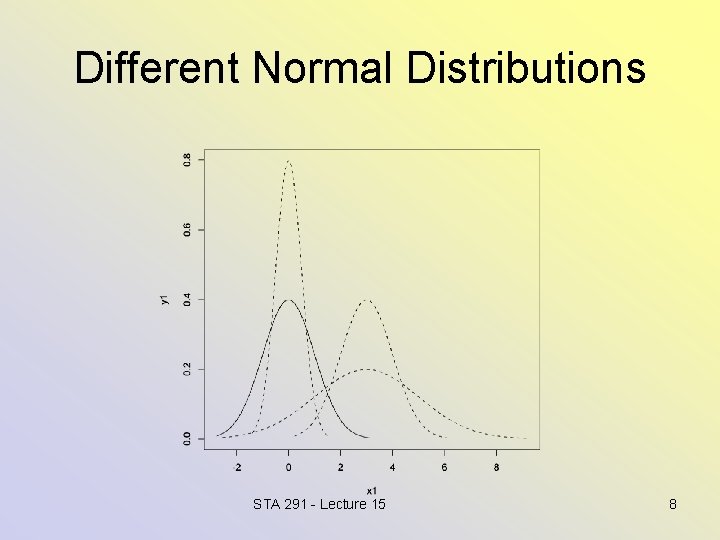
Different Normal Distributions STA 291 - Lecture 15 8
STA 291 - Lecture 15 9
The Normal Probability Distribution • Normal distribution is perfectly symmetric and bell-shaped • Characterized by two parameters: mean μ and standard deviation σ • The 68%-95%-99. 7% rule applies to the normal distribution. • That is, the probability concentrated within 1 standard deviation of the mean is always 68% within 2 SD is 95%; within 3 SD is 99. 7% etc. STA 291 - Lecture 15 10
• It is very common. • The sampling distribution of many common statistics are approximately Normally shaped, when the sample size n gets large. STA 291 - Lecture 15 11
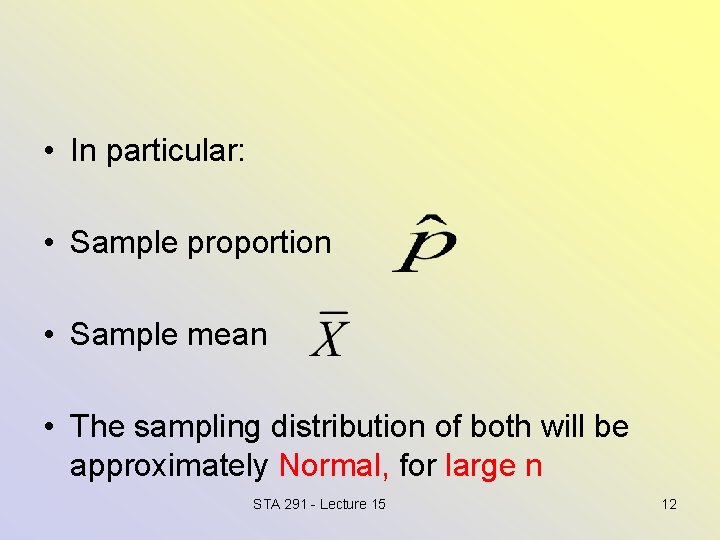
• In particular: • Sample proportion • Sample mean • The sampling distribution of both will be approximately Normal, for large n STA 291 - Lecture 15 12
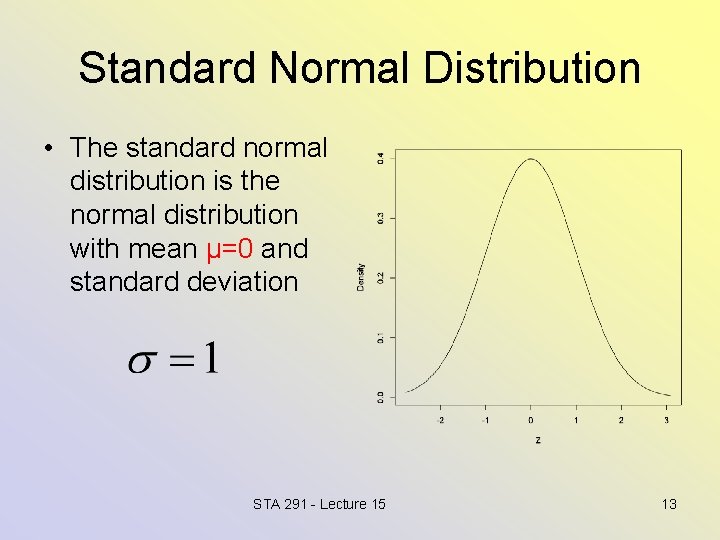
Standard Normal Distribution • The standard normal distribution is the normal distribution with mean μ=0 and standard deviation STA 291 - Lecture 15 13
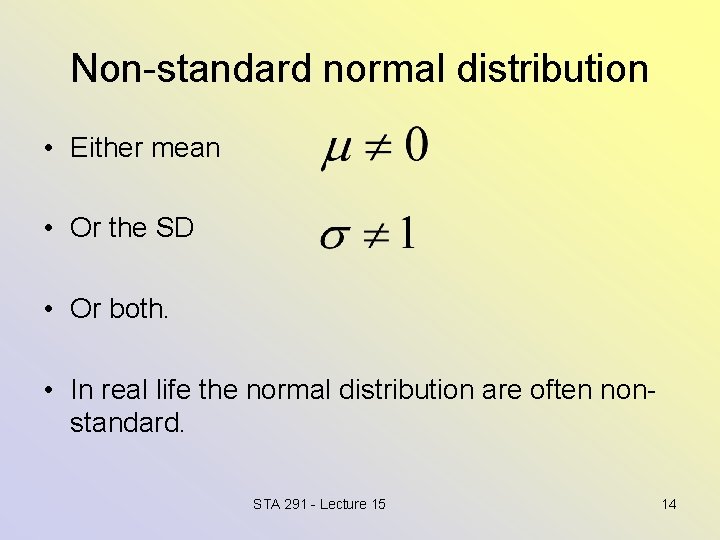
Non-standard normal distribution • Either mean • Or the SD • Or both. • In real life the normal distribution are often nonstandard. STA 291 - Lecture 15 14
Examples of normal random variables • Public demand of gas/water/electricity in a city. • Amount of Rain fall in a season. • Weight/height of a randomly selected adult female. STA 291 - Lecture 15 15

Examples of normal random variables – cont. • Soup sold in a restaurant in a day. • Stock index value tomorrow. STA 291 - Lecture 15 16
Example of non-normal probability distributions Income of a randomly selected family. (skewed, only positive) Price of a randomly selected house. (skewed, only positive) STA 291 - Lecture 15 17
Example of non-normal probability distributions • Number of accidents in a week. (discrete) • Waiting time for a traffic light. (has a discrete value at 0, and only with positive values, and no more than 3 min, etc) STA 291 - Lecture 15 18
Central Limit Theorem • Even the incomes are not normally distributed, the average income of many randomly selected families is approximately normally distributed. • Average does the magic of making things normal! (transform to normal) STA 291 - Lecture 15 19
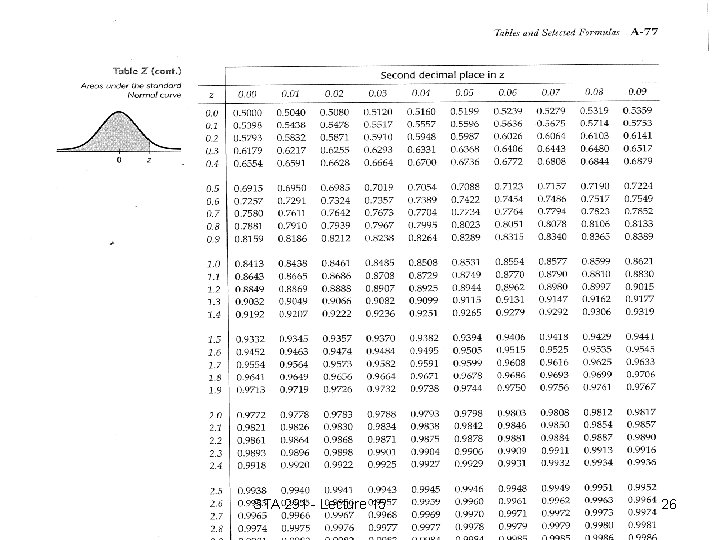
Table 3 is for standard normal • Convert non-standard to standard. • Denote by X -- non-standard normal • Denote by Z -- standard normal STA 291 - Lecture 15 20
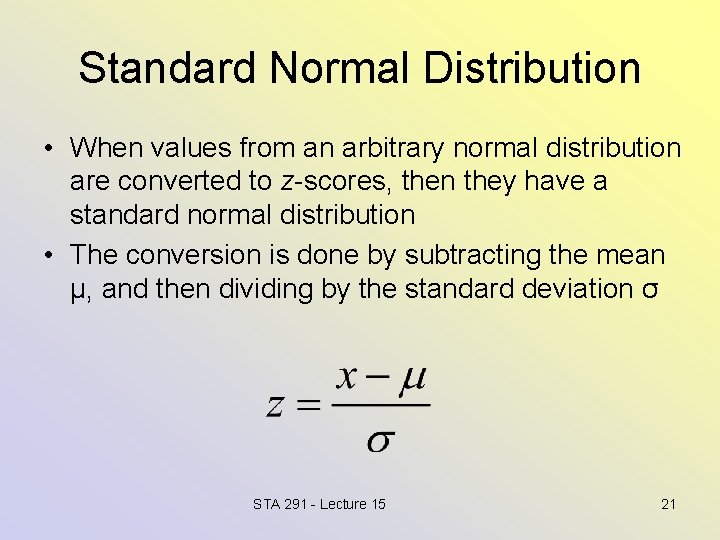
Standard Normal Distribution • When values from an arbitrary normal distribution are converted to z-scores, then they have a standard normal distribution • The conversion is done by subtracting the mean μ, and then dividing by the standard deviation σ STA 291 - Lecture 15 21
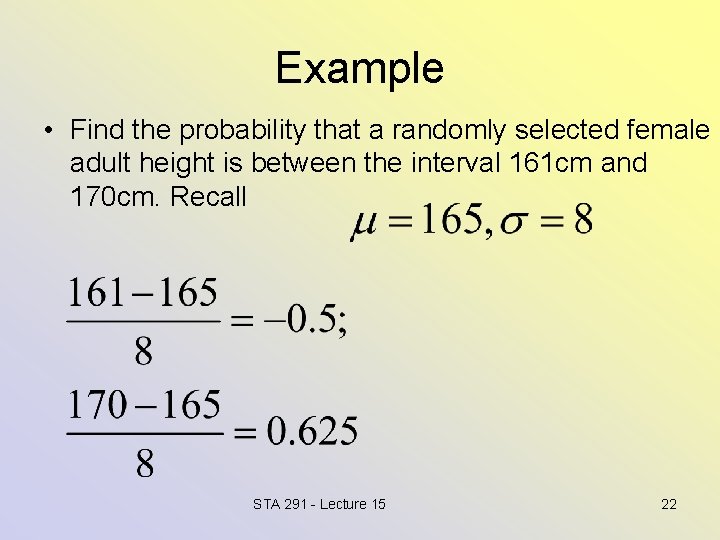
Example • Find the probability that a randomly selected female adult height is between the interval 161 cm and 170 cm. Recall STA 291 - Lecture 15 22
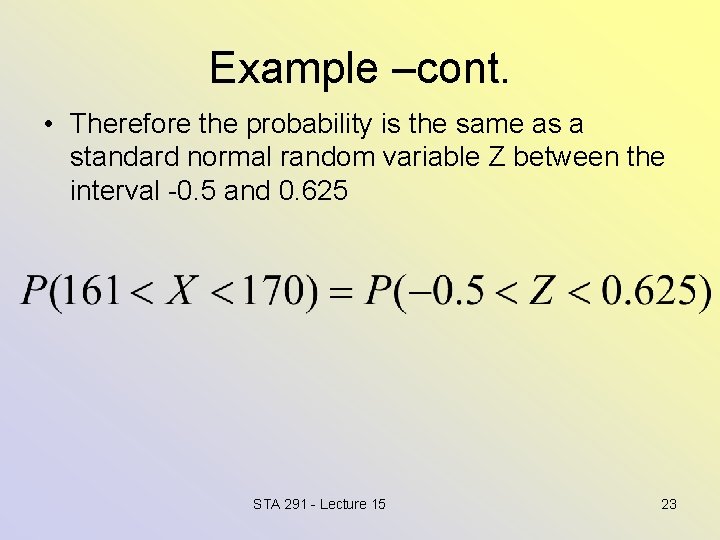
Example –cont. • Therefore the probability is the same as a standard normal random variable Z between the interval -0. 5 and 0. 625 STA 291 - Lecture 15 23
Use table or use Applet? STA 291 - Lecture 15 24
Online Tool • Normal Density Curve • Use it to verify graphically the empirical rule, find probabilities, find percentiles and z-values for one- and two-tailed probabilities STA 291 - Lecture 15 25
STA 291 - Lecture 15 26
z-Scores • The z-score for a value x of a random variable is the number of standard deviations that x is above μ • If x is below μ, then the z-score is negative • The z-score is used to compare values from different normal distributions STA 291 - Lecture 15 27
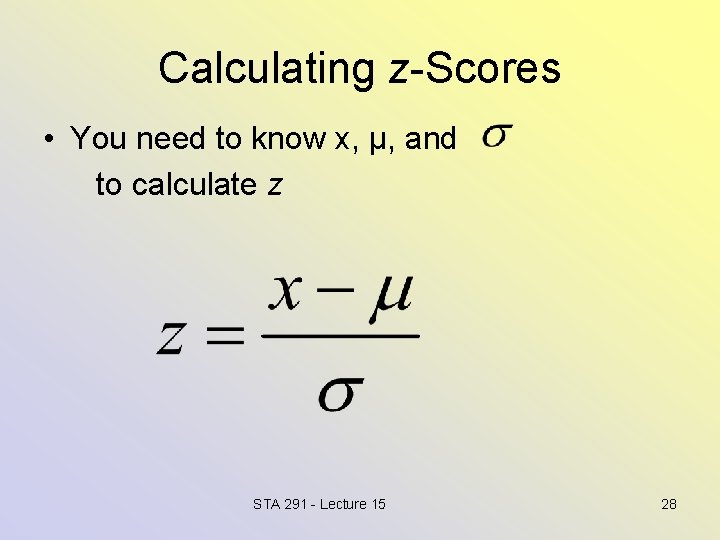
Calculating z-Scores • You need to know x, μ, and to calculate z STA 291 - Lecture 15 28
• Applet does the conversion automatically. (recommended) The table 3 gives probability P(0 < Z < z) = ? STA 291 - Lecture 15 29
Tail Probabilities • SAT Scores: Mean=500, SD =100 • The SAT score 700 has a z-score of z=2 • The probability that a score is beyond 700 is the tail probability of Z beyond 2 STA 291 - Lecture 15 30
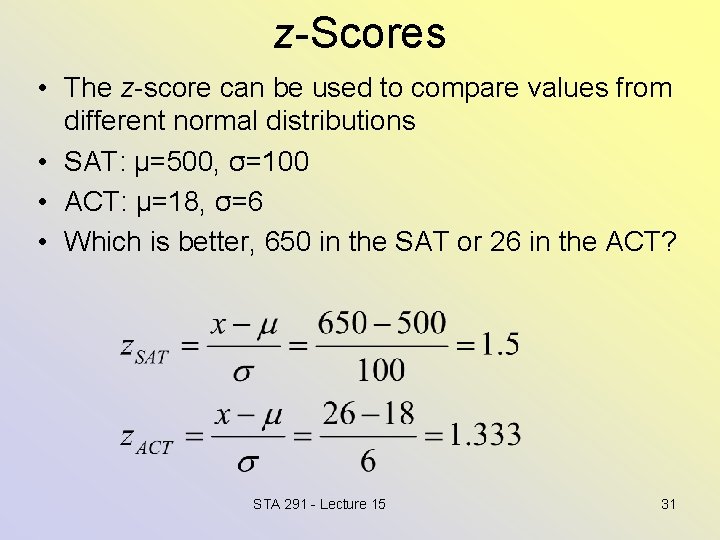
z-Scores • The z-score can be used to compare values from different normal distributions • SAT: μ=500, σ=100 • ACT: μ=18, σ=6 • Which is better, 650 in the SAT or 26 in the ACT? STA 291 - Lecture 15 31
• Corresponding tail probabilities? • How many percent of total test scores have better SAT or ACT scores? STA 291 - Lecture 15 32
Typical Questions 1. Probability (right-hand, left-hand, two-sided, middle) 2. z-score 3. Observation (raw score) • • To find probability, use applet or Table 3. In transforming between 2 and 3, you need mean and standard deviation STA 291 - Lecture 15 33
Finding z-Values for Percentiles • For a normal distribution, how many standard deviations from the mean is the 90 th percentile? • What is the value of z such that 0. 90 probability is less than μ + z σ ? • If 0. 9 probability is less than μ + z σ, then there is 0. 4 probability between 0 and μ + z σ (because there is 0. 5 probability less than 0) • z=1. 28 • The 90 th percentile of a normal distribution is 1. 28 standard deviations above the mean STA 291 - Lecture 15 34
Quartiles of Normal Distributions • Median: z=0 (0 standard deviations above the mean) • Upper Quartile: z = 0. 67 (0. 67 standard deviations above the mean) • Lower Quartile: z= – 0. 67 (0. 67 standard deviations below the mean) STA 291 - Lecture 15 35
• In fact for any normal probability distributions, the 90 th percentile is always 1. 28 SD above the mean the 95 th percentile is ____ SD above mean STA 291 - Lecture 15 36
Finding z-Values for Two-Tail Probabilities • What is the z-value such that the probability is 0. 1 that a normally distributed random variable falls more than z standard deviations above or below the mean • Symmetry: we need to find the z-value such that the right-tail probability is 0. 05 (more than z standard deviations above the mean) • z=1. 65 • 10% probability for a normally distributed random variable is outside 1. 65 standard deviations from the mean, and 90% is within 1. 65 standard deviations from the mean STA 291 - Lecture 15 37

homework online STA 291 - Lecture 15 38
Attendance Survey Question 16 • On a 4”x 6” index card – Please write down your name and section number – Today’s Question: ___? ___ is also been called bell curve. STA 291 - Lecture 15 39
- Slides: 39