
ST software status Monitoring of the Silicon Tracker
- Slides: 14
ST software status Monitoring of the Silicon Tracker • Status of online monitoring • Special data sets needed: • Time alignment • Space alignment • Calibration • Databases Software week, 07 October 2009 ST software status, Jeroen van Tilburg 1
Online Monitoring Tasks Mark To bin Four tasks per subdetector (IT/TT): • TT(IT)DAQMon: • Monitoring of clusters. • 36(33) histograms of various quantities. • TT(IT)Sum. Mon: • Summary bank, Error banks • 4+48(42) histograms. • TT(IT)NZSMon: • Monitoring of noise from NZS data. • 48(42) histograms of noise from each TELL 1 • TT(IT)TAEMon: Monitoring of NZS data • Vetra is becoming closer to Brunel • Monitoring of clusters in different spills (+/-2). • Useful for TED data/start up. Software week, 07 October 2009 ST software status, Jeroen van Tilburg 2
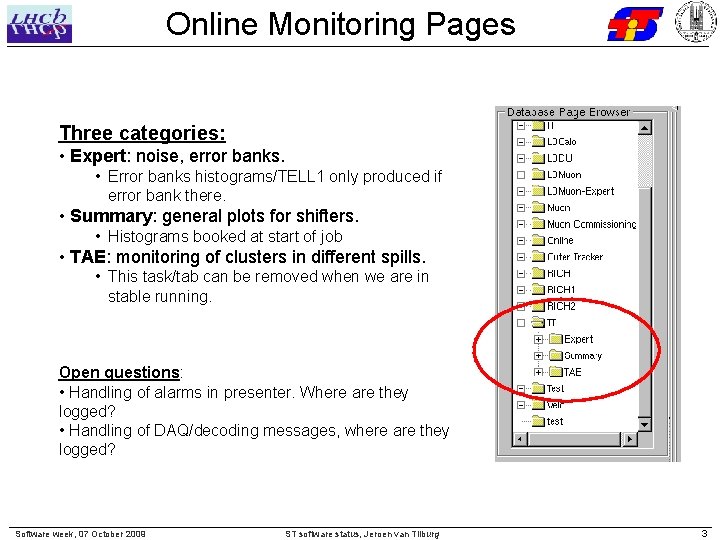
Online Monitoring Pages Three categories: • Expert: noise, error banks. • Error banks histograms/TELL 1 only produced if error bank there. • Summary: general plots for shifters. • Histograms booked at start of job • TAE: monitoring of clusters in different spills. • This task/tab can be removed when we are in stable running. Open questions: • Handling of alarms in presenter. Where are they logged? • Handling of DAQ/decoding messages, where are they logged? Software week, 07 October 2009 ST software status, Jeroen van Tilburg 3
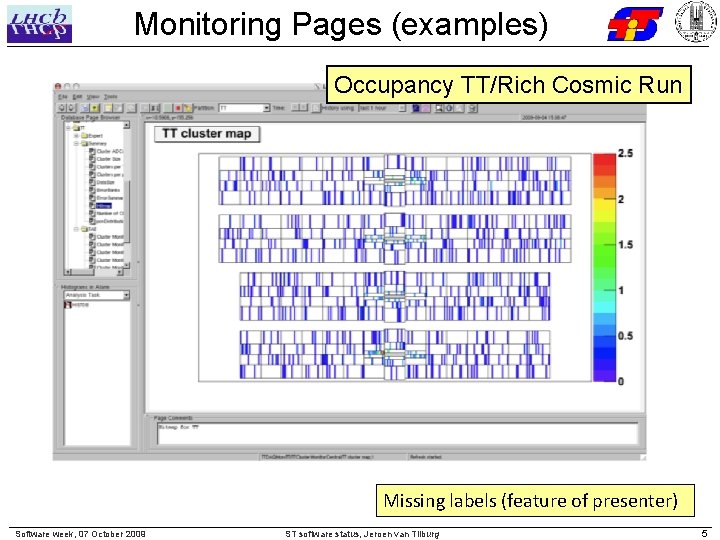
Summary Monitoring Pages • All histograms in Summary pages are booked in the initialize() methods of algorithms. • Missing histograms means something is wrong. • Summary pages (1 histogram/page): /TT/Summary/Hitmap /TT/Summary/Number of Clusters /TT/Summary/Clusters per TELL 1 /TT/Summary/Clusters per port /TT/Summary/Cluster Size /TT/Summary/Cluster ADCs /TT/Summary/Error. Banks /TT/Summary/pcn. Distribution /TT/Summary/Error. Summary /TT/Summary/Data. Size • 2 D plots allow to see dead/noisy regions quickly. • Monitoring used successfully in TED runs. • Some histograms found to more useful than others. • Could reduce number of summary pages if required. • No reference histograms for each page yet. Software week, 07 October 2009 ST software status, Jeroen van Tilburg 4
Monitoring Pages (examples) Occupancy TT/Rich Cosmic Run Missing labels (feature of presenter) Software week, 07 October 2009 ST software status, Jeroen van Tilburg 5
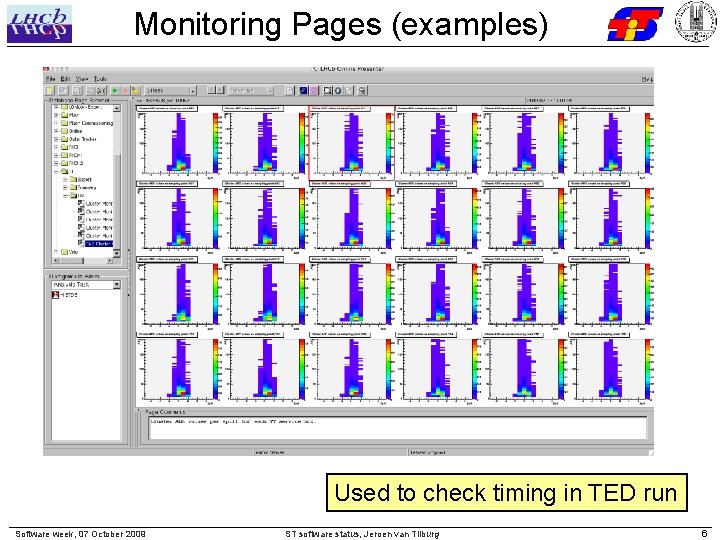
Monitoring Pages (examples) Used to check timing in TED run Software week, 07 October 2009 ST software status, Jeroen van Tilburg 6
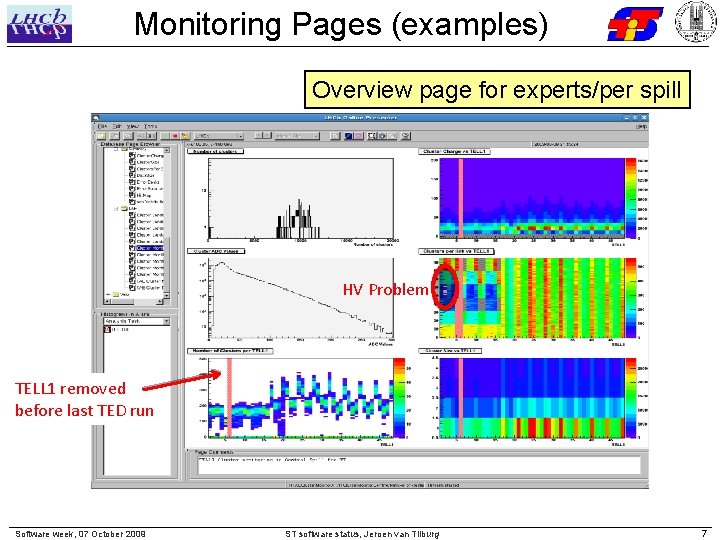
Monitoring Pages (examples) Overview page for experts/per spill HV Problem TELL 1 removed before last TED run Software week, 07 October 2009 ST software status, Jeroen van Tilburg 7
Special data sets Data sets needed by the ST: 1. Time alignment 2. Space alignment 3. Calibration Software week, 07 October 2009 ST software status, Jeroen van Tilburg 8
Special data sets: Time alignment 1. ADC sampling point and L 0 reset timing • No beam required (only test pulses and pedestal data). • Repeated about once per month during machine development. • Parameters should not change really (cross-check). 2. Trigger sampling point • Requires colliding beams. • Already determined during TED run to ~ 1 ns. • Retune global phase during beam collisions. • TT samples 2 ns later for short ladders • Timing will change if Beetle parameters altered • • Timing parameters set per service box (24 in TT, 28 in IT) Required data: ZS in TAE mode. Four runs with 6 ns steps 2 k interactions per run (20 k clusters/service box). Software week, 07 October 2009 ST software status, Jeroen van Tilburg 9
Special data sets: Space alignment • Currently, alignment with TED data. • Expect internal ladder alignment of 10 um in x. • Remaining challenges: other dofs, global alignment, magnetic field. • Repeat alignment with beam-gas and collision events. • Better occupancy in all subdetectors. • Larger range of track angles. • Useful for inter-detector alignment, and other dofs. • Important to have data with magnet on • Calibrate magnetic field. • Determine momentum: better estimate of multiple scattering. • Use J/ψ, Ks and Λ‘s to validate the alignment. • Inter-detector alignment needed to constraint weak modes • No alignment yet between IT-OT. • Introduce global constraints using long and T-TT tracks. • TT alignment always depends on either VELO or IT • Not easy to align TT only to VELO (experience TED run). Software week, 07 October 2009 ST software status, Jeroen van Tilburg 10
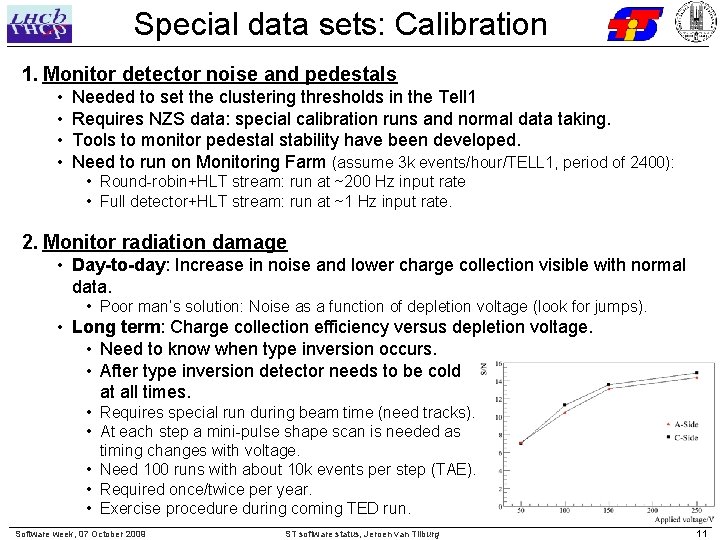
Special data sets: Calibration 1. Monitor detector noise and pedestals • • Needed to set the clustering thresholds in the Tell 1 Requires NZS data: special calibration runs and normal data taking. Tools to monitor pedestal stability have been developed. Need to run on Monitoring Farm (assume 3 k events/hour/TELL 1, period of 2400): • Round-robin+HLT stream: run at ~200 Hz input rate • Full detector+HLT stream: run at ~1 Hz input rate. 2. Monitor radiation damage • Day-to-day: Increase in noise and lower charge collection visible with normal data. • Poor man’s solution: Noise as a function of depletion voltage (look for jumps). • Long term: Charge collection efficiency versus depletion voltage. • Need to know when type inversion occurs. • After type inversion detector needs to be cold at all times. • Requires special run during beam time (need tracks). • At each step a mini-pulse shape scan is needed as timing changes with voltage. • Need 100 runs with about 10 k events per step (TAE). • Required once/twice per year. • Exercise procedure during coming TED run. Software week, 07 October 2009 ST software status, Jeroen van Tilburg 11
Databases What we have stored in the Cond. DB: • Alignment constants • Noise and conversion from ADC to electrons [per strip] • Production id [per module] • Readout map • Tell 1 configuration [in our partition] • Dead strip list: • In fact store ‘tree’ dead sectors, beetles, strips What we need to store: • Detector Monitoring/MC tuning • Efficiency per ladder • Collected charge per ladder • Common Noise • ‘Radiation’ damage monitoring • Pulse shape parameters • Depletion voltage • Leakage Current All parameters are either produced by a ‘Gaudi’ job or can be extracted from PVSS + written to XML • Configuration parameters: • Timing • Beetle settings • Temperatures, humidity Software week, 07 October 2009 ST software status, Jeroen van Tilburg 12
Databases How to keep track of changes in databases: • Meta information. • Critical to know what does the data mean? • Currently as a comment in XML (with date, author, description). • Not very restrictive… • How to access in C++ ? How to see in SQL ? • Should conditions have meta-tags ? • Trending • Need offline trending tools (parameter versus time, but not just time) • Compare databases to identify large changes in parameters • Started to develop python scripts… Software week, 07 October 2009 ST software status, Jeroen van Tilburg 13
Summary • Online monitoring • 4 tasks per subdetector • 3 categories of pages • Successfully used in last TED run. • Special data sets • Time alignment: with first data. • Space alignment: need magnet on, need other VELO and OT. • Calibration: • Need some stream for monitoring of noise and pedestals. • Need to collision data to monitor radiation damage. • Databases • Need to store more parameters (also from PVSS). • Need tools to monitor trends in database Software week, 07 October 2009 ST software status, Jeroen van Tilburg 14