
St Marys Physical Education Department GCSE PE YEAR

- Slides: 42
St Mary’s Physical Education Department GCSE PE YEAR 11
Training Methods Circuit training Continuous training Fartlek training Interval training Weight training Flexibility training
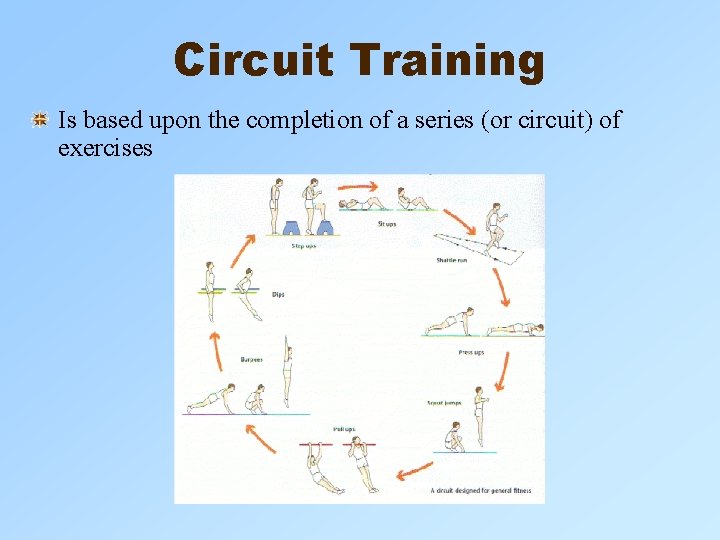
Circuit Training Is based upon the completion of a series (or circuit) of exercises
Circuit Training Can be used to develop any components of fitness What are the components of fitness? Endurance, Speed, Strength and Flexibility A circuit programme usually contains 6 -10 stations/exercises Circuits can be designed to train both aerobic and anaerobic fitness or specifically exercise muscle groups or components of fitness Good circuits will have activities that are relevant to the needs of the performer.
Exercises for Circuit Training Press ups Squat thrusts Sprints Burpees Dips Sit ups Star Jumps Squats Lunges Shuttle runs Pull ups Step ups Running on spot Skipping
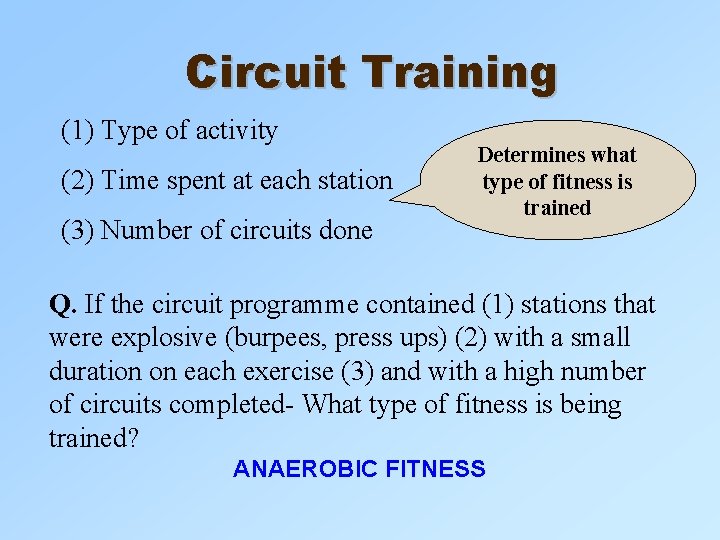
Circuit Training (1) Type of activity (2) Time spent at each station (3) Number of circuits done Determines what type of fitness is trained Q. If the circuit programme contained (1) stations that were explosive (burpees, press ups) (2) with a small duration on each exercise (3) and with a high number of circuits completed- What type of fitness is being trained? ANAEROBIC FITNESS
Skill Circuits can include activities which will develop the fitness and skills needed for specific games. Circuits do not have to be exercise based- skill circuits are designed to work on a particular aspect of skill
TASK What stations would you add to a circuit programme to help improve the skills of (1) a Football player or (2) a Netball player? Please list 6 -10 stations for each player
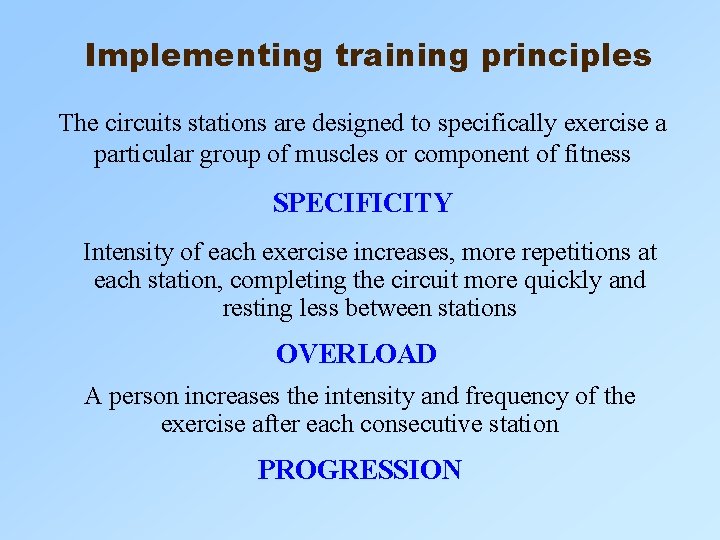
Implementing training principles The circuits stations are designed to specifically exercise a particular group of muscles or component of fitness SPECIFICITY Intensity of each exercise increases, more repetitions at each station, completing the circuit more quickly and resting less between stations OVERLOAD A person increases the intensity and frequency of the exercise after each consecutive station PROGRESSION
Advantages & Disadvantages Advantages: • It is less boring due to all of the exercises being different • It is easily adaptable and can be set up in both indoors and outdoors • It is physically beneficial because you are improving your anaerobic and aerobic fitness Disadvantages: • It can be very time consuming to set up and organize • People can get in each others way if the circuit is busy and performed in a small area
Things to consider when designing your Circuit programme Identify whether you want the circuit to be general (i. e. aerobic and anaerobic) or specific (a muscle group or component of fitness) Plan circuits carefully- be careful not to place stations that are predominantly aerobic after one another as this will overwork certain parts of the body and increase the likelihood of fatigue setting in too soon
Continuous Training Is training without stopping for a rest. The performer maintains the same speed and intensity throughout It should last at least 20 mins What energy system will this develop? AEROBIC ENERGY SYSTEM
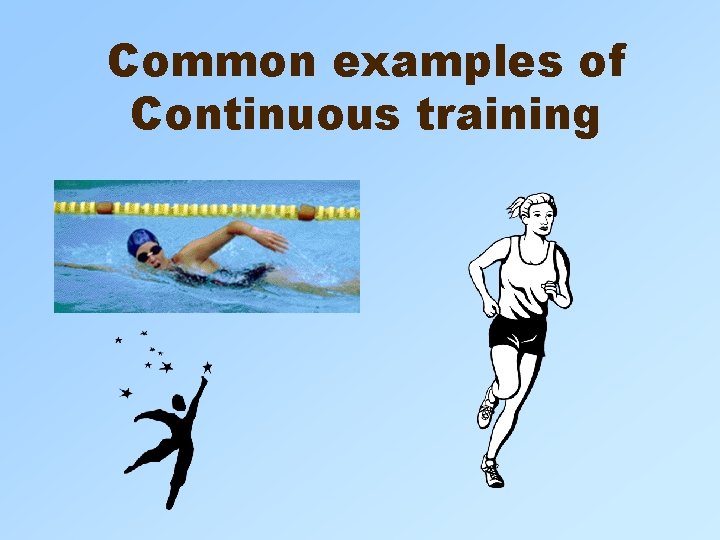
Common examples of Continuous training
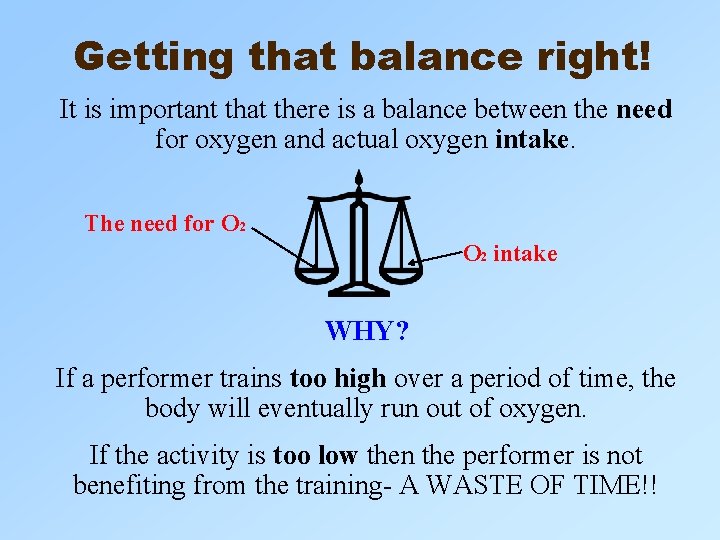
Getting that balance right! It is important that there is a balance between the need for oxygen and actual oxygen intake. The need for O 2 intake WHY? If a performer trains too high over a period of time, the body will eventually run out of oxygen. If the activity is too low then the performer is not benefiting from the training- A WASTE OF TIME!!
Advantages & Disadvantages Advantages: - Keeps you fit and healthy - Good method to improve aerobic and all-round fitness Disadvantages: - If the activity is not high enough to raise the heart rate of the performer then the method is ineffective - If the activity is too hard too soon the performer will most likely exhaust themselves due to the large demand for oxygen
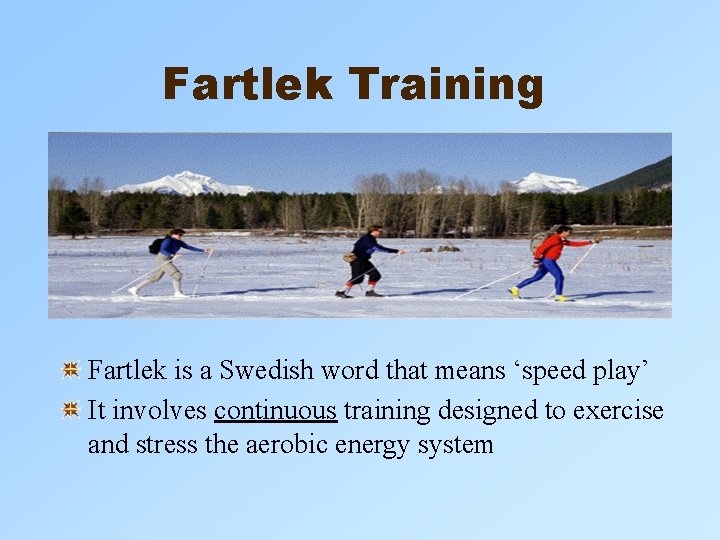
Fartlek Training Fartlek is a Swedish word that means ‘speed play’ It involves continuous training designed to exercise and stress the aerobic energy system
Fartlek Training Involves training using a variety of activities, such as running, walking, sprinting or cycling over varying distances, terrain and speeds without stopping The order in which we place the activities together will produce either an aerobic or anaerobic training effect
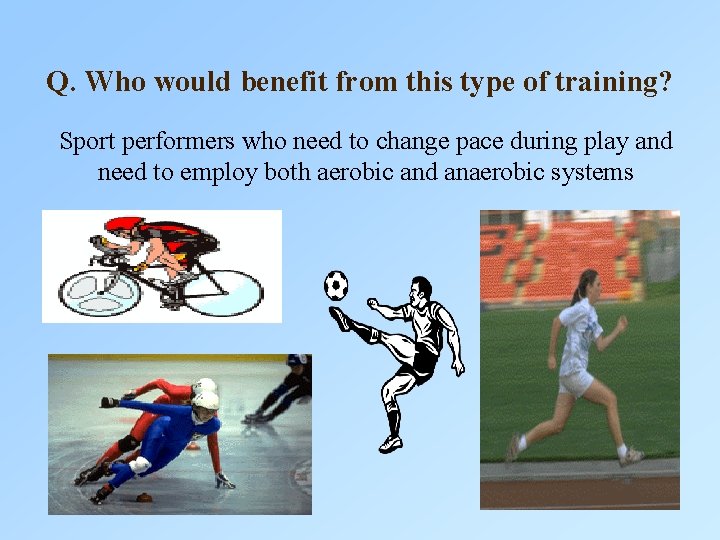
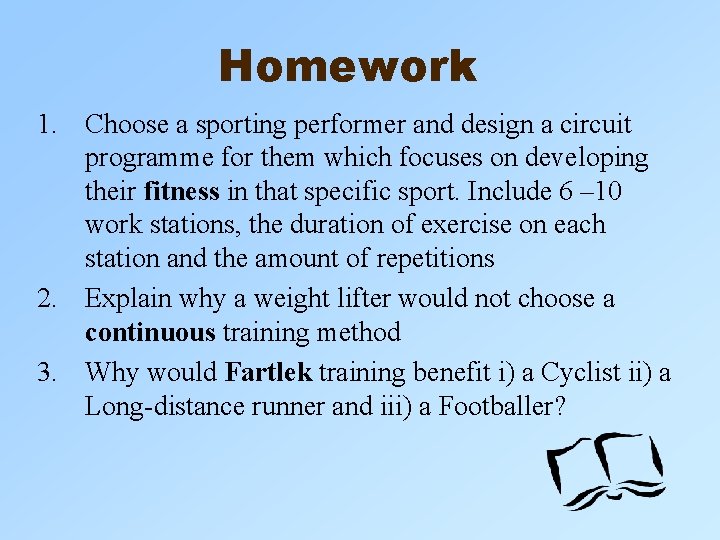
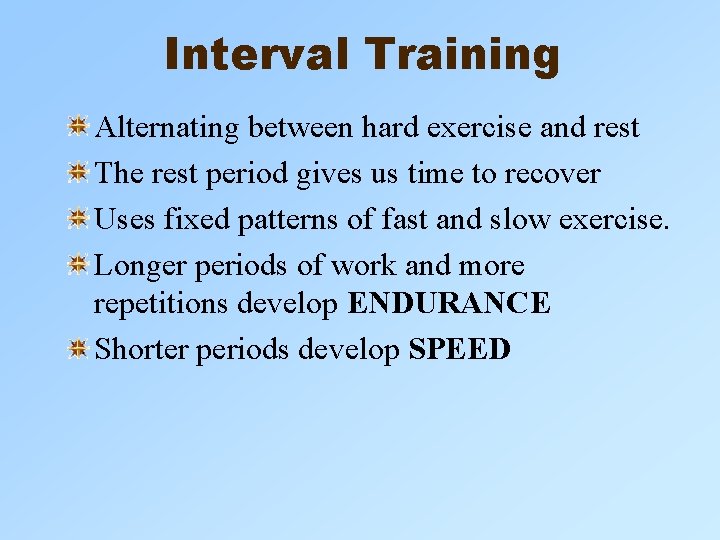
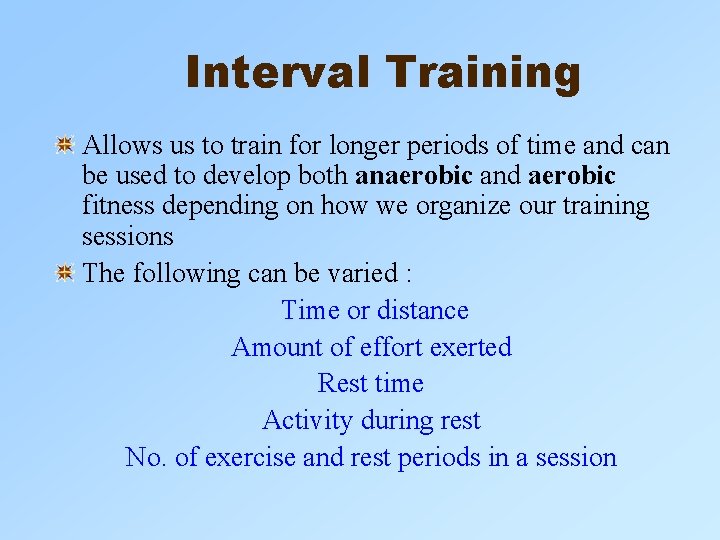
Q. Who would benefit from this type of training? Sport performers who need to change pace during play and need to employ both aerobic and anaerobic systems
Homework 1. Choose a sporting performer and design a circuit programme for them which focuses on developing their fitness in that specific sport. Include 6 – 10 work stations, the duration of exercise on each station and the amount of repetitions 2. Explain why a weight lifter would not choose a continuous training method 3. Why would Fartlek training benefit i) a Cyclist ii) a Long-distance runner and iii) a Footballer?
Interval Training Alternating between hard exercise and rest The rest period gives us time to recover Uses fixed patterns of fast and slow exercise. Longer periods of work and more repetitions develop ENDURANCE Shorter periods develop SPEED
Interval Training Allows us to train for longer periods of time and can be used to develop both anaerobic and aerobic fitness depending on how we organize our training sessions The following can be varied : Time or distance Amount of effort exerted Rest time Activity during rest No. of exercise and rest periods in a session
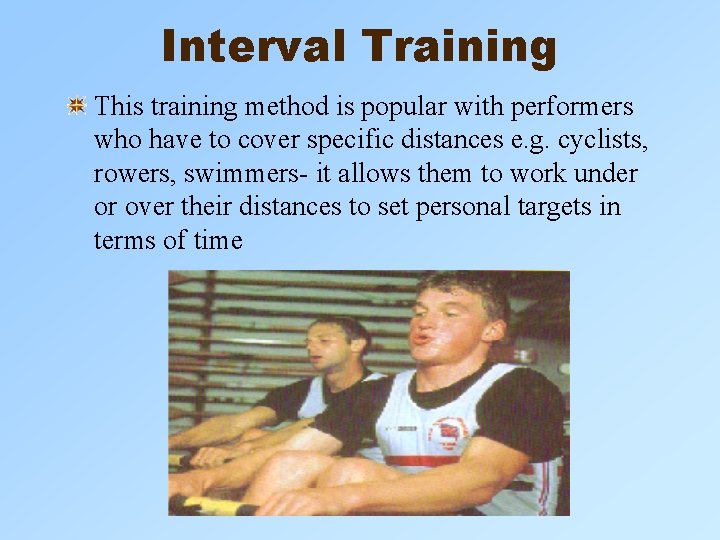
Interval Training This training method is popular with performers who have to cover specific distances e. g. cyclists, rowers, swimmers- it allows them to work under or over their distances to set personal targets in terms of time
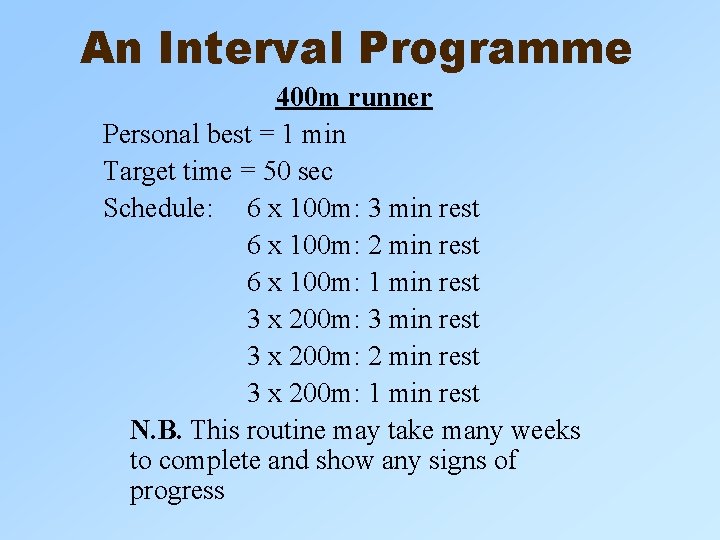
An Interval Programme 400 m runner Personal best = 1 min Target time = 50 sec Schedule: 6 x 100 m: 3 min rest 6 x 100 m: 2 min rest 6 x 100 m: 1 min rest 3 x 200 m: 3 min rest 3 x 200 m: 2 min rest 3 x 200 m: 1 min rest N. B. This routine may take many weeks to complete and show any signs of progress
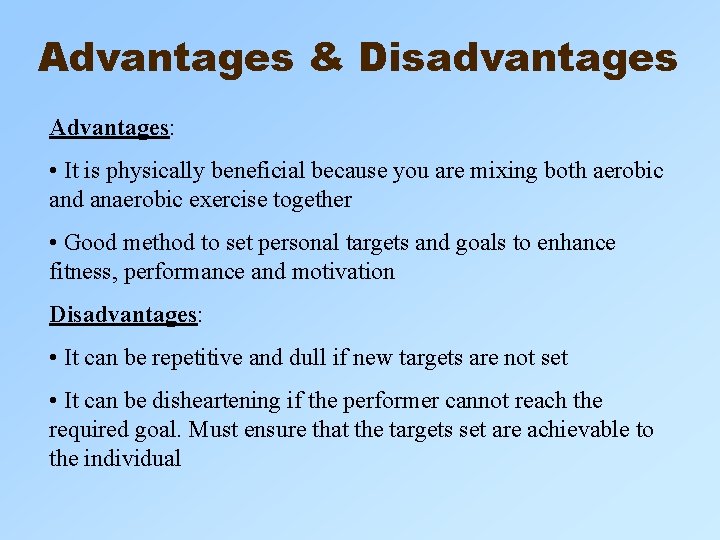
Advantages & Disadvantages Advantages: • It is physically beneficial because you are mixing both aerobic and anaerobic exercise together • Good method to set personal targets and goals to enhance fitness, performance and motivation Disadvantages: • It can be repetitive and dull if new targets are not set • It can be disheartening if the performer cannot reach the required goal. Must ensure that the targets set are achievable to the individual
Weight Training Improves Muscle Strength and Tone and can also be used to improve certain aspects of fitness We use either free weights or machine weights to develop muscles and we should always be supervised when using them
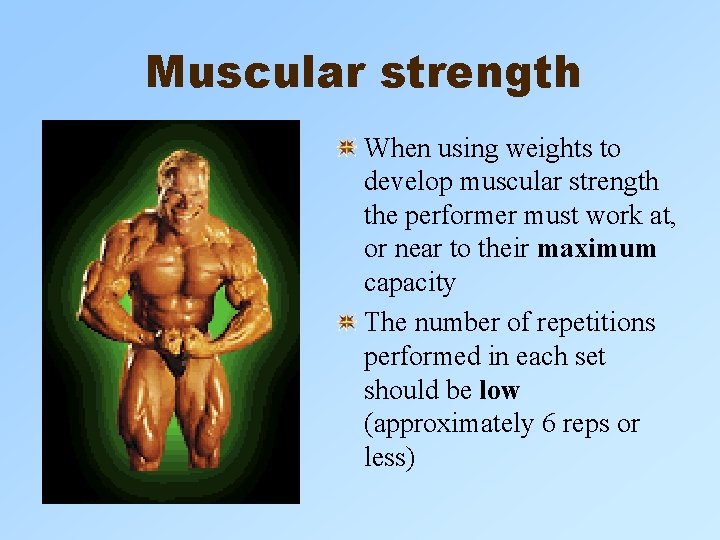
Muscular strength When using weights to develop muscular strength the performer must work at, or near to their maximum capacity The number of repetitions performed in each set should be low (approximately 6 reps or less)
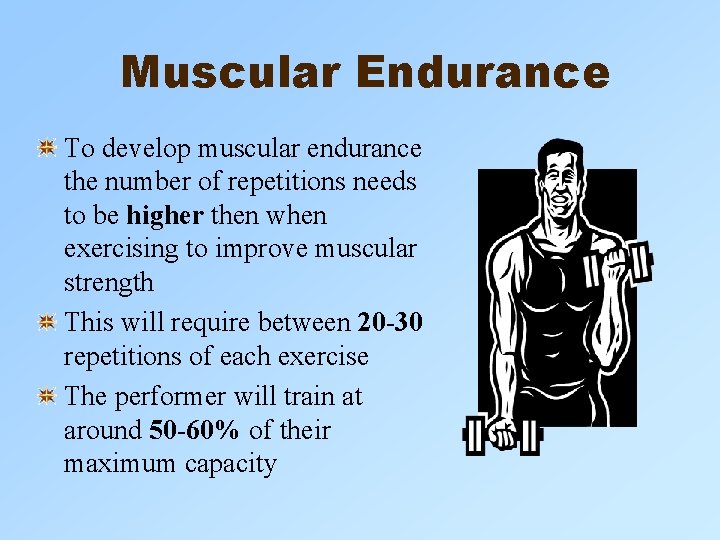
Muscular Endurance To develop muscular endurance the number of repetitions needs to be higher then when exercising to improve muscular strength This will require between 20 -30 repetitions of each exercise The performer will train at around 50 -60% of their maximum capacity
Implementing Training Principles Our individual weight training programme can be designed to develop a particular muscle group SPECIFICITY Gradually increasing the amount of weight after each exercise PROGRESSION How could we stop the effects of reversibility? KEEP TRAINING
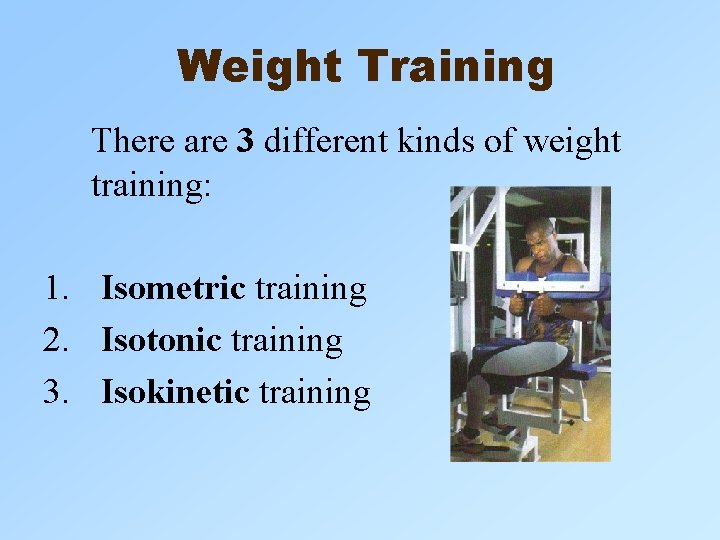
Weight Training There are 3 different kinds of weight training: 1. Isometric training 2. Isotonic training 3. Isokinetic training
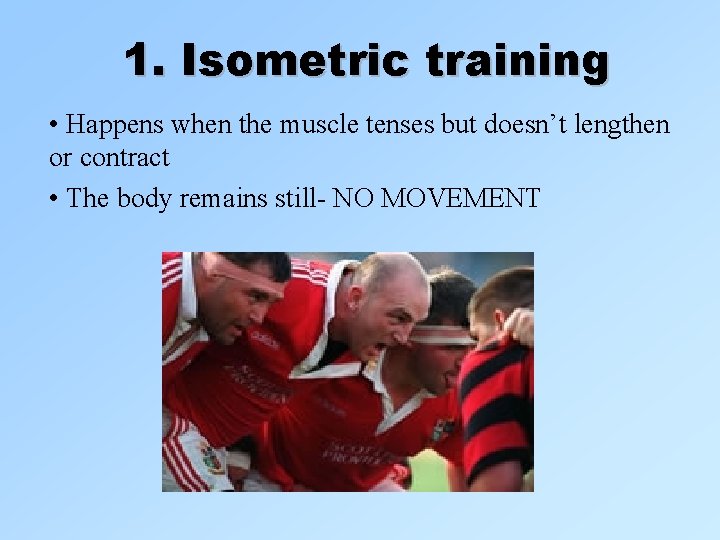
1. Isometric training • Happens when the muscle tenses but doesn’t lengthen or contract • The body remains still- NO MOVEMENT
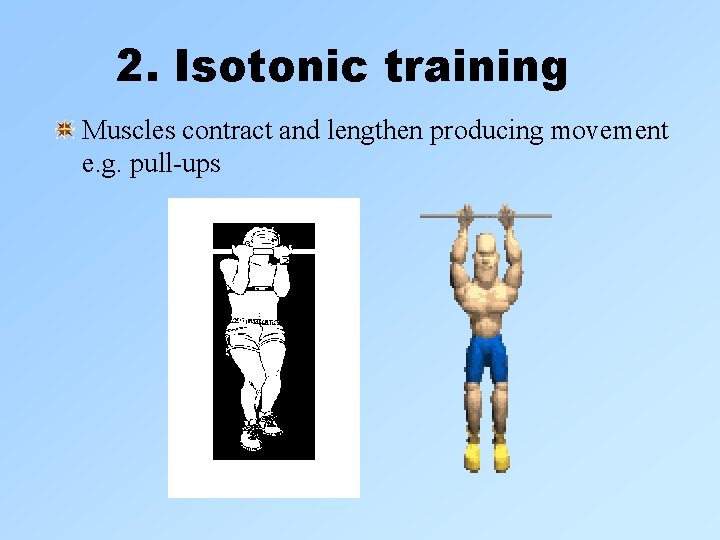
2. Isotonic training Muscles contract and lengthen producing movement e. g. pull-ups
3. Isokinetic Training Muscles contract and shorten at a constant speed. The speed of the movement stays the same throughout The muscles will work at their maximum but the force they produce will vary This is done using special machines and equipment
Advantages & Disadvantages Advantages: Strengthens the muscle throughout the range of movement Easily adaptable to suit most sports Muscles gain strength evenly throughout the range of movement Fastest way to increase muscle strength Cheap, quick and easy to do anywhere Disadvantages: Equipment is very expensive and can be difficult to use if accessibility is low Muscles can become sore because of the stress they’re under when lengthening and there isn’t a sufficient cool down period It is not a good method of training if you have heart problems. Blood flow to the muscle is reduced during exercise, so the blood pressure rises, putting more strain on the heart for little improvement in fitness
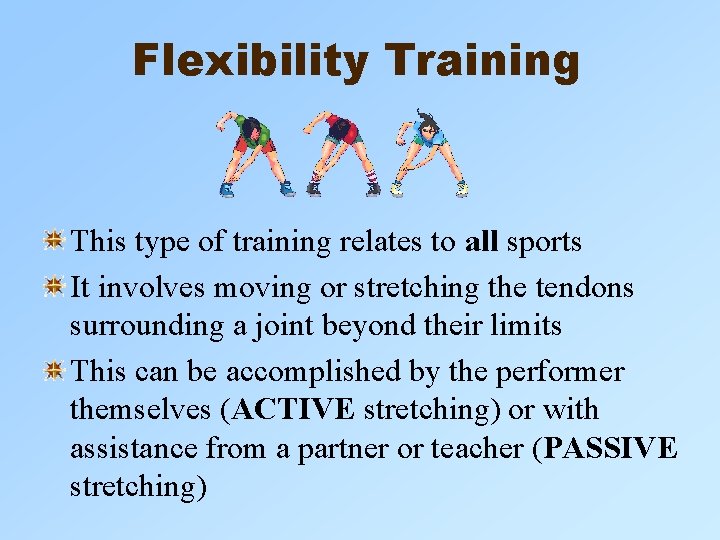
Flexibility Training This type of training relates to all sports It involves moving or stretching the tendons surrounding a joint beyond their limits This can be accomplished by the performer themselves (ACTIVE stretching) or with assistance from a partner or teacher (PASSIVE stretching)
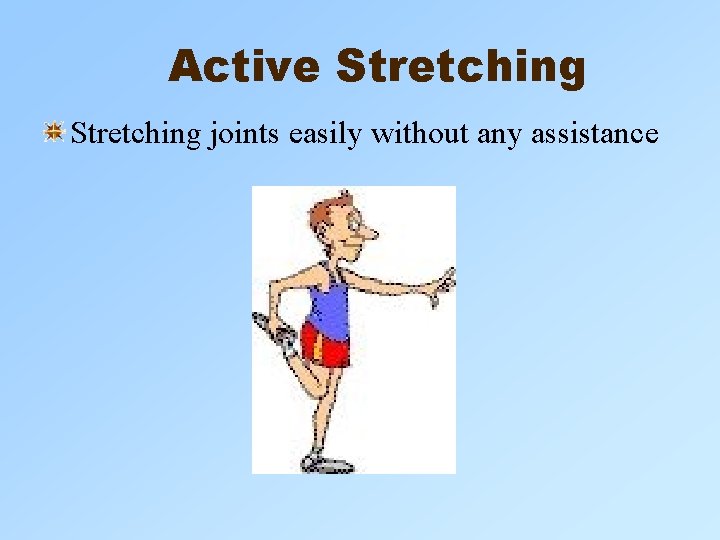
Active Stretching joints easily without any assistance
Passive Stretching joints which can only be achieved with assistance from another e. g. partner, teacher or coach The performer is passive allowing the assistant to stretch the allocated joint The assistant must remember not to stretch the joint too far/ beyond a safe point
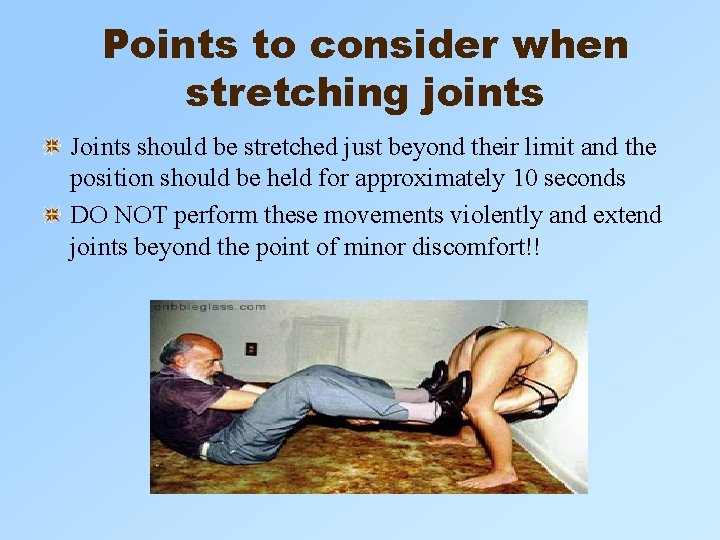
Points to consider when stretching joints Joints should be stretched just beyond their limit and the position should be held for approximately 10 seconds DO NOT perform these movements violently and extend joints beyond the point of minor discomfort!!
Stretching and Flexibility Exercises Form part of: The Training Programme and The Warm Up Phase
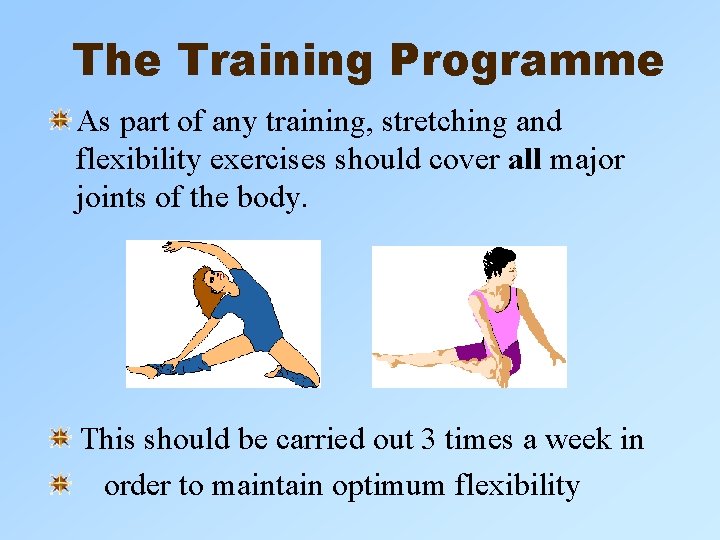
The Training Programme As part of any training, stretching and flexibility exercises should cover all major joints of the body. This should be carried out 3 times a week in order to maintain optimum flexibility
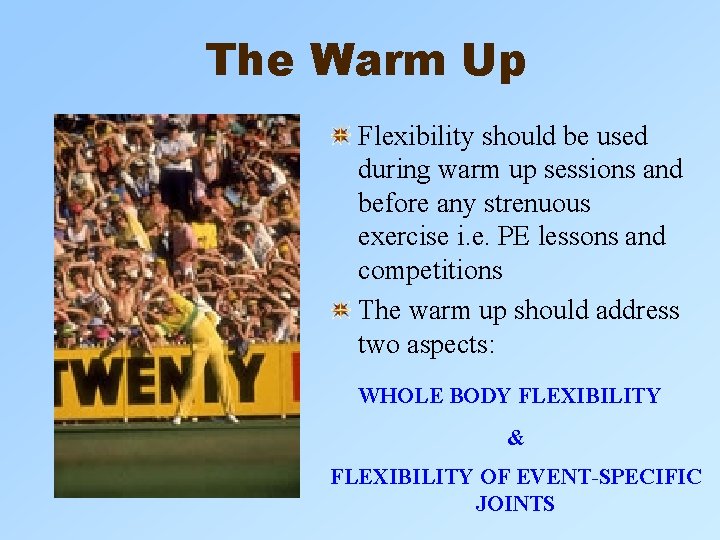
The Warm Up Flexibility should be used during warm up sessions and before any strenuous exercise i. e. PE lessons and competitions The warm up should address two aspects: WHOLE BODY FLEXIBILITY & FLEXIBILITY OF EVENT-SPECIFIC JOINTS
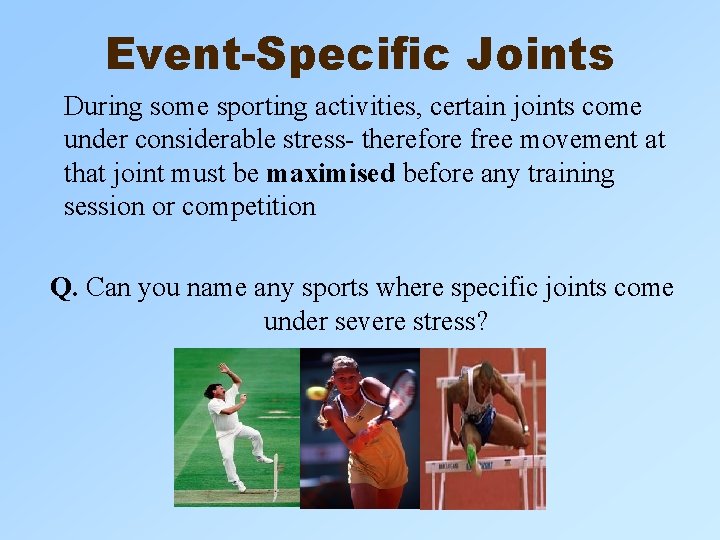
Event-Specific Joints During some sporting activities, certain joints come under considerable stress- therefore free movement at that joint must be maximised before any training session or competition Q. Can you name any sports where specific joints come under severe stress?
Homework 1. Why is interval training the best training method for middle distance runners and swimmers? 2. Explain the difference between isotonic and isometric training. Give examples to illustrate your answer 3. Explain how a teacher could use flexibility during a weight training session? 4. What joints would need to be warmed up for a (1) Tennis player (2) Hurdler and (3) Bowler in cricket prior to performing