
St Leos College Special Education Department Calendar School

- Slides: 30
St. Leo’s College Special Education Department Calendar
School Context • • Voluntary Secondary School for girls Founded by Mercy Sisters in 1839 Under trusteeship of CEIST Current enrolment 1012 students Carlow town Comprehensive intake/non-selective 68 teaching staff Pastoral care and academic performance
St. Leo’s College Mission Statement Inspired by the vision of Catherine Mc. Auley, St. Leo’s College is committed to the holistic development of each student. As a catholic school, we pursue excellence in an inclusive, caring and respectful environment.
Special Education Needs Team Learning Support Co-ordinator (SENCO) Core Team (Three learning support teachers and 1. 5 Special Needs Assistants) All core team also mainstream teachers 25 subject teachers Special Class for pupils Moderate General Learning Disability
Resource Application Present Model National Council for Special Education allocates resources through the local Special Education Needs Officer (SENO) Supports do not automatically transfer from primary school Pupils who have Psycho-Educational Report may not meet criteria for Resource/Learning Support in secondary school. Learning support hours / SNA / Assistive technology • This year secondary schools have received a general allocation of learning support hours for high incidence S. E. N. i. e. specific learning difficulty / borderline or mild general learning disability. • Application required for individual students who experience what is referred to as low incidence S. E. N. needs i. e. physical/sensory/visual disability, autistic spectrum or assessed syndrome.
NCSE New Model of Allocation Step 1: Allocation provided to schools Two components to this: A. School educational profile component – three elements to this: 1. Complex special educational needs 2. Standardised test results 3. Social context of school B. Baseline component – provided to every mainstream school
How we support our pupils? Present Practice • • • Whole School approach (Policies to practice) Mainstream mixed ability classes Emphasis on literacy and numeracy Team teaching * Special class – Moderate General Learning Disability
Identifying and Supporting Pupils Present Practice • The Learning Centre Suite (T. L. C) Rooms – Small groups and One to One • Irish Exemptions- support when timetabled for Irish • If no Irish exemption in place support is provided during a non-exam subject • Assisted Study
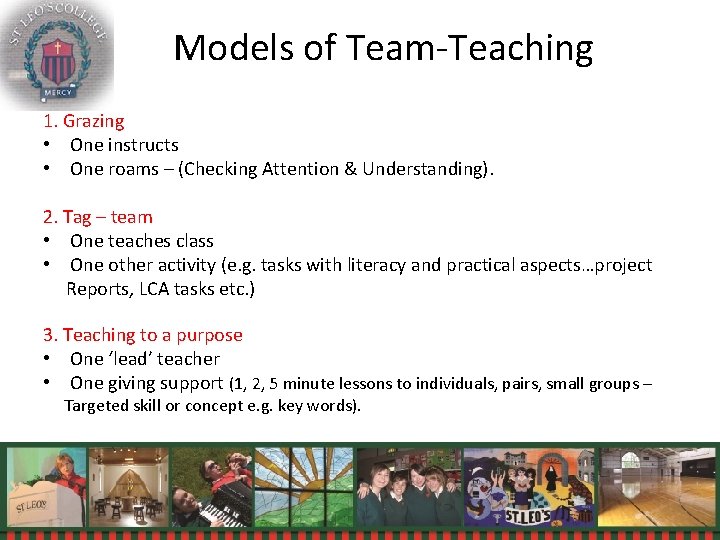
Models of Team-Teaching 1. Grazing • One instructs • One roams – (Checking Attention & Understanding). 2. Tag – team • One teaches class • One other activity (e. g. tasks with literacy and practical aspects…project Reports, LCA tasks etc. ) 3. Teaching to a purpose • One ‘lead’ teacher • One giving support (1, 2, 5 minute lessons to individuals, pairs, small groups – Targeted skill or concept e. g. key words).
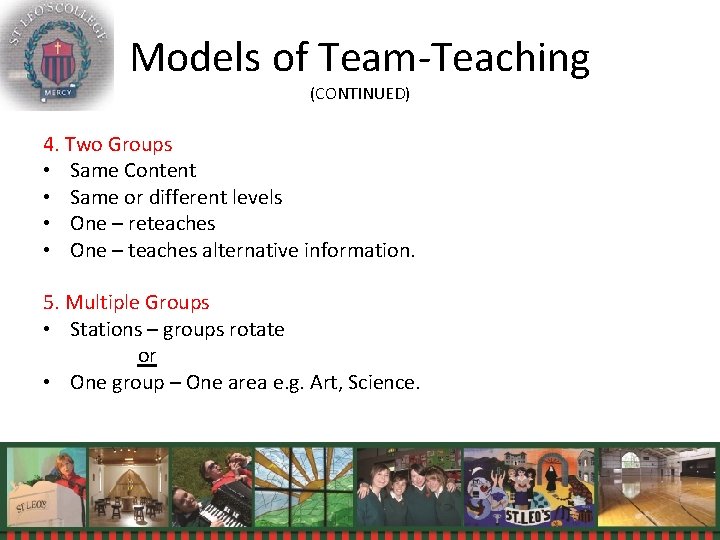
Models of Team-Teaching (CONTINUED) 4. Two Groups • Same Content • Same or different levels • One – reteaches • One – teaches alternative information. 5. Multiple Groups • Stations – groups rotate or • One group – One area e. g. Art, Science.
Current Resource Teaching Allocation Low Incidence Teaching Hours High Incidence Teaching Hours Special class teaching Allocation SNA Posts
Ongoing Assessment in St. Leo’s College • • • Formal and Informal Entrance assessment (CAT IV) NNRIT Group Reading Access Maths
Sharing of relevant information Professional reports are summarised and shared with teachers on Edmodo (Virtual learning site) Recommendations made by relevant professionals are available to staff Primary School Education Passports available on VS Ware
Exceptionally Able Pupils identified based on Entrance Assessment (CAT 4) and NNRIT results Advice provided as to opportunities available to pupils Staff member liaises with pupils throughout the year – Financial Support
Special Education Department Calendar 2016 -17 • • • September Meet Principal/Deputy Principal Meet with Year Head and Class Heads of incoming 1 st years to share relevant information Input to staff meeting on SEN organization in school Meeting for all teachers involved in Learning Support and Resource Depts. Allocate students to teachers working in SEN Dept. Collect all timetables. Photocopy all teacher timetables and student timetables Photocopy all students addresses and phone numbers Arrange weekly meeting for core S. E. N. Team
• September (Continued) • Organize Resource Room and ensure all teachers have necessary room codes. • Arrange T. L. C Rooms – I. T installed/updated etc. • Arrange SEN office. • Meet with Special Needs Assistants • Update SEN Notice board • Finalise timetables • Ensure SEN Dept. has all psychological/professional reports on students and upload information to SEN section on Edmodo. • Contact parents • Study House Exams results from previous May and respond to any emergency cases. • Contact N. E. P’s Psychologist
September (Continued) • Contact SENO- second round of allocation in September in recent years for LITH/SNA support • Meet with Visiting Teachers (Visual and Hearing Impaired) • Renew membership of relevant professional bodies ( I. A. T. S. E and I. L. S. A. ) • Presentation by SENCO and HSCL teacher at First year parents Evening • Allocate additional Learning Support Hours which school may have available • Attend Open Evening and answer queries from parents of incoming First Years who have special educational needs • Assisted Study- target S. E. N. pupils in First Year and Junior School • Interview and timetable T. Y. pupils to act as mentors in Assisted Study
October • Supporting School Leavers 2017 who may require additional on- going support when they leave school • Liaise with H. S. E. Occupational Guidance Officer • Organize standard testing of 2 nd: Access Maths / Access Reading • Draw up list of resources required and place orders • Draw up Student Profile/outline of worksheets • Organize input into School Planning Day • Attend I. A. T. S. E. Seminars • Advertise upcoming LS/Resource related courses especially in Kilkenny and Laois Education Centres or on-line • Prepare for Parent- teachers meetings • Reasonable Accommodations in Certificate Examinations (R. A. C. E. ) applications for Leaving Cert 2017. • Testing of Sixth Year pupils who may require access to a reader/etc commences
Halloween to Christmas November • Preparations for RACE applications – Leaving Cert. 2017 • Preparation for Parent-Teacher meetings • Meet with incoming pupils and their parents for escorted visit around school campus December • Preparations for RACE applications – Junior Cert. 2017 • Prepare for Christmas In-house Exams • Organize Reasonable Accommodations for Christmas Exam • School reports
2017 Commences January • Prepare for Parent- teachers meetings • Meet with Principal re: application for Resource hours for 2017 -2018. • Meet with parents of incoming First Years requiring LITH/SNA Support • Completion of application forms for submission to N. C. S. E for incoming First Years 2017 -18 • Target and meet pupils/parents identified as suitable for L. CA February • Submission of School Leavers Form to NCSE (17 -2 -17) • Organize Reasonable Accommodations for Junior and Leaving Cert Mock Exams • Prepare for Parent- teacher meetings • Submission of School Leavers Form to NCSE • Assist in Entrance Assessment • Organize Reasonable Accommodation if required for any incoming pupil
The Year Marches On March • Second Year Testing - Access Maths and Access Reading • Prepare and assist in Entrance Assessment • Co-ordinator to meet with Principal re: application for ‘Support’ hours for 2017 -2018. • Assist SEN pupils with DARE and HEAR CAO applications April • Submission of application forms to NCSE for Access to SNA support (4 -4 -17) • Prepare for Who Wants to Be a Millinonaire Reading Challenge Commence visiting Feeder primary schools • Analysis of Entrance Assessment results
The year draws to a close May • Visit Primary Schools of incoming 1 st years • Prepare for Summer In-house Exams • Organize reasonable accommodations for Summer In-house Exams • Summer Reports • Presentation of Certificates at Awards Day Ceremony • Identification of Fifth Year pupils who will require RACE in Sixth Year • Facilitate visit of any incoming First Year requiring a high level of support (pupil and parents/guardians/teachers/SNAs)
THROUGHOUT THE YEAR Home Visits Liaise with N. E. P’s Liaise with Túsla Attend Case Conferences Liaise with N. C. S. E. Formal and Informal communication with parents Attendance at weekly meetings of Senior and Junior Year heads, Guidance Counsellers and Deputy Principals • Attend meetings as member of various review and sub-groups • On going CPD • •
RACE Applications Pupils tested to ascertain whether to proceed with application for the following accommodations • Spelling and Grammar Waiver • Reader • Scribe • Assistive Technology
Transition to Third Level DARE APPLICATIONS • • Educational Impact Statement Six Educational Indicators Only one required to meet criteria SEN team assist pupils who received support Career Guidance Counsellors support pupils completing Application Form
Moderate Special Class • Only class for pupils with Moderate General Learning Disability in Carlow • Diagnosis of Moderate GLD by a professional in order to access class • Anchor teacher co-ordinates (member of core SEN Team)
Moderate special class (continued) • Emphasis on Literacy and Numeracy • Preparation to sit five subjects in Junior Certificate (English, Mathematics, Art, Home Economics and CSPE) • Shorter school day AND shorter lunch break • Few teachers enabling consolidation of relationships • Preparation to join LCA class in senior Cycle (3)
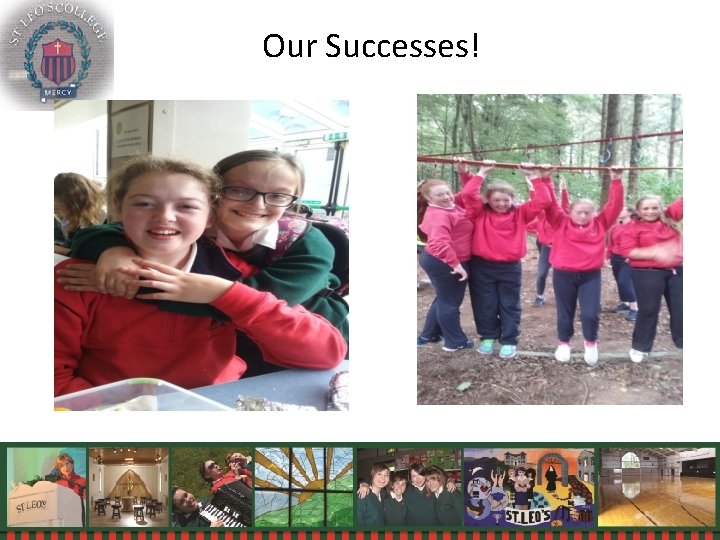
Our Successes!
Key Messages • Teamwork vital for success • Delegation of roles and workload within core team (Timetabling, RACE, HSCL, Moderate Class) • SEN Register • CPD for core and mainstream teachers • ILP’s and IEP’s update and evaluate • SEN Policy, monitor and update • Update relevant documentation • Monitor ‘progress’ of new Allocation Model
GOOD COMMUNICATION ENSURES A WHOLE SCHOOL AND INCLUSIVE APPROACH TO SUPPORT PUPILS WITH SPECIAL EDUCATIONAL NEEDS