
St Ice Skousen Debt Financing Chapter 12 Intermediate
St. Ice |Skousen Debt Financing Chapter 12 Intermediate Accounting 16 E Prepared by: Sarita Sheth | Santa Monica College COPYRIGHT © 2007 Thomson South-Western, a part of The Thomson Corporation. Thomson, the Star logo, and South-Western are trademarks used herein under license.
Learning Objectives 1. Understand the various classification and measurement issues associated with debt. 2. Account for short-term debt obligations, including those expected to be refinanced, and describe the purpose of lines of credit. 3. Apply present value concepts to the accounting for long-term debts such as mortgages. 4. Understand the various types of bonds, compute the price of a bond issue, and account for the issuance, interest, and redemption of bonds.
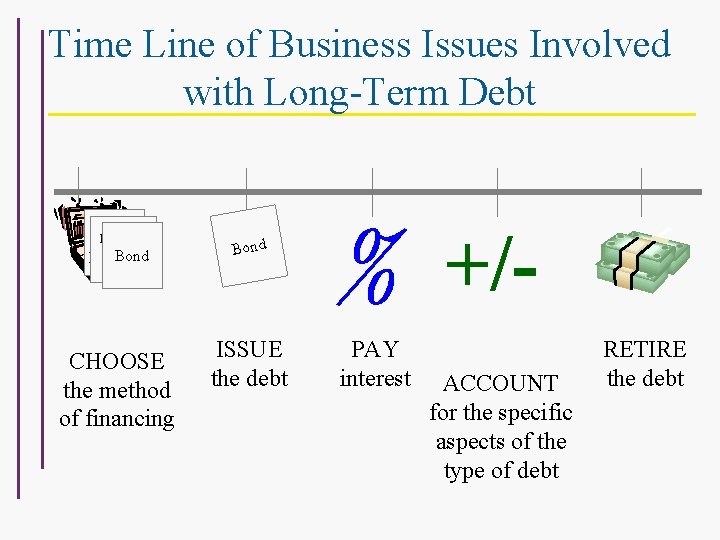
Time Line of Business Issues Involved with Long-Term Debt Notes Mortgage Bond Payable CHOOSE the method of financing +/- Bond ISSUE the debt PAY interest ACCOUNT for the specific aspects of the type of debt RETIRE the debt
Definition of Liabilities • The obligation of a particular entity to transfer assets or provide services. – Must be the result of past transactions or events. – Probable transfer of assets (or services) must be in the future.
Classification of Liabilities • Current Liabilities- Paid within one year or the operating cycle, whichever is longer. • Noncurrent Liabilities. Not paid within one year or the operating cycle, whichever is longer.
Stop and Think Look at Exhibit 12 -3. The 2004 current ratio of Mc. Donald’s is only 0. 81. How will Mc. Donald’s most likely meet its current obligations as they come due?
Measurement of Liabilities For measurement purposes, liabilities can be divided into three categories: 1. Liabilities that are definite in amount. 2. Estimated liabilities. 3. Contingent liabilities.
Accounting for Short-Term Debt • Short-Term obligations are due within one year or an operating cycle. • Account Payable -the amount due for the purchase of materials. • Notes Payable – a formal written promise to pay a sum of money in the future, also known as a promissory note.
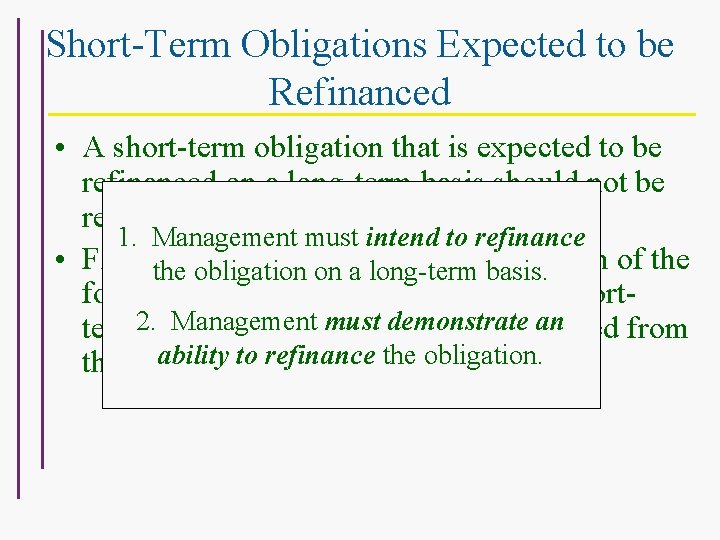
Short-Term Obligations Expected to be Refinanced • A short-term obligation that is expected to be refinanced on a long-term basis should not be reported as a current liability 1. Management must intend to refinance • FASBthe Statement requiresbasis. that both of the obligation. No. on a 6 long-term following conditions be met before a short. Management must an term 2. obligation may be demonstrate properly excluded from abilityliability to refinance the obligation. the current classification:
Short-Term Obligations Expected to be Refinanced • An ability to refinance may be demonstrated by: – Actually refinancing the obligation during the period between the balance sheet date and the date the statements are issued. – Reaching a firm agreement that clearly provides for refinancing on a long-term basis.
Short-Term Obligations Expected to be Refinanced • The terms of the refinancing agreement should be non -cancelable as to all parties. • The terms of the refinancing agreement should extend beyond the current year. • The company should not be in violation of the agreement at the balance sheet date or the date of issuance. • The lender or investor should be financially capable of meeting the refinancing requirements.
Lines of Credit • Line of credit- is a negotiated arrangement with a lender in which the terms are agreed to prior to the need for borrowing. • A company with an established line of credit can access funds quickly without the “red tape”. • Once the line of credit is used to borrow money, the company has a formal liability (current or noncurrent).
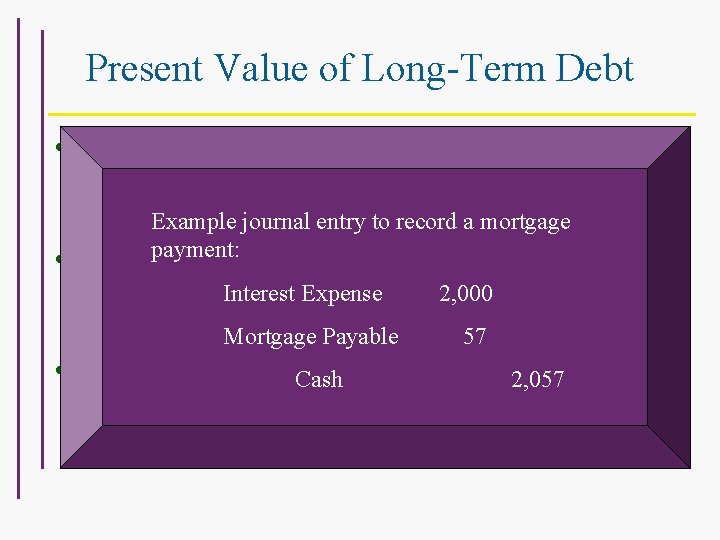
Present Value of Long-Term Debt • A liability should be reported at the amount that would satisfy the obligation on the balance sheet Example date. journal entry to record a mortgage • For a payment: long-term obligation, this amount is the Interest Expense 2, 000 present value of the future payments to be made. Mortgage Payable 57 • The division of these interest Cash payments into 2, 057 and principal components is a process called loan amortization.
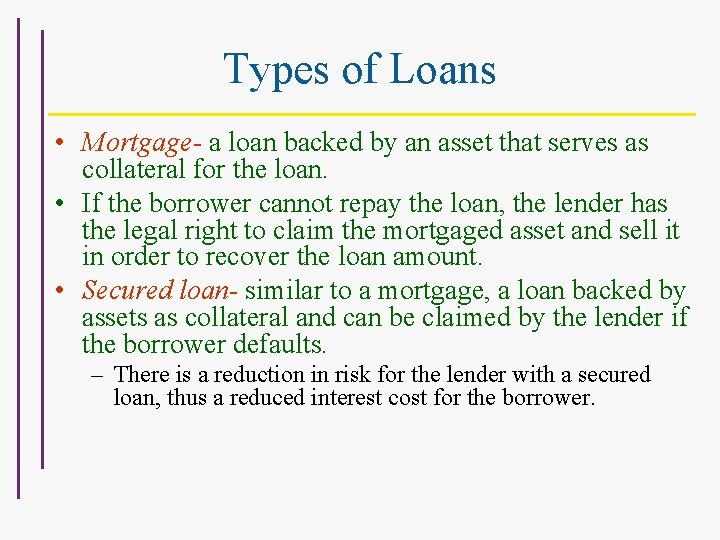
Types of Loans • Mortgage- a loan backed by an asset that serves as collateral for the loan. • If the borrower cannot repay the loan, the lender has the legal right to claim the mortgaged asset and sell it in order to recover the loan amount. • Secured loan- similar to a mortgage, a loan backed by assets as collateral and can be claimed by the lender if the borrower defaults. – There is a reduction in risk for the lender with a secured loan, thus a reduced interest cost for the borrower.
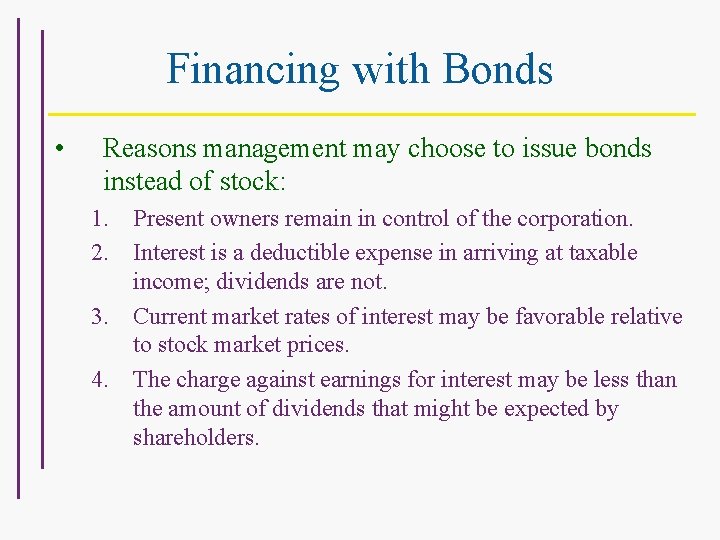
Financing with Bonds • Reasons management may choose to issue bonds instead of stock: 1. Present owners remain in control of the corporation. 2. Interest is a deductible expense in arriving at taxable income; dividends are not. 3. Current market rates of interest may be favorable relative to stock market prices. 4. The charge against earnings for interest may be less than the amount of dividends that might be expected by shareholders.
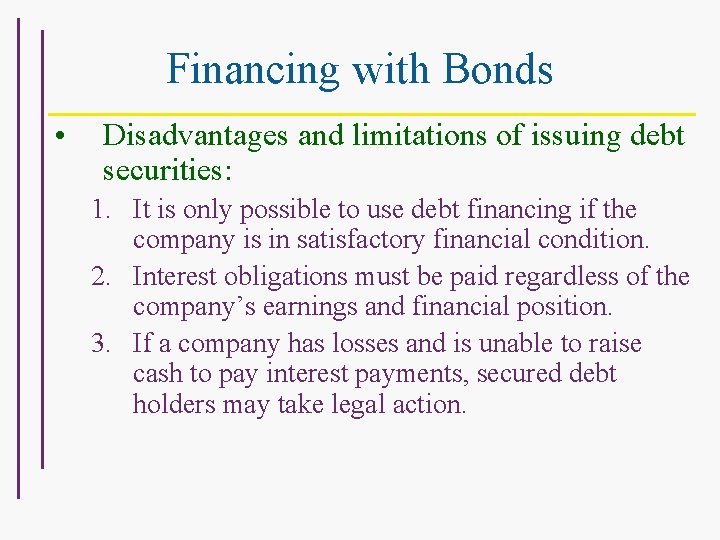
Financing with Bonds • Disadvantages and limitations of issuing debt securities: 1. It is only possible to use debt financing if the company is in satisfactory financial condition. 2. Interest obligations must be paid regardless of the company’s earnings and financial position. 3. If a company has losses and is unable to raise cash to pay interest payments, secured debt holders may take legal action.
Accounting for Bonds • There are three main considerations in accounting for bonds: 1. Recording the issuance or purchase. 2. Recognizing the applicable interest during the life of the bonds. 3. Accounting for the retirement of bonds either at maturity or prior to the maturity date.
Nature of Bonds • Bond Certificates- commonly referred to as bonds are issued in denominations of $1, 000. • Face Value- the amount that will be paid on a bond at maturity date. Also known as par value or maturity value. • Bond indenture- a group contract between the corporation and the bondholders.
Types of Bonds • Term bonds- Bonds that mature in one lump sum on a specified future date. • Serial bonds- Bonds that mature in a series of installments at future dates. • Collateral trust bonds- Bonds usually secured by stocks and bonds of other corporations owned by the issuing company. • Unsecured (debenture) bonds- Bonds for which no specific collateral has been pledged.
Types of Bonds • Registered bonds- Bonds for which the issuing company keeps a record of the names and addresses of all bondholders and pays interest only to those individuals whose names are on file. • Bearer (coupon) bonds- Unregistered bonds for which the issuer has no record of current bondholders, but instead pays interest to anyone who can show evidence of ownership.
Types of Bonds • Zero-interest bonds- Bonds that do not bear interest but instead are sold at significant discounts. • Junk bond- High-risk, high-yield bonds issued by companies in a weak financial condition. • Commodity-backed bonds- Bonds that may be redeemed in terms of commodities. • Callable bonds- Bonds for which the issuer reserves the right to pay the obligation prior to the maturity date.
Market Price of Bonds • Bond discount- The difference between the face value and the sales price when bonds are sold below their face value. § Bond premium- The difference between the face value and the sales price when bonds are sold above their face value.
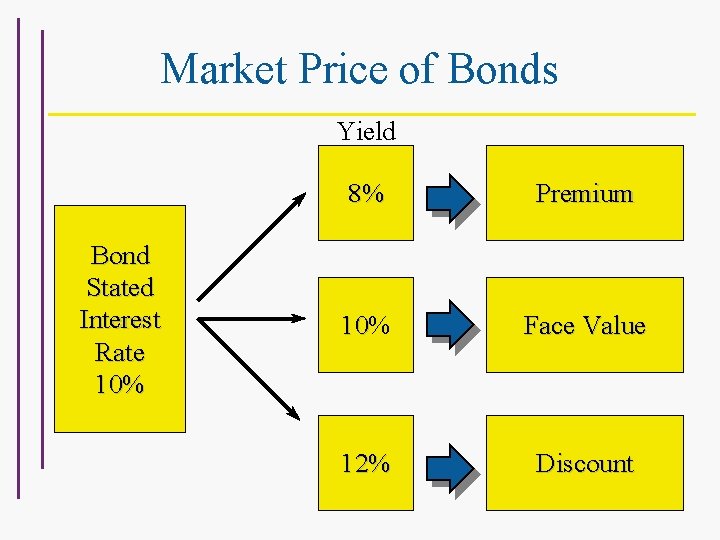
Market Price of Bonds Yield Bond Stated Interest Rate 10% 8% Premium 10% 10 Face Value 12% Discount
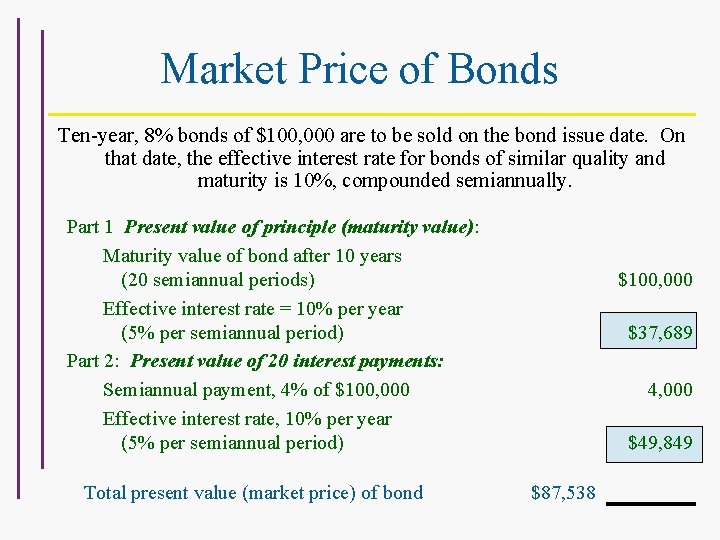
Market Price of Bonds Ten-year, 8% bonds of $100, 000 are to be sold on the bond issue date. On that date, the effective interest rate for bonds of similar quality and maturity is 10%, compounded semiannually. Part 1 Present value of principle (maturity value): Maturity value of bond after 10 years (20 semiannual periods) Effective interest rate = 10% per year (5% per semiannual period) Part 2: Present value of 20 interest payments: Semiannual payment, 4% of $100, 000 Effective interest rate, 10% per year (5% per semiannual period) Total present value (market price) of bond $100, 000 $37, 689 4, 000 $49, 849 $87, 538
Stop and Think In computing the market price for bonds, what is the only thing for which the stated rate of interest is used?
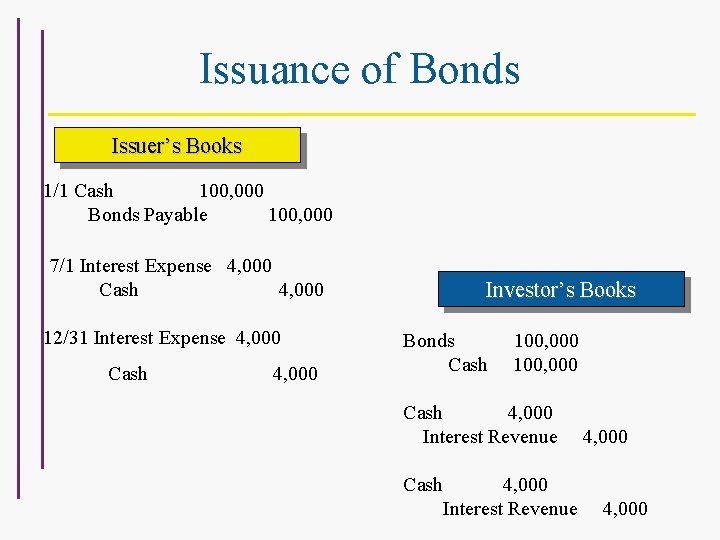
Issuance of Bonds Issuer’s Books 1/1 Cash 100, 000 Bonds Payable 100, 000 7/1 Interest Expense 4, 000 Cash 4, 000 12/31 Interest Expense 4, 000 Cash 4, 000 Investor’s Books Bonds Cash 100, 000 Cash 4, 000 Interest Revenue 4, 000
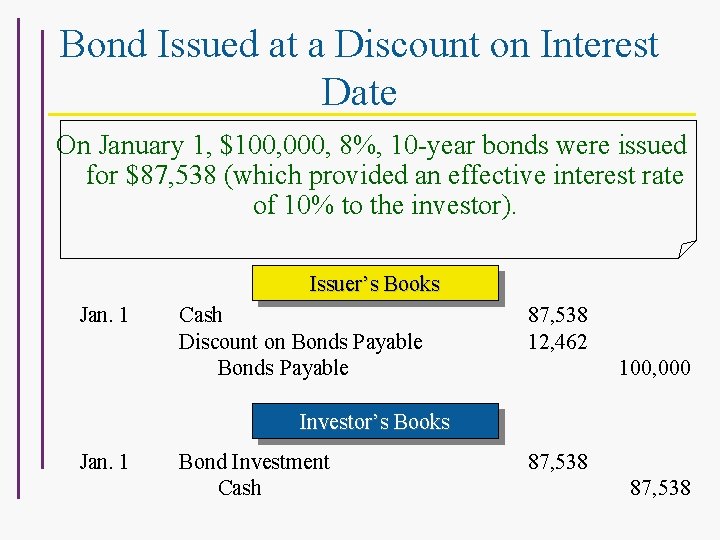
Bond Issued at a Discount on Interest Date On January 1, $100, 000, 8%, 10 -year bonds were issued for $87, 538 (which provided an effective interest rate of 10% to the investor). Issuer’s Books Jan. 1 Cash Discount on Bonds Payable 87, 538 12, 462 100, 000 Investor’s Books Jan. 1 Bond Investment Cash 87, 538
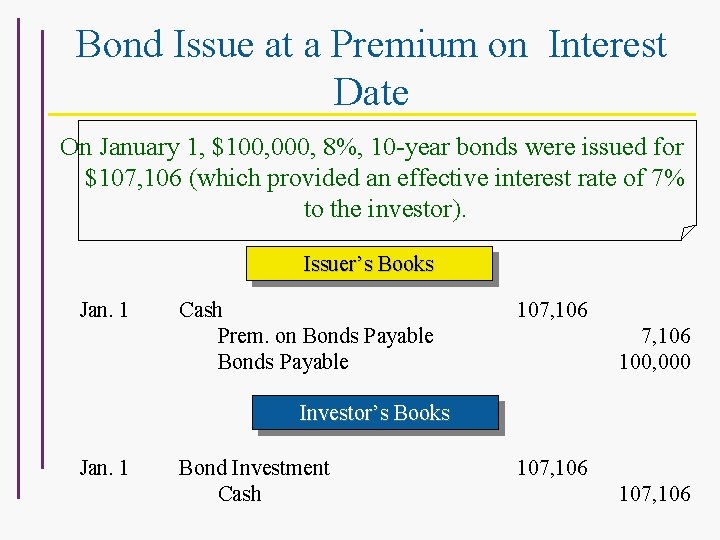
Bond Issue at a Premium on Interest Date On January 1, $100, 000, 8%, 10 -year bonds were issued for $107, 106 (which provided an effective interest rate of 7% to the investor). Issuer’s Books Jan. 1 Cash Prem. on Bonds Payable 107, 106 100, 000 Investor’s Books Jan. 1 Bond Investment Cash 107, 106
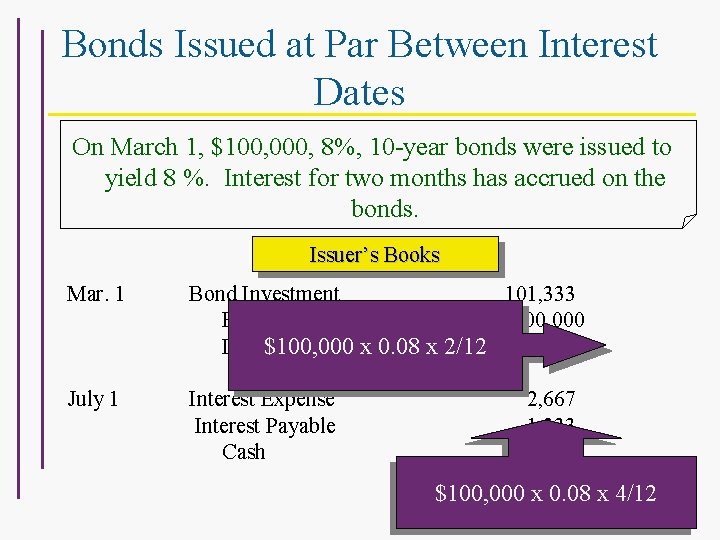
Bonds Issued at Par Between Interest Dates On March 1, $100, 000, 8%, 10 -year bonds were issued to yield 8 %. Interest for two months has accrued on the bonds. Issuer’s Books Mar. 1 Bond Investment 101, 333 Bonds Payable 100, 000 Interest Payablex 0. 08 x 2/12 1, 333 $100, 000 July 1 Interest Expense Interest Payable Cash 2, 667 1, 333 4, 000 $100, 000 x 0. 08 x 4/12
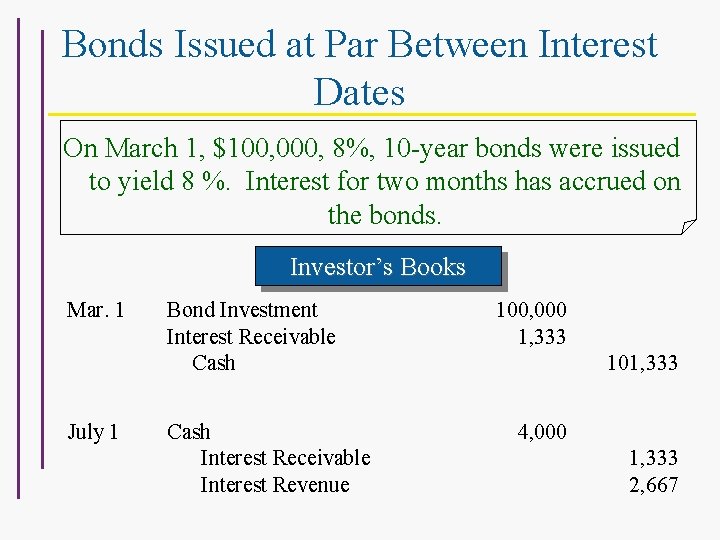
Bonds Issued at Par Between Interest Dates On March 1, $100, 000, 8%, 10 -year bonds were issued to yield 8 %. Interest for two months has accrued on the bonds. Investor’s Books Mar. 1 July 1 Bond Investment Interest Receivable Cash Interest Receivable Interest Revenue 100, 000 1, 333 101, 333 4, 000 1, 333 2, 667
When Bonds are Issued at a Premium or Discount: • The market acts to adjust the stated interest rate to a market or effective interest rate. • The periodic interest payments made by the issuer are not the total interest expense. • An adjustment to interest expense (amortization) associated with the cash payment is necessary to reflect the effective interest being incurred on the bonds. • There are two methods used to amortize the premium/ discount: – Straight Line Method – Effective Interest Method
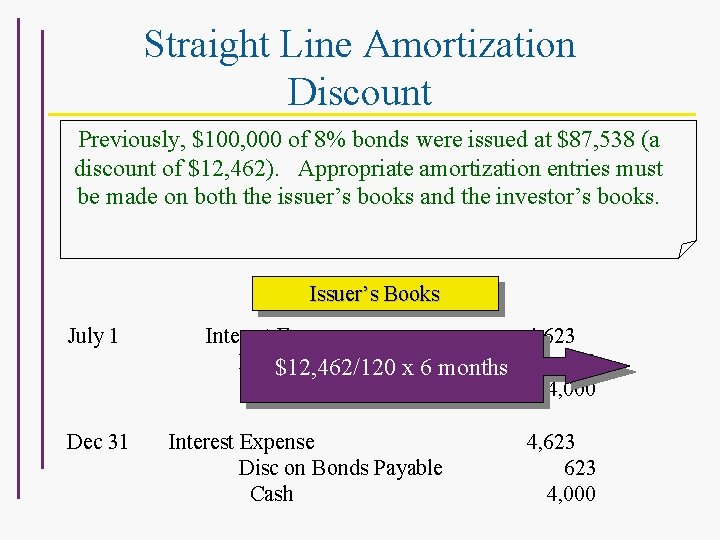
Straight Line Amortization Discount Previously, $100, 000 of 8% bonds were issued at $87, 538 (a discount of $12, 462). Appropriate amortization entries must be made on both the issuer’s books and the investor’s books. Issuer’s Books July 1 Dec 31 Interest Expense 4, 623 Disc$12, 462/120 on Bonds Payable 623 x 6 months Cash 4, 000 Interest Expense Disc on Bonds Payable Cash 4, 623 4, 000
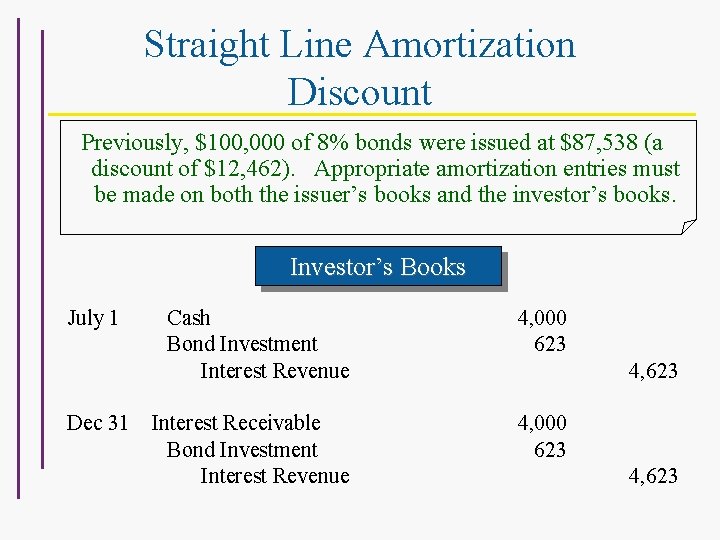
Straight Line Amortization Discount Previously, $100, 000 of 8% bonds were issued at $87, 538 (a discount of $12, 462). Appropriate amortization entries must be made on both the issuer’s books and the investor’s books. Investor’s Books July 1 Dec 31 Cash Bond Investment Interest Revenue 4, 000 623 Interest Receivable Bond Investment Interest Revenue 4, 000 623 4, 623
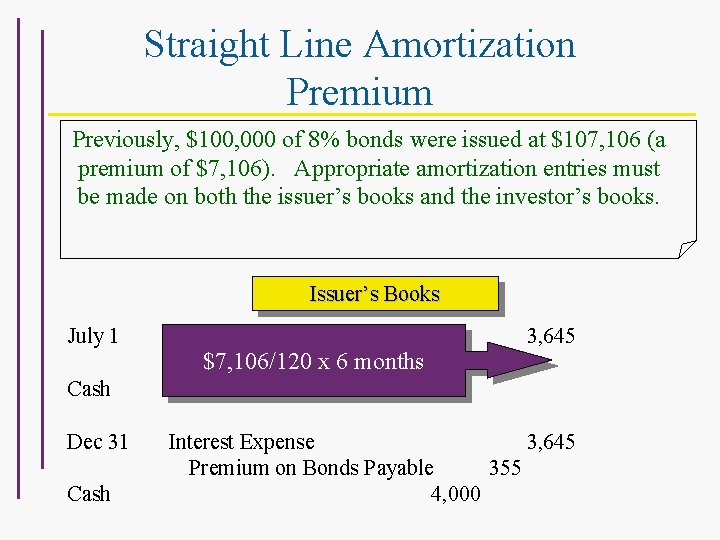
Straight Line Amortization Premium Previously, $100, 000 of 8% bonds were issued at $107, 106 (a premium of $7, 106). Appropriate amortization entries must be made on both the issuer’s books and the investor’s books. Issuer’s Books July 1 Cash Dec 31 Cash Interest Expense $7, 106/120 6 months Premium on x. Bonds Payable 4, 000 3, 645 355 Interest Expense 3, 645 Premium on Bonds Payable 355 4, 000
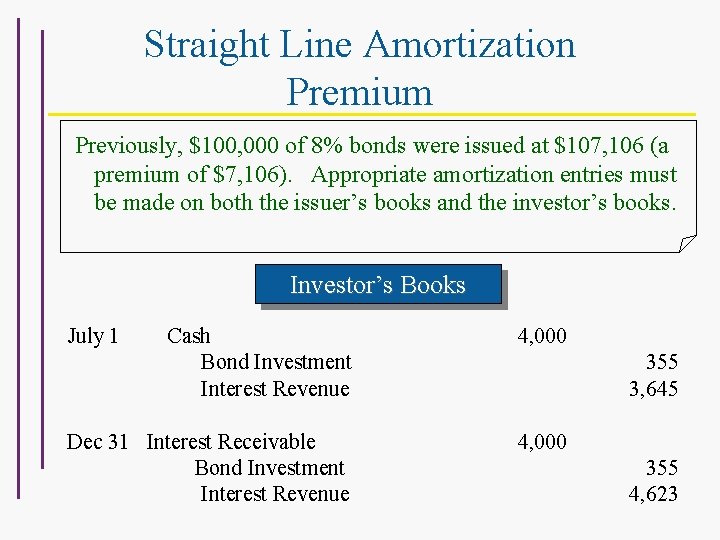
Straight Line Amortization Premium Previously, $100, 000 of 8% bonds were issued at $107, 106 (a premium of $7, 106). Appropriate amortization entries must be made on both the issuer’s books and the investor’s books. Investor’s Books July 1 Cash Bond Investment Interest Revenue 4, 000 Dec 31 Interest Receivable Bond Investment Interest Revenue 4, 000 355 3, 645 355 4, 623
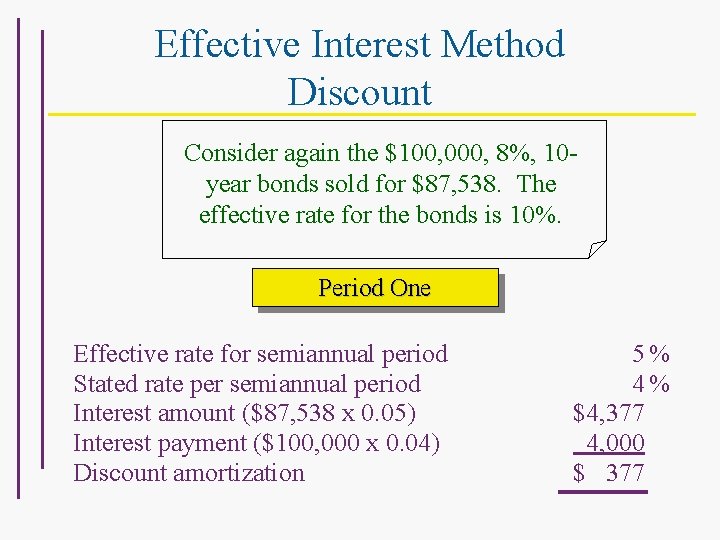
Effective Interest Method Discount Consider again the $100, 000, 8%, 10 year bonds sold for $87, 538. The effective rate for the bonds is 10%. Period One Effective rate for semiannual period Stated rate per semiannual period Interest amount ($87, 538 x 0. 05) Interest payment ($100, 000 x 0. 04) Discount amortization 5% 4% $4, 377 4, 000 $ 377
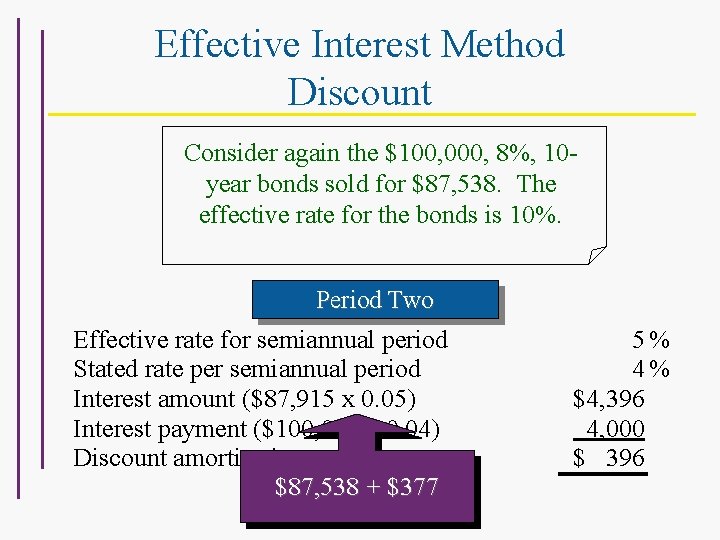
Effective Interest Method Discount Consider again the $100, 000, 8%, 10 year bonds sold for $87, 538. The effective rate for the bonds is 10%. Period Two Effective rate for semiannual period Stated rate per semiannual period Interest amount ($87, 915 x 0. 05) Interest payment ($100, 000 x 0. 04) Discount amortization $87, 538 + $377 5% 4% $4, 396 4, 000 $ 396
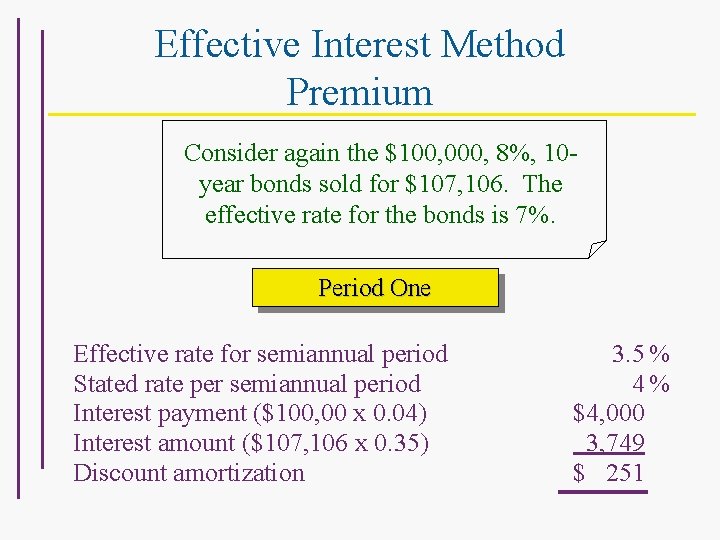
Effective Interest Method Premium Consider again the $100, 000, 8%, 10 year bonds sold for $107, 106. The effective rate for the bonds is 7%. Period One Effective rate for semiannual period Stated rate per semiannual period Interest payment ($100, 00 x 0. 04) Interest amount ($107, 106 x 0. 35) Discount amortization 3. 5 % 4% $4, 000 3, 749 $ 251
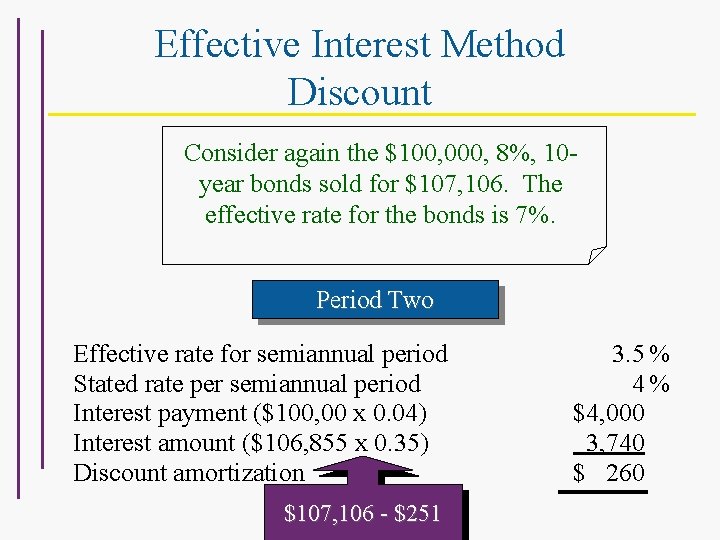
Effective Interest Method Discount Consider again the $100, 000, 8%, 10 year bonds sold for $107, 106. The effective rate for the bonds is 7%. Period Two Effective rate for semiannual period Stated rate per semiannual period Interest payment ($100, 00 x 0. 04) Interest amount ($106, 855 x 0. 35) Discount amortization $107, 106 - $251 3. 5 % 4% $4, 000 3, 740 $ 260
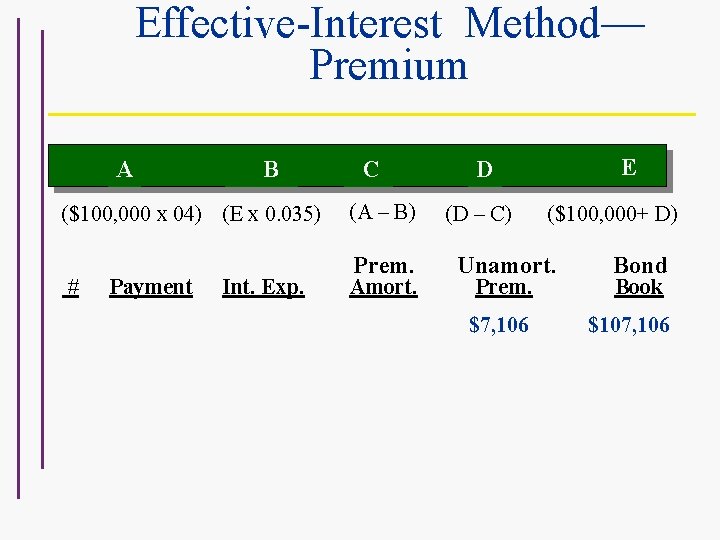
Effective-Interest Method— Premium A B ($100, 000 x 04) (E x 0. 035) # Payment Int. Exp. C (A – B) Prem. Amort. E D (D – C) ($100, 000+ D) Unamort. Prem. $7, 106 Bond Book $107, 106
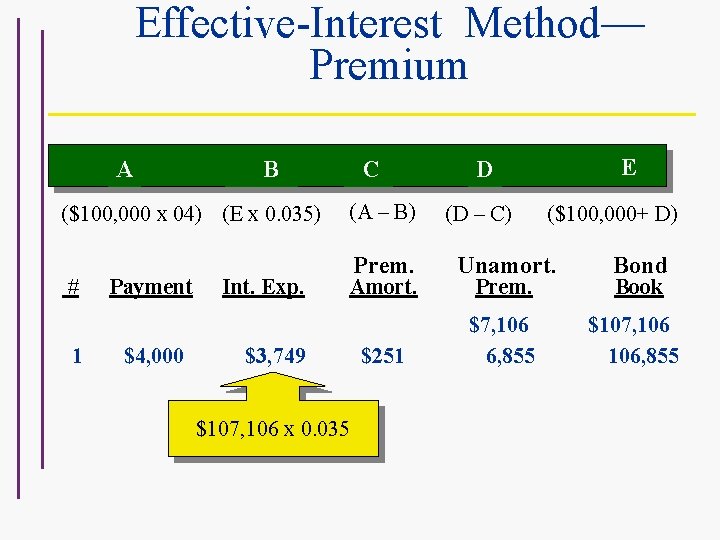
Effective-Interest Method— Premium A ($100, 000 x 04) (E x 0. 035) # 1 Payment $4, 000 C B Int. Exp. (A – B) $107, 106 x 0. 035 (D – C) ($100, 000+ D) Prem. Unamort. $251 $7, 106 6, 855 Amort. $3, 749 E D Prem. Bond Book $107, 106, 855
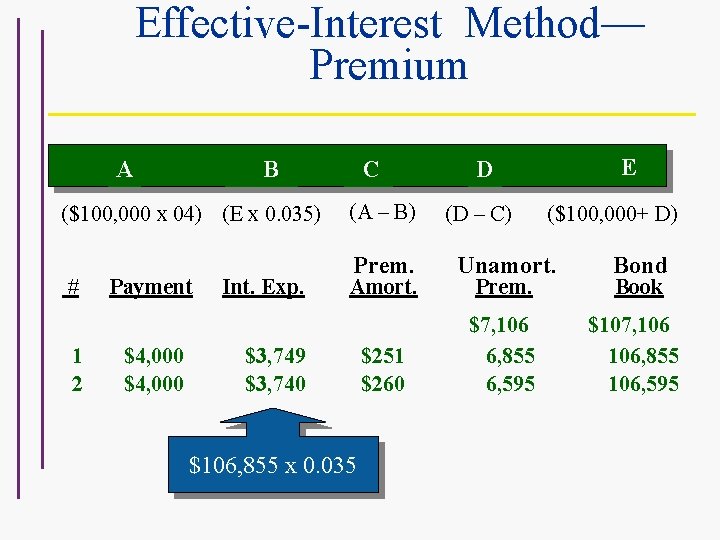
Effective-Interest Method— Premium A ($100, 000 x 04) (E x 0. 035) # 1 2 Payment $4, 000 C B Int. Exp. (A – B) E D (D – C) ($100, 000+ D) Prem. Unamort. $251 $260 $7, 106 6, 855 6, 595 Amort. $3, 749 $3, 740 $106, 855 x 0. 035 Prem. Bond Book $107, 106, 855 106, 595
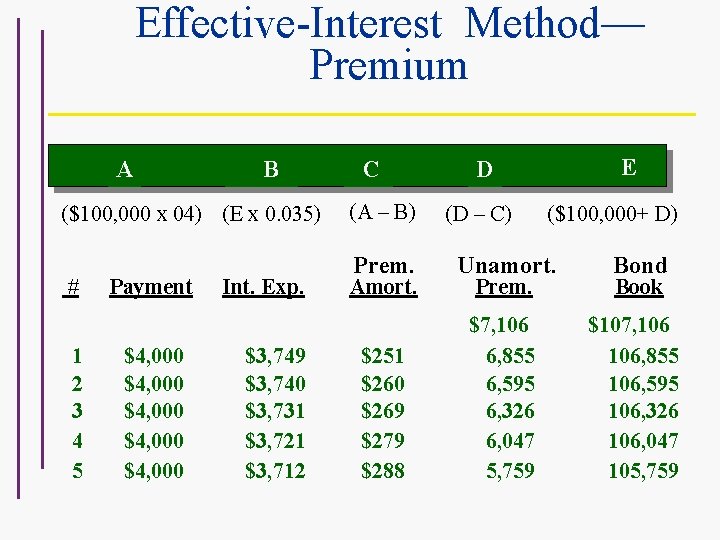
Effective-Interest Method— Premium A B ($100, 000 x 04) (E x 0. 035) # 1 2 3 4 5 Payment $4, 000 $4, 000 Int. Exp. $3, 749 $3, 740 $3, 731 $3, 721 $3, 712 C (A – B) E D (D – C) ($100, 000+ D) Prem. Unamort. $251 $260 $269 $279 $288 $7, 106 6, 855 6, 595 6, 326 6, 047 5, 759 Amort. Prem. Bond Book $107, 106, 855 106, 595 106, 326 106, 047 105, 759
Straight-Line vs. Effective-Interest Amortization Methods • Insert exhibit 12 -7
Stop & Think When preparing a bond amortization schedule like the one that follows, there are certain numbers within that schedule that you know without having to do any elaborate computations. Which ONE of the following numbers can be determined using a very simple computation?
Extinguishment of Debt Prior to Maturity 1. Bonds may be redeemed by the issuer by purchasing the bonds on the open market or by exercising the call provision (if available). 2. Bonds may be converted, that is, exchanged for other securities. 3. Bonds may be refinanced by using the proceeds from the sale of a new bond issue to retire outstanding bonds.
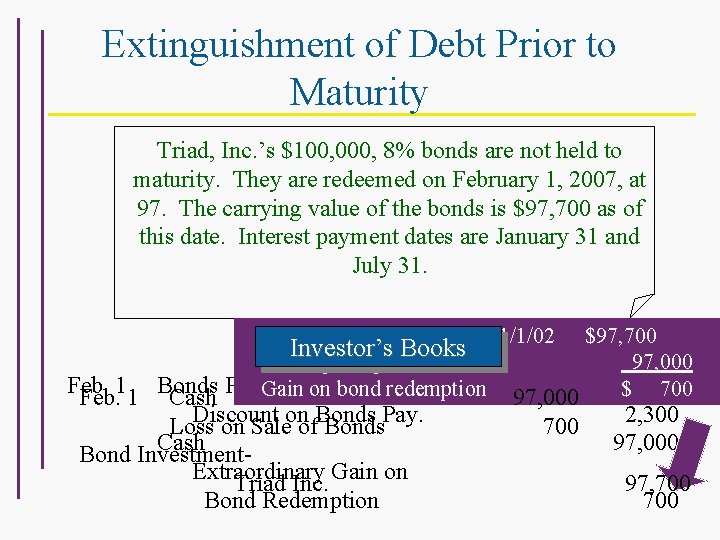
Extinguishment of Debt Prior to Maturity Triad, Inc. ’s $100, 000, 8% bonds are not held to maturity. They are redeemed on February 1, 2007, at 97. The carrying value of the bonds is $97, 700 as of this date. Interest payment dates are January 31 and July 31. Carry value of bonds, 1/1/02 $97, 700 97, 000 Feb. Gain on bond redemption 100, 000 $ 700 Feb. 11 Bonds Cash Payable 97, 000 Issuer’s Books Investor’s Books Redemption price Discount Loss on Saleonof. Bonds. Pay. Cash Bond Investment. Extraordinary Triad Inc. Gain on Bond Redemption 700 2, 300 97, 000 97, 700
Convertible Bonds • Convertible debt securities usually have the following features: 1. An interest rate lower than the issuer could establish for nonconvertible debt. 2. An initial conversion price higher than the market value of the common stock at time of issuance. 3. A call option retained by the issuer • Convertible debt gives both the issuer and the holder advantages.
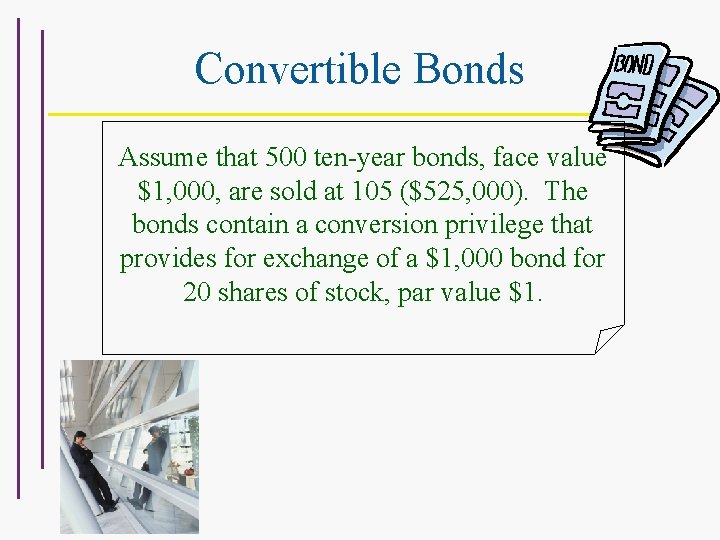
Convertible Bonds Assume that 500 ten-year bonds, face value $1, 000, are sold at 105 ($525, 000). The bonds contain a conversion privilege that provides for exchange of a $1, 000 bond for 20 shares of stock, par value $1.
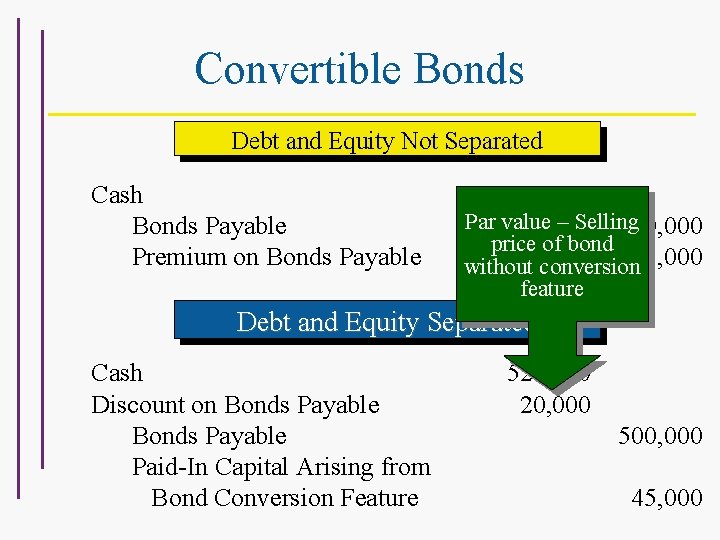
Convertible Bonds Debt and Equity Not Separated Cash Bonds Payable Premium on Bonds Payable 525, 000 Par value – Selling 500, 000 price of bond without conversion 25, 000 feature Debt and Equity Separated Cash Discount on Bonds Payable Paid-In Capital Arising from Bond Conversion Feature 525, 000 20, 000 500, 000 45, 000
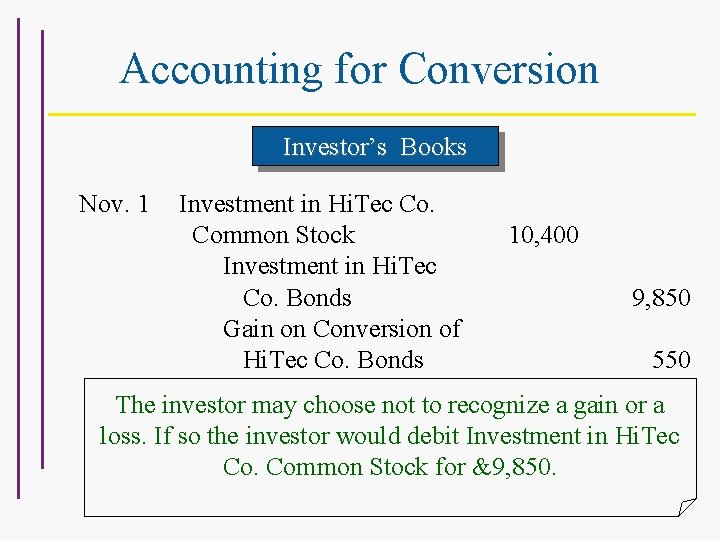
Accounting for Conversion Investor’s Books Nov. 1 Investment in Hi. Tec Co. Common Stock Investment in Hi. Tec Co. Bonds Gain on Conversion of Hi. Tec Co. Bonds 10, 400 9, 850 550 The investor may choose not to recognize a gain or a loss. If so the investor would debit Investment in Hi. Tec Co. Common Stock for &9, 850.
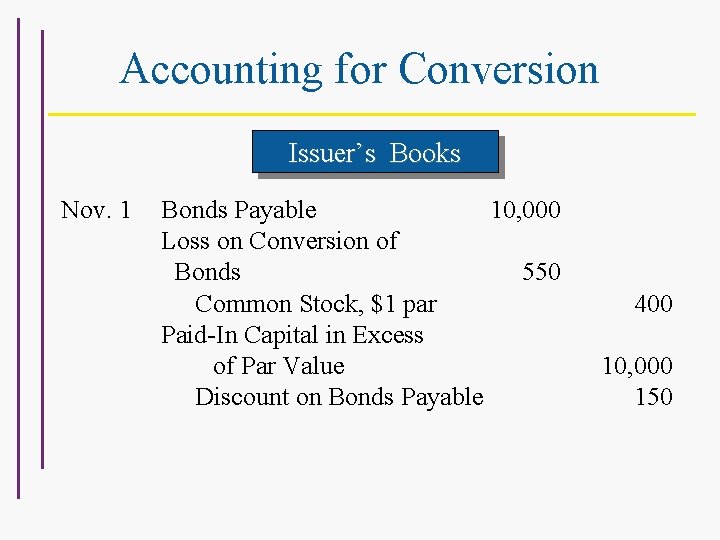
Accounting for Conversion Issuer’s Books Nov. 1 Bonds Payable 10, 000 Loss on Conversion of Bonds 550 Common Stock, $1 par Paid-In Capital in Excess of Par Value Discount on Bonds Payable 400 10, 000 150
Off-Balance-Sheet Financing • Off-Balance-Sheet-Financing- procedures to avoid disclosing all debt on the balance sheet in order to make the company’s financial position look stronger. • Common techniques used: – – – Leases Unconsolidated subsidiaries Variable interest entities (VIEs) Joint ventures Research and development arrangements Project financing arrangements
Analyzing a Firm’s Debt Position • Debt-to-Equity Ratio- measures the relationship between the debt and equity of an entity. Formula: total debt ÷ total stockholders’ equity • Debt Ratio- indicates a company’s overall ability to repay its debts. Formula: total liabilities ÷ total assets. • Times Interest Earned- shows a company’s ability to meet interest payments. Formula: income before interest expense and income taxes ÷ interest expense for the period.
Disclosing Debt in the Financial Statements • Companies may want to disclose additional information about long-term debt in the notes like: – – – – – Nature of the liabilities Maturity dates Interest rates Methods of liquidation Conversion privileges Sinking fund requirements Borrowing restrictions Assets pledged, Dividend limitations
Troubled Debt Restructuring Troubled debt restructuring exists only if the “creditor for economic or legal reasons related to the debtor’s financial difficulties grants a concession to the debtor that it would not otherwise consider. ” (SFAS 15. 2)
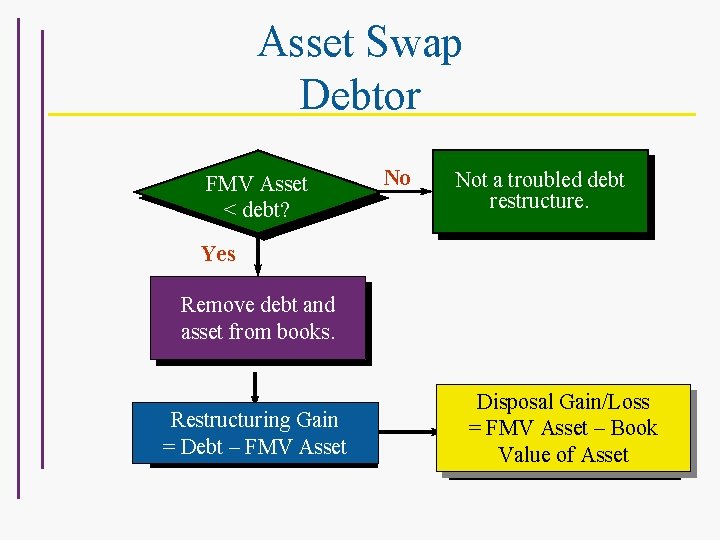
Asset Swap Debtor FMV Asset < debt? No Not a troubled debt restructure. Yes Remove debt and asset from books. Restructuring Gain = Debt – FMV Asset Disposal Gain/Loss = FMV Asset – Book Value of Asset
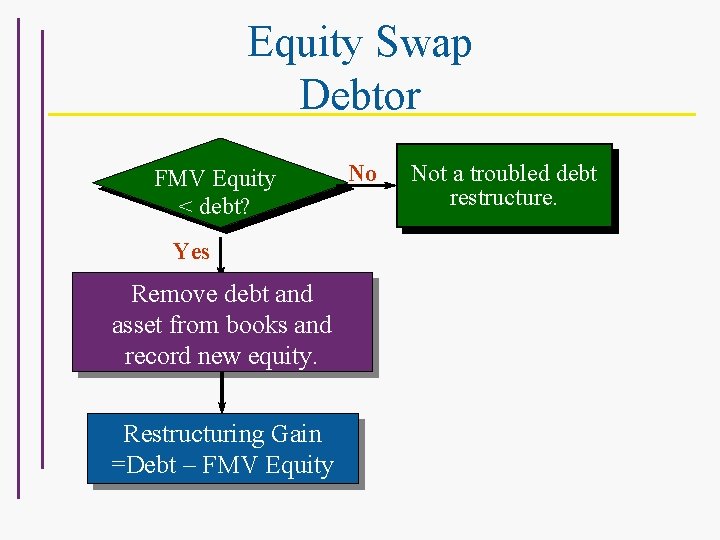
Equity Swap Debtor FMV Equity < debt? Yes Remove debt and asset from books and record new equity. Restructuring Gain =Debt – FMV Equity No Not a troubled debt restructure.
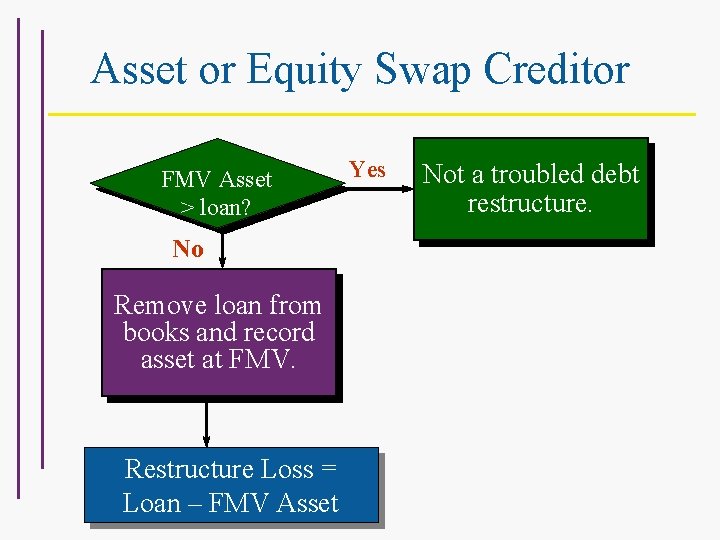
Asset or Equity Swap Creditor FMV Asset > loan? No Remove loan from books and record asset at FMV. Restructure Loss = Loan – FMV Asset Yes Not a troubled debt restructure.
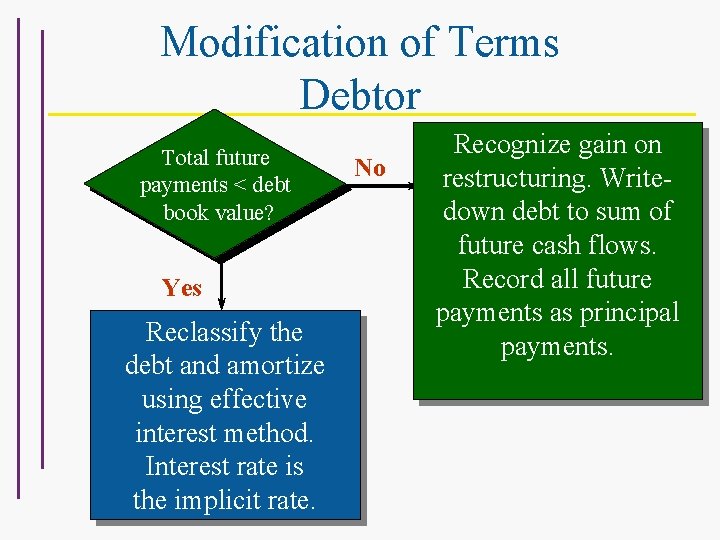
Modification of Terms Debtor Total future payments < debt book value? Yes Reclassify the debt and amortize using effective interest method. Interest rate is the implicit rate. No Recognize gain on restructuring. Writedown debt to sum of future cash flows. Record all future payments as principal payments.
- Slides: 60