
St Helens Multi Agency Adult Safeguarding Procedures St


- Slides: 29
St. Helens Multi Agency Adult Safeguarding Procedures St Helens CCG PLT Briefing 23. 09. 2015 1
THE CORE PURPOSE OF ADULT CARE AND SUPPORT IS TO HELP PEOPLE TO ACHIEVE THE OUTCOMES THAT MATTER TO THEM IN THEIR LIFE. UNDERPINNING ALL INDIVIDUAL ‘CARE AND SUPPORT FUNCTIONS’, INCLUDING SAFEGUARDING, IS THE NEED TO FOCUS ON THE ADULT’S NEEDS AND GOALS.
Definition of safeguarding Protecting an Adult’s right to live safely, free from abuse and neglect. It is about people and organisations working together to prevent and stop both the risks and experience of abuse or neglect, while at the same time making sure that the Adult’s wellbeing is promoted
Key responsibilities • Adult safeguarding is an important part of what many public services do, but the key responsibility is with local authorities to make enquiries if it believes an Adult is subject to, or at risk of, abuse or neglect. An enquiry should establish whether any action needs to be taken or stop or prevent abuse or neglect, and if so, by whom.
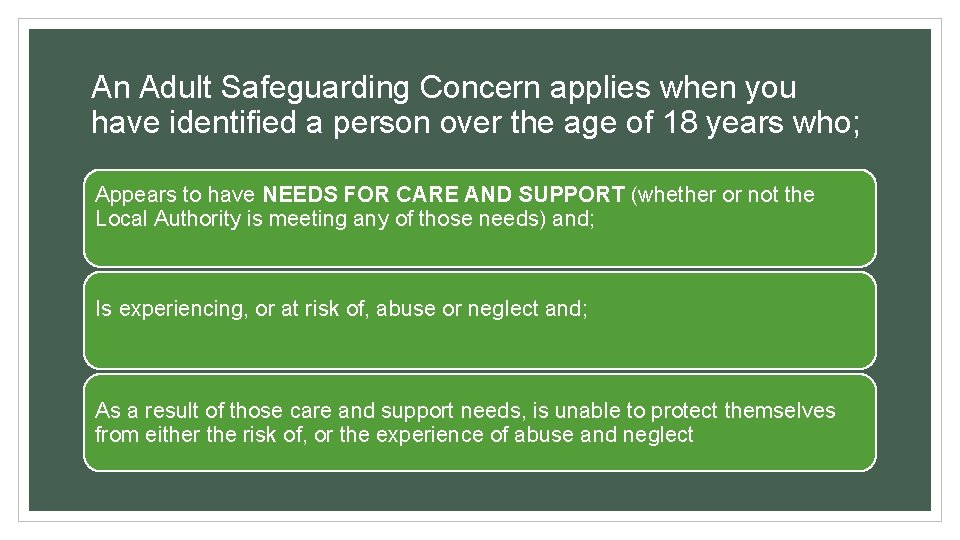
An Adult Safeguarding Concern applies when you have identified a person over the age of 18 years who; Appears to have NEEDS FOR CARE AND SUPPORT (whether or not the Local Authority is meeting any of those needs) and; Is experiencing, or at risk of, abuse or neglect and; As a result of those care and support needs, is unable to protect themselves from either the risk of, or the experience of abuse and neglect
There are three conditions 1. The Adult’s needs arise from or are related to physical or mental impairment or illness. 2. As a result of the Adult’s needs he/she is unable to achieve two or more of the SPECIFIED OUTCOMES listed below. Definition of Care and Support Needs
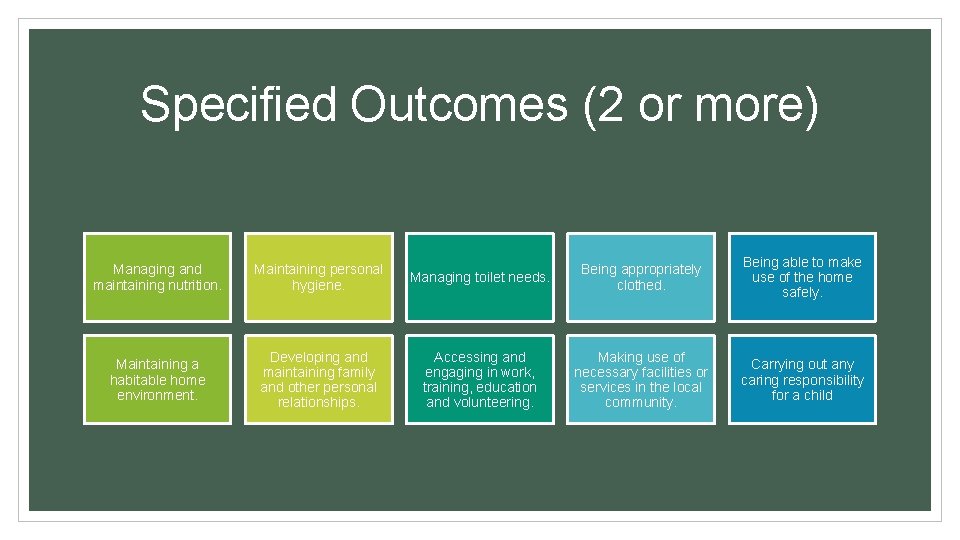
Specified Outcomes (2 or more) Managing and maintaining nutrition. Maintaining personal hygiene. Maintaining a habitable home environment. Developing and maintaining family and other personal relationships. Managing toilet needs. Being appropriately clothed. Being able to make use of the home safely. Accessing and engaging in work, training, education and volunteering. Making use of necessary facilities or services in the local community. Carrying out any caring responsibility for a child
3. As a consequence of being unable to achieve these outcomes there is, or is likely to be, a significant impact on wellbeing – including the Adult’s ability to protect themselves from abuse and neglect.
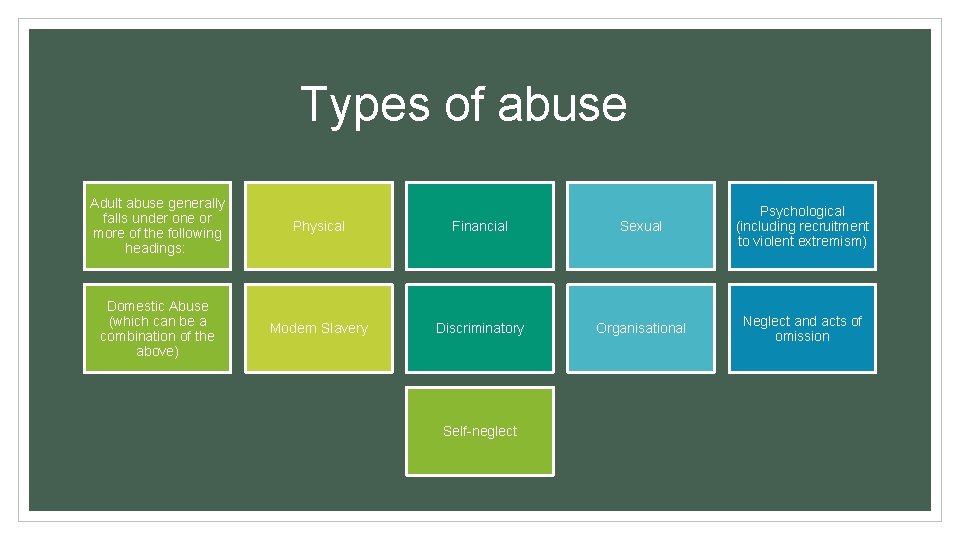
Types of abuse Adult abuse generally falls under one or more of the following headings: Physical Financial Sexual Psychological (including recruitment to violent extremism) Domestic Abuse (which can be a combination of the above) Modern Slavery Discriminatory Organisational Neglect and acts of omission Self-neglect
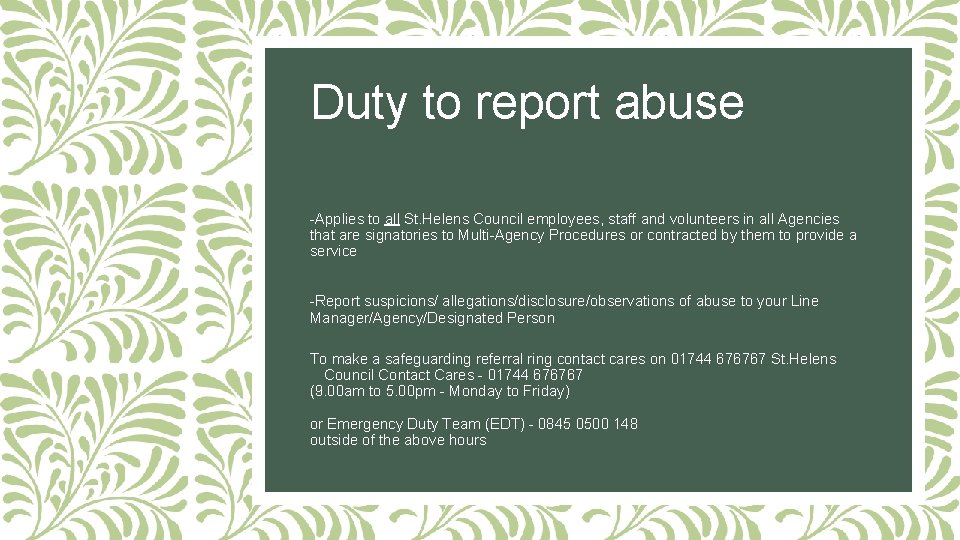
Duty to report abuse -Applies to all St. Helens Council employees, staff and volunteers in all Agencies that are signatories to Multi-Agency Procedures or contracted by them to provide a service -Report suspicions/ allegations/disclosure/observations of abuse to your Line Manager/Agency/Designated Person To make a safeguarding referral ring contact cares on 01744 676767 St. Helens Council Contact Cares - 01744 676767 (9. 00 am to 5. 00 pm - Monday to Friday) or Emergency Duty Team (EDT) - 0845 0500 148 outside of the above hours
Member's duty • All Council employees have a duty to report alleged or suspected abuse / neglect; this includes Elected Members. • It is the responsibility of the Adult Safeguarding Unit and Adult Social Care teams to investigate the concerns raised. • Enquiry Practitioners are qualified Social Care professionals who are trained to investigate safeguarding concerns, complete robust risk assessments and implement safety plans. • Information regarding outcomes of safeguarding concerns will only be shared on a need to know basis.
Physical, sexual, financial and emotional abuse may also be termed Domestic Abuse where the abusive behaviour is carried out by a person who is or has been an intimate partner or family member regardless of gender or sexuality. There is a current domestic abuse strategy (2020), which has been developed in partnership with agencies across sectors and provides a framework for coordinated action to take place to tackle domestic abuse. Safe 2 Speak, Safer Communities, Safeguarding and Contact Cares have recently met to establish a pathway at Contact Cares for those referred as domestic abuse victims, although not all domestic abuse victims would be suitable to refer to safeguarding. Domestic abuse
Encompasses slavery, human trafficking, forced labour and domestic servitude. Traffickers and slave masters use whatever means they have at their disposal to coerce, deceive and force individuals into a life of abuse, servitude and inhumane treatment. Safeguarding work in partnership with other organisations and are in discussions with the modern slavery team to provide training to Local Authority staff. Modern slavery
Safeguarding Adults Board PRIORITIES STRUCTURE FUNCTION AND DUTIES SUBGROUPS
• Priority 1: To deliver positive outcomes for those using our services Ensuring Safeguarding services are delivered effectively and professionally, with Making Safeguarding Personal at the heart of how those services are delivered. • Priority 2: To enhance our governance, systems and processes to support effective safeguarding services Ensuring that there are effective governance, scrutiny and business processes in place to ensure that the safety and well-being of adults who are subject to, or at risk of, abuse and neglect are at the heart of Board members’ own organisational priorities. This includes ensuring that the findings from Safeguarding Adult Reviews and other key areas of Practice improvement are implemented. • Priority 3: To provide excellent standards of partnership working and to effectively engage with our community to build awareness and confidence in our safeguarding services We will promote safeguarding adults in the community by listening to their concerns and raising awareness & well-being to prevent neglect and abuse, with a particular focus on diverse, isolated and under-represented communities. This includes working with other key Groups, Boards, Committees and Partners, including the Children’s Safeguarding Partnership, to build effective partnerships. Additionally, we will deliver training and development in areas where awareness and understanding needs to be improved. SAB Priorities
• The Strategic Leads Group brings together the Boards Statutory Partners and key stakeholders to support and provide strategic leadership to the Board • Performance and Practice Group • The key function of the Performance and Practice Group is to analyse and interrogate safeguarding data and activity to increase the Boards understanding of abuse & neglect. • Engagement & Communications Group • The purpose of this Group is to raise awareness of safeguarding with partners, service users and the wider community through a range of communication and information methods. • Training & Development • A key role of the Safeguarding Adults Board is to raise awareness of safeguarding issues to those at risk of abuse & neglect, the wider community and, importantly, members of staff of organisations who work with people at risk. Over the last 12 months, the Training & Development Group has developed and delivered tailored sessions to embed safeguarding across all these key areas. SAB Structure and sub-groups
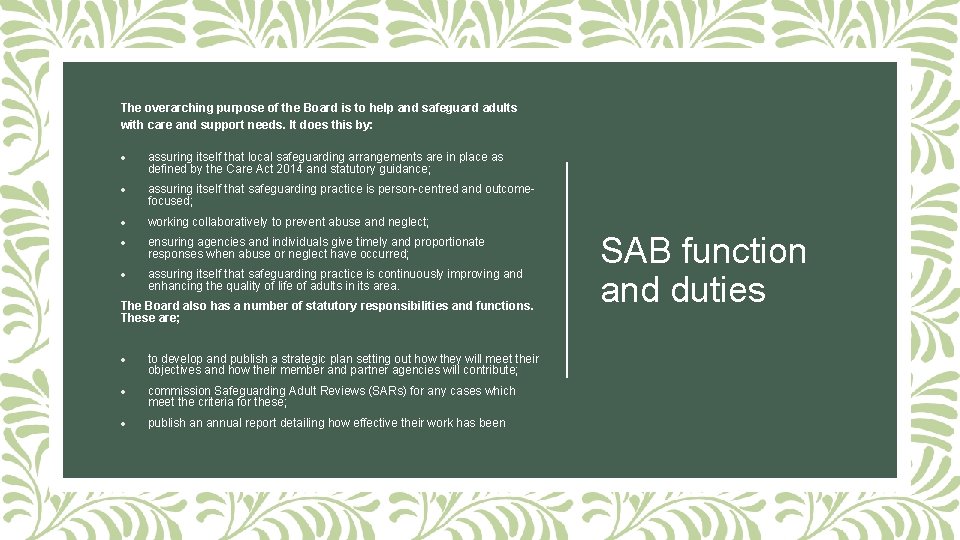
The overarching purpose of the Board is to help and safeguard adults with care and support needs. It does this by: assuring itself that local safeguarding arrangements are in place as defined by the Care Act 2014 and statutory guidance; assuring itself that safeguarding practice is person-centred and outcomefocused; working collaboratively to prevent abuse and neglect; ensuring agencies and individuals give timely and proportionate responses when abuse or neglect have occurred; assuring itself that safeguarding practice is continuously improving and enhancing the quality of life of adults in its area. The Board also has a number of statutory responsibilities and functions. These are; to develop and publish a strategic plan setting out how they will meet their objectives and how their member and partner agencies will contribute; commission Safeguarding Adult Reviews (SARs) for any cases which meet the criteria for these; publish an annual report detailing how effective their work has been SAB function and duties
DATA 19/20
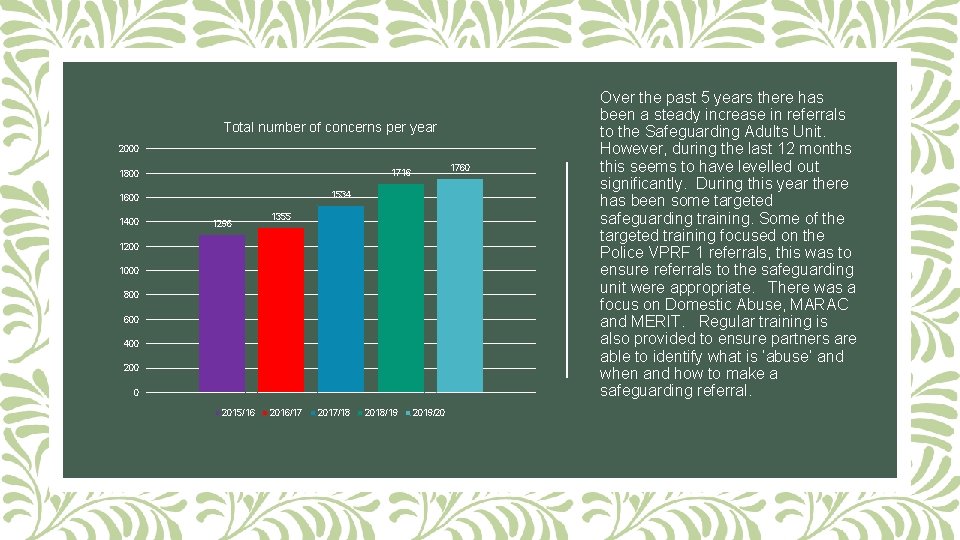
Total number of concerns per year 2000 1534 1600 1400 1760 1716 1800 1296 1355 1200 1000 800 600 400 200 0 2015/16 2016/17 2017/18 2018/19 2019/20 Over the past 5 years there has been a steady increase in referrals to the Safeguarding Adults Unit. However, during the last 12 months this seems to have levelled out significantly. During this year there has been some targeted safeguarding training. Some of the targeted training focused on the Police VPRF 1 referrals, this was to ensure referrals to the safeguarding unit were appropriate. There was a focus on Domestic Abuse, MARAC and MERIT. Regular training is also provided to ensure partners are able to identify what is ‘abuse’ and when and how to make a safeguarding referral.
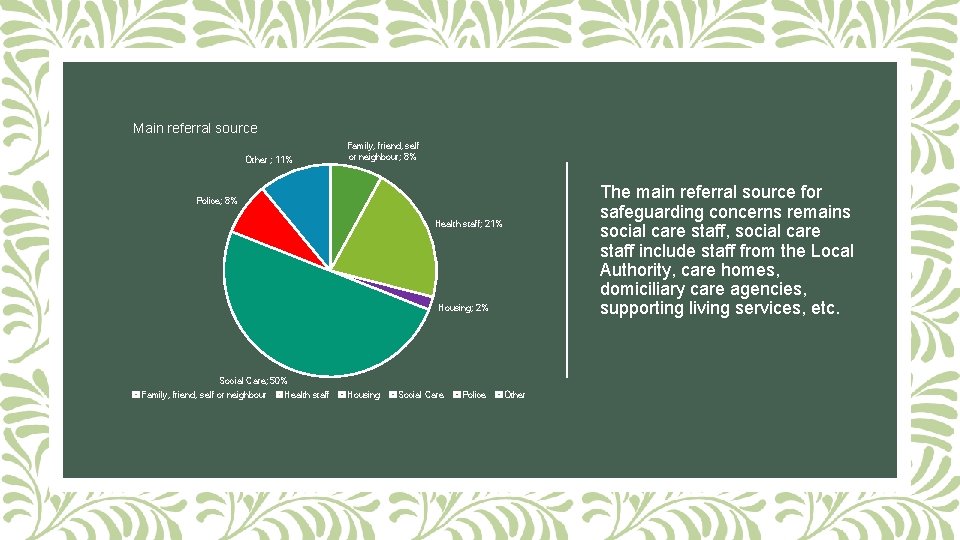
Main referral source Other ; 11% Family, friend, self or neighbour; 8% The main referral source for safeguarding concerns remains social care staff, social care staff include staff from the Local Authority, care homes, domiciliary care agencies, supporting living services, etc. Police; 8% Health staff; 21% Housing; 2% Social Care; 50% Family, friend, self or neighbour Health staff Housing Social Care Police Other
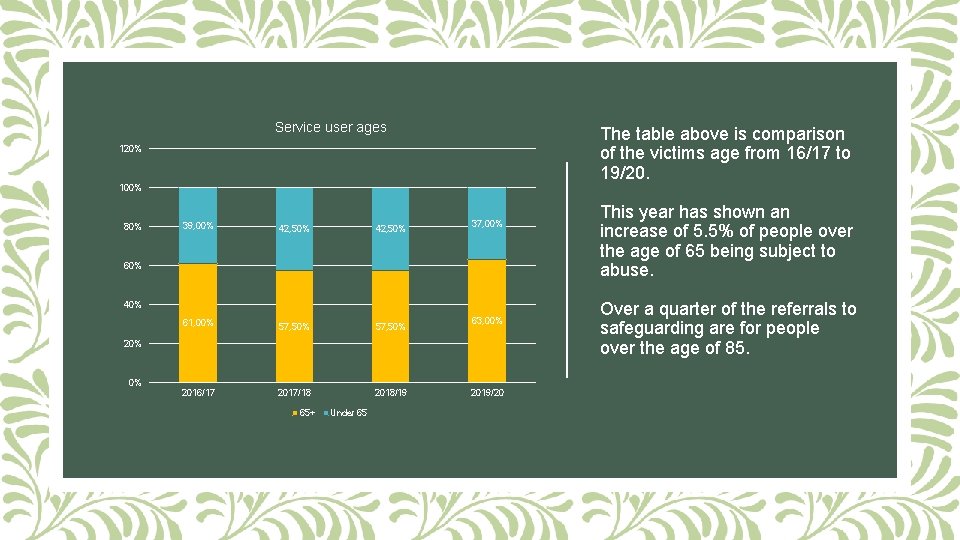
Service user ages The table above is comparison of the victims age from 16/17 to 19/20. 120% 100% 80% 39, 00% 42, 50% 37, 00% 60% 40% 61, 00% 57, 50% 2016/17 2017/18 2018/19 63, 00% 20% 0% 65+ Under 65 2019/20 This year has shown an increase of 5. 5% of people over the age of 65 being subject to abuse. Over a quarter of the referrals to safeguarding are for people over the age of 85.
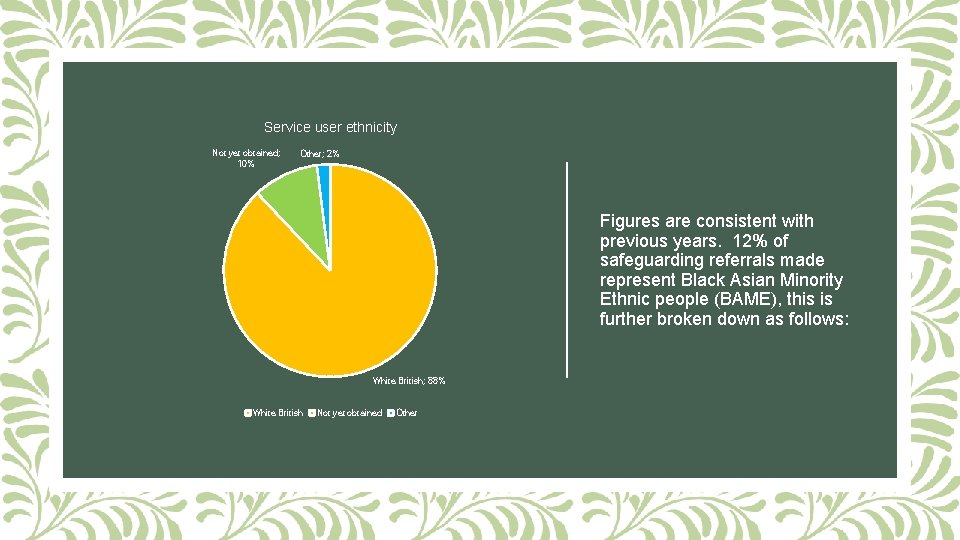
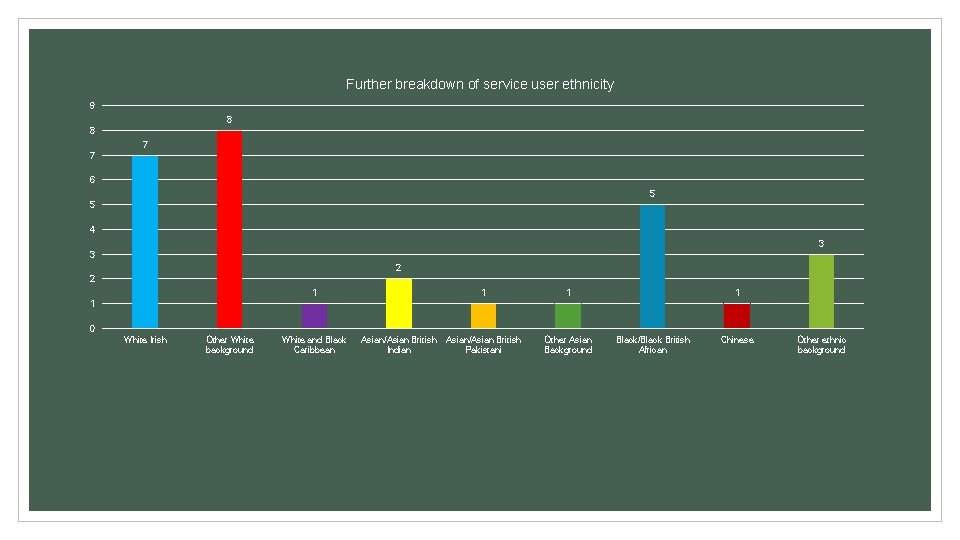
Service user ethnicity Not yet obtained; 10% Other; 2% Figures are consistent with previous years. 12% of safeguarding referrals made represent Black Asian Minority Ethnic people (BAME), this is further broken down as follows: White British; 88% White British Not yet obtained Other
Further breakdown of service user ethnicity 9 8 8 7 7 6 5 5 4 3 3 2 2 1 1 1 Asian/Asian British Pakistani Other Asian Background 1 1 0 White Irish Other White background White and Black Caribbean Asian/Asian British Indian Black/Black British African Chinese Other ethnic background
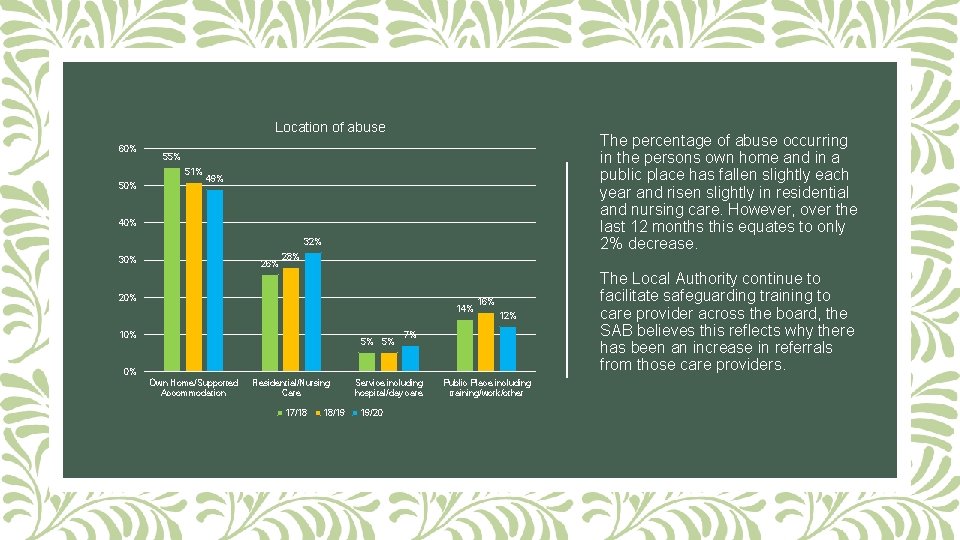
Location of abuse 60% 51% 50% The percentage of abuse occurring in the persons own home and in a public place has fallen slightly each year and risen slightly in residential and nursing care. However, over the last 12 months this equates to only 2% decrease. 55% 49% 40% 32% 30% 26% 28% 20% 14% 10% 5% 5% 16% 12% 7% 0% Own Home/Supported Accommodation Residential/Nursing Care 17/18 18/19 Service including hospital/day care 19/20 Public Place including training/work/other The Local Authority continue to facilitate safeguarding training to care provider across the board, the SAB believes this reflects why there has been an increase in referrals from those care providers.
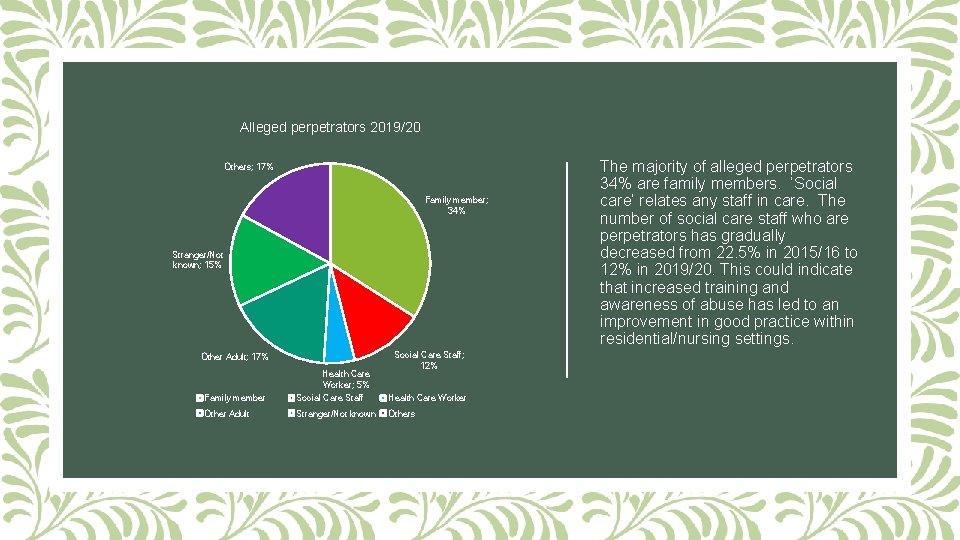
Alleged perpetrators 2019/20 Others; 17% Family member; 34% Stranger/Not known; 15% Other Adult; 17% Social Care Staff; 12% Family member Health Care Worker; 5% Social Care Staff Health Care Worker Other Adult Stranger/Not known Others The majority of alleged perpetrators 34% are family members. ‘Social care’ relates any staff in care. The number of social care staff who are perpetrators has gradually decreased from 22. 5% in 2015/16 to 12% in 2019/20. This could indicate that increased training and awareness of abuse has led to an improvement in good practice within residential/nursing settings.
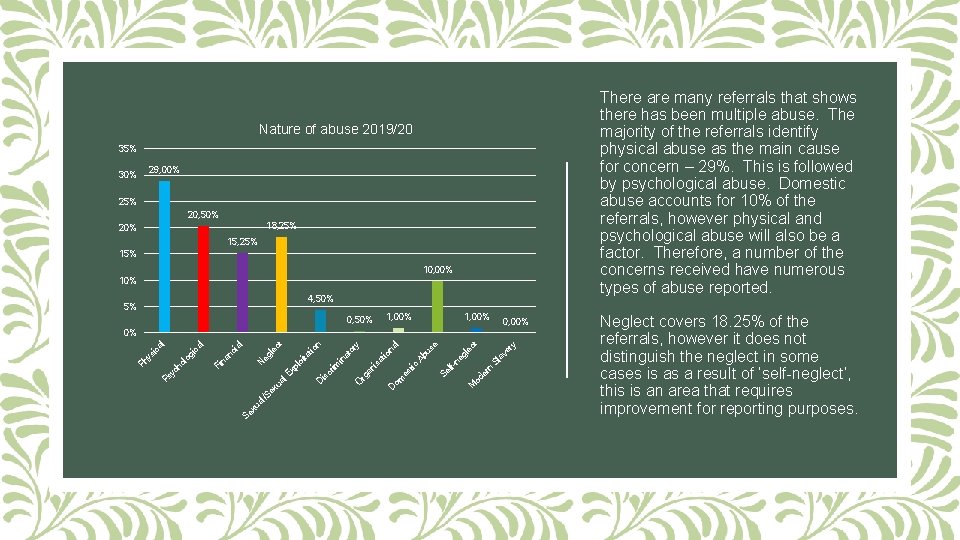
There are many referrals that shows there has been multiple abuse. The majority of the referrals identify physical abuse as the main cause for concern – 29%. This is followed by psychological abuse. Domestic abuse accounts for 10% of the referrals, however physical and psychological abuse will also be a factor. Therefore, a number of the concerns received have numerous types of abuse reported. Nature of abuse 2019/20 35% 30% 29, 00% 25% 20, 50% 18, 25% 20% 15, 25% 10, 00% 10% 4, 50% 5% 1, 00% 0, 50% 1, 00% 0, 00% n Sl av er y ec t gl od er tic es om D M at an is rg Se lfne Ab us e al io n ry to in a O D is c pl Ex ua l al /S ex xu Se rim eg N oi ta tio n le c t ia l nc Fi na lo g ho yc Ps Ph ys ic ic al al 0% Neglect covers 18. 25% of the referrals, however it does not distinguish the neglect in some cases is as a result of ‘self-neglect’, this is an area that requires improvement for reporting purposes.
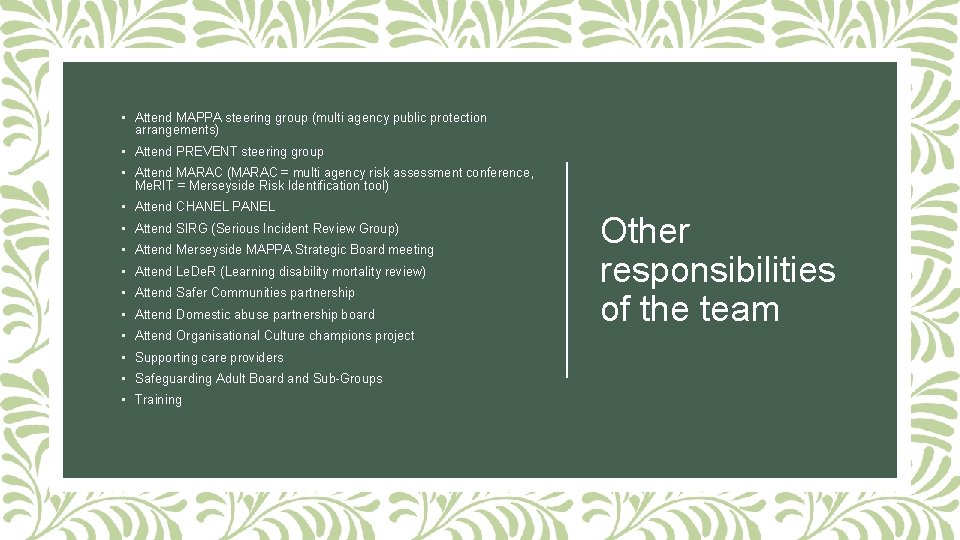
• Attend MAPPA steering group (multi agency public protection arrangements) • Attend PREVENT steering group • Attend MARAC (MARAC = multi agency risk assessment conference, Me. RIT = Merseyside Risk Identification tool) • Attend CHANEL PANEL • Attend SIRG (Serious Incident Review Group) • Attend Merseyside MAPPA Strategic Board meeting • Attend Le. De. R (Learning disability mortality review) • Attend Safer Communities partnership • Attend Domestic abuse partnership board • Attend Organisational Culture champions project • Supporting care providers • Safeguarding Adult Board and Sub-Groups • Training Other responsibilities of the team
QUESTIONS
THANK YOU