
St Colmcille A brief history EARLY LIFE Colmcille
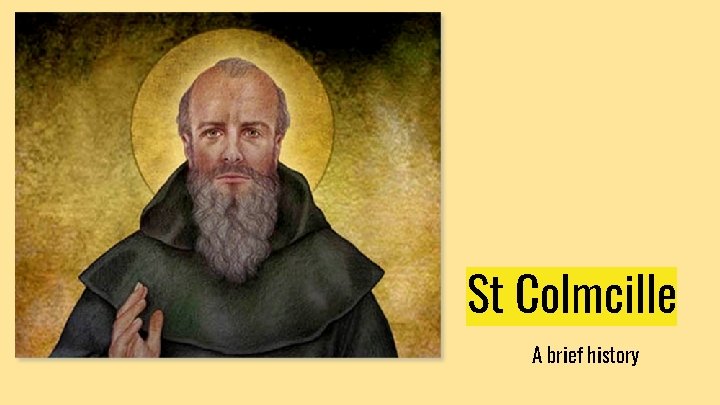
St Colmcille A brief history
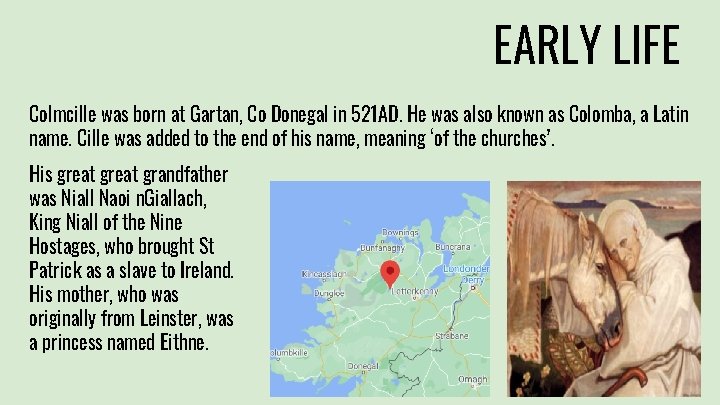
EARLY LIFE Colmcille was born at Gartan, Co Donegal in 521 AD. He was also known as Colomba, a Latin name. Cille was added to the end of his name, meaning ‘of the churches’. His great grandfather was Niall Naoi n. Giallach, King Niall of the Nine Hostages, who brought St Patrick as a slave to Ireland. His mother, who was originally from Leinster, was a princess named Eithne.

EDUCATION He went to school in Kilmacrennan, followed by a monastic school in Co Down, and finally finishing his education in Clonard Monastery in Co Meath. Columba was one of twelve students of St Finnian who became known as the Twelve Apostles of Ireland. He became a monk and eventually was ordained a priest. Clonard Monastery, Co Meath.

FOUNDING MONASTERIES St Colmcille returned to Ulster after his time in Clonard. The years following he was responsible for the founding of very important monasteries in many counties including Derry, Offaly and Meath. In his lifetime, Colmcille founded over 60 churches and monasteries. Durrow Abbey.

COPYRIGHT DISPUTE St Colmcille was involved in the first ever known copyright dispute. He copied a psalter (book of psalms) at the scriptorium while under St Finnian. He felt he was entitled to keep this copy, however St Finnian disagreed. The King took the side of St Finnian, which caused unrest, and a terrible battle ensued on St Colmcilles behalf. St Colmcille had a heavy heart and conscience after the violent clashes and decided to leave Ireland in search of spreading the word of God and continuing his work in other lands.
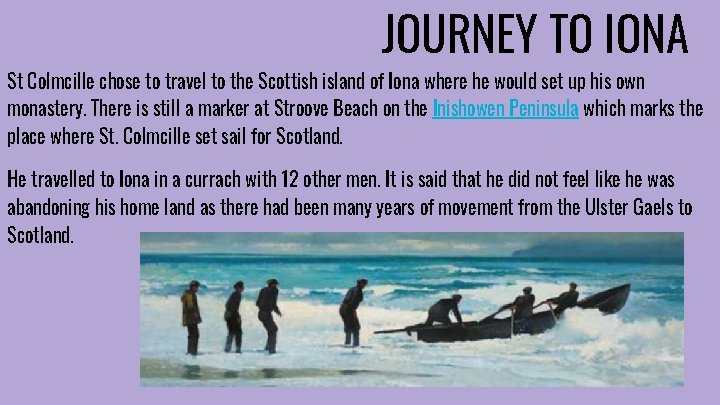
JOURNEY TO IONA St Colmcille chose to travel to the Scottish island of Iona where he would set up his own monastery. There is still a marker at Stroove Beach on the Inishowen Peninsula which marks the place where St. Colmcille set sail for Scotland. He travelled to Iona in a currach with 12 other men. It is said that he did not feel like he was abandoning his home land as there had been many years of movement from the Ulster Gaels to Scotland.
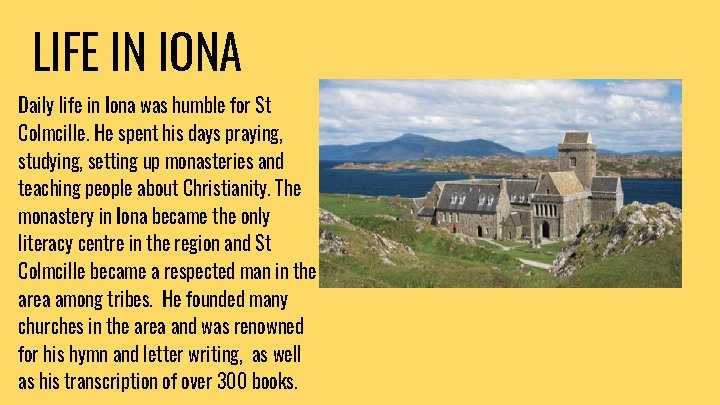
LIFE IN IONA Daily life in Iona was humble for St Colmcille. He spent his days praying, studying, setting up monasteries and teaching people about Christianity. The monastery in Iona became the only literacy centre in the region and St Colmcille became a respected man in the area among tribes. He founded many churches in the area and was renowned for his hymn and letter writing, as well as his transcription of over 300 books.
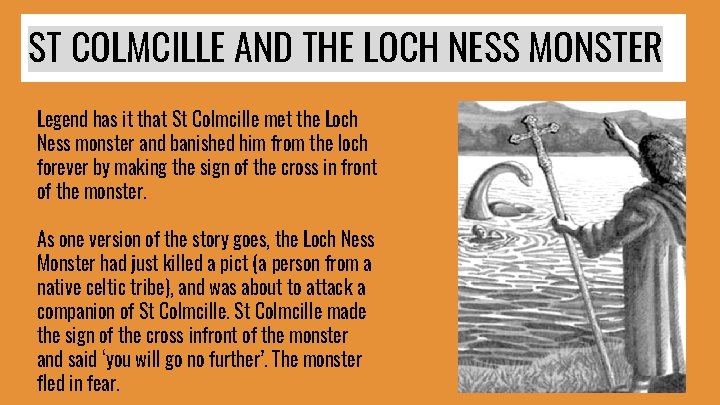
ST COLMCILLE AND THE LOCH NESS MONSTER Legend has it that St Colmcille met the Loch Ness monster and banished him from the loch forever by making the sign of the cross in front of the monster. As one version of the story goes, the Loch Ness Monster had just killed a pict (a person from a native celtic tribe), and was about to attack a companion of St Colmcille made the sign of the cross infront of the monster and said ‘you will go no further’. The monster fled in fear.

THE LEGACY OF ST COLMCILLE St Colmcille died in Iona around 597 AD. He left behind him a great legacy. -He is recognised as one of Ireland's patron saints, alongside St Patrick and St Brigid. -The first ever Celtic cross was found in Iona in his monastery. -Some of the earliest non-latin poetry in Europe is attributed to St Colmcille, as is the oldest Irish illuminated manuscript ‘an cathach’. It is believed to be the manuscript that the copyright allegations are from. -Iona is still a place of pilgrimage to this day.
- Slides: 9