
St Anselm Anselm of Canterbury By Poppy Atkinson

St. Anselm ( Anselm of Canterbury) By Poppy Atkinson Timeline of his life 1033 – Born Anselmo D’Aosta in Aosta Italy Anselm was a Christian and is very famous due to his Ontological Argument. 1060 – Entered into Benedictine Abbey This is an argument over the existence of of Bec, Normandy God. Anselm’s Ontological Argument 1. It is true by definition that God is a being than which none greater can be imagined. 1078 – Elected Abbot of the Abbey 2. God exists as an idea in the mind. 3. A being that exists in the mind and in reality is 1093 - He accepted to go to Canterbury greater than a being that exists only in the mind. 4. If God exists only in the mind, then we can imagine something greater than God. 1097 - He was exiled by William II 5. But we cannot imagine something that is greater than God - a being greater than the greatest 1107 - He was exiled by Henry possible being. 6. Therefore, God exists both in mind and in reality. 1063 – Made Prior of the Abbey 1109 – Died Canterbury, England My point of view on the Ontological Argument I don’t agree with Anselm because anyone could think anything is the best thing but that does not automatically make it real. The impact of the argument This impacted the world as people still have the argument today! People expand on this argument to prove his theory. Watch these videos! https: //www. youtube. com/watch? v=1 qx. Fe. Drd. A 84 https: //www. youtube. com/watch? v=Fm. Ts. S 5 x. FA 6 k

The life and ideas of St. Anselm By Fran Mason
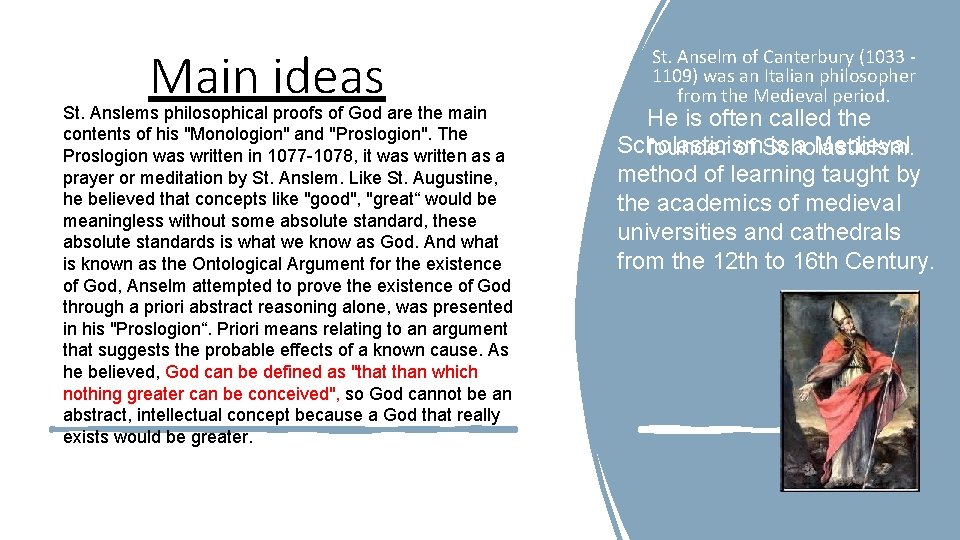
Main ideas St. Anslems philosophical proofs of God are the main contents of his "Monologion" and "Proslogion". The Proslogion was written in 1077 -1078, it was written as a prayer or meditation by St. Anslem. Like St. Augustine, he believed that concepts like "good", "great“ would be meaningless without some absolute standard, these absolute standards is what we know as God. And what is known as the Ontological Argument for the existence of God, Anselm attempted to prove the existence of God through a priori abstract reasoning alone, was presented in his "Proslogion“. Priori means relating to an argument that suggests the probable effects of a known cause. As he believed, God can be defined as "that than which nothing greater can be conceived", so God cannot be an abstract, intellectual concept because a God that really exists would be greater. St. Anselm of Canterbury (1033 1109) was an Italian philosopher from the Medieval period. He is often called the Scholasticism is a Medieval founder of Scholasticism. method of learning taught by the academics of medieval universities and cathedrals from the 12 th to 16 th Century.
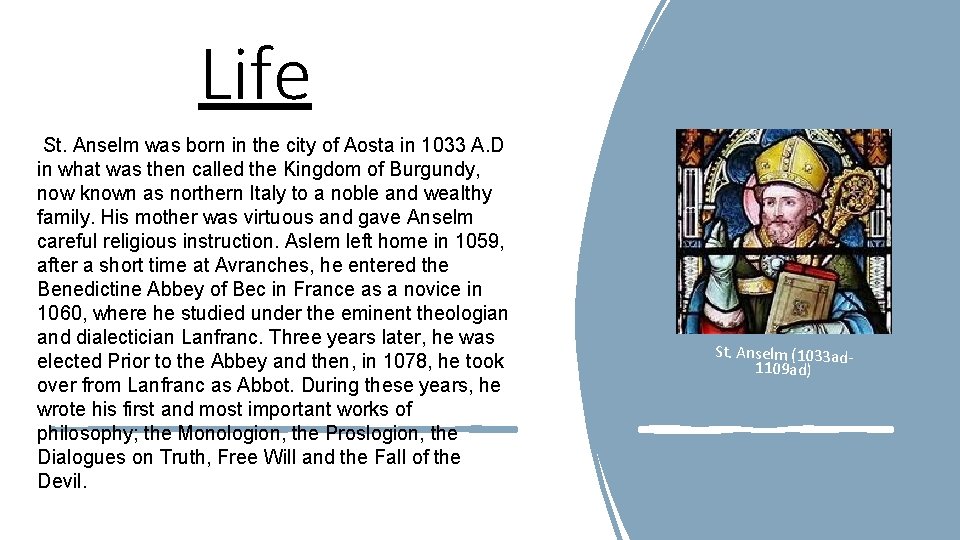
Life St. Anselm was born in the city of Aosta in 1033 A. D in what was then called the Kingdom of Burgundy, now known as northern Italy to a noble and wealthy family. His mother was virtuous and gave Anselm careful religious instruction. Aslem left home in 1059, after a short time at Avranches, he entered the Benedictine Abbey of Bec in France as a novice in 1060, where he studied under the eminent theologian and dialectician Lanfranc. Three years later, he was elected Prior to the Abbey and then, in 1078, he took over from Lanfranc as Abbot. During these years, he wrote his first and most important works of philosophy; the Monologion, the Proslogion, the Dialogues on Truth, Free Will and the Fall of the Devil. St. Anselm (1033 ad 1109 ad)
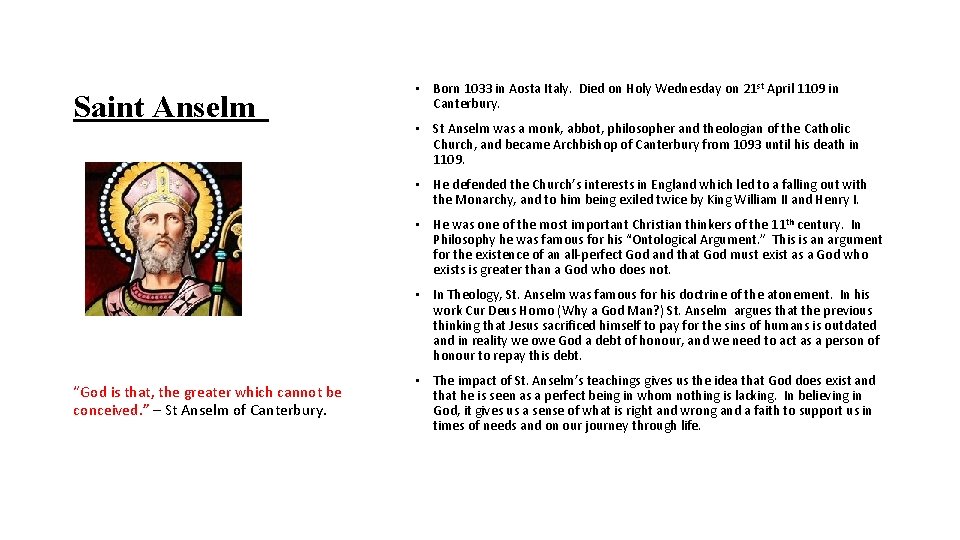
Saint Anselm • Born 1033 in Aosta Italy. Died on Holy Wednesday on 21 st April 1109 in Canterbury. • St Anselm was a monk, abbot, philosopher and theologian of the Catholic Church, and became Archbishop of Canterbury from 1093 until his death in 1109. • He defended the Church’s interests in England which led to a falling out with the Monarchy, and to him being exiled twice by King William II and Henry I. • He was one of the most important Christian thinkers of the 11 th century. In Philosophy he was famous for his “Ontological Argument. ” This is an argument for the existence of an all-perfect God and that God must exist as a God who exists is greater than a God who does not. • In Theology, St. Anselm was famous for his doctrine of the atonement. In his work Cur Deus Homo (Why a God Man? ) St. Anselm argues that the previous thinking that Jesus sacrificed himself to pay for the sins of humans is outdated and in reality we owe God a debt of honour, and we need to act as a person of honour to repay this debt. “God is that, the greater which cannot be conceived. ” – St Anselm of Canterbury. • The impact of St. Anselm’s teachings gives us the idea that God does exist and that he is seen as a perfect being in whom nothing is lacking. In believing in God, it gives us a sense of what is right and wrong and a faith to support us in times of needs and on our journey through life.
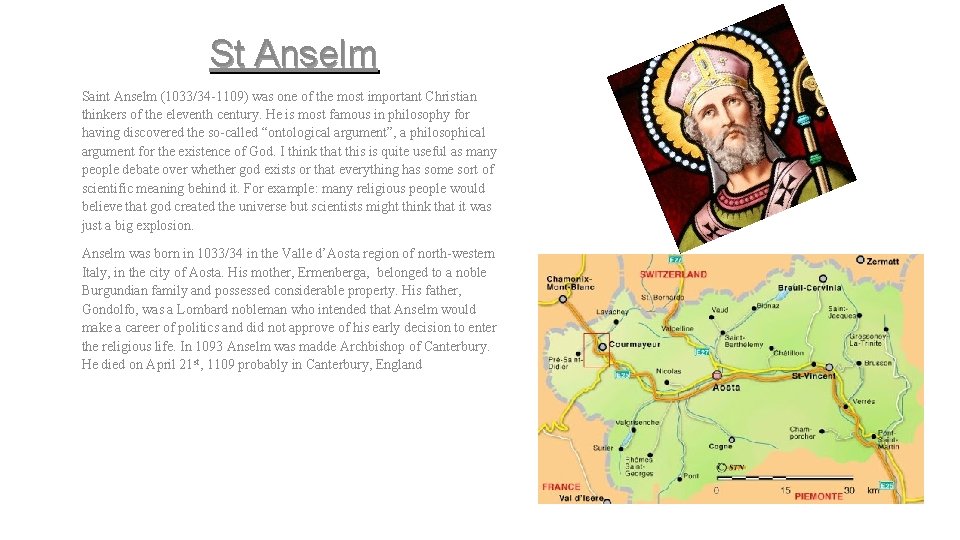
St Anselm Saint Anselm (1033/34 -1109) was one of the most important Christian thinkers of the eleventh century. He is most famous in philosophy for having discovered the so-called “ontological argument”, a philosophical argument for the existence of God. I think that this is quite useful as many people debate over whether god exists or that everything has some sort of scientific meaning behind it. For example: many religious people would believe that god created the universe but scientists might think that it was just a big explosion. Anselm was born in 1033/34 in the Valle d’Aosta region of north-western Italy, in the city of Aosta. His mother, Ermenberga, belonged to a noble Burgundian family and possessed considerable property. His father, Gondolfo, was a Lombard nobleman who intended that Anselm would make a career of politics and did not approve of his early decision to enter the religious life. In 1093 Anselm was madde Archbishop of Canterbury. He died on April 21 st, 1109 probably in Canterbury, England
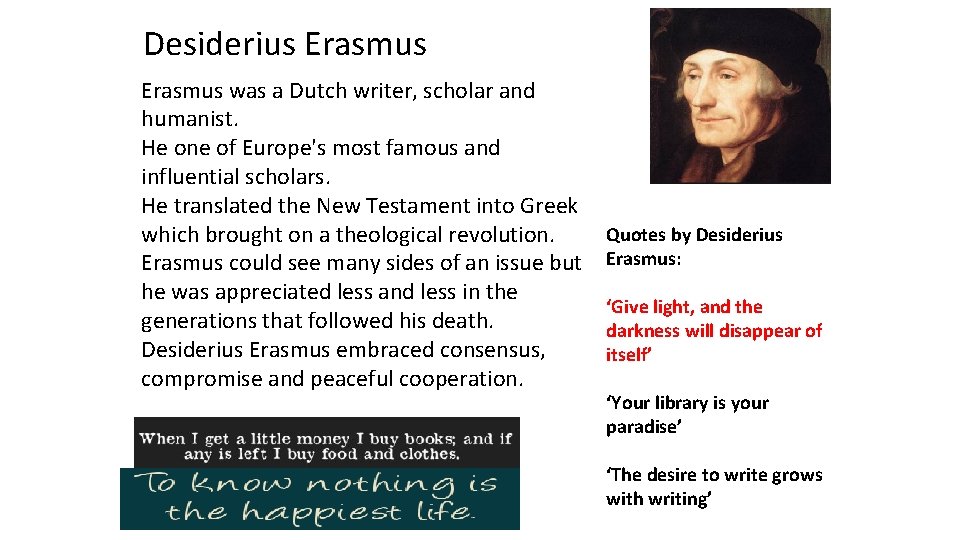
Desiderius Erasmus was a Dutch writer, scholar and humanist. He one of Europe's most famous and influential scholars. He translated the New Testament into Greek which brought on a theological revolution. Erasmus could see many sides of an issue but he was appreciated less and less in the generations that followed his death. Desiderius Erasmus embraced consensus, compromise and peaceful cooperation. Quotes by Desiderius Erasmus: ‘Give light, and the darkness will disappear of itself’ ‘Your library is your paradise’ ‘The desire to write grows with writing’

Desiderius Erasmus, (born October 27, 1469 in Rotterdam, Holland died July 12, 1536, in Switzerland), was a Dutch humanist who was the greatest scholar of the northern Renaissance, and the first editor of the New Testament, and an important figure in the branch of Christian theology that deals with the lives, writings, and doctrines of the early Christian theologians, and classical literature.
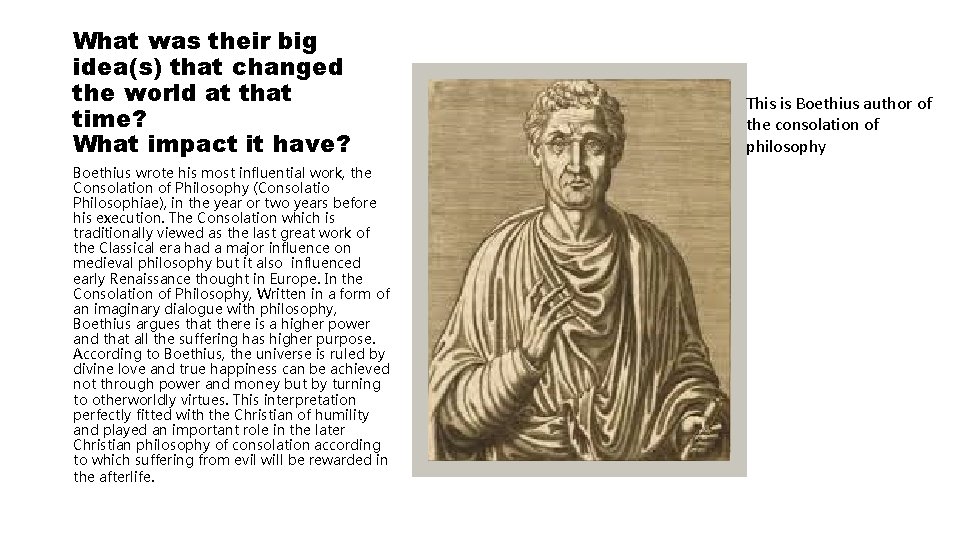
What was their big idea(s) that changed the world at that time? What impact it have? Boethius wrote his most influential work, the Consolation of Philosophy (Consolatio Philosophiae), in the year or two years before his execution. The Consolation which is traditionally viewed as the last great work of the Classical era had a major influence on medieval philosophy but it also influenced early Renaissance thought in Europe. In the Consolation of Philosophy, Written in a form of an imaginary dialogue with philosophy, Boethius argues that there is a higher power and that all the suffering has higher purpose. According to Boethius, the universe is ruled by divine love and true happiness can be achieved not through power and money but by turning to otherworldly virtues. This interpretation perfectly fitted with the Christian of humility and played an important role in the later Christian philosophy of consolation according to which suffering from evil will be rewarded in the afterlife. This is Boethius author of the consolation of philosophy

Boethius Born: 480 AD Died: 524 Cause of death: Execution Occupation: Philosopher Boethius was a very famous philosopher during the 6 th century who was born and raised in Rome, Italy. However he was executed in 524 due to the conspiracies that he was trying to overthrow the king. Whilst imprisoned, he composed many different philosophical points about fortune, death and many other issues. He had also been admired for his translation of Aristotle. But he is most famous for ‘The Consolation of Philosophy’ and many other famous pieces. His main point was that humans are essentially good and only when they give in to ‘wickedness’
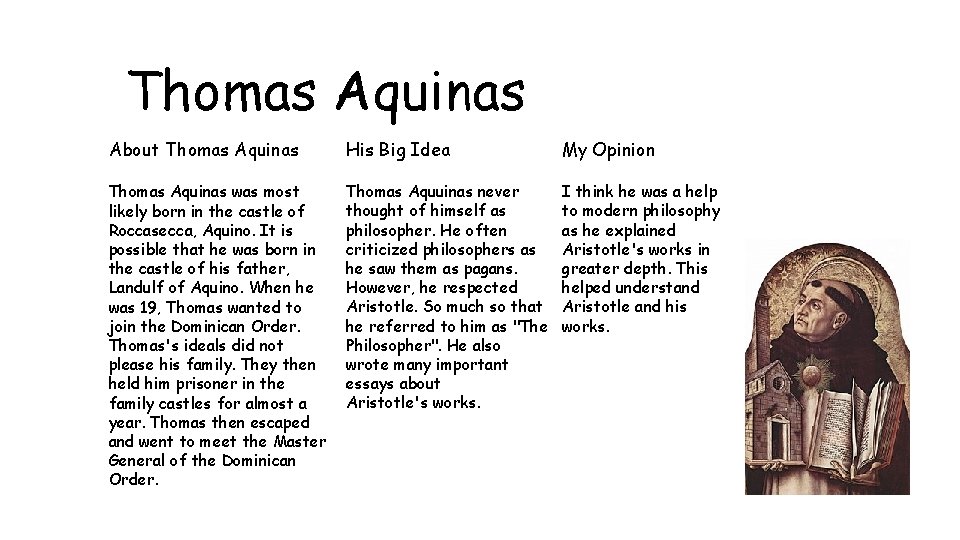
Thomas Aquinas About Thomas Aquinas His Big Idea My Opinion Thomas Aquinas was most likely born in the castle of Roccasecca, Aquino. It is possible that he was born in the castle of his father, Landulf of Aquino. When he was 19, Thomas wanted to join the Dominican Order. Thomas's ideals did not please his family. They then held him prisoner in the family castles for almost a year. Thomas then escaped and went to meet the Master General of the Dominican Order. Thomas Aquuinas never thought of himself as philosopher. He often criticized philosophers as he saw them as pagans. However, he respected Aristotle. So much so that he referred to him as "The Philosopher". He also wrote many important essays about Aristotle's works. I think he was a help to modern philosophy as he explained Aristotle's works in greater depth. This helped understand Aristotle and his works.
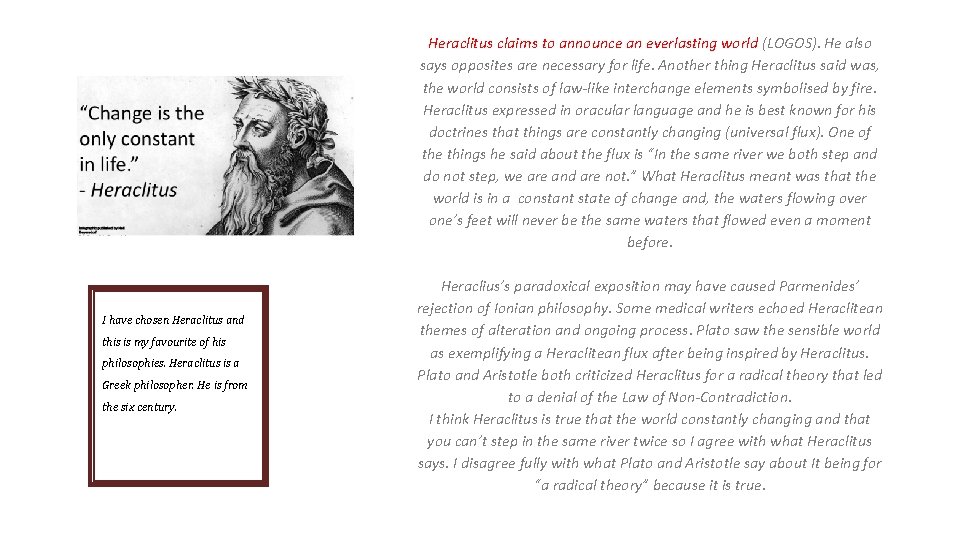
I have chosen Heraclitus and this is my favourite of his philosophies. Heraclitus is a Greek philosopher. He is from the six century. Heraclitus claims to announce an everlasting world (LOGOS). He also says opposites are necessary for life. Another thing Heraclitus said was, the world consists of law-like interchange elements symbolised by fire. Heraclitus expressed in oracular language and he is best known for his doctrines that things are constantly changing (universal flux). One of the things he said about the flux is “In the same river we both step and do not step, we are and are not. ” What Heraclitus meant was that the world is in a constant state of change and, the waters flowing over one’s feet will never be the same waters that flowed even a moment before. Heraclius’s paradoxical exposition may have caused Parmenides’ rejection of Ionian philosophy. Some medical writers echoed Heraclitean themes of alteration and ongoing process. Plato saw the sensible world as exemplifying a Heraclitean flux after being inspired by Heraclitus. Plato and Aristotle both criticized Heraclitus for a radical theory that led to a denial of the Law of Non-Contradiction. I think Heraclitus is true that the world constantly changing and that you can’t step in the same river twice so I agree with what Heraclitus says. I disagree fully with what Plato and Aristotle say about It being for “a radical theory” because it is true.
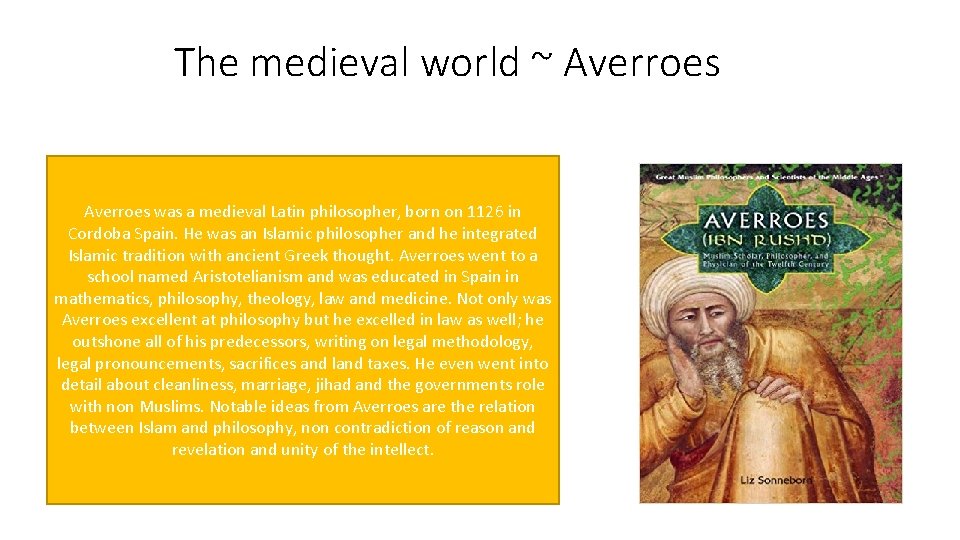
The medieval world ~ Averroes was a medieval Latin philosopher, born on 1126 in Cordoba Spain. He was an Islamic philosopher and he integrated Islamic tradition with ancient Greek thought. Averroes went to a school named Aristotelianism and was educated in Spain in mathematics, philosophy, theology, law and medicine. Not only was Averroes excellent at philosophy but he excelled in law as well; he outshone all of his predecessors, writing on legal methodology, legal pronouncements, sacrifices and land taxes. He even went into detail about cleanliness, marriage, jihad and the governments role with non Muslims. Notable ideas from Averroes are the relation between Islam and philosophy, non contradiction of reason and revelation and unity of the intellect.

Averroes By Megan Greenwood
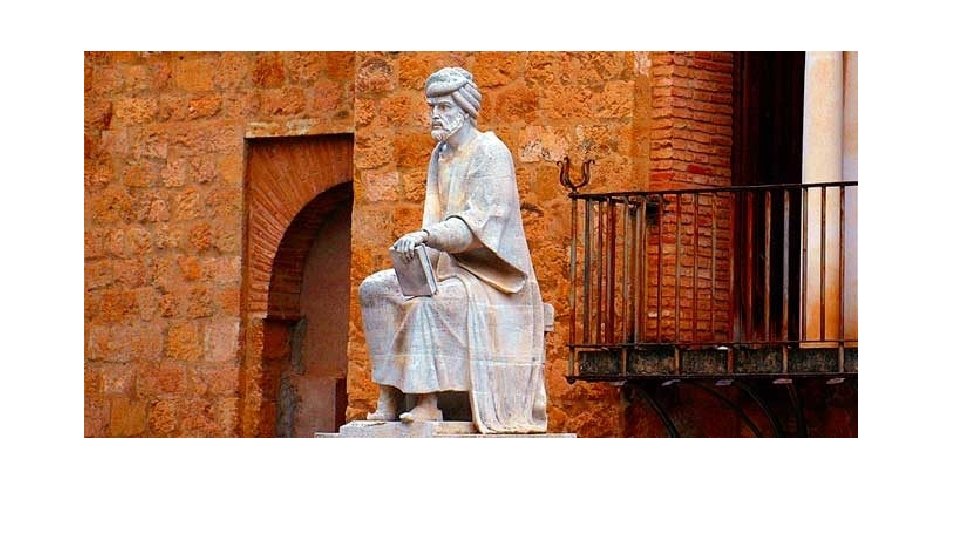
Who was Averroes? • Averroes was also known as ibn rusd or rushd. • He lived from 1126 to 1198. • He was a scholar who mainly studied Islamic philosophy. • He also studied Islamic theology, law, politics, classical music, and the sciences of medicine, psychology, physics, astronomy, geography and mathematics.
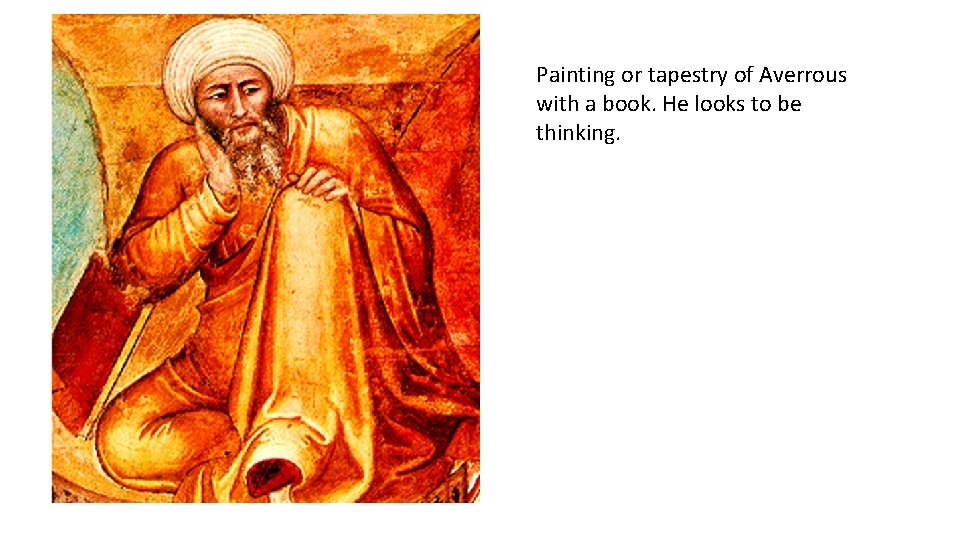
Painting or tapestry of Averrous with a book. He looks to be thinking.
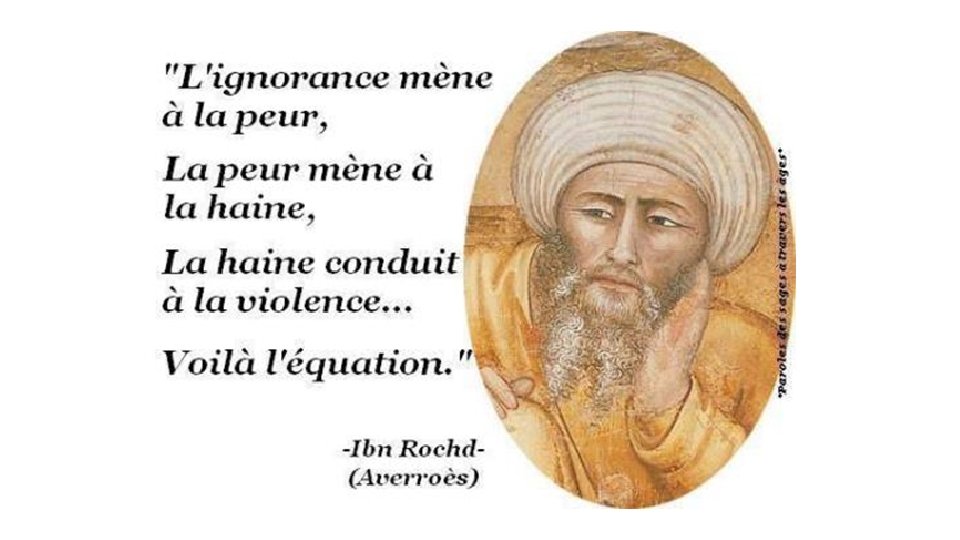
Main ideas • The quote on the last slide translates to: • Ignorance leads to fear, fear leads to hatred, and hatred leads to violence.
- Slides: 19