
st 21 Century Physical Education What SHOULD it

- Slides: 36
st 21 Century Physical Education- What SHOULD it Look Like! John W. Dunlop Polar Master Technology Trainer National Board Certified Teacher-EMC/PE Portage Public Schools Portage, MI John W Dunlop-Polar Electro, Inc.
th 20 Historical Foundations of Century Physical Education • Early 20 th Century-Gymnastics, Posture • WWI-prepare armed forces, survey concluded children were woefully subpar physically • 1920’s-P. E. expanded, depression erased gains of the 20’s, 40% of programs dropped John W Dunlop-Polar Electro, Inc.
th 20 Historical Foundations of Century Physical Education • 1940’s-1970’s-Division of Fitness created by Dept. of Defense, Health and Welfare • Nearly 60% of American children failed fitness tests compared to 9% of European children • New steps created to develop a greater opportunity for females John W Dunlop-Polar Electro, Inc.
th 20 Historical Foundations of Century Physical Education • Programs for individuals with disabilities were created • Research became more specialized in fields of pedagogy, exercise physiology, motor learning, and Sociology of sport • Focus of programs was on development of sport related skills John W Dunlop-Polar Electro, Inc.
th 20 Historical Foundations of Century Physical Education • 1970 -2000 -Continued growth in area of P. E. and sport mainly due to technology • Programs grow to serve all age groups • Importance placed on healthy lifestyle behaviors • Health-related fitness test (Fitnessgram) created John W Dunlop-Polar Electro, Inc.
“Old School” Philosophy • Physical education programs focused on developing athletes • For years, PE addressed the needs of only 25 -30% of its participants • Teachers were not held accountable for results • This resulted in a painful, nightmarish experience for a large percentage of the population • PE becomes “unnecessary” and “expendable” John W Dunlop-Polar Electro, Inc.
The “Unfit” States of America • Cardiovascular disease is the number one killer in America, accounting for nearly 41% of all deaths nationwide. • More than one in five Americans have CVD, accounting for one death every 33 seconds. • 45% of CVD deaths could have been prevented with changes in lifestyle and increased exercise. • In 1998, heart disease killed over 950, 000 Americans; More than cancer, accidents, pneumonia, influenza, pulmonary disease, and diabetes mellitus combined. John W Dunlop-Polar Electro, Inc.
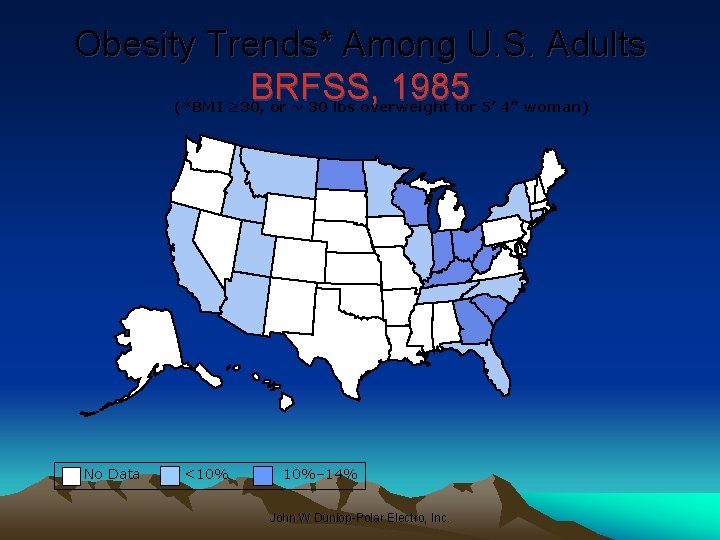
Obesity Trends* Among U. S. Adults BRFSS, 1985 (*BMI ≥ 30, or ~ 30 lbs overweight for 5’ 4” woman) No Data <10% 10%– 14% John W Dunlop-Polar Electro, Inc.
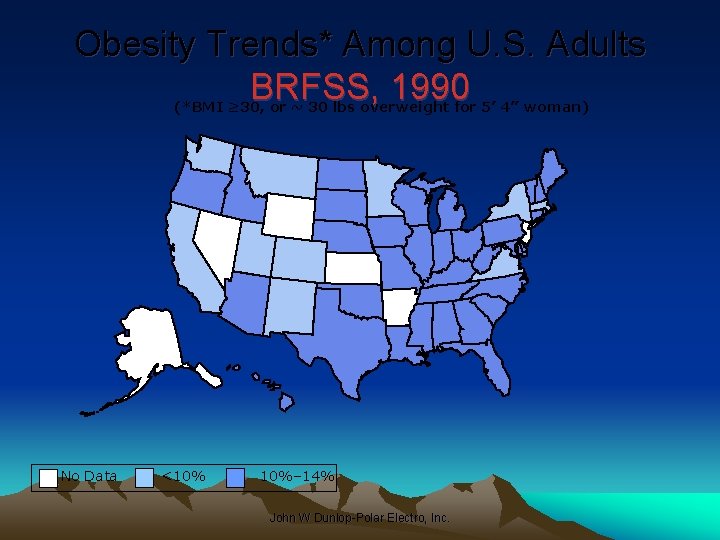
Obesity Trends* Among U. S. Adults BRFSS, 1990 (*BMI ≥ 30, or ~ 30 lbs overweight for 5’ 4” woman) No Data <10% 10%– 14% John W Dunlop-Polar Electro, Inc.
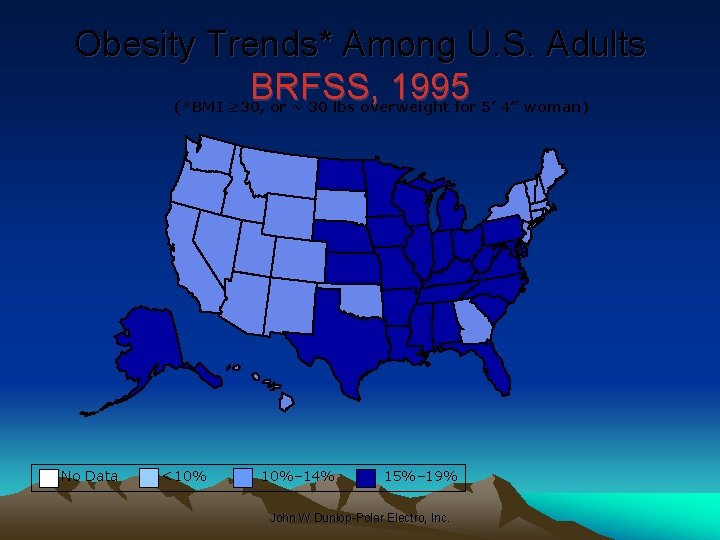
Obesity Trends* Among U. S. Adults BRFSS, 1995 (*BMI ≥ 30, or ~ 30 lbs overweight for 5’ 4” woman) No Data <10% 10%– 14% 15%– 19% John W Dunlop-Polar Electro, Inc.
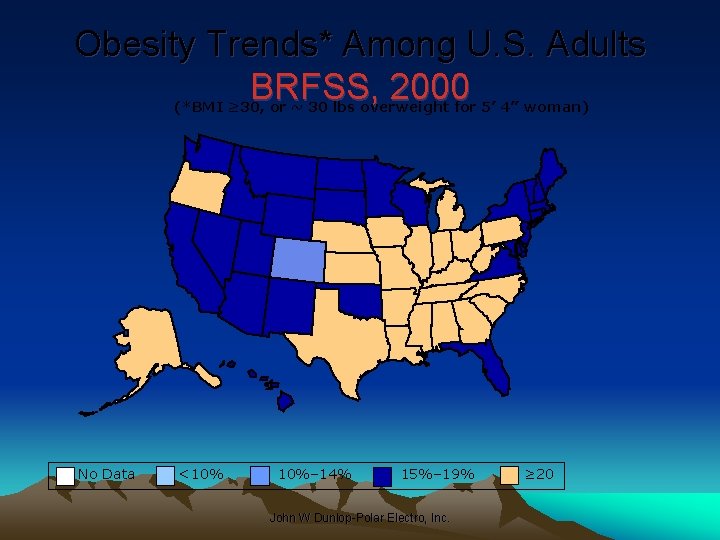
Obesity Trends* Among U. S. Adults BRFSS, 2000 (*BMI ≥ 30, or ~ 30 lbs overweight for 5’ 4” woman) No Data <10% 10%– 14% 15%– 19% John W Dunlop-Polar Electro, Inc. ≥ 20
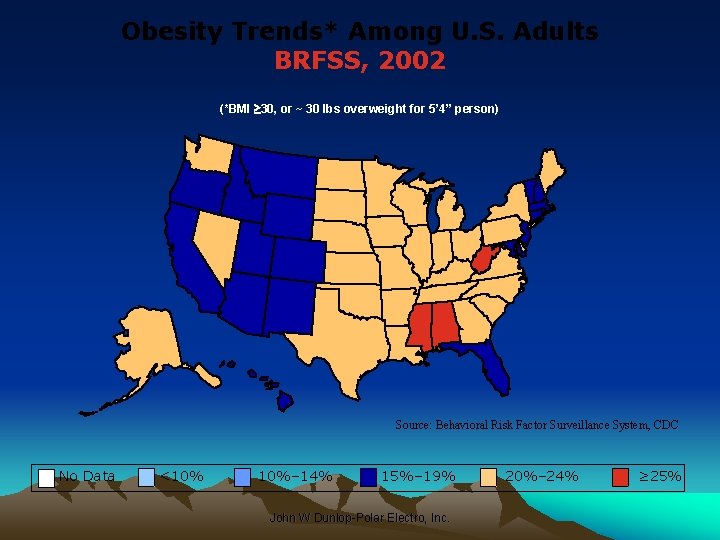
Obesity Trends* Among U. S. Adults BRFSS, 2002 (*BMI 30, or ~ 30 lbs overweight for 5’ 4” person) Source: Behavioral Risk Factor Surveillance System, CDC No Data <10% 10%– 14% 15%– 19% John W Dunlop-Polar Electro, Inc. 20%– 24% ≥ 25%
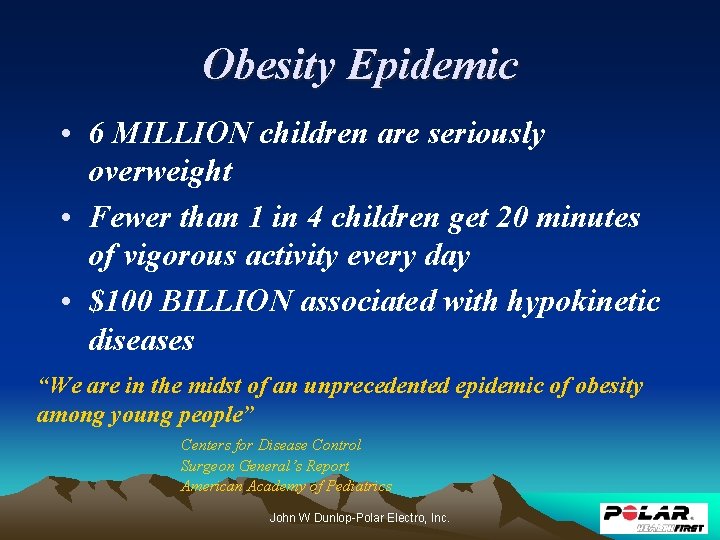
Obesity Epidemic • 6 MILLION children are seriously overweight • Fewer than 1 in 4 children get 20 minutes of vigorous activity every day • $100 BILLION associated with hypokinetic diseases “We are in the midst of an unprecedented epidemic of obesity among young people” Centers for Disease Control Surgeon General’s Report American Academy of Pediatrics John W Dunlop-Polar Electro, Inc.
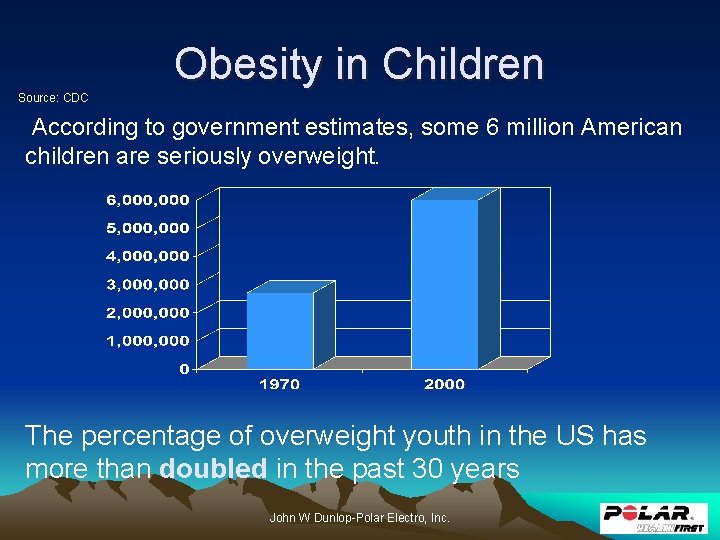
Obesity in Children Source: CDC According to government estimates, some 6 million American children are seriously overweight. The percentage of overweight youth in the US has more than doubled in the past 30 years John W Dunlop-Polar Electro, Inc.
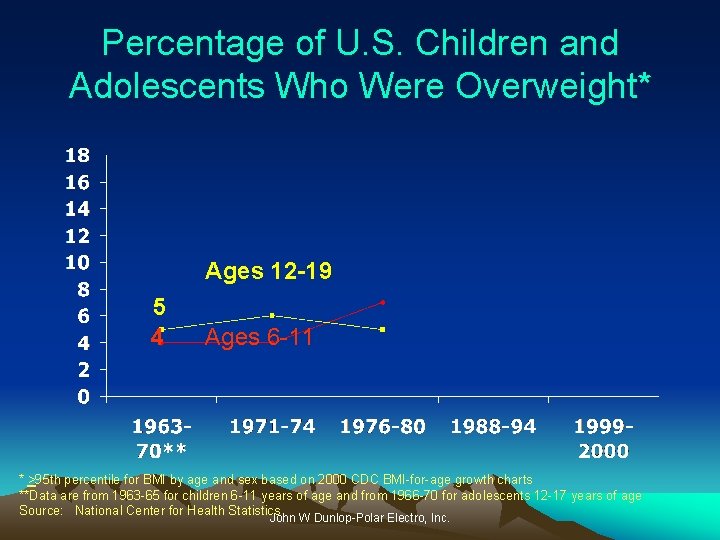
Percentage of U. S. Children and Adolescents Who Were Overweight* Ages 12 -19 5 4 Ages 6 -11 * >95 th percentile for BMI by age and sex based on 2000 CDC BMI-for-age growth charts **Data are from 1963 -65 for children 6 -11 years of age and from 1966 -70 for adolescents 12 -17 years of age Source: National Center for Health Statistics John W Dunlop-Polar Electro, Inc.
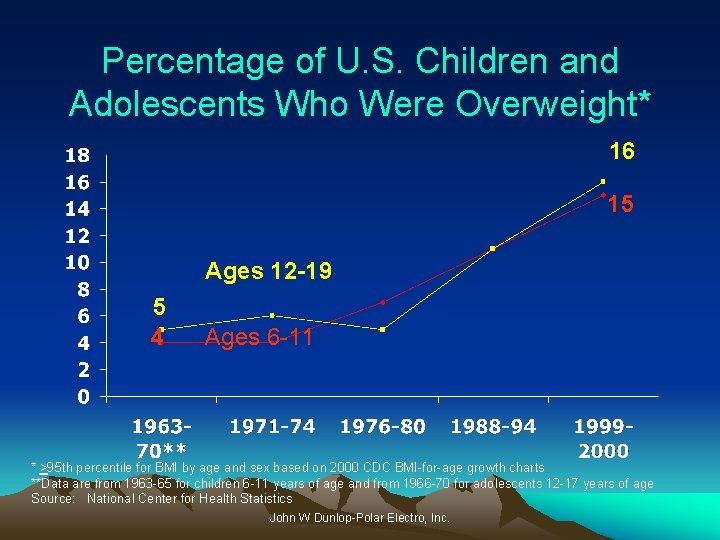
Percentage of U. S. Children and Adolescents Who Were Overweight* 16 15 Ages 12 -19 5 4 Ages 6 -11 * >95 th percentile for BMI by age and sex based on 2000 CDC BMI-for-age growth charts **Data are from 1963 -65 for children 6 -11 years of age and from 1966 -70 for adolescents 12 -17 years of age Source: National Center for Health Statistics John W Dunlop-Polar Electro, Inc.
The PE Revolution • Development of national PE standards in 1995 • Groundbreaking publications-Surgeon General’s report(1996), CDC physical activity guidelines(1998), Healthy People 2000 and 2010, Secretaries’ of HHS and Education Report to the President (Fall 2000) • Focus is on development of a healthy, active lifestyle versus skill development • Stresses participation rather than performance • Fitness assessment addresses healthy levels of fitness and serves as a process, not a product • A concerted move toward change • Create and enjoyable experience for our students! John W Dunlop-Polar Electro, Inc.
Positive (Quality) Physical Education • Opportunity to learn – Qualified teachers – Adequate time • Meaningful content – National/state standards for physical education • Appropriate instruction • Formative and summative assessment John W Dunlop-Polar Electro, Inc.
Curriculum Alignment with NASPE National Standards and State Content Standards and Benchmarks • Instruction in a variety of motor skills • Development of cognitive concepts • Health-Related Fitness education and assessment strategies • Opportunities to develop social and cooperative skills John W Dunlop-Polar Electro, Inc.
Role of Quality Physical Education Programs • Acquire Physical Competence • Build Health Related Fitness • Create Cognitive Understanding about Physical Activity • Develop Positive Personal-Social Character Traits John W Dunlop-Polar Electro, Inc.
Definition of a Physically Educated Person • HAS learned skills necessary to perform a variety of physical activities • IS physically fit • DOES participate regularly in physical activity • KNOWS the implications of and the benefits from involvement in physical activities • VALUES physical activity and its contribution to a healthful lifestyle John W Dunlop-Polar Electro, Inc.
Purpose of National Standards for Physical Education • To define what a student should know and be able to do as a result of a quality physical education program • Provides credibility to our profession as we are one of many disciplines with standards John W Dunlop-Polar Electro, Inc.
National Standards, nd 2 Edition • Standard 1: Demonstrates competency in motor skills and movement patterns needed to perform a variety of physical activities (Physical skills) • Standard 2: Demonstrates understanding of movement concepts, principles, strategies, and tactics as they apply to the learning and performance of physical activities (Cognitive) • Standard 3: Participates regularly in physical activity (Physical activity) John W Dunlop-Polar Electro, Inc.
National Standards, nd 2 Edition • Standard 4: Achieves and maintains a health enhancing level of physical fitness (Health-related fitness) • Standard 5: Exhibits responsible personal and social behavior that respects self and others in physical activity settings (Behavioral skills) • Standard 6: Values physical activity for health, enjoyment, challenge, self-expression and/or social interaction (Intrinsic value) John W Dunlop-Polar Electro, Inc.
Examples of Positive (Quality) Physical Education • All children being active – Stations – Small group games – Technology (heart rate monitors, pedometers) • Choices – Variety of activities – Various practice levels – Personal goals • Cooperative Activities John W Dunlop-Polar Electro, Inc.
Recommended Amounts of Physical Activity and Education • Physical activity – At least 60 minutes, and up to several hours, a day of physical activity • NASPE • Dietary Guidelines for Americans (Federal government) • Physical education – ES: at least 150 minutes/week – MS, HS: at least 225 minutes/week • NASPE • Others that support the NASPE recommendation (e. g. , CDC) John W Dunlop-Polar Electro, Inc.
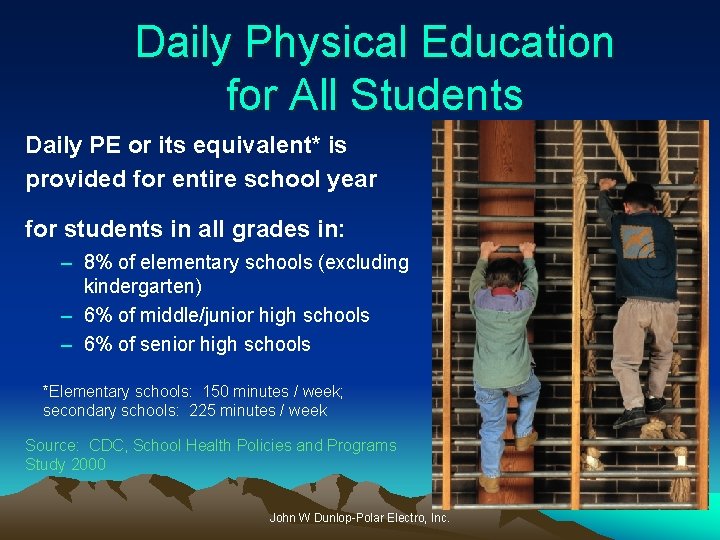
Daily Physical Education for All Students Daily PE or its equivalent* is provided for entire school year for students in all grades in: – 8% of elementary schools (excluding kindergarten) – 6% of middle/junior high schools – 6% of senior high schools *Elementary schools: 150 minutes / week; secondary schools: 225 minutes / week Source: CDC, School Health Policies and Programs Study 2000 John W Dunlop-Polar Electro, Inc.
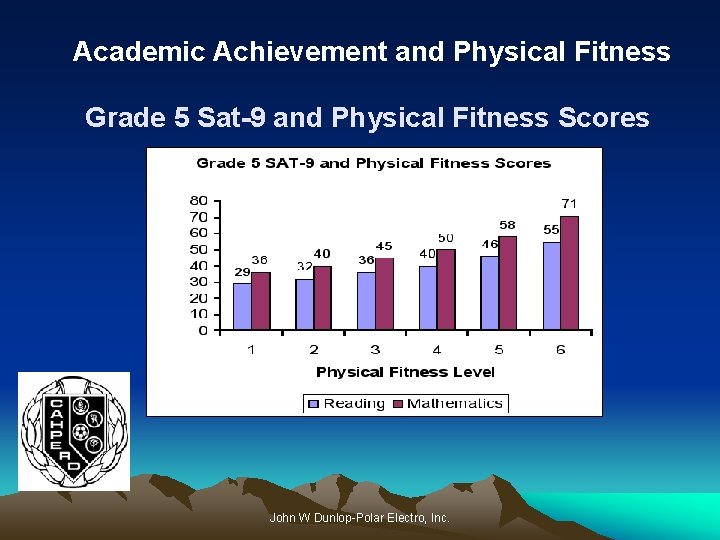
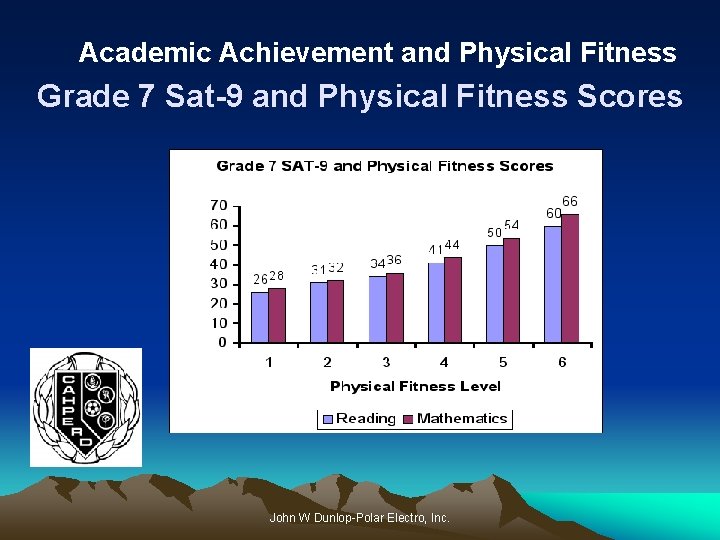
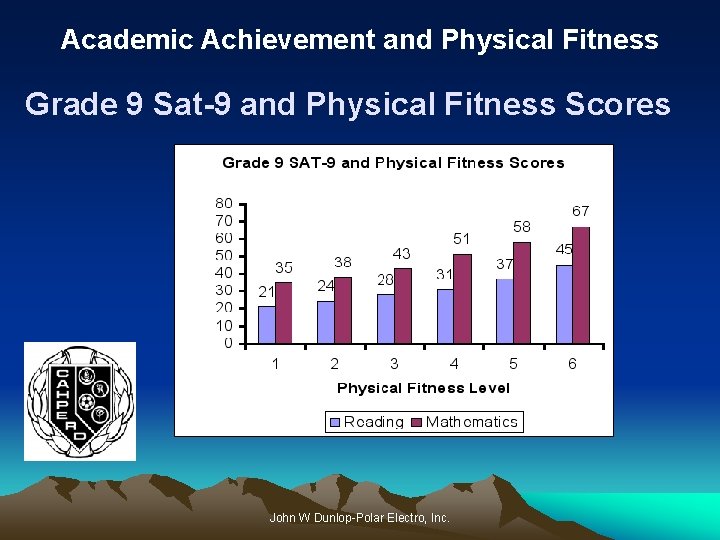
The Brain/Body Connection • Research has not been conducted to conclusively demonstrate a link between physical activity and improved academic performance • However, such a link might be expected • Research does show that: – Movement stimulates brain functioning – Physical activity increases adolescents’ self-esteem and reduces anxiety and stress…thus, through it’s effects on mental health, may help increase students’ capacity for learning – Increases in time for physical education did not lead to lower test scores John W Dunlop-Polar Electro, Inc.
Academic Achievement and Physical Fitness Grade 5 Sat-9 and Physical Fitness Scores John W Dunlop-Polar Electro, Inc.
Academic Achievement and Physical Fitness Grade 7 Sat-9 and Physical Fitness Scores John W Dunlop-Polar Electro, Inc.
Academic Achievement and Physical Fitness Grade 9 Sat-9 and Physical Fitness Scores John W Dunlop-Polar Electro, Inc.
Barriers Preventing Physical Education Reform • A lack of accountability for results in most P. E. programs still exists today • P. E. does not have standardized fitness or health and wellness tests • P. E. is not a part of statewide educational assessment tests (WSAS) • P. E. is not part of overall GPA in many schools John W Dunlop-Polar Electro, Inc.
Barriers Preventing Physical Education Reform • Lack of integration between education and health communities • Negative perceptions of P. E. continue to hinder advancement • P. E. lacks a strong policy presence at Federal, State and Local levels • Parents have yet to grasp the severity of the situation John W Dunlop-Polar Electro, Inc.
10 -Step Action Plan for P. E. Stakeholders 1. Demand increased accountability from P. E. Programs 2. Develop National fitness and cognitive health tests 3. Conduct research to quantify the cost of physical inactivity 4. Include P. E. in Statewide educational assessment tests 5. Incorporate P. E. in student’s overall GPA John W Dunlop-Polar Electro, Inc.
10 -Step Action Plan for P. E. Stakeholders 6. Revolutionize Physical Education training in the United States 7. Transition ALL P. E. programs to the New “Lifestyle” Curriculum 8. Increase public policy advocacy efforts to advance Physical Education reform 9. Create stronger partnerships between the education and health communities 10. Create a parent involvement initiative John W Dunlop-Polar Electro, Inc.
Resources • • www. pelinks 4 u. org www. pe 4 life. org www. pecentral. com www. aahperd. org National Association for Sport and Physical Education C. A. P. E-Center for the Advancement of Physical Education John W Dunlop-Polar Electro, Inc.